Is God a Pluralist? (TGC)

religious-symbolsIt was in my freshman composition class at the University of California, Irvine, that I first heard a professor say, “Well, you know, most of the differences in religion don’t matter. The main point is that God just wants all is just to love each other, right?” It’s a claim that’s become increasingly familiar to me ever since.

But is it true? Is God indifferent to religion? Does he care how he’s worshiped? In other words, is God a pluralist?

While it comes in myriad different forms, the kind of pluralism I’m talking about is a sort of relativism about religion, claiming either that all religions are equally salvific, or that outward forms don’t matter since all faiths share a common core, or that the divine is too grand and unknowable to be encompassed by some exclusive set of doctrines. Unless you adhere to a conservative religious confession—Christianity, Judaism, Islam, and so forth—some kind of religious pluralism is the default mindset among the broader “spiritual but not religious” late-modern culture we live in. But why?

For one, it seems to reinforce political pluralism—the social accommodation of various religious beliefs. If there’s no big difference, then there’s not much to fight about. What’s more, and this is probably the most enticing reason to adopt it at the popular level, it seems more humble and open to other viewpoints. Everybody’s equally right (or equally wrong), so no one can claim religious superiority. It’s a more “tolerant” view since there’s no one correct religion against all the others, and thus the moral playing field is level.

At least, that’s how it appears at first.

You can go read about why this is a dubious assumption over at The Gospel Coalition.

Sabbath Sticks, OT Morality, and the Jesus Tea Strainer

There’s a very troublesome text smack dab in the middle of Numbers 15, which I suspect many of us wouldn’t know what to do with if asked about it:

While the Israelites were in the wilderness, a man was found gathering wood on the Sabbath day. Those who found him gathering wood brought him to Moses and Aaron and the whole assembly, and they kept him in custody, because it was not clear what should be done to him. Then the Lord said to Moses, “The man must die. The whole assembly must stone him outside the camp.” So the assembly took him outside the camp and stoned him to death,as the Lord commanded Moses. (Num. 15:32-36)

well-that-escalated-quicklyOn first reading we’re left thinking, “Well, that escalated quickly.” It’s a bit harsh isn’t? I mean, really, picking up a few sticks on the Sabbath and he’s to be executed? Is that how God works? Is that a moral Bible? Indeed, some skeptical critics point to that story specifically in order to prove that it isn’t.

I was reminded of this as I watched my friend Andrew Wilson debate (or rather, get interrupted by) Steve Chalke about the authority of Scripture and how to read the OT.  During the debate, after a lot of prodding for clarification, Chalke finally came out and said that while he believed that the event happened, Moses or the author was simply confused as to God’s commands, having misheard him or something (I kid you not, that’s what he says, I’m not lying). Given who Jesus is, and the fact that God is unchanging, he simply couldn’t believe that God would wipe a guy out just for picking up some sticks on Sabbath, so the text is simply wrong on that point. And pretty much every other time it says God strikes something down (all throughout the OT and NT).

Now, I can’t be too harsh here. I really do get the hesitation. It’s an odd, initially terrifying story that I’m somewhat tempted to edit myself. That said, as I watched and considered, I thought of a few points (a couple contextual, one broadly theological) that ought to be considered as we approach troubling texts like these in order to do them justice without chopping them up. I’ll tackle them in no particular order:

1. Flagrant defiance – The first has to do with the act itself. Looking at it the stick-collecting in a sort of flat sense, it does seem fairly innocuous. A few sticks–what’s the big deal? But, see, I don’t think it is as simple as just a few sticks. Say for instance you have a child and you see him reach for a cookie, so you say to him, “Don’t lay a finger on those until after dinner–I don’t want you to spoil your supper.” Your child then looks up at you, looks at the cookie, looks back up at you, and then with a smug look, grabs the cookie and stuffs it in his mouth. Now, at that point, what do we have? We don’t have a simple cookie-eating incident do we? Instead we have an act of willful flagrant defiance that merits some more serious attention. Superficially innocuous actions can be laden with deeper meaning.

Was it worth it?

Was it worth it?

Now, a 5-year old doing some boundary-testing is still pretty mild, but consider the case in question. The Israelites have been saved out of grinding slavery and given a good law by the sovereign God of the Universe. Moses came down from the mountain of smoke, lightning, and fire, and delivered the Ten Commandments, the foundational charter laws of the Covenant, on tablets written by the finger of God himself. The fourth, the command to keep the Sabbath Holy, is actually the lengthiest of the ten. At this point you begin to see that this man, in going out to collect something as stupid as a bunch of sticks, isn’t just bending a little rule–he’s acting in flagrant defiance of the express will of the King of the nation. This is not a mild act, but an aggressive breach against authority demonstrating his total repudiation of the rule of the Lord.

Some might wonder if I’m importing or imposing this interpretation on the text, but I think I’m on solid contextual ground when we consider that this little episode is recorded right after the regulations forbidding sacrifices to atone for intentional sins or “sins with a high hand” in verses 32-33:

“‘But anyone who sins defiantly, whether native-born or foreigner, blasphemes the Lord and must be cut off from the people of Israel. Because they have despised the Lord’s word and broken his commands, they must surely be cut off; their guilt remains on them.’”

The fact that we don’t see this, I think, is indicative of how little importance we place on the idea of authority culturally, or the idea of defying God’s authority. We simply don’t take that category of sin seriously, because of our modern, Western mindset.

2. National Significance – The second factor to consider is that this is probably not just about this one guy.  I’ll be honest that it’s been a conviction of mine for as far back as I can remember that God doesn’t owe me my next breath–both by dint of authorial rights as well as because of my own sins and wickedness. That said, it’s hard to not see this as a national, and indeed, redemptive-historical issue.

God has purposes for his people. They are to live in relationship with him and serve as a light to the world in their worship and obedience. The laws serve as a hedge around them, protecting them from the pagan influences of their neighbors as well as training them in the proper life with God. These laws aren’t simply for the life of Israel, then, but for God’s cosmic redemptive purposes for Israel among the nations. In that light, the question becomes then: Is God serious about his law? Is he just blowing smoke when he commands these things, or do we need to take him seriously? Are these serious commands or mere suggestions?

I would suggest then, that while he was culpable and deserving in himself, this early case of Sabbath defiance also had ramifications beyond his own case that were at issue as well. The course of the life of the nation was stake such that tragic, but just, action had to be taken to ensure there was clarity and resolved on this point.

3. Appropriate For The Time – Third, I think there is also a level of progressive revelation at work here. Both Wilson and Chalke agreed that compared to most of the laws of the surrounding nations, the law of Israel was comparatively humane and just. In fact, one of the processes we can see in Scripture is the idea that God meets people in history, deals with them in a manner that’s appropriate to them at the time in order to move them along towards the divine ideal. He starts out with their pagan, distorted thinking and then employs laws that are suited to them (but are no longer suited to us) in order to bring them along slowly.

Think of it this way: were I to have children, some of the rules I might give to my 5-year old would be harsh and inappropriate for a 15-year old. For instance, I might tell a five-year old child, “Every time you go outside, you need to come ask permission. If you don’t, you’ll be grounded from play for a week.” Now, to a 15-year old, this would seem draconian–indeed, to apply it to the 15-year-old it would be–but it makes perfect sense for a 5-year old at a time when you’re trying ingrain the lessons of the importance of parental authority, safety, and so forth. A second point follows from this: simply because I change the house rules for my 15-year-old to something different than when he was 5, it doesn’t mean that I’ve overall changed my mind or something. It means that in my consistency of character I have spoken differently in different situations.

In a similar way, God implemented laws back then and there, which were appropriate in the process of moral and theological education (“because of the hardness of your heart”) that he wouldn’t apply now–especially in light of the new covenant in Christ and the move from a theocractic national kingdom to a spiritual Kingdom. But that’s not because he would have been unrighteous in applying them then, but because we’ve moved on from that part of the story. To try to go back is to miss the intended movement at work. Nor is he inconsistent when he shifts his demands, or changes the application of underlying principles in the New Covenant.

Of course, being a Brit, Wilson would make it a *tea* strainer.

Of course, being a Brit, Wilson would make it a *tea* strainer.

Returning to The Tea-Strainer – Where does all of this go? Well, for one I hope it sheds some light on Numbers 15. But further than that, I think this serves to highlight what Wilson has called the difference between a Christ-centered lens versus a Christ-centered “tea-strainer” hermeneutic. The one allows you to look at a text in a different light, while the other simply screens out the bits we don’t like. Returning to the debate I referenced above, we see that Chalke looks at this text and says, “Well, looking at Christ in the NT, I know God couldn’t have commanded that and therefore we see that Moses was probably confused.” And therefore, the text is actually wrong. (Again, go watch the video, I’m not exaggerating here).

I had a couple of friends complain about the article when I shared it last week to the effect that, “Well, that doesn’t reflect the Christocentric hermeneutic I’m talking about, or the best versions of it.” Well, if that’s the case, then that’s lovely. I’m ecstatic to hear it. But sadly it does reflect Chalke’s self-designated “Christ-centric” hermeneutic, and it’s even the sort of thing that I’ve seen Brian Zahnd, someone I have serious respect for, write before, to wild applause and cheers in some sectors.

So what do we say instead? I, and I think Wilson as well, would say something like, “Well, looking at Christ, his affirmation of the OT, as well as instruction to the effect that he has fulfilled and we’re moving on now, let’s look back and see how this command was functionally-appropriate for the time.” It’s a way of accepting all of what Jesus says when he affirms:

“Do not think that I have come to abolish the Law or the Prophets; I have not come to abolish them but to fulfill them. For truly I tell you, until heaven and earth disappear, not the smallest letter, not the least stroke of a pen, will by any means disappear from the Law until everything is accomplished.”

There’s both an affirmation that it’s all true, it was all valid, and yet, at the same time, now that Christ has come, we aren’t going back there. God spoke it all and did it all–every single law, judgment, story, and so forth–to somehow point forward towards a climax of grace and justice in the life, death and resurrection of Jesus Christ. But of course, if you just cut bits out, or say the Israelites or Moses were confused at such & such point when the text says “the word of the Lord”, then you’re actually leaving out some of the testimony to the Glory of Christ.

So, which hermeneutic are you working with? A lens or a tea-strainer?

Soli Deo Gloria

I work through some related issues in “The Cure that Killed the Patient“, as well as this post on the importance of Context the Conquest of Canaan.

A Lie About God is a Lie About Life

liesOur culture likes the idea of heresy. Whenever you see the word ‘heresy’ used on your average blog or article it’s synonymous with bold, controversial, and creative thinking. It is thought not confined with dogma and church controls. It’s ideas that scare the “theologians”, and break out of the traditional mold. (As to why scaring theologians has become a valued activity, I’m clueless. Is there similar trend elsewhere? Should I want to perplex philosophers? Or, mystify mathematicians? Maybe frighten some physicists?)

In some quarters, heresy is sexy.

Alister McGrath has even gone so far as to talk about our “love affair with heresy.” It epitomizes all that we entrepreneurial, free-thinking, radically individualistic Americans believe about religion. It’s up to us to figure out and nobody has a right to lay down a “correct” or “right” way to think about spirituality and God.

In this context, anybody trying to talk about orthodoxy or heresy immediately calls to mind images of nefarious, medieval church councils, trials, and other wickedness.

So Why Does Jesus Think Differently? So why do Jesus, Paul, Peter, and John seem to approach the problem of false teaching differently than we do? Because they do. Very differently. A sampling:

Jesus: Beware of false prophets, who come to you in sheep’s clothing but inwardly are ravenous wolves. You will recognize them by their fruits. Are grapes gathered from thorn bushes, or figs from thistles? So, every healthy tree bears good fruit, but the diseased tree bears bad fruit. A healthy tree cannot bear bad fruit, nor can a diseased tree bear good fruit. Every tree that does not bear good fruit is cut down and thrown into the fire. (Matthew 7:15-20)

Paul: I am astonished that you are so quickly deserting him who called you in the grace of Christ and are turning to a different gospel—not that there is another one, but there are some who trouble you and want to distort the gospel of Christ. But even if we or an angel from heaven should preach to you a gospel contrary to the one we preached to you, let him be accursed. As we have said before, so now I say again: If anyone is preaching to you a gospel contrary to the one you received, let him be accursed. (Galatians 1:6-9)

John: For many deceivers have gone out into the world, those who do not confess the coming of Jesus Christ in the flesh. Such a one is the deceiver and the antichrist. Watch yourselves, so that you may not lose what we have worked for, but may win a full reward. Everyone who goes on ahead and does not abide in the teaching of Christ, does not have God. Whoever abides in the teaching has both the Father and the Son. If anyone comes to you and does not bring this teaching, do not receive him into your house or give him any greeting, for whoever greets him takes part in his wicked works. (2 John 1:7-11)

Peter: But false prophets also arose among the people, just as there will be false teachers among you, who will secretly bring in destructive heresies, even denying the Master who bought them, bringing upon themselves swift destruction. And many will follow their sensuality, and because of them the way of truth will be blasphemed. And in their greed they will exploit you with false words. Their condemnation from long ago is not idle, and their destruction is not asleep. (2 Peter 2:1-3)

Their attitude seems so intolerant and harsh. What about freedom of thought? Independence of mind?  What accounts for the difference? Is it just that we are more enlightened and cosmopolitan than these backwards dogmatists?

Eugene Petersen, my favorite pastoral theologian and theological pastor, cuts to the heart of the matter when discussing John’s attitude towards false teaching:

“Our age has developed a kind of loose geniality about what people say they believe. We are especially tolerant in matters of religion. But much of the vaunted tolerance is only indifference. We don’t care because we don’t think it matters. My tolerance disappears quickly if a person’s belief interferes with my life. I am not tolerant of persons who believe that they have as much right to my possessions as I do and proceed to help themselves… I am not tolerant of businesses that believe that their only obligation is to make a profit and that pollute our environment and deliver poorly made products in the process. And [John] is not tolerant when people he loves are being told lies about God, because he knows that such lies will reduce their lives, impair the vitality of their spirits, imprison them in old guilts, and cripple them with anxieties and fears…

That is [John’s] position: a lie about God becomes a lie about life, and he will not have it. Nothing counts more in the way we live than what we believe about God. A failure to get it right in our minds becomes a failure to get it right in our lives. A wrong idea of God translates into sloppiness and cowardice, fearful minds and sickly emotions.

One of the wickedest things one person can do [is] to tell a person that God is an angry tyrant, [because the person who believes it will] defensively avoid him if he can… It is wicked to tell a person that God is a senile grandfather [because the person who believes it will] live carelessly and trivially with no sense of transcendent purpose… It is wicked to tell a person a lie about God because, if we come to believe the wrong things about God, we will think wrong things about ourselves, and we will live meanly or badly. Telling a person a lie about God distorts reality, perverts life and damages all the processes of living.”, Traveling Light: Reflections on the Free Life (Downers Grove, Ill.: InterVarsity Press, 1982), pp. 33-35.

We don’t care about false teaching and heresy because we don’t see what it does. We don’t see that “A lie about God becomes a lie about life.” Jesus is intensely opposed heresy because he doesn’t miss the connection between what we believe about God and every inch of our lives. Paul opposes it with every fiber of his being because he is passionately for the church. John is not simply out to control his “beloved”, but rather make sure that they remain free, truly free to live the life God has called his children to.

Good theology is not just an academic exercise for “theologians” in seminaries. It’s not just for pastors in their studies. It’s for everyday Christians for everyday living. This is why we are to care about these things. This is why we preach, teach, and correct in light of the Word of God.

To sum up, we might ask a final question: “Why does Jesus hate heresy?” Because He loves you too much to have you believe lies about God.

Soli Deo Gloria

A (Very) Brief, Gospel-Centered Defense Against the Problem of Evil

christ-on-the-cross-1587In brief, the classic problem of evil stands as the greatest, most persuasive, damning, and straightforward objection to the existence of God, especially the Christian one. The classic form dating back to Epicurus and retooled by David Hume runs something like this:

  1. If God exists he is all-good and all-powerful.
  2. If he is all-good he will want to remove evil from the world
  3. If he is all-powerful he can remove evil from the world.
  4. There is evil in the world.
  5. Therefore, God doesn’t exist, or he is not all-good, or all-powerful.

Straight-forward enough, right?

Still, in recent developments in the philosophy of religion, it has been noticed that the strict version just outlined can be evaded by pointing out that if God had a good enough reason to, he might allow evil to exist while being all-powerful and all-good. The skeptical rejoinder, then, is that there is no such reason forthcoming from believers to justify all of the apparently pointless evils we see in the world.

Now, while there’s a great deal of lengthy literature on the subject (some of which I’ve read) about the logical, evidential, and powerful existential forms of the argument, I’ve come to the conclusion that, in nuce, the outlines of a logically-intuitive, and even pastorally-comforting ,defense against the problem of evil are given to us in the simple Gospel story of the life, death, and resurrection of Jesus Christ itself.

Note, this is not a theodicy--an explanation of why God allows evil to exist–it is only a defense, showing that it is logically possible for God and evil to exist. With that clarification made, here’s my attempt at a Gospel-centered defense against the problem of evil in a nutshell:

  1. If God raised Jesus Christ from the dead, I have good reason to believe both that he exists, and that he is unfathomably powerful.
  2. Furthermore, if he is good enough to send his only-begotten Son to die on behalf of a sinful, rebellious world he loves, he is unfathomably good.
  3. Next, if God is wise enough to use what is objectively the most horrifying, and initially apparently pointless, event in human history–the unjust murder of the Godman–for the salvation of the world, then it is entirely reasonable to trust he has a good enough reason for allowing the evil that he currently does.
  4. Finally, the death and resurrection of Jesus Christ are the promise that ultimately evil will be judged, removed, and made right.There is comfort and hope for the future.

All of these points could be filled out at length, of course; this is a nutshell–and a very small one at that.  And yet, it is enough to set us marveling at the way, once again, all of life’s deepest, most troubling questions find their answer in the Gospel of Jesus Christ.

Soli Deo Gloria

A Silly Little Dialogue on Morality, And Keller on the Public Square

kid arguingDigging through some old files, I found my first attempt at a moral dialogue from back in my college days. It’s a bit silly and incomplete, but I felt like sharing it:

“I want to be a dictator when I grow up”, said little Jimmy.

“What are you talking about?”, inquired Sara with a confused look.

“I want to be a dictator when I grow up,” repeated Jimmy. “That way I can do whatever I want and no-one can tell me what to do.”

“You can’t do anything you want. There are still rules you have to follow, stupid,” replied Sara, this time a little annoyed. “Nobody can do whatever they want.”

“Yes, you can. If you’re a dictator then you make up the rules and you can do whatever you want. Nobody can tell you what to do and you’re never wrong because all you have to do is say you’re right and you are.” Jimmy said this and then crossed his little arms with a smug expression of victory on his face.

“That’s not true!”, exclaimed Sara furiously. “You’re not right just because you say so. You might be able to push people around but you’re not always right.”

“Who says I’m not? Huh, if I have the power then whatever I say is right is right and whatever I say is wrong is wrong. So there.”

“No, well, well, what if God says you’re wrong? Huh? What would you do about that?”, questioned Sara. “You’re not bigger than God. You can’t tell Him what to do. He makes up the rules, not you.” This time Sara crossed her arms in satisfaction.

“God doesn’t exist. That’s what my teacher said at least.”

“Yes He does! How do you think we got here stupid?!”

“Evolution,” replied Jimmy evenly. “Evolution tells us how we got here without God.”

Sara, now a little flustered, stumbled on, “Ok, whatever, but that still doesn’t mean that you can make up the rules. Just because God doesn’t exist, doesn’t mean you can do whatever you want. You have to listen to what other people think. You can’t just make up the rules by yourself.”

“Why? What’s the difference if I make them up or if a bunch of people make them up? They’re still made up by somebody. They still depend on what either a bunch of people feel or what one person feels. What makes what a bunch of people think more important than what just one person thinks? Because there’s more of them? Fine, let’s just switch it then. Would it be wrong for one person to have to do what a whole bunch of people say just because he’s one they are a bunch. Just because they’re stronger than him? That’s just as bad as one really strong person making everybody do what he wants.”

“That’s not what I mean.”

“Well, what do you mean? If there is no God to say what right and wrong is, then there’s nothing besides what’s in our heads, some instincts, or what we feel, to base our rules of right and wrong. If you disagree with me, my opinion is just as good as yours and if I’m strong enough then it’s better than yours.”

“….you suck.”

Actually the whole thing reminds me of a passage from Tim Keller’s The Reason for God. And since you’ve been kind enough to read thus far, you deserved the reward of encountering something intelligent, so I’ll quote it here. He’s talking about the possibility of having a religiously “neutral” conversation about morality in the public square:

Rorty insists that religion-based beliefs are conversation stoppers. But all of our most fundamental convictions about things are beliefs that are nearly impossible to justify to those who don’t share them. Secular concepts such as “self-realization” and “autonomy” are impossible to prove and are “conversation stoppers” just as much as appeals to the Bible.

Statements that seem to be common sense to the speakers are nonetheless often profoundly religious in nature. Imagine that Ms. A argues that all the safety nets for the poor should be removed, in the name of “survival of the fittest.” Ms. B might respond, “The poor have the right to a decent standard of living— they are human beings like the rest of us!” Ms. A could then come back with the fact that many bioethicists today think the concept of “human” is artificial and impossible to define. She might continue that there is no possibility of treating all living organisms as ends rather than means and that some always have to die that others may live. That is simply the way nature works. If Ms. B counters with a pragmatic argument, that we should help the poor simply because it makes society work better, Ms. A could come up with many similar pragmatic arguments about why letting some of the poor just die would be even more efficient. Now Ms. B would be getting angry. She would respond heatedly that starving the poor is simply unethical, but Ms. A could retort, “Who says ethics must be the same for everyone?” Ms. B would finally exclaim: “I wouldn’t want to live in a society like the one you are describing!”

In this interchange Ms. B has tried to follow John Rawls and find universally accessible, “neutral and objective” arguments that would convince everyone that we must not starve the poor. She has failed because there are none. In the end Ms. B affirms the equality and dignity of human individuals simply because she believes it is true and right. She takes as an article of faith that people are more valuable than rocks or trees— though she can’t prove such a belief scientifically. Her public policy proposals are ultimately based on a religious stance.

–The Reason for God, (pp. 14-15)

Of course, both of these dialogues are short and rough, but I think they’re enough to show that trying to craft a morality without God isn’t as straightforward as all that, nor is crafting an ideologically neutral public square.

Soli Deo Gloria

Talking About Humble Theology (Or, I Was On a Podcast)

everydayA couple of days ago I chatted with Ryan Pelton over at the Everyday Theology Podcast. After my article “Sneering Calvinists” over at TGC, he wanted to follow up and chat about what it looks like to show humility and grace to those who disagree with us theologically. How can we learn from other theological tribes and why does that matter?

In the process, I end up telling a little bit of my own story of swimming on over to the Reformedish theological camp after my initial hesitations. Fun stuff.

Also, it turns out that I sound like I have a retainer in when I’m on the phone with people.

You can check it out here at the EVERYDAY THEOLOGY site. 

Soli Deo Gloria

Yes, I Happen To Think Other People Are Wrong–And So Do You

its-okay-if-you-disagree-with-me“So wait, you think all those other people who disagree with you are wrong?”

Have you ever been in a conversation about a controversial subject and run up against that flabbergasted response, or something like it? This can happen in just about any conversation, but it’s most common in the area of religion, either between believers/non-believers, or believers of different theological persuasions.

For some, the question means something along the lines of, “Wait, how can you be so sure that you’re right given the sheer tonage of people who believe differently?” That’s a question of justification–a challenge to give reasons for why you disagree with so many. That’s a legitimate challenge in my book. Others, though, are dealing with a different issue. The assumption for many, either unstated, or stated shortly thereafter, is that the simple act of believing something to be true, yourself correct, and others wrong is inherently arrogant, immoral, and astoundingly intolerant.

But the plain fact of the matter is that it’s not. It’s just how believing works.

There’s a basic feature of belief such that, when you believe something to be true, you necessarily think you are right in holding said belief. If you didn’t think you were right on that point, you wouldn’t hold that point. You’d believe something else. The corollary is that if you think something is true, and someone believes otherwise, you think they are wrong with respect to that particular piece of reality.

Take something trivial–if I look outside at the world and come to the belief that it is currently raining, and then someone asks me, “Do you think your judgment that it is currently raining is correct?”, it’s quite sensible for me to answer: “Yes.”  They then ask me,  “So you think you’re right in believing that it’s raining?” The obvious answer to that question is “Yes.” It is rather impossible for me to coherently hold the belief ‘It is now raining’, and ‘I am wrong about my belief that it is raining’ at the same time. Now, the obvious corollary is that should someone ask me after that, “So you believe that all the people who don’t think it’s raining right now are just wrong?”, I’ll respond, “Yes, I do happen to think they’re wrong on that point.”

Note, my belief that other people are wrong and I’m right in this situation isn’t really a moral issue. I’m not particularly arrogant for believing myself to be correct, nor am I implying that they’re particularly stupid for disagreeing with me. Nor does this imply that I am not open to correction on this belief. It just naturally follows from the fact that I hold something to be true. Actually, all it means in this case is that I happen to be closer to the window and have been able to see that the world really is a certain way that they don’t see yet. In fact, when I state the belief, ‘It is raining right now’, my focus is not on my correctness, but simply on the fact that it’s raining.

Now take this out of the trivial.  Say I go ahead and say, “I believe that Jesus Christ is the Lord, resurrected from the dead, and vindicated of all of his claims to be Messiah, Son of God, and so forth.” I actually hold that these things are true descriptions of the way things are. Just by the nature of what a belief is–holding of something to be true–it naturally follows that I think I’m right in holding this belief, and that those who believe contrary are wrong on this point.

Again, this doesn’t preclude me from holding my beliefs humbly, admitting the possibility of error, or being open to correction. Nor does this mean I believe myself to be particularly smart, good, or reasonable for believing this over those with whom I disagree. It simply means I currently believe the world to be this way–it is the case that Jesus Christ is Lord of all, and so forth. Also, of necessity, the person who doesn’t believe Jesus is Lord of all, and so forth, similarly holds her own views to be correct, and mine to be incorrect. And that’s perfectly fine.

Of course, none of this means we shouldn’t challenge the arrogance and presumption with which some people hold their beliefs. The diversity of views held by other intelligent, morally-sensitive individuals ought to give us pause to slow down, and consider our own beliefs, or the reasons that lead others to believe as they do. And yet, once we’ve established our beliefs–that we believe reality is a certain way, even religious reality–it’s okay to admit we think we’re right and that others are wrong.

Now, at this point, some might be unconvinced. You disagree. “Believing something does not require you to think you’re correct and other people are wrong. It’s possible to hold your own beliefs on a subject without holding that opposing views on the same subject are confused or wrong. Derek, you’re mistaken and wrong on this point…oh, wait.”

Exactly.

Soli Deo Gloria

Can a God of Love Have Wrath?

bosnian gravesOne of the most common tropes in popular theology today is that a God of Love couldn’t be a God of Wrath. The two are completely and utterly opposed. The God of Jesus Christ, overflowing with love for the world in the Gospel, couldn’t possibly stand over against the world in wrath and judgement. Love affirms, while wrath condemns. Love embraces, while wrath rejects. Love is the unfathomable beauty of God, while wrath is everything dark about human hate projected onto God.

Miroslav Volf used to think that the too–until the Bosnian War, that is:

The apostle Paul ascribed to God actions and attitudes that stand in sharp contrast with how such a doting grandparent behaves. He spoke rather freely of God’s “judgment”, “condemnation”, even of God’s “wrath” (see Romans 1:18-3:20). Setting aside the litany of things that the Apostle believed merit God’s condemnation, let’s focus on the fact of it. In particular, let’s examine the appropriateness of God’s wrath, the strongest form of God’s censure….

I used to think that wrath was unworthy of God. Isn’t God love? Shouldn’t divine love be beyond wrath? God is love, and God loves every person and every creature. That’s exactly why God is wrathful against some of them. My last resistance to the idea of God’s wrath was a casualty of the war in former Yugoslavia, the region from which I come. According to some estimates, 200,000 people were killed and over 3,000,000 were displaced. My villages and cities were destroyed, my people shelled day in and day out, some of them brutalized beyond imagination, and I could not imagine God not being angry. Or think of Rwanda in the last decade of the past century, where 800,000 people were hacked to death in one hundred days! How did God react to the carnage? By doting on the perpetrators in a grandparently fashion? By refusing to condemn the bloodbath but instead affirming the perpetrators basic goodness? Wasn’t God fiercely angry with them? Though I used to complain about the indecency of the idea of God’s wrath, I came to think that I would have to rebel against a God who wasn’t wrathful at the sight of the world’s evil. God isn’t wrathful in spite of being love. God is wrathful because God is love.

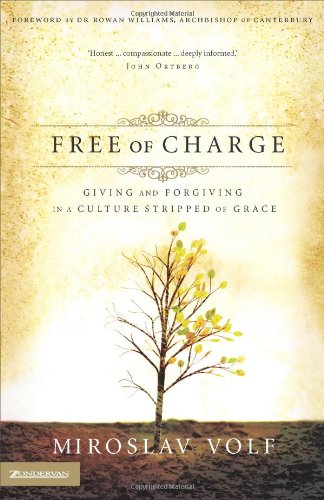
-Miroslav Volf, Free of Charge: Giving and Forgiving in a Culture Stripped of Grace pp. 138-139

Wrath isn’t the opposite of love, then–indifference is. There are caveats on all of this, of course. It must be remembered wrath is not a primary attribute of God, but rather a relative one provoked by sin–much the way mercy are. What’s more, God is impassible and so his wrath must be conceived of within the parameters of the Creator/creature distinction, with the appropriate safeguards of analogical language in place, protecting us from some crude, explosive Zeus-like wrath. And yet, the bottom line is that it is still something properly, indeed, necessarily affirmed of the God who is the Lover of the world.

free of chargeOf course, there’s a danger that comes with a theoretical knowledge of God’s wrath–that we keep it at arm’s length and fail to relate it to our own sin:

    Once we accept the appropriateness of God’s wrath, condemnation, and judgment, there is no way of keeping it out there, reserved for others. We have to bring it home as well. I originally resisted the notion of a wrathful God because I dreaded being that wrath’s target; I still do. I knew I couldn’t just direct God’s wrath against others, as if it were a weapon I could aim at targets I particularly detested. It’s God’s wrath, not mine, the wrath of the one and impartial God, lover of all humanity. If I want it to fall on evildoers, I must let it fall on myself – when I deserve it.

Also, once we affirm that God’s condemnation of wrongdoing is appropriate, we cannot reserve God’s condemnation for heinous crimes. Where would the line be drawn? On what grounds could it be drawn? Everything that deserves to be condemned should be condemned in proportion to its weight as an offense – from a single slight to a murder, from indolence to idolatry, from lust to rape. To condemn heinous offenses but not light ones would be manifestly unfair. An offense is an offense and deserves condemnation…

-ibid, pg. 139

And yet, thankfully that is not the whole of the story. God’s love is revealed not only in condemnation of sin, but chiefly in the salvation of sinners from that judgment in the death of his Son:

For while we were still weak, at the right time Christ died for the ungodly. For one will scarcely die for a righteous person—though perhaps for a good person one would dare even to die—but God shows his love for us in that while we were still sinners, Christ died for us.Since, therefore, we have now been justified by his blood, much more shall we be saved by him from the wrath of God. For if while we were enemies we were reconciled to God by the death of his Son, much more, now that we are reconciled, shall we be saved by his life. More than that, we also rejoice in God through our Lord Jesus Christ, through whom we have now received reconciliation. (Romans 5:6-11)

Soli Deo Gloria

Unapologetic by Francis Spufford (TGC Review)

unapologeticFrancis Spufford. Unapologetic: Why, Despite Everything, Christianity Can Still Make Surprising Emotional Sense. New York: HarperOne, 2013. 240 pp. $25.99.

Friedrich Schleiermacher wrote his classic treatise On Religion: Speeches to Its Cultured Despisers at the behest of his radically irreligious friends—emancipated thinkers who wanted to know how he could share so much of their intellectual world and yet be an ordained, believing Christian. The result was a novel, innovative phenomenology of religion that aimed at rendering religion intelligible to a large swath of modern, intellectual Europe, and which influenced liberal Christian theology for generations.

In many ways Francis Spufford’s unique, hilariously pugnacious, and vivaciously argued tour-de-force Unapologetic: Why, Despite Everything, Christianity Can Still Make Surprising Emotional Sense could be considered a version of that same project. Only this time the book aims at “awkward” post-Christian Brits who have trouble making sense of why an emotionally competent adult would embrace belief in a sky-fairy and so forth.

Before you’re too put off, though, unlike Schleiermacher or Spong-style modern liberals, Spufford knows that big doctrines like the incarnation and the actual events of history (cross and resurrection) matter as issues of truth. He’s not offering some soggy song about the power of metaphors. The emotions must somehow connect to reality. Still, though he engages in some humorous polemics against Dawkins & Co., it’s not a traditional, philosophic apologetic for the truth-claims of the Christian faith—he doesn’t think that can really be done. Rather, it’s more of a Pascalian wager in the sense that, assuming we can’t know either way, there is real satisfaction and dignity in belief. It’s a brief, pop phenomenology of the Christian faith that tries to help the non-religious understand what it’s like from the inside.

Check out the rest of my review over at The Gospel Coalition.

“I Just Believe in One Less God Than You Do”–Or Not

atheism-believing-in-one-less-god-than-you-age-quoteIn the spirit of recycling (and nostalgia), I’ve rifled through old conversations I’ve saved from my pre-blogging, internet correspondence to see if there’s anything serviceable. One dialogue in particular found me channeling Tim Keller on the subject of idolatry. One chap, an aggressive atheist of the Dawkinsian sort, was challenging me on my juvenile belief in God and trotted out the now-famous quote among the New Atheist set:

“I contend that we are both atheists. I just believe in one fewer god than you do. When you understand why you dismiss all the other possible gods, you will understand why I dismiss yours.”

–Stephen H. Roberts

After giving a lengthy list of reasons I have for believing in God, I addressed the quote (grammar:

At this point, I would like to address your quote. I think the question is not whether or not you believe in one less god than I do. I think the reality of the situation is that irrespective of the particular propositions we affirm, we both worship gods. The difference between you and I is that I’ve chosen the Christian one and that in all likelihood, you remain oblivious to the nature of yours.

Let me explain what I mean.

Functionally-speaking, everybody has a “god”, even if they don’t have a “religion.” You have something that you’ve placed at the center of your life that gives it direction, meaning, purpose, and value. You devote your time, energy, love, and affection to this thing as if it were the most central thing in the universe. That, in the monotheistic traditions, is what is called an idol. It is a god-substitute. The point isn’t whether or not you will worship a god. The point is “which god will you worship?”

The Christian claim is that if you match Jesus up with any other god, he wins all day, every day, and (of course) twice on Sundays. So, if you match Jesus up with the most common American god, Money, Jesus wins. Jesus is totally better than money. Money never satisfies. It never delivers what it promises. You can work for it, slave for it, sacrifice everything at the altar for (like your time, relationships, children, marriage, health) and in the end, even when you get it, it lets you down. You keep needing more and more and it never fills that gap. Also, if you don’t get it, if you fail your god, the crushing despair you feel can’t be relieved. Money doesn’t forgive you. When money is your god, being poor is a sin and you’re gonna have a hard time working that off of your soul.

In any case, money can be devalued, can be lost (think market crash in 2008), and, in the end, will distort your soul if you make it the ultimate thing in your life. Jesus ,on the other hand, well, he’s not going anywhere. He doesn’t accept you based on your performance, but by grace, loving you despite all your flaws. He forgives you when you fail. He delivers on what he promises. I could go on of hours, but you kinda get the point. Jesus > Money. Name anything else, even really good things, (Jesus > relationships, Jesus > your personal freedom, Jesus > sex, Jesus > power, Jesus > fame, Jesus > stuff, Jesus > a career, Jesus > status, Jesus > being a rockstar, etc.), and Jesus wins every time.

And remember, you already worship something. You build your sense of self on something. Something is already your god. I don’t know what your particular god is, but I know you have one. The question is whether or not you recognize it, and how well does it match up against the God revealed in Jesus Christ. That is why I think Mr. Robert’s quote, while being trivially true at the purely propositional level, is fundamentally wrong.

A few years on, I would probably adjust tone and my specific elaboration, and yet the fundamental point still holds. The world isn’t divided up between believers and non-believers, worshippers and non-worshippers–we all believe and we all worship. The fundamental difference is the object of our belief and worship–Jesus, or something else.

Soli Deo Gloria