Why Did God Give the Tree of the Knowledge of Good and Evil? 5 Reasons

forbidden-treeAs the fountainhead of the story of the Bible, some of the most complicated questions in theology are densely clustered in the first few chapters of Genesis. After hearing the story as a kid in Sunday School, one of the first ones you end up asking is, “Why would God put the Tree of the Knowledge of Good and Evil in the middle of the Garden? I mean, given that it could derail the whole project so quickly, why put it there at all? What’s the point? What reasons could God possibly have?”

Leave it to Turretin to tackle the issue with his usual, rigorous clarity, to come up with, not one, but five reasons for planting the tree in the middle of the Garden. Before laying out his answer, though, it’s important to set a bit of background.

Locating Adam

First, you need to know that Turretin treats the question in his section dealing with human nature in its originally constituted state. That makes a big difference when it comes to a couple of his reasons. See, earlier on in this topic he points out that when you’re dealing with questions of anthropology in theology, you need to recognize there are four states you need to think about (Vol. 1, Top. 8, Qu. 1.I-II). There’s:

(a) human nature as God originally made it

(b) human nature after we made a mess of it through sin

(c) human nature after God has regenerated it as it goes through the process of sanctification

(d) human nature once God has ultimately perfected and glorified it in the future

Much confusion results when theologians don’t distinguish these states in their discussions of human nature and they end up heatedly talking past each other.

Second, you have to know that, along with all the other Reformed dogmaticians of his time, Turretin considered Adam to be entered into a covenant of nature or works, with God. Strictly speaking, it’s a covenant only by God’s condescension. God isn’t an equal party, being an infinite creator, and is only under obligation according to his own Word. All the same, Adam was given a law with curses attached for disobedience and blessings by way of reward for obedience. For more on this, see here.

From there, we can move on to discuss the Tree of the Knowledge of Good and Evil. In his section on the topic (Vol. 1, Top. 8, Qu. 4), he quickly dispenses with the idea that we can know what kind of fruit tree it was. Instead, we must discover why it got its name. Turretin’s suggestion is that the tree’s name revealed its nature as both a sacramental tree as well as pointing ahead to its experiential reality. In other words, by eating of it, Adam and Eve would know by experience what it means to know the good of obedience and the evil of disobedience.

This command to not eat of the Tree was what we might call a “positive” law in that eating the fruit wasn’t inherently good or evil, but only became so by the command of God. It’s wrong “because God said so.” Still, it symbolically represented the whole of the natural law and became a test, a trial, where the obedience of Adam would be “explored.” Would he cling to God’s own word in love and obedience, or prefer his own will by heeding the voice of the tempter? (Incidentally, for those puzzled by the reference, yes, classic Reformed theology had a robust, creational doctrine of natural law).

Making Things Explicit

So then, now we are prepared to hear Turretin’s five reasons that God placed the Tree in the Garden as an explicitly, “exploratory” command, on top of Adam’s natural obligations:

  1. In order that God, who had granted the dominion of all things to man, might declare himself to be the Lord of man and man might understand himself to be a servant bound to obey and adhere to him. Although the natural law had already clearly declared that, yet because someone might think the natural law to be a property of nature and not a law, he wished therefore (by a peculiar law about a think absolutely indifferent) to declare this more clearly. Thus on the one hand, the dominion of God might appear…on the other, the duty of man.
  2. That sin might be made the more conspicuous by that external symbol and the evil of the concealed ulcer be dragged to the light (or the virtue of the obedience be far more clearly exhibited). For the virtue of obedience would have been the more illustrious as the evil was because forbidden of God…
  3. To declare that man was created by him with free will; for if he had been without it, he would not have imposed such a law upon him.
  4. That by interdicting the fruit of a beautiful tree, he might teach that his happiness does not consist in the enjoyment of earthly things; otherwise God would not have wished to prevent his using it.
  5. To teach that God alone and his service must be sought before all things as the highest good and that we should acquiesce in it alone.

Now, many might seek to add further reasons to Turretin’s here. Indeed, one of the most interesting and compelling suggestions is that the Tree was ultimately to be a gift to Adam after passing his test (his probationary period, if you will) and entering into the blessings of obedience. All the same, at this stage in the narrative, Turretin’s answers are instructive for us.

First, it’s helpful to realize Turretin doesn’t limit himself to one reason. Oftentimes we consider and discard answers in theology because we presume there must be only one correct answer to any situation and neglect the fact that multiple answers or multiple dimensions to a single answer might be true. We shouldn’t be hasty or reductionistic, especially when dealing with the purposes of God.

Also, it’s worth mentioning how well this account comports with Paul’s illustrative retelling his/Adam’s/Israel’s situation in Romans 7 when it comes to the entrance of the Law:

What then shall we say? That the law is sin? By no means! Yet if it had not been for the law, I would not have known sin. For I would not have known what it is to covet if the law had not said, “You shall not covet.” But sin, seizing an opportunity through the commandment, produced in me all kinds of covetousness. For apart from the law, sin lies dead. I was once alive apart from the law, but when the commandment came, sin came alive and I died. The very commandment that promised life proved to be death to me. For sin, seizing an opportunity through the commandment, deceived me and through it killed me. So the law is holy, and the commandment is holy and righteous and good. Did that which is good, then, bring death to me? By no means! It was sin, producing death in me through what is good, in order that sin might be shown to be sin, and through the commandment might become sinful beyond measure. (Romans 7:7-13)

I would be surprised if Turretin wasn’t explicitly engaged in some intertextual interpretation here.

Finally, if we could sum up all these reasons into one basic thought, it’s that God wanted to make things explicit. The Tree of the Knowledge of Good and Evil clarified humanity’s relationship with God, set expectations, held out promises and threats, and instructed Adam in what his truest and deepest good was. God is not arbitrary, cruel, or unclear. He declares his law explicitly for the good of his creatures. Unfortunately, we very explicitly botched it.

Thankfully, he declares his gospel by an even clearer word: Jesus.

Soli Deo Gloria

Three Concepts You’ll Need To Settle the Domain of the Word

Domain of the wordMost Christian doctrines don’t make sense unless you’re thinking properly about a whole bunch of other doctrines. The recent LA Theology Conference made that point about atonement. Unless you’ve got a good handle on the nature of Jesus’ incarnation or the creation, you probably won’t be able to keep Christ’s atonement in its proper biblical shape. Things go wonky without them (not to mention a few others).

John Webster argues the same thing is true of the doctrine of Scripture in his fairly recent and highly-praised work The Domain of the Word and his earlier, excellent little offering Holy Scripture. Unless you have certain elements in the doctrine of God, the church, and providence in proper order–who God is, how he acts, and what he happens to want to do with the texts–our reflections on what the Bible actually is will inevitably fall short. You have to approach the Bible “indirectly”, as it were, by appreciating its place in the broader scope of the Triune God’s creative and saving communicative activity in history.

While I can’t even begin to scratch the surface of Webster’s rich, subtle reflections on this point, I thought it would be worth roughly and very inelegantly summarizing a small segment early on in the first chapter of The Domain of the Word (pp. 13-17), where he elaborates on the importance of thinking of Scripture with three central concepts in mind: providence, sanctification, and inspiration.

The Word and the Word 

To begin, though, he sets up a bit of a contrast. For about as long as there’s been doctrinal reflection on the nature of Scripture, people have tried to think of it along the lines of an incarnational analogy. Just as Jesus is the Godman, comprised of both Divine and human natures, so the Scriptures are something of a lesser incarnation. The divine Word or words, are given to us in fleshly, human form. Hebrew, Greek, human linguistic structures and mediums are the housing for a message that transcends far beyond that.

Now, this analogy can go in all sorts of directions. Classically, it has been used as a helpful way of understanding the simultaneous humanity and perfection of the Scriptures. Just as Jesus was both human and yet perfect because divine, so God’s written Word is given through human means, yet nonetheless perfect as having come from the mouth of God. More recently, others have used it to talk about Scripture’s usefulness as a divine text that, nonetheless, exhibits the limitations and, in some constructions, errors and sins of all humanity (much to the chagrin of anybody who’s paying attention to the Christological implications).

In order to avoid undue divinizing of Scripture, creating an unfortunate blurring of the Creator/creature distinction, as well as a host of other difficulties, Webster points us in a different direction, and suggest that we locate our idea within the three concepts we already mentioned. In this way, Webster wants to capture the way Scripture fits in God’s various workings, beginning from the most general (providence) to the most specific (inspiration).

Three Key Terms

First, locating our doctrine of Scripture with relation to the doctrine of providence reminds us that the various words, passages, texts, and books of the Bible were written in the midst of the history over which God is Lord. A sparrow doesn’t fall to the ground without the Father’s consent, how much more the Scriptures which form his self-testimony? In other words, we need to desecularize our view of the processes of culture and history which produced these texts (and all other texts for that matter). This isn’t to deny the human, cultural and historical influences on the way Scripture came to be the way it is, but it is to remember that all of history’s movements come together under God’s hands. When you look at the historical process, you need to realize you’re not seeing all the action when you’ve accounted for human psychological, political, and even theological motivations. Father, Son, and Spirit rule over history governing, preserving, and upholding all its activities–even that of the production of Scripture. God’s providence doesn’t compete or deny the natural and the human, but sustains and underlies it.

Second, locating our doctrine of Scripture with relation to the idea of sanctification reminds us of the important work of the Holy Spirit in the lives and histories of the writers of Scripture. Humans can be sanctified by the Spirit, set apart as holy, in order to serve as God’s ambassadors and mouthpieces. So can the human words of those apostles and prophets that God called and commissioned to proclaim his words to the nations. For Webster, the Spirit’s work of sanctification is the middle term between providence and inspiration, and speaks of the Spirit’s preparation and setting apart of the particular persons and processes of the production of Scripture (events, literary elements, redaction, reception, etc). The Spirit set apart the prophets (Jeremiah, Paul), cleanses their lips (Isaiah), and specifically teaches them how to speak his words (Peter). He does this, not by denying their humanity, but calling it, redeeming it, and perfecting it by way of purification. Scripture is Holy because of the Spirit’s work in consecrating these instruments (humans and their histories) for his own.

Third, we come to the final term of ‘inspiration.’ This is the final and most specific term which refers, not to God’s broader process, or some generic notion of inspiredness that all literature falls under. Instead, it is this specific superintendence and supervenience of God in and through his human servants who speak specific words as the Spirit moves them. Webster says we must be careful not to separate this from either providence or sanctification as if God’s inspiration is some intrusive overturning of human, creaturely processes. It’s not a detached miracle that competitively suspends the human dimension, resulting in a mechanical activity, but an organic movement by the Spirit to heal particular authors, Paul, or Peter, so their specific word given in Scripture can be those through which the Spirit addresses us.

Webster concludes this section by noting that the resulting words provided by the Spirit are not some arbitrary deposit of ‘inspiredness’ that does its work all by itself apart from God’s continuing use of it. Instead, they are a settlement of the Word. After God has breathed out these words of Holy Scripture, we have reached a definitive stage in the publication, or revelation of God’s Word that determines all future hearing and receiving of the Word. After this, we don’t need more inspiration, or a more comprehensive supplement that goes further on beyond what the apostles have written. Rather, we need the renewal of heart that leads to listening and receiving the Word that has already been spoken for what it is.

Of course, in looking at this inadequate little summary, the key doctrine underlying all three of these terms is thinking through the nature of divine activity. God is the ultimate root of all Christian doctrine. Human epistemic limitations due to finitude and sin, social formation of language, history, and so forth, are not the final, determining factors here. It’s not that we ought not consider these realities, but as we do, we dare not forget that it is the Triune God sets the limits to the Domain of the Word.

Soli Deo Gloria

When the Trinity said, “Let there Be Light”

lightOne of the problems with reading Augustine as a blogger is the pain at not being able to write about every little choice tidbit or argument you run across. Unfortunately, it’s not possible without simply turning your blog into a commentary on City of God (a not unworthwhile proposition). For now I simply want to highlight one fascinating bit of trinitarian theology Augustine does in his discussion of creation in book 11.

In this section, he begins to treat the truth of the Christian faith against the pagans and so moves to discussing the reality of the world, God’s creation ex nihilo and the fact that creation had a beginning. At one point he sets himself to meditate on the statement, “God saw that it was good” after declaring “let there be light.” He argues that this doesn’t mean that God found out after creating that he’d managed to do a good job. Scripture indicates God’s delight in what he has made according to his own eternal wisdom and will. God’s thoughts are not successive or time-bound like ours. He knows all with a perfect knowledge we cannot imagine. After some elaboration in this vein, he concludes by reflecting on the way Scripture communicates the truth of God’s creation in Genesis 1:

For this reason, if we were merely being asked, ‘Who made the light?’ it would be enough to answer, ‘God.’ If further information regarding the means by which it was made had been intended, it would have sufficed to say, ‘And God said, Let there be light, and there was light,’ that we might know not only that God had made the world, but also that He had made it by the Word. But there are three things above all which we need to know about a created thing, three things we must be told: who made it, how he made it, and why he made it. That is why the Scripture says, ‘God said, “Let there be light, and there was light.  And God saw the light that it was good.”‘  If, then, we ask who made it, it was ‘God.’  If, by what means, He said ‘Let it be,’ and it was.  If we ask, why He made it, ‘it was good.’  Neither is there any author more excellent than God, nor any skill more efficacious than the word of God, nor any cause better than that good might be created by the good God. (Bk. XI.21)

Three questions give three answers. Who made the world? God. How did he make it? His Word. Why did he make it? Because a good God makes good things. Where is the Trinity is all this? Well, just a couple of chapters later he concludes a section critiquing Origen by asking:

As I suggested above, there are three questions to be asked in respect of any created being: Who made it? How? and Why? I put forward the answers: ‘God’, ‘Through His Word’, ‘Because it was good.’ Now whether this formula is to be regarded as a mystical revelation of the Trinity, the Father, the Son, and the Holy Spirit, or whether there is anything which prevents this interpretation of the passage in Scripture is a question meriting extended discussion; and we are not to be forced to unravel every question in a single volume. (Bk. XI.23)

So it seems he might be shutting the question down. But then he moves on to discuss the revelation of the divine Trinity in Creation in the very next chapter, suggesting an answer to the question. He begins that section by affirming the Father’s eternal generation of the Son and the Holy Spirit’s procession from both so that we have these three who are co-eternal and consubstantial with each other, one, undivided, distinctive according to the persons, but inseparable according to the divine nature and action. He then begins to connect some interesting dots by way of examining the Holy Spirit’s relationship to the Father and the Son. He says this:

As for the question whether the Holy Spirit of the good Father and the good Son can rightly be called the goodness of both, as being common to both, I should not dare to hazard a rash judgment about that. I should however be more ready to risk the statement that he is the holiness of them both, not as a mere quality, but being himself a subsistent being — a substance — and the third person in the Trinity. What lends probability to this suggestion is the fact that although the Father is spirit, and the Son is spirit, and the Father and the Son are both holy, it remains true that holiness is the distinguishing attribute of the Spirit, which suggests that he is the holiness of both, in substantial and consubstantial form. Now if the divine goodness is identical with the divine holiness, it is evidently not a rash presumption but a reasonable inference to find a hint of the Trinity in the description of God’s creative works, expressed somewhat enigmatically, so as to exercise our speculations. This hint we may find when we ask the questions. Who? How? and Why? (Bk. XI.24)

Now we come to the heart of Augustine’s speculative investigation of whether God’s act of creation points us to God’s Trinitarian being.

It was, of course, the Father of the Word who said, ‘Let it be made.’ And since creation was effected by his speaking, there can be no doubt that it was done by means of the Word. And the statement, ‘God saw that it was good’ makes it quite plain that God did not create under stress of any compulsion, or because he lackes something for his own needs; his only motive was goodness; he created because his creation was good. And the assertion of the goodness of the created work follows the act of creation in order to emphasize that the work corresponded with the goodness which was the reason for its creation.

Now if his goodness is rightly interpreted as the Holy Spirit, then the whole united Trinity is revealed to us in its works. Hence comes the origin, the enlightenment, and the felicity of the Holy City constituted by the angels on high. If we ask whence it arises, God founded it; if whence comes its wisdom, it receives light from God; if whence comes its bliss, it rejoices in God. It receives its mode of being by subsisting in God, its enlightenment by beholding him, its joy from cleaving to him. It exists; it sees; it loves. It is strong with God’s eternity; it shines with God’s truth; it rejoices in God’s goodness. (ibid.)

All of this may seem a bit far-fetched and strained to modern readers and exegetes. And that may be. Staring at the sun too long can strain the eyes, and Augustine as known to strain a bit in his ardent desire to see the glory of the Triune God in all things. Of course, we might stop and consider that it is our eyes are weak from lack of effort to penetrate beyond the shallows into the depths of Scriptural texts by reading it in light of the broader confession of the Canon and the Church.

In either case, Augustine has given us hints at a rich vision of activity and purposes of the Triune God in creation. God does not create in some impersonal, mechanistic fashion, but via his powerful, personal Word. Father and Son are good with the goodness that is the Holy Spirit. For that reason, God does not make in order to fulfill some existential gap in his own being, but because the good God makes good things. It is from the fullness of his own Triune life that God says, “Let there be light” and rejoices in the good work of his Word.

Soli Deo Gloria

The Nonviolent God of the Exodus?

sacrificial lambI keep returning to the issue of the consistency between the Old Testament and the New Testament in it’s portrayal of God because the issue keeps getting brought up in popular (and academic) forums. Driven largely by a particular, non-violent hermeneutic, a significant drive towards screening out large sections of the Old Testament portrayal of God is afoot.

The basic argument is that while the Old Testament is fine for what it is–a limited, time-bound telling of God’s dealings with his people according to their lights–Jesus came along and corrected that view. But now we need to go back and look at the Old Testament in light of Jesus and judge it according to his standard of non-violent love as given us in the Gospels and the Sermon on the Mount, but most of all in his enemy-loving death on the cross. By that standard, much of the Old Testament’s depiction of God’s activity falls short and we ought to gently set it aside as not a full or accurate revelation of who God is. God allowed his children, the Israelites, to tell stories about him as best they could, but now that his children have grown up into the Church, we must speak more accurately of God.

We can call this the “Nonviolent God” premise or hermeneutic. Note, this is not the “Christian nonviolence” position. Though this is inevitably a form of nonviolence, there are many like Preston Sprinkle, or even my Mere Fidelity companion Andrew Wilson, who would advocate for nonviolent practices as a part of the progressive ethic revealed in the New Testament, while still accepting the full truth and authority of the Old Testament.

Still, if we set out the basic argument in logical form, it flows something like this:

Nonviolent God Premise 1: Jesus shows us what God is like in a way that supersedes and corrects all prior conceptions.

Nonviolent God Premise 2: Jesus’ nonviolent practices show us that his God would never perform acts of violent judgment, because he would rather die for his enemies on the Cross than kill them.

Nonviolent God Conclusion 3: Accounts like those of the Invasion and Conquest of Canaan are inconsistent with the God revealed in Jesus Christ, therefore God did not command them or perform them.

These narratives, then, are highly-accommodated tellings or permissible falsehoods allowed in God’s benevolence. But thankfully we have Jesus now, we can see clearly that this is wrong, and we can move on, applying a Jesus-hermeneutic and still appropriating the OT Scriptures as they fit.

But here’s the rub that occurred to me when I was reading Psalm 78: acts like those are the chief events by which the God of Israel is identified and identifies himself in the OT. They are ineliminably at the core of Israel’s narrative understanding of the Lord with whom they are in covenant: “I am the LORD your God, who brought you out of Egypt” (Exod. 20:2, Deut. 5:6; cf. also, Lev. 26:13; Ps. 81:10). Indeed, one of the main OT confessions of faith is found in Deuteronomy, where worshipers coming to celebrate the festival of the first-fruits. Worshipers were supposed to respond to the priests as they brought their offerings to the LORD:

“And you shall make response before the LORD your God, ‘A wandering Aramean was my father. And he went down into Egypt and sojourned there, few in number, and there he became a nation, great, mighty, and populous. And the Egyptians treated us harshly and humiliated us and laid on us hard labor. Then we cried to the LORD, the God of our fathers, and the LORD heard our voice and saw our affliction, our toil, and our oppression. And the LORD brought us out of Egypt with a mighty hand and an outstretched arm, with great deeds of terror, with signs and wonders. And he brought us into this place and gave us this land, a land flowing with milk and honey. And behold, now I bring the first of the fruit of the ground, which you, O LORD, have given me.’ And you shall set it down before the LORD your God and worship before the LORD your God. (Deuteronomy 26:5-10 ESV)

The “great deeds of terror and signs and wonders” are precisely those events which our Nonviolent God Hermeneutic ought to lead us to reject as less than appropriate for the God of Jesus Christ.

Which leads me to posit couple more premises and a logical entailment that isn’t usually accepted by more Evangelical advocates of the Nonviolent God hermeneutic, but I think follow naturally.

OT Data Premise 4: The Exodus from Egypt and Redemption of Israel was accomplished by similar, if not more aggressive divine acts of violent mercy and judgment such as: the 10 plagues (rivers of blood, sickness, deadly hale, economic devastation, etc) , the drowning of a massive Egyptian army in Red Sea, and finally, the execution of the firstborn in all the land as an act of Judgment on the gods of the Egyptians (Exod. 12).

OT Data Subpremise 4.5: It is clear from the narrative that each of these acts of divine violence was not ancillary to process of redemption. It occurs precisely in and through these acts of divine judgment. There is simply no way to read out God’s activity (even those who distance God via the destroying angel must admit that it is by God’s permission, will, and command that the angel goes out. Exod 12:13 depicts God himself speaking of passing over house and destroying the firstborn in others).  

OT Data Premise 5: Yet, the God of Israel willed to be known primarily as the God who accomplished the mighty acts of mercy and judgment in the Exodus and Redemption of Israel (cf. Exodus and the hundreds of celebratory references in the Prophets and Psalms). Indeed, the foundational Passover celebration and meal memorialize an act divine violence and mercy–the death of the firstborn–which is surely as problematic as the accounts of the Canaanites (though I think there are better approaches to contextualizing that). 

Logical Entailment of the Nonviolent God Premises: Jesus reveals to us a fundamentally different God than the God of the Exodus and Redemption and therefore a different God than the God of Israel.

At this point, my question becomes, “How is this not some form of Neo-Marcionism?” Note, I don’t mean full-blown Marcionism. That would require a Gnostic rejection of Creation, materiality, and a whole lot more. But how does this hermeneutic not slowly but surely lead us to the conclusion that the God of the Old Testament is a significantly different being than the God of Jesus Christ? How can we continue to narratively-identify them when the chief liberating acts of the one allegedly deny the chief liberating acts of the other?

Again, I don’t really have as much of a problem with the kind of nonviolence approach that says God has a multi-stage plan in which his people can participate in warfare in one stage (Israel) and then move away from it in another (the Church/New Israel). I actually do believe there are significant discontinuities as well as continuities between the Old and the New Testament. Thank God for that, or I, a Gentile, wouldn’t be here. I don’t think the OT Law in its entirety is for applicable, or even advisable to today. I think Jesus has changed some things. Still, the problem comes when we arrive at a “Jesus”-hermeneutic that ends up retooling our entire doctrine of God, the cross (atonement), and entire telling of salvation history.

Let me be clear: most of the Evangelicals flirting with or advocating the Nonviolent God hermeneutic have not gone this far. I am not call them Marcionites straight out or even all Neo-Marcionites. What I am saying is that unchecked or ungrounded by other concerns, it logically flows into something like this. That’s something that ought to give us pause.

Losing the Exodus means losing the God of the Exodus. And that’s a bridge too far.

Soli Deo Gloria

Landscape Artist

landscapePsalm 107 is a testimony to the great love of the LORD, recounting his mighty acts of salvation for his chosen people Israel. Towards the end, the Psalmist gives us a powerful, albeit quirky image of the LORD’s wonder-working salvation:

He turns rivers into a desert,
springs of water into thirsty ground,
a fruitful land into a salty waste,
because of the evil of its inhabitants.
He turns a desert into pools of water,
a parched land into springs of water.
And there he lets the hungry dwell,
and they establish a city to live in;
they sow fields and plant vineyards and get a fruitful yield.
By his blessing they multiply greatly,
and he does not let their livestock diminish.
(Psalm 107:33-38)

In this life, it often appears that then land of the righteous is desolate while the unrighteous seem to reap a bountiful harvest that overflows into abundance.

Their investments multiply. Their children grow strong. And those of the righteous? They seem to languish in poverty and overcome with illness.

Yet the Psalmist testifies that the LORD is a mighty God who works a salvation of reversal.

The full become empty and the empty are filled. The barren give fruit while the fertile dry up.

Rich valleys and fields become salted wastelands, cursed and bereft of life.

Deserts are transformed into lush gardens teeming with life.

Gardens become the foundation of cities and culture.

Where once was a desert and the threat of death, there stands a city where the hungry can be nourished.

The God of Israel is in the habit of reworking the landscape of reality.

For those who trust on him, this is what he does in the resurrection of Jesus Christ.

Soli Deo Gloria

Justification in the Already-Not-Yet and the Costco Card of Works

 He will render to each one according to his works: to those who by patience in well-doing seek for glory and honor and immortality, he will give eternal life; but for those who are self-seeking and do not obey the truth, but obey unrighteousness, there will be wrath and fury.  There will be tribulation and distress for every human being who does evil, the Jew first and also the Greek, but glory and honor and peace for everyone who does good, the Jew first and also the Greek. For God shows no partiality. (Romans 2:6-11)

 For I am not aware of anything against myself, but I am not thereby acquitted. It is the Lord who judges me.  Therefore do not pronounce judgment before the time, before the Lord comes, who will bring to light the things now hidden in darkness and will disclose the purposes of the heart. Then each one will receive his commendation from God. (1 Corinthians 4:4-5)

These texts and a few others like them (James 2:14-16, 2 Cor. 5:10) seem pretty problematic for the Protestant defender of justification by faith. Many of us who are raised hearing the message of justification in Christ being received as a gift of grace by faith alone–good news that I wholeheartedly affirm–often stumble when we run across these verses that seem to link our justification to our good works in some way.

Various options have been presented, with one of the most popular suggestions being that texts like Romans 2 are only talking about a hypothetical judgment on the basis of works that nobody attains. Sort of setting up works in order to knock it down with faith kind of thing. While this is a broad and complex subject, I wanted to just briefly outline and quote an alternative proposal by G.K. Beale and others that I’ve found quite helpful.

costcoJustification in the Already-Not-Yet and the Costo Card of Works

Pointing in a couple of directions, Beale, Richard Gaffin, and a few others talk about a two-stage or double-justification of the believer. Drawing on the already/not yet dimension of New Testament theology, they say there is a sense and dimension of our justification which is already fully accomplished. And yet, there are texts that point us to the idea that some part of our judgment and justification still awaits and that the Spirit-inspired works that we engage in through union with Christ will play a part of that.

Drawing on Jonathan Edwards, Beale talks about this as the difference ‘Initial’ justification and also of ‘manifestive’ justification. The first is received by union with Christ through faith in the final work of Christ in his life, penal death, and justifying resurrection. Christ’s work is the “basis”, the cause, the foundation for our justification and nothing else. That said, the next stage of ‘manifestive’ justification–demonstrating before the world that a believer truly has been united to Christ–is “in accordance with” our works, or lines up with the fact of our Spirit-wrought obedience.

If you’re confused, Beale has a helpful section and analogy spelling it out. And really, this example is the whole point of my post:

How can believers be said to “judged by works” and yet be justified by faith? There is much more to be said that can be elaborated on here about the believer’s righteous works in connection to this consummate, manifestive stage of justification, and the following is just the beginning of an answer to that question. An illustration must suffice for now to summarize my own view of this connection. In the United States there are large discount food stores that require people to pay an annual fee to have the privilege of buying food there. Once this fee is paid, the member must present a card as evidence of having paid the fee; only then is entrance to the store allowed. The card is necessary to get into the store, but it is not the ultimate reason that the person is granted access. The paid fee is the ultimate reason for the entrance, and the card is the evidence that the fee has been paid. We may refer to the fee paid as the necessary causal condition of entrance into the store and the evidence-testifying card as the necessary condition (but not the necessary causal condition). The card is the external manifestation or proof that the prior price was paid, so that both the money paid and the card are necessary for admittance, but they do not have the same conditional force for allowing entrance…

Likewise, Christ’s justifying penal death (together with his imputed obedient life through identification with his vindicating resurrection) is the price paid “once for all” (Heb. 9:12; cf. 26-28), and the good works done within the context of Christian faith become the inevitable evidence of such faith at the final judicial evaluation. –G.K. Beale, “Resurrection in the Already-And-Not-Yet Phases of Justification”, in For the Glory of God’s Name:Essays in Honor of John Pipereds. Sam Storms and Justin Taylor, pp. 204-25

In other words, Jesus pays the price connected with our initial and ultimate justification. Our Spirit-wrought works are the Costco card we will inevitably have in our hand as our manifestive justification, proving, or giving evidence that we have indeed accepted Christ’s sacrifice on our behalf and have been united with him. Beale’s whole article is worth reading in the way he spells out the importance of the resurrection of the body and works for the public vindication of believers.

I think a reading like this actually makes quite good sense. It secures the essential, unique, fundamental work of Jesus Christ for us, outside of us that we gain access to only through trusting faith. It also makes sense of the sorts of texts in Romans 2 and in the Corinthian letters that speak of the necessity of works for our final justification, without resorting to writing them off as hypotheticals. By faith we are united to Christ, justified by our gracious God, and filled with the Holy Spirit who enables us to do works which manifest that faith.

For more on this, I suggest Beale’s big book on NT theology, or, shorter and more quickly at hand, Richard Gaffin has a helpful related article on justification by faith with works in Calvin over at Reformation21.

Soli Deo Gloria 

The Liberation of the Triune God

exodusOne of the helpful emphases of the Reformed tradition is its acknowledgment of the continuity as well as discontinuity of Old and New Testaments. This comes through very strongly in Turretin’s Institutes and even makes an appearance in his doctrine of the Trinity. After a couple of clarifying questions, as well as a lengthy question devoted to proving the doctrine of the Trinity from New Testament Scripture, he moves on to try and demonstrate the revelation of the Trinity in the Old Testament. For while it is admittedly true that God reveals himself as Father, Son, and Holy Spirit with greater clarity in New Testament, that does not at all mean that we cannot see him revealed as such in the Old as well.

He then proceeds to do some careful lexical and exegetical work in some of the usual places such as Genesis 1:26, and other references to the Divine plural in the manner of the Fathers, as well as some other surprises. The passage that caught my eye was his treatment of the salvation of Israel from Egypt. Here argues from the works of Father, Son, and Spirit in the Exodus to their unified of the Triune action in the Old Testament.

…the same may be proved from the deliverance of the people out of Egyptian bondage, the guidance of them through the wilderness, and introduction into Canaan. He is that true God whom the Israelite. He is that true God whom the Israelites acknowledged and worshipped, who brought them out of Egypt, lead them through wilderness and introduced them into the land of promise. For no other besides God could have performed so great a work, as he himself testifies in the preface to the Law. “I am the Lord thy God who brough thee out of the land of Egypt.” Also, he often claims this as his prerogative (Ex. 3:2; 23:20; 32:34), in which this work is ascribed to the three persons of the Trinity–the Father, the Son, and the Holy Spirit.

Concerning the Father, the adversaries do not doubt; concerning the Son, the following passages prove (Ex. 3:2; 23:20; 32:34), in which this work is ascribed to the “angel of Jehovah.” That this angel is not a created angel, but the uncreated Son of God himself, sent by God for this work and often manifesting himself under this form to the patriarchs, is evident from the description of him and the various attributes given to him (which are such as cannot apply to a creature, but belong to God alone). (1) He says he is the God of Abraham, of Isaac and of Jacob (Ex. 3:6); calls the Israelites his people (Ex. 3:7); sends Moses to Pharaoh (Ex. 3:10); promises himself divine worship after their deliverance from Egypt (Ex. 3:12). (2) He is said to have gone before the Israelites in a pillar of cloud and fire (Ex. 4:19), which is expressly attributed to Jehovah (Ex. 13:21; Num. 11:25; 14:14). (3) It is said that “the name of God” will be in himso that they will not escape unpunished who rebel against him (Exd. 23:20, 21). (4) He is called “the very presence of God” (“My presence shall go with thee,” Ex. 33:14) because he is the image of the invisible God, the express image of the person of the Father.

That the Holy Spirit also here concurred as a person with the others is evident from the noted passage: “I will mention the lovingkindesses of the Lord” (Is. 63:7-14). He said “surely they are my people, so he was their Savior.” “The angel of his presence saved them in his love, but they rebelled and vexed his Holy Spirit,” Here three distinct person are enumerated: “Jehovah,” “the angel of his presence,” and “the Holy Spirit.” Distinct operations are ascribed to each: to Jehovah, lovingkindness towards the people; to the angel of his presence, redemption; and to the Holy Spirit, vexation and contention with the people, which he was turned to be their enemy. Since, then, a truly divine work is ascribed to these three, it is necessary that they should be one true God essentially (although mutually distinguished in mode of subsisting and personall). –Third Topic, Q. XXV, sec. IX

There are a number of features worth noting in this treatment. The first is Turretin’s view of the Angel of the LORD, or the Angel of YHWH. As he makes clear in a number of places, Turretin views this as an appearance of the pre-incarnate Son. It is an appearance in angelic/human form that is, nonetheless, distinct from his incarnation in that there is no hypostatic union, but only concrete manifestation. Still, this is a thesis that Christian theologians have long appealed to in order to explain the way the Angel is both identified as a distinct agent who nonetheless is identified as the LORD somehow.

Connected with that is the issue of narrative identification of God by his works. The idea is that God is to be identified by his activities in history. God’s being is not constituted by his activity in history. Nonetheless, he is known and identified by his activity in history. YHWH is the God who rescued Israel from Egypt. That is YHWH’s activity and YHWH’s identity. Therefore, if an actor is identified as an actor in that same salvation, then they are identified with YHWH himself. In other words, if someone is doing what Scripture says only God does, then we must be dealing with God.

At the same time, there is clearly a distinction of the persons in their working of the one work of redeeming Israel from Egypt. The Fathers had a phrase that summed up this principle that while “the external works of the Trinity are undivided”–in other words, Father, Son, and Spirit are at work in the same work–nonetheless, the order and distinction among the persons should be observed. Father, Son, and Spirit are at work in the Incarnation of the Son, but only the Son becomes incarnate. The same is true here. While it is true that Father, Son, and Spirit are identified as agents of Israel liberation and are therefore identified as God, their particular activities are not lost to view. The God who is Father, Son, and Spirit acts Triunely to bring about Israel’s salvation.

Finally, the issue of “canonical” interpretation pops up in the passage. Turretin practices what might be called a form of canonical interpretation, taking the whole of the Old Testament to be the proper context for the interpretation of the Exodus event. Though the Exodus texts might not explicitly mention the activity of the Spirit, the LORD’s words in Isaiah about the same event illuminates it theologically. While we see Turretin employing this canonical reading within the Old Testament, the same principle holds true for the New Testament and the Old Testament. The New Testament’s clearer light is normative for how Christians are to read the Old Testament. Of course, that also takes some careful examination of the way that the New Testament is actually using an Old Testament text. Still, the principle holds. Jesus tells us what divorce law was about (Mark 10). Paul’s reading of the events of Exodus 34 in 1 Corinthians 10 actually helps us read Exodus 34. Hebrews tells us what the sacrificial system was really all about.

This is why I keep reading dead types. There’s gold in them thar hills. Turretin reminds us that our liberating God is our Triune God and our Triune God is a liberating God.

Soli Deo Gloria

Unchanging and Promise-keeping: A Reformed Metaphysics of the Exodus

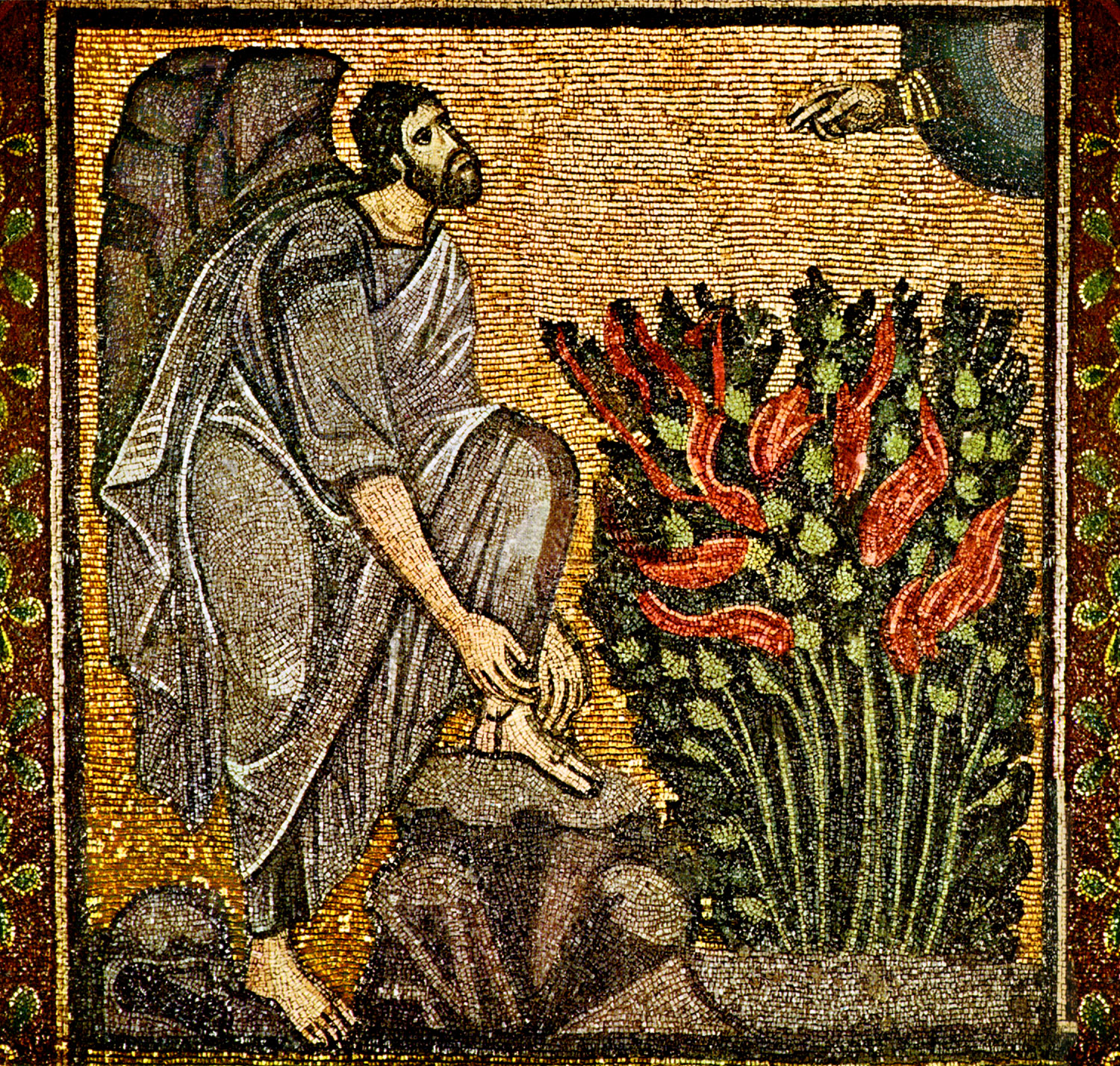
burning bushFew texts in the Bible have been as metaphysically-significant as Moses’ encounter with God at the Burning Bush. With the giving the Divine Name “I am that I am” in Exodus 3:14, the stage was set, not only for covenantal history, but philosophical reflection in the West for millennia to come.

When the Greek translation of the OT, the Septuagint (LXX), rendered that phrase something along the lines, “I am that which is”, a door was opened for philosophically-inclined Jewish and especially later Christian theologians to attempt an identification with the God of Israel, with the philosophical category of being.

Beginning with Justin Martyr down on through Augustine and Aquinas, this text became important for developing a Christian theology of the being and attributes of God. If God is the one who supremely is, then certain corollary attributes follow: independence, eternity, unchangeability, infinity, and so forth. Etienne Gilson famously dubbed this tradition of philosophical reflection “the Metaphysics of Exodus.”

Of course, not everybody has been sanguine about this history.

From various angles, the tradition has been attacked. Lexically, the Septuagint’s rendering has been called into question, and various alternative renderings of the complicated Hebrew have been offered.

Theologically, metaphysical interpretation of this sort has been rubbished as one more, if not the chief, example of the Greek captivity of Christian theology, imposing foreign categories upon the text in order to arrive at foregone philosophical conclusions.

Others have argued that the text is nowhere near philosophical categories. Connected with this, certain modern theologians assert that God is testifying to his faithfulness, or his consistency of action, not his mode of being. Biblical thought is concerned with God’s character, not his ontology.

While some of these arguments have some weight to them, especially the exegetical ones, I thought it might be worth presenting a chunk of Francis Turretin’s exposition of the divine name as a prime example of the tradition. It’s instructive in itself, not because everything in it holds up, but because many haven’t taken the time to look at what this type of argumentation looks like. Also, because it makes a key point that, whatever you do with the rest of it, still needs to be heard: ontology and character are bound up with each other.

There can be no simple bifurcation between being and doing.

The etymology and signification of the word is such as agrees with God alone. From Scripture, it is evident that it implies most especially three things which are seen to be connected (Is. 44:24-26):

(a) The eternity and independence of God, inasmuch as he is a necessary being, and existing of himself, independent of any other, self-existent (autoon)–“I am that I am” (Ex. 3:14). Hence he is called simply the being (ho on, as the ancient philosophers and Plato especially acknowledged). John describes him by the three distinctions of time: “which is, and which was, and which is to come” (ho on kai ho en kai ho erchomenos, Rev. 1:4). In reference to this we have that expression of the ancient heathen: “Zeus was, Zeus is, Zeus will be, O great Zeus” (Zeus hen, Zeus esti, Zeus essetai o megale Zeu, Pausanias, Description of Greece 10.12.10).

(b) It implies causality and efficiency because what is the first and most perfect in each genus is the cause of the rest (for God is by himself so that he is the cause of being to all others, Is. 44:24).

(c) It implies immutability and constancy in promises because he really performs and does what he has promised by giving to his promises being (to einai), not only self-existent (autoon), but also essentially existent (ousion) and essence-making (ousiopoios). In this sense, he says that he had not been known to the patriarch by his name Jehovah (Ex. 6:3), not as to the signifying word (for the contrary is evident from the book of Genesis), but as to the thing signified (because he had not as yet given being to his promises concerning the multiplication of seed, the bringing of people out of Egypt, their introduction to Canaan, etc.). He had made himself known to the patriarch by his power in the creation of the world, in its government and in the bestowal of many blessings and their wonderful defense; but he had not as yet really declared himself to be Jehovah, by fulfilling the promises given to the patriarchs. But since eternal existence, omnipotent power and immutable truth belong to God alone, the name Jehovah (which embraces these three) ought to be peculiar to him alone. —Institutes of Elenctic Theology Volume 1, Third Topic, Q. IV, Sec. V

As I said, there are a few things that are instructive about this passage.

For one thing, the diversity of sources appealed to is always enlightening to note, simply because at certain times Christians, or especially Evangelicals, have been accused (and been guilty) of intellectual ghettoization. Turretin can comfortably appeal to pagan philosophical and literary tradition in order to supplement his point.

Even more important is the point we see in subsection “c”. Turretin engages in some theological exegesis by appealing to the acts of God, the character of God, in order to ensure the point about the being of God. As Vanhoozer has argued, metaphysics is unavoidable because we must give an account what God is like in order to account for who he has shown himself to be. What must the God who acts in this story be like in order to do and say the kinds of things we see in the biblical narrative?

Well, Turretin answers that a promise-keeping God must be an unchanging God, who is in no way dependent on creation for his being or power. Otherwise, God’s promise-keeping is tentative, questionable, and contested. It would not be grounded solely in God’s own, unwavering power, but in the vagaries of history and chance.

So even if we reject the identification of God with being in the text, and link the name with issues of God’s covenant-keeping character, it’s clear that some level of metaphysical, or ontological reflection on the Name of God is warranted, even demanded by the text.

As the Psalmist says, “You are good and do good” (Psalm 119:68). Turretin would simply remind us to link and properly emphasize the verbs: He does good because He is good.

Soli Deo Gloria

Locating Atonement in Romans 8 #LATC15

This last week was the LA Theology Conference 2015 put on by Fred Sanders and Oliver Crisp and as usual, it was a delight. It was also a challenge. The subject of the conference was “locating atonement” with respect to other key doctrines. The idea is that atonement is one doctrine that, in particular, tends to get stretched out of shape unless it is properly situated within the broader framework of Christians thought. Well, the speakers all did a bang-up job of relating the atonement to various subjects in Christian theology and I can’t wait for the book to come out in the fall. But instead of summarizing them, I figured I would honor the spirit of the conference by doing a bit of “locating” of my own.

lamb slainIn this (hopefully) brief post, I want to say something about what we can see about the proper doctrinal location of the atonement based in most part on Romans 8:1-17, (with some bouncing about in the rest of Romans 8 and a few other texts). In other words, given that this section contains a passage universally acknowledged as a key atonement text in the New Testament, which doctrinal layers or themes need to be acknowledged in order to grasp Paul’s logic in the text. If you don’t have a Bible nearby, I invite you to read it here.

First, I have to acknowledge this will be an uneven, rather surface-level, engagement at points. It is a blog post. Second, not everything that can be said about atonement, nor atonement in this passage, will be said. I go into far greater depth in this lengthy piece, as well as others, but this is just a short one intended to demonstrate the way the Scriptures themselves situate the truth of God’s work through the Cross of Jesus.

1. Triune – First, note that the atoning action is clearly the work of the Triune God.  The work of Father, Son, and Holy Spirit structure the passage as a whole. It all begins in verse 3 with God (the Father)’s action in “sending his own Son in the likeness of sinful flesh.” Here we have the first action of the Father who moves to “send” the Son, in proper Trinitarian fashion, as the originator of the atoning action in Christ. At the same time, this verse also introduces the Son’s action: being “sent.” For this action–this sending/being sent–to happen, there is an inner conformity, a unity of action between the Father and the Son. While the Father “offers up” his Son (Rom. 8:32), the Son offers himself up to Father (Eph. 5:1). Although it is not stated in this text, it must also be remembered that Luke shows us that the Father sends the Son on his historical mission which culminates at the Cross in and by the power of the Holy Spirit (Lk. 1:33-35; 3:16, 21-22; 4:1, 14, 18). Also, the author of Hebrews reminds us that the Son “through the eternal Spirit offered himself without blemish to God” (Heb. 9:14).  In which case, we see already the three Persons at work in the Father’s sending of his Son and the Son’s coming at the behest of the Father. (As we’ll see below, the Spirit’s presence and work pervades the passage).

2. Incarnational—Looking to that same early passage, we see that the atonement of Christ has as its necessary condition the coming of the Son in “the likeness of sinful flesh” (8:3). It was necessary that the Father send the Son in the “likeness” (homoioma) of this sinful flesh, in order to identify with sinful humanity as far as possible, without sinning, as the rest of the New Testament tells us, and thereby be the place where He could deal with the sin of humanity. The logic of sinlessness is present here, even if it is not as clearly spelled out as it is in other texts. While not present here, we should also note that it is in the incarnation that the impassible God assumes humanity in order to undergo passion on our behalf, in order to one day end our passion.

3. Penal—Next, the atonement of the Son has, in some sense, a clearly legal and penal efficacy. Whatever the Son does, it is clear the result is that “There is therefore no condemnation for those who are in Christ Jesus” (8:1). What’s more, Paul tells us that the Father sent the Son precisely to do what “the Law” was insufficient to do, weakened as it was by our sinful flesh, which set us in constant opposition to it (8:7).  God “condemned (katakrima) sin in the flesh” of Jesus, “in order that the righteous requirement of the law might be fulfilled in us, who walk not according to the flesh but according to the Spirit” (8:3-4). For anyone looking to grapple with text of Scripture, I don’t know what we can term this language of “condemnation” other than legal, forensic, and penal.

4. Sacrificial—Of course, the atonement is also sacrificial.  The Father condemns sin in the flesh of Jesus by putting him forward “for sin” (8:3). This term peri hamartias (for sin) was regularly used in the LXX to translate the Hebrew term for “sin offering” in the OT (Lev. 5:6-7; 11; 16:3, 5, 9; Num. 6:16;  7:16; 2 Chron. 29:23-24). How does this deal with sin? James Dunn says in his Romans commentary, “The theology is fairly clear…the death of the sin offering effects God’s condemnation of sin by destruction of the sinful flesh.” In this way, the wrath of God is propitiated/expiated/cleared, and judgment is rendered (Rom. 3:25). So then, the Father hands over the Son, the Son offers himself up in the Spirit to be a sin offering, removing the guilt from his people.

5. Covenantal–Which brings us to the next locus, the covenantal dimension. While this should be evident from the language of the Law in the passage, it is made even clearer when we notice the “in Christ” language. As N.T.Wright has argued, “Christ” should not simply be taken as a name, but rather read with its full titular sense drawn from its Jewish background, Messiah, “the one in whom the people of God are summed up.” Along with this, the phrase “in the Messiah” should be seen to have an incorporative sense. It can at times connote or denote “the people of whom the Messiah is the representative.” Jesus is the Representative Messiah in whom people can be incorporated by faith, so that his accomplishments can become theirs.It is because of this logic that, if the Father deals with sin in his Son, then he has dealt with the sin of those who are in him. It is for this reason that there is “no more condemnation” for those who are “in Christ Jesus” (8:1). (Also, for those who weren’t aware, Wright’s formulation is basically a modified, Reformed federal theology of union with Christ with some 2nd Temple beef.)

6. Pneumatological– This next one is not immediately obvious, but in this passage the atonement is a pneumatological reality in various senses. First, as we pointed out from Hebrews, the Son offers himself in the Spirit. Second, The Father’s actions through the Spirit do not end with sending the Son, or condemning sin, but continue on through the resurrection of Jesus Christ by the power of that same Spirit (8:11).  Paul indicates that the Spirit is the agent by which God raises Jesus from the dead, by the corollary that if we have the same Spirit we will “also” be given life through that same Spirit as Christ was.   Jesus’ resurrection is an important part of God’s atoning action in Christ because according to Paul, he “was handed over to death for our trespasses and was raised for our justification” (Rom. 4:25). Resurrection as vindication is itself a justifying act, vindicating Jesus as the Representative Messiah of his people.

Third, the Spirit is the gift the atonement is aimed at, as well as the agent of the atonement’s sanctifying goal. Having received the Spirit, believers can live not according to the flesh, but out of the power of the Spirit. They are then no longer hostile towards God and his law (Rom. 8:7-9). It is in this way that Paul says the “righteous decree” was “fulfilled in us”(Rom. 8:4). The term translated “righteous decree” (dikaioma) is a peculiar one which speaks of “the righteous decree”, or the “covenant decree” of the law for life. In this case, the “decree” is the decree of Deut. 30:6-20, which says that those who do these things “shall live.” The believers’ lives in the Spirit conform to it and so the decree is “fulfilled” in them. The Son was sent that believers might be given the Spirit, through whom they can now have a life at peace with God. They can be obedient to his revealed will, his law. This is because this Spirit is a “spirit of adoption”, which confirms them as children of God, co-heirs with Christ who enables them to pray with Christ, “Abba! Father!” (Rom. 8:15-17).

7. Eschatological – Finally, the atonement is connected to eschatology. The atonement exhausts the curse of the law and so issues in New Resurrection and New Creation. Paul says, “If the Spirit of him who raised Jesus from the dead dwells in one, he who raised Christ Jesus from the dead will also give life to your mortal bodies through his Spirit who dwells in you” (Rom. 8:11). This new life of reconciled relationship with God issues ultimately in the resurrection of the believer. Later Paul notes that those who are in Christ and have the “first fruits of the Spirit” wait for the “redemption of our bodies” (Rom. 8:23). This is the final stage in our being remade into the image of our firstborn brother, Jesus (Rom. 8:29). It is not a present reality, but a hope which believers wait for in patience (Rom. 8:25). This hope is also connected to reconciliation with creation. “For the creation waits with eager longing for the revealing of the sons of God…in hope that the creation itself will be set free from its bondage to decay and obtain the freedom of the glory of God” (Rom. 8:19-21). When believers receive the redemption of their bodies, creation itself will receive redemption. The two are intimately connected (Rom. 8:23).

According to Paul, atonement has Triune, incarnational, penal, sacrificial, covenantal, pneumatological, and eschatological dimensions. And that’s just one passage. So how much of a tragedy is it, then, when in our preaching and teaching we separate out Christ’s work into its own airtight, doctrinal package? No, it is only when we set the atonement in its proper doctrinal location in our preaching and teaching that our people can see it for the multi-faceted, saving jewel of the Gospel that it is.

Soli Deo Gloria

Peter Pan’s Shadow And the Promises of God

These are a shadow of the things to come, but the substance belongs to Christ. (Colossians 2:17)

For since the law has but a shadow of the good things to come instead of the true form of these realities, it can never, by the same sacrifices that are continually offered every year, make perfect those who draw near. (Hebrews 10:1)

They serve a copy and shadow of the heavenly things. For when Moses was about to erect the tent, he was instructed by God, saying, “See that you make everything according to the pattern that was shown you on the mountain.” (Hebrews 8:5)

Clearly, one of the New Testament writers’ favorite images for relating the truth of the Gospel in the NT to the revelation of the Old Testament was that of “types” and “shadows.” The images are rich, intuitive, and quite helpful in explaining the issue of continuity between the Old Testament and the New. For that reason, Christian theologians of all ages and ecclesiastical persuasions have fastened on these two metaphors and methods of relating the truths of the two covenants, as well as the problem of progressive revelation. As we saw earlier, Turretin leaned on the idea heavily in his defense of the Old Testament’s authority.

The relationship between type and antitype is suggested by the roots of the terms with the idea of stamping or making an impression of an image on a coin or something. There is a correspondence between the stamp and the thing stamped. In the same way, an Old Testament type links up with its New Testament antitype by serving as a preview or advanced model of the coming reality.

peter's shadow 2Picking up the second image, everybody knows that a shadow is not the same thing as its object. It doesn’t have the same substance, weight, or reality. And yet, at the same time, it is dependent upon and similar to the thing that it is a shadow of. My shadow is similar, yet different from me. Its shape is determined, yes, by the light and the distance I am from the ground, but also, in a deciding sense, from my own shape.

So looking at some examples in the Old Testament, Hebrews indicates that the sacrificial system, with its various kinds of sacrifices for thanksgiving, atonement, cleansing, and so forth, all point forward to different dimensions of the ultimate sacrifice that Christ offered upon the cross. Moses was a type of Christ in the liberation and Exodus for the people of God he brought about, which prefigured the New Exodus Christ was to bring about. They are not the substance that is Christ, but they point forward in a way that is determinatively shaped by the substance that is Christ. They are the promises that are copies and shadows of heavenly and better things.

The history, practice, and theology of biblical typology is complex, storied, and well worth pursuing at length. Unfortunately, I don’t have the time, so I am not going to do that. All I want to do is follow up and make one brief, particular point about how we should think of how these metaphors function for expressing continuity and discontinuity.

A Different Type of Type

In some recent discussions regarding issues like atonement or the doctrine of God, I have seen some more progressive theological types refer to the metaphor of types and shadows in order to justify a particular kind of overturning or undermining of the Old Testament revelation. Alongside what we’ve called the Jesus-Tea-strainer hermeneutic, some have argued that now that Christ has come he has revealed the true, hidden nature of these types and shadows. Instead of coming as their more straightforward fulfillment, though, he comes as their abolishment. Or, he comes to reveal how screwed up our understanding has truly been up until this point.

Peter's shadowAs an example, when it comes to the sacrificial system, some will say that Christ served as an antitype by being an altogether different kind of sacrifice. Israelites may have offered sacrifices in the OT as propitiatory, concerned with putting away wrath, but Christ as the antitype shows that the types were distorted refractions of the reality of a God beyond the economy of sacrifice and exchange. Yes, the OT pointed to God’s salvation and victory, but the antitype of Christ shows that all of those OT victories were just shadows pointing forward to the non-violent victory of a God who would never engage in tribal warfare.

On this view, the shadows and types actually distort the reality of the original. Instead of being proper shadows, they are more like Peter Pan’s shadow, running around, behaving in ways that give a false impression of the original. Types end up, less like helpful, advanced signposts, and more like funhouse mirror perversions.

A Promising God

Now, there are multiple problems with this hermeneutic, but the first is that it actually imputes falsehood and unintended deceptiveness about God to the Old Testament authors. Of course, humans are finite and liars, to boot, much of the time. The problem is, of course, that this turns into a functional denial of God’s proper inspiration and authorship of the Old Testament and its authority. Or at least a serious demotion of it. My concern here isn’t that we’re left with a less than perfect book on our shelves. My concern is that our view of inspiration is caught up in your view of God with respect to his trustworthiness as a communicator, as well as his faithfulness as a covenant-keeper. 

Classically, Christian theologians have seen God’s history with Israel, the signs, the symbols, Temple, Tabernacle, priesthood, kingship, and the whole of it, as the divinely-intended matrix of meaning prepared with care for Jesus’ entrance into the world. Jesus fulfills the promises and signs God has made to Israel, just as he said and predicted. It is God, so to speak, setting his own expectations for what he’s going to do to save Israel. As Kevin Vanhoozer says:

Yet Jesus’ story neither begins nor makes sense apart from the broader canvas of God’s prior speech and activity in the history of Israel. Who God reveals himself to be is the one who in Jesus keeps his word to Israel. God’s speech in Jesus Christ may be definitive, but it presupposes prior divine communicative action. The God whose nature is displayed in the history of Jesus Christ is the same as the God who declares his nature by his name in Exodus 3:14 and 34:6–7: merciful, gracious, steadfast love. –Remythologizing Theology, pg. 215

On this other view, though, we come to see Jesus’ story as the last step in a valiant attempt by God to get his message across, that finally (mostly) broke through, correcting all of his earlier communicative misfires. “Long ago, at many times and in many ways, God spoke to our fathers by the prophets”, but apparently he was stuttering up until the time he said “Jesus Christ.” Not only does this rob us of the comfort of understanding God’s promise and fulfillment, it leaves us in the precarious position of having to make sense of which bits of the OT are revelatory or not, which we should discard as false or still hold as true, according to our own lights. We can’t see which promises God intends to keep, and which were simply the flights of fancy of an ancient tribal people.

Again, ultimately, what it robs us of is confidence in the communicative efficacy of our Promising God. For the life of me, I can’t see how that view of Scripture is supposed to sustain the kind of faith that Jesus spoke of when he said, “It is written, “‘Man shall not live by bread alone, but by every word that comes from the mouth of God'” (Matt. 4:4).

Soli Deo Gloria