For a long time now Paul’s discourse at the Areopageus in Acts 17:16-31 has been a favorite text of mine. As a philosophy student in college I loved the picture of Paul debating with the philosophers of his day, quoting their poets and philosophers, and engaging the best of their thought in order to clear the way for the proclamation of the Gospel. I’ve long seen it as a model for understanding how to properly contextualize and challenge the thought of the culture while at the same time maintaining a faithful witness to Christ.
It wasn’t until a couple of years ago that I found out about a certain line of interpretation, particularly in some hyper-Reformed circles, that sees this whole engagement as a failure. The idea is that Paul here, instead of engaging in some straightforward Gospel-preaching like he does in other places, makes the mistake of trying to make the Gospel presentable to the philosophers, ends up getting laughed out of court, and from there on resolves to “know nothing but Christ and him crucified.” (1 Cor 2:1-5) Silly Paul, philosophy is for pagans!
Now I’ve always thought this was a forced interpretation. Then again, what do I know? D.A. Carson on the other hand, well, he’s got an actual case for it:
There are good reasons for rejecting this false reading:
This is not a natural reading of Acts. As you work your way through that book, you do not stumble upon some flag or other that warns you that at this Paul goofs. This false interpretation is achieved by putting together an unnatural reading of Acts with a false reading of 1 Corinthians 2.
The theology of the Areopagus address is in fact very much in line with the theology of Paul expressed in Romans.
The Greek text at the end of Acts 17 does not say that “a few men” believed, as if this were a dismissive or condemning assessment, but that “certain people” believed. This expression is in line with other summaries in Acts.
In Athens Paul had already been preaching not only in the synagogue to biblically literate folk, but to people in the marketplace who were biblically illiterate (Acts 17:17). What he had been preaching was “the good news” (Acts 17:18), the Gospel.
Transparently Paul was cut off in Acts 17 before he was finished. He had set up the framework in which alone the Gospel is coherent: one transcendent God, sovereign, providential, personal; creation; fall into idolatry; the flow of redemptive history; final judgment. He was moving into Jesus’ resurrection, and more, when he was interrupted.
Paul was not a rookie. He had been through twenty years of tough ministry (read 2 Cor. 11), much of it before pagan biblical illiterates. To suppose that on this occasion he panicked and trimmed the Gospel is ridiculous.
Acts 17 shows that Paul thinks “worldviewishly.” Even after 1 Corinthians 2 Paul still thinks worldviewishly: 2 Corinthians 10:5 finds him still striving to bring “every thought” into submission to Christ–and the context shows this refers not to simply isolated thoughts but to entire worldviews.
1 Corinthians 2:1-5 does not cast Paul’s resolution to preach nothing but the cross against the background of Athens (as if he were confessing he had failed there, but against the background of Corinth, which loved eloquence and rhetoric above substance. The apostle does not succumb to mere oratory: he resolves to stick with “Jesus Christ and him crucified.”
-D.A. Carson, For the Love of God Vol. 2, February 15
Kids, the moral of the story is that Paul isn’t confessing a ministry flub in 1 Corinthians 2, and repenting of his foolish decision to engage with the philosophers in a contextually-specific way. So if you’ve ever thought that it helps to know and be able to discuss the actual thought-processes of your neighbors and peers in order to present the Gospel to them effectively, don’t worry, so did Paul.
Historical myopia is a perennial danger to Church, especially in the area of theology. Every generation has its own particular, culturally-conditioned ways of talking about the Gospel, even when it works from the same biblical texts and recites the same creeds. In our own sin and shortsightedness, we have themes we love to highlight and those topics we’d rather not bring up in polite company. This is why every once in a while it’s good to stop, expand our vision, and listen to Christians of other generations expound or summarize the faith, especially the giants, those respected teachers known for speaking well for the Church as a whole.
On that note, here’s St. Irenaeus, the first great church theologian of the post-Apostolic period, laying out the Church’s faith in contrast to the convoluted Valentinian Gnostic system:
The Church, though dispersed through our the whole world, even to the ends of the earth, has received from the apostles and their disciples this faith: [She believes] in one God, the Father Almighty, Maker of heaven, and earth, and the sea, and all things that are in them; and in one Christ Jesus, the Son of God, who became incarnate for our salvation; and in the Holy Spirit, who proclaimed through the prophets the dispensations of God, and the advents, and the birth from a virgin, and the passion, and the resurrection from the dead, and the ascension into heaven in the flesh of the beloved Christ Jesus, our Lord, and His [future] manifestation from heaven in the glory of the Father “to gather all things in one,” and to raise up anew all flesh of the whole human race, in order that to Christ Jesus, our Lord, and God, and Saviour, and King, according to the will of the invisible Father, “every knee should bow, of things in heaven, and things in earth, and things under the earth, and that every tongue should confess” to Him, and that He should execute just judgment towards all; that He may send “spiritual wickednesses,” and the angels who transgressed and became apostates, together with the ungodly, and unrighteous, and wicked, and profane among men, into everlasting fire; but may, in the exercise of His grace, confer immortality on the righteous, and holy, and those who have kept His commandments, and have persevered in His love, some from the beginning [of their Christian course], and others from [the date of] their repentance, and may surround them with everlasting glory. -St. Irenaeus of Lyons, Against Heresies, 1.10.1
A couple of years ago Rob Bell wrote a little book about Heaven, Hell, and all that God stuff. You might have heard of it. If you haven’t, don’t worry about it–he didn’t say anything new. (Or necessarily very good. I’ll be honest, even though I was a Bell fan in college, I was pretty disappointed with that last one.) In any case, it kicked off a little bit of a crap-storm in the Evangelical world. Well, actually, it was the online theological storm of the century. There were pre-emptive tweets by Evangelical megastars, negative reviews, glowing recommendations, counter-reviews, charges of heresy, charges of heresy-hunting, gangs roaming the internet with clubs watching for signs of dissent or support, refugee camps, and basically all that is unholy in the blogosphere.
At the same time, some good conversations and decent theology got out too.
Now, thankfully this all went down before I had a blog up and running. Given the amount of Facebook conversations I was involved in during that whole imbroglio, I praise God that in his providence that he spared me from my own immaturity. It seems though, that Rob Bell has written another book. It’s about God, or at least, What We Talk About When We Talk About God. Well, here’s the trailer:
Before I read it, or anybody else reads it, or writes a review, or tweets some 140-character gem and the whole blogging world explodes with outrage and applause, I have a few thoughts to offer up to the online world, both within my own Reformedish tribe, as well as those outside it:
1. Calm Down – First things first–calm down. Whoever you are, turn it down a notch. If you’re a Bell fan, slow your roll. No, he’s not going to unveil the secrets of the universe. It’s not revolutionary or visionary. He’s probably just written down something somebody else has written in a printed blog format
with
oddly-spaced lines that
emphasize some
point
that you’ve never heard of because you’re not reading
academically-hip
theological literature
like he
does.
If you’re a Bell critic, especially if you’re Reformed, calm down. Realize that if you really believe the confessions, none of what he writes means God isn’t actually sovereign, won’t take care of his church, or that the whole church will drift into heresy and death because of it. Yes, given the last book, you will probably not like a lot of this one. Yes, many people will read it and agree to propositions about and perceptions of God you find to be unworthy and un-scriptural. Yes, you might have plenty of correcting to do. But once again, this has been the situation of the Church for the last 2,000 years. It will survive one book.
In fact, just take a minute to recover by reading Romans 9 or some of the Institutes. There. Feel better?
Okay, let’s move on.
2. Read First, Shoot Later (Or, Don’t Shoot, Pray Before You Write) – This one’s mostly for critics–read the book before you say anything super-critical about it. Seriously. It doesn’t help to declaim something as full of heresy and beyond the pale if you’ve never read the dang thing. Also, when you do read it, do it with the spirit of generosity, trying your best to love your neighbor as yourself, reading as sympathetically as you’d like to be read. Don’t caricature or misquote, or uncharitably misrepresent. You might still find a whole bunch of stuff you don’t like–stuff that troubles and disturbs you so that you feel the need to correct in print. That’s fine. I believe firmly that any publicly-promulgated doctrine or false teaching needs to be corrected publicly for the health and life the church. Jesus and the apostles hated heresy, so if there is any, by all means, declaim away. That said, remember that it needs to be done in a spirit of love and with the integrity that flows from the Gospel. Our polemics may be passionate, but they should always be principled and never be putrid. Truth cannot be championed by dishonesty, and especially if you’re a pastor, remember that you’re setting an example for your hearer/readers. The way you react often sets the tone for your people, as well as the watching world. As the old hymn goes, they will know us by our love. Love doesn’t exclude disagreement and confrontation, but it should change the way it goes down. Pray before you hit ‘publish’ on that blog.
3. Try to Understand the Other Team – I hate to call them teams, but yes, in issues like this, realistically the theological spectrum ends up splitting into opposing teams who drive the conversation, with some people trying to occupy the center but usually leaning one way more than the other. I’ll just say that both sides need to strive to understand the other’s concerns. For instance, if you read Love Wins and you didn’t for an instant sympathize with the criticisms that Bell was launching against some traditional doctrines, I’m just going hazard a guess that you’re probably not an effective evangelist, because he was hitting at legitimate (or at least common) theological and cultural concerns. I’m not saying he gave the right answers, but if you can’t understand why those answers resonated with so many in our culture, then you’re not going to be able to thoughtfully and compassionately provide the answers you deem to be the biblical ones with any kind of charity or grace to those without as clear of a theological vision as you. At the other end of things, if you were a Bell fan and you absolutely loved the book, and were unable to see the criticisms as anything more than insecure heresy-hunting conducted by narrow-minded gate-keepers, then I’d hazard a guess that you might be suffering from a sort of reverse-theological boundary keeping, which immediately privileges anything deemed to be “unorthodox” by the Evangelical majority. If you can’t see why more thoughtful, sensitive believers of a more “conservative” bent might have felt attacked or caricatured in that book, you probably won’t be someone who can graciously and thoughtfully correct them on what you deem to be their theological deficiencies.
4. Criticism Is Not Inherently Narrow-minded Oppression – Expanding on that last point, realize that we wouldn’t have half of the New Testament if the apostles like Paul, John, or Peter weren’t passionate about correcting errors both in doctrine and practice. Colossians is an attack on syncretistic theology of a Jewish-Hellenistic sort that threatened to lead the Colossian believers back into a beggarly superstition, trusting in various intermediaries instead of the supremacy of Christ. Galatians combats the Judaizing failure to recognize the eschatological shift in redemptive-history brought about by Jesus’ life, death, and resurrection due to nationalistic self-righteousness, which threatened to split the community between Gentiles and Jews. John combats love-denying proto-Gnosticism that, again, tears at community. The list could easily go on. The NT authors pursued public false teaching with passion because they knew that there was a real link-up between sound doctrine and a life-giving love of God in their flocks. The point is, Bell fans need to realize that when he writes a book publicly expounding a theological position that sets itself in direct, or even tacit, opposition to a large portion of the theological populace, criticizing and writing it off, it is not unreasonable to expect some push-back–not because his theology is necessarily heretical. It might not be. But even if it is merely perceived as such, understand that it might be very real, pastoral concern that drives the criticism, not personal animosity or jealousy. Because he’s a teacher, even if he’s just “asking questions”, (there’s a way of “asking questions” that’s really answering them), every public word is held to account. (James 3) My point is, not every criticism is narrow-minded oppression of theological diversity, but might be real pastoral accountability being exercised, even if you think it’s mistaken.
5. Cling to What is Good, Hate What is Evil – Depending on which translation you use, Romans 12:9 might place the “hate what is evil” or the “cling to what is good” first. In this case, as a word to the initially apprehensive, I would say go in with an attitude that seeks to learn or discern whatever good you can from the book before you find the less-than-good. Of course, be like the Bereans and test everything against the scriptures. (Acts 17:11) If you find something in there that doesn’t line up, reject it. That’s a given. Still, it bears repeating that before you go hunting for everything that’s wrong with it, try to find the good you can affirm on the basis of God’s self-revelation in Christ and the scriptures. If for no other reason than to be able to have a fruitful conversation with someone who actually enjoyed the book, you need to be able to affirm the good before you move to critique the bad.
I don’t expect that this is the only thing I’ll say on the whole issue. I might even write one of those critical or, I wish, glowing reviews. (I’d love to love this book.) But for now, before I’ve read a single word, here’s what I’ve got to say. I pray it blesses God’s church, bringing more light than heat.
Seriously, I cannot recommend this book enough whether you’re single, dating, married, newly-married, divorced, or an infant. Read it.
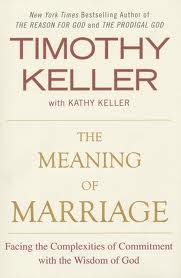
I ended the last post asking “What does love have to be if it’s something I can promise?” How is it different than the poetic love that Kierkegaard is speaking of? In this post I’ll lay out three differences between poetic and covenantal love, largely drawn from Keller’s The Meaning of Marriage.
1. More Action than Emotion – If poetic love is primarily an affair of the emotions that just sweeps you up in a passion, covenantal love is primarily an action. Paul assumes this when commands husbands to love their wives. (Eph 5:25) You can’t command feelings, but you can command activities. Saying “I love you” or “I do” with a covenantal love in view, is committing yourself to “BE” and “DO” certain things for a person. It is a decision to sacrificially commit yourself fully and wholly in loyalty to another person, putting their welfare, joy, and life above your own. When I promised to love my wife, I didn’t promise “I will always feel warm fuzzies towards you.” I promised, “I will be a husband to you–I will care, pray, show affection, be there when you need me, support you, cling to you, and will your good.”
Now, of course it does involve emotion, but often-times what I find is that these emotions can actually flow from the actions. For example, it might be a date night with my wife bit I’m tired and just want to stay home and watch TV to decompress after a long week. Making the decision to go through the trouble of getting ready, getting dressed, shaving (my neck–because neck beards are unnacceptable), and getting in the car when I don’t really feel like it, surprisingly can lead towards actually feeling like it. The loving action stirs up my loving emotion so by the time we’re on the road, I’m actually excited for the night out with my wife. That’s a microcosm of what can happen in marriage as a whole, when the decision to act in loving ways is made independent of a current emotional basis, the emotion often follows.
2. Other-centered not Self-centered – The next difference is what love is centered on. Aside from the fact that it’s unstable, our culture’s understanding of love is essentially self-centered. It’s consumeristic in that it basically says, “As long as you fulfill me, please me, tickle my fancy, then I’m here. As soon as the buzz fades, I leave.” If love is primarily about an emotion felt, then you only ‘love’ the person when they are producing feelings in you. Actually, that’s why you’re loving them. The point is, in this view, love is a potent emotion that the other person inspires in you because of what they do for you, who they are–it’s primarily a selfish experience about you, your wants, your desires.
By contrast, in the Bible love is not primarily about what I get out of the person or what I feel about the person, but about what I am willing to give to the person. Am I willing to give them time, faithfulness, exclusivity? I know how much I love someone by how much I am willing to put their needs ahead of my own, not necessarily how much I “feel” about them. In consumer love, the self is placed before the relationship: the point is you’re in it to get something out of it. In covenant love, the relationship is placed before the self. In fact, the point is, covenant love is a union where I so identify myself with you, that your needs become my needs, your wants are my wants even when they’re not what I personally want. I am so bound to you that I desire to serve you just like I serve me. Covenant love doesn’t tally. It doesn’t keep records because when I give to you, in love I have identified your needs as my own. Now, how beautiful is this? Two people who have so placed the needstrying to sacrifice, two people trying to out-serve each other, two people out for each other’s joy instead of two people out for their own joy.
3. Vertical v. Horizontal– This brings us to the final difference. If love is primarily an emotional thing, if the reason I go to the other, serve, the other, etc. give emotion to the other is because of the way we make each other feel, then this is essentially a consumer transaction. We are paying each other in warm fuzzies. If that’s the case, then it makes sense to think about marriage as basically something that’s just happening between you and your spouse and to be honest, I don’t know if that’s going to work out for very long. Unfortunately, in most marriages there comes a time when I just can’t say, “I love you” because I don’t feel it. In the hardness of my heart, I’m going to be tempted to say, “You’re not worth it” or “I just don’t have the strength.”
This is where Kierkegaard’s “love transformed by the eternal” comes into play–what if love was not just between two people, but between two people and God? See, when we promise, when we say “I do”, we’re promising God not our spouse. So, when I’m serving my wife, I’m serving my God. When I’m loving my wife, I’m loving God. I can’t separate the two. Of course, the inverse means that to break faith with spouse is to break faith with God at the same time. This is at the core of why God has something to say about divorce and marriage–as a covenant partner it is His business.
At first this sounds threatening, but in reality, it should be encouraging. If it’s not just me and the sinner I married, then I have a shot. When that day comes when you look at your spouse and you, in the hardness of your heart, might say, “You’re not worth this”–putting my relationship in the context of my relationship with God gives me the strength to love when it’s hard, stick it out when it’s painful, and be faithful anyways. When it’s not just me and another sinner trying to tell each other we’re worth it, it’s a lot easier: Why? Because God is always worth it. Even more than that, it’s not just me and another sinner trying to pull this off on our own strength. If you understand that love has a vertical dimension to it, it means that you can call on God to sustain your love. He has a vested interest in this because ultimately, at the core of who God is and what God has done is the reality covenantal love.
Good News, There is Love
This is something we cannot let our hearts forget: the Gospel is a story about covenantal love. Since we live our lives, and even our marriages, out of the stories we tell ourselves, we need to remind ourselves daily that there is story above all stories–a true story about one, Jesus Christ, who saw his bride and said, “It’s not about me.” He was not drawn to her because she was so awesome that she created all kinds of warm feelings in him out of her own worthiness. Instead, He decided to love her despite her unworthiness. He decided to bind himself and make a covenant with her; to put her needs ahead of His own; to serve her and not himself; to give rather than receive; to be trustworthy and faithful when she was untrustworthy and faithless; to unite himself with her so much that her needs became his needs, and her sins became his sins, and in order to keep the covenant, her death became his death, so that His life could be her life. It is this story that needs to set the framework within which we understand love and marriage. Once again, as in all things, the Gospel of a God who proves his own covenantal love for us in the death of Christ for sinners changes everything. (Rom 5:8)
Sadly, everybody remembers her as Kierkegaard’s fiance and not the wife of her husband…that guy.
February is here and love is in the air–or maybe that’s packaged chocolates and commercial opportunity. In either case, the subject of love and romance will be coming up again, which is why I must once more bring up my favorite philosopher: Soren Kierkegaard.
For those of you who know a little of his biography, he seems an odd choice to turn to on the subject of love–he was one of my philosophers who failed at it. Tragically he broke off his engagement with the lovely Regine Olsen because he felt his depressive melancholy made him unsuitable as a husband. What could we possibly learn from him about love?
Well, for one thing, he’s experienced at failure, so that gives you some insight. Still, Kierkegaard, for all of his Danish weirdness, has this going for him: he’s easily one of the most biblical, prophetic thinkers of the modern period. Under both his own name, and through pseudonyms, he made it his aim to present Christianity anew, true Christianity, with force to a culture that thought it already understood it.
Works of Love and La Dispute In his Works of Love he turns his meditations to the biblical concept of love. The first half is an extended exploration of the command to “love your neighbor as yourself” (Matt. 22:39). The piece that captured my attention was the focus he gives to the “you shall” in Jesus’ command–the fact that Jesus commands love at all. Kierkegaard emphasizes, “You shall love–this, then, is the word of the royal law.” Again, “the mark of Christian love and its distinguishing characteristic is this, that it contains the apparent contradiction: to love is a duty.” (pg. 40) Later he writes, “Only when it is a duty to love, only then is love eternally secured against every change, eternally made free in blessed independence, eternally and happily secured against despair.” (pg. 44)
Against the popular, romantic “poetic” conception of love that dominated the intellectual scene of his day, Kierkegaard pressed the idea that the highest form of love was not the “spontaneous”, sudden, seizing form of love that sweeps over a couple of lovers, but rather love as duty–love as something secured by the eternal, the command of God. The love of the lovers is beautiful, yes, but it is fleeting–it can change. Even if it lasts, it’s not to be trusted entirely. It can leave. La Dispute gives us one of the best, contemporary expressions of this kind of love on their album, “Somewhere At The Bottom Of The River Between Vega And Altair“, exploring the dynamics of a failed marriage, rent asunder by the wife’s affair.
Speaking in the aftermath, the wife sings, “I know I tore two worlds apart but I can’t change the way I felt./Love swept in like a storm and ripped the hinges from the doors./Love poured in like a flood, I couldn’t stop it anymore. I will not be drowned” (Sad Prayers for Guilty Bodies), or, even more poignantly:
Oh husband, I could not control it Husband, I could not abstain One cannot stop the wind from blowing Nor refuse the falling rain Love stirred up a storm inside me Wrapped its arms around my waist I failed you dear, I’m sorry, oh I’m sorry There was nothing I could do No, there was nothing I could Sure as the rain will fall Some love just fails without reason
Poetic love is that inherently unstable, emotional chaos that sweeps over us with great passion, and apparently can leave us as quickly. Matt Chandler calls this the “naked angel in a diaper” theory where basically, at any point, cupid can show up and strike you. It has no rhyme or reason, like the blowing of the wind or the falling rain.
Kierkegaard points out that the poets instinctively know this; note how often their lovers swear, make promises, and bind themselves to each other in their love. Still, if they only swear by themselves, it is an insecure promise because humans are changeable, unstable. Only when you swear by something higher, something eternal, duty, God himself, can love be something secure. “The love which simply exists, however fortunate, however blissful, however satisfying, however poetic it is, still must survive the test of the years. But the love which has undergone the transformation of the eternal by becoming duty has won continuity.” (pg. 47)
Kierkegaard, Keller, and Covenant Love Kierkegaard was pointing his culture to a love “transformed by the eternal”: covenantal love. When we hear the word “covenant” today, we mostly don’t know what we’re dealing with. Contracts are closest thing we can imagine, but that’s far too impersonal for the biblical notion of covenant. The concept and language of covenant in the Bible is that of a legal bond, a union based on promises before God and humans of fidelity, friendship, love, exclusivity, and trust.
Now to us this “legalizing” of the relationship seems to drain all of the emotion, the passion–the love!–out of things. For moderns, it’s either love or law, not both. Tim Keller has recently pointed out that, in fact, the law, the promise, especially the marriage promise, doesn’t kill emotion and intimacy, but actually is a testimony to it and increases it. (The Meaning of Marriage, pp 84-85) Marriage–the public, binding promise–is the ultimate expression of romantic love because its the giving of the whole self. Someone who doesn’t want to eventually get married to the person they’re dating is basically saying, “I don’t love you enough to curtail my freedom for you.” How intimate. Ultimately, only when romantic love is set within the framework of a binding obligation do the lovers truly have space to reveal their true selves, without fear of abandonment or rejection. Until then, you’re still on the performance platform, constantly under pressure to put your best foot forward to make sure the other person doesn’t bolt. Ironically, only when you give up your “freedom”, your romantic autonomy, are you able to be truly free to be with the other.
Love, it turns out, hangs on a promise.
So what does love have to be if it’s something I can promise? How is it different than the poetic love that Kierkegaard is speaking of? In my next post, I’ll lay out more clearly the difference between this covenant love and the poetic love.
One of my college students worked up a piece for the rest of my college group analyzing and summarizing Martin Luther’s instructions on prayer to his barber, Master Peter. I figured I’d post it here for easy access and to bless the blog-readers as well. Also, I’m really proud of him.
Learning Prayer through a Letter from Martin Luther to His Barber
By Matt Poblenz
Many people think that liturgy stifles spiritual growth, but Martin Luther believed differently. In Luther’s letter to his barber (Peter), we see how he views liturgy and bible reading in conjunction to, what he deems one of the most important disciplines, prayer. Luther starts off his letter with a quick prayer for his recipient, that “our dear Lord grant to you and everybody to do it (prayer) better than I!” This petition not only shows the importance of prayer to Luther, but this transitions him into his opening statements about prayer.
Before, Luther walks Peter (and us) through prayer step by step, he has some remarks about prayer. The main subject, in these opening remarks is the importance of prayer. Luther believes “it is a good thing to let prayer be the first business of the morning and the last at night.” He also instructs to guard yourself from business or ideas that can cause us to be distracted from prayer. Furthermore, he offers up two places to prayer: a quiet solitary place (for Luther his room), and a gathering of believers meeting to worship (for Luther Church during service). The places Luther suggests help limit the pacing ideas or business that can distract us from prayer.
Luther does admit that there will be causes of emergency when the Lord’s work may have to come before a chance to pray. But, Luther instructs that in these cases we be mindful of God’s word and turn our action into prayer through the act of blessing. Likewise, Luther encourages us to meditate on our prayer and corresponding scripture through out the day and because “one must unceasingly guard against sin and wrong-doing, something one cannot do unless one fears God and keeps his commandment in mind.” Luther asks that we keep a habit of prayer, because if not, “we become lax and lazy, cool and listless toward prayer.” Furthermore, “the Devil that oppresses us is not lazy or careless, and our flesh is to ready and eager to sin and is disinclined to the spirit of power.”
After his opening statements regarding the importance of prayer Luther begins his break down of prayer. He has a simple four step process for prayer. First, one must humble themselves and acknowledge their place before God; “O Heavenly Father, dear God, I am a poor unworthy sinner.” Your opening may very, but it is important to acknowledge your place and humble yourself because it prepares your heart for the rest of the prayer. You become prepared in multiple ways, because you are reminded of God’s power, beauty, and love. Luther concludes his opening, “I do not deserve to raise my eyes or hands toward you or to pray. But because you have commanded us all to pray and have promised to hear us and through your Son Jesus Christ have taught us both how and what to pray, I come to you in obedience to your word, trusting in your gracious promise.”
Second, Luther recites the passage from the bible. This part can also be a section from a catechism or a hymn, but Luther suggests use of the holy scriptures. He recites the whole passage word for word from the bible ( like the Lord’s Prayer, ten commandments, or a whole psalm). This allows structure and focus as this is what we will be praying from.
Third, Luther states a section of the passage and prays through it by expounding upon it. Luther explains his method of expounding by using the ten commandments; “I divide each commandment into four parts, as I form a garland of four strands.” He continues, “that is I think of each commandment as, first, instruction, which is really what it is intended to be, and consider what the Lord God commands of me so earnestly. Second I turn it into a thanksgiving; third, a confession; and fourth a prayer (petition).”
He gives a more specific example of his expounding methods by using the first commandment:
He firsts states his instruction; “here I consider that God expects and teaches me to trust him sincerely in all things and that it is his most earnest purpose to be my God.”
He then turns the commandment into a thanksgiving; “I give thanks for his infinite compassion by which he has come to me in such a fatherly way and unasked, unbidden, and unmerited, has offered to be my God, to care for me, and to be my comfort, guardian, help and strength in every time of need.”
Luther, then confesses his sins regarding this area; “ I confess and acknowledge my great sin and ingratitude for having so shamefully despised such sublime teachings and such a precious gift throughout my whole life, and for having fearfully provoked his wrath by countless acts of idolatry.”
Finally he petitions to God; “preserve my heart so that I shall never become forgetful and ungrateful, that I may never seek after other gods or other consolation on earth or in any creature, but cling truly and solely to you, my only God.”
After you conclude expounding upon sections of the scripture (as many as time permits or you’d like), you end the prayer with an Amen. However, make sure you speak the Amen firmly. Be confident that God has heard you: “do not leave your prayer without having said or thought, ‘very well, God has heard my prayer; this is certainty and truth.’” Luther reminds us that Amen means “this is truth” and, therefore, our Amens should be said with a conviction that what you have prayed is true.
I was talking to a buddy the other day about the benefits and drawbacks of programs like AA and NA for dealing with addiction. While there is no denying the efficacy and overall benefit of the programs, my buddy struggled with the fact that so often people in the program are trained to identify themselves with their problems. Of course, that only solidifies the addiction’s grip on our life and imagination because we live out of our perceived identities.
Paul David Tripp, again, cuts to the heart of why creating an identity beyond our problems and sins is so crucial for actually overcoming them:
In the press of everyday life, it is easy to forget who we are. As we try to replace old behaviors with new ones, it is easy to take our eyes off our status as children of God. In fact, the longer we struggle with a problem, the more likely we are to define ourselves by that problem (divorced, addicted, depressed, co-dependent, ADD). We come to believe that our problem is who we are. But while these labels may describe particular ways we struggle as sinners in a fallen world, they are not our identity! If we allow them to define us, we will live trapped within their boundaries. This is no way for a child of God to live!
There is a radical difference between saying, “I am a depressed person,” and saying, “I am a child of God ‘in Christ’ and I tend to struggle with depression.” The second statement does not pretend the war isn’t raging, but it is infused with hope. It says, “Yes, I wrestle with depression every day, but I am not alone. I do not rest on my own strength and wisdom. I have come to understand that my Creator and Savior is also my Father. I am beginning to grasp how rich I really am because of my place in his family, and I am learning to live out of the riches he has provided, rather than the poverty of the identities I used to assign myself.” It is never a waste of time to remind people of who they are in Christ. Doing so stimulates hope, courage, and faith. —Instruments in the Redeemer’s Hands, pp. 260-261
Instead of identifying ourselves primarily in terms of our struggles, the Biblical call is to constantly remember who we are in Christ and the great resources that come with being a part of the family of God. It is only as we are reshaped in light of the Gospel by the power of the Spirit that we are able to become the kind of people who, yes, struggle, but in Christ are defined by his victory, not our failure.
The other day I wrote a piece in which I outlined 3 ways Christians could reasonably disagree on what to do about helping the poor politically. It was essentially an explication of how someone could look at all of those Bible verses about helping the poor, believe them, want to put them into practice, and yet still find themselves voting against politicians and policies that attempt to enact long-term redistribution and aid to the poor via governmental programs. It was a plea for mutual understanding between economically left-leaning and right-leaning Christians, especially for the former not to assume bad-faith motives such as greed or heartlessness on the part of the latter in their voting patterns. Again, often-times these patterns are rooted in legitimate concern for the poor and a genuine difference of opinion on what is actually helpful to them.
Unfortunately, these good-faith reasons aren’t the only ones that people, even Christians, use to justify their voting, or even their giving patterns. Often-times there is a deeply un-Christian sensibility that informs our attitudes towards aid to the poor, rooted more in American, middle-class self-righteousness than in the Gospel or sound political theology. It’s easily spotted when the subject of taxes or charity comes up–certain platitudes and memes are tossed about having to do with “rights” and having “earned” our way of life, so on and so forth, implying that the poor simply deserve their lot and not our help. To a certain extent, I get it. There’s biblical warrant for connecting work with wages, property rights, etc. Still, these truths often get used to justify callousness and are turned into opportunities for spiritual-economic pride that just cut plainly against the grain of Scripture.
Now, I originally planned to write a more substantial post in which I dealt with a number of these attitudes myself, but I ran across a brilliant quote by Robert Murray M’Cheyne that about sums it up:
Now, dear Christians, some of you pray night and day to be branches of the true Vine; you pray to be made all over in the image of Christ. If so, you must be like him in giving…”Though he was rich, yet for our sakes he became poor”
Objection 1 – “My money is my own.”
Answer: Christ might have said, “My blood is my own, my life is my own”…then where should we have been?
Objection 2 – “The poor are undeserving”
Answer: Christ might have said, “The are wicked rebels…shall I lay down my life for these? I will give to the good angels.” But no, he left the ninety-nine, and came after the lost. He gave his blood for the undeserving.
Objection 3 –“The poor may abuse it.”
Answer: Christ might have said the same; yea, with far greater truth. Christ knew that thousands would trample his blood under their feet; that most would despise it; that many would make it an excuse for sinning more; yet he gave his own blood.
Oh Dear Christians! If you would be like Christ, give much, give often, give freely, to the vile and poor, the thankless and the undeserving. Christ is glorious and happy and so will you be. It is not your money I want, but your happiness. Remember his own word, “It is more blessed to give than to receive.”
Note, you may still hold that governmental redistribution of economic goods is unwise, stretches beyond the government’s actual scope of authority, and is actually unhelpful for the poor–that’s fine. But God forbid that ever bleeds into an overall attitude of disregard for the poor. Objections like these should never be at the heart of any Christian who has received and understood the Gospel. The Gospel is about a God who saves by sheer grace, giving freely of himself to the undeserving. That needs to sink down deep into our minds, our souls, and reshape the way we approach even our own heart-motives for taking the economic positions we do.
If you don’t think the government should be the main source of aid, then make sure you are giving yourself, either directly, or through a church body. If you’re arguing for what you deem to be a wiser fiscal policy, beware that any of these creeping self-righteous attitudes infect your logic and your rhetoric, especially if you’re going to talk about your Christian ethics in other areas of political concern. The bottom-line with everything is: when it comes to the poor, don’t forget the Gospel.
Note the emotional tenor conveyed by the underline and punctuation. My wife is an expressive writer.
It’s February now, so thoughts of romance and love are in the air. As I think about my sweet McKenna, I’ve realized that great moments have not been lacking in our marriage. She’s kinda the best for all sorts of reasons–one of which is her ability to constantly surprise me.
This was easily one of my favorites so far.
Admittedly I’ve only been at it a year and a half, but waking up to find this lovely little note on a Sunday morning (right before I had to get ready for church) was a humorous chance to be what I’m supposed to be as a husband–a sacrificial servant who dies to himself for the sake of his wife. (Eph. 5) And there was joy in that.
Obviously, killing one cockroach in the morning before work isn’t an extreme “death to self” moment. Yes, it was a truly GINORMOUS beast and put up a serious fight. At most though, I had to simply swallow the inconvenience of time wasted on a busy Sunday morning. Still, most of the time love looks like the little things. Yes, the dates, the romance, the big decisions, and all of the normal things that we focus on in a marriage are key, important, and foundational. And so is taking out the trash when she asks you the first time and cleaning up beard trimmings in the sink, even when you’d rather just sit down and watch TV, or read a book–without whining.
In the end, it’s through the little acts of daily faithfulness and service that we honor God in our marriages.
As we look towards Valentine’s Day this month, a word to husbands: yeah, plan out the big date. Make it romantic–you know, put on nice clothes and stuff. Buy the flowers–make ’em classy. Try going to a restaurant that doesn’t wrap its food in foil. And while you’re at it, kill a bug or two, make sure your towel isn’t on the floor, vaccum something–seek out the joy of serving her. I’m not great at this, but by the grace of God, I want to get better.
Young ministry-types like myself, especially in the Reformed tradition, are usually pretty concerned about the quality of their preaching. We study, we prep, we exegete, we outline, and practice, making sure that our sermons are sharp, sound, and culturally-relevant (well, some of us on that last one). There’s one key piece that’s often lacking in our zealous preparation–an area that God’s been convicting me about recently–the prayer prep.
J.C. Ryle has some convicting comments on that oversight. Commenting on Mark 6:30-34, here writes:
These words are deeply instructive. They are a bright example to all ministers of the Gospel, and to all laborers in the great work of doing good to souls. All such people should daily do as the apostles did on this occasion. They should tell all their work before Christ, and ask him for advice, guidance, strength, and help.
Prayer is the main secret of success in spiritual business. It moves him who can move heaven and earth. It brings down the promised aid of the Holy Spirit, without whom the finest sermons, the clearest teaching and hardest work are all alike in vain. It is not always those who have the most eminent gifts who are most successful laborers for God. It is generally those who keep closest communion with Christ and are most constant in prayer. It is those who cry with the prophet Ezekiel, “Come from the four winds, O breath, and breathe into these slain, that they may live” (Ezekiel 37:9). It is those who follow most exactly the apostolic model, and give their “attention to prayer and the ministry of the word” (Acts 6:4). Happy is the church that has a praying as well as a preaching ministry! The question we should ask about new ministers is not merely “Can they preach well?” but “Do they pray much for their people?” –The Gospel of Mark, pg. 90
Pastors, preachers, laborers for the Gospel in all forms, the message is clear: pray. Study, prep, practice, and strive as best you can to develop yourself as a minister and counselor of the Gospel. Don’t abandon the very necessary disciplines it takes to grow into the call God has placed on your life, but realize that without prayer, you’re trying to accomplish a spiritual work by purely human effort, trying to minister the Word in a way that effectively denies the Gospel of grace you’re supposed to be preaching. Let’s be blunt and say that this is folly. Remember, salvation “depends not on human will or exertion, but on God, who has mercy.”(Rom. 9:16) Instead, pray and seek to “move him who can move heaven and earth”, and wait expectantly with faith, looking for God to breath life into dry bones. He’s done it before.






 Reformedish