Arguments Always Involve Relationships

argumentAlastair Roberts has written very interesting post, well worth your time, in defence of the Christian practice of argument or polemical discourse about the truth. In the middle of it, partially in order to help overcome the silly split we often place between reason and emotion, he makes the claim that all of our conversations have various relational dimensions to them. And then he proves it:

Discourse is always relational in character. When engaged in discourse, we are engaging in relationship with:

  1. Our selves
  2. Other persons on our ‘side’
  3. Our own positions
  4. The conversation itself
  5. Our interlocutors
  6. Our interlocutors’ positions
  7. The truth
  8. Spectators and other third parties

In order to think and reason carefully, we must ensure that every one of these relationships is healthy. Where one or more of these relationships is unhealthy—and one of these relationships is seldom unhealthy without infecting the others—our entire discourse can be damaged. The following are a few examples of ways in which each one of these relationships can be unhealthy:

  1. Pride can give rise to an unhealthy relationship with our selves, making it difficult for us to acknowledge ourselves to have been wrong, especially in public.
  2. Fear of losing the friendship of other persons on our own ‘side’ can cause us to step back from making unpopular but necessary criticisms of unhealthy beliefs that have traction in our own camp.
  3. We can over-identify with our own positions, presuming that an attack upon them is an attack upon ourselves.
  4. We can react in fear, impatience, or hostility to the way that the testing and openness of the conversation can place our certainties in question.
  5. An instinctive reaction against our interlocutors can make it difficult to hear them out carefully and charitably.
  6. Negative associations that we have established with aspects of our interlocutors’ positions (dimensions of its rhetoric, terminology, labels, etc.) can cause us to react rather than thoughtfully respond.
  7. We can react in fear to the prospect of the truth as something that can unsettle the status quo, demand our loyalty, or undermine our claims upon reality.
  8. We can allow the tensions that we have with third parties to prevent us from giving people that they recommend a careful and charitable hearing. Alternatively, we could also allow ourselves to get caught up in the stampede of the crowd on social media and fail to think about the matter that they are reacting to clearly for ourselves.

Anyone who’s been on facebook for more than about 20 minutes can recognize these dynamics. Roberts continues:

This list is very far from comprehensive. However, it should give some sense of the many fronts upon which we need to manage our relational dynamics and the affective states associated with these. The thinking process is not just a matter of machine-like logic-crunching and brainpower: it is an interpersonal and relational process and a matter of various virtues, of patience, of charity, of love, of courage, of nerve, of self-control, of trust, of hope, etc. The sharpest minds can be worse than useless when their owners lack virtue or self-control in handling their affective states.

The lack of self-control in handling affective states usually owes more to lack of training than to vice. I have commented on various occasions upon the ways in which much of our education fails to prepare us for the real world situations where the relational character of healthy and clear thinking proves most challenging. In consequence, many people—even those with advanced education—lack the capacity to think well under pressure or to manage the relational dynamics that shape their thinking (dynamics of which many are entirely unaware).

In the rest of the post, he goes on to analyze more dimensions to the reality of argument and to defend it as a practice and our need to develop the emotional and intellectual resources to deal with it.

Again, I cannot recommend it enough. Indeed, this whole post is designed simply to tempt you to read it. Right here. Or again, I’m going to link it here.  Or, if you missed that, you can go ahead and read the whole article here.

Soli Deo Gloria
Read a Chapter Between Chapters

Insert stock Bible image here.

Insert stock Bible image here.

Obviously, I’m a fan of books. I always have been and I always will. Ever since I got the call to ministry, those books have tended to be about theology and the Scriptures, and that only intensified once I got to seminary. Systematic theology, biblical studies, commentaries, and works of Christian history litter the floors of my office, bursting off of the shelves I have for them (also, I need to clean up a bit). Those books have shaped me, grown, and deepened my knowledge of the Bible, the gospel, and God himself. One of the sad quirks of becoming a student of theology and the Bible, though, is that you can actually end up losing your drive to read the Bible itself.

Somewhere in the rush to consume as many studies on Paul as you can afford, you begin to realize, “When was the last time I really just sat and read through Paul?”  I mean, I still read a couple chapters of my Bible for a daily devotional, but there’s a point where I realized the proportion of pages of Scripture compared to pages about Scripture, got wildly out of hand.  I’m fairly sure I’m not the only one this has happened to.

Now, to be fair, when you become a student of the Scriptures, to some degree it makes sense to do a bunch of reading in commentaries, studies, and so forth. In order to really get at the depths of a particular text or settle the meaning of a particular difficult verse that takes about 15 words, you may have to read 30 or 40 pages. Still, lately I’ve been convicted that I need to start tipping the balance back, if not completely in the other direction, at least more than it currently is.

So, I’ve come up with a very simple plan. I’m going to try to go on a “chapter between chapters” plan. In other words, on top of my daily, morning reading, after every chapter I read in work of theology or biblical studies, I’m going to pop open my Bible and read a chapter there too. Obviously, the chapters in my theology texts are going to be much longer than the biblical chapters, but this is a fairly straightforward way of ensuring that I’m engaged in the Biblical text throughout the whole of my day alongside my broader theological studies, not simply during sermon prep or those special little chunks of devotional time.

Which books will I read in particular? Well, I suppose I’m going to start with the four gospels. Recently, Mark Labberton mentioned that for a great many years he’s made it a practice to, whatever else he was studying, make sure he was reading at least one of the Gospels. While all of Scripture testifies to Christ, looking clearly at his person, his way of speaking and engaging with his followers and outsiders in the Gospels ought to be formative in the lives of his disciples. That sounds like wisdom to me.

Am I saying that everyone else needs to do this? Not really. But I figured if you’re like me and you want to find ways to dip into Scripture more, it might help to have a plan. A chapter between chapters just might be it.

Soli Deo Gloria


The Scandal of the Untameable ‘I AM’

Jesus had a habit of scandalizing the moralistic types of his day. Sometimes he went out of his way to press in on their tidy interpretations of the Sabbath by healing those in need on the Sabbath (Luke 6; John 9). Other times, he associated with sinners who any truly holy man would shun (Luke 7:39). Still further, Jesus claimed prerogatives that seemed to go beyond the authority of any mere man, even a would-be messiah. Nobody could forgive sins but God alone (Mark 2:7). And who can take authority over God’s house but God himself (Luke 19:44-20:2)?

Nothing offended first-century religious sensibilities more than Jesus’s extravagant, explicit claims for himself. Jesus claimed the “Son gives life to whomever he wishes” (John 5:26), that “I and the Father are one” (John 10:30), and “No one can know the Father except through the Son” (Matt. 11:27). Easily the most startling of these of these pronouncements was his bold claim in the face of his critics, “Before Abraham was ‘I AM’” (John 8:58), for which the crowd picked up stones to execute him.

The crowds knew that by claiming this name, Jesus identified himself with the divine name “I AM” (Yahweh, or the LORD), the covenant God of Israel, revealed to Moses at the burning bush (Ex. 3). When God revealed his name to Moses, he said that the peole would know him forever by this name (Ex. 3:15). By this name they would know the one who saved them, that the commands of God would be authorized (Ex. 20:1; 18; Lev. 1:2; Num. 5:1-2). It was scandalous for Jesus to take this name because a “sinful” mortal had identified himself with the holy, perfect God of Israel. If he wasn’t right, he was blaspheming.

We know Jesus backed up his talk. When the Father raised the Son in the power of the Spirit (Rom. 1:4; 1 Tim. 3:16), he was fully vindicated in all of his claims, established as the true LORD of the world, and yes, proven to be the eternal Son of the Father. So, after a couple thousand years of church history, some councils, creeds, and confessions, the scandal of these words has somewhat dissipated.

But for many today, it seems that Jesus’s confession still scandalizes our reigning moral sensibilities.

You can read the rest of this article and learn what the new “Modern Scandal” of the I AM is at The Gospel Coalition.

Soli Deo Gloria

Predicting the Moral Weather 16 Centuries Early

crowdContinuing his defense of Christ against the charges of the pagans who attribute the fall of Rome to abandoning, the old Roman gods, in Book II chapter 20 Augustine takes a brief chapter to discuss the preferred moral ethos of the pagan critics. As I read his, obviously unsympathetic, exposition of the “kind of felicity the opponents of Christianity wish to enjoy”, as the title of the chapter goes, I couldn’t help but note the numerous parallels to be found in the reigning ethos of our contemporary, capitalist, liberal (in the classic and modern sense), democratic culture. At the heart of Augustine’s critique is how little they care about the actual moral character of their citizens. As long as they are materially okay and everyone is broadly freed to do whatever they want, then they’ll be happy.

What I’d like to simply do is quote and then comment, drawing out links to the present.

‘So long as it lasts,’ they say, ‘so long as it enjoys material prosperity, and the glory of victorious war, or, better, the security of piece, why should we worry?

I mean, right off the bat: material prosperity, military victory, and peace. What’s more American than that?

What concerns us is that we should get richer all the time, to have enough for extravagant spending every day, enough to keep our inferiors in their place. It is all right for the poor to serve the rich, so as to get enough to eat and to enjoy a lazy life under their patronage; while the rich make sue of the poor to ensure a crowd of hangers-on to minister to their pride;

An increasing gap between rich and poor, with varying responses to the problem, at once sounding like liberal and conservative solutions to the problem.

if the people applaud those who supply them with pleasures rather than those who offer salutary advice;

There are any number of examples here but can we stop and think for a minute about the glorification of celebrity culture for a minute? Name the last ethicist who got serious air-time or public accolades? Now, how many film, TV, and music awards shows do we have every year?

if no one imposes disagreeable duties, or forbids perverted delights;

Self-explanatory, but we are not a responsibility culture. We are a culture of personal freedom and autonomy that extends in all directions. Well, as long as nobody messes with each other’s stuff:

if kings are interested not in the morality but the docility of their subjects; if provinces are under rulers who are regarded not as directors of conduct but as controllers of material things and providers of material satisfactions, and are treated with servile fear instead of sincere respect.

Here we begin to get into those features of modern culture caught up with our differing conception of the role of government, but it’s been a long time since we’ve understood it as an instrument of moral formation for our society. Governments are increasingly seen as referees making sure nobody plays too rough.  Governmental respect is low, but as long as we fear its power.

The laws should punish offences against another’s property, not offences against a mans own personal character. No one should be brought to trial except for an offence, or threat of offence, against another’s proper, house, or person; but anyone should be free to do as he likes about his own, or with his won, or with others, if they consent.

Again, the assumption that the character of the citizenry is a moral concern of government is gone–and there’s something inevitable about that when you’re trying to manage a pluralistic culture. Still, minimalistic, consent-based moralities are increasingly seen as the norm to which we should be aspiring.

There should be plentiful supply of public prostitutes, for the benefit of all those who prefer them, and especially for those who cannot keep private mistresses.

Don’t mess with my porn, bro.

It is a good thing to have imposing houses luxuriously furnished, where lavish banquets can be held, where people can, if they like, spend night and day in debauchery, and eat and drink till they are sick; to have the din of dancing everywhere, and theatres full of fevered shouts of degenerate pleasure and every kind of cruel and degraded indulgence.

Luxury and opulence are not an object of reproach. The idea that certain forms of financial extravagance are obscene–that there even is such a thing as financial extravagance–is for communists. Various forms of gluttony, both of the garden-variety or the more delicate tastes of the foodie class, binge-drinking, and so forth, can be noted to be on the rise.

Most interesting is the reaction of the mob against anybody who raises a protest:

Anyone who disapproves of this kind of happiness should rank as a public enemy: anyone who attempts to change it or get rid of it should be hustled out of hearing by the freedom-loving majority; he should be kicked out, and removed from the land of the living.

If this sound unfamiliar to you, then you haven’t been paying attention to the drift of most public discourse over the last few years. Obviously, the rhetoric is a bit soaring, but the fact of the matter is that dissent from the partyline on the nature of freedom, autonomy, and so forth is increasingly marginalized and given no space in academic forums and eventually the public square.

Finally, the idolatrous root is arrived at.

We should reckon the true gods to be those who see that the people get this happiness and then preserve it for them. Then let them be worshipped as they wish, let them demand what shows they like, so that they can enjoy them with their devotees, or, at least, receive them from their worshippers. All the gods have to do is ensure that there is no threat to this happiness from enemies, or plagues, or any other disasters.’

Whether it’s the hands-off god of Moralistic Therapeutic Deism that only wants us to be happy or just your more average cultural deification of created goods, we trust the “gods” who promise to give us these basic ultimate values. We will serve whatever god serves us best.

Obviously, this is all a bit dark and pessimistic. It’s an evaluation that needs to be paired with Augustine’s underlying confidence and hope for history because of the work of Christ. Still, the moral insight is prescient, revealing a pattern, a tapestry that seems to be reweaving itself before our very eyes. Of course, it wasn’t the end of the Church then and, though in post-Christendom we face a somewhat different challenge, it won’t be now. Still, it’s good to recognize the pattern for what it is–its interconnections and precedents.

Soli Deo Gloria

A Prayer for My Niece, Siena Joy Stewart on the Day of Her Birth

Siena Joy Stewart. My precious niece.

Siena Joy Stewart. My precious niece.

My sister Valerie and her husband Shawn are two of my favorite people on the planet. So far, they have produced another one of my favorite humans, my nephew Jack. At 2:36 pm, after many hours of heroic labor, my sister gave birth to a little girl (20.5 in; 7 lb 11 oz.) who I’m quite convinced I’m going to be a big fan of: Siena Joy Stewart. Yes, she was a week late, but I’m sure that’s just a matter of the extra quality in preparation involved. She’s going to be a very special young woman.

When Jack was born, I wrote him a prayer because I realized, besides smashing cars with him, prayer is probably my main responsibility towards him. I’m going to do the same for Siena. My wife and I have been praying for her daily for some months now and I’m sure there are years of prayer to come, but these are just a few hopes and dreams, blessings and pronouncements on her.

Holy Father, thank you for your many gifts. Thank you specifically for this new blessing of a wonderful little girl, Siena Joy. Thank you for your providence that has brought her to us. Thank you for this grace on the life of Shawn and Val as parents. I anticipate that we will not stop giving thanks to you for her all of our days.

Thank you, gracious God, for the promise contained in her name for who this little girl will be one day. Already she is a deep joy to her family. I do pray that you make that a continuing reality. That Siena Joy would fill the lives of all she knows with that deep, cavernous joy that comes with being in the presence of one graced with the gifts of God. I also pray that she would live into her name, “Siena”, whose character reflects that warm, earthy depth of her mother and father.

Beyond that, I want to pray some specific things for her.

Salvation. As I prayed for Jack, God, you are her maker, I pray that you would become her Father in Christ; adopt her by your grace. Let her come to repent and believe the Gospel early and deeply, be united by faith to Christ, and given the gift of your Spirit. I pray that someday quite soon she could answer Heidelberg’s first question, “What is your only comfort in life and in death?” with the proper answer, from the heart:

“That I am not my own, but I belong– body and soul, in life and in death–to my faithful Savior Jesus Christ. He has fully paid for all my sins with his precious blood and has set me free from the tyranny of the devil. He also watches over me in such a way that not a hair can fall from my head without the will of my Father in heaven:  in fact, all things must work together for my salvation. Because I belong to him, Christ, by his Holy Spirit, assures me of eternal life and makes me wholeheartedly willing and ready from now on to live for him.”

Father, as much as I love having her as a niece, I want her as my little sister in Christ. Let this be the reality that forms the core of who she is.

Courage. It takes courage to follow the call to whole personhood out in a world broken by sin and evil. I pray that Siena Joy would be marked with a fearlessness that is grounded in her assurance that her heavenly Father is for her and keeps watch over all her steps as she seeks to follow you.

Mercy. We live in a graceless culture where judgment consistently triumphs over mercy. I pray that Siena Joy would be a woman of great mercy, whose tender heart towards the broken and afflicted by sin would be a sweet balm that blesses all she meets.

Holiness. Please, Father, set her apart. Set her apart all the days of her life, so that her life may shine with the beauty and glory of holiness. But not a holiness that keeps its distance, but the contagious holiness the draws others in to your arms of grace.

Insight. Give Siena insight by the Spirit–eyes to truly see. Give her vision through the veil of lies and deception that so often clouds the eyes of the heart and stops us from beholding your untamed goodness. May she live with a vision of her God, the whole of her life.

Assurance. May this vision then give her assurance. Both of her salvation, but also of her calling to glorify you in all the particular gifts that you have graced her with. She has been fearfully and wonderfully made, with eternal purposes in mind. May she plant her feet firmly and step forward in confident assurance.

Hope. May this assurance be the substance of a deeply hopeful character. I have no idea what our world holds, but I pray that Siena Joy would look forward and know that her future is determined, not by the powers of the world, but by the mighty, gracious power of her Lord Jesus Christ.

I ask these things with great faith and anticipation, grateful in advance for what you’re going to do, in the Name of Jesus, Amen.

Soli Deo Gloria

Retrieval–It’s What All The Hip Reformed Catholic Kids Do

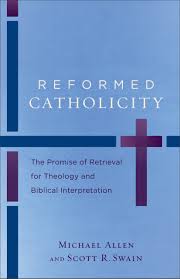
reformed catholicityThe theological hills are alive with the sound of “retrieval”–the idea that theology can only go forward if it begins by looking backward to the tradition that maintained and fed the faith that came before it. Whether it’s looking back to the Fathers, or Thomas, or the early Reformed tradition, across the denomination divides, theologians are increasingly explicit about their necessary dependence on the theology of their forebears, whether in the Creed, Counsels, or Confessions. In his section arguing for the importance of recovering traditioned thought in The Drama of Doctrine, Kevin Vanhoozer listed a number of reasons (Biblical, traditional, philosophical, inevitable, and spiritual), but among them was the fact that it was “fashionable” (pg. 158), by which he meant supported by contemporary movements in literary theory.

In other words, all the cool kids are doing it.

I was reminded of this point as I opened Michael Allen and Scott Swain’s little volume Reformed Catholicity: The Promise of Retrieval for Theology and Biblical Interpretation. Part of their project is making the case for a Reformed iteration of this movement that appreciates the traditional shape of even Protestant practices like Sola Scriptura, which commonly is interpreted as precluding this sort of activity. In order to set the stage for their own project, though, they begin by compiling and briefly describing a fascinating list of recent movements in theology that have set the stage, or contributed to the revival of retrieval in theology (pp. 4-12). I thought it might be useful to briefly summarize their summary and comment on their summary list.

  1. Nouvelle Theologie. Earlier in the 20th Century a bunch of Roman Catholic theologians like De Lubac and Congar led the way in trying to reappropriate patristic and biblical theology for systematics, sacramental theology, and liturgical practice. Much of this theology set the stage for the developments of Vatican II.
  2. Karl Barth. Barth’s Church Dogmatics did many things, but one of the big long-term effects it had was reviving the discipline of dogmatics in theology, drawing heavily as it did on patristic and Reformational sources.
  3. Reception History. Plenty of Biblical scholars like working with the historical context of the text, but there’s a big movement to do work on compiling commentaries or studies on the historical reception of texts. In other words, not just asking “how ought we read it?”, but asking “how has it been read in the past?” in order answer the former.
  4. Donald Bloesch and “Consensual Christianity.” Bloesch was a UCC theologian who tried to develop a “consensual” Christianity based on the witness of Holy Scripture and the Church’s tradition as a cross-denominational resource for the Church
  5. Thomas Oden’s “Paleo-Orthodoxy.” Thomas Oden’s conversion from liberal, Protestantism to a sort of “paleo-orthodoxy”, a “pastiche” of patristic and Protestant theology is an approach towards a “consensual Christianity.” He has also headed up the Ancient Christian Commentary on Scripture series in order to facilitate this sort of scholarship and spirituality as well.
  6. Robert Webber’s Ancient-Future Christianity. Webber has written various works and developed a number of ministries devoted to helping Evangelicals tap in the Christian past for the sake of engaging postmodern culture in worship and evangelism.
  7. The Modern Hymn Movement. Reformed and Presbyterian churches and ministries like RUF, Indelible Grace, and Keith and Kristyn Getty have been retooling classic hymns and developing new ones for revived congregational worship.
  8. Carl Braaten and Robert Jenson’s Evangelical Catholicism. From within the Lutheran tradition, Braaten and Jenson have been trying to focus the church on classical resources as a way forward for the ecumenical conversation and the strength of the church. To that end, they launched the Center for Catholic and Evangelical Theology, begin the journal Pro Ecclesia, and published a number of influential volumes in that vein. Allen and Swain note, though, that while Bloesch and Oden’s retrieval ends up looking like pretty standard classical theism, Jenson and others have still engaged in quite a bit of theological reconstruction, showing the retrieval doesn’t only lead to repetition.
  9. Theological Interpretation of Scripture. One big movement afoot is the drive towards theological exegesis”, or reading Scripture to do theology and not just historical or textual criticism. To that end, a lot of theoretical ink has been spilled, but a number of good theological commentary series have begun as well.
  10. Radical Orthodoxy. The movement by theologians like Catherine Pickstock, Graham Ward, and John Milbank, to reappropriate a sort of Christian Platonism in order to combat the decline of the Church, leans heavily on the idea of retrieval, even if it has been often criticized for its idiosyncratic and problematic readings of the history it’s attempting to retrieve.
  11. Evangelical Ressourcement. Evangelicals are getting in on the fun too. D.H. Williams has been arguing for recovering the early church as a theological resource and Hans Boersma has been even more specific in advocating a particular sacramental ontology, mostly drawing on the Nouvelle Theologie of Roman Catholic theologians.
  12. The Emerging or Emergent Church(es). Whatever their problems have been, the emerging or emergent movement did have an emphasis on retrieving the various insights, texts, and practices of the Christian past to meet the postmodern future. Of course, this played out differently for various kinds of emerging or emergent churches.
  13. Ressourcement Thomism. Thomism is the gift that keeps on giving. At least, that’s what a number of recent Roman Catholic theologians like Matthew Levering, Gilles Emery, and Reinhard Hutter have been arguing. Engaging with movements in biblical studies, systematics, and philosophical movements, these theologians have been making the case that Thomas still has something to say to the modern church.

As I read Allen and Swain’s list, I was fascinated to note how many of the movement and theologians had their effects on my own journey. When I was young in theology, the emergent conversation was in full swing and so the talk of appealing to tradition was definitely in the air. Thankfully reading some Pelikan and Vanhoozer showed me early that it could be done while keeping your Orthodox and Evangelical wits about you. In philosophy, MacIntyre’s work in After Virtue and Whose Justice? Which Rationality? had its effect as well. Oden and Bloesch are sitting on my shelf, duly marked up, as well as some Barth, Boersma, and Jenson. I suppose my early classes in the history of philosophy had their effect as well. It’s hard to take a whole class on Augustine’s thought and believe him irrelevant to any theological conversation. This is also largely the impulse behind my big reading projects.

Beyond this personal reflection, though, a few things are worth noting about this list.

First, retrieval is an ecumenical endeavor. Theologians across the major traditions, both Catholic and Protestant, are well-represented. Although, one important absence ought to be noted and that is the names of any Eastern Orthodox theologians. The burgeoning awareness of Eastern Orthodox theology has definitely spurred on the movement towards engagement with the Fathers on the part of Western theologians.

Second, retrieval is not a monolith. As already noted with the case of Jenson and someone like Oden, two theologians may be committed to the project and yet their engagement may yield wildly diverging judgments on something like the doctrine of God. What’s more, since it is an ecumenical endeavor with a catholic spirit, it will inevitably bear diverse fruits as theologians approach the catholic tradition from within their own ecclesiastic locations.

Third, and connected to the second, retrieval theology need not yield theological sterility. Some of the most creative theological minds of the 20th Century are included in that brief summary. Indeed, when think of some of the work being done in the Theological Interpretation of Scripture, some of the brightest of our own very young century are those looking back to the wisdom of yesteryear through figural and typological readings. Many have ended up breaking the modern, interpretive mold in the process.

Finally, retrieval can be quite practical. Indeed, most of the movements and theologians mentioned are quite heavily involved with the cause of church renewal within their respective communions. Looking to the past is not simply done for the sake of dry antiquarianism, but for the life of the Church in the world today. In other words, it’s not only done to preserve the memory of the victories of church triumphant, but for the battles the church militant is currently embroiled in.

Now the question is, what exactly will Allen and Swain contribute to the discussion? I suppose I’ll just have to keep reading to find out. I’d suggest that many of you consider doing the same. You can purchase the book here.

Soli Deo Gloria

Christmas: Thus God and Man are United in Christ. Thus, in Christ, we Possess God.

christ childThe heart of the Christmas message is that there, lying in the manger, lies God in human flesh. In a word, then, Christmas is about the Chalcedonian Definition (451 A.D), or rather, the other way round. If you’ve never read it, here it is:

Therefore, following the holy fathers, we all with one accord teach men to acknowledge one and the same Son, our Lord Jesus Christ, at once complete in Godhead and complete in manhood, truly God and truly man, consisting also of a reasonable soul and body; of one substance with the Father as regards his Godhead, and at the same time of one substance with us as regards his manhood; like us in all respects, apart from sin; as regards his Godhead, begotten of the Father before the ages, but yet as regards his manhood begotten, for us men and for our salvation, of Mary the Virgin, the God-bearer; one and the same Christ, Son, Lord, Only-begotten, recognized in two natures, without confusion, without change, without division, without separation; the distinction of natures being in no way annulled by the union, but rather the characteristics of each nature being preserved and coming together to form one person and subsistence, not as parted or separated into two persons, but one and the same Son and Only-begotten God the Word, Lord Jesus Christ; even as the prophets from earliest times spoke of him, and our Lord Jesus Christ himself taught us, and the creed of the fathers has handed down to us.

As technically precise as it is, many have questioned and wondered whether in defining, or at least laying down some boundaries for how to think about Christ, the Fathers have departed from the simpler, or clearer language of Scripture. The worry is that in the process of parsing of things metaphysically, through the conceptualities of Greek philosophy and terminology, the Biblical Gospel has been lost.

Herman Bavinck answers this sort of charge at length, beautifully summarizing his findings in this brief passage:

Thus God and man are united in Christ. While Scripture does not speak the language of the later theology, materially it contains what the Christian church confesses in its doctrine of the two natures…For according to Scripture, the Word that was with God and was himself God became flesh (John 1:14). He who was the reflection of God’s glory and the exact imprint of God’s very being has become partaker in our flesh and blood and like us in all things (Heb. 1:3; 2:14). God sent his own Son into the world, who was born of a woman (Gal. 4:4). Though existing in “the form of God,” he “emptied himself, taking the form of a slave” (Phil. 2:7). From the fathers, according to the flesh (κατα σαρκα), comes the Messiah, who is over all, God blessed forever (Rom. 9:5). Though the image of the invisible God, the firstborn of all creation, he is nevertheless also the firstborn from the dead (Col. 1:13–18); though son of David, he is simultaneously David’s Lord (Matt. 22:43); even though walking about on earth, he still continues to be “in the bosom of the Father” (John 1:18), “the one who is in heaven” (John 3:13), and existed before Abraham was (John 8:58); in a word, the fullness of deity dwells in him bodily (σωματικως, Col. 2:9). Every moment in Scripture, divine as well as human predicates are attributed to the same personal subject: divine and human existence, omnipresence and [geographical] limitation, eternity and time, creative omnipotence and creaturely weakness. What else is this but the church’s doctrine of the two natures united in one person?

Reformed Dogmatics Volume 3: Sin and Salvation, pg. 298-299

It must not be lost to sight that all of this theologizing is done to preserve the crucial Gospel truth: it is God who is with us, to save us in Christ. Calvin comments on Matthew 1:23:

The phrase, God is with us, is no doubt frequently employed in Scripture to denote, that he is present with us by his assistance and grace, and displays the power of his hand in our defense. But here we are instructed as to the manner in which God communicates with men. For out of Christ we are alienated from him; but through Christ we are not only received into his favor, but are made one with him. When Paul says, that the Jews under the law were nigh to God, (Ephesians 2:17,) and that a deadly enmity (Ephesians 2:15) subsisted between him and the Gentiles, he means only that, by shadows and figures, God then gave to the people whom he had adopted the tokens of his presence. That promise was still in force, “The Lord thy God is among you,” (Deuteronomy 7:21,) and, “This is my rest for ever,” (Psalm 132:14.) But while the familiar intercourse between God and the people depended on a Mediator, what had not yet fully taken place was shadowed out by symbols. His seat and residence is placed “between the Cherubim,” (Psalm 80:1,) because the ark was the figure and visible pledge of his glory.

But in Christ the actual presence of God with his people, and not, as before, his shadowy presence, has been exhibited. This is the reason, why Paul says, that “in him dwelleth all the fullness of the Godhead bodily,” (Colossians 2:9.) And certainly he would not be a properly qualified Mediator, if he did not unite both natures in his person, and thus bring men into an alliance with God…

For it cannot be denied, that this name, Immanuel, contains an implied contrast between the presence of God, as exhibited in Christ, with every other kind of presence, which was manifested to the ancient people before his coming. If the reason of this name began to be actually true, when Christ appeared in the flesh, it follows that it was not completely, but only in part, that God was formerly united with the Fathers.

Hence arises another proof, that Christ is God manifested in the flesh, (1 Timothy 3:16.) He discharged, indeed, the office of Mediator from the beginning of the world; but as this depended wholly on the latest revelation, he is justly called Immanuel at that time, when clothed, as it were, with a new character, he appears in public as a Priest, to atone for the sins of men by the sacrifice of his body, to reconcile them to the Father by the price of his blood, and, in a word, to fulfill every part of the salvation of men. The first thing which we ought to consider in this name is the divine majesty of Christ, so as to yield to him the reverence which is due to the only and eternal God. But we must not, at the same time, forget the fruit which God intended that we should collect and receive from this name. For whenever we contemplate the one person of Christ as God-man, we ought to hold it for certain that, if we are united to Christ by faith, we possess God.

This is a staggering and astonishing reality. If we are united to Christ, “by faith, we possess God.” This is the mystery, the miracle, and the grace of Christmas: in Christ, God truly gives himself to sinners for their salvation and joy.

Soli Deo Gloria 

Top #Reformedish Posts of 2014

2014This was a big year for me in terms of writing. Or, at least it felt that way. Though I slowed down a bit this fall, I still think I had an overall average of about three pieces per week, most of the time pushing into the four- or five-per-week range. While most of this was for my own personal blog, a fair amount went to other sites. What I’d like to do here is simply list out my top articles of the year on my own site, the articles I think did best on others, as well as some of my own favorite to write. Sound good? Alright. (In any case, it wouldn’t matter because this is my blog and I’m going to do it anyways.)

Top Post of the Year

Far and away my most popular post of the year was a quick one I wrote for TGC:

Dating Advice You Actually Need.” At last count, it had been shared something like 19,000 times and my editor told me it passed 100,000 views a little bit ago. I tell you, it’s always the marriage and dating ones.

Top Posts on My Blog. These were the most popular things published on my blog.

1. “23 Things To Do Instead of Getting Engaged Before You’re 23” and Other Myths. This was response to that viral piece that went around earlier this year. Again, it took almost no time to write, but it was about dating and relationships, so it spread quickly.

2. A Few Words About Driscoll, William Wallace II, and Advice For Young Pastors. I wrote this after a couple of the Driscoll scandals, but before some of the later stuff came out and the implosion.

3. If Jesus is the Word of God, Can We Call the Bible the Word of God? This was a fun piece responding to a very annoying charge made against evangelical views of Scripture. I also found the creepiest image for it.

4. A Few Follow-Up Thoughts on Sneering Calvinists. I wrote a piece for TGC which will be linked below, and then I had to write this clarifying follow-up.

5. The Beauty of the Cross: 19 Objections and Answers to Penal Substitutionary Atonement. This is easily my favorite article of the year. It’s not really an article, but more of an essay. It’s probably the longest thing I’ve written since grad school and I love it.

Top Posts Elsewhere. These were the pieces I think were most popular written not on my blog. Also, my guesses here are just that: guesses. So the ranking does not matter.

1. Recovering an Engaging Doctrine of God. This was definitely not a top post in terms of page-views, but it’s probably the finest thing I’ve written all year. I kind of love this piece. It’s at the heart of what I care about most.

2. The Progressive Evangelical Package. I wrote this a few months back outlining what I took to be the “progressive Evangelical package” of positions and their underlying values. Needless to say, this proved controversial.

3. Sneering Calvinists. Lest it be said I merely troll the other side, this was a piece telling my Reformed brothers and sisters to calm down with their sneering and engage others with grace.

4. Should Evangelicals Care About Gungor’s Doubts? Michael Gungor said some things about doubt and faith and people reported on it. It was a controversy.

5. The Danger of ‘What This Really Means”. I don’t know if this is actually one of my most popular, but I think it was important on the danger interpretive suspicion in our current debates.

6.  Making the Case For Make-up: In Which Calvin Defends Lip-Gloss. Can’t be explained. Only read.

Random Favorites. And here are a few randoms I enjoyed writing that were also fairly popular.

A (Very) Brief, Gospel-Centered Defense Against the Problem of Evil

‘Plain Readings’ of Scripture, Job, and Other Assorted Thoughts on the #CalvinismDebate

Love, Hate, and A Counter-Intuitive God

Abraham, Cultural Distance, and Offering Up Our Moral Conscience

Sabbath Sticks, OT Morality, and the Jesus Tea Strainer

A Crash-Course in Revelation (Or, Reformedish Thoughts on Scripture According to Westminster)

Alright, that’s about it for now. Thanks for reading and making it a fun year, folks!

Soli Deo Gloria

“God Is My Hobby” Or, Salinger, Osteen, and Bonhoeffer Walk Into a Bar

osteenMy Franny and Zooey gleanings have been numerous. One fantastic paragraph comes in the middle of a conversation between Zooey and his mother Mrs. Glass with regards to his younger sister Franny. Mrs. Glass is worried over the apparent spiritual meltdown Franny’s having consisting of mumbling, crying, and losing appetite and sleep. After much badgering and antagonism, Zooey sets himself to enlighten his mother as to the problem with his sister and it’s connection to a little book she’s been carrying around with her. It’s a little book about the Jesus Prayer and the contemplative spiritual practice surrounding it, involving repeating the prayer “Lord Jesus, have mercy on me” over and over until it becomes a part of your heart, your breath, your very being.

The brilliant part comes in Zooey’s final response in this exchange:

Mrs. Glass took a deep drag on her cigarette, watching him, then crossed her legs
and asked, demanded, “Is that what Franny’s supposed to be doing? I mean is that what
she’s doing and all?”

“So I gather. Don’t ask me, ask her.”

There was a short pause, and a dubious one. Then Mrs. Glass abruptly and rather
pluckily asked, “How long do you have to do it?”

Zooey’s face lit up with pleasure. He turned to her. “How long?” he said. “Oh, not
long. Till the painters want to get in your room. Then a procession of saints and
bodhisattvas march in, carrying bowls of chicken broth. The Hall Johnson Choir starts up
in the background, and the cameras move in on a nice old gentleman in a loincloth
standing against a background of mountains and blue skies and white clouds, and a look
of peace comes over everybody’s—”

“All right, just stop that,” Mrs. Glass said.

“Well, Jesus. I’m only trying to help. Mercy. I don’t want you to go away with the impression that there’re any—you know—any incon-veniences involved in the religious life. I mean a lot of people don’t take it up just because they think it’s going to involve a certain amount of nasty application and perseverance—you know what I mean.” It was clear that the speaker, with patent relish, was now reaching the high point of his address. He wagged his orange stick solemnly at his mother. “As soon as we get out of the chapel here, I hope you’ll accept from me a little volume I’ve always admired. I believe it touches on some of the fine points we’ve discussed this morning. ‘God Is My Hobby.’ By Dr. Homer Vincent Claude Pierson, Jr. In this little book, I think you’ll find, Dr. Pierson tells us very clearly how when he was twenty-one years of age he started putting aside a little time each day—two minutes in the morning and two minutes at night, if I remember correctly—and at the end of the first year, just by these little informal visits with God, he increased his annual income seventy-four per cent. I believe I have an extra copy, and if you’ll be good enough—”

In the context of the broader story there’s much more going on. Still, in one paragraph, Zooey Glass’ amusingly damning little conceit about “God Is My Hobby” gets you a far better snapshot portrait of so much wrong with contemporary, American religion than any lengthy jeremiad about the Moralistic Therapeutic Deism of the Gospel of Osteenism. Here you have it in nuce: the self-satisfied, oh-so-comfortable, non-transformative commercialism of it all. And this was written in 1955, pre-TBN in all of its gold-throne glory.

I am not sure I have “gospel” application here. I wish I could even say “See, even thoughtful unbelievers see through this, so who do you think you’re fooling? Who are you drawing in by lowering the asking price on the gospel for cut-rate prices?” Because while it’s true that thoughtful  non-believers will see through it, that’s not the problem here, now is it?

I suppose it’s another excuse to exhort preachers once again to heed the words of Bonhoeffer on cheap and costly grace.

“Cheap grace means grace sold on the market like cheapjacks’ wares. The sacraments, the forgiveness of sin, and the consolations of religion are thrown away at cut prices. Grace is represented as the Church’s inexhaustible treasury, from which she showers blessings with generous hands, without asking questions or fixing limits. Grace without price; grace without cost! The essence of grace, we suppose, is that the account has been paid in advance; and, because it has been paid, everything can be had for nothing. Since the cost was infinite, the possibilities of using and spending it are infinite. What would grace be if it were not cheap?…

Cheap grace is the preaching of forgiveness without requiring repentance, baptism without church discipline, Communion without confession, absolution without personal confession. Cheap grace is grace without discipleship, grace without the cross, grace without Jesus Christ, living and incarnate.

Costly grace is the treasure hidden in the field; for the sake of it a man will go and sell all that he has. It is the pearl of great price to buy which the merchant will sell all his goods. It is the kingly rule of Christ, for whose sake a man will pluck out the eye which causes him to stumble; it is the call of Jesus Christ at which the disciple leaves his nets and follows him.

Costly grace is the gospel which must be sought again and again, the gift which must be asked for, the door at which a man must knock.

Such grace is costly because it calls us to follow, and it is grace because it calls us to follow Jesus Christ. It is costly because it costs a man his life, and it is grace because it gives a man the only true life. It is costly because it condemns sin, and grace because it justifies the sinner. Above all, it is costly because it cost God the life of his Son: “ye were bought at a price,” and what has cost God much cannot be cheap for us. Above all, it is grace because God did not reckon his Son too dear a price to pay for our life, but delivered him up for us. Costly grace is the Incarnation of God.”
― Dietrich Bonhoeffer, The Cost of Discipleship

I suppose what I’m saying is that if Osteen, Bonhoeffer walked into a bar, I know which one would have Zooey’s, or rather, Salinger’s attention.

Soli Deo Gloria

Mere Fidelity: Atonement

A few weeks ago Matt Anderson and I invited on Adam Johnson and Pascal-Emmanuel Gobry to talk about atonement. Our qualifications? Well, on our end, Anderson runs the Mere Orthodoxy site and I wrote this super-long post about penal substitutionary atonement. Adam Johnson has actually written a couple of books on the subject and teaches at Biola’s Torrey Honors program. So he’s kind of an expert. Now, Pascal, well, he’s my favorite French Catholic writer/twitter-fiend/troll on the internet right now. We debate stuff like this all the time, so we figured why not on the podcast?

So, here it is:

For more show links that I don’t feel like hassling with, go to MereOrthodoxy. They’re actually very helpful.

Soli Deo Gloria