T.S. Eliot is one of my favorite poets that I don’t read–at least not his poetry. When reading Scruton I found out he had a lecture series involving the notion of heresy, so of course I was intrigued. It took some digging to track them down though, because they had been suppressed by Eliot himself due to some unfortunately anti-Semitic content. In any case, I found them and tracked down his definition of heresy and heretics:
Furthermore, the essential of any important heresy is not simply that it is wrong: it is that it is partly right. It is characteristic of the more interesting heretics, in the context in which I use the term, that they have an exceptionally acute perception, or profound insight, of some part of the truth; an insight more important often than the inferences of those who are aware of more but less acutely aware of anything. So far as we are able to redress the balance, effect the compensation, ourselves, we may find such authors of the greatest value. If we value them as they value themselves we shall go astray. And in the present state of affairs, with the low degree of education to be expected of public and of reviewers, we are more likely to go wrong than right; we must remember too, that an heresy is apt to have a seductive simplicity, to make a direct and persuasive appeal to intellect and emotions, and to be altogether more plausible than the truth.
-Eliot, T. S., 1888-1965. After Strange Gods : A Primer of Modern Heresy; London : Faber and Faber.
In other words, heretics are usually never totally wrong. In fact, they often-times grasp a vital truth more profoundly than others, but let it distort their thought when it becomes a focal point dominating all other truths. For that reason, sometimes interacting intellectually with heretics, or distorting teachers, is helpful–albeit in a negative way. One thinks of the way that Calvin’s interactions with Osiander on the issue of union with Christ which forced him to clarify his own thought on the matter. This doesn’t excuse heresy or mean we shouldn’t strive to avoid it and cling to the truth any less. It does mean that sometimes it’s good to try and understand what motivates it in order that our orthodoxy might be all the stronger. If I can understand the repugnancy of the absolutist dogmatism that drives some towards relativism, I can learn to present truth in a more gracious and understanding manner. If I can understand what would motivate a panentheistic denial of transcendence, I can know better how to communicate the beauty of a God whose transcendence is the ground for his immanence.
In other words, in the sovereignty of God even heretics can teach us something about the truth.
Paul’s debate with the philosophers at the Areopagus remains a favorite story of mine. The Areopagus, or Mars Hill, in Athens was the cultural and intellectual center of the ancient world, so when the apostle Paul was asked to speak there on this strange new teaching about “Jesus” and “the Resurrection”, he spoke with great erudition and made an appeal for the Gospel tailored to his ‘religious’ but intellectually skeptical audience.
What We Talk About When We Talk About God is Rob Bell’s Areopagus speech.
You can read the rest of my feature review of his book HERE at Christ and Pop Culture.
Soli Deo Gloria
PS. It’s why I haven’t written anything this week and might not write much else.
Obama isn’t the most precise theologian. Nor should that be expected of him–he’s only a politician after all.
In a recent interview before the selection of the new Pope Francis, President Obama was asked about his thoughts on the incoming pope. He expressed his hope that the next Holy Father would be faithful to what he considers the “central message of the Gospel.” Admirable sentiment. I think we should all hope for a pope who loves the Gospel. The question we have to ask ourselves is: what do we mean by the Gospel? Well, according to the President it’s “that we treat everybody as children of God and that we love them the way Jesus Christ taught us to love them.”
Now, I don’t want to single out or beat up on the President, but when you have people like Andy Stanley using language about him being pastor-in-chief and what-not, his definition of the Gospel becomes culturally-important. People listen to it whether they should or not. As such it becomes a teachable moment. Being a preacher-type, I can’t help myself.
The notion of ‘culture’ has fascinated me ever since I first got my hands on Lesslie Newbigin’s The Gospel in a Pluralist Society in which he lays out his vision for engaging Western culture for the Gospel. It was around the time that the whole emergent church thing was still a thing and it seemed like everyone was talking about the shift to “postmodern” culture and what that meant. In middle of that conversation I started to realize that ‘culture’ was an important issue for evangelism, discipleship, and just ministry in general.
As I went on to read more about the issue, I found that almost everybody in the theological literature agrees that if you’re going to do ministry, then you have to understand cultural context you’re set in. Whether it’s modern culture, postmodern culture, indigenous cultures, or church cultures, ‘culture’ is everywhere and ever-so-important. Of course, this raises the issue of what exactly we mean by the term ‘culture’.
Seems like something we ought to have nailed down if we’re going to be talking about it so much.
You can almost feel the philosophy coming off of him.
Now I’ve had my own working definition of it for some time. The problem I’ve found is that, depending on the publication, author, or discipline you’re reading, everybody seems to have their own definition of it, many which seem to be at odds with each other.
This is why I was so pleased when I found that in first pages of his insightful little workModern Culture, Roger Scruton helpfully lays out three different senses of the term ‘culture’ that are typically used today:
Common – The first is what might be called ‘common’ culture. It takes its cues from Herder, whose notion of kulturindicated the unique spirit of a nation or people as opposed to zivilization which could be shared with various other nations. This, apparently, was taken up and developed by the German romantics who pointed to the idea that culture is what shapes and is found in the various songs, art, traditions of a nation. In this view, it is what is common to all the people in a nation or tribe. This means that nobody, “however ill-educated, is deprived of culture, since culture and social membership is the same idea.” (pg. 1) It is this interpretation that most of the early anthropologists and sociologists of our day work with.
High – The second is what might be called ‘high’ culture and takes its roots in a more classical understanding that is linked to the idea of culture as cultivation and virtue. It is not common to all, but must be acquired through education, which usually requires some intellect, as well as leisure and resources for study. To have culture on this view is the province of the few and the well-educated. It comes with a knowledge of the broad literary canon, an appreciation of the right sorts of music and the arts. Culture, in this view, is a sort of moral-technical expertise. This idea has been championed by literary critics such as Matthew Arnold, and later by T.S. Eliot, and of course, Scruton himself. In fact, the book as a whole should be seen as a defense of high culture. (pp. 1-2)
Pop– Scruton says that a third sort of culture has emerged recently from the battles between the two. As we noted, the idea of common culture is usually attached to a tribe or a nation, a set, identifiable grouping of people whose culture can be identified and is generally shared. One of main characteristics of the modern/postmodern world which we inhabit is the breakdown of the various tribes associated with ‘traditional society.’ (pg. 2) There are no uncontested practices, thought patterns, songs, and narratives which can be appealed to without a sense of irony. That being said, humans still have need for a sort of solid and stable identity-shaping environment just as the traditional societies gave. It is in this situation that what might be termed ‘popular’ culture emerges, as a sort of tertium quid, a third thing, both like and unlike both of the prior conceptions. Pop culture is the province of ‘cultural studies’ programs in college and is thought of by its defenders as an equally valid ‘culture of the people’. Essentially pop culture is what’s involved when the notion of high culture as something that is a feature of “choice, taste, and leisure” in the sense of cultivation is merged with the common such as pop art and entertainment. (pp. 2-3) As Scruton notes, “Any activity or artefact is considered cultural, if it is an identity-forming product of social interaction.” (pg. 3)
Of course, Scruton looks upon this last development with dismay, and, as mentioned earlier, in the rest of the work will launch a defense of high culture against any relativistic, postmodern deconstructions, or anti-elitist protests of the equal validity of popular culture.That doesn’t concern me at this point.
For Christians and ministers of the Gospel in particular, there are a number of theses I would like to simply list for reflection, without much additional comment.
While these categories are not air-tight, uncontested, or always easily-distinguishable, it’s good to have some baseline working definitions to think with, especially when you’re reading about cultural engagement. It’s helpful to know what your author is dealing with because prescriptions for one category don’t always carry into the others.
Christians should be engaged with culture at all levels. Common, high, or pop, there is no level or layer that can be ignored by ministers of the Gospel. Anything that is forming our people for good or ill, is our concern.
Accordingly, effective ministers will become students of the common culture of the communities they inhabit.
Depending on the type of congregation, or minister, they should also try be serious, not merely cursory, students of both the high and pop culture that our people draw on for their social-identity construction. (I emphasize ‘try’ because pastors have a lot on their plate already.)
Preaching that both affirms and critiques in light of the Gospel needs to be alert to both the unconsciously formative, and consciously chosen elements of cultural formation. Sometimes it is the common cultural assumptions that are most difficult to expose, simply because they are assumptions.
As always, there’s more to say, but I don’t want to say it right now, so maybe I’ll say it later. Or maybe you should say it in the comments. Knock yourself out.
“Certain new theologians dispute original sin, which is the only part of Christian theology which can really be proved.” -G.K. Chesterton, Orthodoxy
When even Holocaust historians are shocked at their own findings, you know the picture is horrifying. After 13 years of research, a group of historians studying at the Holocaust Memorial Museum released new estimates about the extent of human brutality and wide-scale involvement in the enslavement and degradation of their fellow humans in Nazi Germany.
Like a lot of Americans, I sat down the other night to watch the Oscars for the first time in years with some friends. When I witnessed Seth MacFarlane’s talented-but-crude, sexist, I-love-myself-so-much performance, I was reminded why. At the end of the night though, when my hope for humanity was at its lowest, Ben Affleck injected this wonderful, impromptu moment of redemptive decency. In the middle of his breathless acceptance speech he thanked his wife, Jennifer Garner, but it wasn’t the typical air-brushed gratitude we’re used to:
I want to thank you for working on our marriage for 10 Christmases. It’s good, it is work, but it’s the best kind of work, and there’s no one I’d rather work with.
Illustration by the amazing Seth T. Hahne Pretty stoked.
9/11 was a weird day for me. I was a sophomore in high school at the time and I distinctly remember thinking to myself, “Oh God, I hope it wasn’t Arabs”, as soon as I heard that a plane had been crashed into the first tower. I’m 3/4 Palestinian and at times have a distinctly Arab cast to me. My last name is Rishmawy. Admittedly it was a selfish thought, but I just didn’t see that going well for me in high school. And I was right.
That afternoon in football practice, upon discovering that I was of Arab descent, a “Palestilian” according to one educated linguist on the team, a team-mate of mine took it upon himself to spear me in the back–twice. For those of you who’ve never played, that sort of thing hurts. Thankfully my coach caught on quickly and put an end to that. Still, for the next few years I was lovingly called “dune-coon”, “sand-nigger”, “Taliban”, “Osama”, etc. by a good chunk of my team-mates and friends. And yes, I do mean lovingly. It was wrong, and I don’t really get it, but for some reason racial slurs were a way of bonding in the locker-room. Still, it grated on me at times.
As frustrating and awkward as being an Arab high-schooler in post-9/11 America could be at times, given garden-variety prejudices, fears, and ignorance–none of those slurs frustrated me as much as what some of my well-meaning, Evangelical brothers and sisters ignorantly implied: that I and my entire ethnic heritage were an unfortunate mistake–Abraham’s mistake to be exact.
Alasdair MacIntyre is widely credited with restoring the category of ‘story’ or ‘narrative’ to the forefront of the discussion in meta-ethics. In his influential work After Virtue (1981)he set out his argument for the bankruptcy of most modern ethical theories such as utilarianism and Rawlsian contractarianism and the necessity of recovering an Aristotelian-Thomistic virtue-ethics set within a narrative framework. Among other things, MacIntyre argues that the virtues, those moral practices and habits that characterize the just person, only make sense within a narrative framework because all human action is essentially historical in character–it is historically-enacted and historically-motivated. That is an inescapable feature of human life–whether pagan, post-Enlightenment liberal, or orthodox Christian, we live out of the stories and narratives we tell ourselves. Even the most postmodern among us, suspicious of the various master narratives told to us by modernity, are still living in the sort of story that includes moderns trying to control us through master narratives. Indeed, it is commonly suggested that instead of the idea of the “worldview”, a narrative-identity is a more useful conception for understanding the comprehensive perspective through which we approach moral action in the world.
Now, none of this is all that new. Why bring it up? Simply to introduce a few loosely connected quotes and notes on the importance of narrative for Christian reflection on the moral life that ought to be kept in mind. One is cautionary, the other couple are complementary and, after thinking on them, can be classified under the rubric of Creation, Sin, and Redemption.
1. The Story is About Something (Creation) – First the caution. Oliver O’Donovan in his Resurrection and the Moral Order alerts us against the sort of historicisms which take this emphasis on narrative and history to the point of forgetting that the story is about something. In essence, the denial of the category of ‘nature’ or creation as a relevant one for moral reflection:
We cannot object to the idea that history should be taken seriously. A Christian response to historicism will wish to make precisely the opposite point: when history is made the categorical matrix for all meaning and value, it cannot be then taken seriously as history. A story has to be a story about something; but when everything is a story there is nothing for the story to be about. The subject of a story must be something or someone of intrinsic value and worth; if it is not, the story loses all its interest and importance as a story. The story of what has happened in God’s good providence to the good world which God made is ‘history’ in the fullest sense. But when that world is itself dissolved into history…then history is left without a subject, so that we have no history any more, but only…’process’. And then again, the story of the world as Christians have told it has its turning-point in the saving act of God in Jesus Christ. Through that crisis it is uniquely determined towards its end. But when every determination to every end is understood equally as a determination to the end of history, the critical moment of the story is lost, the turning-point forgotten.
-Oliver O’Donovan, Resurrection and the Moral Order: An Outline for Evangelical Ethics, pg. 60
O’Donovan is getting at the point that creation, as a whole and in human natures as created, is the necessary pre-requisite for history as the stage of moral action–it is the set-up. Unless the human being is a certain sort of thing before the action, and the world is a certain kind of place, the things that happen within it lose their meaning. Without creation as the “theater of God’s glory”, to use Calvin’s phrase, there can be no drama of redemption.
2. You Are Not the Only, or Main, Author/Character (Sin) – Although it wasn’t likely his intention, a quote from MacIntyre himself sheds some light on the nature of sin:
I spoke earlier of the agent as not only an actor, but an author. Now I must emphasize that what the agent is able to do and say intelligibly as an actor is deeply affected by the fact that we are never more (and sometimes less) that the co-authors of our own narratives. Only in fantasy do we live what story we please. In life, as both Aristotle and Engels noted, we are always under certain constraints. We enter upon a stage which we did not design and we find ourselves as part of an action that was not of our making. Each of us being a main character in his own drama plays subordinate parts in the dramas of others and each drama constrains the others. In my drama, perhaps, I am Hamlet or Iago or at least the swineherd who may yet become a prince, but to you I am only A Gentleman or at best Second Murderer, while you are my Polonius or my Gravedigger, but your own hero. Each of our dramas exerts constraints on each others’s making the whole different from the parts, but still dramatic.
Alasdair MacIntyre, After Virtue 2nd Ed., pg. 213
In drawing attention to the narrative shape of our lives, there comes the realization that, in some sense, we are not just agents but authors. In a theological context this comes with a serious qualification, though–given the doctrine of creatio ex nihilo and God’s sustaining providence we are sub-authors at best. MacIntyre reinforces the point by calling our attention to the fact that at the merely human level my authorship is not total or complete. I am a sort of Mad-libber who inserts my responses at key points in the story that already has particular parameters beyond my control. This begins to expose the narcissistic madness we engage in when we claim credit for the blessings in our lives. Most of the good that comes our way is not in any way attributable to our own wonderful moral character, at least not by comparison to others. The fact that you’re reading this blog on a computer right now has more to do with the fact that you were born into a society in which computers are easily-accessed and not in the 5th Century China, than your own stellar work ethic. The resulting story of my life is, yes, something I’m responsible for, but at the same time, not something I can claim credit for. Paul asks, “What do you have which you did not receive?” (1 Cor 4:7) And yet, that’s precisely what sin is: claiming credit for someone else’s work. It is our willfully blind, ungrateful denial of the Author of our existence, who determines the times and the places in which we will play our parts in his story. (Acts 17:26)
MacIntyre also begins to show us the way this false sense of authorship leads to conflict with our neighbors. At the end of the day, in our arrogance and pride we are convinced that we are both the author and the main character in the epic which everybody else plays a bit part or supporting role. Most conflict comes when you find out that the story doesn’t revolve around you, or when you clash with your neighbor because he’s trying to accomplish his own heroic ends at your expense, and not playing the bit role you’ve assigned him. What else should we expect when two sinners, who’ve rejected any acknowledgment of the true Author or story-line, begin to encounter the “constraints” imposed by the dramas of others?
3. The Power is in the Story (Redemption) – This one is for preachers and pastors. Nearly 60 years before MacIntyre wrote After Virtue, J. Gresham Machen was criticizing the Liberals of his day, among other things, for misunderstanding the nature of Christian moral exhortation. In denying or radically reducing the basic outlines of the gospel narrative into generalized moral principles, “a life”, they robbed it of its power to result in real moral change:
From the beginning Christianity was certainly a life. But how was the life produced? It might conceivably have been produced by exhortation. That method had often been tried in the ancient world; in the Hellenistic age there were many wandering preachers who told men how they ought to live. But such exhortation proved to be powerless. Although the ideals of the Cynic and Stoic preachers were high, these preachers never succeeded in transforming society. The strange thing about Christianity was that it adopted an entirely different method. It transformed the lives of men not by appealing to the human will, but by telling a story; not by exhortation, but by the narration of an event. It is no wonder that such a method seemed strange. Could anything be more impractical than the attempt to influence conduct by rehearsing events concerning the death of a religious teacher? That is what Paul called “the foolishness of the message.” It seemed foolish to the ancient world, and it seems foolish to liberal preachers today. But the strange thing is that it works. The effects of it appear even in this world. Where the most eloquent exhortation fails, the simple story of an event succeeds; the lives of men are transformed by a piece of news.
– J. Gresham Machen, Christianity and Liberalism, pg 42
The Christian call to repentance is not simply a challenge to live differently or adopt some new moral principles. It is fundamentally a call to embrace the drama of redemption that God has authored in Christ as a new story to live by–and that only happens as the Holy Spirit enlightens our hearts through the preaching of the Gospel. Preaching aimed at real transformation can never degenerate into mere moral exhortation because at the end of the day, the power is in the story.
A couple of years ago Rob Bell wrote a little book about Heaven, Hell, and all that God stuff. You might have heard of it. If you haven’t, don’t worry about it–he didn’t say anything new. (Or necessarily very good. I’ll be honest, even though I was a Bell fan in college, I was pretty disappointed with that last one.) In any case, it kicked off a little bit of a crap-storm in the Evangelical world. Well, actually, it was the online theological storm of the century. There were pre-emptive tweets by Evangelical megastars, negative reviews, glowing recommendations, counter-reviews, charges of heresy, charges of heresy-hunting, gangs roaming the internet with clubs watching for signs of dissent or support, refugee camps, and basically all that is unholy in the blogosphere.
At the same time, some good conversations and decent theology got out too.
Now, thankfully this all went down before I had a blog up and running. Given the amount of Facebook conversations I was involved in during that whole imbroglio, I praise God that in his providence that he spared me from my own immaturity. It seems though, that Rob Bell has written another book. It’s about God, or at least, What We Talk About When We Talk About God. Well, here’s the trailer:
Before I read it, or anybody else reads it, or writes a review, or tweets some 140-character gem and the whole blogging world explodes with outrage and applause, I have a few thoughts to offer up to the online world, both within my own Reformedish tribe, as well as those outside it:
1. Calm Down – First things first–calm down. Whoever you are, turn it down a notch. If you’re a Bell fan, slow your roll. No, he’s not going to unveil the secrets of the universe. It’s not revolutionary or visionary. He’s probably just written down something somebody else has written in a printed blog format
with
oddly-spaced lines that
emphasize some
point
that you’ve never heard of because you’re not reading
academically-hip
theological literature
like he
does.
If you’re a Bell critic, especially if you’re Reformed, calm down. Realize that if you really believe the confessions, none of what he writes means God isn’t actually sovereign, won’t take care of his church, or that the whole church will drift into heresy and death because of it. Yes, given the last book, you will probably not like a lot of this one. Yes, many people will read it and agree to propositions about and perceptions of God you find to be unworthy and un-scriptural. Yes, you might have plenty of correcting to do. But once again, this has been the situation of the Church for the last 2,000 years. It will survive one book.
In fact, just take a minute to recover by reading Romans 9 or some of the Institutes. There. Feel better?
Okay, let’s move on.
2. Read First, Shoot Later (Or, Don’t Shoot, Pray Before You Write) – This one’s mostly for critics–read the book before you say anything super-critical about it. Seriously. It doesn’t help to declaim something as full of heresy and beyond the pale if you’ve never read the dang thing. Also, when you do read it, do it with the spirit of generosity, trying your best to love your neighbor as yourself, reading as sympathetically as you’d like to be read. Don’t caricature or misquote, or uncharitably misrepresent. You might still find a whole bunch of stuff you don’t like–stuff that troubles and disturbs you so that you feel the need to correct in print. That’s fine. I believe firmly that any publicly-promulgated doctrine or false teaching needs to be corrected publicly for the health and life the church. Jesus and the apostles hated heresy, so if there is any, by all means, declaim away. That said, remember that it needs to be done in a spirit of love and with the integrity that flows from the Gospel. Our polemics may be passionate, but they should always be principled and never be putrid. Truth cannot be championed by dishonesty, and especially if you’re a pastor, remember that you’re setting an example for your hearer/readers. The way you react often sets the tone for your people, as well as the watching world. As the old hymn goes, they will know us by our love. Love doesn’t exclude disagreement and confrontation, but it should change the way it goes down. Pray before you hit ‘publish’ on that blog.
3. Try to Understand the Other Team – I hate to call them teams, but yes, in issues like this, realistically the theological spectrum ends up splitting into opposing teams who drive the conversation, with some people trying to occupy the center but usually leaning one way more than the other. I’ll just say that both sides need to strive to understand the other’s concerns. For instance, if you read Love Wins and you didn’t for an instant sympathize with the criticisms that Bell was launching against some traditional doctrines, I’m just going hazard a guess that you’re probably not an effective evangelist, because he was hitting at legitimate (or at least common) theological and cultural concerns. I’m not saying he gave the right answers, but if you can’t understand why those answers resonated with so many in our culture, then you’re not going to be able to thoughtfully and compassionately provide the answers you deem to be the biblical ones with any kind of charity or grace to those without as clear of a theological vision as you. At the other end of things, if you were a Bell fan and you absolutely loved the book, and were unable to see the criticisms as anything more than insecure heresy-hunting conducted by narrow-minded gate-keepers, then I’d hazard a guess that you might be suffering from a sort of reverse-theological boundary keeping, which immediately privileges anything deemed to be “unorthodox” by the Evangelical majority. If you can’t see why more thoughtful, sensitive believers of a more “conservative” bent might have felt attacked or caricatured in that book, you probably won’t be someone who can graciously and thoughtfully correct them on what you deem to be their theological deficiencies.
4. Criticism Is Not Inherently Narrow-minded Oppression – Expanding on that last point, realize that we wouldn’t have half of the New Testament if the apostles like Paul, John, or Peter weren’t passionate about correcting errors both in doctrine and practice. Colossians is an attack on syncretistic theology of a Jewish-Hellenistic sort that threatened to lead the Colossian believers back into a beggarly superstition, trusting in various intermediaries instead of the supremacy of Christ. Galatians combats the Judaizing failure to recognize the eschatological shift in redemptive-history brought about by Jesus’ life, death, and resurrection due to nationalistic self-righteousness, which threatened to split the community between Gentiles and Jews. John combats love-denying proto-Gnosticism that, again, tears at community. The list could easily go on. The NT authors pursued public false teaching with passion because they knew that there was a real link-up between sound doctrine and a life-giving love of God in their flocks. The point is, Bell fans need to realize that when he writes a book publicly expounding a theological position that sets itself in direct, or even tacit, opposition to a large portion of the theological populace, criticizing and writing it off, it is not unreasonable to expect some push-back–not because his theology is necessarily heretical. It might not be. But even if it is merely perceived as such, understand that it might be very real, pastoral concern that drives the criticism, not personal animosity or jealousy. Because he’s a teacher, even if he’s just “asking questions”, (there’s a way of “asking questions” that’s really answering them), every public word is held to account. (James 3) My point is, not every criticism is narrow-minded oppression of theological diversity, but might be real pastoral accountability being exercised, even if you think it’s mistaken.
5. Cling to What is Good, Hate What is Evil – Depending on which translation you use, Romans 12:9 might place the “hate what is evil” or the “cling to what is good” first. In this case, as a word to the initially apprehensive, I would say go in with an attitude that seeks to learn or discern whatever good you can from the book before you find the less-than-good. Of course, be like the Bereans and test everything against the scriptures. (Acts 17:11) If you find something in there that doesn’t line up, reject it. That’s a given. Still, it bears repeating that before you go hunting for everything that’s wrong with it, try to find the good you can affirm on the basis of God’s self-revelation in Christ and the scriptures. If for no other reason than to be able to have a fruitful conversation with someone who actually enjoyed the book, you need to be able to affirm the good before you move to critique the bad.
I don’t expect that this is the only thing I’ll say on the whole issue. I might even write one of those critical or, I wish, glowing reviews. (I’d love to love this book.) But for now, before I’ve read a single word, here’s what I’ve got to say. I pray it blesses God’s church, bringing more light than heat.
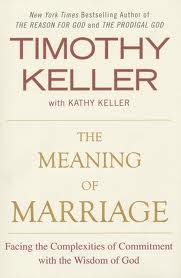
Seriously, I cannot recommend this book enough whether you’re single, dating, married, newly-married, divorced, or an infant. Read it.
I ended the last post asking “What does love have to be if it’s something I can promise?” How is it different than the poetic love that Kierkegaard is speaking of? In this post I’ll lay out three differences between poetic and covenantal love, largely drawn from Keller’s The Meaning of Marriage.
1. More Action than Emotion – If poetic love is primarily an affair of the emotions that just sweeps you up in a passion, covenantal love is primarily an action. Paul assumes this when commands husbands to love their wives. (Eph 5:25) You can’t command feelings, but you can command activities. Saying “I love you” or “I do” with a covenantal love in view, is committing yourself to “BE” and “DO” certain things for a person. It is a decision to sacrificially commit yourself fully and wholly in loyalty to another person, putting their welfare, joy, and life above your own. When I promised to love my wife, I didn’t promise “I will always feel warm fuzzies towards you.” I promised, “I will be a husband to you–I will care, pray, show affection, be there when you need me, support you, cling to you, and will your good.”
Now, of course it does involve emotion, but often-times what I find is that these emotions can actually flow from the actions. For example, it might be a date night with my wife bit I’m tired and just want to stay home and watch TV to decompress after a long week. Making the decision to go through the trouble of getting ready, getting dressed, shaving (my neck–because neck beards are unnacceptable), and getting in the car when I don’t really feel like it, surprisingly can lead towards actually feeling like it. The loving action stirs up my loving emotion so by the time we’re on the road, I’m actually excited for the night out with my wife. That’s a microcosm of what can happen in marriage as a whole, when the decision to act in loving ways is made independent of a current emotional basis, the emotion often follows.
2. Other-centered not Self-centered – The next difference is what love is centered on. Aside from the fact that it’s unstable, our culture’s understanding of love is essentially self-centered. It’s consumeristic in that it basically says, “As long as you fulfill me, please me, tickle my fancy, then I’m here. As soon as the buzz fades, I leave.” If love is primarily about an emotion felt, then you only ‘love’ the person when they are producing feelings in you. Actually, that’s why you’re loving them. The point is, in this view, love is a potent emotion that the other person inspires in you because of what they do for you, who they are–it’s primarily a selfish experience about you, your wants, your desires.
By contrast, in the Bible love is not primarily about what I get out of the person or what I feel about the person, but about what I am willing to give to the person. Am I willing to give them time, faithfulness, exclusivity? I know how much I love someone by how much I am willing to put their needs ahead of my own, not necessarily how much I “feel” about them. In consumer love, the self is placed before the relationship: the point is you’re in it to get something out of it. In covenant love, the relationship is placed before the self. In fact, the point is, covenant love is a union where I so identify myself with you, that your needs become my needs, your wants are my wants even when they’re not what I personally want. I am so bound to you that I desire to serve you just like I serve me. Covenant love doesn’t tally. It doesn’t keep records because when I give to you, in love I have identified your needs as my own. Now, how beautiful is this? Two people who have so placed the needstrying to sacrifice, two people trying to out-serve each other, two people out for each other’s joy instead of two people out for their own joy.
3. Vertical v. Horizontal– This brings us to the final difference. If love is primarily an emotional thing, if the reason I go to the other, serve, the other, etc. give emotion to the other is because of the way we make each other feel, then this is essentially a consumer transaction. We are paying each other in warm fuzzies. If that’s the case, then it makes sense to think about marriage as basically something that’s just happening between you and your spouse and to be honest, I don’t know if that’s going to work out for very long. Unfortunately, in most marriages there comes a time when I just can’t say, “I love you” because I don’t feel it. In the hardness of my heart, I’m going to be tempted to say, “You’re not worth it” or “I just don’t have the strength.”
This is where Kierkegaard’s “love transformed by the eternal” comes into play–what if love was not just between two people, but between two people and God? See, when we promise, when we say “I do”, we’re promising God not our spouse. So, when I’m serving my wife, I’m serving my God. When I’m loving my wife, I’m loving God. I can’t separate the two. Of course, the inverse means that to break faith with spouse is to break faith with God at the same time. This is at the core of why God has something to say about divorce and marriage–as a covenant partner it is His business.
At first this sounds threatening, but in reality, it should be encouraging. If it’s not just me and the sinner I married, then I have a shot. When that day comes when you look at your spouse and you, in the hardness of your heart, might say, “You’re not worth this”–putting my relationship in the context of my relationship with God gives me the strength to love when it’s hard, stick it out when it’s painful, and be faithful anyways. When it’s not just me and another sinner trying to tell each other we’re worth it, it’s a lot easier: Why? Because God is always worth it. Even more than that, it’s not just me and another sinner trying to pull this off on our own strength. If you understand that love has a vertical dimension to it, it means that you can call on God to sustain your love. He has a vested interest in this because ultimately, at the core of who God is and what God has done is the reality covenantal love.
Good News, There is Love
This is something we cannot let our hearts forget: the Gospel is a story about covenantal love. Since we live our lives, and even our marriages, out of the stories we tell ourselves, we need to remind ourselves daily that there is story above all stories–a true story about one, Jesus Christ, who saw his bride and said, “It’s not about me.” He was not drawn to her because she was so awesome that she created all kinds of warm feelings in him out of her own worthiness. Instead, He decided to love her despite her unworthiness. He decided to bind himself and make a covenant with her; to put her needs ahead of His own; to serve her and not himself; to give rather than receive; to be trustworthy and faithful when she was untrustworthy and faithless; to unite himself with her so much that her needs became his needs, and her sins became his sins, and in order to keep the covenant, her death became his death, so that His life could be her life. It is this story that needs to set the framework within which we understand love and marriage. Once again, as in all things, the Gospel of a God who proves his own covenantal love for us in the death of Christ for sinners changes everything. (Rom 5:8)
 T.S. Eliot is one of my favorite poets that I don’t read–at least not his poetry. When reading Scruton I found out he had a lecture series involving the notion of heresy, so of course I was intrigued. It took some digging to track them down though, because they had been suppressed by Eliot himself due to some unfortunately anti-Semitic content. In any case, I found them and tracked down his definition of heresy and heretics:





 Reformedish