The Doctrine Without Which Holy Week Is Not Good News

21733-unionDuring Holy Week, especially the tail-end of Good Friday and Resurrection Sunday, we celebrate the climax of the saving events of the Gospel. In this week we see all of Jesus’ work summed up. We see Jesus proclaiming and living out the Kingdom in perfect obedience to the Father. We see Jesus lifted up on the cross, bearing the sins of the people, exposing the darkness of satan, and exhausting the curse in his death. We see Jesus, risen to new life again, bringing about the New Age in his own resurrected person.

And yet, the reality is, none of these saving events are of any use if the doctrine of union with Christ is not true. Calvin explains:

First, we must understand that as long as Christ remains outside of us, and we are separated from him, all that he has suffered and done for the salvation of the human race remains useless and of no value for us. Therefore, to share with us what he has received from the Father, he had to become ours and to dwell within us. For this reason, he is called “our Head” [Ephesians 4:15], and “the first-born among many brethren” [Romans 8:29]. We also, in turn, are said to be “engrafted into him” [Romans 11:17], and to “put on Christ” [Galatians 3:27]; for, as I have said, all that he possesses is nothing to us until we grow into one body with him. It is true that we obtain this by faith. Yet since we see that not all indiscriminately embrace that communion with Christ which is offered through the gospel, reason itself teaches us to climb higher and to examine into the secret energy of the Spirit, by which we come to enjoy Christ and all his benefits. –Institutes, 3.1.1

Unless I am united to Christ, all of his obedience to the covenant, or righteousness, is not mine–I am left to stand on my own false works before the judge of all the earth. Unless I am united with Christ, then his sin-bearing death is not mine, and I am left to give an account for all my wicked sins. Unless I am united with Christ, I am not part of the crop of which Christ is the first-fruits, and I can only reap the death that  sin leads to and have no life through the Spirit. I’ll quote Robert Letham again at length on the logic of union and salvation:

According to Paul in Romans 5:12-21, just as Adam plunged the whole race into sin and death because of their relationship of solidarity with him, so the second Adam brings life and righteousness to all who sustain a relationship of solidarity with him

If, because of one man’s trespass, death reigned through that one man, much more will those who receive the abundance of grace and the free gift of righteousness reign in life through the one man Jesus Christ. (Rom. 5:17 ESV)

Here Paul reflects on his previous statement of the one way of salvation from sin by the propitiatory death of Christ, which avails for all who believe (Rom. 3:21ff). Justification is received only by faith and is grounded in what Christ did once for all in his death and resurrection (4:25).  Paul’s point is that we are not addressed merely as discrete individuals; instead, we are a team of which we all were members. His sin plunged the whole team into sin, ruin, death, and condemnation. What Christ did for us was also done as the head of a team of which we are a part. He did it on our behalf, for us–and God reckons it to our account as a result of our being united, through faith, with him as the head of the team. Our justification is therefore grounded on union with Christ.

Union and Sanctification

In Romans 6:1ff, in answer to charges that his gospel encourages moral indifference, Paul insists that believers, the justified, live to Christ and do not give themselves over to sin.  This is because they died with Christ to sin and rose again to new life in his resurrection. Not only did Christ die and rise again for them, but they died and rose with him. Union with Christ is the foundational basis for sanctification and the dynamic force that empowers it. As Paul says, “Do you not know that as many were baptized into Christ Jesus were baptized into his death; we were buried with him through baptism into death, so that as Christ was raised from the dead through the glory of the Father so we too should live in newness of life” (6:3-4).

Union and Resurrection

Paul argues in 1 Corinthians 15 that the resurrection of Christ and the future resurrection of his church is one reality (vv. 12-19). Paul argues back and forth from one to the other. If Christ is not raised, there can be no resurrection of believers. If there is no general resurrection, Christ cannot have been raised himself. The two stand together. In fact, Christ has been raised–and so, therefore, will we be. Christ is the firstfruits of the resurrection of believers at his return (vv. 19-23). Not only is his resurrection first in time, but as firstfruits, it is of the same kind as the full harvest. Hence, it is the guarantee not only that the full harvest will be gathered but that both his resurrection and ours are identical. From this it is clear that the resurrection of believers at the parousia is a resurrection in Christ. The resurrections are effectively the same…Christ resurrection and the resurrection of the righteous, separated by indefinite time, are identical because the later occurs in union with the former.

–Robert Letham, Union with Christ: In Scripture, History, and Theology, pg. 5-7

This Holy Week, then, as we contemplate Jesus’ works accomplished on our behalf outside of us, let us glory in the union that makes them ours by faith.

Soli Deo Gloria
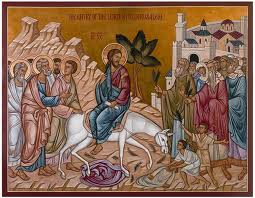
The Ridiculous Entry into Jerusalem

ridiculous entryToday we begin Holy Week, the last week of Jesus’ pre-Resurrection ministry, by celebrating Palm Sunday and his Triumphant Entry into Jerusalem. Here is the standard account in Matthew:

Now when they drew near to Jerusalem and came to Bethphage, to the Mount of Olives, then Jesus sent two disciples, saying to them, “Go into the village in front of you, and immediately you will find a donkey tied, and a colt with her. Untie them and bring them to me.  If anyone says anything to you, you shall say, ‘The Lord needs them,’ and he will send them at once.” This took place to fulfill what was spoken by the prophet, saying,

 “Say to the daughter of Zion,
‘Behold, your king is coming to you,
    humble, and mounted on a donkey,
    on a colt, the foal of a beast of burden.’”

 The disciples went and did as Jesus had directed them.  They brought the donkey and the colt and put on them their cloaks, and he sat on them. Most of the crowd spread their cloaks on the road, and others cut branches from the trees and spread them on the road. And the crowds that went before him and that followed him were shouting, “Hosanna to the Son of David! Blessed is he who comes in the name of the Lord! Hosanna in the highest!” And when he entered Jerusalem, the whole city was stirred up, saying, “Who is this?” And the crowds said, “This is the prophet Jesus, from Nazareth of Galilee.” (Matt. 21:1-9)

To ears trained by a couple thousand years of church history to hear these Hosannas as those of glorious choirs, and the donkey as a dignified steed, we miss the glorious irony of this most ridiculous of all entries. John Calvin highlights how foolish the whole thing would have been:

This would have been a ridiculous display, if it had not been in accordance with the prediction of Zechariah, (9:9.) In order to lay claim to the honors of royalty, he enters Jerusalem, riding an ass. A magnificent display, truly! more especially when the ass was borrowed from some person, and when the want of a saddle and of accouterments compelled the disciples to throw their garments on it, which was mark of mean and disgraceful poverty. He is attended, I admit, by a large retinue; but of what sort of people? Of those who had hastily assembled from the neighboring villages. Sounds of loud and joyful welcome are heard; but from whom? From the very poorest, and from those who belong to the despised multitude. One might think, therefore, that he intentionally exposed himself to the ridicule of all.

And yet, this was necessary because:

…in consequence of the time of his death being at hand, he intended to show, by a solemn performance, what was the nature of his kingdom. So then, as his removal to heaven was at hand, he intended to commence his reign openly on earth….But as he had two things to do at the same time, — as he had to exhibit some proof of his kingdom, and to show that it does not resemble earthly kingdoms, and does not consist of the fading riches of this world, it was altogether necessary for him to take this method. (Harmony of the Gospels, Vol 2, Comment on Matthew 21:1)

This is the way the King came announcing his kingdom: in humility, poverty, absurdity, and weakness. And yet, because of this, we see all the more clearly that it “does not consist in the fading riches of this world.” The gold and the pomp we might have expected would have only obscured the true glory of our King.

So then, as we sing our hosannas today, and lift our palms to the King of glory, let us recall his humble, and, indeed, ridiculous entry into Jerusalem.

Soli Deo Gloria

In Which Calvin Defends Lip-Gloss (Christ and Pop Culture)

lip-glossMy wife spent this last Saturday morning ministering to and mentoring young women in foster care. As part of a larger program, she spent focused one-on-one time with a number of six teenage girls, listening to their stories, talking to them, and giving them a gift that she has cultivated with care and grace over a number of years: proper skin care and a knowledge of how to apply makeup that works with their facial features.

A number of these young women have grown up in difficult and abusive homes. Some don’t have mothers. Others had never had a stitch of makeup on in their lives and wouldn’t know where to start. And so, my wife, expert that she is, taught them how to wash their faces, massaged them, and then helped them understand how to use makeup in a way that amplifies and accentuates their natural features–eyes, cheeks, lashes, and lips–instead of drowning them out in a wash of paint.

I see this as a service and not simply a misguided encouragement to vanity, and to make my case, I’d like to call to the stand a witness: Genevan Reformer John Calvin’s theology of the body.

You can go read the rest of this, admittedly provocative, story at Christ and Pop Culture.

Calvin on the Christian Life by Michael Horton (The Gospel Coalition Book Review)

calvinMichael Horton. Calvin on the Christian Life: Glorifying and Enjoying God Forever. Wheaton, IL: Crossway, 2014. 272 pp. $19.99.

In the history of the church, particularly its Western Protestant wing, few theological lights shine brighter than John Calvin’s. The Reformer par excellence, he stands out for his theological acumen, systematic comprehensiveness, and care as a biblical exegete. Beyond Calvin the theologian and biblical scholar, though, there was Calvin the pastor—the man passionately concerned that all of human life be lived before God (coram Deo) and in light of the gospel. Though it’s often presented this way in history textbooks, the Reformation wasn’t simply an academic theological debate about justification and the thoughts we think on a Sunday morning, but rather a total restructuring of Christian life and practice. It was about, as James K.A. Smith puts it, the “sanctification of ordinary life.” For that reason Calvin was concerned not only with teaching doctrine, but also with the life of piety flowing from that doctrine.

This is the Calvin that theologian and Westminster Seminary (California) professor Michael Horton introduces us to in his new volume on Calvin and the Christian Life. With an engaging blend of biography, theology, and commentary, and with copious reference to Calvin’s Institutes, commentaries, tracts, and key secondary literature, Horton takes us on a whirlwind tour through the Reformer’s thought as a whole.

Please read my review over at The Gospel Coalition and PICK UP THIS BOOK!!!

Soli Deo Gloria

This is Why I Read Calvin: He Points Me to Jesus

CalvinThis, this is Gospel-gold. It doesn’t get better than this:

“We see that our whole salvation and all its parts are comprehended in Christ [Acts 4:12]. We should therefore take care not to derive the least portion of it from anywhere else. If we seek salvation we are taught by the very name of Jesus that it is “of him” [1 Cor 1:30]. If we seek any other gifts of the Spirit, they will be found in his anointing. If we seek strength, it lies in his dominion; if purity, in his conception; if gentleness, it appears in his birth. For by his birth he was made like us in all respects [Heb 2:17] that he might learn to feel our pain [compare Heb 5:2]. If we seek redemption, it lies in his passion: if acquittal, in his condemnation; if remission of the curse, in his cross [Gal 3:13]; if satisfaction, in his sacrifice; if purification, in his blood; if reconciliation, in his descent into hell; if mortification of the flesh, in his tomb; if newness of life, in his resurrection; if immortality, in the same; if inheritance of the Heavenly Kingdom, in his entrance into heaven; if protection, if security, if abundant supply of all blessings, in his Kingdom; if untroubled expectation of judgment, in the power given to him to judge. In short, since rich store of every good abounds in him, let us drink our fill from this fountain, and from no other.”

-John Calvin Institutes 2.16.19

Passages like this make me mourn for those who refuse to read Calvin because of the bad taste some Youtube video, or jerky Calvinist, left in their mouth. Please don’t rob yourself of the spiritual riches to be found as Calvin points you to Christ in passage after passage.

Soli Deo Gloria

Calvin’s Pain and Our Comfort

I’ve written about some of the physical struggles and pains that I’ve struggled with over the last few years of ministry. They can and have been trying, exhausting, discouraging, as well as humbling and sanctifying all at once. I’d love to be rid of them (and praise God he has been healing me of them slowly!), because there are times when it has felt like all too much, all too terrible, and utterly pointless.

It comes as no little encouragement then to hear Michael Horton speak briefly on Calvin’s great many horrifying illnesses, and the way God used that to shape his pastoral theology. It begins to explain why the Institutes were a great comfort to me when this whole episode began.

I would encourage those of you suffering with chronic illnesses, whether in vocational ministry, or simply a saint worried that your suffering is hindering your service to the Lord to watch this and be blessed.

 (HT: Justin Taylor)

Looking forward to Horton’s new book Calvin on the Christian Life: Glorifying and Enjoying God Forever.

Soli Deo Gloria

A Prayer for Strength in Temple-Building

solomons_temple_jerusalemThis is a prayer in light of Haggai’s call to the returned Exiles to rebuild the Temple, in spite of the opposition they faced. This is now our prayer as we strive to build up the Temple of Christ, the Church:

Grant, Almighty God, that as we must carry on a warfare in this world, and as it is thy will to try us with many contests,—O grant, that we may never faint, however extreme may be the trials which we shall have to endure: and as thou hast favored us with so great an honor as to make us the framers and builders of thy spiritual temple, may every one of us present and consecrate himself wholly to thee: and, inasmuch as each of us has received some peculiar gift, may we strive to employ it in building this temple, so that thou mayest be worshipped among us perpetually; and especially, may each of us offer himself wholly as a spiritual sacrifice to thee, until we shall at length be renewed in thine image, and be received into a full participation of that glory, which has been attained for us by the blood of thy only-begotten Son. Amen.

–John Calvin, Lectures on Haggai

Soli Deo Gloria

Why Calvinism Not Lutheranism? Books

Last week over at First Things James Rogers asked:

Why is Calvinism so influential among American Evangelicals while Lutheranism is not? We might describe the statistically modal convert to Calvinism—that is, the most frequently observed kind of convert—as a person like this: A young adult, usually male. Raised in a broad though indistinct Evangelical (and sometimes nominally Catholic) home. Bright. A reader. Searching for better intellectual answers to questions about God, Jesus and the Bible. Is open to becoming a pastor. Why does this young man so much more often become a Calvinist instead a Lutheran?

It’s a good question. When I was doing my theological searching early on, I found myself initially more attracted to Lutheranism given their apparent lack of emphasis on predestination as well as Luther’s fiery wit. (Also, I was in my anti-Piper phase.) In fact, many of us raised in more a-historical, non-denominational Evangelical backgrounds are likely to hear of Martin Luther as the Reformer, instead of Calvin, just because of the 95 theses and the issue of justification by faith. So why is it that so many of us end up learning the Westminster or Heidelberg catechism, instead of Luther’s?

Rogers lists a number of possible reasons I find worth summarizing here:

  • American Lutheran churches have tended to be ethnically-focused and insular. That alone just makes it harder to even find.
  • Beyond that, it’s hard to read your way in. Calvin wrote an influential systematics, while Luther’s works are more piecemeal and polemically-situated. That makes immersion in the one easier than the other.
  • In the same vein, Lutheran Confessional documents assume and refer to a lot of church history, so their clarity and accessibility leave something to be desired. Reformed documents tend to spell things out more cleanly, assume less, and verify more, making them welcoming to the newbie. The opposite holds true of the catechisms–Luther gives less and assumes more. Westminster gives more distinctly formative theology to the inquirer.
  • Ecclesiastically, Calvinists know their Bibles and confessions, on average better than their Lutheran counterparts, so you’re more likely to run into a Calvinist who knows their stuff.
  • Sacramentally, Lutheran practice and theology is even less accessible. Functionally, most Evangelicals are rockin’ a pseudo-Zwinglian view of Baptism and the bread & wine/grape juice. Making the jump to baptismal regeneration and Luther’s consubstantion is leap, both theologically and experientially.
  • Drawing on Lutheran theologian Philip Cary, he makes big contrast between the two modes of piety: one focused on the mental assent of the believer, and the other on Christ’s faithfulness alone as the sole ground of my comfort. The Evangelical/Calvinist assures himself by remembering he’s assented in proper faith, while the Lutheran has it because he remembers Christ’s faithfulness given to him in baptism. Lutheran air is made of thicker stuff than the Zwinglian rationalism and nominalism the average Evangelical is used to, so it’s a bit of more an awkward shift than simply picking up a Reformed soteriology.

Finally, he ends with an appeal to Lutherans to be as winsomely passionate about evangelizing for a Lutheran view of Word and Sacrament as Calvinists are about predestination.

Me with BooksReading My Way In – Given Rogers’ Lutheranism, his apology for it is understandable and somewhat slanted read of Calvinist piety is somewhat forgivable. Only somewhat, though, given the classic Reformed emphasis on union with Christ, which, honestly does all that the Lutheran’s does, as well as gives us a bit of a boost into sanctification. That said, his point about the cultural difference is a real one. Still, the more interesting point for me was the one about reading, because in my experience far easier to read yourself into Calvinism or Reformed theology. I would say there are a few reasons for this, though, beyond Calvin and confessional documents.

As DeYoung points out in the article I referenced yesterday, Calvinism (whether broadly or narrowly defined) has dominated the theological conversation in America since its founding. I mean, just think about the Pilgrims–Puritan Calvinists. Beyond that, Reformed thought, especially its soteriology, can be found across denominational lines be it Episcopal, Presbyterian, Particular Baptist, or whatever else. This is also the case in our revival heritage. While Finney is horrifyingly hyper-Arminian (and that’s really unfair to Arminians), much revivalist piety has still had a Reformed rooting. In other words, it travels well, which means that if you go digging into the literature, you’ll be able to find broadly Reformed thinkers in various places.

Institutionally it’s been better represented as well in terms of universities, publishing houses, and authors. This last one is probably the most pertinent one right now. Honestly, it’s easier to read yourself into Calvinism, because who knows of any good, current, pop-level Lutheran books, writers, or preachers? Tullian Tchividjian? (I kid.) Really though, the only current theologians I can think of are Wolfhart Pannenberg and Robert Jenson–brilliant heavyweights, to be sure–but not exactly great book-club reading. Maybe someone might name Dietrich Bonhoeffer, but again, not very pop or accessible, and at this point in history he’s become a figure that transcends confessional lines. There’s no current Lutheran author I know of, comparable to a Tim Keller or even a John Piper for popular reach.

So when a theologically-minded young man (or woman) goes shopping around for books on pressing theological subject, if he’s not pulled into Eastern Orthodoxy, Roman Catholicism, or some emergent, Heidegger-quoting business, it’s far easier to put a copy of Desiring God (Piper), or Knowing God (Packer), into his hands than find something written by a Lutheran. Or again, when a pastor is looking for a book to turn into a sermon series, it’s the Calvinists that are publishing en masse, so some Reformed emphasis will be bleeding into non-Reformed Evangelical preaching. That prepares the young Evangelical hearer to search for more of the that rich vein. Even picking up Rogers’ point about confessional literature, yes, I found Heidelberg before Luther’s Catechism, but I did so because of Kevin DeYoung’s excellent little commentary on it The Good News We Almost Forgot.

If you want my two cents, then, for why so many young, theological types choose Reformed theology over Lutheranism: books. Accessible, pop-level books that gave us a big picture of God, and a desire to read the thicker theologians and texts that we’d catch glimpses of in those pages.

Soli Deo Gloria

Can Calvinism Accommodate Other Systems of Thought?

Kevin DeYoung had an interesting little post last week. He essentially riffed on E. Brooks Holifield’s contention that, to a large degree, American theology for the first couple of centuries, “was an extended debate…about the meaning and the truth of Calvinism.” After filling out the historical picture a bit, DeYoung then gave his own four reasons why it’s unsurprising that American theology still is consumed with wrestling with Calvinism, or rather, Reformed theology:

1. It is an all-encompassing worldview which, when handled with consistency, does not easily accommodate other intellectual rivals.

2. It is a scandalous theology, utterly at odds with later American ideas of egalitarianism and self-determination.

3. It is so absolutely other-worldly–either in glory or in shame, depending on your perspective–that it begs for a response. It’s almost impossible to be indifferent to Calvinism.

4. When pastors, theologians, churches, denominations, and movements are gripped by the vision of Reformed theology, they tend to be dogged in their persistence to perpetuate it, defend it, and celebrate it.

The whole thing’s worth reading. I find myself mostly nodding my head at his four observations. Reformed theology is pretty comprehensive, definitely scandalous, demands a response, and commands loyalty. That’s part of what has drawn me in. I do find myself wondering about part of the first point, though, as to Reformed theology’s inability to easily accommodate other intellectual rivals.

I guess I’d have to ask, which rivals are we speaking of here? Are we talking about rival systems of thought in general like Buddhism or Marxism? Or just rival systems of theology like Thomism, or, Lutheranism, or something? If the first, well, yes, but then again, I’d say that’s a feature of Christianity in general, not merely its Reformed iteration.

If the second, then I’d say, well, maybe. From what I’ve come to understand (and I’ll easily concede DeYoung’s expertise here) certain types of Reformed theology are a little more open to taking on shared insights and emphasizing commonalities with, say, Thomism on the doctrine of God, or Lutheranism in justification and so forth. So, a post-Van Tillian, or Kuyperian might really emphasize the distinctness of the systems, while those steeped in post-Reformation orthodoxy might want to emphasize the catholicity and continuity of thought at points. Also, it may depend on what we’re referring to when it comes to the term “Calvinism.” Is it only Dordtian soteriology, or the broader framework of thought? Either way, that shifts the discussion. Again, these are just my novice impressions.

Certainly, I won’t dispute DeYoung’s closing judgment:

Although Calvinism is certainly not the dominant theological tradition like it was in the early days of this country, it continues to be a potent strain of religious devotion. Read through the most popular blogs and you’ll see the debate has not died down. When it comes to assessing Geneva, one person’s city on a hill is another person’s pit of hell.

Final question: What do ya’ll think? I’m particularly interested in those of you who have some familiarity with the Reformed tradition. How accommodating can Calvinism be?

Soli Deo Gloria

Update: My buddy Dr. Brian Mattson weighed in on the question here. The response is excellent and worth the read. His big takeaway:

Calvinism, as an all-encompassing worldview, and when handled with consistency, is superior to its rivals in the act of accommodating rivals.


If Grace, Then Sin?

cough syrupGod saves us by sheer grace; we cannot earn it and none of our good works can procure it. God justifies us because we have trusted in and united to Christ’s work on our behalf, his sin-bearing death and his life-giving resurrection. That’s the gist of the Gospel of Paul according to the Reformation.

As we noted the other day, one of the great objections leveled against the Gospel of the Reformers was that it was an invitation to license: “If God saves us by grace, then why be good? Won’t people just keep sinning if they know they’re going to be forgiven?” This isn’t a crazy question either. Any pastor who has tried to preach the Gospel to his people will have had it come up. Paul apparently did.

In his letter to the Romans, he asks question of a hypothetical interlocutor:

“What shall we say then? Are we to continue in sin that grace may abound?” (Rom 6:1)

His answer?

“By no means! How can we who died to sin still live in it?” (Rom. 6:2)

John Calvin takes up Paul’s denunciation and briefly outlines the Reformed response to the charge against the Gospel of grace, both by critics, and by sinners who’d love to take advantage of it. Commenting on the Romans 6:2, and summarizing the argument to follow:

[It is] an argument derived from what is of an opposite character. “He who sins certainly lives to sin; we have died to sin through the grace of Christ; then it is false, that what abolishes sin gives vigor to it.” The state of the case is really this, — that the faithful are never reconciled to God without the gift of regeneration; nay, we are for this end justified, — that we may afterwards serve God in holiness of life. Christ indeed does not cleanse us by his blood, nor render God propitious to us by his expiation, in any other way than by making us partakers of his Spirit, who renews us to a holy life. It would then be a most strange inversion of the work of God were sin to gather strength on account of the grace which is offered to us in Christ; for medicine is not a feeder of the disease, which it destroys. We must further bear in mind, what I have already referred to — that Paul does not state here what God finds us to be, when he calls us to an union with his Son, but what it behoves us to be, after he has had mercy on us, and has freely adopted us; for by an adverb, denoting a future time, he shows what kind of change ought to follow righteousness.

Comment on Romans 6:2

Once again we come back to the reality of double-gift we receive in union with Christ. There is no grace of justification and forgiveness that comes separated from the Holy Spirit’s work of cleansing regeneration. The “medicine” of grace doesn’t make sin stronger, but destroys it at the root. This is why, though we are saved not by our works, we are never saved without them. Though we are not accepted because of our obedience, the truly accepted will obey.

Paul’s solution to licentiousness is not to add more imperatives in bolder print. It is not making the indicatives dependent on the imperatives. It is preaching the indicatives with greater clarity and force that the imperatives naturally follow. Actually, it is through our teaching people clearly the truth of their saving union with Christ, the gift of forgiveness and free justification, and the cleansing work of the Holy Spirit,  that the Holy Spirit actually increases their faith, thereby cutting the root of their sin: unbelief.

So, does preaching grace too strongly merely encourage sin? No, it’s our greatest weapon against it. The reality we have to continually keep in mind is that the medicine is working at the deepest core of our being. It’s the difference between an antibiotic that kills the bacteria and a cough medicine that simply deals with symptoms. Just looking at the symptoms, it might seem like it’s not having any effect. Underneath though, the deep reality is that it is eating away at the bacteria of sin in our lives, eradicating it from the inside out.

Soli Deo Gloria