Does Diversity of Form Lead to Diversity of Message in Theology? (Engaging KJV Pt. 2)

Last week I kicked off a little series engaging Kevin Vanhoozer’s Remythologizing Theology by working through the essays devoted to it in a recent volume of the Southeastern Theological Review. I opened with an appreciative post outlining Vanhoozer’s unique place in Evangelical theology, but from there I figured it would make sense just going through the various essays in order, beginning with Stephen J. Wellum’s “A Critical Appreciation of Kevin Vanhoozer’s Remythologizing Theology.

“A Critical Appreciation” aptly sums up the thrust of the essay; it’s appreciative, then critical. Wellum begins with an excellent multi-page summary outline of RT, noting carefully the methodological as well as material proposals Vanhoozer is making. From there, he moves into three areas of criticism within his overall appreciative take on the work. While Wellum raises some material issues (how does the author-analogy for sovereignty deal with reprobation?), he settles in mostly on issues of theological framework, truth, and method.

Though his section on the absence of apologetics, or rather the assumption of a Reformed theological framework, is worth pursuing, it overlaps with the thrust of Crisp’s essay, so I’ll leave that to the side for this post. What I’d like to do is frame Wellum’s question to Vanhoozer on the issue of literary forms, and then summarize what Vanhoozer has to say in his puckishly-titled follow-up article “Vanhoozer responds to the four horsemen of an apocalyptic panel discussion on Remythologizing Theology.”

mediumMore Than One Medium, More Than One Message? – Back in the day, Marshall McLuhan taught everybody that the “medium is the message”–essentially form and content are inseparable; how you say something is part of what you’re saying. For instance, print media and visual media are two very different things and they radically shape what is being communicated. Vanhoozer is well-known for giving the dictum a theological twist and arguing that the form, or forms, of the message–specifically the various genres of literature in Scripture–should play a role in our theologizing about the message, especially in Is There a Meaning in this Text? and The Drama of Doctrine.

It’s here that Wellum starts to wonder, “are literary forms overblown?” (pg. 24) See, it’s not just that Vanhoozer claims we should be paying more attention to genre so we can figure out that you’re not supposed to read Revelation the same way you read the book of Acts. That’s all fine and good. What causes his query is the further claim that he sees Vanhoozer making–that the plurality of mediums and genres (canonical plurality) yields a plurality of conceptualities and theologies (theological plurality.) Quoting Vanhoozer in DoD (pg. 275):

The plurality on the level of the canon may call for an equivalent plurality on the level of interpretative traditions. If no single conceptual (read, confessional) system is adequate to the theological plentitude of the canon, then we need a certain amount of polyphony outside the canon, too, in order to do justice to it. The church would be a poorer place if there were not Mennonite or Lutheran or Greek Orthodox voices in it.

Applying the idea to atonement theology, this would mean that instead of privileging one of the many metaphors used to speak of Christ’s work to one, single, conceptual framework, a remythologizing approach will let them all come to play and shape our understanding. In RT, he says something along the same lines about our theology of God. Again, he quote Vanhoozer,“The reality of God outruns any one theologian’s attempt to conceptualize it, just as Scripture outruns the attempt of any one interpretative scheme to capture its meaning (RT, p. 474).”

At this point, Wellum throws up his hands and confesses that he’s not quite sure what to make of all of this. It’s all fine and good to think through the various genres of Scripture, as we struggle to do theology that honors all that God revealed, but “why does this lead to theological diversity?” (pg. 25) Sure, we should think through and include all the metaphors used in Scripture when thinking through the Cross, but isn’t it possible to take them all into account and land at an account of things that is better than other attempts? “…does this entail that there is no single conceptual system which accurately understands the Scripture, or at least, in terms of the areas that are central to an understanding of the Gospel?” (pg. 25) Pushing further, Wellum also asks whether this holds up in light of the inter-textual usage of the Old Testament texts by New Testament authors, who seem to appropriate texts freely across literary forms as they re-read them in light of the redemptive-historical story-line of Scripture.

These are good questions. So what does Vanhoozer have to say about it? Well, as with everything he says, he says it playfully and humbly–especially since Wellum happens to be his former student.

The Master Responds – So what’s he getting at? Well, to begin Vanhoozer does a little clarifying as to what he does not mean by theological plurality:

The first thing to be said is that I am careful to locate diversity on the level of vocabulary (e.g., metaphors) and concepts, not the more fundamental judgments that underlie them (e.g., ontological judgments). A second
preliminary observation: diversity is not the same thing as indeterminacy or contradiction. To be sure, there is a certain tension in saying that the same basic theological judgment may be rendered in more than one set of concepts, some of which catch certain nuances better than others. But we need only think of the various metaphors to describe the saving significance of Jesus’  cross to see how canonical perspectives generate theological perspectives. (pg. 75)

In other words, don’t take this too far. Recognizing understandable theological plurality is not a charter contradictory or incoherent doctrinal formulations. It is, however, a call to humility in our theological pronouncements given our finiteness and the fecundity of texts themselves.

Next, Vanhoozer happily concedes Wellum’s last observation about the NT author’s seeming emphasis on redemptive-historical readings over ones sensitive to literary form. That said, in the dispute between Christ and the Tempter (Luke 4), Vanhoozer points out that they’re not just trading true propositions. The issue up for dispute is where these statements fit in the canonical narrative of redemption. In other words, the issue of re-reading texts in light of redemptive history is still an issue of appreciating form–in this case, the form of the whole canon.

Finally, one of the key points to understand, is that Vanhoozer’s reflections on form and genre are an attempt at correcting against some approaches to the place of genre in theology on offer.  For so many Evangelical theologians, possibly including Wellum, understanding genres is important so that you can better crack open the shell of the text, and get to the juicy propositional content. Vanhoozer’s basic hunch about the forms of biblical discourse is that they “do more than provide packaging for theological content.” (pg. 75) Vanhoozer’s concern is that we see Scripture not merely as a treasure-trove of divine propositions to be deciphered and reassembled in the proper, systematic order.

God had particular purposes in using wisdom, apocalyptic, narrative, instead of one, clear, monological form, and this is an insight of theological importance:

Form is also an ingredient in “rightly handling [orthotomeo] the word of truth” (2 Tim. 2:15). It is through the various literary forms of Scripture, including stories and histories, that the divine authorial imagination shapes our view of God, the world, and ourselves, thus forming us to be those who can make right judgments concerning fittingness. (pg. 76)

At a more than systematic level, the forms of Scripture train the disciple in ways of seeing, hearing, knowing, loving, and responding to drama of the Gospel, and that says something about the God of the Gospel.

One of Ricoeur’s line in particular continues to intrigue me: “Not just any theology can be wed to the narrative form.” How much more is this the case with a theology wed to history, apocalyptic, wisdom, prophecy, law, and gospel! (pg. 76)

A Clarifying Word – For some, questions will remain. I have a couple myself. Knowing this, Vanhoozer points the inquisitive to works by Ricoeur, as well as his own essay “Love’s Wisdom: the authority of Scripture’s form and content for faith’s understanding and theological judgment ” (Journal of Reformed Theology 5, 2011) At the end of the day, given the amount of space he had, this is a helpful, clarifying word, though not a final one from Vanhoozer.

Still, in the space he takes, we find a challenge to go back to the text and really see the formal diversity for what it is: not an obstacle to be puzzled apart, reduced to a clear, propositional form, but God’s diverse word that strikes “all the chords of the human soul, not just the intellectual”, in order to train us to take our place in the grand Theo-drama of redemption.

Soli Deo Gloria 

3 Things We Can Learn From The Genealogies

genealogyWhenever I read the Chronicles, I generally skipped the first 12 chapters full of genealogies. Yes, they’re in the Bible. Yes, I believe they’re inspired, but, let’s be honest, they can be pretty boring. It’s kind of hard to see the point of 12 chapters of list after list of people who don’t actually do anything of note. I can’t imagine I’m the only one who has felt this way.

Enter Gerald Bray.

In his systematic theology God is Love, Bray helpfully gives us three questions that we should always ask when studying any text:

  1. What does it tell us about God? What does it say about who he is and what he does?
  2. What does it tell us about human beings? What are we meant to be and what has gone wrong?
  3. What has God done about this problem and how does he expect of us in light of what he’s done?

As a test-case, he applies them to the study of the genealogies, to see what these “endless list of ‘begats'” can tell us, shedding on light the deep riches of God’s Word that await those patient enough to mine for it:

What do the genealogies reveal about God? They tell us that he is a faithful Lord, who keeps his covenant from one generation to another. Whoever we are and however far we may have descended from the source of our human life in Adam, we are still part of God’s plan. Over the centuries we have developed differently, we have lost contact with on another, and we have even turned on each other in hostility, but in spite of all that, we are still related and interconnected in ways that go beyond our immediate understanding or experience.

Secondly, what do the genealogies say about us? They say that form the world’s point of view, most of us are nobodies. We live and die in a long chain of humanity, but there is not much that anyone will remember about us as individuals. Yet without us, future generations will not be born and the legacy of the past will not be preserved. We are part of a great cloud of witnesses, a long chain of faithful people who have lived for God in the place where he put them. Even if we know little about our ancestors, we owe them a great debt of gratitude for their loyalty and perseverance, when they had little or nothing to gain from it or to show for it.

Finally, what do the genealogies say about God’s dealings with us? They tell us that we are called to be obedient and to keep the faith we have inherited, passing it on undiminished to the next generation. They remind us that there is a purpose in our calling that goes beyond ourselves. Even if we are not celebrated by future generations and leave little for posterity to remember us by, we shall nevertheless have made an indispensable contribution to the purposes of God in human history. So the genealogies bring us a message from God, even if they appear on the surface to be barren and unprofitable. All we have to do is ask the right questions, and their meaning will be quickly opened up to us.

God is Love: A Biblical And Systematic Theology, pg. 59

Now things might not open up that quickly for you and I, and yet Bray is right. All of Scripture really is profitable for the believer who seeks to hear God’s word to his people (2 Tim 3:16), and is willing to learn the right questions.

Soli Deo Gloria 

The Importance of Context in the Conquest of Canaan (The Story Notes #7)

jerichoMy church is, across all departments, going through The Story, a chronological, abridged edition of the Bible that takes you through the story of Scripture from Genesis to the end of Acts in 31, novel-like chapters. It’s a fun project that’s challenging me to deal with narrative sections, teach large chunks at a clip, and point my kids to Christ throughout the whole redemptive-historical story-line of the text.

That said, it seemed worth it to start posting my notes for these talks on a regular basis. It might happen every week, or not, depending on how helpful I think it is, or time constraints. My one request is that you remember these are pretty rough notes and I’m teaching my students, not a broader audience.

Text – Joshua 6 and the Invasion of Jericho

While a lot of us have trouble with most of what they read in the Old Testament, up until now a lot of us could get by okay. Let’s not play around here, though–there is a serious difficulty for many of us reading and understanding texts like this. The invasion and conquest of Canaan presents an assault on the modern mind, with modern sensitivities, horrified at what strikes us as a simple war of conquest in the name of God. We live in a post-9/11 world and the specter of religious terrorism, and not to mention modern ethnic cleansing, so this stuff understandably terrifies us.

Problem is, it seems like the Bible is full of awkward sections like this. What do we do with these pictures of violence? Or all the weird laws that we find in the Torah? How do we accept them as the word of God and possibly relate them to our own lives when they seem so terrible? We have to do something with them don’t we? This isn’t just an academic question for a lot of us. These are the texts that get thrown in our faces by our atheist and agnostic classmates when the Bible comes up. And, if we’re honest, they’re the ones that keep some of us up at night, doubting if what we’ve been taught in Sunday School is really all just a made-up, human construction.

What I want to do tonight is try to deal with this text, yes, but also the importance of reading the troubling texts of Scripture in context. In this case there are three contexts that I would tell you that you have to consider: historical, redemptive-historical, and the Gospel. But to set that up, let’s recap the story.

The Story Recap– At this point, the 40 years are up, and the Israelites are beginning to enter and take the promised Land. Joshua, Moses’ Second in Command, is now leading Israel’s armies and beginning to fight the Amalekites, and the rest of the Canaanite peoples, in order to take possession of it. That’s pretty much the story so far from last week.

1. Historical Context – So, here they are, about to take the ‘city’ of Jericho, and here’s where it becomes important to start examining the first context, the historical one, in order to understand what we’re reading.

a. Geopolitical-Theological Power Centers – Most of us, when we hear about a city like Jericho, make the mistake of thinking of a modern city, or maybe an old town, filled with normal life, families, etc. with Israel camping around, ready to invade. Here’s where modern archeology and biblical scholarship begins to shed some light. See, the reality is, most of the “cities” we see listed as being taken are really concentrated military/political/theological centers that controlled the regions.

They were small, maybe about the size of Trinity (our church campus). Realize, this is not LA or even Tustin we’re talking about. These were small, composed of maybe a couple hundred people which is why Israel can march around seven times in one day, and then still have the energy to conquer it. Beyond that, they consisted of military personnel, local royalty, slaves and prostitutes, with the civilian populations (if significant) living outside the walls. This was an attack on the equivalent of a key military base.

And here we come to something important: there is every reason to think that these civilian populations cleared out as the armies approached. There are a number of texts in the Law and in Exodus where God promises to “drive them out” before the Israelites:

I will send my terror in front of you, and will throw into confusion all the people against whom you shall come, and I will make all your enemies turn their backs to you. And I will send the pestilence in front of you, which shall drive out the Hivites, the Canaanites, and the Hittites from before you. I will not drive them out from before you in one year, or the land would become desolate and the wild animals would multiply against you. Little by little I will drive them out from before you, until you have increased and possess the land. –Exod 23:27-31

So, when Rahab talks about the “Fear” that had fallen on the land, there is the strong implication that most of any civilian population had cleared out before the Israelites ever got there. If they didn’t, before, then after 7 days of watching Israel marching around the gates, they did. These were not large massacres, but strategic strikes on key religious and political centers.

b. War Hyperbole and Rhetoric-– Beyond that, we need to address the language about total destruction in these texts right? Because we read these awkward phrases about “men and women and children”, “left no one breathing”, “left no survivors”, etc. According to Scholar Paul Copan we need to know that this is typical Ancient Near Eastern War Rhetoric:

This stereotypical ancient Near East language of “all” people describes attacks on what turn out to be military forts or garrisons containing combatants — not a general population that includes women and children. We have no archaeological evidence of civilian populations at Jericho or Ai (6:21; 8:25).8 The word “city [‘ir]” during this time in Canaan was where the (military) king, the army, and the priesthood resided. So for Joshua, mentioning “women” and “young and old” turns out to be stock ancient Near East language that he could have used even if “women” and “young and old” were not living there. The language of “all” (“men and women”) at Jericho and Ai is a “stereotypical expression for the destruction of all human life in the fort, presumably composed entirely of combatants.”9 The text does not require that “women” and “young and old” must have been in these cities — and this same situation could apply to Saul’s battling against the Amalekites.

So we have good reason to doubt that there was even close to the picture of  families and dense, civilian populations here. And this is not an issue of the text lying either. This is typical ANE war rhetoric and most people would have heard and read it that way.

c. Infiltration as Well — This is backed up by the fact that If you look at the earlier sections of the Law, there are dozens of laws talking about not inter-marrying with people of the land, or later on in Judges, the Bible talks about fights with the Canaanites, that assume they weren’t all wiped out, but continued to be a significant presence in the land. Again, as we saw in this Exodus text, the strategy wasn’t coming in and actually totally wiping people out, but slowly infiltrating key power centers and moving into the land that way. This is not the indiscriminate wholesale slaughter that we might be tempted to picture.

These and a number of other historical factors need to be considered when reading these texts. We live at a distance of thousands of years from these text and bring assumptions to it that the original readers wouldn’t have shared, and don’t assume things that they would have. So whenever you run across a difficult text in the OT, realize that there are a times when a lot of confusion and heart-ache can be avoided with a good commentary and some historical scholarship. Not entirely, of course, but still significant.

2. Redemptive-Historical Context – That said, the historical context isn’t the only one to consider. Another level that we have to consider is the “Redemptive-historical” context–or the whole story of the Bible. These events take their place in a longer story and must be understood within that context or they don’t make sense.

a. God’s patient judgment – One angle on this is to consider why God says he is driving out the Canaanites. Back in Genesis 15:13-16 God says:

Then the Lord said to Abram, “Know for certain that your offspring will be sojourners in a land that is not theirs and will be servants there, and they will be afflicted for four hundred years. But I will bring judgment on the nation that they serve, and afterward they shall come out with great possessions. As for you, you shall go to your fathers in peace; you shall be buried in a good old age. And they shall come back here in the fourth generation, for the iniquity of the Amorites is not yet complete.”

Then again, we read in Deuteronomy 9:4-5:

“Do not say in your heart, after the Lord your God has thrust them out before you, ‘It is because of my righteousness that the Lord has brought me in to possess this land,’ whereas it is because of the wickedness of these nations that the Lord is driving them out before you.  Not because of your righteousness or the uprightness of your heart are you going in to possess their land, but because of the wickedness of these nations the Lord your God is driving them out from before you, and that he may confirm the word that the Lord swore to your fathers, to Abraham, to Isaac, and to Jacob.”

In these texts we see that God was using the Israelites as his sword of judgment. This is not God just looking around at random and destroying a people. The cultures that were invaded were abysmally dark, notorious for their rampant injustices towards the weak and the poor. They were conquerors and bloody bullies who soaked the land in blood and death. These are not peaceful monasteries in Tibet we’re talking about here. Their worship was corrupted to the point that it involved bestiality, temple prostitution (which like involved sex-slavery), and, most horrifying of all, child sacrifice. We have archeological digs with pits, full of the skulls of children these cultures offered up to the flame. As an associate of mine pointed out, just consider Rahab the prostitute–how weird is it that she was willing for invaders to come? No, for her, and those like her, this was not just invasion, but in many ways, liberation.

See, God tells us that he is the God who care about poor, powerless, etc. He cannot and will not let injustice go on forever and so, at times, his final judgment breaks out in the present in order to stop gross injustice. Beyond that, in the first text we see that God waited 400+ years for the people to become corrupt enough to justify thing. He didn’t just pick a land and take it, he waited until the culture became so corrupt and wicked that their judgment was merited and necessary. This was God’s extreme patience towards the Canaanites–he waits hundreds of years for their sin to ripen and mature (far longer than we probably would have), until even God’s patient mercy must give way to judgment.

b. God will give them no taste for conquest — The other thing we need to note is that this is not a set-up for empire-building. In Deuteronomy he commands them not to have standing armies, chariots, or any of the other paraphernalia of empires. This a limited project, undertaken at one time, for a specific purpose. This is not a program of Empire to be appropriated later, or used to justify other violence. “You get this land, about half the size of California and no more.” This is part of the logic of the total destruction of these key sites. Israel is not to get a taste for war. And you see in the rest of the OT, the rest of the Yahweh-approved wars are fought defensively.

c. God’s other purpose is to create a Redemptive Space — The second reason that needs to be considered is what were God’s purposes with Israel. God had project: he wanted to create a people through whom the world would see what God was like. What’s more, the ultimate goal is not for Israel alone, but that all the nations of the world may be saved and blessed by God through Israel in the coming of her Messiah. For this to happen, Israel needed a land, a space to develop a culture as a people, set apart from other peoples, for the redemption of all peoples. They needed space to practice the 10 commandments. A set-apart, holy land devoted to justice, peace, and the true worship of God, in a way that would be un-corrupted by the local Canaanites and their distorted practices.

This is another, if not the key reason to understand that this was not a whole-sale killing, genocide or ethnic-cleansing. Israel took Rahab and her family in as they acknowledged the true God, and as a friend pointed out, this is likely just a shadow of Israel’s mercy to other people–the accounts don’t cover everything. Just as they included repentant Egyptians in the crowd as they left Egypt, it is not unlikely that repentant Canaanites could join the people. Of course, this points ahead to the Gospel of Jesus and the inclusion of the Gentiles. Clearing out the nations serves the purpose of one day bringing in the nations.

So what we’re seeing then, is a tactical, limited invasion, whose goal was to establish beach-heads, driving out the surrounding peoples and their corrupt cultures slowly. Why? For God’s specific, purposes of judgment on a wicked people, and the grand redemptive purpose of saving all peoples. (Incidentally, this is why this can’t be used as a warrant for modern violence–different covenant, no divine command, etc.)

This is where I make an analogy that might not work. Most of us look back at WW2 and think there was a lot of horrible stuff that happened on both sides. I mean, I think I’m only now reconciling myself to the horror of the firebombing of Dresden and the terror of Hiroshima. These were…damnable. Thing is, with all of Europe in the choke-hold of a monster, and the gaping jaws of Auschwitz and the camps devouring millions of Jews, I don’t think any of us would say that no bullets should have been fired or that no bombs ought to have been dropped.

If that holds true for the temporal salvation of some people and one point in history, how much more then for the salvation of the whole world? Again, this may not work for you. I get that. I’m not sure it does entirely for me either. Still, it might put the breaks on our rush to rule this out as something God “couldn’t” do. We have a God who has committed to saving historical beings, precisely in history. We shouldn’t be surprised if that involves some messy moments.

3. Theological Context of Christ – Of course, the final context I would say we need to look at this in, is the Gospel of Jesus Christ. On the one hand, you can’t understand Jesus without the rest of the story of the Bible. On the other, you can’t understand the story of the Bible without look at the Gospel of Jesus. The life, death, and resurrection of Jesus are like a light at the center of the Story-line that allows us to see all things properly in its light.

In this case, I think the Gospel reminds us of a couple of big-picture theological truths that we need to keep in mind when we look at these stories.

God Hates Sin – One thing these texts remind us of is the radical seriousness with which God takes sin. I was talking to a buddy the other day and he was telling me how it just really occurred to him that God hates sin–like, he really can’t stand it to the core of his being. But honestly, that’s a good thing, right? If God is good, loving, just, great, righteous, and holy, he really can’t love sin. He can’t and shouldn’t put up with it forever, right? I mean oppressing the poor has to end sometime right? Violence, arrogance, racism, rape, child-sacrifice, sex-slave trade, and idolatry can’t go on forever. And we don’t want it to.

This is what we see in the Cross of Jesus. The cross of Jesus is God judging sin for what it is–something damnable and horrifying–something that has not place in God’s world and will ultimately be done away with. What happened to Jesus is what ought to happen to us, and will, if we don’t allow him to be judged in our place.

God Loves Sinners – Now, while that’s one truth we need to see, there’s a far deeper one beneath it that is essential for us to consider–God loves sinners:

For while we were still weak, at the right time Christ died for the ungodly. For one will scarcely die for a righteous person—though perhaps for a good person one would dare even to die—but God shows his love for us in that while we were still sinners, Christ died for us. Since, therefore, we have now been justified by his blood, much more shall we be saved by him from the wrath of God. For if while we were enemies we were reconciled to God by the death of his Son, much more, now that we are reconciled, shall we be saved by his life. (Romans 5:6-10, ESV)

The fundamental truth about God that we see in the Cross and resurrection of Jesus Christ is that his will is to save them. He loves them. He doesn’t want to judge us. He doesn’t want to ultimately condemn us. He is just, so if we refuse to turn, if we continue to hate good and choose evil, well, he’ll let us do that and suffer the consequence. But his deep desire is to draw us to himself. He looks at us and says, “Though I can’t stand what you’ve done, both to me, your neighbor, and yourself, yet I love you. I would separate you from your guilt. I would remove from you your sin, that I might hold you to my own heart that loves you still.”

So in order to do that, he suffers judgment himself. Realize, the God we see in the OT, is the same God who was willing  to become a man and suffer the worst pain that anyone in human history has ever faced. This is the God who suffers the rejection of Hell for us, so that we might not face it. In the end, God conquers sinners through judgment–His own, on the Cross. This is ultimately what I have to look to.

We’ve gone through a lot of these different contextual issues and historical considerations that change the shape of how we think about these text. They’re important to consider and helpful as we wrestle with the awkwardness of the story of scripture. At the end of the day, though, I have to put my trust in that God is who I see in Jesus Christ and him crucified–the God who proved himself perfectly just and perfectly loving in a way I could have never imagined. I never could have fathomed a God so good he was willing to die for those who wanted to put him to death in order to save them from death.

So when I come to these troubling texts, no, I don’t just read them and say, “Welp, it’s the Bible, so, no problem here.” I have doubts and struggles. What I do say is, “God, you’ve already proven yourself to be unfathomably just and unfathomably loving beyond my finite and fallen comprehension. I still don’t have a grid for the Gospel. I’m having trouble accepting this, but I trust you, so shine a light on this.” Then I wait. I study, pray, and wait. And you know what? I think God’s okay with that.

If you’re struggling tonight, that’s okay. Church is meant to be a place where, yes, we confess, praise, trust, and grow. It also should be a place where you can safely struggle. What I do hope you’ve seen is that when it comes to difficult texts, context matters–a lot. And can make a big difference. So before you chuck your Bible across the room, slow down, ask questions, do a little digging and prayer and trust God to show up.

Soli Deo Gloria

Okay, so, I know this is an incomplete treatment of the text, or even the whole conquest. I didn’t address God’s rights as creator, scratch the surface of the epistemological issues, moral grounding, and the authority of scripture over culture. Honestly, I had a half hour, and I try not to push my students beyond that. For those who are interested in exploring the question in greater depth, I would commend these resources to you:

1. Is God a Moral Monster? by Paul Copan – This has three chapters devoted to the question of the context that are extremely helpful on this question.
2. How Could God Order the Killing of the Canaanites? by Paul Copan – Short article summarizing much of the book.
3. Is YHWH a War Criminal? by Alastair Roberts — Another thoughtful, article-length treatment of the subject.

The Spiritual Value of Mortgage Banking

houseIn some churches, guys are often fed the lie that unless they’re a pastor, or doing some ‘secular’ work that can be quickly linked to some moral or spiritual value, it’s 2nd-class work. Or if you’re in a church where the whole ‘man of adventure’ thing is being pushed, unless you’re out chopping down wood, or fighting some battle, it’s ‘just a job’ that you have to suck it up and work it for a paycheck. Mike Erre addresses this myth in his book Why Guys Need God: The Spiritual Side of Money, Sex, and Relationships, by talking about his buddy who’s an average, un-sexy job in the mortgage industry:

How should my friend see his job? As simply a means of paying the bills? Or as something much more?

The first thing we might say to this friend is that he must see his job within the big, epic, story we talked about…[creation, fall, redemption]. It is part of being human and being a man. And he must find a way to name the animals in his current occupation in order for him to see its place within the larger story. This is absolutely critical if he is to discover God’s purposes for him in his job. How does he do this?

We might begin by saying that human beings need shelter. That is not optional. Owning a house, then, is a good thing. Helping people to live in a way that brings comfort and security is an important thing. Not only that, but because of the legal and financial gymnastics involved in buying a home, my friend is offering a valuable service to his clients by guiding them through the bewildering maze of numbers, points, and payments.

This man also does his work with honesty and integrity. He genuinely seems to put his clients first and tries to bring Jesus glory by speaking kindly and considerately to all around him. He truly does his work “as unto the Lord.” Is this not worship? Is this any less spiritual than pastoral work or missionary work? Of course not. Many have come to faith because of this man’s life and work. He demonstrates what Jesus is like through his kindness and honesty. And he is generous with his money. He works to remedy injustice around him, and he supports several ministries as well as his local church. (pg. 68)

This is an ordinary man following God’s call. Through the way he carries out his daily work as a mortgage broker he is living as an Image-bearer and a disciple of Jesus, on mission in the world.

Honestly, whatever you’re doing (excluding the obviously immoral), you can do as part of your call as an Image-bearer and a disciple of Jesus. Do not be fooled into thinking that the only ‘spiritual’ things you do are those that happen in the local body. I love the local body, and I think people need to serve in it, but don’t for a minute think that the other 40-50 hours a week you spend at your job isn’t also an opportunity to love your neighbor and glorify God in what you do.

Soli Deo Gloria

6 Reasons to Dig Into Calvin’s Commentaries (TGC)

commentaries-slideReading John Calvin’s Institutes after seminary, in the midst of some trials, was easily one of the most theologically formative seasons in my life. Finally encountering the titan’s thought face to face (so to speak) after years of only encountering the stray quote, paean of praise, or jeremiad of condemnation was eye-opening as well as spiritually comforting as he pointed me, page after page, to the goodwill of my fatherly God in Christ. At a less personal level, the four books of the Institutes impressed me in terms of their economy, depth, clarity, scope, scriptural insight, and continual pastoral relevance. I’m probably preaching to the choir here.

But Calvin fans, old and new, don’t always appreciate that the Institutes form a relatively small portion of his corpus. A brilliant systematician and teacher, he was first and foremost a biblical commentator who produced nearly verse-by-verse commentaries on the majority of the books of the Bible.

Recently, I’ve set myself to the task of slowly reading through some of Calvin’s commentaries as part of my devotional time, commenting on them week by week. After a few months, I’ve become convinced it would be a tragedy if these texts were neglected, especially by younger newcomers to the Reformed tradition like myself. They are a treasure trove for the life and ministry of the pastor as well as the lay believer.
Tim Keller gave us a few reasons to read through the Institutes a few months ago, and I couldn’t have agreed more. I’d like to simply piggy-back off of that and offer six reasons why you ought to dig into Calvin’s commentaries as well.
You can go read those reasons over at The Gospel Coalition.
Soli Deo Gloria

Why I’m Excited About N.T. Wright’s Big New Book: Paul the OT Theologian, Greek Culture, and the Roman World

paul and the faithfulness of GodN.T. Wright is releasing his big book on Paul Paul and the Faithfulness of God in his ‘Christian Origins and the Question of God’ series. It’s so big, that, in fact, it’s two books on Paul, each of which could be two books (2 volumes weighing in at 1700 pages.) Now, of course, this is the only excuse that I’ll accept given how long he’s taken to write it (10 years since RSG). In any case, I’m beyond excited to read this beast for multiple reasons, but as I was scanning through the table of contents (posted online), I was reminded of one of the biggest reasons I love reading Wright: he refuses to limit Paul’s horizons. His first volume is a few hundred pages simply tracing NT background in multiple fronts: Greco-Roman philosophy, Rome, and the OT/2nd Temple Judaism. He doesn’t get to Paul’s theology proper until the second volume!

See, for some Pauline scholars it’s all about Greece. Paul is a Hellenized Jew who is engaging and appropriating language and thought from the world around him to speak of Christ to the Greeks. For others, it’s all about Rome, and Paul is preaching a serious, counter-imperial Gospel that cuts to the heart of Roman political culture. And still, for others, he is chiefly an OT theologian, transformed by Christ, who is engaged in demonstrating Jesus as the Jewish Messiah who fulfills all the prophecies and, bringing about reconciliation with the Gentiles. For Wright it’s about Paul the OT theologian, transformed by Christ, apostle to the Gentiles, engaging Rome, and the surrounding Hellenistic culture with the Gospel of Jesus.

‘Gospel’ Backgrounds: Isaiah or Rome?
You can see this approach at work in an article of his on the gospel in Galatians. He notes that typically, exegetes have wanted to understand Paul’s use of the word ‘gospel’ (euangelion) in relation one of two backgrounds: Isaiah or Rome. Wright notes that the approaches are favored usually either by those who see Paul primarily as a Jewish thinker, or a Hellenistic one, respectively.

Gospel in Isaiah
In the septuagint, the Greek translation of the OT, the prophet Isaiah declares:

Get you up to a high mountain,
O Zion, herald of good tidings (ho euangelizomenos Zion);
lift up your voice with strength,
O Jerusalem, herald of good tidings (ho euangelizomenos Ierosaleme)
lift it up, do not fear;
say to the cities of Judah,
‘Here is your God!’ (40.9)

How beautiful upon the mountains
are the feet of the messenger who announces peace,
who brings good news,
who announces salvation.
who says to Zion, ‘Your God reigns’. (52.7)

These passages talking about God returning to Zion as king, the return from Exile, the defeat of Israel’s enemies (Babylon, etc), and so forth. They are majestic passages of national hope that were taken up in the 2nd Temple period (Wright cites a number of texts here) as foretelling a future day of salvation and good news where God would return and become King in their midst. And, of course, it’s easy enough to see how Jesus fits in as the fulfillment of all of this.

Gospel in Rome
Of course, there’s a pretty good case to be made for the Roman context as well. To quote Wright directly and save myself some time:

In the Greek world, ‘euangelion‘ is a technical term for “news of victory”’. More specifically, it refers to the announcement of the birth or accession of an emperor. Not least at the time of Augustus, who became the first Roman emperor following a long period of civil war, the coming of a new ruler meant the promise of peace, a new start for the world:

The providence which has ordered the whole of our life, showing concern and zeal, has ordained the most perfect consummation for human life by giving to it Augustus, by filling him with virtue for doing the work of a benefactor among men, and by sending in him, as it were, a saviour for us and those who come after us, to make war to cease, to create order everywhere. . . ; the birthday of the god [Augustus] was the beginning for the world of the glad tidings that have come to men through him. . .

In which case, you can see where the whole counter-imperial thing comes from. In this view, Paul’s gospel is: “These things are not true of Caesar, but of Jesus, the world’s true Lord, whose birth was real good news.”

Yes and Yes
Now, I’ll have to admit, both of these answers were tempting to me while I was younger. As a good Evangelical boy, I knew Jesus was the fulfillment of OT prophecy even if I hadn’t read too many of them. Then, when I was a bit older, all of the counter-Imperial stuff made a lot of historical sense as well, plus it sounded awesome. (I’ll just be honest, when you’re 20, being against Empire is sexy.) In fact, it’s what I favored most, until the last few years when I really started to see just how deep the Old Testament thread ran, especially with works by G.K. Beale and such. Not that I’d rejected seeing Paul’s gospel engaging with the wider thought-world, but it hasn’t been a focus.

Still, reviewing this passage reminded me of why I fell in love with Wright as an exegete and historian, and why I’m looking forward to this new book:

Which of these backgrounds, then, is the appropriate one against which to read the New Testament evidence? Is ‘the gospel’, for Paul, an Isaianic message or an Imperial proclamation? I suggest that the anti-thesis between the two is a false one, based on the spurious either-or that has misleadingly divided New Testament studies for many years

Yes, he just called out a false either/or (which is a great way to make me your fan) in NT studies, and moves on to a constructive solution that has the best of both worlds.

Wright pushes us to understand Paul as the OT theologian who takes the Gospel of Isaiah and uses it to answer the Gospel of Rome. He points out that the 2nd Temple Jews didn’t live in ‘water-tight’ worlds closed off from the surrounding cultures, nor the OT Jews for that matter. The Gospel of Isaiah was always about God’s true Kingship over and against the pagan rulers like Babylon, and later, for 2nd Temple thinkers, Greece and Rome. What’s more, the false bracketing between ‘religious’ and ‘secular’ that often underlay efforts to split the two backgrounds, makes no sense when Emperors and Kings are claiming divine honors.  Again, it was always about the Servant King who would come to conquer Israel’s enemies and reestablish God’s rule where the pagan pretenders were claiming what was his alone.

So, with that in mind, how much of a stretch is it to see Paul, the OT theologian and 2nd Temple thinker, applying the Gospel of Isaiah, in a fresh and Christ-centered way, to the Gospel of Rome? In other words, (and I think I’m stealing this from Wright), you have to imagine Paul with both feet planted firmly in the OT, staring out at the Greco-Roman world, proclaiming the Gospel of Jesus the Lord promised to Israel to a world that thought it already had one.

As Wright puts it:

The more Jewish we make Paul’s ‘gospel’, the more it confronts directly the pretensions of the Imperial cult, and indeed all other paganisms whether ‘religious’ or ‘secular’. It is because of Jewish monotheism that there can be ‘no king but god’…The all-embracing royal and religious claims of Caesar are directly challenged by the equally all-embracing claim of Israel’s god. To announce that YHWH is king is to announce that Caesar is not.

Basically Paul was saying, “You think your Caesar is the King who brings salvation? I’ve got real good news for you, one that’s been promised for ages, Jesus, the Servant King of Israel is the one whose rule brings true salvation.”

That works nicely doesn’t it?

Paul’s Gospel and Ours
This is part of why I like reading Wright on Paul. Despite my qualms, which are real enough, on what he has to say about justification, (I prefer Michael Bird’s Reformed-Hybrid view) he is still one of the most faithful, creative, thorough, and helpful exegetes of Paul out there. He gets that while Paul was an apostle called to deliver the Gospel with divine authority, he was still a genius who expounded it with great intricacy and care. What’s more, he’s not just a dry academic, but a churchman who wants to present pastors with a vision of how to preach this stuff. In a sense, his vision of Paul as OT theologian looking to proclaim the biblical Gospel of Jesus to the pagan world around him, helps him present Paul as a model for pastors looking to do the same thing today.

If you’d like to learn more about the upcoming book, I’d suggest this interview with Michael Bird and N.T. Wright.

Soli Deo Gloria

When God is Like Alfred Hitchcock

hitchcock3 (1)If there’s one thing I hate, it’s not knowing things.  Well, certain things. Some things I genuinely don’t care about, but usually, since I’m kind of narcissistic, I like knowing what’s going on. This is frustrating because there’s a lot that I don’t know and never will. I am small, limited, and, at times, quite foolish. Also, I’m only 27–that’s the definition of not knowing a bunch of stuff about life (aside from being 19, which is a particularly ignorant year in your life, precisely because you’ve got a year of college under your belt so you have the illusion of knowledge, while still not really knowing anything).

This is part of why I read Calvin–he reminds me of truths that keep me sane. In John 2:17, we are told that the disciples remembered a passage of Scripture that applied to Jesus when he was clearing out the Temple (“zeal for your house…”). Calvin moves to address the fact that some people might be perplexed as to how the disciples could have remembered a passage whose meaning they couldn’t have originally known. Calvin says that we shouldn’t be surprised at this, because the Holy Spirit revealed it to them after much after the fact. I mean, that is the Spirit’s job, to reveal Christ.

After making this comment, he moves on to make a general point about God’s revelation:

And, indeed, it does not always happen that the reason of God’s works is immediately perceived by us, but afterwards, in process of time, He makes known to us his purpose. And this is a bridle exceedingly well adapted to restrain our presumption, that we may not murmur against God if at any time our judgment does not entirely approve of what he does. We are at the same time reminded, that when God holds us as it were in suspense, it is our duty to wait for the time of more abundant knowledge, and to restrain the excessive haste which is natural to us; for the reason why God delays the full manifestation of his works is, that he may keep us humble.

–Commentary on John 2:17

The line that kills me is “when God holds us as it were in suspense.” In authoring the grand drama of redemption, God can be like Alfred Hitchcock–at least when it comes to my bit of the story.

Of course, he has that right. He’s the producer, director, author, main character, and editing team all rolled into one. I don’t have the right to demand God to answer me or explain himself to me. I still watch cartoons, forget to brush my teeth sometimes, and laugh at jokes a junior higher would roll his eyes at. I am not the pinnacle of knowledge and wisdom. And so it’s good that I remember that God’s time-table of revelation might be a little different than mine. My place isn’t to sit in judgment on God’s works, or God’s decision to inform me about his works, but to humbly and patiently wait for God to reveal what he deems fit and the right time.

I make no bones about the fact that this is a simple post with a simple point. That said, sometimes simple is best. All too often we are tempted to forget the simple truth of God’s transcendent goodness and wisdom, leading to all sorts of dismay and folly. Which, I suppose, is one of the reasons God keeps us in suspense about some things. Try and remember that today. Go read Job 38-42 or something.

That said, God has not kept us completely in the dark. Kind of like the blanket you cover your face with in the middle of a scene you just can’t take, he has provided a focus for us in those moments where the suspense is killing you: his unfailing love and grace towards us through Jesus Christ in the Gospel.

Soli Deo Gloria

Jesus’ Favorite Book

torahSadly, for orthodox Christians who would readily confess Christ’s divinity and humanity, it’s very easy to forget Jesus was a real person sometimes. By that I mean that he probably had a lot of the normal personal tastes, likes, dislikes, and so forth, that we would think of. He probably had dishes that Mary made he was particularly fond of, or stories Joseph told that he loved best, or friends up the street he would duck out to go play with. You might even imagine that there were spots he loved to go think, or hide away, much as we all do.

That we forget this is tragic because it robs us of part of the glory of the Gospel that God became man, a specific man, at a particular time and place, who could fully identify with the experience of being a human person.

I was reminded of this the other day when I ran across a remarkable quote by Christopher Wright in David Murray’s book Jesus on Every Page on Jesus and the Old Testament.  He quotes Wright at length:

In the midst of the many intrinsically fascinating reasons why Old Testament study is so rewarding, the most exciting to me is the way it never fails to add new depths to my understanding of Jesus. I find myself aware that in reading the Hebrew Scriptures I am handling something that gives me a closer common link with Jesus than any archaeological artifact could do. For these are the words he read. These were the stories he knew. These were the songs he sang. These were the depths of wisdom and revelation and prophecy that shaped his whole view of ‘life, the universe and everything.” This is where he found his insights into the mind of his Father God. Above all, this is where he found the shape of his own mission. In short, the deeper you go into understanding the Old Testament, the closer you come to the heart of Jesus. (After all, Jesus never actually read the New Testament!)

–Christopher J.H. Wright, Knowing Jesus Through the Old Testament, pg. ix

I’d never really thought about it that way, but the Bible was Jesus’ favorite book. (Now, being a peasant, I’m not sure that he had access to many others, but that doesn’t change the point.) When you’re reading the Old Testament, you’re reading words that Jesus read, sang, prayed, dwelt on, meditated over, struggled with, memorized, and loved.

When we were dating, McKenna and I made up a list of movies we wanted the other to see because they were particularly important to us. Watching those movies together was as experience we wanted to have with each other, yes because we liked the movies, but at a deeper level, because we felt that they revealed something about us to each other. In a similar way (alongside of the theologically-thicker ways), when you dive into the Old Testament, you’re learning something the very human Jesus who walked the earth 2,000 years ago. As Wright points out, this is just one more reason for us to dive into the Old Testament.

Of course, the joy of that is that is not to feel closer to someone who lived and loved a very long time ago. The still very-human, though resurrected and ascended, Jesus still loves those texts, has revealed himself in them, and promises to give himself to us through them if we will only meet him there.

Soli Deo Gloria

Calvin Explains Chalcedonian Christology in Two Paragraphs

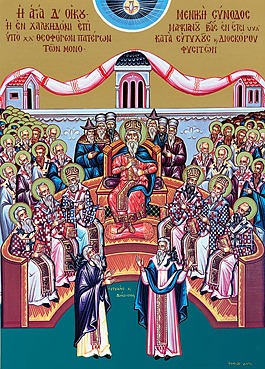
chalcedonAfter much controversy and struggle in the Church, the Council of Chalcedon (451 AD) put out a formal definition on person of Christ, regarding his full divinity, humanity, and the union of the two natures. While not exhausting the depth and beauty of the person of Christ, it lays down important boundaries within which theologians must stay if they are to properly teach the glory of the Son who took on flesh for our salvation.

Chalcedon has stood as the bulwark of orthodox-catholic Christology across traditions for a millenia and a half, and yet, while lengthy expositions of it are available, it still takes some time digging to find a good, clean summary explanation of what the Definition actually says. That’s why I was pleased to find this passage in Calvin’s comments on John 1:14, “and the Speech* (Word) became flesh, and dwelt among us”, in which he briefly and clearly expounds the scriptural truth that Chalcedon teaches:

The plain meaning therefore is, that the Speech begotten by God before all ages, and who always dwelt with the Father, was made man. On this article there are two things chiefly to be observed. The first is, that two natures were so united in one Person in Christ, that one and the same Christ is true God and true man. The second is, that the unity of person does not hinder the two natures from remaining distinct, so that his Divinity retains all that is peculiar to itself, and his humanity holds separately whatever belongs to it. And, therefore as Satan has made a variety of foolish attempts to overturn sound doctrine by heretics, he has always brought forward one or another of these two errors; either that he was the Son of God and the Son of man in so confused a manner, that neither his Divinity remained entire, nor did he wear the true nature of man; or that he was clothed with flesh, so as to be as it were double, and to have two separate persons. Thus Nestorius expressly acknowledged both natures, but imagined two Christs, one who was God, and another who was man. Eutyches, on the other hand, while he acknowledged that the one Christ is the Son of God and the Son of man, left him neither of the two natures, but imagined that they were mingled together. And in the present day, Servetus and the Anabaptists invent a Christ who is confusedly compounded of two natures, as if he were a Divine man. In words, indeed, he acknowledges that Christ is God; but if you admit his raving imaginations, the Divinity is at one time changed into human nature, and at another time, the nature of man is swallowed up by the Divinity.

The Evangelist says what is well adapted to refute both of these blasphemies. When he tells us that the Speech was made flesh, we clearly infer from this the unity of his Person; for it is impossible that he who is now a man could be any other than he who was always the true God, since it is said that God was made man. On the other hand, since he distinctly gives to the man Christ the name of the Speech, it follows that Christ, when he became man, did not cease to be what he formerly was, and that no change took place in that eternal essence of God which was clothed with flesh. In short, the Son of God began to be man in such a manner that he still continues to be that eternal Speech who had no beginning of time.

Commentary on John 1:14

The whole section is worth review as Calvin deftly comments on controversies both ancient and contemporary to his own day. Indeed, as challenges and confusions about just who Jesus is continue into our own, students and disciples of the Word would benefit from listening into the disputes of another age. While they’re framed in different ways, they are often-times structurally similar such that hearing the answer discussed in a context less immediate and personally-charged for us, can cast a clearer light for our own days.

Of course, the point of all this is not mere doctrinal correctness, but the life of doxology that follows. Christ is not properly worshipped and glorified, unless his magnificent person is properly taught and displayed according to Scripture.

Soli Deo Gloria 

*Calvin follows Erasmus in rendering the word ‘logos‘ as ‘Speech’ instead of ‘Word’. For his explanation, see his comments here.

Genesis 1: Meet the Author (The Story Notes)

My church has begun a church-wide, across all departments, study through The Story, a chronological, abridged edition of the Bible that takes you through the story of Scripture from Genesis to the end of Acts in 31, novel-like chapters. That’s what I’ll be teaching through with my college student for the next 9 months or so. It’s a fun project that’s challenging me to deal with narrative sections, teach large chunks at a clip, and point my kids to Christ throughout the whole redemptive-historical storyline of the text.

That said, it seemed worth it to start posting my notes for these talks on a regular basis. It might happen every week, or not, depending on how helpful I think it is, or time constraints. My one request is that you remember these are pretty rough notes and I’m teaching my students, not a broader audience.

Well, with that intro out of the way, here’s Genesis 1.

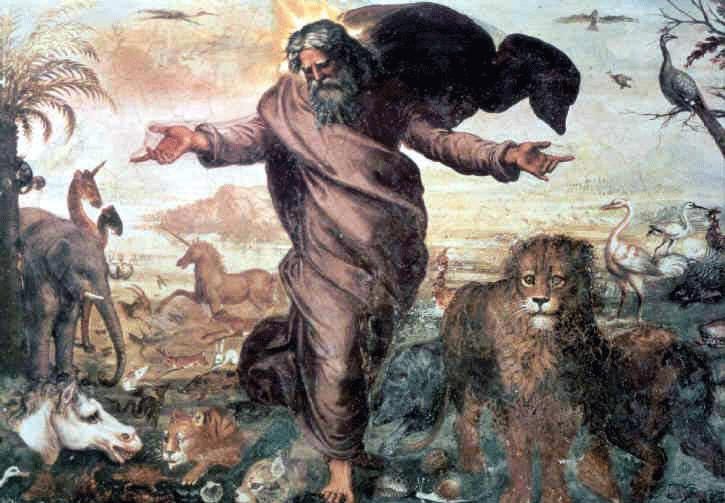
God-creating-creatures-by-RText: Genesis 1:1-2:3

Alright,  I’d like to have some nice fluffy intro, but there is so much to say here and  I can’t, which I hate so I’ll just start in. Note right off the bat, this is a beautifully-structured passage. Read it out loud like we just did and you notice it is a carefully constructed, poetic, balanced presentation whose structure has been arranged, measured, and given a rhythm and weight to it. This is not strictly Hebrew poetry, but it’s not just prose either. You’ll notice the repetition of key words and phrases over and over again with minor variations here.

There is a careful structure here built around sevens, which I wish I could go into in detail here, but let me ask you, which word stood out the most in that passage? What dominated it? There’s a lot of repetition and rhythm, but what was the center, the core, the heart of the passage?

“God”, right? I don’t know if any of you counted, but the word “God” is repeated 35 times, a multiple of 7, the number of perfection in Scripture. So, if you weren’t sure what the passage was about, very clearly, right out the gate, you see that, while there’s a lot going on, and we’ll get to some of it, at the center of the passage. and actually, the beginning and the end, stands God.

I make this point bluntly at the beginning because we’re going through the Story of the Bible and one thing you have to get clear if you’re going to understand it is just who the main character is and what is he like. If you think Gollum is the main character of LOTR you will be quite confused and disappointed at the ending, and well, throughout the novels. Or, if you understand that Frodo is the main character, but are under the impression that he is a wizard instead of a hobbit, you’ll be confused as to why he doesn’t magic himself out of certain situations. In the same way, if you miss that God is at the center of the story, and exactly what kind of God you’re dealing with, you’ll be rather confused as you read along.

So, it matters to know that this passage, and indeed, the series as a whole, is about God. This is what we’re trying to get out of this series: a knowledge of who God is, and really of God himself. Now, this passage presents to us a bit about who God is, by showing us the big thing that God ‘does’ to get the whole story going. And it tells us some key things about him that I just want us to start off with:

1. There is one God, ruler of all. – Against the ‘gods’ of the pagans and the polytheistic world, the Hebrew Scriptures testify to one God, sovereign ruler of all. In the Ancient Near East, the dominant creation myth had two gods fighting (Marduk and Tiamat), with Marduk coming out on top, killing Tiamat and creating the world out of her dead body, and human slaves out of her blood, with a pantheon of support gods behind him. In opposition to this, Genesis gives us a picture of a single God who simply commands things into existence. There is no cosmic battle, or fight, but the simple ordering of King God’s world. The stars, the moon, the sun that your neighbors worship? Those are lamps and clocks that Yahweh hung up in the sky. He is incomparable and unique. There is nothing and no one like him.

2. He is the Creator, not the creation. – God made stuff, he is not the stuff. Unlike some strands of modern New Age thought that says that God is the universe, we see that God made the universe. It all bears his mark, but he is not contained within it. Which is why he knows it inside out and is all-powerful over it. He made time and space so he is not contained by time and space. There is no limit to him. He is present to us here and now, but is not limited to here and now.  Something else that flows from this, is that the stuff is HIS stuff. All of it. Also, the stuff is good because he made it. The world is not something to be scared of, but enjoyed as his creation. (Next week we will talk about the fall and how things go bad.)

3. God is a Speaking, Communicating God – How does God make the world? God creates all things by speaking it into existence. He is, essentially, a communicator even in the way he creates. He ‘makes common’ the quality of existence to things that don’t exist yet. This also means that he is a God who can make himself known to us. We get skeptical about this nowadays because of our smallness, and our sinfulness, which is real. We start to doubt that we could ever really know what God is like, especially since so many people have different ideas about God. All we have are guesses.

Now, that sounds humble enough at first, but it denies what we see here in the text: that if God is a God who can effectively bring the world into existence through his words, so he can make himself known to us through his words. No, we can’t figure him out on our own, but God can make himself known to us.  And, in fact, part of our being made in his Image means that we can understand him when he does (apart from sin.)

4. God is Triune – This one is really the most important and undergirds and is revealed in the others. The sovereign King God who alone exists and is not creation but speaks it into existence has revealed himself as the Triune God: Father, Son, and Holy Spirit. To see this, we only get hints here in the text (The Spirit, hovering) but if you turn to John 1:1, you read “In the beginning was the Word, and the Word was with God, and the Word was God. He was in the beginning with God. All things were made through him, and without him was not any thing made that was made. (John 1:1-3, ESV)”

We see that the one God who is before all things and made all things, made it through his Word and Spirit. The fact that the world was made through the Spirit and By the Word, means that they are not the world–they are eternal God alongside the Father. See, from all of eternity, God has been Father, Son, and Holy Spirit, delighting in perfect community. This tells you something about why God created: he didn’t need us. He was perfect and complete, full of joy, love, and endless life. He was not lonely or needy. He did not make us to amuse himself or because eh needed help with things. His life is perfect apart from us. He created the world with a good purpose, though, to share himself with us.

5. God is a God of purpose and that Purpose is to Dwell With Us – To dwell with us. God created all things with a rhythm, a pattern, a meaning, an order (6 days). We saw that earlier. What I didn’t go into yet, was the two-part structure of the first 6 days of Creation. See, if you pay attention closely, you’ll see that what God does in the passage is first, create creation kingdoms (Light & Darkness, Waters & Skies, Land), and then, the next three days he creates creation kings who ‘rule’ or keep the areas (Sun & moon, Fish & birds, animals & Humans.).

More importantly, what we have to see is that the picture we’re getting is of God the King, constructing a palace, a Temple to dwell in and ‘rest’ on the ‘Sabbath’ of creation as the Creator King.  This is what anybody in the ancient Near East would have heard. At the end of those stories, the king god would always set up shop in their palace-temple and begin their rule. Here, we see the Creator King has finished establishing his kingdom and setting up his sub-rulers and so now he will dwell in his palace-temple. In this case, the whole world. (For more on this, see here.)

The idea is to dwell in the Temple of Creation with his creations. This is, in fact, why he creates us. The idea is that he wants to dwell with us to share himself with us and bless us. For us to enjoy him, know him, and enjoy the world that he made in the way that he intended us to.

That said, we are not the point of this text. We’re important. We come at the crown, we’re significant, more so than the rest of the creation, but let’s be honest, we’re still not the point. God is. We exist for God, by God, to God, in God’s Image. He makes all things and provides all things for us, but we are his. We are supporting characters.

And here’s the Problem – We tend to forget all of this. We tend to put ourselves at the center of the story, time and time again. We’ll talk about that next week in more detail when we come to the story of Adam and Eve and the fall. Still, we tend to put ourselves at the center of the story which screws with our ability to see the story for what it is. All of the problems we encounter become our problems to solve. All of the blessings in our life are our gifts to ourselves. All the purpose we have is whatever we’ve chosen for us. All of the good, the bad, the ugly, the weird, etc. is now on us or for us and to us, and the whole thing starts to lose it’s shape.

The biggest tragedy of all is that when we put ourselves at the center, we lose our ability to see GOD for who he is. It’s like losing the north star at sea, or forgetting who you’re married to, or losing equilibrium and living your life off-balance. When you lose sight of God, your life starts to lose shape.

In the Beginning –  This is what Jesus came to do: to put God back at the center of the story for us.

The true light, which gives light to everyone, was coming into the world. He was in the world, and the world was made through him, yet the world did not know him. He came to his own, and his own people did not receive him…And the Word became flesh and dwelt among us, and we have seen his glory, glory as of the only Son from the Father, full of grace and truth…No one has ever seen God; the only God, who is at the Father’s side,he has made him known.(John 1:9-11, 14, 18 ESV)

This God makes himself known, not just in general, but in one way. It’s not just ‘god’ but the God of Jesus Christ. He is the one through whom God made the world. And what we see here in John is that his purposes for Creation are reaffirmed through the life and ministry of Jesus Christ, the incarnate Son. He came to the world he made, and although we denied him, he decided to dwell with his creation that he made.

I don’t know what you needed to hear tonight. Maybe you needed to be reminded that you don’t set the grid for your life? That you are not the one setting the agenda? Maybe you needed to remember that God is bigger than your problems? Maybe you need to remember that the God who made all things can re-create the broken pieces? Maybe you need to be reminded that God’s purpose in Christ is to dwell with you? Or maybe, just maybe, you just need to take this time to worship, praise and adore something greater than yourself.

Listen to the Spirit speaking of the Son who points us to the Father, says in his written Word. Amen.

Soli Deo Gloria