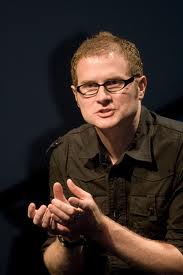
So Rob Bell Wrote Another Book About God — Some Thoughts Before Actually Reading It

Rob BellA couple of years ago Rob Bell wrote a little book about Heaven, Hell, and all that God stuff. You might have heard of it. If you haven’t, don’t worry about it–he didn’t say anything new. (Or necessarily very good. I’ll be honest, even though I was a Bell fan in college, I was pretty disappointed with that last one.)  In any case, it kicked off a little bit of a crap-storm in the Evangelical world. Well, actually, it was the online theological storm of the century. There were pre-emptive tweets by Evangelical megastars, negative reviews, glowing recommendations, counter-reviews, charges of heresy, charges of heresy-hunting, gangs roaming the internet with clubs watching for signs of dissent or support, refugee camps, and basically all that is unholy in the blogosphere.

At the same time, some good conversations and decent theology got out too.

Now, thankfully this all went down before I had a blog up and running. Given the amount of Facebook conversations I was involved in during that whole imbroglio, I praise God that in his providence that he spared me from my own immaturity. It seems though, that Rob Bell has written another book. It’s about God, or at least, What We Talk About When We Talk About God. Well, here’s the trailer:

Before I read it, or anybody else reads it, or writes a review, or tweets some 140-character gem and the whole blogging world explodes with outrage and applause, I have a few thoughts to offer up to the online world, both within my own Reformedish tribe, as well as those outside it:

1. Calm Down – First things first–calm down. Whoever you are, turn it down a notch. If you’re a Bell fan, slow your roll. No, he’s not going to unveil the secrets of the universe. It’s not revolutionary or visionary. He’s probably just written down something somebody else has written in a printed blog format

with

oddly-spaced lines that

emphasize some

point

that you’ve never heard of because you’re not reading

academically-hip

theological literature

like he

does.

If you’re a Bell critic, especially if you’re Reformed, calm down. Realize that if you really believe the confessions, none of what he writes means God isn’t actually sovereign, won’t take care of his church, or that the whole church will drift into heresy and death because of it. Yes, given the last book, you will probably not like a lot of this one. Yes, many people will read it and agree to propositions about and perceptions of God you find to be unworthy and un-scriptural. Yes, you might have plenty of correcting to do. But once again, this has been the situation of the Church for the last 2,000 years. It will survive one book.

In fact, just take a minute to recover by reading Romans 9 or some of the Institutes. There. Feel better?

Okay, let’s move on.

2. Read First, Shoot Later (Or, Don’t Shoot, Pray Before You Write) – This one’s mostly for critics–read the book before you say anything super-critical about it. Seriously. It doesn’t help to declaim something as full of heresy and beyond the pale if you’ve never read the dang thing. Also, when you do read it, do it with the spirit of generosity, trying your best to love your neighbor as yourself, reading as sympathetically as you’d like to be read. Don’t caricature or misquote, or uncharitably misrepresent. You might still find a whole bunch of stuff you don’t like–stuff that troubles and disturbs you so that you feel the need to correct in print. That’s fine. I believe firmly that any publicly-promulgated doctrine or false teaching needs to be corrected publicly for the health and life the church. Jesus and the apostles hated heresy, so if there is any, by all means, declaim away. That said, remember that it needs to be done in a spirit of love and with the integrity that flows from the Gospel. Our polemics may be passionate, but they should always be principled and never be putrid.  Truth cannot be championed by dishonesty, and especially if you’re a pastor, remember that you’re setting an example for your hearer/readers. The way you react often sets the tone for your people, as well as the watching world. As the old hymn goes, they will know us by our love. Love doesn’t exclude disagreement and confrontation, but it should change the way it goes down. Pray before you hit ‘publish’ on that blog.

3. Try to Understand the Other Team – I hate to call them teams, but yes, in issues like this, realistically the theological spectrum ends up splitting into opposing teams who drive the conversation, with some people trying to occupy the center but usually leaning one way more than the other. I’ll just say that both sides need to strive to understand the other’s concerns. For instance, if you read Love Wins and you didn’t for an instant sympathize with the criticisms that Bell was launching against some traditional doctrines, I’m just going hazard a guess that you’re probably not an effective evangelist, because he was hitting at legitimate (or at least common) theological and cultural concerns. I’m not saying he gave the right answers, but if you can’t understand why those answers resonated with so many in our culture, then you’re not going to be able to thoughtfully and compassionately provide the answers you deem to be the biblical ones with any kind of charity or grace to those without as clear of a theological vision as you. At the other end of things, if you were a Bell fan and you absolutely loved the book, and were unable to see the criticisms as anything more than insecure heresy-hunting conducted by narrow-minded gate-keepers, then I’d hazard a guess that you might be suffering from a sort of reverse-theological boundary keeping, which immediately privileges anything deemed to be “unorthodox” by the Evangelical majority. If you can’t see why more thoughtful, sensitive believers of a more “conservative” bent might have felt attacked or caricatured in that book, you probably won’t be someone who can graciously and thoughtfully correct them on what you deem to be their theological deficiencies.

4. Criticism Is Not Inherently Narrow-minded Oppression – Expanding on that last point, realize that we wouldn’t have half of the New Testament if the apostles like Paul, John, or Peter weren’t passionate about correcting errors both in doctrine and practice. Colossians is an attack on syncretistic theology of a Jewish-Hellenistic sort that threatened to lead the Colossian believers back into a beggarly superstition, trusting in various intermediaries instead of the supremacy of Christ. Galatians combats the Judaizing failure to recognize the eschatological shift in redemptive-history brought about by Jesus’ life, death, and resurrection due to nationalistic self-righteousness, which threatened to split the community between Gentiles and Jews. John combats love-denying proto-Gnosticism that, again, tears at community. The list could easily go on. The NT authors pursued public false teaching with passion because they knew that there was a real link-up between sound doctrine and a life-giving love of God in their flocks. The point is, Bell fans need to realize that when he writes a book publicly expounding a theological position that sets itself in direct, or even tacit, opposition to a large portion of the theological populace, criticizing and writing it off, it is not unreasonable to expect some push-back–not because his theology is necessarily heretical. It might not be. But even if it is merely perceived as such, understand that it might be very real, pastoral concern that drives the criticism, not personal animosity or jealousy. Because he’s a teacher, even if he’s just “asking questions”, (there’s a way of “asking questions” that’s really answering them), every public word is held to account. (James 3) My point is, not every criticism is narrow-minded oppression of theological diversity, but might be real pastoral accountability being exercised, even if you think it’s mistaken.

5. Cling to What is Good, Hate What is Evil – Depending on which translation you use, Romans 12:9 might place the “hate what is evil” or the “cling to what is good” first. In this case, as a word to the initially apprehensive, I would say go in with an attitude that seeks to learn or discern whatever good you can from the book before you find the less-than-good. Of course, be like the Bereans and test everything against the scriptures. (Acts 17:11) If you find something in there that doesn’t line up, reject it. That’s a given. Still, it bears repeating that before you go hunting for everything that’s wrong with it, try to find the good you can affirm on the basis of God’s self-revelation in Christ and the scriptures. If for no other reason than to be able to have a fruitful conversation with someone who actually enjoyed the book, you need to be able to affirm the good before you move to critique the bad.

I don’t expect that this is the only thing I’ll say on the whole issue. I might even write one of those critical or, I wish, glowing reviews. (I’d love to love this book.) But for now, before I’ve read a single word, here’s what I’ve got to say. I pray it blesses God’s church, bringing more light than heat.

Soli Deo Gloria

All Things to All People? Really, Paul?

If you’ve heard more than 1 or 2 sermons on evangelism or outreach you’ve probably heard Paul’s declaration: “I became all things to all people so that by all possible means I might save some.” (1 Cor 9:22) Paul here makes the point that he has used his freedom in Christ, not for selfish gain, but in order to identify as far as possible with people in all cultural, racial, and socio-economic categories in order to present the Gospel to them. We would expect no less from the Paul who says that, “there is neither Jew nor Gentile, neither slave nor free, nor is there male and female, for you are all one in Christ Jesus.” (Gal. 3:28)

Paul preachingPaul was about reaching everybody and so should we be. Right. I think a lot of us might pay lip-service to this but we don’t understand the real scope of who Paul interacted with–the fact that for Paul this wasn’t just a preacher’s hyperbole, but a straight-forward description of his practice. Historian Robin Lane Fox gives us an eye-opening summary of Paul’s ministry in his magisterial account of the Christianization of the Roman Empire:

Paul admitted to being “all things to all men,” and our best account of a Christian mission, the Acts of the Apostles, bears him out. Paul’s churches included slaves and people who needed to be told “not to steal”: Paul himself referred to the “deep, abysmal poverty” of his Christians in Macedonia. Yet his converts also included people “in Caesar’s household,” slaves, presumably, in the service of the Emperor. At Corinth, he converted Erastus, the “steward of the city,” another eminent post which was often help by a public slave: it is quite uncertain whether this man could be the Erastus whom a recent inscription in Corinth’s theatre revealed as a freeborn magistrate, the aedile of the colony. He attracted women of independent status and a certain property, people like Phoebe, the “patroness” of many of the Christians at Corinth, and Lydia, the “trader in purple,” a luxury commodity. These women ranked far below the civic, let alone the Imperial aristocracies. But Acts adds a higher dimension which we might not otherwise have guessed: Paul was heard with respect by one member of Athen’s exclusive Areopagus and by the “first man of Malta.” He received friendly advice from “Asiarchs” in Ephesus, men at the summit of provincial society, where they served at vast expense as priests in the Imperial cult. On Cyprus, he impressed the Roman governor, Sergius Paulus, by a miracle which he worked in his presence.  —Pagans and Christians, pg. 293

Paul’s boast was not empty; his contacts range from prisons to palaces. Now, aside from having Jesus come to personally knock him off his horse and commission him to preach the Gospel, Paul was a uniquely gifted man. Orthodox, brilliant, and cosmopolitan he was able to relate to the upper echelons of intellectual culture and society with ease. No doubt this is what impresses many of us–it should. Not all Christians can interact at the high levels at which Paul did. God calls and equips some of us for these extraordinary levels of witness and that deserves a special appreciation for the gifting and sacrifice that requires.

What ought to be even more fascinating in the example of Paul though, is that a man of such native talent and ability did not count it beneath him to pastor people who “needed to be told ‘not to steal’.” Part of what captivates us about Paul’s high-level contacts is that we would love to rub shoulders with the elite, the rich, the social movers and shakers. It’s a glamorous ministry to most of us. (Of course, Paul got a lot of these opportunities after getting arrested or having the tar beat out of him, so it wasn’t that glamorous.) Still, much, if not most, of his ministry was not to the social elite but to the outcast–both racially (Gentiles), and socially (slaves, barbarians, etc.) He humbled himself, made himself as nothing, going to dregs of society in order to share the Gospel. Of course, in this he was only following his master. (Phil 2:6-9)

That’s something for us to consider in this new year: am I striving to become the kind of person of whom it could be said “she became all things to all people” for the sake of the Gospel? Even of the poor? Even of the dregs? Even of the outcast? Are our churches the kinds of places where pastors need to be continually reminding people “not to steal”? Who is welcome among us? Who catches our attention as an object of God’s grace in the Gospel? Have I been humbled by the Gospel enough to follow Paul, who followed Christ?

For those of us struggling with this, it might be helpful to recall Paul’s words to the Corinthians when they were getting too big for their britches:

For consider your calling, brothers: not many of you were wise according to worldly standards, not many were powerful, not many were of noble birth. But God chose what is foolish in the world to shame the wise; God chose what is weak in the world to shame the strong; God chose what is low and despised in the world, even things that are not, to bring to nothing things that are, so that no human being might boast in the presence of God. And because of him you are in Christ Jesus, who became to us wisdom from God, righteousness and sanctification and redemption, so that, as it is written, “Let the one who boasts, boast in the Lord.”

1 Corinthians 1:26-31

Soli Deo Gloria

Playful, Passionate, Principled, but never Putrid Polemics (Or, Don’t Forget Jesus in an Argument)

If you’ve ever had an “intensely engaged” discussion with a friend in person, a facebook comment, a blog, etc. the odds are that you’ve engaged in polemics. The Webster definition of polemics is “an aggressive attack on or refutation of the opinions or principles of another” or “the art or practice of disputation or controversy.” Basically it’s a form of reasoned argumentation against a position with which you disagree.

Having spent a couple of years in a philosophy program, then seminary, as well as far too much time on the blogosphere, I’ve observed and participated in quite of bit of polemics myself. I have what you might call a “polemical bent”,  which is probably why I like thinkers like Luther, Calvin, Pascal, Kierkegaard, and Plantinga. Brothers can argue.

In that time, I’ve had some time to think about  some of the basic attitudes and approaches to polemics, some of which are consistent with Christian life and some of which are not. I’d like to offer up some reflections three qualities or attitudes that should define your approach to whatever discussion you engage in, and one that shouldn’t. These aren’t comprehensive, exhaustive, or entirely correct, but, for what it’s worth, here they are.

Playful– The first quality that I think should be cultivated within our discussions with others  is playfulness, a certain amount of mirth and good humor. It’s that kind of light-hearted reasonableness that G.K. Chesterton seems to embody in his works like Orthodoxy and Heretics. To say that his arguments are playful is not to say that they aren’t “serious”, or aren’t dealing with serious issues, but that they are clearly not driven by fear or pride but rather a humble self-forgetfulness and joy deeply rooted in the Gospel. His ability to sport and laugh at, and with, his interlocutors managed to communicate both disagreement with and real fondness for them. This is not an excuse for being flippant, disrespectful, or condescending. When your heart is filled with confidence in God, it allows you to speak with humor and grace knowing that whatever the outcome of the argument, you’re securely held in the arms of your Father because of the Son. One of the benefits of engaging your intellectual “opponents” with this attitude is that it is attractive. So often people are used to dealing with Christians arguing out of their insecurities or pride which drives them to be snippy, harsh, humorless, and retaliatory. Nobody wants to listen to someone like that, or end up believing whatever they’re arguing for. The Gospel should lead to a confident, good-naturedness that, on the one hand, respects the other person, and at the same time allows you to take yourself less seriously.

Passionate– The second quality that ought to characterize our polemics is passion.  Like the first, it is deeply rooted in the truth of the Gospel and a deep love for people. You can see this is all over Paul’s letters. Paul is nothing but passionate in his polemics for the sake of the Gospel. Galatians, anybody? Paul goes aggro in that letter because of his great gospel-fear that they might be abandoning Christ, and so he forcefully makes his points at times, giving voice to his real concern in order to communicate just how important the issue was. Sometimes people might know you disagree, but really have no idea how important an issue is until they hear the concern or passion in your voice. Paul’s letter not only communicated truth, but the way he communicated it gave it an emotional tenor, an urgency, that was just as vital as the content. A lot of us may be scared of passionate engagement with our neighbors and friends over the truth. We’re scared of offending, or coming off as pushy or unloving. In a world like ours where our radios, TVs, and blogs are full of people just yelling and trying to brow-beat people into submission, that’s a real danger. I don’t want to minimize that. We should never argue just to argue. So often that’s what we find ourselves caught up in: meaningless arguments about things that really, nobody should get that agitated over. Still, this shouldn’t stop us from engaging passionately with our friends about things that really matter. Love engages over truth. Apathy or an unwillingness to trouble yourself with have a difficult conversation out of fear is not the loving thing to do. The truth is something to be passionate about because truth is about life.

Principled- The third quality that it ought to possess is that of being principled. (Honestly, I could have used other words like “integrity”, “honesty”, etc, but I’m a sucker for cheap alliteration.) We must always strive in our engagements with others to be principled in our dealings, speaking honestly, actively avoiding unfair caricatures, and cheap shots. Whenever arguing against a position we must strive to represent our interlocutors accurately, fairly, and charitably. In other words, don’t purposely take the dumbest interpretation of any statement they make and argue against that.  That’s just dishonest. I’ll be the first to admit that there is a place for irony, sarcasm, and the reductio ad absurdum in arguments. There is a place for humorously following someone’s premises out to their surprising conclusions, or creating humorous, sarcastic analogies to bring out a point. Still, there is absolutely no place for a lack of integrity in our communication with others, even those with whom we deeply disagree. This is part of how we love our neighbors as ourselves as Jesus taught us to. Being people who confess the lordship of Jesus, the one who is the Truth, we should never play fast and loose with the truth in order to score a cheap, rhetorical point.

Never Putrid– If we strive for and keep these three qualities in mind as we engage others, they will keep us from descending into the putrid polemics that seems to define our culture’s approach to “rational”discourse. So much of what we hear and read today pours out of corrupted hearts darkened by arrogance, rage, pride, fear, and the rot of our decomposing sin nature. So much of what is popular out there is just straight-up lies, fear-mongering, cynical mockery, caricature, manipulation, gracelessness, straw-manning, cheap shots, and rhetorical bullying. It is simply putrid. For those of us who have been raised in Christ and indwelled by the resurrection Spirit of God, there should be nothing rotten or foul about what we say. Even those words we utter that cut should only cut in the way a doctor’s scalpel does–in order to heal. They should be words of life, not death, because we are made, and are being remade, in the image of the God who, by his Word, speaks life into existence.

Once again, I write all of these things, not as someone who has achieved or arrived. Lord knows I have not even come close in this area. Instead, I write them as one still struggling alongside; still fumbling about trying to become the kind of person who speaks rightly and righteously.

Why Jesus Hates Heresy (And So Should You)

I’d like to take a moment to point something out that may have escaped your attention last time you went to church or watched  a Nooma: Jesus and the rest of the New Testament authors don’t like false teaching, or heresy. I mean, they really hate it. It doesn’t take long reading through the thing to see the forceful way they spoke of “false teachers/prophets” and “false teaching” about God and the Gospel.  Don’t believe me? Here are just a few quotes. See for yourself.

Gentle Jesus

Beware of false prophets, who come to you in sheep’s clothing but inwardly are ravenous wolves. You will recognize them by their fruits. Are grapes gathered from thorn bushes, or figs from thistles? So, every healthy tree bears good fruit, but the diseased tree bears bad fruit. A healthy tree cannot bear bad fruit, nor can a diseased tree bear good fruit. Every tree that does not bear good fruit is cut down and thrown into the fire. (Matthew 7:15-20)

Not so Gentle Paul

I appeal to you, brothers, to watch out for those who cause divisions and create obstacles contrary to the doctrine that you have been taught; avoid them. (Romans 16:17)

I am astonished that you are so quickly deserting him who called you in the grace of Christ and are turning to a different gospel—not that there is another one, but there are some who trouble you and want to distort the gospel of Christ. But even if we or an angel from heaven should preach to you a gospel contrary to the one we preached to you, let him be accursed. As we have said before, so now I say again: If anyone is preaching to you a gospel contrary to the one you received, let him be accursed. (Galatians 1:6-9)

Now the Spirit expressly says that in later times some will depart from the faith by devoting themselves to deceitful spirits and teachings of demons, through the insincerity of liars whose consciences are seared, who forbid marriage and require abstinence from foods that God created to be received with thanksgiving by those who believe and know the truth. For everything created by God is good, and nothing is to be rejected if it is received with thanksgiving, for it is made holy by the word of God and prayer. (1 Timothy 4:1-5)

O Timothy, guard the deposit entrusted to you. Avoid the irreverent babble and contradictions of what is falsely called “knowledge,” for by professing it some have swerved from the faith. Grace be with you. (1 Timothy 6:20-21)

Old-Man John

Beloved, do not believe every spirit, but test the spirits to see whether they are from God, for many false prophets have gone out into the world. (1 John 4:1)

Beloved, do not believe every spirit, but test the spirits to see whether they are from God, for many false prophets have gone out into the world. By this you know the Spirit of God: every spirit that confesses that Jesus Christ has come in the flesh is from God, and every spirit that does not confess Jesus is not from God. This is the spirit of the antichrist, which you heard was coming and now is in the world already. (1 John 4:1-3)

For many deceivers have gone out into the world, those who do not confess the coming of Jesus Christ in the flesh. Such a one is the deceiver and the antichrist. Watch yourselves, so that you may not lose what we have worked for, but may win a full reward. Everyone who goes on ahead and does not abide in the teaching of Christ, does not have God. Whoever abides in the teaching has both the Father and the Son. If anyone comes to you and does not bring this teaching, do not receive him into your house or give him any greeting, for whoever greets him takes part in his wicked works. (2 John 1:7-11)

Peter “the Rock” Bar-Jonah

But false prophets also arose among the people, just as there will be false teachers among you, who will secretly bring in destructive heresies, even denying the Master who bought them, bringing upon themselves swift destruction. And many will follow their sensuality, and because of them the way of truth will be blasphemed. And in their greed they will exploit you with false words. Their condemnation from long ago is not idle, and their destruction is not asleep. (2 Peter 2:1-3)

This is Weird to Us

These quotes can seem disturbing to people of our age.

Our culture likes the idea of heresy. Whenever you see the word ‘heretic’ used on your average blog, news article, etc. it’s synonymous with bold, controversial, and creative thinking. It’s thought not confined with dogma and church controls. It’s ideas that scare the “theologians”, and break out of the traditional mold. (As to why scaring theologians has become a valued activity, I’m somewhat puzzled. Is there similar trend elsewhere? Should I want to perplex philosophers? Or, mystify mathematicians?)

It’s sexy.

Alister McGrath has even gone so far as to talk about our “love affair with heresy.” It epitomizes all that us entrepreneurial, free-thinking, radically individualistic Americans believe about religion. It’s up to us to figure out and nobody has a right to lay down a “correct” or “right” way to think about spirituality and God.

In this context, anybody trying to talk about orthodoxy or heresy immediately calls to mind images of nefarious, medieval church councils, trials, and other wickedness. (Which, incidentally were the result of false teaching about the nature of the church.)

So, why do they think different?

So why do Jesus, Paul, Peter, and John seem to approach the problem of false teaching differently than we do? Their attitude seems so intolerant and harsh. What about freedom of thought? Independence of mind?  What accounts for the difference? Is it just that we are more enlightened and cosmopolitan than these backwards dogmatists?

Eugene Petersen, my favorite pastoral theologian and theological pastor, cuts to the heart of the matter when discussing John’s attitude towards false teaching:

“Our age has developed a kind of loose geniality about what people say they believe. We are especially tolerant in matters of religion. But much of the vaunted tolerance is only indifference. We don’t care because we don’t think it matters. My tolerance disappears quickly if a person’s belief interferes with my life. I am not tolerant of persons who believe that they have as much right to my possessions as I do and proceed to help themselves… I am not tolerant of businesses that believe that their only obligation is to make a profit and that pollute our environment and deliver poorly made products in the process. And [John] is not tolerant when people he loves are being told lies about God, because he knows that such lies will reduce their lives, impair the vitality of their spirits, imprison them in old guilts, and cripple them with anxieties and fears…

That is [John’s] position: a lie about God becomes a lie about life, and he will not have it. Nothing counts more in the way we live than what we believe about God. A failure to get it right in our minds becomes a failure to get it right in our lives. A wrong idea of God translates into sloppiness and cowardice, fearful minds and sickly emotions.

One of the wickedest things one person can do [is] to tell a person that God is an angry tyrant, [because the person who believes it will] defensively avoid him if he can… It is wicked to tell a person that God is a senile grandfather [because the person who believes it will] live carelessly and trivially with no sense of transcendent purpose… It is wicked to tell a person a lie about God because, if we come to believe the wrong things about God, we will think wrong things about ourselves, and we will live meanly or badly. Telling a person a lie about God distorts reality, perverts life and damages all the processes of living.”, Traveling Light: Reflections on the Free Life (Downers Grove, Ill.: InterVarsity Press, 1982), pp. 33-35.

We don’t care about false teaching and heresy because we don’t see what it does. We don’t see that “A lie about God becomes a lie about life.” Jesus is intensely opposed heresy because he doesn’t miss the connection between what we believe about God and every inch of our lives. Paul opposes it with every fiber of his being because he is passionately for the church. John is not simply out to control his “beloved”, but rather make sure that they remain free, truly free to live the life God has called his children to.

Good theology is not just an academic exercise for “theologians” in seminaries. It’s not just for pastors in their studies. It’s for everyday Christians for everyday living. This is why we care about these things. This is why we preach, teach, and correct in light of the Word of God.

So again, “Why does Jesus hate heresy?” He loves you too much to have you believe lies about God.

Soli Deo Gloria

Resources for avoiding Heresy:

1. Any good systematic theology. (Classic Christianity by Thomas Oden, The Christian Faith by Michael Horton)
2. Heresies and How to Avoid Them by Ben Quash and Michael Ward
3. Heresy: A History of Defending Truth by Alister McGrath
4. Free article by Craig Blomberg “The New Testament Definition of Heresy (Or When do Jesus and the Apostles Really Get Mad?)