Locating Atonement: Explorations in Constructive Dogmatics (Review)

locating atonementFred Sanders and Oliver Crisp sure know how throw a party. Or “theology conference.” This past year’s LA Theology Conference was focused on the idea of “locating atonement” and they pulled out all the stops, drawing in names like Bruce McCormack, Matthew Levering, Michael Horton, and a host of others. Their stated aim was to take us beyond the important, yet typical questions plaguing atonement discussions over the last 70 years such as: How many typologies or “theories” of atonement are there? Which one is right? How do we relate them? and so forth. Instead, they tasked their presenters with examining the subject of atonement in light of its relations to other doctrines. Ten months later, they’ve delivered an exciting new volume on atonement theology Locating Atonement: Explorations in Constructive Dogmatics.

As a general comment on the collection of essays as a whole, it’s important to note that they’re not presented as one, unified work. There is a diversity among the contributors with respect to issues like impassibility, penal substitution, how much “ontology” plays a role in our accounts of atonement, and so forth. That said, a few characteristics come through. First, they’re all top-notch. Second, they demonstrate a broadly catholic, if predominantly Western orientation, attuned to the theological tradition that comes before it. Finally, as technically erudite as these essays can get, all of them have their eye on the preaching and teaching of the Church, not merely the formulations of the academy.

Though all the essays were worth engaging–so I will–my comments on each will vary because, well, this review got away from me. That said, length of summary should not be necessarily read as an indication of the relative value of each essay.

After Sanders and Crisp’s intro, Adonis Vidu opens up the constructive essays by taking up a thread in his work in Atonement, Law, and Justice on simplicity and divine action (one of my favorites of 2014). Specifically, he sets about trying to set the atonement in the context of the trinitarian principle that the external works of the Trinity are undivided. In other words, there are no works that the Son does in which the Father and the Spirit are not intimately and also equally involved since they have one shared nature, will, and mind even though possessed their own particular way. So, while it is the Son who becomes incarnate, he does so in the power of the Spirit and in accordance with the will of the Father and so forth. Using this classic principle and a strongly Thomistic account of simplicity and pure being, Vidu tries to help smooth out some of the less helpful ways we popularly think about atonement, specifically with the idea that the Father is somehow acting on or against the Son in a way that threatens the unity of the Godhead. In doing so, Vidu raises some important and salutary concerns, trying to direct our attention to the classic tradition which formed the theological context in which our atonement doctrines were originally formulated and outside of which, it can likely only suffer distortion. My only concern is that while he has forcefully and rightly protected the undivided unity of action, I’d love to see him fill out the distinctness within that unity a bit more.

Matthew Levering’s delightful essay relates the doctrine of creation and atonement by engaging Nicholas Wolterstorff on the issue. Wolterstorff recently challenged the “reciprocity principle” at the heart of satisfaction accounts of atonement, essentially by appealing to Jesus’ rejection of the principle in the Sermon on the Mount. This, in turn, shapes his objections to classic satisfaction accounts. In response, first, Levering counters by showing that Wolterstorff’s reading of Jesus and the New Testament is simply wrong on its own terms. Jesus actually reaffirms the reciprocity principle in a number of places as do the apostles. Second, he grounds this reading theologically by expounding Aquinas’ account of God’s gift of distributive justice with the gift of creation. But I won’t blow that for you. Suffice it to say that this is a quintessentially careful piece of theological reasoning from Levering that you won’t want to ignore.

In his piece, Jeremy Treat argues that covenant is an integrative doctrine for atonement theology, which allows us to cut through a number of false dichotomies plaguing us in the contemporary discussion. In a sense, he strives to give a broadly covenantal approach, situating Jesus’ work as the recapitulation and fulfillment of the story of Adam and Israel, attempting to appeal even to the non-Reformed. Using covenant as the key grid for organizing our understanding of atonement, Treat argues that atonement can be both legal and relational, individual and corporate, retributive and restorative, as well as make sense of the unity of Christ’s atoning life, death, and resurrection. These twenty pages would save us all a lot of grief if they were broadly digested within the church. Also, if you haven’t picked up Treat’s The Crucified King–which you should have–this ought to whet your appetite for it.

Benjamin Myers offers up a piece relating atonement and incarnation by expositing the “patristic model” of atonement. In doing so, he’s trying to move us past Gustaf Aulen’s rather skewed “classical” ransom account of atonement offered up in Christus Victor, which tended to obscure things a bit. In past times, writers like J.N.D. Kelly had referred to this stream of thought as something of a physicalist account because it hinges on the Son becoming man, joining his immortal deity to our mortal natures, passing through life, and overcoming death by filling our mortality with his unconquerable life through resurrection. And that’s a horrible summary of Myers’ careful 12-step case. Myers has done us all a favor in highlighting and recapturing a stream of Patristic thought often lost to us in the post-Aulen discussion–a 12-step program, if you will. My one argument is with his treatment of Athanasius that, for my money, tries a little too hard to screen out the penal and forensic elements within it. Indeed, it’s rather instructive to compare his essay at this point to Levering’s earlier appeal to those same passages in conjunction with Thomas. All the same, strong showing from the Australian contingent.

Kyle Strobel and Adam Johnson have a rather unique essay on the relationships between wisdom and atonement. It’s a rather phenomenal little piece that treats the atonement as a work of God’s Wisdom, rescuing the world from its folly through the foolishness of the cross. I’m temped to say it’s almost a way of retelling the whole economy of redemption from the angle of wisdom.  It’s a treasure trove of theological insight (might have been the most surprising essay at the conference for me) and word on the street is Johnson is following it up with a little work on atonement that should be smashing.

Luke Stamps treats the often-forgotten yet crucial doctrine of dyothelitism (that Christ had two wills, a human and a divine one according to each nature) with respect to the atonement.  This is one of those places where clear, systematic thinking is most helpful with exegesis. There are number of key insights here, but for me, the bit that finally clicked was the way monothelitic accounts of Christ’s will, of necessity, require a social trinity doctrine. Without understanding that Christ has two wills–one human and one divine will shared with Father and Spirit–the only way Christ can pray “Not my will but yours”, is if the Son as God has a will distinct from that of the Father and the Spirit. Some might want to go there, but Stamps shows why this reading might have some costs to our doctrine of the Trinity we should not be willing to pay.

Daniel J. Hill and Joseph Jedwab’s essay focuses on relating atonement and the very concept of punishment. Without actually arguing for its justness, they present an argument for the conceptual coherence of the idea of the Son being punished for or assuming responsibility for the sins of others. It’s a fairly analytic essay and, for what it aims to do, fairly helpful. That said, it’s necessarily quite limited.

Eric T. Yang and Stephen Davis offer up a piece analyzing the link between wrath and atonement. They present a somewhat standard defense of the notion of the appropriateness of affirming wrath as an affection or emotion in God, with a disappointing but typical rejection of impassibility. What’s more, they argue that not simply penal substitutionary accounts, but other forms ought to consider incorporating a robust notion of divine wrath in their readings of the atonement.

T. Mark McConnell relates the doctrine of atonement with the much-neglected issue of shame as distinct from guilt. Guilt says, “I have done wrong”, while shame says, “I am wrong.” According to McConnell, not only are we living in a society that is awash in shame, even if it’s lost its sense of guilt, at the heart of the Scriptures is a story about God overcoming Adam’s nakedness and shame in the Garden. Drawing on Ireneaus and the theology of the vicarious humanity of Christ from T.F. Torrance, McConnell lays out the way that understanding atonement as recapitulation allows us to see Christ reconstituting and remaking us as overcoming of our alienating shame in his reconciling life, death, and resurrection. Jesus is the one who bears our shame away, killing it on the cross, and clothing us once more. Overall, this is a very important pastoral dimension to the atonement that ought to be regained where it has been lost. That said, I would definitely shy away from adopting the “fallen humanity” view which McConnell has forwarded–I think something like his model can and must be constructed without it–nor would I necessarily foreground shame as prior and deeper to the problem of guilt as McConnell has. Bracing essay, nonetheless.

Alongside Vidu’s, Bruce McCormack’s essay on atonement and human suffering is the densest of the various pieces, defying easy summary. It’s also one of the most conflicted for me. In order to treat the problem of suffering and the will of God, McCormack develops a theological account of the death of Jesus as the will of God. First, he treats it in terms of the Gospel accounts where Jesus’ death is seen as the apocalyptic outpouring of the wrath of God upon the Son. McCormack then turns to deepening the New Testament witness through H.U. Von Balthasar’s profound theology of the cross and his account of the judgment of hell and being with the dead. Though, of course, with his own Christological corrections. With this account in place he argues for the uniquely redemptive nature of Jesus’ death as an answer, not to mere physical death, but as the foundation for the resurrection. It is a condemnation of the old order, paving a way for the new. For myself, I couldn’t go with this tinkering with impassibility, view of synthetic construction of the gospels, and a couple other Barthian themes related to God’s being and history. All in all, though, a stimulating and moving read.

I’ll be blunt and say that Elenore Stump’s was the most frustrating for me. Of course, it was sharp work. It is Stump; she’s brilliant. But theologically, her attempt to offer a cut-rate account of the atonement’s relation to the Eucharist thinly-conceived, had some some rather semi-Pelagian tendencies. That said, her discussion of second-person experiences and the role of story in our spiritual formation was illuminating.

Michael Horton rounds out the books with his chapter on Ascension and atonement. He provocatively sets out to answer H.U. Von Balthasar’s charge that Protestantism can’t encompass or reckon with Ireneaus’ basic attitude in theology. He does so in tracing out two streams of thought on ascent and descent, salvation, and metaphysics. One is an Irenaean stream and another Origenist, with Origen the less congenial of the two. It’s a tale of two ascensions, two deifications, two Eucharists, and two metaphysics. Unsurprisingly, Calvin and the Reformed tradition a la Bavinck are clearly the heroes here. And I agree with that point. But Horton does his best to show them in continuity with a broader “catholic” tradition, as well. Again, this one defies simple explanation, but it’s really a first-rate piece to close down the house.

Well, that about wraps it up. If you haven’t picked up on it, yet, I highly recommend the volume. Oliver Crisp and Fred Sanders have done a bang-up job pulling this all together.

Soli Deo Gloria

Gratitude: Leithart’s History of Western Philosophy According to Grandma’s Tureen

gratitudeI love a good intellectual history when I can get my hands on one. Intellectual histories, if done right, give you a solid blend of philosophical (theological, etc) engagement, history, and joy of a well-told story. That’s exactly what Peter Leithart delivers in his recent (2014) offering Gratitude: An Intellectual History. Many will know that the idea of “the Gift” has gotten a lot of attention over the 20th Century in philosophy, anthropology, and related fields. When anthropologist Marcel Mauss “rediscovered” the reciprocity involved in the process of gift-giving in the tribal culture of Polynesia and Melanesia, he kicked off a chain of reflection on the conditions and reality of the gift. What goes into making a gift a gift? What are the ties implied in the giving of the gift? Contemporaries tend to think of gifts as, of necessity, having “no strings attached.” But if every gift implies an obligation, a “debt” of gratitude, can there every truly be such a thing as a gift?

Leithart noticed a gap in the literature. While there’s no end of resources on the gift, there’s little that’s focused on the corresponding category: gratitude. Gifts and gratitude go together. But just exactly what that means, it turns out, has been a matter of debate and controversy over the centuries in the West. Gratitude hasn’t always been simply an issue of thank you cards after your wedding—indeed, it probably never has been simply an issue of anything. The circle of gifts and gratitude have made the world go round, encompassing everything from the deepest questions of political theory, interpersonal ethics, and the nature of the divine-human relationship itself. Paul, lest we forget, says ingratitude–not acknowledging God’s gifts for what they are–is at the heart of human rebellion against God (Romans 1).

Taking an expansive view, Leithart, then, aims to tell the story of the Western history’s various political, philosophical, theological, and cultural orientations towards the nature of gift and the corresponding enactment of gratitude. Guided by Leithart’s steady hands, we are led through a movement from circles of honor in ancient Greece and Rome, to the ingratitude of Jesus, on to the patron(age) saints of the Middle Ages, the disruptive ingratitude of the Reformers, an attempt to bend the circles into straight lines in modernity, and up through the methodological ingratitude of postmodernity. Summarizing this engagement is beyond me. That said, it’s not beyond Leithart to summarize himself. And that’s exactly what he does at the end of the work, using a delightful thought experiment: Grandma’s gift soup tureen.

Leithart asks us at the beginning of the book to enter into the dilemmas of gift of gratitude by imagining this situation:

Imagine that your beloved grandmother gave you a rather ugly soup tureen as a wedding gift. Seeing as you have no use for the tureen, how ought you respond? You would, of course, write an appropriately deceptive note of thanks, but what then? Would you box the tureen away and never use it? Would you use it to feed the cat? What if Grandma were coming for dinner? Would you let her see you using her gift to feed the cat?…Variations on the hypothetical can be spun out further…but the point is clear enough. Gifts, especially from a respected giver, carry something of the giver with them. (16-17)

Gifts carry a responsibility, then, of showing proper gratitude and an ethic that is associated with it.

With this in mind, Leithart decides to summarize his story by playfully imagining what a variety (though not the totality!) of the figures treated in his narrative would tell you about how to respond to Grandma’s ugly, gift tureen:

  • Aristotle would warn you that receiving the tureen puts you in a position of inferiority and that, if you want to be a virtuous and independent person, you should pay Grandma back with a bigger gift as soon as possible. Then forget you ever received the gift in the first place.
  • Cicero would tell you to follow accepted custom, take the gift, look for a chance to reciprocate, and expect that your good offices will advance your political career.
  • Seneca would encourage you to exaggerate the quality and beauty of the gift, to appear at Grandma’s door every morning to accompany her on her way to the grocery store, loudly celebrating her generosity at every stoplight. He would encourage you to look for the right time and way to repay her.
  • Jesus and Paul would tell you to honor and love Grandma, thank God with sincerity, and move on.
  • The Beowulf poet would encourage you to pass out soup tureens to your employees to display your largesse.
  • Calvin and Luther would tell you to thank God, while recognizing you do not deserve the tureen or your grandmother’s love. They would remind you that grace is a gift that can never be repaid.
  • Hobbes would tell you that you should receive the tureen in such a way that Grandma will never regret having given it to you, which means, do not use it to feed the cat.
  • Locke would say that you should thank her and show esteem for her, so long as her gift was not an attempt to influence your decision to vote Democrat.
  • Adam Smith would tell you that gratitude is a proper sentiment in response to something that give pleasure, like a tureen.
  • Kant would tell you that since Grandma gave first, you are obligated to her by a sacred duty, a debt that can never be repaid.
  • Kierkegaard would remind you that we are to thank God even in suffering.
  • Nietzsche would urge you to show gratitude especially if the tureen is ugly, to show Grandma how powerless she is to harm you.
  • Heidegger would mumble something incomprehensible in German, hike up his lederhosen, and leave with Nazi salute.
  • Mauss would be at the head of a gaggle of anthropologists warning you that there is no such thing as a free gift, that Grandma might return later to reclaim her property, and that her display of generosity is likely a power play intended to put you in her debt.
  • Derrida would say that you soiled the gift as soon as you said thank you.
  • Marion would strip the tureen to its essence of pure givability, and you and Grandma would both disappear into phenomenological vapor. (217-128)

And there you have it: the history of Western thought on gratitude, served up in Grandma’s tureen. If this hasn’t whet your appetite, I’m not sure what else I can say. I suppose I’ll say this: Peter Leithart has written first-rate book. It’s a gift for which I’m very grateful. (To God, of course.)

Soli Deo Gloria

“What Does the Bible Really Say About Homosexuality?” by Kevin DeYoung (Book Review)

deyoungObviously, one of the most contested and painful issues in the church and in the world today is the moral status of same-sex relationships. Within the publishing world, there’s been a blitz of blogs, books, conferences, and symposia on the subject, with no signs of abatement any time soon. In the middle of all of this muddle, faithful Christians are understandably confused.

Many are wondering where to look for resources. They’re thinking about that heavily-footnoted blog their friend shared that made them question what they’d believed before, or pastors are wondering which of the recent spate of works will be helpful to hand to the questioning college student, or the new elder, looking to shepherd that that student faithfully.

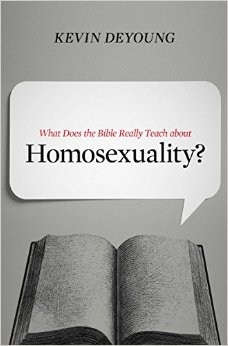
If that’s you, I’d like to commend to you Kevin DeYoung’s helpful, new book on the subject, What Does the Bible Really Teach About Homosexuality?

Now, I’ll be upfront and say I’m a Kevin DeYoung fan. I read his blog and I’ve read a number of books, my favorite being his work on the Heidelberg catechism, which was pretty significant for my move over into the Reformedish direction. So I’m obviously predisposed to be sympathetic to his work. With that in mind, take this post as you like. Also, know I got a free copy of the book, though I wasn’t required to say anything nice about it.

That confession aside, I’ll say it’s DeYoung doing what he does best: taking a complicated subject, and with clear, straightforward prose, reviewing significant biblical and theological material, asking the important questions, explaining it, and applying it.  In this case, DeYoung is very clear about his aim, which is to treat the specific question of “What does the Bible really say about homosexuality, or same-sex, sexual activity? Is it healthy, approved of by God in the appropriate situations, or is it sin to be avoided as the Church has said for about 2000 years?”  Unsurprisingly, DeYoung answers in favor of the latter. As he says, it’s a defense of the traditional understanding of marriage.

DeYoung’s structure is really rather basic. He doesn’t really get into sociological, psychological, or political questions (except for an appendix or two at the end). Instead, the first section focuses specifically on explaining the logic of the Biblical narrative and relevant texts (Gen 1, Leviticus, Rom. 1, etc), and the second half is devoted to answering key questions and challenges like the inconsistency of the church (what about gluttony?), the disputed nature of the same-sex activities in the NT times, and other popular, understandable questions.

So what are some of the highlights?

Well, first, this is not really aimed at specialized blogger debates, or niche scholarship. When DeYoung cites his sources, it’s clear he’s done his homework and read the big names on both sides, as well as the source material carefully. He tackles the main, exegetical, historical, and contextual challenges that need to be addressed. It’s solid work. That said, it’s meant for everybody. It’s a clear book for college students with questions, educated people in the pews, pastors, elders, and small group leaders. Which is so needed. I’ve read Robert Gagnon’s big book on the subject, and I think most pastors should, but there’s no way I’m handing my kids 500 pages of footnotes.

Next, it’s pretty calm. That’s kind of an odd thing to praise, but I get tired of the histrionic tones of some the people defending a classical position on the subject. It just gets shrill, depressing, and kind of unhelpful, especially if you’re going to be sensitive and pastoral towards those for whom the issue is a source of personal pain and struggle. DeYoung manages to stay away from the bluster, all the while driving home the weighty issues of sin, salvation, and the holiness of the church that are caught up in the question. For that, I’m grateful.

DeYoung also manages to set the stage well. I think my favorite section in the whole book was the intro chapter where he sets up the question of what the Bible says about homosexuality by talking about what the Bible says about everything; he basically goes through the story-line of creation, fall, redemption through Christ, and the goal God has for everything in the consummation of the ages. One of things I’ve told my students before is that there are some answers that Christianity gives that only make sense if you’ve understood its place within the whole. Yes, you need to tackle Greek words, Roman context, exegetical twists, but he says:

…before we get up close to the trees, we should step back and make sure we are gazing upon the same forest. As is so often the case with controversial matters, we will never agree on the smaller subplots if it turns out we aren’t even telling the same story. (9-10)

The most important part of that story, of course, is Jesus’ saving life, death, and resurrection. And that’s at the center of DeYoung’s little work. Pastors, small group leaders, and just Christians, realize that you cannot simply charge into conversations about these issues armed with a knowledge of key texts. You really need to soak in and connect these to the broader gospel realities, or the medicine simply will not go down.

A final plus, it’s only maybe 150 (shortish) pages. For those familiar with the arguments, it takes maybe an hour, hour and a half, and probably not a lot more if you’re not, which is surprising given the important ground it covers. I take this to be a strength. If you’re “not a reader”, I think you can make it through this book, and, at this point, most Christians really need to have read something solid on the subject.

One word, though: the book’s title really is what the book is about. It’s a book for people for whom the Bible is the sine qua non of spiritual authority. DeYoung’s polemic is mostly about answering revisionist reinterpretations of the texts that try to get around traditional interpretations. He also spends time defending what the Bible says in the objections section, but for those who have to wrestle with more complex questions of hermeneutics, the authority of Scripture, and so forth, you’re probably going to need a more heavy work. Which is probably why DeYoung included a helpful annotated bibliography at the end.

Well, there you have it. Some of my posts are just encouragements to pick up helpful resources. This is one on a key subject that most of us are wrestling with. I hope you find it as helpful as I did.

Soli Deo Gloria 


Faith, Form, and Fashion by Paul Helm (TGC Review)

Paul Helm. Faith, Form, and Fashion: Classic Reformed Theology and Its Postmodern Critics. Eugene, OR: Cascade Books, 2014. 284 pp. $32.00.

Paul Helm is worried about the state of Reformed theology. The dangers that trouble him, though, are not the enemies at the gate but the dangerous friends unwittingly doing damage from within. In his latest, forceful offering—Faith, Form, and Fashion: Classic Reformed Theology and Its Postmodern Critics (henceforth FFF)—Helm takes aim at recent strands in Reformed theology he thinks are drinking too deeply from the well of postmodernity, endangering the well-established methods of “Classic Reformed Theology” (which Helm calls CRT) in order to accommodate the intellectual fashions of the age. More specifically, he singles out Kevin Vanhoozer’s theodramatic theological proposal, as well as the work of John Franke, as the chief exemplars of this drift.

We want to be clear at the outset that students of Reformed theology and philosophy owe Helm, teaching fellow at Regent College in Vancouver, a debt of gratitude for his generally excellent work in the field. What’s more, conversations about the issues he raises need to be engaged. Regrettably, FFF is not the book to constructively carry it forward. While there is much value in his introductory comments, Helm’s portrait and criticism of his interlocutors is beset by a lack of interpretive charity so as to be deeply misleading, and at times simply factually mistaken.

Since we are better acquainted with Vanhoozer’s corpus, and the bulk of Helm’s critique is aimed at him (Franke gets a chapter-and-a-half, compared with Vanhoozer’s five-and-a-half chapters), we will focus our analysis on his critique of Vanhoozer.

You can go read the rest of this review over at The Gospel Coalition. If you’re at all interested in Vanhoozer, or the criticism of him, I highly advise it.

Soli Deo Gloria

5 Best Reformedish Books of 2014

The year of our Lord 2014 has been a great year of reading for me. I can only think of a couple of duds in the pile of books I’ve had the fortune of getting my hands on and cruising through. This means one thing: picking this year’s Top Reformedish books of 2014 was a difficult task. There were a great number that I thought of and considered for this. As it happened, though, there were a few standouts I would like to highlight and commend to you for your reading pleasure and edification.

A couple of notes before I proceed, though.

First, I am not including Herman Bavinck’s Reformed Dogmatics here simply because I have an article coming out on it later this month, and because it sits in a category all by itself. It is not a book of 2014. It is a work that transcends the years and decades.

Second, it just so happens that all of the books I’m highlighting I have actually already reviewed. Where relevant, I will simply note, excerpt, and forgo any more summary.

Finally, this list is not in any particular order. I am a notoriously bad ranker and decision-maker. Just ask my wife.

faith speaking understanding1. Faith Speaking Understanding by Kevin Vanhoozer. I’ve reviewed Vanhoozer’s book at The Gospel Coalition. This is some of what I said:

Let me put it this way: if Drama of Doctrine and Remythologizing Theology had a child, it would be Faith Speaking Understanding. Though intended as a briefer, less intimidating introduction to and practical application of his theodramatic theology for pastors and serious students, it isn’t a mere rehash of the last two works. As Vanhoozer explains, Faith Speaking Understanding is “an upstart sibling with a swagger of its own, namely a full-fledged proposal for the role of theology in the church’s task of making disciples” (xv).

Swagger it may have, but it’s swagger mediated through Vanhoozer’s inimitable style, irenic tone, and jovial spirit. Vanhoozer’s prose is a joy to read—a seamless movement between biblical and theological reflection (as evidenced by the extensive and helpful indexes of Scripture and theology) that is robustly catholic and winsomely evangelical.

calvin2. Calvin on the Christian Life by Michael Horton. I also reviewed this for The Gospel Coalition. Here’s what I said there:

In the history of the church, particularly its Western Protestant wing, few theological lights shine brighter than John Calvin’s. The Reformer par excellence, he stands out for his theological acumen, systematic comprehensiveness, and care as a biblical exegete. Beyond Calvin the theologian and biblical scholar, though, there was Calvin the pastor—the man passionately concerned that all of human life be lived before God (coram Deo) and in light of the gospel. Though it’s often presented this way in history textbooks, the Reformation wasn’t simply an academic theological debate about justification and the thoughts we think on a Sunday morning, but rather a total restructuring of Christian life and practice. It was about, as James K.A. Smith puts it, the “sanctification of ordinary life.” For that reason Calvin was concerned not only with teaching doctrine, but also with the life of piety flowing from that doctrine.

This is the Calvin that theologian and Westminster Seminary (California) professor Michael Horton introduces us to in his new volume on Calvin and the Christian Life. With an engaging blend of biography, theology, and commentary, and with copious reference to Calvin’s Institutes, commentaries, tracts, and key secondary literature, Horton takes us on a whirlwind tour through the Reformer’s thought as a whole.

age of atheists3. The Age of Atheists by Peter Watson. There’s a bit of a theme here in that I also reviewed this for The Gospel Coalition. Here’s what I said there:

In The Age of Atheists: How We Have Sought to Live Since the Death of God Peter Watson hopes to change the narrative by pushing back on Taylor’s impoverishment thesis. In this massive and thoroughly entrancing work of intellectual and cultural history, the prolific London-based author aims to recount hitherto-untold drama of the multifarious and rather “thick” ways we’ve tried to “live without God” ever since we discovered his death about 120 years ago.

Beginning with Nietzsche himself, Watson focuses on the lives, stories, and theories of those who haven’t merely lamented the loss of God but pushed through to find meaning—or rather “meanings”—of a more humble sort on the other side. Jumping from Europe to America to the Isles, Watson presents us with a cascading torrent of names (the back cover alone is plastered with them)—whether poet, philosopher, novelist, dancer, psychiatrist, or theologian—all of whom offered visions of life beyond traditional religious belief. The overall effect is to overwhelm you with the wealth of non-theistic options to meaning and fulfillment. To put it bluntly, Watson wants to show us we have more options than glum Dawkinsism or Jesus.

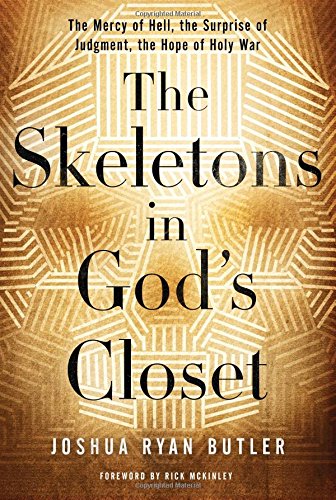
skeletons4. The Skeletons in God’s Closet by Joshua Ryan Butler.  And again, this is one I reviewed at The Gospel Coalition. Here’s some of what I said there:

The Skeletons in God’s Closet has the potential to be a game-changer for a lot of struggling Christians and skeptics. Thoroughly orthodox, Butler also speaks in a language and with the sensibility of someone who can still step out of his Christian shoes to hear, think, and feel the tension from the outside. In a lot of ways, it’s the book Love Wins tried to be but failed due to doctrinal drift. Instead, by helping readers walk through the difficult texts in Scripture, Butler sets out for them a broader vision for the beautiful character of a God who doesn’t give a doctrinal inch. Is it perfect? No. Would I have hit a couple of themes harder, or connected a couple of dots differently? Probably.

Still, Butler has done the church a magnificent service by showing a postmodern world that doctrines like hell and holy war aren’t about a God whose malevolence has to be restrained. Instead, The Skeletons in God’s Closet shows us a God who is good down to his bones, and utterly committed to loving and saving his world in Christ.

crucified king5. Tie: The Crucified King by Jeremy Treat and Atonement, Law, and Justice by Adonis Vidu.  I did not review these two at The Gospel Coalition. Still, I have already talked briefly about these two works here:

On The Crucified King:

In one sense, I found it to be a gravely disappointing book. It’s disappointing because Treat has written the book I wanted to write on the subject. Giving equal attention to biblical theology and systematic categories, Treat reunites what never should have been divorced in much modern theology: kingdom and cross as well as Christus Victor and penal substitution accounts of the atonement.

viduOn Atonement, Law and Justice:

Vidu aims to provide an account of the history of atonement theology down into the present that presents theologians against the background of the various legal and political theories dominant at the time. In this way, we can begin to appreciate better the way these theological concepts shaped and were shaped by their native settings. Five judicious, careful, and lucid chapters are devoted to the descriptive task, focusing on Patristic, Medieval, Reformation, modern, and contemporary periods…What’s more, along the way, he corrects a number of common misunderstandings and caricatures of historic positions.

If I went on to cite runners-up and honorable mentions, we’d be here for a while. It’s been a good year for books. I hope this list finds you in time for you to update your Amazon.com wishlist for last-minute purchases. If not, it ought to give you an idea of how to use your spare gift cash.

Soli Deo Gloria

You Were Made For More Than Safety — “Risky Gospel” by Owen Strachan (Review for Christianity Today)

strachanExodus tells us that God saved Israel that it might “serve/worship” (avodah) him (Ex. 7:16; 8:1; 9:1). Contrary to what we might think, the Israelites weren’t set “free” to go off, settle in, and have a safe, pleasant life according to their own whims. God had particular, sometimes difficult, purposes for them. God’s redemption aimed at creating a people to boldly worship, serve, and represent him before the nations (Ex. 19:5-6). In Risky Gospel: Abandon Fear and Do Something Awesome, Owen Strachan, assistant professor of Christian theology and church history at Boyce College and executive director of the Council on Biblical Manhood and Womanhood (CBMW), revives this message for a modern Christian audience. Framing our situation with Jesus’ parable of the talents (Matt. 25:14-30), he invites us to do more than accept life in a fallen world, hoping not to screw up too badly before the master returns.

Instead of living “safe,” miserly lives as the wicked servant did, we are called to go out, fulfill the creation mandate, and “take dominion” of the world (Gen. 1:26-30)—in other words, “build something awesome.” For this, we’ll need a willingness to take up our crosses and risk discomfort, failure, and pain in order to boldly do great things for the glory of God.

Sadly, instead of bold worshippers, Strachan sees a landscape filled with Christians who are tired, scared, defeated, and satisfied with small, pointless pursuits; we’re living our “stressed life now.” To use Andy Crouch’s language of “gestures” and “postures” (Culture Making, pp. 90-96), Christians have been flinching, slouching, and playing it safe for so long, we’ve developed a sort of scoliosis of the soul. In other words, we’re stuck. Stuck in weak prayer lives. Stuck in our parents’ basement. Stuck in suburban monotony. Stuck in marriages we’re scared to actually try at and are tempted to bail on. Stuck trying to merely hunker down and survive the Christian life. Well, as a good doctor would, Strachan endeavors to apply the medicine of the gospel to straighten our spines, and walk with the upright boldness of people who know the trustworthiness of God.

You can read the rest of my review over at Christianity Today

Top 5 Reformedish Books of 2012

Everybody else is doing one so I figure I will too. I must note that my “Top 5” of 2012 were not all published in 2012—I may just have happened to read them this last year. Also, they appear in no particular order:

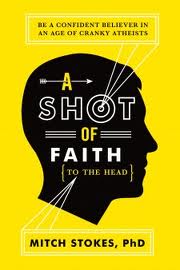
  1. A Shot of Faith to the Head: Be a Confident Believer in an Age of Cranky Atheists by Mitch Stokes – I’ve already reviewed this book here. Read it if you want the run-down.
  2. union with christUnion with Christ: Reframing Theology and Ministry for the Church by J. Todd Billings – Union with Christ is an essential theme and doctrine in Christianity, particularly within the Reformed tradition. In conversation with Augustine, Calvin, Bavinck, Barth, and others, Billings does some serious, but readable theological work, expounding the deep implications for theology and ministry of our union with Christ. For under 200 pages Billings’ scope is wide, covering everything from salvation to theological epistemology, the doctrine of God, Christology, the Lord’s Supper, social justice, and paradigms for mission. It also functions as an excellent, irenic introduction Calvin and the Reformed tradition as a whole. I cannot recommend this book highly enough.
  3. Meaning of MarriageThe Meaning of Marriage by Timothy and Kathy Keller – What can I say? It’s a Tim Keller book on marriage. That means it’s going to be well-researched, relevant, biblical, practical, theological, very readable, and, of course, gospel-centered. I’ve recommended this book to just about everybody: college students, engaged couples, newly-weds, oldly-weds, pastors, and marital experts. The great thing is that what you learn in this book won’t just teach you about marriage, it will teach you about all of your relationships, and most of all, the way the good news of Jesus Christ really does change everything.
  4. Lord and servantLord and Servant: A Covenant Christology by Michael Scott Horton – While this book was probably one of the most fun for me to read this year, it was also one of the nerdiest. Lord and Servant is the second in Horton’s quadrilogy of dogmatics and maybe the most important. In this series, he sets out to explore various classic theological topics letting the biblical notion of covenant–with its all-important Creator/creature distinction—and the eschatological story-line of the Bible shape the discussion. Much like the others, he’s working with some very high level theological and exegetical tools, interspersing and engaging with contemporary philosophical theology (Radical Orthodoxy), biblical studies (N.T. Wright), and patristics (Irenaeus) with insights from Calvin and the post-Reformation dogmatic tradition. As the subtitle indicates the end-goal of the work is Christology, but Horton does so much more in this volume with significant sections on: the doctrine of God, anthropology, Christology proper, and the contemporary atonement discussion. Horton has some of the finest discussions I’ve seen on the contemporary doctrine of God debates, as well as a thoroughly Reformed proposal for understanding the atonement in its fullness that beautifully incorporates insights from other traditions, as well as from its critics. In fact, the atonement discussion is worth the price of the book alone. Although this is admittedly not easy reading, for anybody with a taste for serious theology, it is a must.
  5. New Testament Biblical TheologyNew Testament Biblical Theology: The Unfolding the Old Testament in the New by G.K. Beale – It was almost a tie for me between this volume and Beale’s earlier one The Temple and the Church’s Mission: A Biblical Theology of the Dwelling Place of God. At a whopping 967 pages of text, excluding indexes, it is hard to convey the truly colossal accomplishment of Beale’s magnum opus. Beale doesn’t set out to write your typical New Testament Theology with summaries of the Pauline corpus, or the Gospels, with a minor constructive chapter at the end. Instead, Beale gives us a truly Biblical theology focusing on the major redemptive-historical storyline of scripture, showing the way the promises in the OT of a New Creation Kingdom are inaugurated and fulfilled through the life, death, and resurrection of Jesus Christ. Not only does he trace the fulfillment of the OT storyline in the NT, but he does so in light of Second Temple Jewish background material, and with an eye towards contemporary theological discussions. On top of it all, this stuff preaches!! Pastors, seminarians, biblical scholars, and students would do well to purchase this and work their way slowly through it, page by page. There is a wealth of biblical riches here.
  • Honorable Mention: Christianity and Liberalism by J. Gresham Machen – Written at the height of the Fundamentalist/Modernist controversy, Machen aims to set out a clear choice between classic Christianity, the faith essentially shared for 2,000 years across Protestant, Catholic, and Orthodox lines, and that of the Modern theological liberalism that was prevailing in his day. I finally hunkered down to read it these last couple of weeks and have been stunned at the relevance this work still has nearly 90 years after it was written. Get this book, if only for the fact that you can download it for free.

So if you’re looking for something to read in the 2013 year, you may want to start with one of these. All of them will faithfully point you to Christ and help you love God with all of your heart, soul, strength, and mind.

Soli Deo Gloria

P.S. There are a couple that probably should be on here, but this thing was taking too long so they’ll make next year’s: Tim Keller’s Center Church and Ross Douthat’s Bad Religion.

Book Review- A Shot of Faith (to the Head): Be a Confident Believer in an Age of Cranky Atheists by Mitch Stokes

Mitch Stokes. A Shot of Faith (to the Head): Be a Confident Believer in an Age of Cranky Atheists. Nashville: Thomas Nelson, 2012. 252 pp. $16.99. ($11.35 on Amazon)

In the last few years, with the rise of the New Atheism, authors like Dawkins, Dennett, Harris, and Hitchens have made popular Christian apologetics popular again. A veritable cottage industry of “responses” and rejoinders have been churned out by top-notch scholars (and some hacks too) either presenting arguments for Christianity or attempting to dismantle the claims of the New Atheists. While a number of these books are well-written and quite valuable, none of them quite accomplish what Mitch Stokes’ has in his recent work, A Shot of Faith to the Head: Be A Confident Believer in an Age of Cranky Atheists.  

He Knows What He’s Doing

What makes this book different? The key is that Stokes knows what he’s doing and, more importantly, what he isn’t. So often works of apologetics try to cover everything and don’t end up adequately covering anything.  Stokes knows better. He’s narrowed his focus, honed in on the key issues, and goes to work on them in a humorous, engaging, and readable fashion. What are those issues? The relationship between faith and reason, science, and the problem of evil.

Stokes is particularly qualified to tackle these. Before taking up his position as the Senior Fellow of Philosophy at New St. Andrews in Moscow, Idaho he got his MA in religion at Yale under Nicholas Wolterstorff, then went on to get his Ph.D. at Notre Dame under Alvin Plantinga and Peter Van Inwagen. No big deal–just three of the foremost philosophers of religion alive. And, if that weren’t enough,  prior to entering the philosophy game, he got an MS in mechanical engineering. The man knows what he’s talking about.

Introducing Reformed Epistemology–You’re Welcome

One way of describing Stokes’ project is translating Alvin Plantinga for everybody. Plantinga, while being, in my opinion, the most brilliant Christian philosopher working in the analytic tradition today, has not gone out of his way to make his philosophical genius widely accessible to the general reader. Don’t get me wrong, I think he’s hilarious and pretty clear as far as analytic philosophers go. Let’s be honest though, the average layman or pastor won’t take the time to read all 500 pages of Warranted Christian Belief  even if it’s worth it (which it is). Stokes takes the best of the Reformed epistemological approach developed by Plantinga and Wolterstorff (don’t worry, you don’t have to be a Calvinist to buy into it) applied to various issues in philosophy over the last 40 years and condenses it into short, winsome, witty, and clearly laid-out chapters uncluttered with small print or symbolic logic.  He also includes helpful “For Your Arsenal” summary points at the back of each chapter for easy recall of the information.

This isn’t to say that he merely repeats Plantinga, or offers nothing new–he does, especially the way he frames the discussion historically, concretely grounding these ideas in conversation with Hume and Locke on down to W.V.O. Quine. Still, even if translating Plantinga were all he did, this would be crucial because in engaging with both believers and unbelievers with the Gospel over the last couple of years, I’ve come to realize that the issue of epistemology is one that is too often ignored, or simply botched in most popular works on apologetics even though it lies at the root of so many of these discussions. By focusing his sights on the epistemological questions, Stokes really is aiming to give readers a “shot of faith to the head.”

So how does he actually do it? Stokes starts out by explaining and debunking the evidentialist objection to belief in God, that there isn’t sufficient evidence to “prove” he exists. He shows that, in fact, evidentialism is self-defeating–some beliefs must be basic, taken without reasons or evidence, otherwise reasoning itself cannot get off the ground. In fact, he pushes on to show that a demand for arguments and “reasons” for all of our beliefs, actually leads us to the conclusion that atheism itself is self-defeating. In place of the rationalism and evidentialism so commonly assumed by skeptics, Stokes proposes an alternative definition for what it means for a belief to be rational, that it is the product of “properly-functioning cognitive faculty operating in the appropriate environment” (read as good thinking equipment), like sense-perception, memory, and reason; this is a Reidian, reliabilist approach to epistemology as recovered and retooled by Plantinga and others. Stokes goes on to show that belief by way of testimony, or faith, is actually another valid way of coming by our beliefs, and that it is perfectly rational to believe in God by way faith, testimony, or “taking God at his word.”  Pressing a bit further, Stokes makes the very Plantingan point that if the “Christian epistemic story” is true, then the Christian can believe in God in a way that is basic and rational. Basically, in order to show that faith is irrational, you have to prove Christianity false first.

Now, none of these considerations means that he discounts reason or even the arguments for the existence of God–he actually has a very helpful “intermission” section dealing with the nature of the arguments and the problem of the burden of proof. Instead, Stokes shows that these arguments are helpful in supplementing faith and in dealing with “defeater” beliefs.

Defeaters and Highlights

What’s a “defeater”? A defeater is basically a reason to ditch a belief we gained previously in light of new evidence to the contrary, or that casts suspicion on the way we arrived at our belief. This is why Stokes moves on from his general discussion on faith and reason to consider the two main defeater beliefs for God out there today: science and the problem of evil.

I won’t review these two sections extensively, but some highlights include:

  • Helpful corrections of the historical record when it comes to the “history of the warfare between science and religion.” (Stokes has written short biographies of both Galileo and Newton so he’s well-equipped to handle this.)
  • A good discussion of the difference between the unnecessary “god of the Gaps” who intervenes from time to time to fix things that science can’t figure out and the God of the Bible who supervenes over and upholds the created order.
  • A much-needed guide to distinguishing between methodological naturalism, philosophical naturalism, and the scientific provincialism that convinces so many that accepting the former is predicated by the latter.
  • A fascinating historical and philosophical analysis of the rise of science, the way science actually proceeds, and how theism gives us confidence to engage in scientific study given belief in the Image of God and the rationality of a universe created by God.
  • Numbers. Stokes has an absorbing discussion on the nature of numbers that made even a math-hater like me wonder at the beauty of a mathematically-ordered universe–and how bizarre the existence of such a one truly is unless the world was created by a rational God.
  • A clean introduction into the “problem of evil” discussion that’s been going on in academic philosophy since the 1960s.
  • Short, but clear, Plantingan responses to both the logical and the probabilistic versions of the problem of evil, using both the Free Will Defense with respect to the logical, and a sober reflection on the epistemological limitations of finite thinkers in relation to the probabilistic.
  • A theistic turning of the tables, using the insights of the moral argument to point out that, without God, there is no absolute, moral standard, in which case the objection from evil can’t even get off the ground.
  • A bold statement of the uncommon yet undeniably appealing O Felix Culpa (Happy Fault) theodicy. (I won’t blow the surprise for you.)

Conclusions 

To sum up: Mitch Stokes has done the church a great service with this book.  By making available some of the best insights of the Christian community’s academic philosophers, believers who read this can be humbly confident that their faith in the Gospel is not blind, irrational, or illegitimate. Rather, it is in fact capable of standing up to the fiercest intellectual objections. I highly recommend this book to doubting believers, inquisitive skeptics, and especially pastors who want to be able to lovingly and persuasively commend the Gospel to the both groups.

Soli Deo Gloria