A Kingdom of Forgiven Priests (Story Notes #6)

GoldCalfMy church is, across all departments, going through The Story, a chronological, abridged edition of the Bible that takes you through the story of Scripture from Genesis to the end of Acts in 31, novel-like chapters. It’s a fun project that’s challenging me to deal with narrative sections, teach large chunks at a clip, and point my kids to Christ throughout the whole redemptive-historical story-line of the text.

That said, it seemed worth it to start posting my notes for these talks on a regular basis. It might happen every week, or not, depending on how helpful I think it is, or time constraints. My one request is that you remember these are pretty rough notes and I’m teaching my students, not a broader audience.

Things get screwy when you forget who you are–even for a little bit. For instance, when a poor college kid forgets that he’s a poor college kid, and acts like a rich one–well, that looks like years of credit card debt. The same thing is true for Christians who forget their identity–it can look ugly. Tonight we’re looking at the story of Israel getting its primary identity, and as we look at that, we’ll learn something about our own identity as a Kingdom of Forgiven Priests.

Recap – Now, at this point in the story, God has already set the Israelites free. God basically kicked the Egyptians butts by sending ten plagues from everything like flies, to hailstorms to boils to killing the firstborn in every household and so finally the Pharoah let the people Go (Sunday school style). Yeah, and so Moses led them out of Egypt into the desert and here’s where we pick up in verse 1

Text – Exodus 19:1-6

A Kingdom of Priests — Ok, so here we are at the base of the mountain and God here is about to make his covenant with the Israelites. He’s about to make the deal that will make the Israelites his people and he tells them that if they will be his people, if they will keep his covenant, his ordinances and worship him, then the nation of Israel will be for him “A Kingdom of Priests and a holy nation.”

Here we see what God was up to in saving the Israelites. He saved them out of slavery to Pharoah in order that they could be free to be for him a “Kingdom of Priests and a Holy nation.” He saved them for a task. He saved them so that they might serve God his priests, so that they might be a holy nation “out of all the nations.”

In this context, what does it mean to be a priest? Well, in the ancient world and even today, a priest was someone who stood between God and the rest of the people. He was the person who represented God to man and brought man to God. He was the go-between, the representative, the middleman. He taught people the ways of God and led the people in the worship of God. If you wanted to know what a god was like, you’d go check out his priest.

So, what does it mean for God to call an entire nation to be his “Kingdom of Priests”? Well, God is calling these people, to be his representatives to the world. They were to be a nation that taught the rest of the world what God was like. Like Adam in the Garden, they were to live in a way that revealed God to his world.

Israel and the Church

Ok, now, if you have your Bibles I want you to go to 1 Peter 2:9. Fast-forward from Moses about a thousand years to about the year 60 something A.D. Peter, one of the first followers of Jesus is writing a letter of encouragement to Jewish and Gentile Christians, the beginnings of the Church scattered throughout Asia Minor who are possibly suffering persecution and whatnot. Towards the beginning of the letter here in chapter 2 verse 9 he drops this statement:

“But you are a chosen people, a royal priesthood, a holy nation, a people belonging to God, that you may declare the praises of him who called you out of darkness into his wonderful light. Once you were not a people, but now you are the people of God; once you had not received mercy, but now you have received mercy…Live such good lives among the pagans that, though they accuse you of doing wrong, they may see your good deeds and glorify God on the day he visits us.”

Hold on there, did you hear that first part? “But you are a chosen people, A ROYAL PRIESTHOOD, A HOLY NATION, belonging to God that you may declare the praises of him who called you out of darkness into his wonderful light.” Do you see what Peter is doing here? He’s writing to this early Christian community composed of both Gentiles and Jews and invokes the Exodus text about the Israelites to apply it now to the community that has formed around the person of Jesus.

He tells this group that they are now to be to Jesus, what the Israelites had been for God back in the day. They are to be the people who declare the praises of “Him” who called them out of darkness into his marvelous light. Just as the Israelites were supposed to do this for the God revealed himself in the Exodus, the church is supposed to do this for that same God who revealed himself in Jesus.

This happens in two basic ways, both in the OT and in the NT:

1. Living Good Lives Among the Pagans — See, in just a chapter, Moses is going to lay down the 10 commandments (and the rest of the commands of the covenant) that express God’s expectations for the relationship. As Israel obeys those commands and observes them, the world begins to see what God is like.

It’s kind of like in your family, you have family rules. When you find out about your friends house-rules growing up, you find out about their parents. Are they uptight? Relaxed? Fun? Organized? Etc. In the same way, God’s commands are the house-rules that reflect God himself. That’s because those commands are not just arbitrary rules that God makes up, but expressions of his character. So, when you look at the commands they begin to tell you about what he’s like:

1-3 God demands we worship no other gods, we worship him and honor him properly because he cares about true relationship.

4. God tells us to rest because he is the creator and wants us to trust in him.

5. He wants us to honor our parents, and respect the authority by which the world functions.

6. Lying about our neighbors destroys the fabric of love and respect he wants for the world.

7. Stealing is the opposite of the generosity which characterizes the Creator God.

8. Murder is the opposite of the God who gives life.

9. Adultery is an affront to the value God places on relationships and promise-keeping.

10. Coveting reflects an ingratitude and lack of contentment that denies God’s provision.

The point is, in each of these commands you see something about the world and the God who made it. As Israel lives out these commands, the pagan nations around them find out something about the God that they worship. They would see that the God of Israel had just and wise laws and so was a just and wise God.

The same is true for us. As we live good, just, patient, honest lives in front of our neighbors, they should see something about the God we worship. It should be the kind of thing where, even though they don’t believe in God, or agree with our beliefs, they should be glad we’re their neighbors because of the lives we live with them.

Problem –  The problem is that Israel sucks at this. I mean, really, royally sucks at this. They hear the law, agree to it in a very sacred ceremony, and then Moses goes up the mountain for a 40 day to get the law on Tablets. In the middle of that, Israel get’s antsy and decides, “You know, let’s make an idol. That sounds like just what we need. Let’s get an idol.” Of course, right at the front of the list of commands is, “no idols”, right? Now, as usually happens, when you start worshiping other things, other sins follow. All idolatry leads to immorality somehow. In this case, they start partying, doing weird, freaky sexual stuff, and just getting crazy.

Now, I read this and kinda shake my head, but that’s totally me, right? I mean, I’ll be at church one minute, and then next I’m cursing somebody out in my car, or hating my neighbor, or back at that same sinful pattern I’ve been trying to break. I don’t know what it is for you. Maybe it’s being at that party. The blunt in hand. Blacked out again. Sinfully controlling people around you. Lying to make yourself look better. Disrespecting your parents. Coveting and comparing yourself to your neighbor. Murdering people in your heart.

So, how are we supposed to be priests if we’re caught up in all of this? How do we represent God to the world if half the time we look just like them?

2.  Singing His Praises For Salvation. This leads us to the next way we show the world what God is like. Its something that comes up, not so much in the text of the chapter, but in all the chapters that the Story cuts out. See, over next chunk of Exodus, and the whole book of Leviticus, God lays out a pattern for worshiping him, the other key task of the priests.

“And let them make me a sanctuary, that I may dwell in their midst.(Exodus 25:8, ESV)” Just like in the Garden, God wants to dwell with his people. He gives laws for how the Tabernacle, the traveling tent in which God met with Moses should be made. If you study it, it’s gorgeous and intricate, in-laid with all kinds of craftsmanship. Beyond that, it goes through in painstaking detail the processes involved in dwelling and worshiping the holy God. There is chapter after chapter about how to deal with ceremonial issues, and at the center of them all stands the chapter on the Day of Atonement.

See, God gives the people of God his laws, but the fundamental truth about Israel is that it can’t keep it. Inevitably, they will fail to obey God’s commands and so for them to maintain right relationship, God institutes the sacrificial system in order to deal with that. The sacrificial system teaches two truths simultaneously: God wants relationship with us, and our sin gets in the way of that. God’s holy and perfect character is opposed to our sin, while still loving us.  Throughout the system of sacrifice we see that God is totally holy, perfect, righteous, and will not tolerate sin. And yet, he loves sinners and wants to be near them, so he provisionally accepts sacrifices in their place to pay for their sins.

In the sacrifices, there were multiple levels of meaning going on, but at the heart of it was the recognition that sin deserves death. As the worshiper brought the animal to be slaughtered, they were basically saying, “God, through my sin I’ve chosen to reject you, the source of life, which deserves death. Through sin, I’ve chosen to break relationship with you, the source of life, so I shouldn’t have life with you.” And God accepted that animal in their place.

Thing is, all of this points to the Gospel of Jesus at multiple levels. In Jesus, God makes a way for the relationship to work. In Jesus, God comes near to us despite all of our failures and all of our inability to perfectly keep the Law. Jesus is God in the flesh, coming near to dwell with us. It is God saying, “I know what you’re like. I know you can’t pull this off, or make this relationship work, so I’ll go ahead and ensure it.” And so Jesus goes to the Cross, and actually substitutes himself for us to pay for our sins as they deserve, without destroying us in the process.

So, in the sacrificial system we see why we worship. We worship because God has come near in Jesus and saved us from sin and guilt, and set us free to live for him. And there’s a holy irony about it: when you see God’s grace towards you in Christ, forgiving you for your failure to keep the commands, you begin to worship him more, and the reverse of the idolatry pattern kicks in: you start to obey more.

And this is the pattern that we model to the world. We show the world who God is in our obedience, our praise to God for his mercy on our disobedience, and our renewed love and gratitude for him in that.

What does this Look like? A lot of things, but it includes people who praise God by obeying and singing about his forgiveness for the times they fail. People who strive to live holy lives in front of the world around them. People who are honest about their failure to one another. People who are gracious when others do the same. It looks like a Kingdom of Forgiven Priests.

Soli Deo Gloria

Living the Epic Drama in Short Stories (CaPC)

munroAlice Munro won a Nobel Prize in Literature this week. Aside from being the first Canadian, and thirteenth woman to do so, this is significant because she won it, not for a novel, but for being a “master of the contemporary short story.” That’s pretty cool.

When asked why she writes short stories instead of novels, Munro told The Atlantic:

So why do I like to write short stories? Well, I certainly didn’t intend to. I was going to write a novel. And still! I still come up with ideas for novels. And I even start novels. But something happens to them. They break up. I look at what I really want to do with the material, and it never turns out to be a novel. But when I was younger, it was simply a matter of expediency. I had small children, I didn’t have any help. Some of this was before the days of automatic washing machines, if you can actually believe it. There was no way I could get that kind of time. I couldn’t look ahead and say, this is going to take me a year, because I thought every moment something might happen that would take all time away from me. So I wrote in bits and pieces with a limited time expectation. Perhaps I got used to thinking of my material in terms of things that worked that way. And then when I got a little more time, I started writing these odder stories, which branch out a lot. But I still didn’t write a novel, in spite of good intentions.

Munro, basically: “I had novel ideas and I’d start them, but…yeah, life, so short stories.”

You can go read my reflections on what that means for our short stories over at Christ and Pop Culture.

Abraham and the Sacrifice of Faith (The Story Notes #3)

My church is, across all departments, going through The Story, a chronological, abridged edition of the Bible that takes you through the story of Scripture from Genesis to the end of Acts in 31, novel-like chapters. It’s a fun project that’s challenging me to deal with narrative sections, teach large chunks at a clip, and point my kids to Christ throughout the whole redemptive-historical story-line of the text.

That said, it seemed worth it to start posting my notes for these talks on a regular basis. It might happen every week, or not, depending on how helpful I think it is, or time constraints. My one request is that you remember these are pretty rough notes and I’m teaching my students, not a broader audience.

abraham and isaacText: Genesis 22 (Also, 12, 15)

One of the most terrifying and significant stories in western world, is God’s testing of Abraham with the sacrifice of Isaac. Soren Kierkegaard wrote a whole book about it, meditating on the ethical issues involved in obeying the command of God to sacrifice your child. What does faith look like in that situation? What horror must Abraham have felt as he thought of killing his own child. What a terrible ‘test’ that must have been.

Now, the word ‘test’ can mean test, or trial, or tempt. So, God is putting Abraham through a trial. It’s a trial of faith. A trial of sacrifice. God wants to teach Abraham, and us, something in this test. I’ll just say that Abraham was shocked by the test as well, but probably not for the same reasons as Kierkegaard was.

Sacrifice in the Ancient Near East – See, Abraham grew up in a world of child sacrifice. A lot of the neighboring gods had demanded them. Chemosh and Molech were two that famously consumed child after child after child. Abraham had probably grown up with neighbors who had offered up their children to the flames. We have archeaological digs with pits full of the bones of little children. What’s more he’d only been following this new God, for a while now. He still didn’t know much of his character. He knew he was surprising and powerful, but how different was he from the other gods? The Bible hadn’t been written yet, so he didn’t know that this God actually hated child-sacrifice. As horrifying as it sounds, with the pagan background that he had, I don’t feel that Abraham was shocked because of the kind of request it was.

What’s more, he knew he was a sinner. More than a couple of times, he had been a coward and tried to pimp out his wife. He had been an idolater for so long that he understood the principle involved in atoning for his life with the life of his firstborn son. If I had to guess, though he loved his son as any normal father would, perhaps even more because of how long he had to wait, the request wouldn’t have horrified him for the same reasons it horrifies us.

No, you see, I think the weird thing for Abraham, the thing that would have been running through his mind during those days of walking towards Moriah, would have been the promises. What would this mean for God’s promises?

The Call – Go to the beginning of Genesis chapter 12:1-3. See, after all that had come before, after creation, the fall of Adam and Eve there was a lot of history. Things went from bad to worse. Sin filled the earth and God caused a flood and only left few survivors to start over with. From there, humanity grew again, spread over the earth, and God began to set in motion a plan to fulfill his promise to Eve that one day he would save everything. He decided to start this plan by picking Abram, an idolater who had a wife who couldn’t conceive children.

The Lord had said to Abram, “Go from your country, your people and your father’s household to the land I will show you. “I will make you into a great nation,  and I will bless you;I will make your name great, and you will be a blessing. I will bless those who bless you,and whoever curses you I will curse and all peoples on earth will be blessed through you.”

He told him to leave his family, and strike off and that one day, he would bless him in such a way that his blessing would bless the whole world. He would make his name great. So, Abraham struck out in faith and, yes, went on a good many adventures. One thing to note here is that God chose Abraham explicitly, not just for his own sake, but so that through him, somehow God would bless the wider world around him. God always blesses us to be a blessing to others. His particular choice of Abraham was always part of a global plan to bless all.

The Covenant – Now, beyond that first promise, came a second promise. As we said, Abraham was childless and so he expected that his servant would one day inherit all that he had been blessed with by God. At one point God comes to him and tells him he will bless him even more, but Abraham’s skeptical. “What can you give me since I don’t have a child?’

God at this point makes another great promise to him in Genesis 15:

4 Then the word of the Lord came to him: “This man will not be your heir, but a son who is your own flesh and blood will be your heir.” 5 He took him outside and said, “Look up at the sky and count the stars—if indeed you can count them.” Then he said to him, “So shall your offspring be.”

6 Abram believed the Lord, and he credited it to him as righteousness.

So here, he promises not only that he’d bless him, but he’d give him progeny, so many descendants that we wouldn’t even be able to count them. Abraham believes him, and the text says that it’s counted to him as righteousness.

Then, he goes through this weird ceremony where God has him cut up a bunch of animals, line them up in two lines with a corridor between the halves. Usually this was a covenant ceremony where both parties would walk through the animals and basically agree, “If I bail on this covenant, let me be cut in half like these animals.” Here’s the thing, God puts Abraham to sleep and then shows him a vision of himself going between the animals alone. God basically takes a death-curse on himself–if He doesn’t fulfill the covenant, then he accepts a curse. (Gen. 15:8-21) He tells Abraham to have the sign of the covenant be circumcision, yes, but basically he just promises “If I don’t make this happen, let me be cut in half.”

From there, it’s years and years of waiting. Abraham tries to take things into his own hands and has a kid with a servant girl. God says, ‘no, that’s not the one. Sara will give you a child.’ And guess what? She does. After years, I mean, decades of waiting, God fulfills his promise to Abraham and gives him a son, Isaac, a name which means laughter because the thought of having a kid that late in life had caused them to laugh at the idea when God told them. Then God laughed them.

At that point Abraham had to be thinking “This, this is how it’s going to happen! Isaac! I get it now!” But then, Genesis 22.

What now? This, this is what I think was provoking confusion in Abraham’s heart. God had come through before. Why was he threatening his promise now? How is he going to bless the earth through his line if his line is dead?

Have you ever been in a place like that? In one of those situations where you’re looking up at God and thinking, “What the heck? How is this going to work? What are you doing? This isn’t what you said? You’re killing your promise and it makes no sense. Why would you ask me to give this up? Why would you take this from me? What purpose could this serve?”

So What Did Abraham Learn? Tests are about learning. Trials are about showing. So what did Abraham learn? What was this test about?

Read rest of Gen. 22

How Much Do I Love Him? Realize, to us this is horrifying, but here, God is asking him, ‘Will you sacrifice as much for me as your pagan neighbors will for their pagan gods?’ If you were worshipping those things, you would. Will you do that for me? What do you love more? What holds your heart? Because if he’s not willing to sacrifice it, then God is not as important. One thing he wants us to ask ourselves, what is most important?

Faith Rests in God’s Promises and Past Actions Now, in light of all of this, what was Abraham’s response? He said, “Here I am, Lord.” When Adam hid at the Lord’s call, Abraham answered with a faithful response. But how? How was he able to make that choice? Well, it seems to me that the text says in  Romans and Hebrews tell us that “Abraham reasoned that God could even raise the dead.”. So while God’s promises were what was confusing about the situation, they were also what allowed him to be obedient.

See, it seems that Abraham reasoned, ‘Well, if God promised, and he’s come through on his promises in the past, despite the fact that there was no way life could come from our dead bodies, he’ll make life come from the dead again.’ Abraham trusted in God’s character and God’s promises despite his confusion at God’s request. God proved himself in the past, so he trusted him for the future.

He Rewards Faith? The next thing we see is that God rewards faith. Gen 22: 16 “I swear by myself, declares the Lord, that because you have done this and have not withheld your son, your only son, I will surely bless you and make your descendants as numerous as the stars in the sky and as the sand on the seashore…through your offspring all nations on earth will be blessed, because you have obeyed me.

You have to realize that at some point, God will probably test you. There will be something that you will be challenged to give up. Some way that you’ll be asked to follow God that will test whether you love that thing more than him. What this text shows us is, not that God won’t ever take it, but that you can trust him when he does. He’s looking to bless you in the sacrifice.

Either to replace it with something better, to prepare you for something greater, or to take something that will destroy you.

Ultimately Our Sacrifice Isn’t The One that Counts: What else does Abraham see? That God is the one who provides his own sacrifice. See, there are all kinds of linguistic issues here, but there is a deep pun going on “Abraham saw the place of sacrifice (v. 4); God will provide (see) a lamb (v.8); Abraham saw a ram (v.13); Yahweh provides (lit. “sees,” v. 14a); and Yahweh appears (“makes himself seen,” v. 14b).”[1] What’s more, the land of Moriah (land of vision) is also linguistically linked to the word.

The long and the short of it is that God shows himself to Abraham as the one who provides his own sacrifice. “You’re not the one making the big sacrifice for me, I’m the one who provides it for you.” Now, this should have been obvious given that so far, God has just been promising, promising, promising and so here, once again, God takes the responsibility.

The Great Sacrifice Now, there is a big difference here for us than there was with Abraham. Abraham was able to see God’s promises and had received his blessing and had his word, yes. But, what he didn’t have that we do is the surer promises of having seen Christ. See, we know in a way that Abraham could only dimly, that God had already made the great sacrifice.

But, of course, with Christian eyes and ears we can’t help but see that this is pointing ahead to something truer, something deeper: “For God so loved the World that he have his only-begotten Son.” Abraham points ahead to the great sacrifice when God provides the ram, the true Lamb who takes away sin. Only this time, it is God’s own Son of promise, the Only Son of God who goes under the Knife for sin. This is what we see, that Abraham could not.

And the crazy thing is, in doing so, this is how the promise to Abraham was eventually fulfilled. Paul tells us that God’s promises to Abraham were fulfilled, not only in physical nation of Israel that expanded to fill and make a great nation, but ultimately in his descendant, Jesus Christ, the one through whom all the families of the earth are blessed, and through whom he has descendants of all nations that outnumber the stars of the sky.

I could draw out the implications of this text for pages here, but at the end of the day:We can trust, we can give, we can sacrifice because the Son trusted, gave, and sacrificed himself for us.

Soli Deo Gloria

Jesus’ Favorite Book

torahSadly, for orthodox Christians who would readily confess Christ’s divinity and humanity, it’s very easy to forget Jesus was a real person sometimes. By that I mean that he probably had a lot of the normal personal tastes, likes, dislikes, and so forth, that we would think of. He probably had dishes that Mary made he was particularly fond of, or stories Joseph told that he loved best, or friends up the street he would duck out to go play with. You might even imagine that there were spots he loved to go think, or hide away, much as we all do.

That we forget this is tragic because it robs us of part of the glory of the Gospel that God became man, a specific man, at a particular time and place, who could fully identify with the experience of being a human person.

I was reminded of this the other day when I ran across a remarkable quote by Christopher Wright in David Murray’s book Jesus on Every Page on Jesus and the Old Testament.  He quotes Wright at length:

In the midst of the many intrinsically fascinating reasons why Old Testament study is so rewarding, the most exciting to me is the way it never fails to add new depths to my understanding of Jesus. I find myself aware that in reading the Hebrew Scriptures I am handling something that gives me a closer common link with Jesus than any archaeological artifact could do. For these are the words he read. These were the stories he knew. These were the songs he sang. These were the depths of wisdom and revelation and prophecy that shaped his whole view of ‘life, the universe and everything.” This is where he found his insights into the mind of his Father God. Above all, this is where he found the shape of his own mission. In short, the deeper you go into understanding the Old Testament, the closer you come to the heart of Jesus. (After all, Jesus never actually read the New Testament!)

–Christopher J.H. Wright, Knowing Jesus Through the Old Testament, pg. ix

I’d never really thought about it that way, but the Bible was Jesus’ favorite book. (Now, being a peasant, I’m not sure that he had access to many others, but that doesn’t change the point.) When you’re reading the Old Testament, you’re reading words that Jesus read, sang, prayed, dwelt on, meditated over, struggled with, memorized, and loved.

When we were dating, McKenna and I made up a list of movies we wanted the other to see because they were particularly important to us. Watching those movies together was as experience we wanted to have with each other, yes because we liked the movies, but at a deeper level, because we felt that they revealed something about us to each other. In a similar way (alongside of the theologically-thicker ways), when you dive into the Old Testament, you’re learning something the very human Jesus who walked the earth 2,000 years ago. As Wright points out, this is just one more reason for us to dive into the Old Testament.

Of course, the joy of that is that is not to feel closer to someone who lived and loved a very long time ago. The still very-human, though resurrected and ascended, Jesus still loves those texts, has revealed himself in them, and promises to give himself to us through them if we will only meet him there.

Soli Deo Gloria

‘Substance’? ‘Hypostasis’? But Those Words are Un-Biblical!

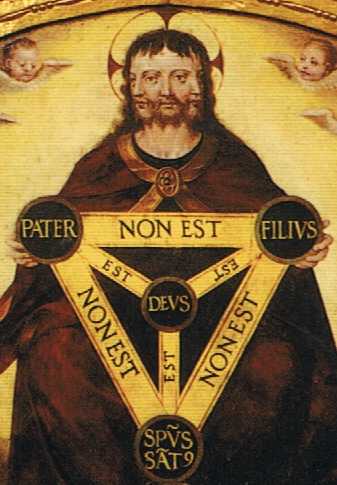
MostHolyTrinityStudying church doctrine can be a challenging endeavor for many of us, even those of us with a deep knowledge of Scripture and a desire to grow deeper in the faith. One issue that comes up frequently for students of a more Biblicist bent is: why all of those goofy, non-biblical words?

I mean, if you’re not familiar with, say, trinitarian theology you end up with all kinds of Greek and Latin words like ‘substance’ or ‘hypostasis’, ‘persona’, and later on, ‘perichoresis’, and so forth. They start to make sense once you’ve read someone explain them about 20 times. Thing is, though, most of those words don’t show up in our translations of the Bible, and when they’re there, they seem to be used in different ways. Or, heck, the word ‘trinity’ doesn’t show up at all. Shouldn’t we be ‘biblical’ in the way that we speak and think of God? How can we do so with terminology taken from surrounding Greek and Latin philosophy and thought?

Calvin tells us that he wrote the Institutes partially so that he wouldn’t have to go into extended doctrinal discussions in his commentaries. Welp, that didn’t really slow him down from writing 4 or 5 pages on John 1:1, expositing the text and defending it from various heretics old (Sabellian, Arian), and new (Servetus.) In the middle of this fascinating discussion, he touches on the issue of non-biblical language.

Now, conservative Reformer that he is, not given to excess or speculation, you might think he would want to do away with all of this jargony mess. Thankfully, he was smarter than that:

I have already remarked that we ought to be sober in thinking, and modest in speaking, about such high mysteries. And yet the ancient writers of the Church were excusable, when, finding that they could not in any other way maintain sound and pure doctrine in opposition to the perplexed and ambiguous phraseology of the heretics, they were compelled to invent some words, which after all had no other meaning than what is taught in the Scriptures. They said that there are three Hypostases, or Subsistences, or Persons, in the one and simple essence of God. The word; ὑπόστασις (Hypostasis) occurs in this sense in Hebrews 1:3, to which corresponds the Latin word Substantia, (substance) as it is employed by Hilary. The Persons (τὰ πρόσωπα) were called by them distinct properties in God, which present themselves to the view of our minds; as Gregory Nazianzen says, “I cannot think of the One (God) without having the Three (Persons) shining around me.”

–Commentary on John 1:1

He points out what Fathers like Athanasius and Augustine had before him: heretics can use ‘Biblical’ language too and use it in ‘ambiguous’, ‘perplexed’, and non-Biblical ways. For that reason, the Fathers were compelled to take language and deploy new words in order to save the meaning of the Biblical record. These were new words used to say more clearly in a foggy and confused time, what Scripture was saying. They did not do this at random or haphazardly. Nor did were they careless to leave undefined, or distinguish the sense in which they used the term from other possible senses.

I think it was N.T. Wright who somewhere used Copernicus as an analogy: say Copernicus had never given a term to his system at which the sun was the center of the universe instead of the earth, and 200 years later someone came along and dubbed it ‘heliocentric.’ Have they misrepresented Copernicus by using that new term that he did not? By no means. They simply gave it a new name in order to keep it clear. In the same way, the Fathers of the Church, guided by the Spirit, in conformity with the Word, developed ways of speaking that preserve and protect the content of Scripture even when not directly drawn from it.

This is the truth that Calvin recognizes and calls us to appreciate here. For that, thoughtful students and spiritual descendants ought to be humbly grateful: both for the work of early teachers like the Fathers, as well as for faithful preservers of the tradition like Calvin.

Soli Deo Gloria 

For more similar thoughts check out:

B.B. Warfield on the ‘Unbiblical’ Doctrine of the Trinity
Vanhoozer and Calvin on the Creeds and Scripture

The Word of Sauron, The Word of Tolkien, and the Word of God

sauronA long time ago, I used to argue with people on blogs. Wait…yeah, I guess I still do. But the story I’m setting up was a long time ago. One of said blogs I argued on was that of my buddy Mike, an old youth pastor of mine who was going the way of the Bell and McLaren (pre-the really, really lame stuff). He’d post some controversial thought to ‘ask a question’ and I’d be the little gadfly college philosophy student who’d jump in and jostle with him. (Also, this was pre-Reformedish days. I would have laughed in your face if you’d have told me in 6 or 7 years I’d be quoting Calvin.)

In any case, he had raised the issue of Scripture one of those posts. Among other questions he was asking whether ‘all’ of the Bible was the Word of God, or only some of the parts, especially those where Divine Speech is specifically denoted, such as in the Prophets. Are the horrifying narrative sections, or the sections where the thoughts and emotions of the prophets, the psalmists, or the god-hating pagans with speaking parts, are speaking truly God’s Word?

In response to this, I came up with an analogy, on the fly, once again Lord of the Rings-related, to answer how I thought, at a minimum, even those sections could be considered the ‘Word of God.’ Once again, remember this is my 21-year old, still-really-piecing-it-together self:

“One way that I think about the way that the whole Bible is the Word of God, is thinking about it much like I think about The Lord of the Rings being the word of ‘Tolkien.’ It is at least all the Word of God in that he is its Divine Author. (I don’t mean to imply some kind of dictation theory of Scripture. I think its possible to have more than one author of a text at different levels. See Wolterstorff or Vanhoozer on this.) That said, not every word spoken in the text can be taken as his direct ‘word’ revealing his thoughts and desires in normative sense–certainly not those uttered by Sauron or Saruman. But, at the same time, those words are there in the text at Tolkien’s prerogative and are part of the overall “Word” that he speaks through the text and so can be taken as his Word.

In the same way, the words of the pagans in Scriptures are God’s Word in the same way that Sauron’s words are Tolkien’s word. There is a way that Tolkien can show us something about or say something about the nature of evil, through the evil words and actions of Sauron, which Tolkien himself would never do or say. In this way, the words and actions are properly Sauron’s, but they are also Tolkien’s in the context of the larger story he is authoring. In an analogous way God says things through these texts in a way that accounts for and does not reduce the multiple human voices, genres, etc, but also accomplishes his specific purposes in the world through the Text as its over-arching Author. Of course, this is an analogy and it kind of breaks down, but I think captures part of the picture.

A few years on, I’d probably massage a few phrases here and there, but in the main, I still find the analogy useful. God’s authorship of Scripture is a nuanced and layered one. That I affirm the Bible as God’s Word in its totality, does not mean I’m proposing a flat reading of the text, that fails to take into account narrative or genre dynamics. Far from it. In fact, it means I have to take care to read it even more carefully, not brushing past or carelessly dismissing any of God’s words, in order to discern just what exactly the Spirit is communicating through the inspired Word.

Soli Deo Gloria

Should Pastors (or any of us) Read the Word on an iPad? (CaPC)

bible ipad

I have a Bible app on my phone and I love it. I usually use it in the morning to listen to my daily readings as I putter around making coffee and becoming human again. I’ve sat down with a number of my students and helped them download that same app in order to show them how easy it is to read a chapter a day instead of spending those 5 minutes checking some inane Reddit thread that, like sugar with teeth, will eventually rot their souls. (I might have to pay for that one later.)

That said, there are some real misgivings about the way the tech format can shape the way we encounter the Word. Over at the Gospel Coalition Matthew Barrett raises some good questions about  pastors using tech in the pulpit in his thoughtful article “Dear Pastor, Bring Your Bible to Church.”

You can read my summary and response over at Christ and Pop Culture.

Whose Experience? Which Story?

experienceSince beginning this blog, I’ve had reason to note the character of online discussion, argument, and debate more carefully than I have in the past. One theme that I’ve wanted to give some attention to has been the increasingly normative place that is given to unique experiences as conferring authority to speak on certain moral matters. I was this close to writing a masterful piece discussing the issue, but then I found that, once again, Alastair Roberts already had.

In a wonderful article speaking into the issue of the recent “purity culture” debates, Roberts points to the root of this mode of argument as an “ethics of empathy”:

At the heart of this ethic is a concern for the feelings and sensitivities of persons and an acute attention to the internal character of people’s experience. The currency for this ethic is the personal narrative and the sharing of feelings. Truth emerges from the empathetic encounter, as people bravely and authentically articulate their stories, in a manner ‘true to themselves’. These stories and the feelings that they express should be honoured as sacred and we should be careful not to invalidate or judge either…

Expanding on this, he writes:

For many of those who place great weight upon personal experience as the locus of truth, the application of frameworks of judgment to contexts beyond our experience can be a cardinal sin. Moral judgments are illegitimate unless we have walked a mile in the other person’s shoes, seen what they have seen, and experienced what they have experienced. For instance, we have never been in the position of the terminally ill person in acute pain, so we have no right to speak about the ethics of euthanasia. We may never have been pregnant in poverty without a partner to support us, so we have no right to speak about the ethics of abortion. We may never have experienced what it is like be trapped in a loveless marriage, so we have no right to speak about the ethics of divorce. We may never have experienced the sexual frustration of living with a spouse who cannot fulfill our sexual needs, so we have no right to speak about the ethics of monogamy. We may never have experienced the hopelessness of the aging unmarried person, so we have no right to speak about the ethics of chastity…

I’m going to have to restrain myself from simply quoting the whole post, because that would just be pointless. I do encourage you to go read it, though.

Paraphrasing Alasdair MacIntyre, the question I’m always tempted to ask of those wielding the experience trump card is “Whose Experience? Which Story?” Why is your experience the valid one? Why is your story the compelling narrative to which my judgments on X moral subject must submit? Why not my experiences and story? Or what about those of my neighbor who disagrees with you? What about the experiences those long-dead? Or those with a different gender? Or those in other countries? Or…you get the point.

My point isn’t to rule out the place of story and personal experience in moral reflection, but to question the weight we currently give it. As Roberts observes, in our current climate, our stories and experiences seem to take on unquestionable moral status, especially if it is one of hurt, oppression, or pain; they are sacred and inviolable. Have you been oppressed by a pastor who was harshly disciplinarian and are now vehemently opposed to any sort of church discipline at all? Well, why is that experience the one that’s normative over against the person whose church was morally-destroyed because of pastoral unwillingness to exercise any discipline at all? We can find both experiences, and many in-between, so why ought we listen to one over the other? If we’re not going to simply lean on the cliched “It’s true for me, but not for you” mantra, we have to deal with the issue of how we judge or accommodate the interpretive pluralism of experience.

This is far from a complete treatment of the subject, but a few quick thoughts:

First, Roberts points out that Jesus and Paul, two unmarried, single men seem to have plenty to say about situations like marriage, parenting, etc. in which they’ve never participated. That’s not to say they hadn’t been around them or given them deep thought, but the Bible doesn’t seem to share the whole, “If you haven’t been in exactly my shoes, you can’t speak to me” philosophy. In fact, he goes on to point out that often-times what we need most is an outside observer who isn’t immediately involved in the situation to help us think things through a bit. While there are times that experience is precisely what gives us insight into a situation we might not have otherwise, in others it is precisely our non-involvement that enables us to judge rightly.

Second, I’d like to restate a point I’ve made in another piece: “while it’s true that your story is specifically your story, it’s also true that it’s a human story, an Adam and Eve story. Your hopes, fears, scars, emotional paralysis, history of hurt, sin, betrayals, judgments, anxieties, and pains have quirks and twists peculiar to you, but they also participate in the general character of life east of Eden. You are not fundamentally alone in your experiences and it is only very human narcissism that tells us that our burdens are essentially unshareable, and our woes unredeemable.” It also means that we live in the same moral and theological world. We can talk to each other about right and wrong, sin and righteousness, grace and redemption even if our particulars are different.

Of course, this can only happen if we understand what we have in the Scriptures as a divinely-authorized set of interpretations of moral experience. We need to see that in the Bible we have THE normative, sacred story (made up of hundreds of little stories) of Creation, Fall, and Redemption that shines a light on all of our stories and experiences. Because we are sinful (fallen) and small (finite) we can’t even be sure of our interpretations of our experiences, but God gives us a new grid through which we learn to re-read our experiences properly. In a sense, when we submit to the Scriptures, what we’re saying is that God’s experiences and God’s story get the final word over ours. It is the one story that we can trust because God’s perspective is not limited or sinfully twisted like ours. Only his judgments are pure and wholly true, because only he knows the end from the beginning, and the ends for which he began all things.

Soli Deo Gloria

Three Dangers and One Hope for Pastors

parsonCalvin was nothing if not a theologian in service of the church. As much as he had to say about justification, faith, salvation in Christ, all of that was for the sake of the church and the right worship of God. To that end, he devoted a significant section to the proper calling and role of elders within the Christ’s Church, not only in the Institutes, but within the commentaries. As a careful student of the apostles though, he was not only concerned with right order but faithful pastoral care as we can see by his expansive comments on 1 Peter 5:1-4.

First he lays out the 3-fold structure of Peter’s instructions for pastors:

In exhorting pastors to their duty, he points out especially three vices which are found to prevail much, even sloth, desire of gain, and lust for power. In opposition to the first vice he sets alacrity or a willing attention; to the second, liberality; to the third, moderation and meekness, by which they are to keep themselves in their own rank or station.

Commentary on Catholic Epistles, 1 Peter 5:1-4

He then goes on to comment on the three at length, notably devoting special attention to the issue of pride or power:

  1. Sloth – He then says that pastors ought not to exercise care over the flock of the Lord, as far only as they are constrained; for they who seek to do no more than what constraint compels them, do their work formally and negligently. Hence he would have them to do willingly what they do, as those who are really devoted to their work.
  2. Avarice – To correct avarice, he bids them to perform their office with a ready mind; for whosoever has not this end in view, to spend himself and his labor disinterestedly and gladly in behalf of the Church, is not a minister of Christ, but a slave to his own stomach and his purse.
  3. Lust for Power – The third vice which he condemns is a lust for exercising power or dominion. But it may be asked, what kind of power does he mean? This, as it seems to me, may be gathered from the opposite clause, in which he bids them to be examples to the flock. It is the same as though he had said that they are to preside for this end, to be eminent in holiness, which cannot be, except they humbly subject themselves and their life to the same common rule. What stands opposed to this virtue is tyrannical pride, when the pastor exempts himself from all subjection, and tyrannizes over the Church. It was for this that Ezekiel condemned the false prophets, that is, that . (Ezekiel 34:4.) Christ also condemned the Pharisees, because they laid intolerable burdens on the shoulders of the people which they would not touch, no, not with a finger. (Matthew 23:4.) This imperious rigour, then, which ungodly pastors exercise over the Church, cannot be corrected, except their authority be restrained, so that they may rule in such a way as to afford an example of a godly life.

-ibid., v. 1-3

Far from encouraging an overweening authoritarianism, Calvin exhorts pastors not to keep themselves above the flock. Spiritual leadership does not equal license, or an invitation to “tyrannical pride.” “Imperious rigor” is not what is needed, but the “example of a godly life” in which pastors are chief in pursuit of holiness before anything else. Then, he moves to impress them with the importance of following the Peter’s commands by acknowledging the real obstacles pastors face:

Except pastors retain this end in view, it can by no means be that they will in good earnest proceed in the course of their calling, but will, on the contrary, become often faint; for there are innumerable hindrances which are sufficient to discourage the most prudent. They have often to do with ungrateful men, from whom they receive an unworthy reward; long and great labors are often in vain; Satan sometimes prevails in his wicked devices.

-ibid. v. 4

In fact, there is only “one remedy” for the discouragement they face amidst their many labors:

…to turn his eyes to the coming of Christ. Thus it will be, that he, who seems to derive no encouragement from men, will assiduously go on in his labors, knowing that a great reward is prepared for him by the Lord. And further, lest a protracted expectation should produce languor, he at the same time sets forth the greatness of the reward, which is sufficient to compensate for all delay: An unfading crown of glory, he says, awaits you.

-ibid. v 4

Finally, he calls attention to the fact that in the end Peter “calls Christ the chief Pastor”:

for we are to rule the Church under him and in his name, in no other way but that he should be still really the Pastor. So the word chief here does not only mean the principal, but him whose power all others ought to submit to, as they do not represent him except according to his command and authority.

-ibid, v. 4

This is a warning and a comfort. All pastoral authority is exercised only under the authority of Christ–remembering this will keep us from that tyrannical pride and vice. The comfort comes in knowing that as we pastor and fail, we have an unfailing Pastor who is keeping care over our souls as well.

Soli Deo Gloria

Judge or Expert Witness? Vanhoozer and Calvin on Scripture and the Councils

gavel and bibleKevin Vanhoozer’s Drama of Doctrine: A Canonical-Linguistic Approach to Christian Theology has one of the most sophisticated and nuanced Protestant approaches to the doctrine of sola scriptura and the relationship between scripture and tradition that I’ve encountered yet. As I was perusing through it the other day, I ran across this wonderful little teaser passage on Calvin, scripture, and the councils:

The Reformation was not a matter of Scripture versus tradition but of reclaiming the ancient tradition as a correct interpretation of Scripture versus later distortions of that tradition. The Reformers regarded the early church councils by and large as true because they agreed with Scripture, not because they had authority in and of themselves.

Certain critics of sola scriptura that the Reformers demythologized tradition by chasing the Holy Spirit out of the life of the church into a book. This goes too far. It is preferable to view tradition, like the church itself, as an example of what Calvin calls “external means” of grace. Tradition does not produce its effect ex opere operato; on the contrary, tradition efficaciously hands on the gospel only when it preserves the Word in the power of the Spirit. It is an external aid to faith, but not an infallible one. To speak of the ministerial authority of tradition is not espouse not a “coincidence” but an “ancillary” view of the relationship of Scripture and tradition.

Calvin honors the early church councils precisely because, for the most part, they were governed by word and Spirit: “[W]e willingly embrace and reverence as holy the early councils, such as those of Nicaea, Constantinople, Ephesus I, Chalcedon and the like…insofar as they relate to the teachings of the faith. For they contain nothing but the pure and genuine exposition of Scripture.” (Institutes 4.9.8) However, when one council contradicts another, as Chalcedon contradicted Ephesus II, the church must return to the word as ultimate norm. Church councils have a provisional, ministerial authority. To give them absolute authority, says Calvin, is to forget biblical warnings about false prophets and false teachers (Matt. 24:11; Acts 20:21-29; 1 Tim 4:1; 2 Tim 4:3; 2 Pet. 2:1). Indeed, with regard to Ephesus II–the council that accepted Eutyches’ heresy concerning the person of Christ–Calvin offers a sobering judgment: “The church was not there.” (Ibid., 4.9.8) This haunting observation neatly reverses the medieval formula extra ecclesiam, nulla salusCalvin might well have said: Extra scriptura et pneuma, nulla ecclesiam–“Outside word and Spirit, there is no church.”

Sola Scriptura refers to the practice of attending the Spirit speaking in the Scriptures as the final appeal in doctrinal disputes. How do we recognize the Spirit’s speaking? Church tradition enjoys the authority not of the judge but of the witness. Better: tradition enjoys the authority that attaches to the testimony of many witnesses. In this light, we many view the church fathers and church councils as expert witnesses as to the sense of Scripture in the courtroom drama of doctrine. Neither the Fathers nor the councils sit on the bench; the triune God has the final say. The task of theology is to cross-examine the witnesses in order to offer proximate judgments under the ultimate authority of the presiding judge: the Spirit speaking in the Scriptures.

To practice sola scriptura  is to treat Scripture alone as the “norming norm” and tradition as the “normed norm.” A theology that practices sola scriptura recognizes the ministerial authority of tradition, namely, its ability to nurture individuals in and to hand on the apostolic faith through the church’s corporate witness. Canon may be the cradle of the Christian doctrine, but tradition is its wet nurse. —The Drama of Doctrine: A Canonical-Linguistic Approach to Christian Doctrine, pg. 233-234

Again, that’s merely a teaser–Vanhoozer expands on each of those points at length. He shows us that the practice of sola scriptura is not a necessary recipe for historical ignorance or hopeless subjectivity in interpretation. It is a call to treat expert witnesses with all the due deference they deserve, while recognizing the true judge of the church: God in his Word.

Soli Deo Gloria