What do we learn of the Cross in the Gospels? (Mere Fidelity Podcast)

Mere FidelityThis week on Mere Fidelity, the boys and I discuss Jesus’ atoning work on the Cross as it is displayed and uniquely narrated in the Gospels. In other words, what specifically do the Gospel writers tell us about Jesus’ work as theologians intent on setting forth the saving significance of Jesus’ death and resurrection?

We hope this discussion spurs your Holy Week reflections along as we head towards Maundy Thursday, Good Friday, and Easter Sunday.

Soli Deo Gloria

Calvin’s Multi-faceted Atonement (TGC)

cross calvinIf there’s one thing anybody knows about Calvin’s doctrine of salvation it’s that he taught the doctrine of double-predestination. If people venture beyond that, according to the popular picture of 20th-century theology, Calvin is basically the creative chap who invented penal substitutionary atonement as a variation on Anselm’s theme, and most of his thought was concerned with Christ satisfying the wrath of God. End of story, right?

Contrary to this opinion, Calvin was not a one-trick pony when it came to the expansive work of Christ’s cross. Robert Peterson wrote an excellent book on Calvin’s Doctrine of the Atonement, attempting to exposit the great reformer’s thought in order to display the multi-faceted, biblical character of theology of salvation. In three early chapters, Peterson establishes a foundation that Christ’s work first of all rooted in the free love of God. He didn’t need to be persuaded to care for us, but of his own initiative, God sent the Son to save us. What’s more, it is a work grounded in a solidly soteriological and Chalcedonian doctrine of the incarnation of the Son; the Son became the Godman that he might save sinners. Then, he moves on to show the way that Christ’s atonement accomplished this in his role as the mediator who redeems us in each of his offices of prophet, king, and priest.

Beyond that, Peterson highlights six key biblical themes Calvin used to explain Christ’s work on the cross. While the six are clearly intertwined, nonetheless, they all do specific work in Calvin’s thought. Following Peterson’s framework, I’d like to introduce and highlight selected quotations from Calvin in order to show that he taught a densely woven tapestry bright with the many threads of our redemption.

You can read the rest here at The Gospel Coalition.

Soli Deo Gloria

Kevin Vanhoozer on the Crucified King

I don’t do the random quote and link post but, in this case, I’ll break protocol. Last year I endorsed Jeremy Treat’s The Crucified King as one of my favorite books of the year. Well, now you don’t have to take only my word for it. Zondervan Academic’s excellent “Common Places” series edited by Michael Allen and Scott Swain at their blog has asked senior scholars to endorse the words of young, up and coming scholars for the attention of the rest of us. Today’s post features the inimitable Kevin Vanhoozer’s summary and review of Treat’s work.

“Things fall apart; the center cannot hold.”
—William B. Yeats, “The Second Coming”

Yeats probably did not have the academy and church in mind when he penned these lines in 1919, but he could have, for theological things, and the gospel itself, have been coming apart for centuries. Theology itself has come apart: what God joined together—doctrine and life—has been cast asunder, into the academy and church respectively. And, within the academy, the disciplines of biblical theology and systematic theology go their separate ways, speaking different languages. Even worse, the story and logic of the gospel have come apart in both the church and the academy, with some Christians focusing on the significance of Jesus’ death with its promise of heaven (cross) and others on Jesus’ message about the reign of God with its promise of justice for earth (kingdom).

The Crucified KingBlessed are the peacemakers, for they seek to repair the center—and shall receive honorable mention in Christianity Today’s Book Awards list, as Jeremy R. Treat’s first book has done in 2015—no mean feat for a work that began life as a doctoral dissertation. Treat’s The Crucified King (Zondervan, 2014) works several important mediations: church and academy; biblical theology and systematic theology; penal substitution and Christus Victor theory of the atonement. His title signals his reconciling intent: rather than viewing the kingdom and the cross as themes that belong to different universes of discourse, Treat argues that they form a seamless whole, centered on the unabbreviated gospel. The subtitle provides further italicized fuel to the mediatorial fire: “Atonement and Kingdom in Biblical and Systematic Theology.”

Please do go read the rest of the review here. And then pick up the book if you haven’t already. It’s well worth your time.

Soli Deo Gloria

Locating Atonement in Romans 8 #LATC15

This last week was the LA Theology Conference 2015 put on by Fred Sanders and Oliver Crisp and as usual, it was a delight. It was also a challenge. The subject of the conference was “locating atonement” with respect to other key doctrines. The idea is that atonement is one doctrine that, in particular, tends to get stretched out of shape unless it is properly situated within the broader framework of Christians thought. Well, the speakers all did a bang-up job of relating the atonement to various subjects in Christian theology and I can’t wait for the book to come out in the fall. But instead of summarizing them, I figured I would honor the spirit of the conference by doing a bit of “locating” of my own.

lamb slainIn this (hopefully) brief post, I want to say something about what we can see about the proper doctrinal location of the atonement based in most part on Romans 8:1-17, (with some bouncing about in the rest of Romans 8 and a few other texts). In other words, given that this section contains a passage universally acknowledged as a key atonement text in the New Testament, which doctrinal layers or themes need to be acknowledged in order to grasp Paul’s logic in the text. If you don’t have a Bible nearby, I invite you to read it here.

First, I have to acknowledge this will be an uneven, rather surface-level, engagement at points. It is a blog post. Second, not everything that can be said about atonement, nor atonement in this passage, will be said. I go into far greater depth in this lengthy piece, as well as others, but this is just a short one intended to demonstrate the way the Scriptures themselves situate the truth of God’s work through the Cross of Jesus.

1. Triune – First, note that the atoning action is clearly the work of the Triune God.  The work of Father, Son, and Holy Spirit structure the passage as a whole. It all begins in verse 3 with God (the Father)’s action in “sending his own Son in the likeness of sinful flesh.” Here we have the first action of the Father who moves to “send” the Son, in proper Trinitarian fashion, as the originator of the atoning action in Christ. At the same time, this verse also introduces the Son’s action: being “sent.” For this action–this sending/being sent–to happen, there is an inner conformity, a unity of action between the Father and the Son. While the Father “offers up” his Son (Rom. 8:32), the Son offers himself up to Father (Eph. 5:1). Although it is not stated in this text, it must also be remembered that Luke shows us that the Father sends the Son on his historical mission which culminates at the Cross in and by the power of the Holy Spirit (Lk. 1:33-35; 3:16, 21-22; 4:1, 14, 18). Also, the author of Hebrews reminds us that the Son “through the eternal Spirit offered himself without blemish to God” (Heb. 9:14).  In which case, we see already the three Persons at work in the Father’s sending of his Son and the Son’s coming at the behest of the Father. (As we’ll see below, the Spirit’s presence and work pervades the passage).

2. Incarnational—Looking to that same early passage, we see that the atonement of Christ has as its necessary condition the coming of the Son in “the likeness of sinful flesh” (8:3). It was necessary that the Father send the Son in the “likeness” (homoioma) of this sinful flesh, in order to identify with sinful humanity as far as possible, without sinning, as the rest of the New Testament tells us, and thereby be the place where He could deal with the sin of humanity. The logic of sinlessness is present here, even if it is not as clearly spelled out as it is in other texts. While not present here, we should also note that it is in the incarnation that the impassible God assumes humanity in order to undergo passion on our behalf, in order to one day end our passion.

3. Penal—Next, the atonement of the Son has, in some sense, a clearly legal and penal efficacy. Whatever the Son does, it is clear the result is that “There is therefore no condemnation for those who are in Christ Jesus” (8:1). What’s more, Paul tells us that the Father sent the Son precisely to do what “the Law” was insufficient to do, weakened as it was by our sinful flesh, which set us in constant opposition to it (8:7).  God “condemned (katakrima) sin in the flesh” of Jesus, “in order that the righteous requirement of the law might be fulfilled in us, who walk not according to the flesh but according to the Spirit” (8:3-4). For anyone looking to grapple with text of Scripture, I don’t know what we can term this language of “condemnation” other than legal, forensic, and penal.

4. Sacrificial—Of course, the atonement is also sacrificial.  The Father condemns sin in the flesh of Jesus by putting him forward “for sin” (8:3). This term peri hamartias (for sin) was regularly used in the LXX to translate the Hebrew term for “sin offering” in the OT (Lev. 5:6-7; 11; 16:3, 5, 9; Num. 6:16;  7:16; 2 Chron. 29:23-24). How does this deal with sin? James Dunn says in his Romans commentary, “The theology is fairly clear…the death of the sin offering effects God’s condemnation of sin by destruction of the sinful flesh.” In this way, the wrath of God is propitiated/expiated/cleared, and judgment is rendered (Rom. 3:25). So then, the Father hands over the Son, the Son offers himself up in the Spirit to be a sin offering, removing the guilt from his people.

5. Covenantal–Which brings us to the next locus, the covenantal dimension. While this should be evident from the language of the Law in the passage, it is made even clearer when we notice the “in Christ” language. As N.T.Wright has argued, “Christ” should not simply be taken as a name, but rather read with its full titular sense drawn from its Jewish background, Messiah, “the one in whom the people of God are summed up.” Along with this, the phrase “in the Messiah” should be seen to have an incorporative sense. It can at times connote or denote “the people of whom the Messiah is the representative.” Jesus is the Representative Messiah in whom people can be incorporated by faith, so that his accomplishments can become theirs.It is because of this logic that, if the Father deals with sin in his Son, then he has dealt with the sin of those who are in him. It is for this reason that there is “no more condemnation” for those who are “in Christ Jesus” (8:1). (Also, for those who weren’t aware, Wright’s formulation is basically a modified, Reformed federal theology of union with Christ with some 2nd Temple beef.)

6. Pneumatological– This next one is not immediately obvious, but in this passage the atonement is a pneumatological reality in various senses. First, as we pointed out from Hebrews, the Son offers himself in the Spirit. Second, The Father’s actions through the Spirit do not end with sending the Son, or condemning sin, but continue on through the resurrection of Jesus Christ by the power of that same Spirit (8:11).  Paul indicates that the Spirit is the agent by which God raises Jesus from the dead, by the corollary that if we have the same Spirit we will “also” be given life through that same Spirit as Christ was.   Jesus’ resurrection is an important part of God’s atoning action in Christ because according to Paul, he “was handed over to death for our trespasses and was raised for our justification” (Rom. 4:25). Resurrection as vindication is itself a justifying act, vindicating Jesus as the Representative Messiah of his people.

Third, the Spirit is the gift the atonement is aimed at, as well as the agent of the atonement’s sanctifying goal. Having received the Spirit, believers can live not according to the flesh, but out of the power of the Spirit. They are then no longer hostile towards God and his law (Rom. 8:7-9). It is in this way that Paul says the “righteous decree” was “fulfilled in us”(Rom. 8:4). The term translated “righteous decree” (dikaioma) is a peculiar one which speaks of “the righteous decree”, or the “covenant decree” of the law for life. In this case, the “decree” is the decree of Deut. 30:6-20, which says that those who do these things “shall live.” The believers’ lives in the Spirit conform to it and so the decree is “fulfilled” in them. The Son was sent that believers might be given the Spirit, through whom they can now have a life at peace with God. They can be obedient to his revealed will, his law. This is because this Spirit is a “spirit of adoption”, which confirms them as children of God, co-heirs with Christ who enables them to pray with Christ, “Abba! Father!” (Rom. 8:15-17).

7. Eschatological – Finally, the atonement is connected to eschatology. The atonement exhausts the curse of the law and so issues in New Resurrection and New Creation. Paul says, “If the Spirit of him who raised Jesus from the dead dwells in one, he who raised Christ Jesus from the dead will also give life to your mortal bodies through his Spirit who dwells in you” (Rom. 8:11). This new life of reconciled relationship with God issues ultimately in the resurrection of the believer. Later Paul notes that those who are in Christ and have the “first fruits of the Spirit” wait for the “redemption of our bodies” (Rom. 8:23). This is the final stage in our being remade into the image of our firstborn brother, Jesus (Rom. 8:29). It is not a present reality, but a hope which believers wait for in patience (Rom. 8:25). This hope is also connected to reconciliation with creation. “For the creation waits with eager longing for the revealing of the sons of God…in hope that the creation itself will be set free from its bondage to decay and obtain the freedom of the glory of God” (Rom. 8:19-21). When believers receive the redemption of their bodies, creation itself will receive redemption. The two are intimately connected (Rom. 8:23).

According to Paul, atonement has Triune, incarnational, penal, sacrificial, covenantal, pneumatological, and eschatological dimensions. And that’s just one passage. So how much of a tragedy is it, then, when in our preaching and teaching we separate out Christ’s work into its own airtight, doctrinal package? No, it is only when we set the atonement in its proper doctrinal location in our preaching and teaching that our people can see it for the multi-faceted, saving jewel of the Gospel that it is.

Soli Deo Gloria

Mere Fidelity: Atonement

A few weeks ago Matt Anderson and I invited on Adam Johnson and Pascal-Emmanuel Gobry to talk about atonement. Our qualifications? Well, on our end, Anderson runs the Mere Orthodoxy site and I wrote this super-long post about penal substitutionary atonement. Adam Johnson has actually written a couple of books on the subject and teaches at Biola’s Torrey Honors program. So he’s kind of an expert. Now, Pascal, well, he’s my favorite French Catholic writer/twitter-fiend/troll on the internet right now. We debate stuff like this all the time, so we figured why not on the podcast?

So, here it is:

For more show links that I don’t feel like hassling with, go to MereOrthodoxy. They’re actually very helpful.

Soli Deo Gloria

5 Best Reformedish Books of 2014

The year of our Lord 2014 has been a great year of reading for me. I can only think of a couple of duds in the pile of books I’ve had the fortune of getting my hands on and cruising through. This means one thing: picking this year’s Top Reformedish books of 2014 was a difficult task. There were a great number that I thought of and considered for this. As it happened, though, there were a few standouts I would like to highlight and commend to you for your reading pleasure and edification.

A couple of notes before I proceed, though.

First, I am not including Herman Bavinck’s Reformed Dogmatics here simply because I have an article coming out on it later this month, and because it sits in a category all by itself. It is not a book of 2014. It is a work that transcends the years and decades.

Second, it just so happens that all of the books I’m highlighting I have actually already reviewed. Where relevant, I will simply note, excerpt, and forgo any more summary.

Finally, this list is not in any particular order. I am a notoriously bad ranker and decision-maker. Just ask my wife.

faith speaking understanding1. Faith Speaking Understanding by Kevin Vanhoozer. I’ve reviewed Vanhoozer’s book at The Gospel Coalition. This is some of what I said:

Let me put it this way: if Drama of Doctrine and Remythologizing Theology had a child, it would be Faith Speaking Understanding. Though intended as a briefer, less intimidating introduction to and practical application of his theodramatic theology for pastors and serious students, it isn’t a mere rehash of the last two works. As Vanhoozer explains, Faith Speaking Understanding is “an upstart sibling with a swagger of its own, namely a full-fledged proposal for the role of theology in the church’s task of making disciples” (xv).

Swagger it may have, but it’s swagger mediated through Vanhoozer’s inimitable style, irenic tone, and jovial spirit. Vanhoozer’s prose is a joy to read—a seamless movement between biblical and theological reflection (as evidenced by the extensive and helpful indexes of Scripture and theology) that is robustly catholic and winsomely evangelical.

calvin2. Calvin on the Christian Life by Michael Horton. I also reviewed this for The Gospel Coalition. Here’s what I said there:

In the history of the church, particularly its Western Protestant wing, few theological lights shine brighter than John Calvin’s. The Reformer par excellence, he stands out for his theological acumen, systematic comprehensiveness, and care as a biblical exegete. Beyond Calvin the theologian and biblical scholar, though, there was Calvin the pastor—the man passionately concerned that all of human life be lived before God (coram Deo) and in light of the gospel. Though it’s often presented this way in history textbooks, the Reformation wasn’t simply an academic theological debate about justification and the thoughts we think on a Sunday morning, but rather a total restructuring of Christian life and practice. It was about, as James K.A. Smith puts it, the “sanctification of ordinary life.” For that reason Calvin was concerned not only with teaching doctrine, but also with the life of piety flowing from that doctrine.

This is the Calvin that theologian and Westminster Seminary (California) professor Michael Horton introduces us to in his new volume on Calvin and the Christian Life. With an engaging blend of biography, theology, and commentary, and with copious reference to Calvin’s Institutes, commentaries, tracts, and key secondary literature, Horton takes us on a whirlwind tour through the Reformer’s thought as a whole.

age of atheists3. The Age of Atheists by Peter Watson. There’s a bit of a theme here in that I also reviewed this for The Gospel Coalition. Here’s what I said there:

In The Age of Atheists: How We Have Sought to Live Since the Death of God Peter Watson hopes to change the narrative by pushing back on Taylor’s impoverishment thesis. In this massive and thoroughly entrancing work of intellectual and cultural history, the prolific London-based author aims to recount hitherto-untold drama of the multifarious and rather “thick” ways we’ve tried to “live without God” ever since we discovered his death about 120 years ago.

Beginning with Nietzsche himself, Watson focuses on the lives, stories, and theories of those who haven’t merely lamented the loss of God but pushed through to find meaning—or rather “meanings”—of a more humble sort on the other side. Jumping from Europe to America to the Isles, Watson presents us with a cascading torrent of names (the back cover alone is plastered with them)—whether poet, philosopher, novelist, dancer, psychiatrist, or theologian—all of whom offered visions of life beyond traditional religious belief. The overall effect is to overwhelm you with the wealth of non-theistic options to meaning and fulfillment. To put it bluntly, Watson wants to show us we have more options than glum Dawkinsism or Jesus.

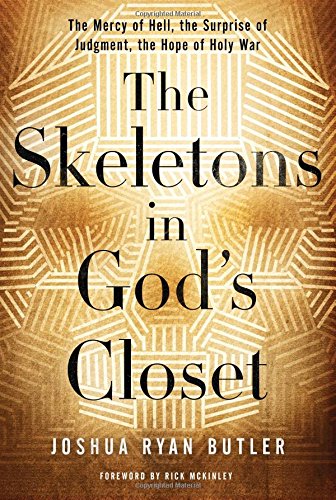
skeletons4. The Skeletons in God’s Closet by Joshua Ryan Butler.  And again, this is one I reviewed at The Gospel Coalition. Here’s some of what I said there:

The Skeletons in God’s Closet has the potential to be a game-changer for a lot of struggling Christians and skeptics. Thoroughly orthodox, Butler also speaks in a language and with the sensibility of someone who can still step out of his Christian shoes to hear, think, and feel the tension from the outside. In a lot of ways, it’s the book Love Wins tried to be but failed due to doctrinal drift. Instead, by helping readers walk through the difficult texts in Scripture, Butler sets out for them a broader vision for the beautiful character of a God who doesn’t give a doctrinal inch. Is it perfect? No. Would I have hit a couple of themes harder, or connected a couple of dots differently? Probably.

Still, Butler has done the church a magnificent service by showing a postmodern world that doctrines like hell and holy war aren’t about a God whose malevolence has to be restrained. Instead, The Skeletons in God’s Closet shows us a God who is good down to his bones, and utterly committed to loving and saving his world in Christ.

crucified king5. Tie: The Crucified King by Jeremy Treat and Atonement, Law, and Justice by Adonis Vidu.  I did not review these two at The Gospel Coalition. Still, I have already talked briefly about these two works here:

On The Crucified King:

In one sense, I found it to be a gravely disappointing book. It’s disappointing because Treat has written the book I wanted to write on the subject. Giving equal attention to biblical theology and systematic categories, Treat reunites what never should have been divorced in much modern theology: kingdom and cross as well as Christus Victor and penal substitution accounts of the atonement.

viduOn Atonement, Law and Justice:

Vidu aims to provide an account of the history of atonement theology down into the present that presents theologians against the background of the various legal and political theories dominant at the time. In this way, we can begin to appreciate better the way these theological concepts shaped and were shaped by their native settings. Five judicious, careful, and lucid chapters are devoted to the descriptive task, focusing on Patristic, Medieval, Reformation, modern, and contemporary periods…What’s more, along the way, he corrects a number of common misunderstandings and caricatures of historic positions.

If I went on to cite runners-up and honorable mentions, we’d be here for a while. It’s been a good year for books. I hope this list finds you in time for you to update your Amazon.com wishlist for last-minute purchases. If not, it ought to give you an idea of how to use your spare gift cash.

Soli Deo Gloria

Two New(er) Atonement Books You Should Read

Atonement theology is one of my passions. The cross of Jesus Christ is at the heart of our faith and the task explaining and displaying it’s ironic beauty the glorious means of our salvation is an unavoidable call for any preacher of the gospel. For that reason, atonement is one of the subjects I spent a good amount of time (and money) reading about in seminary. While I thought I had most of my ducks in a row, I’ve recently dipped back into exploring some recent work in atonement theology that’s been very helpful in sharpening up my thinking in these areas. I wanted to briefly commend two excellent works to you, my readers, for your attention and edification. Hopefully, you read this in time to update your Christmas list!

crucified kingFirst, is Jeremy Treat’s offering The Crucified King: Atonement and Kingdom in Systematic Theology. In one sense, I found it to be a gravely disappointing book. It’s disappointing because Treat has written the book I wanted to write on the subject. Giving equal attention to biblical theology and systematic categories, Treat reunites what never should have been divorced in much modern theology: kingdom and cross as well as Christus Victor and penal substitution accounts of the atonement.

One of the key strengths of his biblical theology section is his ability to go beyond key proof-texts to showing the broader, redemptive-historical framework in which the kingdom and cross fit beginning with Genesis through Torah, the Prophets, the Gospels, the Epistles, and into Revelation. From there he examines the important concept of the threefold office of Christ, and argues that for too long we have failed to recognize the way Christ’s kingly work is central to his cross-work and vice versa. Christ brings the kingdom through the cross; Christ conquers his enemies and saves his people by dying a penal death in their place. Beyond that there are some excellent sections engaging Wright’s conception of the ministry of Jesus, Moltmann’s account of the kingdom, and challenging reflections on the cross-shaped kingdom Christ invites us into.

At this point, I think it’s safe to say that this is the work future theologians and biblical scholars will need to reckon with when writing on the relationship between kingdom and cross. In my opinion, it also definitively puts a nail in the coffin of any attempt to bifurcate or oppose Christus Victor accounts and penal substitution. This can only be done by ignoring both the broader sweep of the biblical narrative, and key texts linking the two firmly together.

For a good preview of what this all looks like, check out this short article by Treat over at the Gospel Coalition. If all this isn’t enough to persuade you, just know two things: this is basically Treat’s dissertation written under Kevin Vanhoozer’s direction. Also, I met him at ETS and he’s a smashing chap.

viduSecond, in a very different register, Adonis Vidu has delivered an important contribution in the ongoing conversation about cross in his sophisticated Atonement, Law, and Justice: The Cross in Historical and Cultural ContextsTheology happens in complex social, intellectual, and philosophical contexts. Oftentimes we fail to appreciate the thrust and shape of historical theological positions because we do not attend the way dominant intellectual frameworks shape the language used and intellectual and moral concerns of the time. This is eminently true of historic and contemporary atonement theology.

Vidu aims to provide an account of the history of atonement theology down into the present that presents theologians against the background of the various legal and political theories dominant at the time. In this way, we can begin to appreciate better the way these theological concepts shaped and were shaped by their native settings. Five judicious, careful, and lucid chapters are devoted to the descriptive task, focusing on Patristic, Medieval, Reformation, modern, and contemporary periods. (All of the chapters are well worth the time, but he chapter on contemporary atonement theologies is very helpful for navigating the complicated and less accessible literature.) What’s more, along the way, he corrects a number of common misunderstandings and caricatures of historic positions.

For instance, in the first chapter, Vidu corrects the oft asserted charge that the newness Christian theology was its assertion of the gratuity of forgiveness as the mere release of debt without the need for repayment. On the contrary, given Hellenic conceptions of justice as order, positive law, and the maintenance of relations, there was no “cold legality” being overturned here. Indeed, he shows the way these ideas influence patristic accounts for understanding the nature of God’s law and their tendency to attribute the retributive function of the law to the accuser, instead of considering it a necessary expression of his just will. In this, then, certain Christus Victor accounts rest on common, Hellenic intuitions about justice.

At the heart of the book lies the contention that all the shifting paradigms for relating law, justice, and atonement are, at bottom, debates about God’s nature and agency in the death of Jesus. For this reason, Vidu’s last chapter argues for the importance of not neglecting the doctrine of God’s simplicity in our account of God’s atoning action in Christ. Though there are currently some heavy objections being lodged against it, Vidu forcefully makes the case that abandoning simplicity will have serious, deleterious effects for our ability to understand the unified, non-conflicted, saving activity of God through Christ’s cross. Instead, he delivers a nuanced, modified account that is able to preserve penal atonement accounts from the sort of mistakes and caricatures it is often saddled with by both detractors and proponents. While I’m reticent about a couple of the moves Vidu makes with respect to relating the agency of Father and Son on the cross, this is an overall salutary contribution on the subject.

I have not even begun to do either of these works any justice. I do hope that some of this whets your appetite and inspires you to check out either one or both of these timely and edifying works. For more, you can check out my larger post on 19 Objections to Penal Substitutionary Atonement, in which I tackle related issues and point you to more resources.

Soli Deo Gloria

P.S. If you’re interested in atonement, check out the line-up for the January 2015 LA Theology Conference all about atonement: Ben Myers, Elenore Stumpe, Michael Horton,  Bruce McCormack, and a whole lot more. Sign-ups are still going here.

Different Dimensions, Not ‘Theories’ of Christ’s Death

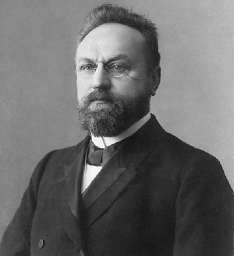
Truly dominant-looking theological man. It's a win for Reformed beardliness everywhere.

Truly dominant-looking theological man. It’s a win for Reformed beardliness everywhere.

It is very common in modern theology to talk about different ‘theories’ of what Christ’s death on the Cross accomplished. Indeed, a couple of weeks ago I talked about the way this was really a mistake that leads us to miss the various angles or aspects of the one, grand work of atonement Christ accomplished on the Cross. Just as there are various, equally important dimensions to God’s character, so there are to Christ’s salvation.

Back in the day, Herman Bavinck was also dealing with a context where a proliferation of atonement ‘theories’ were being offered up to replace older conceptions. This often provoked a sort of agnostic response that the New Testament only provided some facts about the death of Christ upon which various conflicting interpretations could be easily offered and chosen. Bavinck, instead, responded that, “Holy Scripture does not relate to us the bare fact of the death of Christ in order then to base the interpretation and appraisal of it to everyone’s own taste but from all angles puts that fact in the light of the Word.” Essentially, all of the different theories of Christ’s death find their basis in the New Testament alongside each other and ought to be maintained side by side, mutually determining each other, not ruling the others out in our theology as well.

Bavinck then goes on to show us what he means but that, and what solid, biblical atonement theology ought to look like. (Yes, this is a longish quote, but worth every minute):

The first thing this study teaches, we may say, is that the Scriptures continually view the suffering and death of Christ from a different perspective and in each case illumine another aspect of it. Like the person, the work of Christ is so multifaceted that it cannot be captured in a single word nor summarized in a single formula. In the different books of the New Testament, therefore, different meanings of the death of Christ are highlighted, and all of them together help to give us a deep impression and a clear sense of the riches and many-sidedness of the mediator’s work. In the Synoptics, Christ appears on the scene as a preacher and founder of the kingdom of God. That kingdom includes within itself the love of the Father, the forgiveness of sins, righteousness, and eternal life; and Jesus, in his capacity as Messiah, ascribes to himself the power to grant all these benefits to his disciples. Just as he has power to heal the sick, so he also has the authority to forgive sins. By this combination of powers, he proves that he is the complete Savior of his people. For that reason, too, there is no way of gaining admission into that kingdom and no participation in those benefits except by faith in his name. For it is he himself who gives his life as a ransom for many and who, in his death, breaks his body and sheds his blood to inaugurate and confirm the new covenant with all its blessings (Matt. 20:28; 26:28). In the Acts of the Apostles, the death of Christ is especially presented as an appalling crime that was inflicted on Christ by the hands of lawless men but was nevertheless from eternity included in the counsel of God (Acts 2:23; 4:28; 5:30). Therefore, God also raised him from the dead and exalted him as Lord and Christ, Ruler and Savior, in order, in his name, to give repentance to Israel and forgiveness of sins (Acts 2:36; 4:12; 5:31).

For Paul, Christ’s death on the cross was originally the great offense, but when it pleased God to reveal his Son in it, that cross became for him the crown of Jesus’ messiahship and the only means of salvation. For on that cross God made him to be sin and a curse for us in order that in him we would have wisdom and righteousness, sanctification and redemption, salvation and eternal life (Rom. 3:24; 1 Cor. 1:30; 2 Cor. 5:21; Gal. 3:13). The Letter to the Hebrews describes Christ especially as the perfect and eternal high priest who was not only himself sanctified (perfected) through suffering (2:10; 5:9) but by his one perfect sacrifice put away the sins of his people (7:27; 9:26; 10:12) and is still continually at work as high priest in heaven, continuing and completing the purification, sanctification, and perfecting of his own (7:3, 25; 8:1; 9:14; 10:12ff.). Peter pictures Christ’s suffering as that of a lamb without blemish or spot; and in that suffering he not only bore our sins and redeemed us from our futile way of life but left us an example that we might follow in his steps (1 Pet. 1:18f.; 2:21f.). And John makes Christ known to us both as the lamb and the lion, as the life and the light, as the bread and the water of life, as the grain of wheat that, dying, bears fruit, and as the good Shepherd who gives his life for the sheep, as the Savior who gives life to the world, and as the alpha and the omega, the beginning and the end, the first and the last, and so on.

So, indeed, one can find in the New Testament different appraisals of the person and work of Christ, which, however, do not exclude but rather supplement one another and enrich our knowledge. Just as in the old covenant there were diverse sacrifices and the promised Messiah was repeatedly presented under different names, so this many-sidedness in the description carries over into the New Testament and even markedly increases. The death of Christ is a paschal offering, a covenant offering, a praise offering as well as a sacrifice; a ransom and an example; suffering and action; a work and a ministry; a means of justification and sanctification, atonement and consecration, redemption and glorification; in a word, the cause of our whole redemption. Similarly, in theology various “theories” occur side by side, and in the preaching of the church, now one and now another aspect of the work of Christ is in the limelight. None of the above-mentioned mystical and ethical views, accordingly, are untrue as such; on the contrary, they are all based on data contained in Holy Scripture.

Christ, by his incarnation, in his person indeed brought about the union of God and humanity and is, as such, God’s representative to us and our representative to God: the Immanuel who as prophet makes God known to us and as priest consecrates himself on our behalf to the Father. He is the Son, the Word, the Image of God who shares with the Father in the same essence and attributes, and at the same time the Son of Man, the true human, the head of humankind, the second Adam who became like us in all respects, entered into our community of sin and death and bore our sorrows and diseases. He came on earth to fulfill a vocation, to found the kingdom of heaven, to confirm the new covenant in his blood; and in order to do that, he submitted to the will of the Father, became obedient unto death, and pronounced the “Amen” on the righteous judgment that God executed upon death in his suffering and dying. He became the faithful witness (Rev. 1:5), made the good confession before Pilate (1 Tim. 6:13), and became the high priest of our confession (Heb. 3:1). His suffering, therefore, was not only an atonement for our sins and a ransom for our redemption, but in his death the believing community was crucified with him, and in his resurrection this community itself arose from the grave. Christ was never alone; always he stood in fellowship with the humanity whose nature he had assumed. Just as all die in Adam, so they are again made alive in Christ and called to follow in his footsteps. All these elements, which come one-sidedly to the fore in the above-mentioned conceptions of Christ’s death, can be found in Scripture. What matters above all, now, is not to neglect any of them but to unite them into a single whole and to trace the unity that underlies them in Scripture. We can even say they are all inspired by the commendable ambition to link the suffering and death of Christ as closely as possible with his person. For this suffering and death were in fact not “something objective” that can be separated from his person and life and put in a category by itself. Christ’s suffering and death were not his “lot” but his deed. He had power to lay down his life as he did to take it up again (John 10:18). His death was the consummation of his obedience (Phil. 2:8).

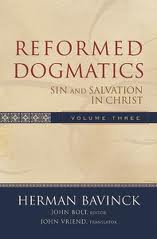
Reformed Dogmatics Volume 3: Sin and Salvation in Christ, pp. 383-384

Of course, for those who know the atonement theology, even this still doesn’t exhaust what Scripture (or Bavinck himself) says about the death of Christ in terms of the defeat of Satan, the powers of sin, and so much more. All the same, you can see Bavinck drawing out dimension after dimension of Christ’s accomplishment on the cross on our behalf, laying them side-by-side in a beautiful, seamless whole.

After reading something like this, I wonder at our tendency to want to single out, separate, or deny part of Christ’s great work on our behalf. No, instead, we must strive in our preaching and teaching to maintain every thread of the marvelous tapestry given us in the New Testament so that the glory of Christ Crucified and Risen may be gloried in, experienced, and wondered at all the more.

Soli Deo Gloria

God Has More Than One Name–And We Need Every One of Them

bavinck sin and salvation imageI’ve said this before, but theology is an issue of finding your balance. This can happen in various ways, but one of the simplest is to pick out one element of biblical truth and elevate it above all others, ignoring, or sidelining important balancing themes. For instance, some have issues with accounts of salvation that emphasize, or indeed, merely teach that God does not accomplish his forgiveness apart from atonement. Is he not a loving Father? Do not fathers forgive all the time without requiring payment or retribution? If even human fathers can do so, how can our heavenly Father be any less merciful or gracious by requiring satisfaction for sins?

Bavinck shows us the problem with that sort of thing:

God is most certainly the Father of humankind, but this name is far from describing the entire relationship in which God stands to his creatures. He is also Creator, Maintainer, Ruler, Sovereign, Lawgiver, Judge, and so on, and it is one-sided and conducive to error if one takes one of these names—disregarding all the others—to be the full revelation of God. Thus, in relation to sin, God is not just a creator or injured party who can cancel the debt and forgive as well as forget the insult but is himself the giver, protector, and avenger of the law, righteousness in person, and as such he cannot forgive sin without atonement (Heb. 9:22). In that capacity he cannot nullify the just demands of the law, for we are not speaking here about personal or private rights, which one can relinquish, but about the righteousness, that is, the perfections and honor of God himself. Against this idea one could appeal to the prerogative of pardon that an earthly government frequently exercises, but this prerogative of pardon is only given to it because it is fallible and in many cases inflicts a penalty that is too severe or even undeserved. In God something like that cannot happen. He is righteousness in person, does not need to restore justice or nullify it by grace, but lets both justice and grace come to expression in the cross of Christ.

-Herman Bavinck, Reformed Dogmatics Volume 3: Sin and Salvation in Christ, pp. 372-373

Of course, one can tip the balance in the other direction and only fixate on God’s role as judge or king and forget that he is the Father who is passionately concerned to forgive. God is not begrudging in securing atonement, but gloriously willing to save sinners even as they reject him (Romans 5:6-8). Still, whichever way it happens, both make the mistake of flattening God’s relationship with his creatures by failing to account for each part of the crucial biblical imagery by which he reveals himself to us.

In other words, God gave us more than one beautiful name for himself in the Scriptures. We need to make sure we understand and worship him in light of all of them.

Soli Deo Gloria

For more on the way God’s atonement is not a denial of forgiveness, but rather the method of God’s forgiveness, see my article here.

Diognetus on Christ’s Atonement (Or, a Rather Reformed Father)

christ pantokratorThe Epistle to Diognetus is a brief, but powerful theological treasure from the early Christian Fathers. In one brief chapter the anonymous Disciple answers the question, “Why was the Son sent so late?” with a condensed account of Christ’s work of salvation on our behalf. I present it here without much comment except to say, despite the allegedly vast differences between Patristic and Reformation theologies of salvation, if I didn’t know better you could have told me Calvin or Luther wrote this:

As long then as the former time endured, He permitted us to be borne along by unruly impulses, being drawn away by the desire of pleasure and various lusts. This was not that He at all delighted in our sins, but that He simply endured them; nor that He approved the time of working iniquity which then was, but that He sought to form a mind conscious of righteousness, so that being convinced in that time of our unworthiness of attaining life through our own works, it should now, through the kindness of God, be vouchsafed to us; and having made it manifest that in ourselves we were unable to enter into the kingdom of God, we might through the power of God be made able.

But when our wickedness had reached its height, and it had been clearly shown that its reward, punishment and death, was impending over us; and when the time had come which God had before appointed for manifesting His own kindness and power, how the one love of God, through exceeding regard for men, did not regard us with hatred, nor thrust us away, nor remember our iniquity against us, but showed great long-suffering, and bore with us, He Himself took on Him the burden of our iniquities, He gave His own Son as a ransom for us, the holy One for transgressors, the blameless One for the wicked, the righteous One for the unrighteous, the incorruptible One for the corruptible, the immortal One for them that are mortal.

For what other thing was capable of covering our sins than His righteousness? By what other one was it possible that we, the wicked and ungodly, could be justified, than by the only Son of God? O sweet exchange! O unsearchable operation! O benefits surpassing all expectation! that the wickedness of many should be hid in a single righteous One, and that the righteousness of One should justify many transgressors! Having therefore convinced us in the former time that our nature was unable to attain to life, and having now revealed the Saviour who is able to save even those things which it was [formerly] impossible to save, by both these facts He desired to lead us to trust in His kindness, to esteem Him our Nourisher, Father, Teacher, Counsellor, Healer, our Wisdom, Light, Honour, Glory, Power, and Life, so that we should not be anxious concerning clothing and food.

–The Epistle to Diognetes, Chapter IX.—Why the Son was sent so late.

You can read the whole epistle here.

Soli Deo Gloria