Are You a Dualist? Is that Bad? Just ask N.T. Wright

I was a sophomore in college when I found out that there was more than one kind of dualism. I was sitting in my class on St. Augustine (it was my medieval philosophy class) when a fellow classmate brought up the issue of dualism and how interesting it was given that nobody believed it. I piped up and said, “Oh, yeah, I’m a dualist.”

Looking at me with surprise, “Oh really? I’ve never met one. That’s odd.”

I didn’t think it odd at all: “Well, I am a Christian so it’s not that weird.”

“Really? I thought the two were kinda not compatible.”

At this point I was truly confused. Turns out we both were.  See, I had been talking about mind-body dualism and he was referring to theological dualism a la Zoroastrianism where you have a good god and a bad god facing off. At that point I started to realize that the subject of dualism was far more complicated than I thought. In fact, I didn’t realize how complicated it was until I read N.T. Wright’s The New Testament and the People of God (NTPG)In that work he lists 9-10 different kinds of dualism that you could speak of when discussing the views of 1st Century Pagans and Jews.

I was reminded of this little discussion when reading this article by Wright on anthropology, or the theology of humanity, in the Apostle Paul’s thought. In it, he offers this helpful summary of his own discussion in NTPG.

So let’s run through these types of dualism or duality, beginning with four types that would be comfortably at home within ancient Jewish thought:

  1. a heavenly duality: not only God exists, but also angels and perhaps other heavenly beings;
  2. a theological or cosmological duality between God and the world, the creator and the creature;
  3. a moral duality between good and evil;
  4. an eschatological duality between the present age and the age to come.

All of these dualities a first-century Jew would take for granted. But none of them constitutes a dualism in any of the following three senses:

  1. a theological or moral dualism in which a good god or gods are ranged, equal and opposite, against a bad god or gods;
  2. a cosmological dualism, a la Plato, in which the world of space, time and matter is radically inferior to the noumenal world; this would include, perhaps, dualisms of form and matter, essence and appearance, spiritual and material, and (in a Platonic sense) heavenly/earthly (something like this would be characteristic of Philo);
  3. an anthropological dualism which postulates a radical twofoldness of soul and body or spirit and body (this, too, would be familiar in Philo).

Then there are three more which might be possible within ancient Judaism:

  1. epistemological duality as between reason and revelation – though this may be problematic, since it’s really the epistemological face of the cosmological dualism which I suggest ancient Jews would mostly reject;
  2. sectarian duality in which the sons of light are ranged against the sons of darkness, as in Qumran;
  3. psychological duality in which the good inclination and the evil inclination seem to be locked in perpetual struggle, as in Rabbinic thought.

It’s important to know about these different sorts dualisms in order to keep a clear theological head on your shoulders wading into these discussions–which I know you do everyday. But seriously, for Christians wanting to understand reality out of a properly Christian worldview, or theological framework, we have to keep in mind what Wright underlines here:

The radical rejection by most ancient Jews, in particular, of what we find in Plato and in much oriental religion, and the radical embrace of space, time and matter as the good gifts of a good creator God, the place where this God is known and the means by which he is to be worshipped – all this remains foundational, and is firmly restated and underlined in the New Testament. Creational, providential and covenantal monotheism simply leave no room for those four dualisms in the middle. In particular, I argued that such dualisms tend to ontologize evil itself, whereas in first-century Judaism evil is not an essential part of the creation, but is the result of a radical distortion within a basically good created order.

While we might not all agree with his judgments on Plato’s dualisms or body and soul, it’s important to keep distinct the things that ought to be distinct (God/creation, good/evil, present age/age to come, etc.) while avoiding tearing apart those things that should be kept together. That basic creational framework of a good God who creates a good world that gets distorted by sin is the backdrop of God’s redemption of all things in Christ. This is what the ancient gnostics missed when they created a Jesus who was simply a redeemer who saved people’s souls from their bodies–in which case, who cares what you do with your body? This is what is absent in pantheistic theologies that drag God into the world, who end up giving us a “compassionate” God that, in the end, is just as trapped in the world’s agony as we are, instead of being the distinct, but sovereign redeemer who can fix it. This is what modern Evangelicals sometimes miss with their tendency for evacuating from the world, despising creation, and simply waiting for Jesus to come back and rapture them out of their nicely air-conditioned churches they hide in most of the week.

God freely created the world distinct from himself, he loves it–he’s going to save it. He wants his people out in the world, in it, but not of it, proclaiming that good news, and working for it out in the world.

The bottom-line is: if you don’t keep your dualisms straight, you might lose the Gospel.

Soli Deo Gloria

Really Quick-Blog #7: Post-Election Blues and Celebrations

Welp, Obama won. Depending on which one of my friends and family you ask, this was either a catastrophe or a brilliant victory. I have my leanings in one direction, but that’s neither here nor there. Last night, as the results were pouring in, I had a bit of realization. I was on facebook, of course, and I was seeing both the dismay or the jubilation on full display in updates of varying maturity and I decided to start a post.

It was a post I still believe in, one telling people that no matter who won, the call was still the same, to pray for him and show him honor. (1 Tim 2:1-2) It was basically a rehash of one point in my post on what people should be doing on election day. It was at that point though, that a wonderful loved one, who shall remain nameless, called me out on my crap. See, in my haste to recover from my youthful, political semi-idolatry and my pastoral instinct to call people back to trust in Christ no matter what circumstance, I had forgotten some things: people are human and elections do matter.

What do I mean by that? I mean, people are human. They have human reactions like fear, joy, heartache, delight, hope, and dismay. These emotions are okay to have in measure. Yes, Jesus is still king, on the throne, ruling, reigning, and bringing all things to a glorious end, and yes, I believe that this election was part of his sovereign lordship of history. Still, some are legitimately sad, worried, and frustrated because of convictions about life, religious freedom, and economic decisions that will affect the jobs of people they know and love. And, yes, some are legitimately happy because of convictions in largely the same areas in the opposite direction. This isn’t to say they’re equally right. They’re not. Truth isn’t like that.

Still, it is to say that while eternal realities are to be our ground, our hope, our life, it’s okay to have reactions to human, historical ones–Jesus did too. Jesus wept at the tomb of Lazarus. He was angered at the money-changers in the Temple. He was delighted by children. He was joyful at the faith of the Centurion. These were human, historical realities, none of which was a surprise to the sovereign God, but at which Jesus rejoiced and grieved.

Where am I going with this? Well, first, I’m saying that last night I was very close to being a sanctimonious ass (in the donkey sense). Me posting what I was going to would have been just a dumb, insensitive, holier-than-thou move. (Not saying anything about other posts of the same vein. Just mine.) I am also saying that it’s okay to grieve for a bit. It’s okay to celebrate too. It’s human and history does matter.

If I may still speak something into the situation, I would just encourage you to consider how you do those things.

To the jubilant, the rejoicing, those who believe that Obama is the right man for the job, and that his economic, moral, and social policies (or at least some of them), are what this country needs right now, it’s okay to be happy, but be careful who you boast in and how you boast.

Thus says the LORD: “Let not the wise man boast in his wisdom, let not the mighty man boast in his might, let not the rich man boast in his riches, but let him who boasts boast in this, that he understands and knows me, that I am the LORD who practices steadfast love, justice, and righteousness in the earth. For in these things I delight, declares the LORD.” (Jer. 9:23-24)

Again, all righteousness, truth, justice that you think this President will usher in, the ultimate source is the LORD. Thank him, and don’t rub it in the face of those who’ve lost.

To the broken, the anxious, the grieving, those who believe that Romney would have been better, and that his economic, moral, and social policies (or at least some of them), are what this country needs right now, it’s okay to grieve, but I would remind you that in all the situations in which Christians should rightly grieve, Paul tells us that you don’t have to “grieve as others do who have no hope.” (1 Thes 4:13)  In the context, Paul is talking about the death of loved ones and resurrection, but for the God who is sovereign over death, nothing is too small, not even American history. You can trust and hope in him.

Well, hopefully I managed to get that out with a minimum of sanctimoniousness. If I didn’t, well, this blog is Reformedish–He’s still working on me.

Soli Deo Gloria

Ps. If you are looking to pray for the President, Kevin DeYoung has written out a simple, faithful prayer as a model to use.

4 Sources of Wisdom (Or, How to Stop Being a Moron)

Proverbs was one of my favorite books in the OT as a teenager because it was just straight advice. Advice is a good thing when you’re a moron high schooler. I mean, I didn’t understand half of it, but the verses were short and it felt easier to read. When I hit college and went through my bitter realist phase (which I may or may not still be in) Ecclesiastes and Job jumped up the list. The reality that life doesn’t work out cleanly, that bitterness has corrupted our work and our play “under the sun”, and that our only hope is in Christ really resonated. It still does.

Still, now that I’ve got my own ministry working with college kids I find myself returning to the Proverbs. One of the things I’ve realized about my job is that I’m not just here to preach the Gospel. I mean, that’s my main job, but part of loving and discipling college students is teaching them some of basics of being an adult. Apparently, I’m supposed to teach them wisdom–the practical knowledge of living in God’s world. Go figure.

Since I’m still somewhat of a youngster myself, the Proverbs have been a blessing to me. In many ways it’s a biblical short-cut on the road to not being a moron.

As I started doing some more in-depth study, I picked up Tremper Longman III’s commentary on Proverbs in the Baker Commentary on the Old Testament Wisdom and Psalms series. (Book nerd note: it’s excellent, readable, preachable, and scholarly.) In it, he notes that not only do the proverbs teach us specific bits of wisdom and practical advice like, “A soft answer turns away wrath, but a harsh word stirs up anger” (Prov 15:1), a key tidbit to remember in the blogging world, but also teaches the way to gain wisdom.

Longman specifically notes four sources of wisdom in Proverbs–where morons ought to look to become wise:

1. Observation and Experience. This should be obvious, but wise people are those who pay attention to life and reflect on the meaning of their experiences. In 6:6-11, the teacher tells the student to go look at the ant, observe his ways, and learn diligence. Wise people stop and think about which of their behaviors work and which don’t. They consider the actions of others, the way the world, history and draw lessons from it. This is why typically older people have more wisdom. Longman points out that in the Proverbs it is always the father or the mother instructing the son and never the other way around. (pg. 75) This not a universal truth–I’ve met some old fools–but it is a general one, that you will grow wiser as you grow older because you’ve experienced more. So, if you’re young and wanting to gain wisdom, listen to older people who’ve gone before and learn from their experiences. It’s the first step to not being a moron.

2. Instruction Based on Tradition. This last point is the essence of the next source of wisdom: tradition. In this passage, a father tells his son to cling to the instruction that was taught to him by his father, which apparently has served him well in his own life:

Hear, O sons, a father’s instruction,
and be attentive, that you may gain insight,
for I give you good precepts;
do not forsake my teaching.
When I was a son with my father,
tender, the only one in the sight of my mother,
he taught me and said to me,
“Let your heart hold fast my words;
keep my commandments, and live.
Get wisdom; get insight;
do not forget, and do not turn away from the words of my mouth.”
(4:1-5)

See, tradition is not just dead, trite ritualism. Over the years accumulated observations about successful and failed strategies for living, truths of human nature, and relationships end up becoming “tradition” that we can learn from. To some degree we know this instinctively. When we want to learn a new skill or a trade, we apprentice ourselves to someone who knows it–an expert that’s been doing it long enough to know the ins and outs of the business. Living well is also a skill, a practice that people have been working at for a long time, and the wise take advantage of the wisdom of their elders. That’s another great way to not be a moron.

3. Learning from Mistakes. Connected to the last two is the idea of learning from one’s mistakes. A great amount learning from experience and heeding the wisdom of the tradition has to do with finding out what doesn’t work. The sages know that you’re gonna screw things up as you go. That’s why two common words you’ll find in the Proverbs are “discipline” and “correction.”

“Those who love discipline love knowledge; and those who hate correction are dullards.” (12:1)

“Those who guard discipline are on the way to life, and those who abandon correction wander aimlessly.” (10:17)

The idea is that the wise are those who receive correction, learn from their mistakes, and do not reject the counsel of those who are trying to return them to the way from which they’ve strayed. This is why pride is so foolish; the proud never learn from their mistakes that eventually lead to their destruction. (Prov. 16:18) On the contrary, the wise humble themselves to the point of loving correction because it leads to wisdom. (Prov. 9:8) The bottom line is that a significant part of learning from experience and from tradition is figuring out what didn’t work and avoiding it. Only morons don’t learn from their mistakes.

4. Revelation. Longman notes that while these three sources–experience, tradition, mistakes–are key for gaining wisdom, nothing is more foundational than revelation, for “at the heart of wisdom is God himself.” (pg. 78) This is clear from the very beginning:

“The fear of Yahweh is the beginning of knowledge, but fools despise wisdom and discipline.” (1:7)

How can you know how to live properly in the world, if you don’t know the character of the one who made it? Indeed, it’s not simply that God is an important feature of reality that one must account for in order to be wise. The Lord is the source of wisdom:

For the LORD gives wisdom;
from his mouth come knowledge and understanding;
he stores up sound wisdom for the upright;
he is a shield to those who walk in integrity,
guarding the paths of justice
and watching over the way of his saints.
(2:6-8)

Ultimately God is the one who teaches you through experience, tradition, and correction. Whatever you learn, you learn because of him. This is why, according to Proverbs, the way to gain wisdom, and yes, stop being a moron, is to humble yourself before the creator of the universe and ask him for it.

Wisdom in Christ

Finally, for the Christian the ultimate source of wisdom is Christ himself “in whom are hidden all the treasures of wisdom and knowledge.” (Col. 2:2-3) If we want to see the fullness of human life, to know what a truly wise life, a life lived in sync with the rhythm with which God created all things, then we must look to Christ. He is not simply wise, but wisdom from God himself, incarnate for us. (1 Cor. 1:30) Jesus is God’s gracious wisdom come to us–to help us stop being morons.

Soli Deo Gloria

Quick-Blog #6 – Some Things to Do on Election Day

Aside from some silly, live, Facebook commentary on the debates, I haven’t spoken much about the election this year. I had a few reasons for this:

  1. My job makes it so that people automatically connect my personal judgments with an endorsement by my church and I don’t want to do that. I am sick to death of people conflating the Gospel with some particular political program. If I hear one more pastor, or church perverting the good news by making it about some lordship other than Christ’s, I’m going to snap.
  2. I am a recovering political junkie, so I decided to take this election off.  (I am still voting, though. More on that below.)
  3. Let’s be honest, I’m too busy otherwise.

Still, I figured it’d be appropriate to very quickly jot down some things you might try this Tuesday:

1. Calm down and remember that no matter who wins, Christ remains Lord.

Seriously, this is not some cheesy “Oh, God is still in control” shtick that doesn’t acknowledge the real, political implications of these elections. I get it, there are serious issues at stake. Still, at the heart of the Gospel is the acknowledgement that Jesus “was declared to be the Son of God in power according to the Spirit of holiness by his resurrection from the dead.”(Rom 1:4) This is what you confess in order to be saved: that Christ is the risen Lord. (Rom 10:9) The good news is that he is risen and reigning over all things in heaven and on earth, even now, no matter who wins. Michael Horton reminds us that, “United to Christ, we should be the most responsible and the least fearful people at the polls on November 6, 2012, because our King already achieved his landslide victory in Jerusalem during Passover, AD 33.” So, no matter who wins on Tuesday, keep your head, Christ is Lord.

2. Pray for your leaders like the Bible tells you to.

First of all, then, I urge that supplications, prayers, intercessions, and thanksgivings be made for all people, for kings and all who are in high positions, that we may lead a peaceful and quiet life, godly and dignified in every way. This is good, and it is pleasing in the sight of God our Savior, who desires all people to be saved and to come to the knowledge of the truth.”(1 Timothy 2:1-4)

Paul instructs Timothy to makes sure the congregation at Ephesus was praying for “kings and all who are in high positions.” If you’re going to claim to take the Bible seriously, then pray for your leaders no matter who they are. Paul was writing this about the Roman Emperors, not godly, Christian kings, but pagans who were persecuting Christians. Peter similarly tells Christians to “Honor everyone. Love the brotherhood. Fear God. Honor the emperor.“(1 Peter 2:17)  In the context of great persecution, Peter tells them to “honor the emperor.”

Instead of freaking out and bemoaning the election, or re-election, of “that guy”, pray for him. If you’re really interested in being a witness in our culture, lay off of the conspiracy-theory emails about a take-over of the country by “them”, whatever that group consists of in your mind, and pray that God would give wisdom, grace, and salvation to whomever comes into, or remains, in office. Remember, we are to lead a “peaceful and quiet life, godly and dignified in every way”, not a panic-stricken and hysterical one.

3. Vote.

I’ve got a buddy who’s got some decent reasons for casting a blank ballot this Tuesday. I hear him and respect a position like his. Still, I do think that part of our responsibilities in being a good neighbor is voting for the common good, seeking the welfare of the city. (Jer. 29:7) We don’t do this to give our allegiance to the candidates because, in the end, our ultimate allegiance is to Christ alone, the living Lord of the universe. We do this in obedience to Christ, for the same reason we pay taxes, in order to live quiet, peaceable lives, giving to Caesar what is Caesar’s, and to God what is God’s. (1 Tim 2:2; Mark 12:17; Rom. 13:7)

4. Ask Forgiveness, Repent, and remember the Body of Christ.

Let’s be honest, too much of the American church has jacked up on this election. Far too many of us have been quick to tear apart the unity of the body of Christ for the sake of a political program. Christ made us one in himself. This was his prayer for us (John 17:21), and instead of living out that unity, we’ve been quick to vilify, reject, oppose, and refuse to recognize the Christian identity of those we disagree with politically. Echoing Paul, Brian Zahnd asks, “Is Christ divided? Was Obama crucified for you? Were you baptized in the name of Romney?” No. Christ is the only one who has done these things. He is the hope of the world. He is the light in the darkness. His kingdom is the one that will never fail and has no end. His reign is the reality on which our lives depend. His life is the one that draws us together, in himself, and made us citizens of a better country. (Heb. 11:16)

So, after you vote, or before, or maybe even today, take some time consider this truth. Stop, ask yourself if, in the heat of the election, you’ve forgotten that, “There is one body and one Spirit—just as you were called to the one hope that belongs to your call—one Lord, one faith, one baptism, one God and Father of all, who is over all and through all and in all.” (Eph 4:4-6)

If so, you need to stop, repent, and ask forgiveness. Remember that in Christ you all are one, no matter how you vote–so ACT LIKE IT. Love each other. Treat each other with respect. You know–act like you believe the Gospel.

Bottom-line is this: don’t forget the Gospel this Tuesday.

Soli Deo Gloria

God Didn’t Just Create the World to Spin on its Own

Last night I talked to my college group about the issue of miracles and the laws of nature. One point that came up was that too often Christians have a limited view of God’s creative activity. They think of him in an essentially deistic fashion–that God created the world and then just left it spinning to itself. On that view, miracles become somewhat random interventions of an absent God. No, instead the Bible presents us with a God who not only creates, but sustains the universe in existence, governing it in wisdom and with fatherly compassion.  On this picture, a miracle is not an “intervention” from a distant God, but a sovereign action of a God already intimately involved with maintaining his creation. It was a good discussion–I love my job.

As I thought back on it this morning, it called to mind Calvin’s excellent comments on God’s creation and governance:

Moreover, to make God a momentary Creator, who once for all finished his work, would be cold and barren, and we must differ from profane men especially in that we see the presence of divine power shining as much in the continuing state of the universe as in its inception, For even though the minds of the impious too are compelled by merely looking upon earth and heaven to rise up to the Creator, yet faith has its own peculiar way of assigning the whole credit for Creation to God. To this pertains that saying of the apostle’s to which we have referred before, that only “by faith we understand that the universe was created by the word of God” [Hebrews 11:3]. For unless we pass on to his providence — however we may seem both to comprehend with the mind and to confess with the tongue — we do not yet properly grasp what it means to say: “God is Creator.” Carnal sense, once confronted with the power of God in the very Creation, stops there, and at most weighs and contemplates only the wisdom, power, and goodness of the author in accomplishing such handiwork. (These matters are self-evident, and even force themselves upon the unwilling.) It contemplates, moreover, some general preserving and governing activity, from which the force of motion derives. In short, carnal sense thinks there is an energy divinely bestowed from the beginning, sufficient to sustain all things. But faith ought to penetrate more deeply, namely, having found him Creator of all, forthwith to conclude he is also everlasting Governor and Preserver — not only in that he drives the celestial frame  as well as its several parts by a universal motion, but also in that he sustains, nourishes, and cares for, everything he has made, even to the least sparrow [cf. Matthew 10:29]. Thus David, having briefly stated that the universe was created by God, immediately descends to the uninterrupted course of His providence, “By the word of Jehovah the heavens were made, and all their host by the breath of his mouth” [Psalm 33:6; cf. Psalm 32:6, Vg.]. Soon thereafter he adds, “Jehovah has looked down upon the sons of men” [Psalm 33:13; cf.Psalm 32:13-14, Vg.], and what follows is in the same vein. For although all men do not reason so clearly, yet, because it would not be believable that human affairs are cared for by God unless he were the Maker of the universe, and nobody seriously believes the universe was made by God without being persuaded that he takes care of his works, David not inappropriately leads us in the best order from the one to the other. In general, philosophers teach and human minds conceive that all parts of the universe are quickened by God’s secret inspiration. Yet they do not reach as far as David is carried, bearing with him all the godly, when he says: “These all look to thee, to give them their food in due season; when thou givest to them, they gather it up; when thou openest thy hand, they are filled with good things; when thou hidest thy face, they are dismayed; when thou takest away their breath, they die and return to the earth. If thou sendest forth thy spirit again, they are created, and thou re-newest the face of the earth” [Psalm 104:27- 30 p.]. Indeed, although they subscribe to Paul’s statement that we have our being and move and live in God [Acts 17:28], yet they are far from that earnest feeling of grace which he commends, because they do not at all taste God’s special care, by which alone his fatherly favor is known.

-John Calvin, Institutes of the Christian Religion, 1.16.1

Calvin, and Scripture, remind us that we serve a God who didn’t just create the world and leave it spinning. No, instead we have a God who, with fatherly kindness and great concern, reigns over it with wisdom and power.

Soli Deo Gloria

Happy Reformation Day! Now Repent

When our Lord and Master Jesus Christ said, “Repent” [Matt. 4:17], he willed the entire life of believers to be one of repentance.

-Martin Luther, the 95 Theses

Among the many important letters Martin Luther wrote in his storied career, the one he wrote in protest of the sale of indulgences to Albrecht, Archbishop of Mainz, on October 31, 1517 might have been the most important. The letter itself isn’t the important part, but enclosed within it was a copy of his “Disputation of Martin Luther on the Power and Efficacy of Indulgences,” which came to be known as The 95 Theses. Now, scholars debate whether or not Luther actually took up a mallet to nail the theses up on Wittenburg’s Castle Church on that same day. Also up for debate is whether or not Luther actually intended to accomplish anything more than invite a scholarly debate between solid, Catholic theologians on an issue of importance. What is not up for debate is the colossal significance these theses had in instigating a theological and socio-political revolution that ripped open Europe, changing the face of Western, indeed global, Christianity to this day: the Protestant Reformation. 

This is what Protestant churches celebrate on Reformation Day. Now, to be clear, we don’t mainly celebrate the politics, although a few good (and many bad) things followed. We certainly don’t sing about the tearing of the visible unity of the church. We don’t rejoice in the centuries of acrimonious disputes that followed. No, in fact, many of these are things we lament–at least we ought to.

What we celebrate is the recovery of an essential insight into the Gospel: the good news that Jesus’ reign and rule are freely available to all, without regard to their present ‘righteousness’, or meritorious works; that we are saved by the grace and good will of our heavenly Father through the work of Jesus Christ; that we are justified, declared righteous because by faith we are united with the Righteous One, King Jesus. As it was later summarized in the 5 Solas: we are saved by grace alone, through faith alone, in Christ alone, according to the Scriptures alone, for God’s glory alone.

Celebrate by Repenting

Unfortunately many of us don’t know how to celebrate this Gospel properly. We sing, we praise, we write blogs about Martin Luther and the message of justification by faith, and in general have some nice, warm thoughts about the whole affair. Now this great news is certainly worth singing about; it’s definitely worth a blog or two. For these truths, unfortunately clouded over and muddied up however temporarily in the dominant, late-medieval theology of the day, to be regained and preached loudly and clearly for all to hear is a glorious thing.

Still, if we want to celebrate Reformation Day properly, there is only one truly appropriate response: repentance. See, surprisingly enough for many Protestants, Martin Luther never mentioned the phrase “justification by faith” in the 95 theses. Not by name at least. He certainly spoke of grace and the nature of forgiveness, issues connected to it, but the subject he opened up with was the nature of repentance.

For centuries Jerome’s mistranslation of Matthew 3:2 as “Do penance” instead of “repent”(as well as some other doctrinal developments) had led to a misunderstanding of Jesus’ call to respond to the Kingdom of God. The Greek term metanoia means a deep, internal change of mind–a reconsidering of one’s course of action in light of new realities. Luther saw that when Jesus called for people to repent, he wasn’t calling for a simple change of external actions, or for meritorious acts of penance, and certainly not for people to buy themselves some grace through indulgences. He was calling people to recognize the arrival of God’s reign and rule by turning and submitting themselves to it; it was an invitation to consciously live in the new reality of God’s kingdom made available by grace through Jesus.

The Reformation was, in many ways, an attempt at this kind of repentance not only in the life of the individual Christian, but in the life of the Church as a whole. For those of us claiming the mantle of ‘Protestant’ there can be no question whether the whole of our lives need be one long process of reconsidering everything in light of the Gospel. Repentance is not simply a one-time act but a life-long task. Sin is too deep and Jesus is too good for us to think we ever have it handled–there will always be some sin our heart needs to release and some gift of God’s grace to embrace. God’s liberating reign in Christ is something we’re called to dive into daily.

So, this Reformation Day celebrate the Gospel by repenting–call to mind the goodness of God, the new reality made available in Christ, and live in light of that. Can’t think of anything? Here’s a starter list:

  • Pride – Consider God’s glorious humility in Christ and get over yourself–discover the joy of self-forgetfulness. In fact, try to practice humility by serving someone else without being able to take credit for it.
  • Lust – Look to God’s beauty in Christ and realize He’s the summit of true desire.
  • Gluttony – Take hold of God’s feast provided in the body and blood of Christ and pass the plate to those in need.
  • Greed – Observe of God’s riches, his generosity in Christ and remember that God provides all we could ever want. Give generously to those who do not have.
  • Sloth – See God’s active drawing near in Christ and respond–act–turn to him. Begin (or re-engage) in the spiritual disciplines that draw you to Christ.
  • Wrath – Remember God’s putting away his own righteous wrath toward you in Christ and put away your own unrighteous rage towards others. Instead, be gracious in word and deed towards those around you–especially the aggravating ones.
  • Envy – Recognize God’s gifts toward you in Christ and be grateful for what you have, not bitter what your neighbor has instead.

These ought to keep you busy for a while. Now, start celebrating!

Soli Deo Gloria

Vital by Anberlin (Or, When Anberlin Decides to be Awesome Again)

I bought my first Anberlin album back as a sophomore in high school. Blueprints for the Blackmarket was revolutionary stuff for the Christian music scene, which is what I was primarily limited to at the time,  and I’ve been a fan ever since. Now, I’ll admit, I wasn’t the biggest fan of their last couple albums New Surrender or Dark is the Way, Light is a Place.  There were some stand-out tracks (“Miserabile Visu”, “Closer”, “To the Wolves”), but on the whole, I’d been worrying whether they lost the magic–or their coffee machine. With the release of their latest album, Vital, my fears were taken to the back shed and beat down to the sound of Stephen Christian’s lovely, raging falsetto, aggressive guitar riffs, and catchy drums. Anberlin delivered this time.

I don’t know if it’s the return of Aaron Sprinkle producing, or just a need to turn a corner, but Anberlin has recovered and produced an album that tops their magnum opus, “Cities.” In many ways this album flows naturally out of moves they made in Dark is the Way–an appreciation for and tasteful use of electronics and synth, but without the falsified feel of so much vocoder-pop playing on the radio. They’ve crafted a new sound while simultaneously returning to the angsty, guitar-driven alt-rock of “Paper-Thin Hymn” and “Feel-Good Drag.”

I’ll name stand-out tracks but honestly, this is one of those don’t-skip-a-song albums where each listen through gives you a new appreciation for a song previously ignored. The opener “Self-Starter” is a typically strong lead-in to the rest of the album. The nice thing is that it’s sustained through-out, even on the ballads. I consistently come back to “Desires” and “Other Side.” “Desires”, featured above, sounds almost like a throw-back to “Feel-Good Drag” both musically and thematically. “Other Side”, with its use of synth notes dripping with longing and low-end, bass and guitar work, reminds me of Tron for some reason, only with some emotional depth. “God, Drugs, and Sex” is a slow, but rich closer that won’t beat out “Miserabile Visu (ex malo bonum)” or “Fin”, but still carries on in the same tradition.

Lyrically, the song I’ve been thinking about most is “Modern Age.”

It reads like a commentary on some of the incoherencies and angst of contemporary, postmoderns. There is a deep desire to be known, to be loved, yet most will “Fall asleep alone. Safer then the off-chance, Of getting your heart attacked, one more time.” The vulnerability that love requires is painful, and postmoderns are reluctant to get hurt, to get burned. A generation born with that misleading but looming 50% divorce rate statistic hanging over their heads, or even more, the painful reality of growing up in one of the those homes, grows up a bit skeptical of attaining the love it deeply desires. Indeed, this skepticism about love bleeds into our other relationships–Christian sings, “Have we all hid ourselves from friends?” We’re a generation that is constantly communicating, surrounding ourselves with friends, and acquaintances, while simultaneously hiding from them. Afraid of true honesty and relational risk we camouflage ourselves, create false identities, and hide in plain sight.

The chorus though, is really what got me thinking:

Don’t we all, want to be loved?
Don’t we all, write our own tune?
Let our silence break tonight
Don’t we all, learn right from wrong?
And don’t we all, want to be loved?
Let our silence break tonight

I was immediately struck by the incoherence between the desire to be loved,  learning right from wrong, and “writing our own tune.” Writing our own tune is a typically modern/postmodern way of thinking about freedom and purpose.  For our life to be truly ours, for the song we sing to be our own, we must have written it ourselves, without any help, so to speak. To be liberated on the modern view is to live unconstrained by expectations, commitments, destiny, fate, social conventions; there can be no moral grammar to which the lyrics of our vitality must conform–anything other than a wholly self-determined song is inauthentic.

The problem is that this is exactly what love and “right and wrong” are; morality is a grammar that provides patterns of existence within which love can flourish and grow. Love by its very nature requires restraints, fidelity, honesty, vulnerability, exclusivity, that impose a limit to the kind of tune we can write. The contradiction appears when we realize that if our lives are going to be anything more than lonely little melodies, if there are going to be deep and beautiful harmonies, we have to allow ourselves to be captured by a different kind of freedom–one that finds itself most deeply in a passionate commitment to something beyond ourselves. It’s the freedom of goodness, of truth, of living in line with the deep rhythm of reality and finding our place in the divine harmony God is writing. See, only then, only when we’ve surrendered ourselves to the truth, submitted to honesty, embraced a song greater than our own can we begin to give ourselves to each other without fear, to risk commitment, to dare to be truly known, to take off the mask–to love.

I’d like to say that Christian gets this, with his anthem-style call to “Let our silence break tonight.”  While there is no explicit deconstruction of this generation’s discordant values, the call itself begins to draw us out. Truly communicating is the first step towards emerging from the self-induced isolation; breaking the silence with honesty is a movement toward true freedom and love.

This is all deeper than I intended to go in an album review. Still, identifying and giving voice to the tensions of a generation is one of Anberlin’s greatest talents. Their ability to do it on a rockin’ good album is why I keep them on repeat. If you haven’t already, go check Vital out–it’s worth your time.

The Gospel According to Bach

Because Chris Tomlin just wasn’t good enough for Reformation Sunday, our choir performed a majestic rendition of Johann Sebastian Bach’s Cantata No. 4 this morning. Now, I have to admit I am a bit of a neanderthal and growing up in the churches I have, great as they were, I was never really exposed to high church culture; it’s not my natural jam. Still, I was deeply moved by this piece.

Musically, it was Bach–’nuff said. Lyrically, again, it was Bach, but this particular piece was based on Martin Luther’s hymn, “Christ Lay in Death’s Cold Prison.” While it was meant to be heard, not merely read, I’d encourage you to take some time this week to work your way through the verses, meditating on the deep, Gospel truths about Christ’s death for sin, and hard-won victory of the powers of hell and the grave. It is heavy with theological and spiritual substance; rich food for the soul. Eat up.

Christ lay in death’s cold prison
bound fast for our transgression;
but now he has arisen
and brought to us salvation.
Let us all be joyful, then,
praise God and give thanks to Him
and sing Hallelujah,
Hallelujah!

O Death, you spared no mortal soul
of any race or nation,
for all were under sins control,
none was without transgression.
Therefore came grim Death so soon
and with swift advance it brought our doom,
and held us in its realm of terror.
Hallelujah!

Our Savior Jesus, God’s own Son,
here in our stead descended.
The knot of sin has been undone,
the claim of death is ended!
Christ has crushed the power of hell;
now there is naught but death’s gray shell;
It’s sting he now has ended.
Hallelujah!

It was a war of majesty,
of Life and Death together;
but Life gained the victory,
and did destroy the other.
Scripture has proclaimed it so,
how one death devoured its foe,
and mocked its fleeting power.
Hallelujah!

Here is the spotless Easter-lamb,
that God the Lord did give us,
who high upon the cross was hung
and sacrificed to save us.
On our doorposts is his blood,
The price he paid to conquer Death:
the Strangler now cannot destroy us.
Hallelujah!

Then let us keep this holy feast
with all delight and pleasure,
which God the Lord makes manifest;
he is our light and pleasure,
who through the splendor of his grace
has lightened our most sacred place.
The night of sin has vanished.
Hallelujah!

So Christians, feast with joy each day
on Christ, the bread of heaven,
the Word of grace has purged away
the old and evil leaven.
Christ alone, our holy meal,
the hungry soul will feed and heal;
faith lives upon no other!
Hallelujah!

Soli Deo Gloria

Quick-Blog #5-How to Meet People in Coffee Shops

I meet new people in coffee shops. All. The. Time. (Seriously, 4 people in 2 days last week.) I mostly like this. I’m a decently friendly guy and I enjoy getting to know different, interesting people. On top of that, I’ve got a bit of an evangelistic streak in me. You probably won’t ever hear me roll through the 4 spiritual laws over an espresso, but it’s unsurprising to find me in a conversation with someone I’ve met 20 minutes prior, discussing their church history and views on Jesus. Still, every once in a while I feel like I have “Talk to me” written on my forehead. I’ve tried to think about how I happen to get into these conversations and I’ve come up with some reasons, both serious and silly. So, if you want to meet people in coffee shops you might try some of these methods, especially if you’re looking to be “missional” and relational in your approach to sharing the Gospel.

1. Read interesting books. Seriously, read interesting books, or at least ones with interesting covers. Then, leave them out on your table. Usually every couple of visits to a coffee shop somebody’ll ask me about the book I’m reading and we”ll start talking. Funniest conversation like that was when I was reading Ross Douthat’s Bad Religion I got to explain that it was social commentary and American religious history, not a biography of the band.

2.  Smile. This is simple, but I generally smile at people when I see them walk in, or we make eye contact. When I’m studying, I look up a lot and almost by reflex find myself smiling at somebody. I might have no intention of talking to them, but somehow, we end up in a conversation because I guess smiling is rare. We live in an increasingly suspicious and cynical culture. In a culture where the biggest cause of depression is loneliness, signs of life and warmth are attractive. Of course, this can easily be misread. Beware the creeper smile. Still, be friendly.

3. Notice People and Ask Questions. If you’re bold and want to be the one to start the conversation, notice people and ask them questions. People are so used to going through their days without anybody taking an active interest in them and their activities that an honest question about something you’ve noticed (again, something not creepy), will usually invite an answer that you can build into a conversation. Noticing books, unique shoes, inquiring about what they’re studying, etc. will usually draw people out of their I-don’t-know-you-keep-the-traditional-3-feet-away shell. Thing is though, you should actually be interested in those things. Don’t ask about something if all you want to do is cut to the chase and get at what you’re really interested in. Be interested in the person. In any case, you probably won’t have anything useful to say to them unless you’ve first paid attention to who they actually are.

4. Commit to Being Somewhere. Place is important. Investing time and committing to going regularly to particular places at particular times, or at least on a regular basis gives you a great opportunity to become familiar with and familiar to regulars as well as randoms. It gives you the opportunity to just start saying hi, and then building out relationships from there. So, pick a place and plant yourself.

5. Have a huge mustache (Men only). Okay, this is a joke, but I seriously get comments on my mustache from random strangers 3-4 times a week. On more than one occasion this has developed into a long conversation about Jesus and inviting them to church. Just sayin’, it’s something you pastor-types might want to try out.

6. Pray. Really, if you want to meet people, engage them about life, truth, and Jesus, then pray before you go anywhere. Pray God will give you opportunities, and wait for God to work. Sometimes you meet nobody, then there are days when you end up talking to a total stranger about their deepest convictions about life, God, and reality. You really don’t know what God will throw your way if you ask him.

Alright, that’s about it. I’m not an evangelism expert, but hopefully some of these tips can help you meet the people that God has placed around you “so that they would seek him and perhaps reach out for him and find him.” (Acts 17:27)

Soli Deo Gloria

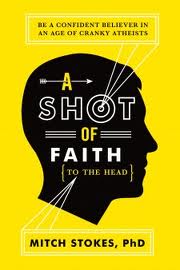
Book Review- A Shot of Faith (to the Head): Be a Confident Believer in an Age of Cranky Atheists by Mitch Stokes

Mitch Stokes. A Shot of Faith (to the Head): Be a Confident Believer in an Age of Cranky Atheists. Nashville: Thomas Nelson, 2012. 252 pp. $16.99. ($11.35 on Amazon)

In the last few years, with the rise of the New Atheism, authors like Dawkins, Dennett, Harris, and Hitchens have made popular Christian apologetics popular again. A veritable cottage industry of “responses” and rejoinders have been churned out by top-notch scholars (and some hacks too) either presenting arguments for Christianity or attempting to dismantle the claims of the New Atheists. While a number of these books are well-written and quite valuable, none of them quite accomplish what Mitch Stokes’ has in his recent work, A Shot of Faith to the Head: Be A Confident Believer in an Age of Cranky Atheists.  

He Knows What He’s Doing

What makes this book different? The key is that Stokes knows what he’s doing and, more importantly, what he isn’t. So often works of apologetics try to cover everything and don’t end up adequately covering anything.  Stokes knows better. He’s narrowed his focus, honed in on the key issues, and goes to work on them in a humorous, engaging, and readable fashion. What are those issues? The relationship between faith and reason, science, and the problem of evil.

Stokes is particularly qualified to tackle these. Before taking up his position as the Senior Fellow of Philosophy at New St. Andrews in Moscow, Idaho he got his MA in religion at Yale under Nicholas Wolterstorff, then went on to get his Ph.D. at Notre Dame under Alvin Plantinga and Peter Van Inwagen. No big deal–just three of the foremost philosophers of religion alive. And, if that weren’t enough,  prior to entering the philosophy game, he got an MS in mechanical engineering. The man knows what he’s talking about.

Introducing Reformed Epistemology–You’re Welcome

One way of describing Stokes’ project is translating Alvin Plantinga for everybody. Plantinga, while being, in my opinion, the most brilliant Christian philosopher working in the analytic tradition today, has not gone out of his way to make his philosophical genius widely accessible to the general reader. Don’t get me wrong, I think he’s hilarious and pretty clear as far as analytic philosophers go. Let’s be honest though, the average layman or pastor won’t take the time to read all 500 pages of Warranted Christian Belief  even if it’s worth it (which it is). Stokes takes the best of the Reformed epistemological approach developed by Plantinga and Wolterstorff (don’t worry, you don’t have to be a Calvinist to buy into it) applied to various issues in philosophy over the last 40 years and condenses it into short, winsome, witty, and clearly laid-out chapters uncluttered with small print or symbolic logic.  He also includes helpful “For Your Arsenal” summary points at the back of each chapter for easy recall of the information.

This isn’t to say that he merely repeats Plantinga, or offers nothing new–he does, especially the way he frames the discussion historically, concretely grounding these ideas in conversation with Hume and Locke on down to W.V.O. Quine. Still, even if translating Plantinga were all he did, this would be crucial because in engaging with both believers and unbelievers with the Gospel over the last couple of years, I’ve come to realize that the issue of epistemology is one that is too often ignored, or simply botched in most popular works on apologetics even though it lies at the root of so many of these discussions. By focusing his sights on the epistemological questions, Stokes really is aiming to give readers a “shot of faith to the head.”

So how does he actually do it? Stokes starts out by explaining and debunking the evidentialist objection to belief in God, that there isn’t sufficient evidence to “prove” he exists. He shows that, in fact, evidentialism is self-defeating–some beliefs must be basic, taken without reasons or evidence, otherwise reasoning itself cannot get off the ground. In fact, he pushes on to show that a demand for arguments and “reasons” for all of our beliefs, actually leads us to the conclusion that atheism itself is self-defeating. In place of the rationalism and evidentialism so commonly assumed by skeptics, Stokes proposes an alternative definition for what it means for a belief to be rational, that it is the product of “properly-functioning cognitive faculty operating in the appropriate environment” (read as good thinking equipment), like sense-perception, memory, and reason; this is a Reidian, reliabilist approach to epistemology as recovered and retooled by Plantinga and others. Stokes goes on to show that belief by way of testimony, or faith, is actually another valid way of coming by our beliefs, and that it is perfectly rational to believe in God by way faith, testimony, or “taking God at his word.”  Pressing a bit further, Stokes makes the very Plantingan point that if the “Christian epistemic story” is true, then the Christian can believe in God in a way that is basic and rational. Basically, in order to show that faith is irrational, you have to prove Christianity false first.

Now, none of these considerations means that he discounts reason or even the arguments for the existence of God–he actually has a very helpful “intermission” section dealing with the nature of the arguments and the problem of the burden of proof. Instead, Stokes shows that these arguments are helpful in supplementing faith and in dealing with “defeater” beliefs.

Defeaters and Highlights

What’s a “defeater”? A defeater is basically a reason to ditch a belief we gained previously in light of new evidence to the contrary, or that casts suspicion on the way we arrived at our belief. This is why Stokes moves on from his general discussion on faith and reason to consider the two main defeater beliefs for God out there today: science and the problem of evil.

I won’t review these two sections extensively, but some highlights include:

  • Helpful corrections of the historical record when it comes to the “history of the warfare between science and religion.” (Stokes has written short biographies of both Galileo and Newton so he’s well-equipped to handle this.)
  • A good discussion of the difference between the unnecessary “god of the Gaps” who intervenes from time to time to fix things that science can’t figure out and the God of the Bible who supervenes over and upholds the created order.
  • A much-needed guide to distinguishing between methodological naturalism, philosophical naturalism, and the scientific provincialism that convinces so many that accepting the former is predicated by the latter.
  • A fascinating historical and philosophical analysis of the rise of science, the way science actually proceeds, and how theism gives us confidence to engage in scientific study given belief in the Image of God and the rationality of a universe created by God.
  • Numbers. Stokes has an absorbing discussion on the nature of numbers that made even a math-hater like me wonder at the beauty of a mathematically-ordered universe–and how bizarre the existence of such a one truly is unless the world was created by a rational God.
  • A clean introduction into the “problem of evil” discussion that’s been going on in academic philosophy since the 1960s.
  • Short, but clear, Plantingan responses to both the logical and the probabilistic versions of the problem of evil, using both the Free Will Defense with respect to the logical, and a sober reflection on the epistemological limitations of finite thinkers in relation to the probabilistic.
  • A theistic turning of the tables, using the insights of the moral argument to point out that, without God, there is no absolute, moral standard, in which case the objection from evil can’t even get off the ground.
  • A bold statement of the uncommon yet undeniably appealing O Felix Culpa (Happy Fault) theodicy. (I won’t blow the surprise for you.)

Conclusions 

To sum up: Mitch Stokes has done the church a great service with this book.  By making available some of the best insights of the Christian community’s academic philosophers, believers who read this can be humbly confident that their faith in the Gospel is not blind, irrational, or illegitimate. Rather, it is in fact capable of standing up to the fiercest intellectual objections. I highly recommend this book to doubting believers, inquisitive skeptics, and especially pastors who want to be able to lovingly and persuasively commend the Gospel to the both groups.

Soli Deo Gloria