Is ‘Grace’ Only a Redemption Word?

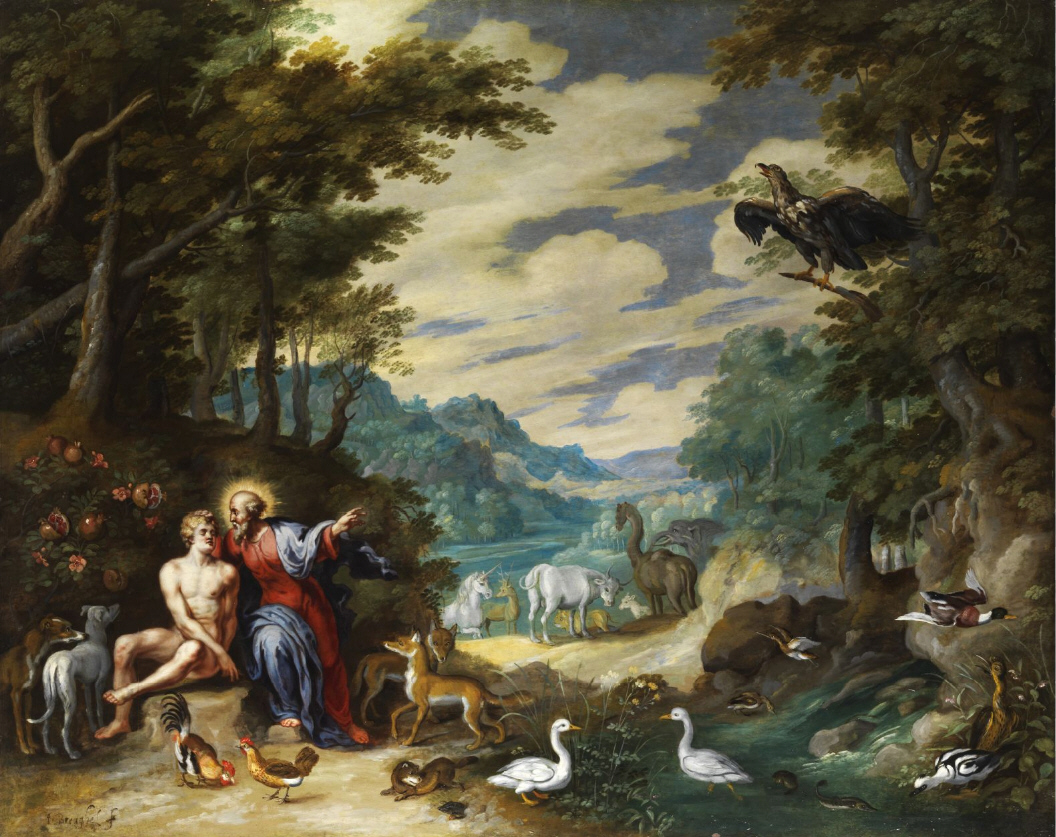
Jan_Brueghel_the_Younger_Creation_of_AdamMany of us tend to think that ‘grace’ is only a redemption word; God is gracious to us because he decides to forgive us and save us through the redeeming work of Christ. While the grace of redemption is deep and glorious, three authors point our hearts to understand the grace of God in Creation as well.

Following Paul’s lead in Colossians 1:15-20, Athanasius points out that it is God’s kindness which leads to our existence, for he holds the world together through the Word:

But the reason why the Word, the Word of God, has united Himself with created things is truly wonderful, and teaches us that the present order of things is none otherwise than is fitting. For the nature of created things, inasmuch as it is brought into being out of nothing, is of a fleeting sort, and weak and mortal, if composed of itself only. But the God of all is good and exceeding noble by nature,—and therefore is kind. For one that is good can grudge nothing: for which reason he does not grudge even existence, but desires all to exist, as objects for His loving-kindness. Seeing then all created nature, as far as its own laws were concerned, to be fleeting and subject to dissolution, lest it should come to this and lest the Universe should be broken up again into nothingness, for this cause He made all things by His own eternal Word, and gave substantive existence to Creation, and moreover did not leave it to be tossed in a tempest in the course of its own nature, lest it should run the risk of once more dropping out of existence; but, because He is good He guides and settles the whole Creation by His own Word, Who is Himself also God, that by the governance and providence and ordering action of the Word, Creation may have light, and be enabled to abide alway securely.

Against the Heathens, §41

Athanasius lyrically reminds us that in itself, creation is not self-sustaining, having been made out of nothing, but must receive its coherence and existence from without. This is exactly what God gives it through the gift of creating through the Son, the Word, who gives the world his own order because “the God of all is good and exceeding noble by nature,—and therefore is kind.”  God’s grace is seen in that he doesn’t even begrudge us our existence, but gives it to us freely and under no compulsion.

Robert M. Adams proposes another way in which grace has a role to play in creation. Many have suggested that if God is perfect, his creation must necessarily be the best of all possible worlds. But given the presence of evil in the world, many doubt this could be the best of all possible worlds. Channeling Augustine’s argument in, I think, Book 3 of On the Freedom of the Will, Adams suggests that it’s not necessarily the case that a perfect God must create the best of all possible worlds:

A God who is gracious with respect to creating might well choose to create and love less excellent creatures than He could have chosen. This is not to suggest that grace in creation consists in a preference for imperfection as such. God could have chosen to create the best of all possible creatures, and still have been gracious in choosing them. God’s graciousness in creation does not imply that the creatures He has chosen to create must be less excellent than the best possible. It implies, rather, that even if they are the best possible creatures, that is not the ground for His choosing them. And it implies that there is nothing in God’s nature or character which would require Him to act on the principle of choosing the best possible creatures to be the object of His creative powers.

-“Must God Create the Best?” in The Problem of Evil: Selected Readings, pg. 281

Contingent beings that we are, it seems that God exercises his grace in creating less than perfect creatures like you and me. Writing in the same vein, Miroslav Volf tells a story that claims rabbinic origins:

Before setting out to create the world, the Almighty took a moment to look into the future of creation. God saw beauty, truth, goodness and the joy of creatures, but the All-Knowing One also saw a never-ending stream of human misdeeds, small, large, and horrendous, a trail of sights, tears, and blood. “If I give sinners their due,” though the Just One, “I’ll have to destroy the world I am about to create. Should I create just to destroy?” And so God decided to forgive the world in advance so that the world could be brought into being. Creation owes its very existence to God’s forgiveness.

Free of Charge: Giving and Forgiving in a Culture Stripped of Grace, pg. 136

While the story is certainly extra-biblical and a bit speculative, Volf rightly contends that it contains a truth testified to in the Scriptures that Christ is “God’s Lamb” destined “before the foundation of the world” (1 Peter 1:20), to be sacrificed to bring sinners into the family of God. For the All-Knowing One, grace towards sin has to be extended even before creation.

God’s grace then, is the foundation, not only of our redemption, but our creation.  We would not exist if it were not for the unmerited and unrestrained bounty of the Triune God pouring forth blessing upon unworthy creatures such as us.

Soli Deo Gloria
That Time Calvin Disagreed with Augustine (Or, How to Read the Fathers Like a Protestant)

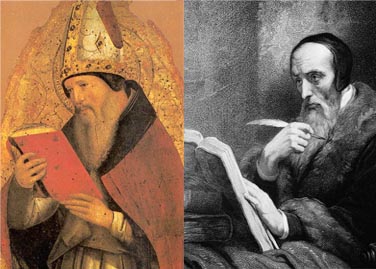
Augustine-JohnCalvinIt doesn’t take a specialist to know that Calvin loved the writings of St. Augustine of Hippo. After the Bible, he quotes Augustine more than anybody else in the Institutes (I think, but don’t quote me on this) more than all the other Fathers combined. Whenever he wanted to establish the antiquity of a doctrine, or its soundness with the interpretation of the Church universal, it’s a safe bet he’s going to pull out an Augustine quote, especially since he was an authority both he and his Roman interlocutors agreed upon.

Calvin’s Quibbles

That said, Calvin wasn’t a slavish admirer of the great bishop as we see here in his comments on the story of Pentecost:

And when. To be fulfilled is taken in this place for to come. For Luke beareth record again of their perseverance, when he saith that they stood all in one place until the time which was set them. Hereunto serveth the adverb, with one accord Furthermore, we have before declared why the Lord did defer the sending of his Spirit a whole month and a half. But the question is, why he sent him upon that day chiefly. I will not refute that high and subtle interpretation of Augustine, that like as the law was given to the old people fifty days after Easter, being written in tables of stone by the hand of God, so the Spirit, whose office it is to write the same in our hearts, did fulfill that which was figured in the giving of the law as many days after the resurrection of Christ, who is the true Passover. Notwithstanding, whereas he urgeth this his subtle interpretation as necessary, in his book of Questions upon Exodus, and in his Second Epistle unto Januarius, I would wish him to be more sober and modest therein. Notwithstanding, let him keep his own interpretation to himself. In the mean season, I will embrace that which is more sound.

-Commentary on Acts 2:1-4

While according him great respect and noting his interpretation, Calvin says that the great Augustine has put forward what he considers to be a less “sober” and “modest” interpretation which he simply cannot follow. So what explanation does he find more plausible?:

Upon the feast day, wherein a great multitude was wont to resort to Jerusalem, was this miracle wrought, that it might be more famous. And truly by means hereof was it spread abroad, even unto the uttermost parts and borders of the earth.  For the same purpose did Christ oftentimes go up to Jerusalem upon the holy days, (John 2, 5, 7, 10, 12,) to the end those miracles which he wrought might be known to many, and that in the greater assembly of people there might be the greater fruit of his doctrine. For so will Luke afterward declare, that Paul made haste that he might come to Jerusalem before the day of Pentecost, not for any religion’s sake, but because of the greater assembly, that he might profit the more, (Acts 20:16.) Therefore, in making choice of the day, the profit of the miracle was respected: First, that it might be the more extolled at Jerusalem, because the Jews were then more bent to consider the works of God; and, secondly, that it might be bruited abroad, even in far countries. They called it the fiftieth day, beginning to reckon at the first-fruits.

-Ibid

We see here the difference I’ve mentioned before when it comes to the Reformers and the earlier, especially medieval, hermeneutical tradition; they will usually privilege the ‘literal’/historical-grammatical sense of the text over any spiritualizing, allegorizing, or typological senses. Calvin isn’t opposed to typological interpretation in principle–he engages in quite a bit of it himself and accepts the prefigurement of Pentecost in the sense of first-fruits pointing towards the initial fruitfulness of the Gospel by the Spirit’s power. He’s concerned, though, that the interpretation first be grounded plausibly in the history of the event. In other words, in a text like this, he insists that the intentionality of the human actors be made sense of and that “the profit of the miracle was respected.” Only then may we move on to the typological meaning without it becoming over-subtle.

Now, that said, I myself think Calvin was being a little over-cautious here; Augustine’s got a point linking Pentecost with the giving of the Law, and the Spirit who writes the Law on our very hearts. Part of the point of typology is that God’s authorship of history can transcend even the human actor’s, or author’s original intent, without violating them. Also, given modern studies in the theological dimension to the authorship of the Gospel writers, it doesn’t strike me as improbable that Luke intended for multiple resonances to be in play in the text connected to as rich a concept as Pentecost.

The Moral of the Story

More interesting than the specific interpretation given to the passage however, was Calvin’s treatment Augustine’s interpretation. Here he offers us a model for a Protestant engagement with the interpretive tradition of the Fathers: respectful, but critical listening. He doesn’t do what so many pop-Protestant approaches do and simply ignore the tradition because, “All I need is my Bible.” Calvin knows that the Church, at least some segments of it, has been reading the Bible well enough for a very long time, so he doesn’t need to reinvent the wheel. He knows the arrogance it takes to approach the text in a way that says the Spirit has skipped 20 centuries of interpreters in order to finally reveals the Scriptures to me. In fact, it is precisely through the teachers of the Church that he works most of the time.

At the same time, in order that the Spirit may truly rule through the Word, Calvin reads the Fathers critically–not disrespectfully, but with a knowledge that they are fallible men, who can err just as he might. As you would treat a respected pastor who has faithfully labored over the texts for years, so with the Fathers: pay careful attention to what they have to say, consider deeply, and go back to the text. Indeed, this lesson is valuable, not only for Protestants looking to read the Fathers, but for Protestants looking to read the early Reformers; Calvin teaches me by his disagreement with Augustine that it’s permissible for me to disagree with Calvin!

Soli Deo Gloria

How to Write a Hugely-Popular Piece For Huffington Post Religion (CaPC)

thinkingFor theological and religious types, Huffington Post Religion (HuffPo) happens to be one of the more predominant avenues toward becoming involved in the online religious discussion. They typically feature big-name scholars and established bloggers, many of whom can be thought-provoking and helpful. But no one cares about that. The real traffic goes to another type of religion piece.

As I’ve read and followed their posts over the past few years, I’ve noticed a few tried and true themes and threads for writers interested in dominating the Christianity conversation traffic-wise. So for those seeking fortune and fame (okay, just fame), I thought I’d offer a few tips…

You can read my tips HERE at Christ and Pop Culture.

Some Thoughts on the Superman and Jesus Thing

man of steel 2After months of waiting, I finally watched the Man of Steel in a midnight showing early Friday (or late Thursday) night. My first comment is that the critics are idiots–it was a fantastic movie.  Unsurprisingly given the team of Nolan, Snyder, and Zimmer, this is easily the best Superman movie to date; plot, cast, visuals, emotional complexity, etc. surpass anything that’s been done with the franchise yet.

But I’m not here to write a movie review. Like most films do, it got me thinking about theology. There have been a number of recent articles on difference and similarities between Jesus and Superman. I haven’t read any of them, but I’ve seen them online and the parallels and divergences aren’t hard to imagine–intentionally so with the former.

Superman is a Messianic figure, a son sent by a father from a different world, raised by surrogate parents, come to save us all. He’s not one of us, but he identifies with our cause, fights the battles we can’t against demons too big for merely human strength. He’s a shining beacon of truth, morality, and hope to a people who misunderstand and fear him despite his unrelenting will to save. The film plays this up to the point where its unmistakable, revealing him to be 33 years of age, and even setting him in a church struggling with a decision about whether to sacrifice himself for the planet, with a stained-glass picture of Jesus in the background.

Of course, every Messianic analogy breaks down and it’s easy enough to point that out with Superman. He really isn’t like Jesus in some very important ways–one of the biggest is that he’s not really human. He might identify with our cause and plight, but he doesn’t ever fully share it. Unless he’s exposed to some Kryptonite or Red Sun, he’s impervious to just about anything you throw at him. Jesus knows what it is to feel human fear and pain–he’s wasn’t bullet, or nailproof. Superman doesn’t bleed out and die, but Jesus does.

The flidside is that he’s not fully divine either; Superman is at best a demi-God. His feats of power, strength, speed, flight, and lasers do not entitle him to the title “Creator.” He is not eternal, immutable, immortal, or omnipotent, no matter how potent he is. He is a being among beings but not the source of all being; a superior being perhaps, but still on the ‘creation’ side of the Creator/creature distinction (if that holds in the DC Universe.)

In fact, when you think about it, theologically Superman is more like the Arian picture of Christ. The teacher Arius taught a savior who was not the eternal Son of God, (“there was a time when he was not”), and yet not a normal man either. He was a mediating being, the chief over creation who was yet still a part of it, and not to be thought of as equal to the Father.

Similarly, the salvation he offers us is that of a shining exemplar, not a redeeming Savior. Yes, he sacrifices himself for us and fights the battle we could never fight, against a ruthless enemy we could not beat. And yet, like so many other popular Hollywood Messiah figures, the goal is that one day he can teach us, inspire us, when we’re ready, to live a new a better way. In a sense, he saves, yes by feats of strength and moral courage, but the redemption of mankind will come by imitation. There is no atonement, or conversion, for Superman is the heroic, morally-educative Pelagian Christ.

This isn’t a real knock on the movie, of course, or even the Superman character. It’s not Kal-El’s fault–only Jesus can be Jesus.

And that’s really the point I’ve wanted to make. While all of our heroes, in some way, seem to point us to the ultimate Hero, all of them fall short. Some have pointed out that Batman is fully human like us, knowing our pains and plight, and in that way, he’s really the more Christ-like hero. The problem is that when he dies, he dies. Part of what makes Jesus glorious, and that the Superman myth draws on is our need for a Savior who can rescue us from the curse of death; we need a hero who can’t be held down by it. Down the line I could go, with blockbuster hero after hero pointing out the various ways they either measure up, or fall miserably short.

The key difference that I’ve seen, though, is that not one of the various heroes on offer can truly offer us the redemption we need most–that liberation of the soul that comes when our sins are paid for and the Spirit is poured out in our hearts, setting us free from our bondage to sin. None but the Crucified and Risen one is strong enough offer me the salvation of a conscience cleansed from sin and reconciled with God.

Soli Deo Gloria

A Proper Christian Mysticism?

mysticismIs there a place for Christian “mysticism?” Thinking of the various incense-laden mysticisms of the East, some implying a denial of the Creator/creature distinction or a strong doctrine of Revelation, many Christians, especially Protestant ones, would vigorously reject the notion. Writing about the “intimacy of relation” we find in our Union with Christ, Reformed theologian John Murray does not shy away from suggesting properly Christian “mysticism”:

Here indeed is mysticism on the highest plane. It is not the mysticism of vague unintelligible feeling or rapture. It is the mysticism of communion with the one true and living God, and it is communion with the one true and living God because and only because it is communion with the three distinct persons of the Godhead in the strict particularity which belongs to each person in that grand economy of saving relationship to us. Believers know the Father and have fellowship with him in his own distinguishing character and operation as Father. They know the Son and have fellowship with him in his own distinguishing character and operation as the Son, the Saviour, the Redeemer, the exalted Lord. They know and have fellowship with the Holy Spirit in his own distinguishing character and operation as the Spirit, the Advocate, the Comforter, the Sanctifier. It is not the blurred confusion of rapturous ecstasy. It is faith solidly founded on the revelation deposited for us in the Scripture and it is faith actively receiving that revelation by the inward witness of the Holy Spirit. But it is also faith tha stirs the deepest springs of emotion in the raptures of love and joy. Believers enter into the holy of holies of communion with the triune God and they do so because they have been raised up together and made to sit together in the heavenlies in Christ Jesus (Eph. 2:6). Their life is hid with Christ in God (Col. 3:3). They draw nigh in full assurance of faith having their hearts sprinkled from an evil conscience and their bodies washed with pure water because Christ is not entered into holy places made with hands but into heaven itself now to appear in the presence of God for them (Heb. 9:24)

-Redemption: Accomplished and Applied, pp. 172-173

So is there a place for a properly Christian mysticism? Yes–within the coordinates of trinitarianly-conceived Union with Christ, the Scriptures teach us that we can rejoice and delight in communion with Father, Son, and Spirit.

Soli Deo Gloria

7 Reasons God Might Not Heal Somebody

healingFor about two and half years now, I’ve had something wrong with my joints and muscles. It started with tendon pain in my knees, then later I had abdominal/hip issues, which then shifted to a shoulder condition, eventually leading to chest muscle pain, and recently to pelvic alignment problems. I’m not quite 27 yet, but the running joke among my college students is that I’m a broken old man. I’ve had five different physical therapists and chiropractors over the last two years and a number of other doctors treat me. Fun stuff.

Now, I’ve prayed, I’ve gone to doctors, changed up my practices, and for some reason it just seems like one thing after another keeps coming up. I know this isn’t the greatest tragedy in the world; we have members in our congregation and friend in our lives who have struggled through much worse. Still, there have been times when I’ve wondered, “God, what are you doing? Why haven’t you healed me yet? I know you can.” For some reason I have hope and confidence that this is not a permanent thing (even though for many it is), but there have been times that I’ve just struggled with the question of why God continues to leave me unhealed–or, for as long as he has, at least.*

That’s why I was particularly interested in reading Sam Storm’s chapter “Why Doesn’t God Always Heal the Sick?” in his new book Tough Topics: Biblical Answers to 25 Challenging Questions. I had my own range of responses to the issue, but I wanted to see what someone who had actually devoted some research to the question had to say.

7 (Possible) Reasons
Storms is quick to recognize that there is some level of mystery involved in the issue of healing, and certainly with respect to God’s will for individual lives. He makes a point of saying that not every case where you know who remains unhealed can be quickly chalked up to one of these reasons. That said, Storms gives 7 possible reasons someone might not be healed.

  1. Faith – As much as this reason has been abused, “we must be willing to acknowledge that occasionally healing does not occur because of the absence of that sort of faith God delights to honor.” (pg. 304) Faith as small as a mustard-seed can be sufficient, but there are a number of cases in the NT seem to suggest that lack of faith can be a factor. (Matthew 9:22, 28-29; 15:28; Mark 2:5, 11; Luke 17:19; Acts 3:16)
  2. Sin – Again, not everyone who isn’t healed is being punished for some specific sin. Jesus rebuts too simple a one-to-one relationship between particular sickness and particular sin (John 9). And yet, as Storms notes, “James 5:15-16 clearly instructs us to confess our sins to one another and pray for one another that we may be healed.” (pg. 305) Sometimes it is the case that unconfessed sin might be holding back God’s hand of healing.
  3. Desire – This is an odd one, but Storms notes that sometimes people actually don’t want to be healed. They have lived with their illness and the lifestyle associated with it for so long, it’s terrifying to think of life without it. A person’s identity can be so wrapped up in it, fearful that the love and care they receive as someone who is ill will suddenly disappear, that healing actually sounds threatening. (pg. 305)
  4. Ask Not – James 4:2 says, “you do not have, because you do not ask.” Storms writes, “The simple fact is that some are not healed because they do not pray.” (pg. 306) Sometimes we really just don’t ask and so God doesn’t give.
  5. Oppression – Healing is often-times blocked because “the demonic cause of the affliction has not been addressed.” (pg. 306) Though not every sickness is attributable to demonic influence, according to the NT some is (Luke 13:16), and when that cause is not attended to, healing may be prevented.
  6. Providence – It would be a serious oversight not to consider the fact that God has plans for history, many of which we simply have no access to, nor could we understand if we did. Storms reminds us that we shouldn’t think healing and sickness is only area where God’s will for our lives must be utterly transparent. To claim that we know what God always does in a particular type of situation, like sickness, is arrogantly claiming knowledge we couldn’t possibly have.
  7. Something Better – “…healing the sick is a good thing (and we should never cease to pray for it), but often there is a better thing that can be attained only by means of physical weakness.” (pg. 307) In our health-obsessed culture, this might sound ridiculous, but God is often more concerned with healing our spiritual infirmities than our physical ones. Sometimes he does so through illnesses which humble us, force us to rely on him, and conform us to the image of Christ. (2 Cor. 4:16-18) For those who think it contrary to God’s goodness to let any of his children suffer in sickness, they ought to consider their response to the fact that God’s goodness allows his saints to suffer persecution, and indeed, ordained the suffering of his own Son for the salvation of the world. (1 Peter 4)

Summing Up
Again, all of these points can be expanded upon and nuanced–as they were in the book. It also might be noted that all of these reasons could only extend for a certain amount of time. Oppression need not last and spiritual lessons might eventually be learned. None of these reasons should be taken as an excuse for prayerlessness, or used to insensitively condemn those already suffering; they should be used (with wisdom) to encourage and comfort.

For myself, I have been challenged and comforted by a number of those reasons in my own walk–or lack of walking, at times–through illness. Few things have led me to embrace God’s Fatherly hand as the source of all things, working them for my good and his glory, than my illnesses. I have never had to rely on him, pray to him, and see him as my deepest strength as I did during those times when it hurt to stand, walk, or even sit for more than 5 minutes. I don’t know when this will “end”, if it ever will, how much it has to do with spiritual attack, spiritual formation, or just a providence beyond my ken. I know I’ll keep praying, asking him to grow me through this, increase my strength, cleanse my heart, protect me from attack, and (imperfectly) trusting that God has his good reasons. I pray that for those of you suffering with illnesses, these meditations would encourage you to the same.

Soli Deo Gloria

*Just to make it clear, there has been some improvement of late with certain treatments, but no radical healing. I’m not languishing here, immobilized for those who might be concerned. Prayers are appreciated, though!

Job, Providence, and Multiple Intentionality

JobIf anybody knows anything about Calvin, it is that he believes God to be the ultimate author of history, good or bad, with all of its twists and turns. Though not obsessed with the doctrine of providence as some might think, he does devote a significant section of Book I of the Institutes to it, defends it in a number of special treatises, and addresses it all throughout the commentaries. One particular passage on Job grabbed my attention when I first read through the Institutes, though, when I was yet early on in developing my Reformedish tendencies.

Theologians, especially those concerned that God not be considered the author of evil, tend to make the distinction between God causing a thing to come to pass directly, or merely “permitting” it to come to pass. While elsewhere Calvin seems affirm a proper place for this distinction (cf. Commentary on Genesis 3:1), he’s not too keen on those who would try to rob God of his sovereign governorship over all things by using the doctrine of permission to get God off the hook for human wickedness. Although they are fully responsible for their choices (Institutes I.17.2-3), not being compelled by some Stoic fate (ibid, I.16.8), men and women make the choices they make according to the “secret plan of God.” Calvin’s beef is with a permission that teaches “that men are borne headlong by blind motion unbeknown to God or with his acquiescence.” God’s providence does not admit of a passive permission in which he simply lets things happen, but rather it is active permission according to his own secret plan, for his own good will.

Calvin backs this up with a battery of scriptural examples and texts, but he opens with the story of Job:

From the first chapter of Job we know that Satan, no less than the angels who willingly obey, presents himself before God [Job 1:6; 2:1] to receive his commands. He does so, indeed, in a different way and with a different end; but he still cannot undertake anything unless God so wills. However, even though a bare permission to afflict the holy man seems then to be added, yet we gather that God was the author of that trial of which Satan and his wicked thieves were the ministers, because this statement is true: “The Lord gave, the Lord has taken away; as it has pleased God, so is it done” [Job 1:2 ]. Satan desperately tries to drive the holy man insane; the Sabaeans cruelly and impiously pillage and make off with another’s possessions. Job recognizes that he was divinely stripped of all his property, and made a poor man, because it so pleased God. Therefore, whatever men or Satan himself may instigate, God nevertheless holds the key, so that he turns their efforts to carry out his judgments.

-Institutes of the Christian Religion, I.18.1

The reason this passage was so fascinating to me was that it called my attention to a single instance where three wills were at work, each a key component in the action, and all for different purposes. At the human level we see the Sabaeans out of a simple human lust and wickedness pillaging and looting in order to satisfy their own desires. Satan was at work as well, goading the Sabaeans in order to afflict Job and cause him to curse God, thereby proving him wrong. God actively permitted Satan to goad the Sabaeans in order to, well, we don’t have the full reasons, but at the very least, prove Satan’s accusations wrong and vindicate the righteousness of his servant Job. The same event is the result of God’s good divine will and the two wicked wills, demonic and human. God is just in his determinations, and yet Satan and the Sabaeans are utterly wicked in theirs.

This is not the way we’re used to thinking about things. Regularly, we would try to figure out, “Well, who’s really responsible here? Who caused it? It’s either God, or the devil, or humans, so which is it?” Or we’d try and parse it out and say that this part was God, this part was Satan, and this part was humans. That’s not what we see in the text, though. Instead, it seems to point us to God working out his own will through wicked demonic and human wills at the very same time.

Calvin moves on to cite the stories of the lying spirit and King Ahab (1 Kings 22:20-22), Jesus’ death at the hands of Pilate and wicked men by the plan of God (Acts 2:23,  4:28), Jeremiah’s declaration that the Chaldean’s cruel invasion was God’s own work (Jeremiah 1:15; 7:14; 50:25), and a half-dozen other instances where human wickedness is also credited to God’s good purposes in history. As Calvin says, “Those who are moderately versed in the Scriptures see that for the sake of brevity I have put forward only a few of many testimonies.”

I’ve wrestled myself for a number of years as to just how God’s sovereignty and our real, human freedom play out. Of course, the Scriptures don’t resolve this tension cleanly for us, nor does Calvin; they just let the it hang there. The conclusion I’ve come to is that both are in the Bible and any solution that too heavily pits the one against the other–either minimizing or limiting God’s control, foreknowledge, and power or those hyper-Calvinists who would call all human freedom a chimera–are reading against the grain of the text. None of this is an “answer”, of course. I have for years gone back and forth between a more deterministic compatibilism, Molinism, and something else I’ve never really had a name for.

What Calvin does in this passage is ensure that whatever your answer, it must be one that reckons with the fact that there are no runaway wills in God’s world; his “permission” is an active one, and he does not stand idly by, wringing his hands in distress, or waiting with baited breath to see what happens next. Again, this is the God of the Gospel who didn’t just stand by and let his Son be crucified by wicked men, but purposed according to his own plan and foreknowledge to save the world through these things.

Soli Deo Gloria

I Hate Writing About Sex (CaPC)

no sexI hate writing about sex; I want to be over the whole sex conversation in general. Honestly, as interesting a subject as it might be, there is nothing easy, simple, or straightforward about it; it’s not the sort of subject I get up and think, “Wow, that would be a great angle for an article to write!” Honestly, I get a pit in my stomach. Culturally-speaking it’s a minefield. The amount of shame, hurt, obsession, money, and political-vitriol attached to discussions of sex makes it nearly impossible not to trigger some negative experience for someone. Our media is over-saturated with issues either directly or indirectly tied to it (gender, family, homosexuality, etc.) making it nearly impossible to say something on one topic without somehow involving another, making the whole thing exhausting and daunting.

The problem is that the conversation about sex isn’t going away. In fact, it just keeps getting louder.

You can go read the rest of my piece HERE at Christ and Pop Culture.

Soli Deo Gloria


A New Gospel-Inspired Peace in Honduras (CaPC)

hondurasI’ve been to Honduras, I think, four times in my life–twice that I can remember and a couple of trips when I was an infant. It’s where my parents were born, my mother grew up, and a majority of my extended family still lives. My mom still goes back regularly to see our family in the capital city of Tegucigalpa and I’d love to take my wife there one day to meet them as well. It’s a beautiful country, with a rich culture, and a generous people. Of course, to me the best part of Honduras is my family, but I’d have to say the food is a close second; everything just tastes better down there.

One thing about Honduras that isn’t so great, is the murder rate: it has the highest per capita murder rate in the world with 87 killings per 100,000.

You can go read about the new hope for peace in Honduras HERE at Christ and Pop Culture.

Who Adopts Us in Salvation?

The FatherIt was in seminary that I began to appreciate the significance of adoption as a distinct moment in our salvation. Even greater than our justification, being declared and thereby rendered righteous with God the King, is being received by grace into his family as beloved children. It is as children that we call out ‘Abba, Father’ and approach the throne of grace with full confidence, knowing that the King of Glory delights to hear our prayers.

The question I had in seminary was, “Who exactly am I adopted by? Is it by the Father, or the whole Trinity?” I initially believed it to be the Father as I understood adoption to occur through union with Christ the Son into his relationship with the Father. Upon hearing me express this view, one of my professors quickly corrected me and warned against introducing a split in the Trinity. To him, it is only proper to attribute adoption to the whole Trinity.  Since that time I’ve gone back and forth, but have come to the conclusion that my initial instincts were correct.

Two principles of trinitarian theology have guided me:

  • First, that although the external acts of the Trinity are undivided, the persons are still to be distinguished. In other words, the Trinity acts in a trinitarian fashion. It’s not that the Father creates, the Son saves, and the Spirit does, whatever he does. Instead, the early church fathers would say that more properly the Father creates, redeems, and sanctifies through the Son and the Spirit. In every action, the whole Trinity is involved.
  • Second, the complementary doctrine of appropriations teaches that, although the work of the Trinity is undivided, it is still fitting to attribute certain graces and actions more properly to a particular person. So, for instance, although the Father and the Spirit are involved, only the Son is properly said to become incarnate. Only the Son is born of a virgin, dies, and rises again, and so forth, even though they happen at the command of the Father in the power of the Spirit.

With these two principles in place, we are in a position to appreciate John Murray’s biblical arguments in Redemption Accomplished and Applied for thinking it is the Father who adopts us, although he does this through the Son and the Spirit:

  1. The first and simplest is that the name “Father” belongs to the first person of the Trinity, just as “the Son” is the second, and the “Holy Spirit” is the third. Jesus directed his prayers to the Father, and he is the Father of our Lord Jesus Christ. (pg. 137)
  2. In John 20:17, Jesus tells Mary Magdalene that he is not yet “ascended to the Father”, clearly referring to the first person, before going on “My Father and your Father, My God and your God.” (pp. 137-138)
  3. In a very similar point, Murray points out that Jesus’ frequent prayer to his “Father in heaven”, or some similar form of address. He also directs his disciples to pray to their Father in heaven, implying that the same divine person is in view. (pg. 138)
  4. In the New Testament, the term “Father” is the personal name of the first person of the Trinity. The Father is often called “the God and Father of our Lord Jesus Christ” (Rom. 15:6; 2 Cor. 1:3; 11:31; Eph. 1:3; Col. 1:3; 1 Pet. 1:3). The phrase “God the Father” also must refer to him (Gal. 1:1; Eph. 6:23; Phil. 2:11; 1 Thes. 1:1; 2 Thess. 1:2; 1 Tim. 1:2; 2 Tim. 1:2; Tit. 1:4; 1 Pet. 1:2; 2 Pet. 1:17; 2 John 3; Jude 1; Rev. 1:6) In almost all of these passages the Father is clearly not referring to the Son or the Spirit. From there Murray says that it is important to observe that “when God is called the Father of believers we have close similarity of expression” to the point where it is an unavoidable conclusion that the same person of the Trinity is being referred to. Again, in places like Romans 1:7 where the phrase “peace from God our Father and the Lord Jesus Christ” is used, both persons are mentioned and distinguished, while one is named “our Father.” (cf. 1 Cor. 1:3; 2 Cor. 1:2; Gal. 1:3; Eph. 1:2; Phil. 1:2; Philemon 3)

For these reasons it seems Biblically-appropriate to understand ourselves to have been adopted through the mediatorial work of the Son and the gift of the Spirit into the Father’s family by grace. This is good news. As Murray writes:

Could anything disclose the marvel of adoption or certify the security of its tenure and privilege more effectively than the fact that the Father himself, on account of whom are all things and through whom are all things, who made the captain of salvation perfect through suffering becomes by deed of grace the Father of the many sons whom he will bring to glory? (pg. 140)

Soli Deo Gloria