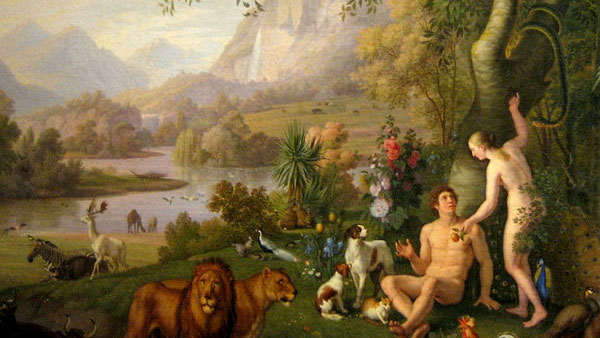
Why Did God Give the Tree of the Knowledge of Good and Evil? 5 Reasons

forbidden-treeAs the fountainhead of the story of the Bible, some of the most complicated questions in theology are densely clustered in the first few chapters of Genesis. After hearing the story as a kid in Sunday School, one of the first ones you end up asking is, “Why would God put the Tree of the Knowledge of Good and Evil in the middle of the Garden? I mean, given that it could derail the whole project so quickly, why put it there at all? What’s the point? What reasons could God possibly have?”

Leave it to Turretin to tackle the issue with his usual, rigorous clarity, to come up with, not one, but five reasons for planting the tree in the middle of the Garden. Before laying out his answer, though, it’s important to set a bit of background.

Locating Adam

First, you need to know that Turretin treats the question in his section dealing with human nature in its originally constituted state. That makes a big difference when it comes to a couple of his reasons. See, earlier on in this topic he points out that when you’re dealing with questions of anthropology in theology, you need to recognize there are four states you need to think about (Vol. 1, Top. 8, Qu. 1.I-II). There’s:

(a) human nature as God originally made it

(b) human nature after we made a mess of it through sin

(c) human nature after God has regenerated it as it goes through the process of sanctification

(d) human nature once God has ultimately perfected and glorified it in the future

Much confusion results when theologians don’t distinguish these states in their discussions of human nature and they end up heatedly talking past each other.

Second, you have to know that, along with all the other Reformed dogmaticians of his time, Turretin considered Adam to be entered into a covenant of nature or works, with God. Strictly speaking, it’s a covenant only by God’s condescension. God isn’t an equal party, being an infinite creator, and is only under obligation according to his own Word. All the same, Adam was given a law with curses attached for disobedience and blessings by way of reward for obedience. For more on this, see here.

From there, we can move on to discuss the Tree of the Knowledge of Good and Evil. In his section on the topic (Vol. 1, Top. 8, Qu. 4), he quickly dispenses with the idea that we can know what kind of fruit tree it was. Instead, we must discover why it got its name. Turretin’s suggestion is that the tree’s name revealed its nature as both a sacramental tree as well as pointing ahead to its experiential reality. In other words, by eating of it, Adam and Eve would know by experience what it means to know the good of obedience and the evil of disobedience.

This command to not eat of the Tree was what we might call a “positive” law in that eating the fruit wasn’t inherently good or evil, but only became so by the command of God. It’s wrong “because God said so.” Still, it symbolically represented the whole of the natural law and became a test, a trial, where the obedience of Adam would be “explored.” Would he cling to God’s own word in love and obedience, or prefer his own will by heeding the voice of the tempter? (Incidentally, for those puzzled by the reference, yes, classic Reformed theology had a robust, creational doctrine of natural law).

Making Things Explicit

So then, now we are prepared to hear Turretin’s five reasons that God placed the Tree in the Garden as an explicitly, “exploratory” command, on top of Adam’s natural obligations:

  1. In order that God, who had granted the dominion of all things to man, might declare himself to be the Lord of man and man might understand himself to be a servant bound to obey and adhere to him. Although the natural law had already clearly declared that, yet because someone might think the natural law to be a property of nature and not a law, he wished therefore (by a peculiar law about a think absolutely indifferent) to declare this more clearly. Thus on the one hand, the dominion of God might appear…on the other, the duty of man.
  2. That sin might be made the more conspicuous by that external symbol and the evil of the concealed ulcer be dragged to the light (or the virtue of the obedience be far more clearly exhibited). For the virtue of obedience would have been the more illustrious as the evil was because forbidden of God…
  3. To declare that man was created by him with free will; for if he had been without it, he would not have imposed such a law upon him.
  4. That by interdicting the fruit of a beautiful tree, he might teach that his happiness does not consist in the enjoyment of earthly things; otherwise God would not have wished to prevent his using it.
  5. To teach that God alone and his service must be sought before all things as the highest good and that we should acquiesce in it alone.

Now, many might seek to add further reasons to Turretin’s here. Indeed, one of the most interesting and compelling suggestions is that the Tree was ultimately to be a gift to Adam after passing his test (his probationary period, if you will) and entering into the blessings of obedience. All the same, at this stage in the narrative, Turretin’s answers are instructive for us.

First, it’s helpful to realize Turretin doesn’t limit himself to one reason. Oftentimes we consider and discard answers in theology because we presume there must be only one correct answer to any situation and neglect the fact that multiple answers or multiple dimensions to a single answer might be true. We shouldn’t be hasty or reductionistic, especially when dealing with the purposes of God.

Also, it’s worth mentioning how well this account comports with Paul’s illustrative retelling his/Adam’s/Israel’s situation in Romans 7 when it comes to the entrance of the Law:

What then shall we say? That the law is sin? By no means! Yet if it had not been for the law, I would not have known sin. For I would not have known what it is to covet if the law had not said, “You shall not covet.” But sin, seizing an opportunity through the commandment, produced in me all kinds of covetousness. For apart from the law, sin lies dead. I was once alive apart from the law, but when the commandment came, sin came alive and I died. The very commandment that promised life proved to be death to me. For sin, seizing an opportunity through the commandment, deceived me and through it killed me. So the law is holy, and the commandment is holy and righteous and good. Did that which is good, then, bring death to me? By no means! It was sin, producing death in me through what is good, in order that sin might be shown to be sin, and through the commandment might become sinful beyond measure. (Romans 7:7-13)

I would be surprised if Turretin wasn’t explicitly engaged in some intertextual interpretation here.

Finally, if we could sum up all these reasons into one basic thought, it’s that God wanted to make things explicit. The Tree of the Knowledge of Good and Evil clarified humanity’s relationship with God, set expectations, held out promises and threats, and instructed Adam in what his truest and deepest good was. God is not arbitrary, cruel, or unclear. He declares his law explicitly for the good of his creatures. Unfortunately, we very explicitly botched it.

Thankfully, he declares his gospel by an even clearer word: Jesus.

Soli Deo Gloria
Read a Chapter Between Chapters

Insert stock Bible image here.

Insert stock Bible image here.

Obviously, I’m a fan of books. I always have been and I always will. Ever since I got the call to ministry, those books have tended to be about theology and the Scriptures, and that only intensified once I got to seminary. Systematic theology, biblical studies, commentaries, and works of Christian history litter the floors of my office, bursting off of the shelves I have for them (also, I need to clean up a bit). Those books have shaped me, grown, and deepened my knowledge of the Bible, the gospel, and God himself. One of the sad quirks of becoming a student of theology and the Bible, though, is that you can actually end up losing your drive to read the Bible itself.

Somewhere in the rush to consume as many studies on Paul as you can afford, you begin to realize, “When was the last time I really just sat and read through Paul?”  I mean, I still read a couple chapters of my Bible for a daily devotional, but there’s a point where I realized the proportion of pages of Scripture compared to pages about Scripture, got wildly out of hand.  I’m fairly sure I’m not the only one this has happened to.

Now, to be fair, when you become a student of the Scriptures, to some degree it makes sense to do a bunch of reading in commentaries, studies, and so forth. In order to really get at the depths of a particular text or settle the meaning of a particular difficult verse that takes about 15 words, you may have to read 30 or 40 pages. Still, lately I’ve been convicted that I need to start tipping the balance back, if not completely in the other direction, at least more than it currently is.

So, I’ve come up with a very simple plan. I’m going to try to go on a “chapter between chapters” plan. In other words, on top of my daily, morning reading, after every chapter I read in work of theology or biblical studies, I’m going to pop open my Bible and read a chapter there too. Obviously, the chapters in my theology texts are going to be much longer than the biblical chapters, but this is a fairly straightforward way of ensuring that I’m engaged in the Biblical text throughout the whole of my day alongside my broader theological studies, not simply during sermon prep or those special little chunks of devotional time.

Which books will I read in particular? Well, I suppose I’m going to start with the four gospels. Recently, Mark Labberton mentioned that for a great many years he’s made it a practice to, whatever else he was studying, make sure he was reading at least one of the Gospels. While all of Scripture testifies to Christ, looking clearly at his person, his way of speaking and engaging with his followers and outsiders in the Gospels ought to be formative in the lives of his disciples. That sounds like wisdom to me.

Am I saying that everyone else needs to do this? Not really. But I figured if you’re like me and you want to find ways to dip into Scripture more, it might help to have a plan. A chapter between chapters just might be it.

Soli Deo Gloria


Two Murders, Two Cities, Two Loves

William_Blake's_Cain_and_AbelAccording to Augustine, it is common that earthly cities are founded by murderers. Fratricides to be exact (City of God, Bk. XV.5). In Scripture, we learn that the first city Cain who slew his brother Abel was the founder of the first earthly city. He was jealous of Abel’s favor before the Lord in offering a right sacrifice and so the sin crouching at his feet overwhelmed Cain as he overwhelmed his brother.

It’s no wonder, then, that he was followed in this “by a kind of reflection” in the founder of the archetypical “capital” of the earthly city of Rome. As the founding myth would have it, there were two brothers, Romulus and Remus. Disagreeing about which hill to build their future city on, they quarreled and Romulus slaughtered his brother, founded the city, and named it after himself. After that, Romulus built his armies, legions, and spread from there.

The two foundings, while similar, also reveal different conflicts at work. In the case of the second pair, Augustine thinks it is obvious what the root of the issue is: both Romulus and Remus were citizens of the City of Man whose aim is self-glory.

Both sought the glory of establishing the Roman state, but a joint foundation would not bring to each the glory that a single founder would enjoy. Anyone whose aim is to enjoy glory in the exercise of power would obviously enjoy less power if his sovereignty was diminished by a living partner. Therefore, in order that the sole power should be wielded by one person, the partner was eliminated; and what would have been kept smaller and better by innocence grew through crime into something bigger and worse.

As the lust for glory provokes Romulus to kill Remus, it would spill into further violence and bloodshed. The lust for dominance and glory is insatiable, and once it has found a crack in the wall, the dam inevitably bursts forth.

But what of Cain and Abel? There was a difference there, right? Cain was the founder of the first city and a representative of the City of Man, but Abel was a citizen of the “Eternal City” of God whose glory is the love of God. There was not “the same ambition for earthly gains”, and Cain was clearly not jealous of Abel’s power–he was a poor shepherd and their was no city to be founded yet. Instead, Augustine says that “Cain’s was the diabolical envy of that the wicked feel for the good simply because they are good, while they themselves are evil.”

Thus the quarrel that arose between Remus and Romulus demonstrated the division of the earthly city against itself; while the conflict between Cain and Abel displayed the hostility between the two cities themselves, the City of God and the city of men. Thus the wicked fight among themselves; and likewise the wicked fight against the good and the good against the wicked.

The city of man built on love of human glory and power is inherently destructive. It not only opposes the good, but eventually tears itself apart. Because human glory is a limited resource, those who desire it cannot share it. And, what’s more, they even hate those who do not seek it, because it seems to diminish their own pursuit of it. Try to opt out of the competition and it makes the prize at the end seem all the less desirable.

But what of the love of the city of God? What of the desire to possess goodness?

A man’s possession of goodness is in no way diminished by the arrival, or the continuance, of a sharer in it; indeed, goodness is a possession enjoyed more widely by the united affection of partners in that possession in proportion to the harmony that exists among them. In fact, anyone who refuses to enjoy this possession in partnership will not enjoy it at all; and he will find that he possesses it in ampler measure in proportion to his ability to love his partner in it.

Love of good and the God who is the Good is an inherently social love. Those who have it naturally seek out fellow citizens who with whom to delight and rejoice together. And this is the joy of the Heavenly Jerusalem that descends from above. There the citizens of the City of God will have their eternal good and delight together in their unchanging possession of, or rather, possession by, the Infinite, Unlimited Subject of their affection.


Soli Deo Gloria 

Three Concepts You’ll Need To Settle the Domain of the Word

Domain of the wordMost Christian doctrines don’t make sense unless you’re thinking properly about a whole bunch of other doctrines. The recent LA Theology Conference made that point about atonement. Unless you’ve got a good handle on the nature of Jesus’ incarnation or the creation, you probably won’t be able to keep Christ’s atonement in its proper biblical shape. Things go wonky without them (not to mention a few others).

John Webster argues the same thing is true of the doctrine of Scripture in his fairly recent and highly-praised work The Domain of the Word and his earlier, excellent little offering Holy Scripture. Unless you have certain elements in the doctrine of God, the church, and providence in proper order–who God is, how he acts, and what he happens to want to do with the texts–our reflections on what the Bible actually is will inevitably fall short. You have to approach the Bible “indirectly”, as it were, by appreciating its place in the broader scope of the Triune God’s creative and saving communicative activity in history.

While I can’t even begin to scratch the surface of Webster’s rich, subtle reflections on this point, I thought it would be worth roughly and very inelegantly summarizing a small segment early on in the first chapter of The Domain of the Word (pp. 13-17), where he elaborates on the importance of thinking of Scripture with three central concepts in mind: providence, sanctification, and inspiration.

The Word and the Word 

To begin, though, he sets up a bit of a contrast. For about as long as there’s been doctrinal reflection on the nature of Scripture, people have tried to think of it along the lines of an incarnational analogy. Just as Jesus is the Godman, comprised of both Divine and human natures, so the Scriptures are something of a lesser incarnation. The divine Word or words, are given to us in fleshly, human form. Hebrew, Greek, human linguistic structures and mediums are the housing for a message that transcends far beyond that.

Now, this analogy can go in all sorts of directions. Classically, it has been used as a helpful way of understanding the simultaneous humanity and perfection of the Scriptures. Just as Jesus was both human and yet perfect because divine, so God’s written Word is given through human means, yet nonetheless perfect as having come from the mouth of God. More recently, others have used it to talk about Scripture’s usefulness as a divine text that, nonetheless, exhibits the limitations and, in some constructions, errors and sins of all humanity (much to the chagrin of anybody who’s paying attention to the Christological implications).

In order to avoid undue divinizing of Scripture, creating an unfortunate blurring of the Creator/creature distinction, as well as a host of other difficulties, Webster points us in a different direction, and suggest that we locate our idea within the three concepts we already mentioned. In this way, Webster wants to capture the way Scripture fits in God’s various workings, beginning from the most general (providence) to the most specific (inspiration).

Three Key Terms

First, locating our doctrine of Scripture with relation to the doctrine of providence reminds us that the various words, passages, texts, and books of the Bible were written in the midst of the history over which God is Lord. A sparrow doesn’t fall to the ground without the Father’s consent, how much more the Scriptures which form his self-testimony? In other words, we need to desecularize our view of the processes of culture and history which produced these texts (and all other texts for that matter). This isn’t to deny the human, cultural and historical influences on the way Scripture came to be the way it is, but it is to remember that all of history’s movements come together under God’s hands. When you look at the historical process, you need to realize you’re not seeing all the action when you’ve accounted for human psychological, political, and even theological motivations. Father, Son, and Spirit rule over history governing, preserving, and upholding all its activities–even that of the production of Scripture. God’s providence doesn’t compete or deny the natural and the human, but sustains and underlies it.

Second, locating our doctrine of Scripture with relation to the idea of sanctification reminds us of the important work of the Holy Spirit in the lives and histories of the writers of Scripture. Humans can be sanctified by the Spirit, set apart as holy, in order to serve as God’s ambassadors and mouthpieces. So can the human words of those apostles and prophets that God called and commissioned to proclaim his words to the nations. For Webster, the Spirit’s work of sanctification is the middle term between providence and inspiration, and speaks of the Spirit’s preparation and setting apart of the particular persons and processes of the production of Scripture (events, literary elements, redaction, reception, etc). The Spirit set apart the prophets (Jeremiah, Paul), cleanses their lips (Isaiah), and specifically teaches them how to speak his words (Peter). He does this, not by denying their humanity, but calling it, redeeming it, and perfecting it by way of purification. Scripture is Holy because of the Spirit’s work in consecrating these instruments (humans and their histories) for his own.

Third, we come to the final term of ‘inspiration.’ This is the final and most specific term which refers, not to God’s broader process, or some generic notion of inspiredness that all literature falls under. Instead, it is this specific superintendence and supervenience of God in and through his human servants who speak specific words as the Spirit moves them. Webster says we must be careful not to separate this from either providence or sanctification as if God’s inspiration is some intrusive overturning of human, creaturely processes. It’s not a detached miracle that competitively suspends the human dimension, resulting in a mechanical activity, but an organic movement by the Spirit to heal particular authors, Paul, or Peter, so their specific word given in Scripture can be those through which the Spirit addresses us.

Webster concludes this section by noting that the resulting words provided by the Spirit are not some arbitrary deposit of ‘inspiredness’ that does its work all by itself apart from God’s continuing use of it. Instead, they are a settlement of the Word. After God has breathed out these words of Holy Scripture, we have reached a definitive stage in the publication, or revelation of God’s Word that determines all future hearing and receiving of the Word. After this, we don’t need more inspiration, or a more comprehensive supplement that goes further on beyond what the apostles have written. Rather, we need the renewal of heart that leads to listening and receiving the Word that has already been spoken for what it is.

Of course, in looking at this inadequate little summary, the key doctrine underlying all three of these terms is thinking through the nature of divine activity. God is the ultimate root of all Christian doctrine. Human epistemic limitations due to finitude and sin, social formation of language, history, and so forth, are not the final, determining factors here. It’s not that we ought not consider these realities, but as we do, we dare not forget that it is the Triune God sets the limits to the Domain of the Word.

Soli Deo Gloria

A Man’s Got To Know His Limitations

do ya punkFor some reason, theologians don’t often get associated with the Christian virtue of humility. It’s ironic that studying the infinite Creator of all things, when undertaken without prayer or community, can lead to a puffed up and inflated sense of self. The greater the subject, the greater the pride when you feel you’ve mastered it, I suppose. In any case, this is one of the reasons I so enjoy running across encouragements to humility in theological exploration.

Yesterday I ran across a particularly fantastic example in Augustine. In one section, he takes up the question of whether God’s sovereignty implies an eternal creation. In other words, if we say God is eternally sovereign, does that require him to have been eternally creating something alongside himself to be sovereign over? Wouldn’t that be another co-eternal? Or how does the fact that God created time itself affect the question? In other words, if God created time along with the world, there’s a way in which you could say there’s never been a time where he hasn’t been sovereign Creator, but that’s because there was no time “before” he made time.

Confused yet?

At the end of a couple pages of this, Augustine wraps up his discussion like this:

And so I return to what our Creator wished us to know. What he has allowed wiser heads to know in this life, or has reserved for the knowledge of those who have reached their fulfillment in the other life, that I confess to be beyond my powers. But I thought I should discuss this question, without reaching any positive conclusion, so that my readers may see what questions they should refrain from tackling, as dangerous, and to discourage them from thinking themselves capable of understanding everything. Instead they should realize that they ought to submit to the wholesome instruction of the Apostle, when he says, ‘In virtue of the authority given to me by God’s grace I say this to all your company: do not be wiser than you ought to be; but be wise in moderation, in proportion to the faith which God has allotted to each of you.’ For if a child’s upbringing is adjusted to his strength, he will grow, and become capable of further progress, but if he is strained beyond his capacity he will fade away before he has the chance to grow up. (City of God, BK. XII.16)

There’s so much I love about this passage.

First, the fact that he did all of that in order to sum up and say, “Don’t try this at home, kids.” Now, this can sound a bit arrogant. But what have to see here is a humble vulnerability in the theological process in which Augustine is exposing his own finite understanding in the process of stretching himself to the limits of his own powers. It’s not easy for a teacher to say, “I don’t know.” All too often, the temptation is the fake a certainty you don’t possess, or hastily land on a conclusion just to have an answer for those who look to you for insight. Augustine refuses to play the expert at the cost of the truth.

With a pastoral heart, he decides to engage the difficulty that he knows might trip up some of his more inquiring readers should they wander down certain paths. The flipside is that he still discusses the issue. It’s this odd movement of saying, “Alright, I’ll go here with you if only to show you that going here might lead to trouble.” It’s not the simple wave of the hand that dismisses such questions as foolish or entirely off-limits, but one that humbly acts as a guide to the theologically perplexed.

Finally, Augustine’s example at the end is one of both caution and invitation. If you press too deep beyond what it is given to you to know at this point, beyond your spiritual and intellectual powers, you might hurt yourself. But the point isn’t to warn against theological study, but about taking care so that you may continue to proceed at the pace of growth the Lord himself intends. There are times when, for the sake of growing in a healthy knowledge of God, it is okay to say, “I’ll put this question aside for now and return it at some future point. I trust that God will continue to reveal himself to me in ways that are appropriate to me in areas that I can handle right now.”

As Dirty Harry put it, “A man’s got to know his limitations.”

Soli Deo Gloria

When the Trinity said, “Let there Be Light”

lightOne of the problems with reading Augustine as a blogger is the pain at not being able to write about every little choice tidbit or argument you run across. Unfortunately, it’s not possible without simply turning your blog into a commentary on City of God (a not unworthwhile proposition). For now I simply want to highlight one fascinating bit of trinitarian theology Augustine does in his discussion of creation in book 11.

In this section, he begins to treat the truth of the Christian faith against the pagans and so moves to discussing the reality of the world, God’s creation ex nihilo and the fact that creation had a beginning. At one point he sets himself to meditate on the statement, “God saw that it was good” after declaring “let there be light.” He argues that this doesn’t mean that God found out after creating that he’d managed to do a good job. Scripture indicates God’s delight in what he has made according to his own eternal wisdom and will. God’s thoughts are not successive or time-bound like ours. He knows all with a perfect knowledge we cannot imagine. After some elaboration in this vein, he concludes by reflecting on the way Scripture communicates the truth of God’s creation in Genesis 1:

For this reason, if we were merely being asked, ‘Who made the light?’ it would be enough to answer, ‘God.’ If further information regarding the means by which it was made had been intended, it would have sufficed to say, ‘And God said, Let there be light, and there was light,’ that we might know not only that God had made the world, but also that He had made it by the Word. But there are three things above all which we need to know about a created thing, three things we must be told: who made it, how he made it, and why he made it. That is why the Scripture says, ‘God said, “Let there be light, and there was light.  And God saw the light that it was good.”‘  If, then, we ask who made it, it was ‘God.’  If, by what means, He said ‘Let it be,’ and it was.  If we ask, why He made it, ‘it was good.’  Neither is there any author more excellent than God, nor any skill more efficacious than the word of God, nor any cause better than that good might be created by the good God. (Bk. XI.21)

Three questions give three answers. Who made the world? God. How did he make it? His Word. Why did he make it? Because a good God makes good things. Where is the Trinity is all this? Well, just a couple of chapters later he concludes a section critiquing Origen by asking:

As I suggested above, there are three questions to be asked in respect of any created being: Who made it? How? and Why? I put forward the answers: ‘God’, ‘Through His Word’, ‘Because it was good.’ Now whether this formula is to be regarded as a mystical revelation of the Trinity, the Father, the Son, and the Holy Spirit, or whether there is anything which prevents this interpretation of the passage in Scripture is a question meriting extended discussion; and we are not to be forced to unravel every question in a single volume. (Bk. XI.23)

So it seems he might be shutting the question down. But then he moves on to discuss the revelation of the divine Trinity in Creation in the very next chapter, suggesting an answer to the question. He begins that section by affirming the Father’s eternal generation of the Son and the Holy Spirit’s procession from both so that we have these three who are co-eternal and consubstantial with each other, one, undivided, distinctive according to the persons, but inseparable according to the divine nature and action. He then begins to connect some interesting dots by way of examining the Holy Spirit’s relationship to the Father and the Son. He says this:

As for the question whether the Holy Spirit of the good Father and the good Son can rightly be called the goodness of both, as being common to both, I should not dare to hazard a rash judgment about that. I should however be more ready to risk the statement that he is the holiness of them both, not as a mere quality, but being himself a subsistent being — a substance — and the third person in the Trinity. What lends probability to this suggestion is the fact that although the Father is spirit, and the Son is spirit, and the Father and the Son are both holy, it remains true that holiness is the distinguishing attribute of the Spirit, which suggests that he is the holiness of both, in substantial and consubstantial form. Now if the divine goodness is identical with the divine holiness, it is evidently not a rash presumption but a reasonable inference to find a hint of the Trinity in the description of God’s creative works, expressed somewhat enigmatically, so as to exercise our speculations. This hint we may find when we ask the questions. Who? How? and Why? (Bk. XI.24)

Now we come to the heart of Augustine’s speculative investigation of whether God’s act of creation points us to God’s Trinitarian being.

It was, of course, the Father of the Word who said, ‘Let it be made.’ And since creation was effected by his speaking, there can be no doubt that it was done by means of the Word. And the statement, ‘God saw that it was good’ makes it quite plain that God did not create under stress of any compulsion, or because he lackes something for his own needs; his only motive was goodness; he created because his creation was good. And the assertion of the goodness of the created work follows the act of creation in order to emphasize that the work corresponded with the goodness which was the reason for its creation.

Now if his goodness is rightly interpreted as the Holy Spirit, then the whole united Trinity is revealed to us in its works. Hence comes the origin, the enlightenment, and the felicity of the Holy City constituted by the angels on high. If we ask whence it arises, God founded it; if whence comes its wisdom, it receives light from God; if whence comes its bliss, it rejoices in God. It receives its mode of being by subsisting in God, its enlightenment by beholding him, its joy from cleaving to him. It exists; it sees; it loves. It is strong with God’s eternity; it shines with God’s truth; it rejoices in God’s goodness. (ibid.)

All of this may seem a bit far-fetched and strained to modern readers and exegetes. And that may be. Staring at the sun too long can strain the eyes, and Augustine as known to strain a bit in his ardent desire to see the glory of the Triune God in all things. Of course, we might stop and consider that it is our eyes are weak from lack of effort to penetrate beyond the shallows into the depths of Scriptural texts by reading it in light of the broader confession of the Canon and the Church.

In either case, Augustine has given us hints at a rich vision of activity and purposes of the Triune God in creation. God does not create in some impersonal, mechanistic fashion, but via his powerful, personal Word. Father and Son are good with the goodness that is the Holy Spirit. For that reason, God does not make in order to fulfill some existential gap in his own being, but because the good God makes good things. It is from the fullness of his own Triune life that God says, “Let there be light” and rejoices in the good work of his Word.

Soli Deo Gloria

Sacraments in Space and Time

lord's supperFollowing Paul’s argument first letter against the licentious Corinthians (10:1-13), Calvin makes an interesting comment on the work of the Holy Spirit worth briefly exploring.

Apparently many were hiding behind the efficacy of the sacraments of baptism and the Lord’s Supper as a sort of prophylactic against judgment, or temptation to sin in spiritually dangerous situations like eating meat in pagan temples. Paul challenges their comfortable assumptions by reminding them that the Israelites had those same sacraments in their own Old Covenant form as well. Just as the Christians were baptized into the name of Christ with the Spirit, Israelites were baptized into Moses through the cloud and sea. Just as Christians ate spiritual food in the Supper, the Lord fed the Israelites with spiritual food of manna and drank water from the Rock that is Christ. And yet, as Paul will go on to point out, through their sin, the Lord became displeased with them and many of them were struck down in the desert. In which case, Corinthians ought not sit too easily in their lax approach toward temple idolatry.

Towards the end of his comment on verse four, Calvin takes up an interesting objection:

There remains another question. “Seeing that we now in the Supper eat the body of Christ, and drink his blood, how could the Jews be partakers of the same spiritual meat and drink, when there was as yet no flesh of Christ that they could eat?” I answer, that though his flesh did not as yet exist, it was, nevertheless, food for them. Nor is this an empty or sophistical subtilty, for their salvation depended on the benefit of his death and resurrection. Hence, they required to receive the flesh and the blood of Christ, that they might participate in the benefit of redemption. This reception of it was the secret work of the Holy Spirit, who wrought in them in such a manner, that Christ’s flesh, though not yet created, was made efficacious in them. He means, however, that they ate in their own way, which was different from ours, and this is what I have previously stated, that Christ is now presented to us more fully, according to the measure of the revelation. For, in the present day, the eating is substantial, which it could not have been then — that is, Christ feeds us with his flesh, which has been sacrificed for us, and appointed as our food, and from this we derive life.

Assuming the relationship of type to antitype between Old Testament and New Testament, Calvin says that believers in both are partakers of the same spiritual meat and drink, the flesh of Christ. That they drank from the rock that was Christ, means they participated in the sacraments of Christ. But the problem is that Christ wasn’t incarnate, sacrificed, risen, and ascended in the time of the Exodus. So how can that relationship hold? Here we get an interesting glimpse into the all-important role the Holy Spirit plays in Calvin’s view of the sacraments.

It’s more commonly known that Calvin’s view of the sacraments is a “spiritual” one, in that the Spirit is the one who makes Christ present to believers in the Supper, or rather, makes believers present to Christ. Lutherans leaned on the idea of Christ’s ubiquity, or the idea that even Christ’s physical nature became omnipresent because of its hypostatic union with the divine nature. Calvin, however, emphasized the importance of the ascension of Christ’s physical, glorified body that has occupies a particular space as a body, seated at the right hand of the Father in the heavenlies (wherever that happened to be). In other words, “where is Christ?” is a question that can legitimately asked.

If they were to be present to the Risen Lord, it would be by the action of the Holy Spirit who “makes things which are widely separated by space to be united with each other, and accordingly causes life from the flesh of Christ to reach us from heaven” (Calvin, quoted by Michael Horton in The Christian Faith,  pg. 814). So the Spirit unites things in space, bridging the distance between the Ascended Lord and his people who depend on him for heavenly life.

What is so fascinating about this passages is that apparently the Eternal Spirit also bridges the distance between the ages and unites them across times. For Calvin, believers in the Old Testament were fed and sustained by the benefits of Christ’s future life, death, and resurrection as the Spirit miraculously applied it to them then. There was an eschatological dimension to the sacraments for Old Testament believers then, just as there is one now.

Remember, every time we celebrate the Lord’s Supper, we proclaim his death until he comes again. And not only that, we must also remember that the Christ who is present to us now through the power of the Holy Spirit is the Risen Christ. We participate by faith in the receiving the life of the age to come now, but also by entering into communion with the Lord who is the age to come in his own person.

Soli Deo Gloria

The Scandal of the Untameable ‘I AM’

Jesus had a habit of scandalizing the moralistic types of his day. Sometimes he went out of his way to press in on their tidy interpretations of the Sabbath by healing those in need on the Sabbath (Luke 6; John 9). Other times, he associated with sinners who any truly holy man would shun (Luke 7:39). Still further, Jesus claimed prerogatives that seemed to go beyond the authority of any mere man, even a would-be messiah. Nobody could forgive sins but God alone (Mark 2:7). And who can take authority over God’s house but God himself (Luke 19:44-20:2)?

Nothing offended first-century religious sensibilities more than Jesus’s extravagant, explicit claims for himself. Jesus claimed the “Son gives life to whomever he wishes” (John 5:26), that “I and the Father are one” (John 10:30), and “No one can know the Father except through the Son” (Matt. 11:27). Easily the most startling of these of these pronouncements was his bold claim in the face of his critics, “Before Abraham was ‘I AM’” (John 8:58), for which the crowd picked up stones to execute him.

The crowds knew that by claiming this name, Jesus identified himself with the divine name “I AM” (Yahweh, or the LORD), the covenant God of Israel, revealed to Moses at the burning bush (Ex. 3). When God revealed his name to Moses, he said that the peole would know him forever by this name (Ex. 3:15). By this name they would know the one who saved them, that the commands of God would be authorized (Ex. 20:1; 18; Lev. 1:2; Num. 5:1-2). It was scandalous for Jesus to take this name because a “sinful” mortal had identified himself with the holy, perfect God of Israel. If he wasn’t right, he was blaspheming.

We know Jesus backed up his talk. When the Father raised the Son in the power of the Spirit (Rom. 1:4; 1 Tim. 3:16), he was fully vindicated in all of his claims, established as the true LORD of the world, and yes, proven to be the eternal Son of the Father. So, after a couple thousand years of church history, some councils, creeds, and confessions, the scandal of these words has somewhat dissipated.

But for many today, it seems that Jesus’s confession still scandalizes our reigning moral sensibilities.

You can read the rest of this article and learn what the new “Modern Scandal” of the I AM is at The Gospel Coalition.

Soli Deo Gloria

Mere Fidelity: War, Nonviolence, etc. w/ guest Preston Sprinkle

This week we chatted about just war theory and nonviolence/pacifism. Is is ever okay for Christians to go to war? What’s the difference between police activity and the law-keeping function of the State among the nations? What counts as violence? Stuff like that.

To do that we invited on our friend Preston Sprinkle as a guest and had a rip-roaring good time. No joke, not only was this a great conversation, it’s probably one of the funniest episodes we’ve ever recorded.

As always, feel free to share this around.

Soli Deo Gloria

Augustine Against the Gods and the City of God For a New Age?

course of empireAs I’ve mentioned recently, I’ve finally taken up Augustine’s City of God in my reading and after the first seven books (of twenty-two) have been finding it immensely enjoyable and intellectually stimulating. I’d been exposed to small sections in my undergraduate courses, but now I’m finally taking in the full sweep of the argument and it’s quite a different experience. For those of you who don’t know, most of the first ten books (roughly 4oo pages), is caught up with Augustine’s polemic against the pagans. They had charged Christianity and Christ with the sack of Rome by the Goths, so Augustine launches a sweeping counterattack against the official theology of Rome as well as its most “enlightened” interpretations via Varro and some of the philosophers such as the Neo-Platonists.

Though not quite through the polemics, I thought it might be worth highlighting a few observations worth reflecting on briefly.

Augustine Against the Gods

First, on the material critique of the gods, it’s fairly amusing to read Augustine pick apart the official state religion and the popular iterations presented in Homer and the poets on its own terms. Augustine takes the time to comb through the writings of the poets and point out the various internal inconsistencies and between common Roman morality and the lecherous, shameful gods that are celebrated as ‘select’ among the pantheon. And then he goes on to document in detail the licentiousness that’s passed off as the proper worship of the gods: prostitution, castration, drunkenness, and countless other abominations. The gods weren’t simply non-existent for Augustine–whether figments of the human imagination or demons masquerading as gods–they were positively dehumanizing.

Looking at the practice and reality of idolatry, one Augustine’s main lines of attack is that it’s all rather untidy. Why the multiplication of so many gods to various functions? Why one god for the planting of seeds and another for their growth? If Jupiter is both father and mother of all, why the profusion of feminine and masculine deities? At one point he quite humorously points that there were about six different gods supposed to be invoked at weddings in order to ensure the consummation of the marriage, making things a bit too crowded for the Bride and Groom to get any of the work done themselves. The spirit of Elisha against the Baals on Mt. Carmel stalks Augustine’s work.

Beyond this, it’s not just that polytheism is metaphysically untidy. Augustine points out that the idolatrous spirit, once it begins down the road of multiplying deities, has no natural way of stopping. The logic of polytheism takes over and gods and goddesses begin to pop in the places that you’d least expect them. Indeed, that’s one of the problems with it. As soon as you lose the one God who creates, redeems, directs, and orders all things, you begin to need more and more gods to keep the system going. It’s not as if idolaters simply switch out the True God for another main deity. This creates the perpetual duty to please and propitiate all of them, or the anxiety that comes in making sure you pick the right one for your needs. There is no rest in polytheism.

Augustine’s polemical vision is broader still, though. He takes aim not only at popular piety, but even the more sophisticated and academic attempts to save or reinterpret the worship of the gods by Varro or even Cicero. Poet or philosopher, it didn’t matter. Augustine aimed both high and law. Actually, one of the more interesting features of his polemic is to show the way that even the more sophisticated constructions of Varro and others eventually fall prey to the same faulty metaphysical assumptions, or else fall prey to others that, while possibly less crass, are no more plausible. Idolatry is idolatry is idolatry. Of course, in order to demonstrate that, Augustine had to be familiar with both popular piety and it’s more academic variations.

In modern polemics, if it’s engaged in at all, theologians and pastors tend to stick to one level of discourse. Some love to get into the thick of more street-level apologetics, whether it be Mormons, skeptical Dawkinsians, or your run of the mill “spiritual-not-religious” critic.  Others enjoy the high-level “apologetic” conducted in academies–the kind of apologetic that doesn’t like being called an apologetic–with conversations centered around “modernity”, deconstruction, critical theory, and abstruse ruminations about the hope of a Christian theo-ontology. Usually, the two modes of discourse don’t mix. For Augustine that wasn’t an option. Chapters skewering the lewdities of the Bacchanalia or the foolishness of multiplying principles of being, give way to an examination of the metaphysical shortcomings of the Neo-Platonists.

One of the other features of note is that Augustine’s critique is conducted at the historical level as well. Indeed, after an initial defense of Christian providence against the pagans, Augustine’s critique of the gods begins there. If Christ and the worship of Christ is allegedly responsible for historical evils, for the loss of the blessings of the gods, Augustine will go to history to answer them. If the gods were such great protectors, why had the Romans suffered such great military losses in the ages when there was unquestioned Roman devotion? What of the horrendous civil wars that cause tumult and death? Or how about the various “natural” tragedies and plagues that this pantheon was responsible to deflect? Had not every god they ever worshiped failed them? Indeed, if Virgil’s press and spin-doctoring of history was to be believed and Rome was supported by the old gods of Troy, why did they have any hope in them? Why should the gods that failed Troy be expected to be the salvation of Rome?

Finally, in terms of material content, Augustine’s critique always contains an appreciation of the true desires contained in Roman values and attempts to show their ultimate fulfillment in Christ. Though his judgment is almost unrelentingly negative in terms of the actual worship or philosophical positions of those whom he engages, he has a knack for recognizing those noble elements in Varro, Seneca, or some of the heroes of Rome such as Regulus. Some of them are clearly groping towards the truth, but they are unfortunately weighed down by tradition or a lack of courage to recognize the truth. In some cases, he looks at the gods they worship and points out that what they really  ought to worship is a different one like Felicity, who offers all that the Romans seek. Of course, that’s merely a set-up to point out that true felicity comes from the one God in Jesus Christ who is the source of all good in this world and the next.

A Modern City of God?

As I have read and reviewed Augustine’s work, I’ve been wondering what it would take to write a contemporary City of God for the current age. As the West enters (and in Europe has been in) a post-Christian era that increasingly resembles an earlier, more pluralistic and pagan age, what would a full-dress assault on the “gods” look like? Does it already exist? There are a number of good apologetics works out there, but I’m not sure I know of something engaging in as far-reaching, or exhaustive examination of the philosophies, popular spiritualities, and secularized idols (ideologies) that compares to the City of God. Possibly the David Bentley Hart duo of Atheist Delusions when paired with his more recent The Experience of God could be thought of as a contender in that way.

One of the challenges to reproducing Augustine’s work in the contemporary period is that there is no recognizable “religious” system on par with the Roman cult in contemporary Western culture. Thinking about the systems of worship we tend to call religions in the West, the pluralism involved seems to be of a somewhat different sort than the variegated worship of the pantheon in ancient Rome. To take on the “gods” of positive religions like Hinduism, Islam, and so forth, would be a massive undertaking, and in the West, is probably largely beside the point. No, the only comparable reality would likely be the sort of secularized idolatry of the deification of the goods of modern culture. In other words, the sort of “hyper-goods” Charles Taylor talks about like freedom as autonomy, unfettered choice, or more obvious candidates such as money, sex, power, celebrity. In that sense, something like Timothy Keller’s Counterfeit Gods might just do the trick, only on a bit of a grander scale (and I say that loving that book).

I suppose, then, that the elements are probably all there in works that are out on the market, simply chopped up into smaller works and spread out, devoted to tackling more specific, niche issues. Perhaps City of God simply isn’t meant to be rewritten and the age calls for another kind of work altogether. A more impatient age can’t take the time to work through a thousand page onslaught on idols of the age.

I wonder, though. Maybe there’s space yet, for another Augustine to meet the current challenges.

And I suppose that’s where I’ll end this ramble. If you have any thoughts, opinions, ruminations, or recommendations, feel free to weigh in through the comments.

Soli Deo Gloria