Final Review: Assorted Thoughts on John Barclay’s Paul and the Gift

paul and the giftI’ve already written once about John M.G. Barclay’s phenomenal new work Paul and the Gift. We also plan on taking up the issue on the Mere Fidelity podcast soon. All the same, having just finished the work, I wanted to address a few themes and offer a few assorted and incomplete judgments about the work. If you’re interested in the thesis of the, Barclay’s own summary of his work that I excerpted here ought to fill you in as he basically delivered on what he promised. And more.

First, an evaluative point: the book really is ground-breaking and it’s set to light up the field of Pauline studies. I don’t think all the rave reviews from other scholars are just an exercise in academic back-scratching, at this point. If you’re at all interested in discussions around the New Perspective or Old Perspective on Paul, Judaism, and justification, this should be on your list along with the other major recent works by Wright, Dunn, and so forth.

Beyond that, I simply wanted to note some thematic takeaways, quibbles, and comments.

Vindication of the Reformers. From a theological and historical perspective, the first thing I noticed was the way Barclay’s work offers at least a partial vindication of the Reformer’s use of Paul in the medieval debates over justification. Recall that Barclay makes a couple of key points.

First, yes, Judaism in general had a very present theology of grace. On that point, E.P. Sanders was correct. Second, “grace” didn’t mean the same thing for all of Paul’s Jewish contemporaries. “Grace is everywhere in Judaism, but it is not everywhere the same.” For many, grace meant the “priority” or “super-abundance” or “singularity” of God’s favor, but for Paul it particularly meant the “incongruity”–the unfittingness–of God’s grace to the undeserving. Second, writing after Augustine and Luther left their mark on the interpretation of grace, when Sanders saw someone affirming the priority of “grace”, he also read into it the “incongruity” of grace because he assumed that everywhere the word is used, it must have that resonance. Not so.

Now, this offers a partial vindication of the Reformers in that, theologically, whatever else you might say about a possible individualism, or misreading of the nature of “works-righteousness”, they were affirming the incongruity of grace against the medieval theology of grace that had managed to sneak “congruity” or worth back into the picture. By conceiving God as “graciously” accepting the merit of the saints which could be procured by good works, penance, “doing what is in us”, and so forth, there is still an element of God accepting or rewarding on the basis of achieved worth or “fittingness”, that’s not dependent on the grace of Christ alone. And this conception of “congruent” grace seems to mirror some of the theology found in 2nd Temple Jewish texts, against which Paul’s teaching stands out starkly.

I did say “partial” for a reason, though. Two related points of difference to note are Barclay’s criticism of Lutheran “non-circularity” and his position on works at the final judgment. Barclay points out that it’s only with Luther that we first find a prominent emphasis on the “non-circularity” of grace, or it’s “unconditional” character in which God’s gift of grace expects no “return” of any kind. It’s a “pure” gift in the modern sense. That’s not something Barclay finds in Paul. For Paul, grace is unconditioned by any notion of worth, but it is not unconditional; Paul expects a change in the life of the believer that issues in good work that will be approved of at the eschaton.

Even with those points made, Barclay’s very careful and sensitive survey of both the 2nd Temple literature and the reception history of Paul does end up highlighting significant parallels between the Reformation debates and Paul’s 2nd Temple context that are illuminating.

Sociology. Second, Barclay, like so many current interpreters of Paul, stresses the sociological dimension to Paul’s theology. Thankfully, Barclay doesn’t use that to screen out or kick to the side classic concerns about individual salvation and such. Still, Barclay is very clear that Paul’s main aim is to create a community of Jew and Gentile upon the joint recognition that both have been received without respect to worth, not according to the old values systems of the world, or according to Torah, but only because of the incongruous grace of God through Christ in the New Age.

Barclay goes into all sorts of helpful social dynamics that Paul’s moral instruction cuts off or addresses, setting things in Jewish and Greco-Roman social context. This angle is a real gain from recent, New Perspective and social science emphases. I found especially illuminating the way Barclay draws on Pierre Bordieu’s notion of practice, habitus, and the body as the site of sanctification.

That said, Barclay can maybe go too far along the sociological angle for my taste. Consider his paraphrase of Galatians 2:15-21:

You and I, Peter, are Jews, used to thinking of ourselves as categorically distinct from “Gentile sinners.” But we know (though conviction and experience) that a person (whether Gentile or Jew) is not considered of worth (“righteous”) by God through Torah-observance (“living Jewishly”), but through faith in (what God has done in) Christ. We look to God to consider us valuable (“righteous”) in Christ, not through obeying the Torah, and this is so even if (in situations like Antioch’s) our resulting behaviour makes us look like “sinners” (“living in a Gentile fashion”). Does that mean that Christ has led us into sin? No way! Only if one were to reinstate the Torah as the arbiter of worth (“righteousness”) would “living like a Gentile” in Christ be classified as “transgression”. In fact (taking myself as a paradigm), I have died to the Torah – it is no longer what constitutes my standard of value – because I have been reconstituted in Christ. My old existence came to an end with the crucified Christ; my new life has arisen from the Christ-event and is therefore shaped by faith in the death of Christ, who loved me and gave himself for me. This divine gift I will by no means reject: if “righteousness” were measured by the Torah, the death of Christ would be without effect.

While there’s much that’s clarifying in this reading, the translation of “righteousness” into the language of “worth”, or the way he focuses in other places on the “transgression” of Torah as a cultural framework of evaluation, or the “recalibration of social norms”, seems more appropriate as a preacherly contextualization for late-modern, Westerners than a straightforward, historical reading of Paul.

Apocalyptic-Augustinian-Lutheran. Barclay says that depending on how you look at it, he might be an Augustinian-Lutheran appropriating New Perspective themes, or vice-versa. So, a strong theology of the incongruity of grace, meets social context and a more fine-grained, positive evaluation of Judaism.

What’s more, Barclay has his eye on drawing on the focus of recent “apocalyptic” readings of Paul highlighting Jesus as divine activity that ruptures history and which avoids presenting salvation as the smooth development of potentialities inherent within it. At the same time, unlike some other apocalyptic readings, he acknowledges that in Galatians and especially Romans, salvation happens in fulfillment of the promises to Israel that came before.

All the same, I’ll just put my cards on the table and say that the Augustinian-Lutheran-Apocalyptic Paul still needs more Calvin and the Reformed emphasis on redemptive-history. (Which is interesting because I thought his treatment of Calvin to be very helpful, historically). This is one of those places where Wright, though he can get a bit carried away, is right to give us “big story” readings of Paul’s letters. Also, I don’t think Barclay has done quite enough justice to the positive, continued place of the Law as instruction in Paul’s thought, even though he does give positive place to the growth of holiness and practice of good works in the life of the believer.

Is Paul’s Grace Real Grace? One of the brilliant points Barclay makes about the whole discussion around whether Judaism was gracious or not, is that people have been coming into the discussion with a master concept of grace that doesn’t recognize its various shades and “perfections”, which don’t always have to come together as a package. This is why Sanders was right to think Judaism had grace in it and wrong to think that Paul disagreed with various of his contemporaries about the issue of God’s grace. In other words, it wasn’t only that they disagree as to whether or not Jesus was the only mediator of it, but it truly was about its nature.

At this point, this is where I put my theologian-in-training hat back on (if I ever happen to take it off). The question I’m toying around with is whether “grace in Paul” simply is grace for the confessional theologian.

In other words, it makes sense for a religious historian to be somewhat neutral about which 2nd Temple Jewish theologian had a “better” conception of grace in order to not prejudge the sources from a Christian standpoint. What’s more, we shouldn’t be anachronistic or slanderous, saying that all Jewish religion at the time was legalistic, graceless, and so forth. It wasn’t.

But the time comes when we must speak dogmatically and make normative statements about other conceptions of grace on the basis of Scripture. If we follow Barclay’s case out to its dogmatic conclusions, according to Paul, according to Scripture, to speak of God’s grace without recognizing (and maybe even denying) that it is not according to merit or worth–even though you see that it’s abundant, prevenient, and so forth–is to speak wrongly of grace. This is no attempt to denigrate Judaism, or certain forms of it, but if we take Paul’s letters as revelation—then where Paul disagrees with his contemporaries about grace on the basis of the “Christ-event”, they are wrong.

Now, this might cut against the grain of Barclay’s methodological aims, but at the end of the day, that’s what I think his exhaustive study of grace in Paul has shown us.

Concluding

To wrap up, none of my quibbles disqualifies anything I’ve said about the book as a must-read bit of Pauline scholarship. Its top-rate and I’ve benefitted from it immensely. Even though it’s not a full-dress commentary, there’s no way I’m going to preach or teach in Galatians or Romans without consulting the passage references, since it’s chocked full of exegetical insights waiting to be applied.

So, yes, if you’re wondering, right about now would be a good time to start adding it to your Christmas list.

Soli Deo Gloria

The Rejection of Cain: Halbertal Contra Girard on Sacrifice and Violence

On SacrificeOne of the most influential accounts of the nature of religious violence and sacrifice in the 20th Century comes from the (quite sadly) recently deceased giant, Rene Girard. For those unfamiliar with it, he begins with an understanding of humans as essentially mimetic or imitative creatures. We desire what we desire because we see others desiring it. Joey has a toy, so little Johnny wants it. This structure of desire has a number of implications, one of which is a build-up of psychic antagonism fueled by frustrated desire, jealousy, and so forth. This toxicity builds up in societies over time and so it needs a spiritual outlet, so a scapegoat is chosen. The scapegoat must be someone close enough to blame, but not close enough to be too important–the outcast (beggar, leper, racial minority, etc) who is hateable and dispensable. They are taken, “sacrificed”, and violently expulsed so that the society can work out its pent up mimetic rage and allow social equilibrium to be restored.
This scapegoat mechanism is taken to be at the root of the ritualized violence of sacrifice as well as the sacred myths we tell from the Greeks on down until the present day. The unique thing, on Girard’s view, about Christianity is that it tells us the scapegoats we choose are innocent. Specifically the story of Jesus, the innocent victim of the mob, in his life, death, and resurrection exposes the scapegoating mechanism for what it is and allows us to break free from the cycle of mimetic violence.

Now, I’ve written appreciatively and critically about Girard before. He’s got a phenomenal eye for social and anthropological dynamics, but for my tastes, his theory of sacrifice has some missing elements. For one thing, despite his best intentions, it fails to take seriously the inner coherence of some of his subjects’ own self-understanding as to just what they’re doing when engaged in ritual and sacrifice. From another angle, Anabaptist theologian D. Snyder Belousek has argued, it’s too much an a priori theory imposed upon the texts–at least the biblical ones–than one drawn from them (Atonement, Justice, and Peace, pg. 173 ). Certainly on sacrifices of atonement there’s something clearly missing with respect to the expiation of guilt and the notion of sin having a Godward orientation. These are just a couple of the reasons I’ve been skeptical of the uses to which he’s been put in recent theology on atonement and violence.

Halbertal on Sacrifice

This is why I was pleased to encounter Jewish philosopher Moshe Halbertal’s little work On Sacrifice, in which he engages the dynamics of sacrifice and violence, as well as the notion’s expansion into our political life, offering a counter-understanding from that of Girard. In Halbertal’s account, sacrifice takes its roots in the relational cycle of gift-giving which secures relationships of love between persons. Sacrifices are a specialized form of gift we engage in when the relationship is asymmetrical as it is with God or the gods. We don’t engage in the normal gift cycles with him because he is not our equal. Instead, our sacrifices, our gifts to him, are an expression of gratitude in returning a portion of what he has given to us. Before they are anything else, sacrifices have a relational purpose aimed at communion.

From there, later dimensions such as atonement are added on, but the gift/relational dimension is primary and foundational. Sacrifices for atonement include not only the original sense of gift, but the acknowledgement of a breach than needs to be healed, made up for, or “paid” back (though not in crassly commercial terms). The underlying aim is still that of inclusion in the relationship of communion and gift-giving, though.

Halbertal points out there is an uncertainty that naturally enters into the picture. Gifts can be rejected, which is even worse, in many ways, than being left out of the gift cycle. It’s one thing to be forgotten. It’s quite another to be seen, to be acknowledged, but then turned away and purposely excluded as unacceptable, as immoral, as lacking in some fundamental way. To have your “gift” deemed unworthy. Halbertal suggests this is partially why ritual develops around sacrifice. Ritual, in some ways, formulaically secures the proper mode of offering a sacrifice in such a way that it won’t be deemed unworthy, but will be accepted.

Incidentally, this is why it’s a mistake to see ancient rituals as fundamentally magical–at least in the biblical account. A magical understanding of sacrificial ritual is the fetishization and deterioration of the sacrificial process which, at core, is a relational practice aimed at securing the relationship of communion. This is part of the prophetic critique of the prophets against the sacrificial system in later centuries; instead of using it as the LORD had intended, for the sake of strengthening communion and relationship, they had turned it into an ex opere operato affair that “worked” even if the worshippers heart was set on other things.

Sacrifice and the Violence of Cain

Now, all of this is relevant in shedding light on a number of important texts related to sacrifice and violence. I’ll take time only with one that Halbertal works with, namely the story of Cain and Abel. In this story, Halbertal sees a number of the basic features of his account of sacrifice, atonement, and some of the dynamics of violence connected to it.

Cain and Abel both offer gifts to God, but Abel is accepted while Cain is rejected. The text is silent as to the reason and Halbertal takes this silence as the suggestion that it’s a matter as mysterious as “human love and endearment” (9). While I think there’s an element of mystery, it’s also important to note that God himself implies that Cain’s offering was rejected because he found some real fault in it (Gen. 4:6-7). All the same, Halbertal insightfully points out the relational stakes involved in the risk of sacrifice and the pain Cain experienced in the rejection of his gifts:

A proper understanding of Cain’s and Abel’s sacrifices provides an alternative to Girard’s account concerning the nexus of violence and sacrifice. The source of violence is in the rejection from the sacrificial bond, the exclusion from the gift cycle. Because Cain’s gift was refused, he was excluded from the most meaningful bond. He brought forward his gift, thus showing his desire to take part, and was slapped in the face, annihilated…. (19)

As we said earlier, it’s far worse to have your gift rejected than to simply be ignored. It is stronger than being ignored, but rather examined and then put to the side consciously. Halbertal says this rejection is the root of Cain’s violence:

Cain asserted his presence through an act of violence. He destroyed the bond that he was excluded from and then made his weight felt again. The response to rejection from the cycle of bounty, to marginalization from what constitutes being itself, might be the deepest element of violence.

Here we see, I think, where Girard’s insight about the jealousy involved in mimetic violence both rings true and needs to be deepened. Which is precisely what Halbertal does:

The first murder was not only motivated by jealousy; it came from the acute response to banishment and isolation. The exclusion from the possibility of giving is a deeper source of violence than the deprivation that results from not getting. (20)

At the core of being human is a sense of having something to offer and to be received as such. Cain’s violence, then, flows from his exclusion from the cycle of gift-giving and the would to his sense of worth as an actor capable of making an acceptable offering.

Before moving on with Halbertal’s analysis, for myself, if I had to hazard a speculative (though fairly conservative) guess at the difference between Cain and Abel’s sacrifices, it’s that in a post-fall context, Cain’s offering failed to acknowledge the atoning dimension. It’s possible that his gift failed to acknowledge the breach of sin. He tried to offer the sacrifice of one who had a knowledge of his own sin as Abel’s sacrifice of the sheep–foreshadowing the temple sacrifices for sin–clearly did. Cain’s offering, then, was laced with pride and arrogance.

Speculation aside, Halbertal’s analysis of sacrifice also sheds light on the nature of God’s judgment upon Cain:

Cain’s punishment was proper and accurate, a kind of perfect retribution. He was not executed but rather excluded forever. He was cast away, to wander. “Cain left the presence of the Lord and settled in the land of Nod, east of Eden” (Gen. 4:16). His initial sacrifice from the fruits was meant to ensure the continuation of that bounty; he wished to return the fruits he was given in order to get more of them, thereby fueling that crucial process. Can was punished: “If you till the soil, it shall no longer yield its strength to you. You shall become a ceaseless wanderer on the earth” (Gen. 4:12). The land–Cain’s source of bounty and life–will turn barren. (21)

Halbertal’s comments are suggestive in a number of ways. First, Cain’s judgment is to be cast out from God’s presence as well as the land the and its bounty that he tried to secure from God. It is a fitting retribution that matches the essence of the crime. What’s more, it’s one that is consistent with the heart of judgment throughout the rest of the Old Testament, especially Israel’s exile from the Land and the Presence of the Lord.

Second, beyond my own speculative guess above, Halbertal–despite claiming the text is mysteriously silent on why Cain is rejected–suggests another angle. Cain’s exile from the fields he plants hints at the possibility of idolatry–valuing the Land over God and using his sacrifice as magical means to attain it. In other words, in Cain we already have the instrumentalized distortion of the sacrifice. But again, that’s only a possibility.

To wrap up, though, Halbertal has given us an illuminating and suggestive account of the nature of sacrifice and its relationship to violence. I’d highly commend the work to any interested audiences.

Soli Deo Gloria


Jesus and the Coherence of Scripture

Jesus and the BibleHaving gifts that differ according to the grace given to us, let us use them: if prophecy, in proportion to our faith (Romans 12:6)
Historically, the Church has taken this verse as an exegetical basis for reading the Scriptures according to the “analogy of faith”  (which shouldn’t be confused with Karl Barth’s version) or the “analogy of Scripture.” The assumption is that prophets are being urged to keep their prophecies consistent with the faith they have received–the deposit of apostolic truth already given to them. They shouldn’t prophesy anything that contradicts what has already been revealed by the Lord, for that would point to a contradiction in Spirit’s revelation and therefore God himself. This reading was then built out into the principle of interpretation that Scripture ought to be read in line with Scripture–it is “self-interpreting” in that sense. And there are a few versions of what this means.

Back in the 80s, Henri Blocher argued in an article in the Scottish Bulletin of Theology (“The ‘Analogy of Faith’ in the Study of Scripture: In Search of Justification and Guidelines’), that the primary sense is the practice of interpreting individual texts in light of the whole of Scripture:

The main application of the analogy is the comparison of all relevant passages on any topic, under the methodical duty to avoid substantial contradictions. It implies a systematic character in biblical interpretation, the totality of a coherent Scripture being the norm. One is not far from the older idea of the ‘hermeneutical circle’, the reciprocal determination of the whole and of the parts. (23)

While this process would have been relatively uncontroversial from the Fathers on into the Post-Reformation period, in the contemporary scene this endeavor becomes far more dubious. Historical critics allege that strong assertions of the coherence of the Biblical books within the canon imposes a false uniformity on a set of diverse texts. They charge that this approach is prone to dehistoricized readings that smack more of the theological systems of the readers than the intentions of the authors in question.

Instead, we need to understand that we have “conversations” (arguments?) going on in Scripture between the various authors, whom often are not only saying distinct things, but may often be contradicting each other in the process. Rather than saying John and Mark are highlighting different angles of what it means for Jesus to be Messiah, or that they are making the same judgments with different language, we must admit that they actually have contradicting Christologies at key points.

From a more theological angle, Blocher mentions those who would resist analogy of faith readings by pointing to the accommodating nature of God himself:

Ever-changing life! Cannot the God of life and of paradoxical kenosis, the-God who writes straight on crooked lines and takes pleasure in always surprising us, speak through contradictions? The opposite, traditional, opinion is charged with Western, or Greek, of Cartesian, ‘rationalism’!

On this view, truth emerges in the midst of the contradiction, the dialectic, the negotiation going on within the canon itself. Theologians, therefore, are not to attempt to harmonize texts and their theologies, but should either affirm the contradictions as contradictions, or  construct some canon within the canon that allows us to adjudicate the disputes in our modern context. Pretty heady stuff, right?

Blocher, however, is not persuaded by this line of reasoning. No, instead he points out that everywhere in Scripture the unity and coherence of revealed truth is assumed:

At all stages of biblical history, coherence is highly valued, and ascribed to whatever teaching is believed to have come from God. Truth, emeth, rhymes with eternity, immutable permanence (Ps. 119:160, etc.). The law of the Lord is pure, that is, perfectly homogeneous, more thoroughly purged of dross than refined silver and gold; all his ordinances go together as one in their lightness (Ps. 19:9). No miracle may authorize unorthodox prophecies (Dt. 13:lff). Inspite of God’s freedom to display new things in history, failure to harmonize with the dominant tone of earlier revelations raises doubts on the authenticity of a message (Je. 28:7ff). Paul exhorts his readers to be of one mind (Phil.2:2, etc.); they are to grow into the unity of faith (Eph. 3:13), since there is only, under one Lord, one faith and one baptism (v.5). His preaching is not ‘Yes’ and ‘No’ (2 Cor. 1:18), an echo of Jesus’ famous words…Paul insists that his message is identical with that of the other apostles (1 Cor. 15:11); their approval and recognition gave him the assurance that he was not running in vain (Gal. 2:2). In the face of misinterpretations, 2 Peter 3:16 reaffirms this accord. John highlights the three witnesses’ agreement (1 Jn. 5:8), and the Fourth Gospel puts forward the theme of ‘repetition’, not parrot-like indeed, but meeting a concern for identity of substance (Jn. 8:26, 28; 16:13). Discord is a symptom of untruth, as it was in the case of the false witnesses of Jesus’ trial (Mk. 14:56,59). Contradictors are to be refuted (Rom.16:17; Tit.l:9): it could never be done if the standard itself embraced several conflicting theologies. (29-30)

Of course, a number of these readings can be contravened, difficulties could be brought forward, and it could be argued that, well, that’s just a couple of apostles, a Psalmist, and a prophet or two. We, though, are Christians who follow Jesus, not Paulinists who follow Paul.

Well, okay, but what does Jesus say about the issue? While there are any number of directions you could take this, Blocher points to an instructive bit of dialogue in the Gospels–Jesus’ confrontation with Satan in the wilderness:

And he took him to Jerusalem and set him on the pinnacle of the temple and said to him, “If you are the Son of God, throw yourself down from here, for it is written, “‘He will command his angels concerning you, to guard you,’ and “‘On their hands they will bear you up, lest you strike your foot against a stone.’” And Jesus answered him, “It is said, ‘You shall not put the Lord your God to the test.’” And when the devil had ended every temptation, he departed from him until an opportune time. (Luke 4:9-13)

Satan attacks Jesus by using Scripture in order to lead him towards disobedience from the Father’s will. So what’s Jesus’ response? The same as it is with the Pharisees and the Sadducees–he quotes Scripture in order to correct a twisted use of Scripture. Blocher expands on this point:

As a matter of fact, the whole logic of our Lord’s appeal to Scripture in argument (and similarly of his apostles’) would instantly collapse if the presupposition of scriptural coherence were taken away. Even against the Tempter, Jesus relies on the internal consistency of his Father’s Word, quoting Scripture to rebuff a twisted use of Scripture. ‘It is written’ would no longer settle an issue if it were conceded that several contradictory views compete with each other on the pages of the Book. The authority of the Word of God would no longer function as it does in Scripture in that case (how could it function at all as supreme?). (30)

Jesus’ response to the Tempter assumes the unity and coherence of Scripture and in this he is followed by his disciples.

Of course, none of this rules out the need for care in applying the of the analogy of faith. There are bad harmonizations. People can be ham-fisted and too quick to assume that John was saying exactly the same thing with his Logos-Christology as Mark when, in fact, Mark is making a slightly different and complementary point about Jesus in the “Son of Man” sayings. Or again, there are ways of trying to harmonize timelines that ignore the nature of biblical history writing which didn’t have the same standards of precision as we do today. Nor should we rush to find the consistencies without careful study, lest we lose the truth in our haste to defend it. The fact that Scripture is coherent and unified does not mean that it is flat and undifferentiated. Respecting that reality may take time, patience, and the vulnerability required to not foreclose interpretive horizons.

Reading with the analogy of faith, the part in light of the whole, means taking seriously the distinctness of each passage within the pattern of the whole, none of which rules out thinking historically, or contextually about them. That’s the kind of reading allows you to recognize, for instance, the different historical situations James and Paul are facing with respect to the issue of faith and works. Or again, we begin to say the way that Paul’s message about the salvation that comes through Jesus the King is not a deviation from Jesus’ proclamation of the Kingdom, since Paul is writing post-death-and-resurrection. Of course the emphasis is going to shift, even if there’s a proper continuity between the two.

So then, all those who decide to read Scripture in light of Scripture are not simply guilty of historical anachronism, a fear of biblical tensions, or a need for “Cartesian” certainty. They’re simply trying to be faithful to the pattern modeled to them by their Lord.

Soli Deo Gloria

Mere Fidelity: The Transfiguration

Mere FidelityAnd after six days Jesus took with him Peter and James, and John his brother, and led them up a high mountain by themselves. And he was transfigured before them, and his face shone like the sun, and his clothes became white as light. And behold, there appeared to them Moses and Elijah, talking with him. And Peter said to Jesus, “Lord, it is good that we are here. If you wish, I will make three tents here, one for you and one for Moses and one for Elijah.” He was still speaking when, behold, a bright cloud overshadowed them, and a voice from the cloud said, “This is my beloved Son, with whom I am well pleased; listen to him.” When the disciples heard this, they fell on their faces and were terrified. But Jesus came and touched them, saying, “Rise, and have no fear.” And when they lifted up their eyes, they saw no one but Jesus only. And as they were coming down the mountain, Jesus commanded them, “Tell no one the vision, until the Son of Man is raised from the dead.” And the disciples asked him, “Then why do the scribes say that first Elijah must come?” He answered, “Elijah does come, and he will restore all things. But I tell you that Elijah has already come, and they did not recognize him, but did to him whatever they pleased. So also the Son of Man will certainly suffer at their hands.” Then the disciples understood that he was speaking to them of John the Baptist.

(Matthew 17:1-13)

The Transfiguration is one the most enigmatic and suggestive episodes in all the Gospels. This week on Mere Fidelity, Alastair, Andrew, and I had a truly fascinating conversation on the Transfiguration from biblical and theological perspectives. It’s one of my favorite discussions we’ve had in a while. I hope this conversation is as much of a blessing and challenge to you for it was for us.

Soli Deo Gloria

1 And 2 Kings as Wisdom Literature

kingsOver and over again, I’ve been convinced that the individual passages and books of Scripture only yield their full fruit when read in the context of the whole canon. If individual words take their meaning and nuance from whole sentences, sentences from paragraphs, and paragraphs in the sweep of larger arguments, then assuming the unity of the Scriptures, individual books can only take their full and proper meaning from being read against the rest of Scripture. Peter Leithart takes this even further, by showing the way that even the type of literature we understand a book to be shifts when set in conversation with the rest of  Scripture.

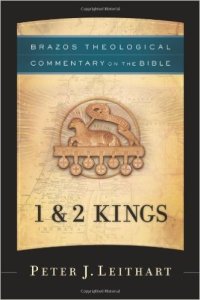
In his illuminating introduction to his Brazos commentary on 1 and 2 Kings–a clear example of biblical narrative if there ever was one–Leithart suggests that it can profitably read as wisdom literature along with Proverbs and Ecclesiastes:

The book of Kings can thus be fruitfully read as wisdom literature, albeit in a rather counterintuitive way. Proverbs describes wisdom as the way to life and prosperity: those devoted to Lady Wisdom are told that “riches and honor” as well as “enduring wealth and righteousness” come with her (8:18). According to Proverbs, there are stable patterns in the world, a moral cause-and-effect overseen by a just God, who rewards those who fear him. Yet, much of the wisdom literature of the Old Testament teaches an apparently contradictory message. Job is blameless in all his ways, yet suffers such excruciating loss that he concludes that Yahweh has abandoned him, and Ecclesiastes seems to directly challenge Proverbs with its recurring message that the wise and the foolish are both teetering toward the grave (Eccles. 2:14—16). Proverbs and Ecclesiastes are not contradictory, but rather highlight two poles of the biblical understanding of wisdom: if Proverbs teaches that Yahweh operates by a moral calculus, Ecclesiastes teaches that this calculus is as much beyond our grasp as Yahweh himself is, and as a result we experience the world as “vapor” (often mistranslated “vanity”) that slips away when we try to understand or control it.

The book of Kings might be read as a historical endorsement of the viewpoint of Proverbs. Good and faithful kings achieve unbelievable wealth and notoriety (Solomon) and are miraculously delivered from enemies (Hezekiah) (2 Kgs. 18-19). Bad kings brace themselves for stinging rebukes from prophets, die randomly in battle (1 Kgs. 22:34-36), and are devoured by wild dogs and scavenging birds (14:11; 2 Kgs. 9:36-37). Though the judgment of the wicked is doubtless a strong theme in 1-2 Kings, the overall effect of the narrative is the opposite, closer to Ecclesiastes than to Proverbs. Wicked kings are delivered as frequently as righteous ones: Ahab defeats the Arameans twice (1 Kgs. 20) before falling to a “chance” Aramean arrow, and Ahabs son also defeats the Arameans twice (2 Kgs. 6-7). Wicked Jehoash of Israel trounces righteous Amaziah of Judah (14:8—14), and Yahweh leads Israel in triumph over Aram during the reigns of Jehoahaz and the equally wicked Jeroboam II (13:22-25; 14:23—27). The book of Kings, especially 1 Kgs. 1-11, narrates the limitations of royal wisdom, while the book as a whole demonstrates the wisdom of Ecclesiastes, a wisdom that finds history elusive, unfathomable, uncontrollable. In its treatment of wisdom, then, 1-2 Kings is prophetic literature, demonstrating that wisdom is essential yet ultimately ineffectual to secure the health and salvation of Israel. –1 & 2 Kings, Brazos Theological Commentary on the Bible, pg. 19

Soli Deo Gloria

Five Practices for Actually Doing Theological Exegesis

bibleA couple of weeks ago I wrote a brief introduction to the idea of Theological Interpretation of Scripture. For class I was recently assigned an excellent little article on the subject by Hank Voss, “From ‘Grammatical-Historical Exegesis’ to ‘Theological Exegesis’: Five Essential Practices” Evangelical Review of Theology (213) 37:2, 140-152, which I figured would be worth examining as a follow-up to it.

In the article, Voss points out that while there’s been a good amount of theological argument for the necessity of what he calls “theological exegesis” (TE), there has been less practical elucidation as to how it’s actually supposed to work. People agree that theological interpretation is important, that simple grammatical-historical exegesis (GHE) is not enough, but there’s less direction and clarity as to how we’re supposed to go about moving from GHE to TE.

Voss wonders,

“How do global theological educators equip leaders in the church to practice theological exegesis? More specifically, how do we balance an emphasis on the human and divine authorship—which has tended to an evangelical strength—while paying greater attention to traditional Evangelical weaknesses: readers, their contexts, and their interpretive communities?” (141)

In order to address the gap, Voss proposes five practices that together constitute a framework and practical pattern for teaching pastors, preachers, and future theologians the exercise of theological exegesis (142).

So what are these practices?

1) Faith Seeking Understanding – First, theological exegesis recognizes that our reading of Scripture flows from faith. Theological exegesis assumes you already believe in Christ and want to know him in Scripture. For that reason, you treat the Bible as a different sort of text than Shakespeare or the New York Times. You read this text already believing in order that you might understand, not reading to understand and then maybe believe. Voss sees two implications of this principle.

  • First, sin is an epistemological category. We must reckon with the fallenness of our interpretive efforts and come to the text dependent on the Lord.
  • Second, dependency on the Lord implies “common hermeneutics” will be turned on its head (143). Reading with faith seeking understanding is prayerful reading, singing even, of the text, that acknowledges the spiritual dimension as prior.

2) Faithful to the Original Contexts —  Second, none of this rules out grammatical-historical exegesis. Voss suggests we must listen to original authors as we would want to be listened to; the golden rule applies here as well. Paying attention to the Divine Author doesn’t mean ignoring the human authors when reading the text. In fact, listening for the former happens as we pay attention to the latter. This means we will avail ourselves of all possible literary, historical, and contextual tools and helps as possible in our exegesis (144).

3) Analogy of Faith – Third, theological exegesis will operate in line with the Reformation emphasis on analogy of faith as a correlate of Sola Scriptura. (145) By the analogy of faith, Voss here is referring to the analogia totus Scripturae. In other words, comparing all the relevant biblical material in order that Scripture might interpret Scripture. This practice relies on the assumption of whole-canon discourse by God through human discourse in the various texts comprising the canon. For this practice, Voss appeals to Jesus’ own reading of Scripture in conversation with the Pharisees as an example (Matthew 22:29-32; 145-146). Jesus’ own practice shakes up some of the “rigidity” of modern reading practices. Voss sees hopeful developments in this area with the proposal of canonical-linguistic readings such as those of Kevin Vanhoozer as well as the renewed interest in the New Testament use of Old Testament in Biblical studies.

4) Rule of Faith – Fourth, Voss suggests that theological exegesis will adopt reading along with the Rule of faith (ROF). This principle is a necessary “Christian” and “catholic” way of reading. In some sense, it is best of thought of as a further subset of Analogy of faith in that the Rule of Faith is an “authoritative summary of Scripture’s message” and so entirely consistent with Evangelical convictions (147), Voss further specifies that the ROF reading implies at least three things:

  1. First, the ROF reads Scripture as the single story of creation, fall, incarnation, redemption, and consummation. All Scripture is read in that frame. (147-148)
  2. Second, the ROF finds Christ at the center of Scripture’s story. Christ is the point of the whole of Scripture, though the details here aren’t always quite spelled out in each text. (148)
  3. Third, the ROF reads Scripture trinitarianly (149). This is not a ham-fisted sighting of the Trinity under every bush, but recognizing the Trinitarian shape of the narrative of the whole and reading in light of it.

5) Community of Faith – Finally, Voss suggests we adopt a rule of reading with the “whole” church (catholica regula) . Exegetes ought to read in light of the “Pentecostal plurality” of the history of interpretation in the Church catholic. If we truly have a Pauline and New Testament understanding of the Church (1 Cor. 12), we’ll set ourselves to listen the Spirit’s voice speaking in illumined readings of Scripture throughout the whole body (150). This involves at least two dimensions. First, the church is a historic, present, and eschatological reality, and so we must listen to the voice of historic church as well, paying attention to readings of Scripture that come from patristic, medieval, Reformation, and modern eras. Second, we must attempt to take a step outside the West to hear the global church–the bulk of it, currently–reading Scripture.

With these five practices, Voss invites the church to begin practicing a theological reading of Scripture that acknowledges we are not simply reviewing a dead letter, or an important cultural artifact, but are reading to discern–to be discerned by–the Voice of the Lord.

Soli Deo Gloria

Four Themes for Pastor Theologians at the CPT Conference 2015

pastor theologianThis week I had the privilege of attending The Center for Pastor Theologians’ first annual conference in Oak Park. I’ve been excited about it for some time, not simply because of the buzz around the subject right now, but also because of the space I inhabit in my own studies, having recently (temporarily?) left my position in the local church. Now, I unfortunately could only make one of the days, but thankfully, it was the largest bulk of the time. That said, what I did catch was on point. Todd Wilson and Gerald Hiestand know how to put a conference together.

First off, Calvary Memorial felt like it was designed to host this sort of event. I mean, really, when I say it’s beautiful, I’m not just blowing smoke. Second, the size of the conference was really nice. I’m terrible with numbers, but it seemed like maybe two hundred or so people were, which is great for meeting, chatting, and feeling like you’re not being herded around like a bunch of cattle. I had the pleasure of meeting a number pastors and students working through some of issues I’ve been chewing on. Beyond that, the line-up was great. Not only the plenaries–which I’ll get to–but the breakout sessions, which featured speakers who could have easily been plenary speakers. If I had some spare cash and any extra time to read, the exhibitor section would have been tempting as well, with their sizable discount on books. All that to say, I look forward to coming back next year.

Oh, and one more thing: I think the thing that surprised me the most was the worship. For one thing, I was surprised at how good it was. The worship team had a tightly ordered, historic, yet contemporary liturgical order with each plenary session that actually ministered to some burdens in my soul. And that’s the second thing: I expected to be challenged and stimulated intellectually, there, but I was blessed to be comforted spiritually. But shouldn’t spiritual benefit be one of the impacts of a theological conference?

The Speakers

Now, as I mentioned, I only made it for the Tuesday portion, but that included the plenaries by Peter Leithart, James K.A. Smith, and Kevin Vanhoozer. While I was sad to miss Wilson and Hiestand’s pieces and the panel discussion, I was far from feeling robbed. All three were in fine form. Leithart discussed the Pastor as Biblical theologian, Smith, the Pastor as Political theologian, and Vanhoozer, the Pastor as Public theologian. Here’s what was funny: while all of the talks were distinct, content-rich, and focused on different aspects of the pastor’s theological work, there were some very clear–though, I think, unplanned–commonalities and themes. What I’d like to do is highlight four of them, summarizing and drawing on the different talks to do so.

Local. The first theme that clearly stood out was their focus on the local setting of the pastor. Leithart explicitly grounded his reflections around the activities of of the preacher in the “parish” ministry of study, pulpit, and table, as he sees one of the challenges of the pastor as biblical theologian is to develop new methods since much biblical scholarship that’s arisen in the academy is simply unusable by the church. As Vanhoozer joked, “Location! Location! Location!” is not only a principle of real estate, but of the reality of gospel-theologizing. Local pastors are theologians who are to know the specific locales–geographical, cultural, and spiritual–of the people (the public) to whom they are ministering. Smith even spoke of pastors as cultural ethnographers who are keen observers of their people and their environments, observing and reflecting on the cultural liturgies that shape the polis that exerts spiritual formative influence on their people.

Apocalyptic. Connected with this is the pastor as “apocalyptic” theologian. I believe the term was Smith’s, but it easily could apply to all three, though especially Leithart who framed his reflections around a close reading Revelation 17. In any case, local pastor-theologians are to be keen cultural observers, in part, in order to “unveil” and unmask the unreality of the prominent paradigms of the good life shaping our people without their understanding. Smith spoke of the “purging of the Christian imagination” that is partly the work of the pastor theologian who exegetes the festivals and practices of Empire. A theological sociologist, of sorts. Vanhoozer also stressed the formative power of culture, returning to some the themes from his work Everyday TheologyPart of ministering the reality of what is “in Christ” to the public of your people, means exposing the lies of the principalities and powers at work in the everyday rituals and narratives that hold our imaginations captive to the bestial practices of Empire.

Canonical. Of course, unsurprisingly, all three stressed the ministry of the Word as forming a canonical consciousness. Vanhoozer noted that the sermon is the “quintessential theological act”, which pastor-theologians practice in order to communicate the excellence of Christ and shape the congregation into who they already are in Christ. Leithart also stressed the ministry of the Word, suggesting that for the Word to have this effect, sermons must begin to take the shape of deep Bible studies, which illumine the narratival, typological, and theological depth of the texts, in order for our people to begin to inhabit the world of the Gospel. Hearing his phenomenal handling of Revelation 17 and the various theological, cultural, and political implications in his presentation, it’s hard to disagree. Looking to the practice of St. Augustine, Smith emphasized the preaching of the Word as well, but also pointed to Augustine’s theological work in his letters to the general Boniface, in which he gave biblical counsel in order to shape Boniface’s vocational self-understanding. The theological ministry of the Word expands beyond the pulpit for the pastor of a sent people living in a secular age.

Liturgical. Finally, all three, unsurprisingly if you know their work, emphasized the liturgy and especially ministering the sacraments as key theological activities of pastor theologians, both for shaping their theologizing and their people. Vanhoozer says the Lord’s Supper is the “summa and apologia” of the gospel; it is a “verbal, visual, and visceral” summary of the good news. As such, it is a powerfully formative liturgical practice for shaping the theological imagination of the polis of the church. The Table and the Pulpit go together in the work of the pastor theologian.

Of course, I’m still barely scratching the surface of these talks, especially since abstracting commonalities like this obscures the unique arguments of Leithart, Smith, and Vanhoozer. For that reason, I’d encourage you to go check out these talks and those of Hiestand and Wilson on the CPT Vimeo channel, which will be posted up by next Monday. I know I’ll be checking in to catch up on the sections I missed myself. In the meantime, they’ve got some helpful videos already up.

To sum up, the conference was a

Soli Deo Gloria

Mere Fidelity: Manhood w/ Nate Pyle

Mere FidelityOur society is wracked by a heavily-freighted questions of meaning, significance, and identity. Few questions are more central, though, than those concerning gender and sexuality. In this show, we invited on our friend Nate Pyle to talk about the subject of “manhood”, as he’s just written what promises to be a helpful book on the subject, Man Enough: How Jesus Redefines Manhood. As always, it’s a fairly lively discussion, since none of us are exactly on the same place on the issue. We do hope this conversation is fruitful and clarifying for you, even if you end up walking away with more questions than when you started.

Language For God in Patristic Thought by Mark Sheridan

patristicStudying Christian history, it’s funny to see the way certain verses take on out-sized significance for how the Bible is read and the faith is interpreted in the tradition. For instance, Etienne Gilson has traced the way a certain “metaphysics of the Exodus” developed around the declaration of the LORD, “I AM who I AM” (Exod. 3:14).

In his study of Language for God in Patristic Tradition:Wrestling with Biblical Anthropomorphism, Mark Sheridan shows that the verse, “God is not as man to be deceived nor as the son of man to be threatened” (Numbers 23:19) and an early (mis)rendering Deuteronomy 1:31 (“As a man takes on the manners of his son”) were two of the key texts that shaped and gave rise to ancient Christian methods of interpreting Scripture. Following the tradition of Philo of Alexandria and others, the Fathers had an explicitly theological method for reading Scripture, especially as it pertained to speaking of the ways and works of God in human language in ways “appropriate” and “fitting” to the divine being. This especially concerned the ascription to God of things like human hands, feet, physical activity (anthropomorphism) as well as human emotions like delight, surprise, repentance, or even anger (anthropopathism), which were particularly problematic for the Fathers.

Sheridan traces the various Scriptural and philosophical intuitions shaping the Fathers of the early Church from essentially three sources: Greco-Roman reading strategies, Hellenistic Jewish appropriations, and finally, the New Testament texts themselves.  First comes the strategy of allegorical interpretations developed by the Hellenistic exegetes in order to save texts like Homer’s Illiad and Odyssey from the moral critiques of the philosophers like Xenophanes, who took aim at the questionable morals and oh-so-human depictions of the gods in such works. Hellenistic Jews like Philo redeployed them in order to read the Old Testament narratives and Law for apologetic and edificatory purposes. Later on, seeing warrant in Pauline and New Testament allegorical and typological readings of the Old Testament, the Fathers drew on the Philonic tradition in order to aid them in their own Christological and moral readings of Scripture.

Having established this groundwork, Sheridan examines the way the Fathers treated key problem texts such as the creation narratives, patriarchal misconduct, or even the Divine command in the Conquest of the Holy Land. He also devotes a lengthy chapter to patristic interpretation of the Psalms, both for their anthropopathic and anthropomorphic language, as well as their morally compromising character in the imprecatory language. Finally, he ends with some comparisons between modern and ancient strategies for reading Scripture, and a very helpful, summary appendix on the theological structures and presuppositions to patristic interpretation. In a sense, it sort of sums up the work as a whole.

First of all, some positives. The book is clean, clear, and well-researched. Sheridan’s obviously an expert and he’s done a marvelous job setting out his theses from the primary sources, focusing on some of the key patristic figures such as Chrysostom, Augustine, and especially Origen. Second, his commentary is uncluttered, to the point, and informative. Next, Sheridan’s great at not simply focusing on the shape of the reading strategies, nor simply doing history for antiquarian interest. He cuts to the heart of the theological issues involved by returning to the question that concerned the Fathers which still concerns us today: what are we to say about God in light of the Scriptures? What is fitting to ascribe to him? These are not easy questions to answer but Sheridan helpfully makes available patristic perspectives that could prove fruitful for current generations to adopt, redeploy, or at least consider as they do their own wrestling with the text, as every generation must do afresh.

On the negative side, I had a couple complaints. First, I found it a bit odd that while the Fathers’ concern with how to treat ascriptions of anger or violence to the Godhead seems to be a special concern, there is no treatment of one of the clearest texts on the matter, Lactantius’ De Ira Dei (On the Anger of God). You can’t treat everything, but that text also might undermine the fairly consistent portrait of the Fathers’ handling of the issue. Second, Sheridan’s own theological interests come out towards the end chapters comparing Ancient and Modern strategies for reading the Bible, especially with respect to texts like the moral failures of the patriarchal narratives, or the conquest narratives, judgment, and so forth. He’s fairly critical of the modern, “literalist” approaches, clearly favoring ancient and, to be honest, rather moralizing interpretations. That said, he gives a fairly thin theological argument in favor of his preference beyond descriptively and unsympathetically explaining modern approaches and saying something like, “that doesn’t seem like enough does it?” Rarely does he theologically argue against modern concern for issues of historicity, sensitivity to genre, and so forth.

In general, though, I came away both more appreciative and critical of the Fathers’ interpretive efforts. Their theological concerns are not always our theological concerns, nor are their prejudices our prejudices. When reading Genesis, we’re not typically afraid that our hearers will think God has actual, physical hands he’s shaping Adam with. We’re worried about evolution and science, while the Fathers were worried about a fall back into the mythology their hearers had just come from, and so rightly aim to highlight God’s distinction from the gods they knew. This is corrective and instructive. Popular preaching in many churches isn’t as concerned as it might be that people draw the wrong impression from the anthropopathic portrayals of God’s ways with us. We fail to consider what it means that “God is not a man.” What’s more, for those interested in Christ-centered preaching, some of the Christological readings Sheridan draws our attention to are simply fantastic. Chrysostom, in particular, comes out shining like a star. Origen, as well, rose in my admittedly prejudiced estimation.

All the same, though I’m quite allergic to modernist, chronological snobbery, I simultaneously came away more appreciative of some of the advances of in modern hermeneutics by comparison. We simply can’t do the same kind etymological theology that was common at the time. Taking seriously historical context, comparative religious backgrounds, and more sober philological work has curbed our tendency to seek out “hidden meanings” often divorced from the literal sense of the text (which not all Fathers did!). And this is a good thing. I don’t think turning the story of Hagar and Sarah into an allegory of moving from the study of logic and rhetoric to the deeper study of philosophy is an adequate reading of the text, as some of the Fathers did. Nor, for all their problems, do I think turning the conquest narratives into a treatment of the conquest of the vices of the soul a reading that respects the texts as the historical narratives as they were given to us.

In sum, the Fathers were careful, sensitive, educated, and time-bound interpreters of Scripture, whose readings and ways of reading are worth our time and attention. They are our spiritual and theological Fathers worthy of our respect, consideration, and apprenticeship, though not our slavish imitation.

Soli Deo Gloria