Mere Fidelity: Out of the House of Bread w/ Preston Yancey

Mere FidelityOn this episode of Mere Fidelity, Matt, Alastair, and I are joined by our friend Preston Yancey. He’s just written a new book entitled Out of the House of Bread on the nature of the spiritual life and the spiritual disciplines. Also, it’s about baking bread. Aren’t you now quite curious how these go together? Possibly hungry for bread too? Well, listen to this episode as you drive to the market to buy bread and find out!

You can also follow the podcast on iTunes, or using this RSS feed. Listen to past episodes on Soundcloud.

*WE ARE CURRENTLY LOOKING FOR PEOPLE TO HELP US TO COVER THE MONTHLY EXPENSES OF THE PODCAST. PLEASE VISIT OUR PATREON PAGE*

Soli Deo Gloria

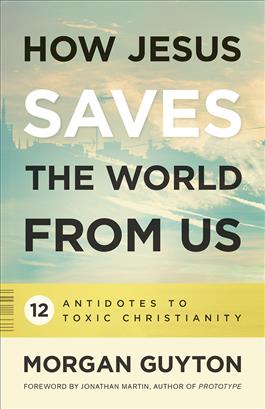
How Jesus Saves the World From Us (Review)

I tend to read different theological authors for various reasons. Some excel at putting into words my deepest, unarticulated beliefs better than I ever could. Others inspire me and provoke us to wonder. While still others are just generally informative—they tell me what I don’t know. Finally, there’s a special category that I’d put my friend Morgan Guyton in—he’s the kind who keeps me honest.

For those of you unfamiliar with him, he’s a Methodist college minister in New Orleans and a blogger at Patheos Progressive channel who gets featured at Huffington Post, Red Letter Christians, and other such periodicals. In other words, we don’t hang out at The Gospel Coalition conferences. AHow-Jesus-Saves-the-World-from-Usll the same, we’ve been blogging, chatting, and arguing quite vociferously back and forth for the last few years in such a way that I’ve been challenged, provoked, and (I think) strengthened in the faith. And this is even with some very significant, theological disagreements.

All that to say, I was pretty excited when I got my copy of his new book How Jesus Saves the World From Us: 12 Antidotes to Toxic Christianity. As you might expect given the title, it can appropriately be put in the recent spate of “progressive Evangelical” manifestos. That said, I was anxious to read it because I know Morgan to be honest, typically trying to eschew some of the sensationalism and invective that infects some of these kinds of works. Indeed, I know for a fact that he got turned down from some publishers precisely because he didn’t want to write the slash-and-burn anti-Evangelical screeds they thought would sell.

Instead, in How Jesus Saves the World From Us, Morgan attempts to put forward a more positive vision of a Christianity stripped from what he sees to be toxic attitudes, behaviors, and corruptions of a beautiful gospel. Each chapter is organized around a fairly clear binary with titles like, “Worship, Not Performance: How We Love God” or “Servanthood not Leadership: How We Follow Our Shepherd”, with the goal of presenting us with two clear paths. The point, then, is a constructive criticism of some of the deficiencies and pathologies of American Christianity with an eye towards a transformed Church. His goal is to call back or give hope to the many who have been burned out or disgusted by the many failures and excesses they’ve experienced at the hands of religious leaders and communities.

As much as I disagreed with some key chapters or sub-points, Morgan had plenty to say that I needed to hear. One of the most gripping chapters was his approach to gaining a holy body, “Breath, not Meat”—his translation of “Spirit, not Flesh.” His imagery of life lived to the flesh as bodies being turned into mere “meat”—dead life—is powerful and pastorally attuned. While, I’m not an anti-capitalist, Morgan’s section on the way our market-economy can play into our subtle commodification of persons and bodies is worth serious consideration. Overall, it’s a helpful dimension to consider in our all-too-thin “spiritual” accounts of sanctification and sin.

Given my recent forays into the theology of Leviticus and the Temple, I was also drawn especially to his chapter on “Temple, Not Program.” I really resonated with his suggestion that churches begin to recover that sense of the sacredness of time and space. Over and over again we’ve heard that the Church is a “people not a place”, but in our hyper-mobile, post-religious culture, that simply plays into the vacuous sensibility that since we can worship God “anywhere” there’s no real use to gathering somewhere with some people to meet in a special way with the Lord. And because we’ve lost that sense of the sacred space of the local church, we’ve increasingly relied on the hyper-programization of a flawlessly-executed program to gin up a sense of the divine in our people.

And, I’ll also mention his chapter on “Servanthood, not Leadership.” While I’d probably nuance his end-point about pastors seeing themselves less as shepherds than as fellow-sheep (I mean, “under-shepherd” is a biblical idea), so much of this chapter was a breath of fresh air compared to more technical models of pastoral leadership built on business-school models of success and platform-building. The professionalization of the pastorate is one of the greater tragedies of the last half-century.

I could go on like this about a number of the other chapters. But though Morgan is my friend, I will register one critical comment that sums up the various sub-points I’d make as a whole. While the format is a useful heuristic tool (“eat this, not that”), unless taken critically, the binary format often leads us to miss a possible third way between the option that Morgan is (rightly) critiquing, and his proposed positive vision.

To take an example, his chapter on “Poetry, Not Math: How We Read the Bible” gives you a nice, clean split. Either we misunderstand the Bible by trying to treat it like a problem to be solved, mastered, used, as a weapon, etc, instead of poetry to be savored and accepted with all of its mysteries and complexities. Which is good as far as it goes. But then (leaning on types like Enns and Rollins) he forwards a functionalist understanding of the Scripture’s authority and a pragmatic notion of its truth in terms of usefulness, ignoring some of the real challenges the original fundamentalists have, or current inerrantists worry about. I suppose my point is that much of the time, yes, the Bible is like poetry, and yet, sometimes it’s a little closer to math.

That’s typically how I felt about the sections I disagreed with. Morgan almost always has his finger on the problem and frequently he identifies issues I never would have thought up about coming from my location. And I really need to hear those different perspectives. But the question is about the way forward or the way we read the need to revise our understandings of certain doctrines like penal substitution or something, to fix what’s wrong.

But again, this is why I say he keeps me honest and why I gained a lot from reading this book. And I think that’s probably fine with him. I don’t see Morgan needing conservatives to agree with all of his solutions. But forcing us to grapple with real issues, hurts, corruptions, and struggles within the Church faithfully from within our own frameworks? Getting us to hear the pained voices of the wounded so that we might strive present a more beautiful gospel and a more glorious Jesus to them? I think he’d be just fine with that. And that’s what Morgan’s done for me in this book.

Soli Deo Gloria

Doctrine and Life Go Together–Mostly, but Sometimes Not

beliefs

Why Indiana Jones? Why not?

Paul’s injunction for Timothy to keep a close watch on his “life and doctrine” in order that he might save his hearers has rung in my ears ever since I realized I was called to the minsitry (1 Tim. 4:16). Life and doctrine go together–what the mind and heart believe, the hands perform. This is why sound doctrine leads to sound living. When we understand the truth of the world, ourselves, and God, how we live in the world will begin to be aligned and attuned to this realities.

Except when it doesn’t.

See, while I still believe that doctrine and life go together, I think there’s a bit of confusion more broadly about the connection between believing and living. People seem to have bought into a popular version of what economists call “rational actor theory”, where (on my dummy definition) people make their decisions in a goal-oriented, reflective, and maximizing way. In other words, there’s something of a clean link up between beliefs and behaviors. If you know one, you should be able to draw a straight line to the other.

This is the kind of folk theory you see at work in a lot of our conversations around politics, or in theology, and so forth. Joe believes in penal substitution, and he just punched Lou in the face, so clearly it’s his violent ideology at work. Jenny struggles with anxiety, so that must be her Arminian theology of providence crushing her with stress. Jake has been flirting with progressive theology lately, so we can expect him to acquire a harem soon. And so forth. Or, we’re shocked when someone who believes as we do acts in a manner we never would.

But the more I watch people, the less that seems correct. Beliefs matter, but humans aren’t consistent, believing machines. For one thing, not all of our beliefs are consistent with each other. Talk to the average person on the street (even the well-educated ones) for very long and it’s easy to find unresolved tensions and contradictions in their thought. In which case, they might act in such a way that deeply contradicts one belief they hold, because it is perfectly consistent with another, different belief and they just haven’t connected the dots.

What’s more, even when people do have consistent beliefs, they don’t always live them out consistently. This is the point of talking about weakness of will, or akrasia as Aristotle termed it. We just know that people often consciously act against their best or conscious beliefs under pressure, temptation, or desire. Or we rationalize and note the way we are exceptions to what we generally expect for others and so forth.

Or even further, we forget that there are usually a number of different conclusions you can draw from your collection of beliefs. Especially if you’re evaluating someone else’s position from the outside. I mean, if you can’t even keep all of your own beliefs straight (as is likely), it’s not surprising that you might have trouble with others’. I can’t tell you how many times I’ve had to explain that “no, point B is not what I believe, nor does it even plausibly follow from point A” to various non-Christian friends over the years on any number of issues.

Finally, (and we could keep going) we forget the way various psychological, emotional, social, and historical pressures influence us from moment to moment, in surprising ways. Traumas (or graces) from the way we were raised might create residual behavioral patterns at the level of habit in a way that isn’t simply dislodged by a good syllogism and a few propositions being switched around in your grey matter.

Theologically, a lot of this makes sense, right? Yes, we were created in the Image of God but that’s been broken such that all of our faculties (reason, will, etc) are damaged by sin. They don’t always function or connect up properly. Even after the grace of Christ comes into our lives, the Holy Spirit is at work to restore us progressively. In which case, there will be many times when our beliefs don’t match up with our living.

I mean, this is a lot of why Paul spends so much time reminding people of what they believe, but then also trying to connect the dots between that and how they live. Whether out of folly or rebellion, they weren’t drawing proper conclusions for living from the doctrine that they were intellectually believing.

More positively, this is part of why people will surprise us with how much better they live than we imagine their beliefs would lead them to. Tim Keller talks about the way the Holy Spirit’s work of common grace in the lives of unbelievers leads many to live more wisely and graciously in some respects than believers. Some of that happens, I think, by a happy disconnect between some of the more corrosive beliefs a person may hold and their instinctive behavior. Or, there are great behaviors produced by odious or harmful beliefs.

There are a number ways this can go.

One, I think, is to maybe slow us down from drawing too straight a line between the behaviors of our intellectual opponents and the beliefs of theirs we despise. Yes, again, I do think there is a connection between life and doctrine. There are beliefs that, held in the right way, change us for the better or for the worse in the long run. But in the mess of history, unless they come out and explicitly explain their behavior, it can be very difficult to interpret just what led someone do the dastardly thing they did. Or it could be that someone–under the pressure of desire, peers, etc.–actually betrayed their beliefs. I’m not saying we can’t draw the line between behaviors and beliefs–I am saying we need to be a lot slower and take more care with that argument.

Second, I think we need to be less surprised when large chunks of population don’t behave according to the model we think they should in our head. This is true when we’re thinking of the Evangelical electorate or any other group. We need to be careful about the kinds of causes or explanations we accept for behavior or the beliefs of people we disagree with. Single-cause/single-belief explanations are almost always wrong. People are complicated, so we need to slow down, weigh a variety of complementary or competing explanations for these sorts of things. So, give the other side the kind of charitable interpretation you’d love the to give you when people on your team are being terrible.

Third, on a personal ministry level–each person is their own person. You’re almost never dealing with a cookie-cutter version of the last person you talked to. Sure, you can begin to create “types”, or “patterns”. Stereotypes usually have some basis in fact. But as soon as you’re sitting across the table from one of those types, the mold will usually start to crack, so before you begin “dialoguing” with the robust arrogance of knowing “exactly who this guy is”, maybe slow down and listen to who he actually is.

There are more conclusions we could draw, but all this to say that doctrine and life are definitely connected, but it’s a complicated affair. Which is why the spiritual life and gospel ministry isn’t a simple matter of formulaic truth-dispensing. Preaching and teaching must take their place in the Church–a web of social and historical relationships in which the Spirit works on a person’s heart, mind, body, and soul over time.

Thankfully, the Spirit’s got plenty of it.

Soli Deo Gloria

Three Mistakes to Avoid in Good Friday Preaching

Preaching “Christ and him crucified” is core to the job description of any minister of the Christian gospel (1 Corinthians 2:2).  Good Friday drives this home more than any other day in the church calendar. On that day, the preacher’s task is to proclaim and explain why the bloody spectacle of the Son of God murdered upon Golgotha is “good news.” How is this moral rupture the center of God’s great act of atonement–of God reconciling the world to himself (2 Corinthians 5:19)?
Christ’s cross itself has always provoked hostility and scorn whether among pagan Greeks or Jews and is, in many ways, no easier to stomach now than it was then; it still confronts us with our sins and bids the old Adam to come, submit to death, so that the New Adam may rise to new life. But that’s not the only difficulty involved.
The fact of the matter is that many have rightly recoiled at some of the defective ways pastors have preached the cross–especially its penal and substitutionary dimensions–in the past. When we make mistakes in this area, it’s easy to give people a distorted and destructive view of both God and the gospel. This is tragic. Both because we deprive people of the beauty of the cross, but also because, as C.S. Lewis points out, the more powerful and good something is, the more destructive it can be if it goes wrong. Much as a doctor cannot be careless in wielding a life-saving scalpel, so preachers cannot treat the preaching of the cross lightly or carelessly lest we bring death instead of life.
While there are a number of ways preaching the cross can go wrong, here are three key mistakes to avoid in your preaching of the cross this Good Friday.
You can read the rest of the article over at Reformation21.
Soli Deo Gloria


Mere Fidelity: The Last Supper and the Last Week of Jesus

Mere FidelityThis week on Mere Fidelity, Alastair, Matt, and I tackle the subject of the Lord’s Supper. We try to set it in the context of the last week of Jesus, while moving around to the various Gospels and the canon of Scripture as a whole. This one–I think–had some particularly appropriate insights as we enter Holy Week heading towards Maundy Thursday and Good Friday. We hope you are as edified as we were.

Feel free to share.

Soli Deo Gloria

Mere Fidelity: What is Apophatic Theology and Can It Work for You?

Mere FidelityThis week on Mere Fidelity we took up the ever-pressing issue of apophatic or negative theology (Don’t say “God is…”, say “God is not…”). To do so, we invited Dr. David Wilmington on to discuss the nature, the limits, and the proper uses of apophatic theology, especially some of the more contemporary forms drinking from the well of postmodern influences like Derrida and so forth. At core, we discuss the issue of language for God and knowledge of the God who transcends language, yet reveals himself in Scripture, nonetheless. This is an admittedly nerdy one, but we think it’s worth your time.

Soli Deo Gloria

Mere Fidelity: Have Evangelicals Become Too Obsessed With Politics?

Mere FidelityIt’s election season again, which means that politics is on our mind more than it usually is. But is it too much? This episode of Mere Fidelty, Matt, Alastair, and I discuss the problem of political engagement and obsession in the church. We take up issues like the disconnect between different political and theological classes, the work of James Davison Hunter & the culture war syndrome, the problem of loudest voice in the room, instrumentalizing the faith, and so forth. And we even give Alastair a fantastic new nickname. You won’t want to miss this one.

Soli Deo Gloria

Atoning for the Altar? Medieval Honor Culture and Leviticus

One of the oddest puzzles in the Law comes in the Day of Atonement ceremonies outlined in Leviticus 16. On this great and holy day, the sins of Israel accumulated throughout the year were cleansed and atoned for in the sacrifices offered up by the high priest in the Holy of Holies. There are a progressive series of sacrifices to be offered up for the high priest, his family, Israel as a whole, the mercy seat, the Tabernacle, and even the altar:

Thus he shall make atonement for the Holy Place, because of the uncleannesses of the people of Israel and because of their transgressions, all their sins. And so he shall do for the tent of meeting, which dwells with them in the midst of their uncleannesses…Then he shall go out to the altar that is before the Lord and make atonement for it, and shall take some of the blood of the bull and some of the blood of the goat, and put it on the horns of the altar all around. And he shall sprinkle some of the blood on it with his finger seven times, and cleanse it and consecrate it from the uncleannesses of the people of Israel. (Lev. 16:16, 18-19)

This may initially strike some of us as peculiar. We typically would think that persons needed to have their sins cleansed and expiated and taken away. But the Holy Place and the altar itself have committed no sins–they are inanimate objects–so why should they need atonement?

leviticus as lit pictureJewish scholar Jacob Milgrom has forwarded an influential theory about the contagion of impurity and sin that causes the uncleannesses of the people to sort of pile up throughout the year around the Holy places of the Tabernacle. Sin is brought in regularly and it also penetrates through, polluting the Holy places rendering it in need of cleansing if God is going to dwell in blessing with his people.

In her work Leviticus as Literature, Mary Douglas finds Milgrom’s work helpful, but she says it’s too materialist in its discussion the accumulation of sin and uncleanness. Instead, she draws some comparative work between the logic of impurity in Leviticus and the discourse of honor in European cultures connected to the virtue of women or the honor of a knight (146).

She notes that the Bible itself presupposes a patronal structure where the client is concerned for the honor of the patron. God is the covenant Lord who has brought separated Israel out from the nations and made it his own people (Ex. 19; Deut. 7:6-10)–they are holy to him.

Defilement as a violation of holiness is a particularly apt expression for an attack on the honour of God perceived as a feudal Lord. The word for holy has the sense of ‘consecrated’, ‘pledged’, ‘betrothed’, as ‘sacrosanct’ in modern English, something forbidden to others, not to be encroached upon, diluted, or attacked. (147)

The Lord has saved Israel into a special relationship of dependence, loyalty, and love. This means they are to be obedient to him and keeping from insulting his honor and glory.

“This power also protects his people or his things and places, and to insult any of them is an insult to his honour.”

Douglas sees this as key to understanding the logic of the defilement of the altar:

In the courts of chivalry a warrior would recognize that his armour is dishonoured if he himself is impeached: as well as his children, and father and mother, his helmet, his coat of arms, his house, all are tainted and made worthless by the contagious dishonour. Blood washes off the major taint, a noble gift cancels a minor fault. In the same way, bringing uncleanness into the Lord God’s sanctuary makes it impure since the place shares in the insult to God. (148)

Of course, I’m obviously delighted to see a 21st century, anthropologist partially vindicate St. Anselm’s appeal to the logic of feudal honor codes to explain atonement. But beyond that, I find the analogy intrinsically persuasive. There is a clear logic of moral identification at work throughout Scripture such that an attack on God’s things is an attack on God and vice versa.

Leviticus is different than many other books–even from it’s closest kin, Deuteronomy and Numbers–but it is not utterly divorced from their moral, covenantal universe. Cleansing the altar, then, is another way of recognizing and reinforcing the holiness, majesty, and glory of the God who has chosen to dwell with Israel.

Soli Deo Gloria

Mere Fidelity: Worship Services and Evangelism

Mere FidelityThis week on Mere Fidelity, we have the full cast and crew on to talk about the point of weekly worship. What is it about? Is Evangelism part of the central purposes or is that a secondary concern? How does this affect the way we go about thinking through our services and the broader church programs surrounding them?

Also, we make fun of Andrew for being an UK televangelist now.

Learning to Pastor From Leviticus

When I was a college minister, Leviticus wasn’t the book I typically went to for pastoral theology. Actually, Leviticus wasn’t the book I typically went to for most things, with the exception of an atonement talk here or there. I suspect I’m not alone. Most of us don’t relish the idea of delighting our parishioners with details of cleansing skin diseases.

But I’ve recently been learning how mistaken we are when we take this approach to Leviticus.

Pastoral Care in the Old Covenant 

In his recent work, Who Shall Ascend to the Mountain of the Lord?: A Biblical Theology of the Book of Leviticus (IVP Academic, 2015), L. Michael Morales draws our attention to the pastoral implications of Leviticus’ first verses:

The LORD called Moses and spoke to him from the tent of meeting, saying, “Speak to the people of Israel and say to them, When any one of you brings an offering to the LORD, you shall bring your offering of livestock from the herd or from the flock. If his offering is a burnt offering from the herd, he shall offer a male without blemish. He shall bring it to the entrance of the tent of meeting, that he may be accepted before the LORD.” (Lev. 1:1–3)

Whenever an Israelite offered a burnt offering to the LORD, he was to present it to the priests first. The priests were to inspect it for any hint of defect, blemish, disease, infirmity, or weakness (Lev. 22:17–28). As Morales points out, this gave the priests a chance to exercise pastoral care for God’s people.

Located at the center of the Torah, the provisions of the sacrificial system formed the heart of Israel’s shared life with God. Not only did God use them to instruct his people in holiness (contrary to what many of us have been trained to think, God likes to both show and tell), but they were how he brought sinful people into his presence. Sacrifice was as much about God’s longing for us to draw near as it was about our inability to do so.

Worshipers, then, were to offer God their best as an act of worship. Offering a weak or defective animal indicated either carelessness about the things of God or a lack of trust in his provision. They signaled a distant heart. So the presentation and inspection of the sacrifices was an opportunity for the priests to offer pastoral accountability, correction, and instruction.

I continue to unpack the implications for New Covenant worshippers and pastors over at The Gospel Coalition.

Soli Deo Gloria