Is Vanhoozer Still a 5-Point Alvinist? (Engaging KJV Pt. 3)

This is the third entry in my series “Engaging Kevin J. Vanhoozer”, devoted to Kevin Vanhoozer’s work Remythologizing Theology by working through the essays devoted to it in a recent volume of the Southeastern Theological Review. You can read part 1, and part 2.

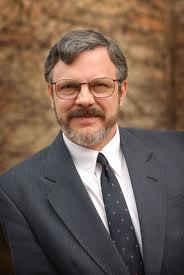
Fabulous beard. Horrible philosophy.

Fabulous beard. Horrible philosophy.

Oliver Crisp’s entry “Remythologizing, Projection, and Belief: A Reply to Vanhoozer,” is almost entirely focused with the methodological component of Vanhoozer’s project. Leaving aside the material proposals about the doctrine of God, Crisp analyzes what he sees to be a major gap in Vanhoozer’s armor, threatening to undercut his whole project: namely, his epistemology.

Projection Issues – One of Vanhoozer’s main foils in Remythologizing Theology is Ludwig Feuerbach, whose main claim was that all of Christian theology is just anthropology, or our best thoughts about ourselves projected onto the screen of eternity. Crisp summarizes:

Belief in God, on this view, is simply the reification of certain notions we have about ourselves, the projection onto the clouds of a father-like entity that is no more real than any other figment of human imagination. (pg. 32)

He then formalizes it in good analytic fashion, into what he calls the “Problem of Projection (PP)”:

(PP) Christian theological language about God is disguised language about the needs of human beings: such language reifies cherished human religious thought, values, beliefs. (pg. 33)

Vanhoozer’s remythologizing approach (which I’ve summarized here) is proposed as an answer to the problem by returning to the text as God’s own self-presentation, or Divine self-projection through Word and Spirit, as given us in God’s speech to us in Scripture. Theology in this view is a responsive, dialogical reality, attending to the story (mythos) of the Theo-Drama, not a monological mythology of our own making.

Crisp Anxieties – All that’s fine and well says Crisp, but there’s a hitch. Who’s to say all of this isn’t just another story? (pg. 33) Why should the Feuerbachian or the modern theologian buy this account? In other words, where’s the epistemology to to match it? All of this just seems to assume a view about God and Scripture, without an account of why we should accept scripture as God’s speech. Crisp takes us through a brief tour of Vanhoozer’s epistemological comments in other works, especially The Drama of Doctrine (DoD), to set up his problem (and solution.)

When it comes to epistemology, Vanhoozer has described himself as a postfoundationalist and an aspectival realist. Instead of coherentism’s metaphor of an interconnecting web of knowledge and foundationalism’s structure metaphor, with certain core, stable beliefs holding up the whole, Vanhoozer’s aspectival realism offers us a map. It is a framework of interpretation through which we see the world; it must be coherent, as well as have some connection to reality if it is to work, is admittedly limited, and yet it is testable, refinable, and correctable on the basis of new insights and information.

And yet, Crisp says, Vanhoozer’s a bit of a “theological magpie”, taking bits and pieces of various frameworks and piecing them together as they fit his own project. So, along with the map, in DoD Vanhoozer seems to adopt some of Alvin Plantinga’s reliablist account of knowledge even though it is a moderate form of foundationalism.

plantinga 4

Your thought has been judged and found wanting.

For those without knowledge of Plantinga’s account (which I favor heavily) Crisp explains:

On this way of thinking, what we believe is innocent until proven guilty. Such beliefs are formed by epistemic mechanisms that function according to a design plan aimed at truth. In his earlier work Vanhoozer even flirts with the Plantinga-inspired notion of properly basic beliefs.10 These are beliefs that are (a) noninferential, that is, not held on the basis of other beliefs from which they are inferred, and (b) justified or warranted, that is, formed in an epistemically responsible manner. (pg. 36)

Here’s where things get interesting. Crisp says this would be great, except that it seems Vanhoozer has dropped this line of thinking in RT because “proper basicality is embedded in a foundational epistemology” that he likely rejects as a postfoundationalist. In any case, he doesn’t mention it in the later work.

This becomes problematic in RT because, well, let me just let Crisp explain again:

Much of the work in this most recent volume involves the spinning out of his particular peroration on the claim that Scripture is the vehicle for divine discourse. But with so much riding on this claim, it is strange that he does not do more to shore up its apparent vulnerability. For, absent the notion of properly basic beliefs, it is not clear (to this reader, at least!) how he can ground the assertion that his hermeneutical framework, and his theological myth, is more likely to be closer to the truth of the matter than the frameworks and myths of his interlocutors. He has not provided an adequate means by which we can adjudicate whether his canon-linguistic approach to doctrine, or his more recent remythologizing approach to theology, is closer to the truth than either Bultmann or Feuerbach. (pg. 37)

In other words, Vanhoozer hasn’t given us a compelling epistemological reason to accept his picture over the others on offer. For someone who doesn’t accept fideism, the truth, or justification question is still up in the air. Along with another proposal derived from the material content of the faith, Crisp suggest that Vanhoozer’s Projection Problem could be cleared up with a heavy dose of Plantinga’s modest foundationalist epistemology, properly basic beliefs and all. It’s a good epistemology, it fits with the project, and Crisp even helpfully tells a little story about how all of this can work together:

What he can say is this. Although we cannot guarantee that we have the absolute truth of the matter, we can be sure that our hermeneutical framework, that is, the framework of canon-linguistic remythologized theology, provides some purchase on the truth, sufficient for us to be confident that it provides a theological myth or story more complete and more accurate than that of Bultmann or Feuerbach. Granted there is no “view from nowhere”—not even the canonical-linguistic view—from which to survey the epistemological landscape and make judgments about it. Nevertheless, what Vanhoozer provides is both internally coherent and a good fit with the biblical material, wherein (as he puts it) we find the mighty speech acts of God. Because our cognitive and linguistic faculties work according to a design-plan aimed at truth, we can move beyond perspectivalism to aspectivalism. That is, we can have some confidence that our theologically attuned hermeneutical frameworks give us the truth of the matter, or near enough, at least some (most?) of the time. Furthermore, because we are fashioned according to a design plan we can know certain things about God because he has designed us to be receptive to him. (pg. 36)

So what does Vanhoozer have to say about all of this?

Vanhoozer’s Confession – As it turns out, it’s all been a happy confusion since he basically agrees. Says Vanhoozer:

Crisp has to ask if I am still a “five-point Alvinist,” because Alvin Plantinga is an epistemological foundationalist while I appear to hold to some kind of postfoundationalism. The problem here is semantic, and can be fairly easily cleared up (I take full responsibility for any misunderstanding). The simple explanation is that I accepted Plantinga’s objections to classical foundationalism, and his proposed positive alternative. Plantinga argues that it is rationally acceptable (warranted) to believe in the existence of God without evidence, proof, or even argument (because belief in God is “properly basic”). Initially, this seemed to be a kind of Calvinist post-foundationalism. In retrospect, however, I acknowledge that Plantinga prefers to describe his Reformed epistemology as a version of foundationalism. Understood in Plantinga’s way, then, I too am happy to call myself a “modest” or “chastened” foundationalist. And I am therefore delighted to accept Crisp’s proposal that belief in Scripture as normative is a properly basic belief (I say as much in Is There a Meaning in this Text?), especially if this lets me escape, Houdini-like, from the Problem of Projection.  (pg. 78)

As you can imagine, I’m grateful to Crisp for squeezing this clear confession of Plantingan faith out of Vanhoozer. I’ve mentioned in the past, I’m a Plantinga fan, so I read Crisp’s account with great interest as I’d had thoughts along the same line.  I’d actually always sort of blended Plantinga and Vanhoozer together in my head hoping that it made sense, so it’s nice to get confirmation and a little constructive clarity from Crisp and Vanhoozer himself.

So, for those who are wondering, yes, one can be Vanhoozerian and a Five-Point Alvinist. All is right in the world.

Soli Deo Gloria

Does Diversity of Form Lead to Diversity of Message in Theology? (Engaging KJV Pt. 2)

Last week I kicked off a little series engaging Kevin Vanhoozer’s Remythologizing Theology by working through the essays devoted to it in a recent volume of the Southeastern Theological Review. I opened with an appreciative post outlining Vanhoozer’s unique place in Evangelical theology, but from there I figured it would make sense just going through the various essays in order, beginning with Stephen J. Wellum’s “A Critical Appreciation of Kevin Vanhoozer’s Remythologizing Theology.

“A Critical Appreciation” aptly sums up the thrust of the essay; it’s appreciative, then critical. Wellum begins with an excellent multi-page summary outline of RT, noting carefully the methodological as well as material proposals Vanhoozer is making. From there, he moves into three areas of criticism within his overall appreciative take on the work. While Wellum raises some material issues (how does the author-analogy for sovereignty deal with reprobation?), he settles in mostly on issues of theological framework, truth, and method.

Though his section on the absence of apologetics, or rather the assumption of a Reformed theological framework, is worth pursuing, it overlaps with the thrust of Crisp’s essay, so I’ll leave that to the side for this post. What I’d like to do is frame Wellum’s question to Vanhoozer on the issue of literary forms, and then summarize what Vanhoozer has to say in his puckishly-titled follow-up article “Vanhoozer responds to the four horsemen of an apocalyptic panel discussion on Remythologizing Theology.”

mediumMore Than One Medium, More Than One Message? – Back in the day, Marshall McLuhan taught everybody that the “medium is the message”–essentially form and content are inseparable; how you say something is part of what you’re saying. For instance, print media and visual media are two very different things and they radically shape what is being communicated. Vanhoozer is well-known for giving the dictum a theological twist and arguing that the form, or forms, of the message–specifically the various genres of literature in Scripture–should play a role in our theologizing about the message, especially in Is There a Meaning in this Text? and The Drama of Doctrine.

It’s here that Wellum starts to wonder, “are literary forms overblown?” (pg. 24) See, it’s not just that Vanhoozer claims we should be paying more attention to genre so we can figure out that you’re not supposed to read Revelation the same way you read the book of Acts. That’s all fine and good. What causes his query is the further claim that he sees Vanhoozer making–that the plurality of mediums and genres (canonical plurality) yields a plurality of conceptualities and theologies (theological plurality.) Quoting Vanhoozer in DoD (pg. 275):

The plurality on the level of the canon may call for an equivalent plurality on the level of interpretative traditions. If no single conceptual (read, confessional) system is adequate to the theological plentitude of the canon, then we need a certain amount of polyphony outside the canon, too, in order to do justice to it. The church would be a poorer place if there were not Mennonite or Lutheran or Greek Orthodox voices in it.

Applying the idea to atonement theology, this would mean that instead of privileging one of the many metaphors used to speak of Christ’s work to one, single, conceptual framework, a remythologizing approach will let them all come to play and shape our understanding. In RT, he says something along the same lines about our theology of God. Again, he quote Vanhoozer,“The reality of God outruns any one theologian’s attempt to conceptualize it, just as Scripture outruns the attempt of any one interpretative scheme to capture its meaning (RT, p. 474).”

At this point, Wellum throws up his hands and confesses that he’s not quite sure what to make of all of this. It’s all fine and good to think through the various genres of Scripture, as we struggle to do theology that honors all that God revealed, but “why does this lead to theological diversity?” (pg. 25) Sure, we should think through and include all the metaphors used in Scripture when thinking through the Cross, but isn’t it possible to take them all into account and land at an account of things that is better than other attempts? “…does this entail that there is no single conceptual system which accurately understands the Scripture, or at least, in terms of the areas that are central to an understanding of the Gospel?” (pg. 25) Pushing further, Wellum also asks whether this holds up in light of the inter-textual usage of the Old Testament texts by New Testament authors, who seem to appropriate texts freely across literary forms as they re-read them in light of the redemptive-historical story-line of Scripture.

These are good questions. So what does Vanhoozer have to say about it? Well, as with everything he says, he says it playfully and humbly–especially since Wellum happens to be his former student.

The Master Responds – So what’s he getting at? Well, to begin Vanhoozer does a little clarifying as to what he does not mean by theological plurality:

The first thing to be said is that I am careful to locate diversity on the level of vocabulary (e.g., metaphors) and concepts, not the more fundamental judgments that underlie them (e.g., ontological judgments). A second
preliminary observation: diversity is not the same thing as indeterminacy or contradiction. To be sure, there is a certain tension in saying that the same basic theological judgment may be rendered in more than one set of concepts, some of which catch certain nuances better than others. But we need only think of the various metaphors to describe the saving significance of Jesus’  cross to see how canonical perspectives generate theological perspectives. (pg. 75)

In other words, don’t take this too far. Recognizing understandable theological plurality is not a charter contradictory or incoherent doctrinal formulations. It is, however, a call to humility in our theological pronouncements given our finiteness and the fecundity of texts themselves.

Next, Vanhoozer happily concedes Wellum’s last observation about the NT author’s seeming emphasis on redemptive-historical readings over ones sensitive to literary form. That said, in the dispute between Christ and the Tempter (Luke 4), Vanhoozer points out that they’re not just trading true propositions. The issue up for dispute is where these statements fit in the canonical narrative of redemption. In other words, the issue of re-reading texts in light of redemptive history is still an issue of appreciating form–in this case, the form of the whole canon.

Finally, one of the key points to understand, is that Vanhoozer’s reflections on form and genre are an attempt at correcting against some approaches to the place of genre in theology on offer.  For so many Evangelical theologians, possibly including Wellum, understanding genres is important so that you can better crack open the shell of the text, and get to the juicy propositional content. Vanhoozer’s basic hunch about the forms of biblical discourse is that they “do more than provide packaging for theological content.” (pg. 75) Vanhoozer’s concern is that we see Scripture not merely as a treasure-trove of divine propositions to be deciphered and reassembled in the proper, systematic order.

God had particular purposes in using wisdom, apocalyptic, narrative, instead of one, clear, monological form, and this is an insight of theological importance:

Form is also an ingredient in “rightly handling [orthotomeo] the word of truth” (2 Tim. 2:15). It is through the various literary forms of Scripture, including stories and histories, that the divine authorial imagination shapes our view of God, the world, and ourselves, thus forming us to be those who can make right judgments concerning fittingness. (pg. 76)

At a more than systematic level, the forms of Scripture train the disciple in ways of seeing, hearing, knowing, loving, and responding to drama of the Gospel, and that says something about the God of the Gospel.

One of Ricoeur’s line in particular continues to intrigue me: “Not just any theology can be wed to the narrative form.” How much more is this the case with a theology wed to history, apocalyptic, wisdom, prophecy, law, and gospel! (pg. 76)

A Clarifying Word – For some, questions will remain. I have a couple myself. Knowing this, Vanhoozer points the inquisitive to works by Ricoeur, as well as his own essay “Love’s Wisdom: the authority of Scripture’s form and content for faith’s understanding and theological judgment ” (Journal of Reformed Theology 5, 2011) At the end of the day, given the amount of space he had, this is a helpful, clarifying word, though not a final one from Vanhoozer.

Still, in the space he takes, we find a challenge to go back to the text and really see the formal diversity for what it is: not an obstacle to be puzzled apart, reduced to a clear, propositional form, but God’s diverse word that strikes “all the chords of the human soul, not just the intellectual”, in order to train us to take our place in the grand Theo-drama of redemption.

Soli Deo Gloria 

A Few Reformation Day Reads

martin-lutherIt’s Reformation Day again–the day we celebrate the Reformation of the Church (and mourn its current disunity) by remembering Martin Luther’s nailing of The 95 theses to the door of the Church in Wittenburg. Last year I wrote a little piece on the proper way of celebrating Reformation Day through repentance. This year, I’d simply like to include a few links and readings for your Reformation Day.

First of all, there’s the 95 Theses themselves, or more properly “Disputation on the Power and Efficacy of Indulgences.” Now, you need to know these are a series of theses to be argued about in a theological context, so some of it inside baseball that only medieval theology experts will get. What’s more, most Protestants, and Luther himself, would come to dispute plenty of these. Luther was still a good Augustinian monk at the time he penned these. That said, there’s real power in some of them, that non-experts like you and I can benefit from, starting with the first and most famous of them all:

When our Lord and Master, Jesus Christ, said “Repent”, He called for the entire life of believers to be one of repentance.

If you want a good understanding of what all went into that from one of those medieval experts, Justin Taylor has an interview with Carl Trueman on it that’s pretty helpful.

Following that, it’d be wise to work your way through Luther’s more mature letter to Pope Leo, commonly known as “The Freedom of the Christian.” It’s really just fabulous. After you get through the hilariously sarcastic opening, (vintage Luther) you get to some truly meaty Reformation spirituality as Luther explains the true righteousness and freedom that God gives us by faith.

Behold:

Now since these promises of God are words of holiness, truth, righteousness, liberty, and peace, and are full of universal goodness; the soul, which cleaves to them with a firm faith, is so united to them, nay, thoroughly absorbed by them, that it not only partakes in, but is penetrated and saturated by, all their virtue. For if the touch of Christ was healing, how much more does that most tender spiritual touch, nay, absorption of the word, communicate to the soul all that belongs to the word. In this way, therefore, the soul, through faith alone, [110] without works, is from the word of God justified, sanctified, endued with truth, peace, and liberty, and filled full with every good thing, and is truly made the child of God; as it is said: “To them gave he power to become the sons of God, even to them that believe on his name.” (John i. 12.)

From all this it is easy to understand why faith has such great power, and why no good works, nor even all good works put together, can compare with it; since no work can cleave to the word of God, or be in the soul. Faith alone and the word reign in it; and such as is the word, such is the soul made by it; just as iron exposed to fire glows like fire, on account of its union with the fire. It is clear then that to a Christian man his faith suffices for everything, and that he has no need of works for justification. But if he has no need of works, neither has he need of the law; and, if he has no need of the law, he is certainly free from the law, and the saying is true: “The law is not made for a righteous man.” (1 Tim. i. 9.) This is that Christian liberty, our faith, the effect of which is, not that we should be careless or lead a bad life, but that no one should need the law or works for justification and salvation.

It’s probably best to print this one, as it’s a longer read.

I’d also commend this article by Michael Horton on the 5 Solas or “Onlys” of the Reformation (“Only Scripture,” “Only Christ,” “Only Grace,” “Only Faith,” and “To God Alone Be Glory.”) It’s a good summary and explanation of the significance of each of these “Five Pillars of the Reformation.”

Finally, Calvin fan that I am, I’d be remiss if I didn’t point you to this excellent recent article by Chuck Colson (no, not that one) over at Mere Orthodoxy on Calvin’s view of salvation and sanctification through union with Christ. One of the chief calumnies against the Reformation is that taught a doctrine that cut the nerve of Christian holiness. It seems fitting end by remembering that receiving a justifying righteousness by the free grace of God comes only through union with Christ, and therefore necessarily results in a deeper holiness than that secured by fear or self-justifying works. The Reformation was not only about recovering a true understanding of God’s justifying grace, but his sanctifying grace, through Christ alone.

To quote Calvin:

Although we may distinguish them, Christ contains both of them inseparably in himself. Do you wish, then, to attain righteousness in Christ? You must first possess Christ; but you cannot possess him without being made partaker in his sanctification, because he cannot be divided into pieces (1 Cor. 1:13). Since, therefore, it is solely by expending himself that the Lord gives us these benefits to enjoy, he bestows both of them at the same time, the one never without the other. Thus it is clear how true it is that we are justified not without works yet not through works, since in our sharing in Christ, which justifies us, sanctification is just as much included as righteousness (Institutes, 3.16.1)

Soli Deo Gloria

What’s So Great About Vanhoozer? (Engaging KJV Part 1)

I don't know what he's thinking right here, but it could probably serve as a Ph.D. thesis.

I don’t know what he’s thinking right here, but it could probably serve as a Ph.D. thesis.

When it comes contemporary systematic theology Kevin J. Vanhoozer is the man. I think I’ve said something like this before, but The Drama of Doctrine single-handedly saved my theology of Scripture when I was in my semi-emerging phase. His recent work Remythologizing Theology: Divine Action, Passion, and Authorship is probably the most important text engaging the doctrine of God and first theology (the confluence of God, scripture, and hermeneutics) that’s come out in the last 10 years. (I’ve summarized Vanhoozer’s summary of what that’s about here.) At least, in my admittedly unqualified opinion.

Imagine my excitement, then, when I got my hands on Southeastern Theological Review‘s volume for Summer 2013, which is dedicated entirely to interacting with Remythologizing. The volume is based on an ETS symposium dedicated to the subject, consisting mainly of four critical essays by Stephen Wellum, Oliver Crisp, and Fred Sanders and is capped off by a final response article by Vanhoozer himself. I’ve been waiting to read some constructive engagement with his work, but since the book is relatively new (only a couple of years old), and has been prohibitively priced (until now), there hasn’t been much.

I’ll just say that for those interested in an introduction to Vanhoozer’s project, or further discussion of the important issues involved, these are excellent essays from top scholars. Vanhoozer’s piece alone is worth the price. In order to encourage readers to either pick up the book, or follow up with the essays, over the next few weeks, I’ll write one post addressing each of the respective essays, probably picking out a key passage framing a critical issue, as well as sections from Vanhoozer’s own response.

What’s So Great About Vanhoozer? For this first week, though, I’d like to summarize a small section from Guest Editor Mark Bowalds’ introductory piece “A Generous Reformer: Kevin Vanhoozer’s Place in Evangelicalism.” Using an early piece in the Vanhoozer corpus, Bowald highlights four key features of Vanhoozer’s theological practice that make him necessary reading for those interested the future of Evangelical theology.

1. “First among these characteristics is his commitment to affirm and promote that quintessential feature of evangelical theology: the unrivalled authority of Scripture and the appropriate and fitting practices of its reading.” (pg. 3) Though nuanced, complex, and catholic (in the best sense), Vanhoozer’s theology unquestionably Evangelical, especially in its orientation to, and robust affirmation of the authority of Scripture. Indeed, anyone who has trucked through Is There a Meaning in This Text?, First Theology, or The Drama of Doctrine has seen his passion for, not only the authority of Scripture in the abstract, but it’s lived practice. For Vanhoozer, theology is not only scientia, but also sapientia, a lived out wisdom that gives the life of the Church its particular form. Scripture is not properly read until it is performed by a company of disciples steeped in the Theo-Drama of the Gospel.

2. “The second feature on display early on is his fearless and insatiable appetite to explore and read broadly and engage positively with diverse traditions and authors.” (pg. 4) Among the many accolades his books could (and have) been awarded with, Vanhoozer’s could probably qualify for that of most interesting bibliographies. For instance, in The Drama of Doctrine, alongside the theological titles of expected theologians (Calvin, McGrath, Webster, Barth, Von Balthasar), you’ll find Jeffrey Knapp’s study Shakespeare’s Tribe: Church, Nation, and Theater in Renaissance England and Stanislavski’s An Actor Prepares. Beyond that, you’ll find these works seamlessly blended with the insights of philosophers such as Wittgenstein, Gadamer, Riceour, Searle, and Habermas. Vanhoozer won’t be limited to the usual suspects when it comes to theological dialogue.

3. “Third, he displays a unique confidence in drawing from this great breadth of material, integrating and weaving it creatively and humorously into dialogue with evangelical thought.” (pg. 4) Following off of this, it must be noted that he engages this diversity well. As Bowald points out, with section titles like “Propositional Paradise Lost? Some problems with the Concept of Revelation”, he’s obviously comfortable playing with the big boys (and girls), and it shows in his delightfully playful literary demeanor. This isn’t mere whimsy, or the sign of an unserious thinker, however, but rather a mode of communication that displays the confidence that Evangelical doctrine ought to engender. Instead of insular jeremiads, or timid, lowest-common denominator forays out into the broader theological world, Vanhoozer displays a creative ease building on and generously critiquing his interlocutors from a generously Evangelical vantage point.

4. “The last noteworthy…aspect of Vanhoozer’s work which emerges from the foundation of these first three, is his willingness to hold on loosely to method.” (pg. 4) As Bowald points out, this feature of Vanhoozer’s thought and practice is often misunderstood. While he definitely has a clear theological method, Vanhoozer is quite comfortable employing various conceptual aids in an ad hoc, bricolage fashion in order to supplement traditional doctrines; a little speech-act theory here, a bit of acting methodology there, and a dash of continental hermeneutics there and you have a retooled doctrine of Sola Scriptura ready for use.  For “serious” theologians, who need there to be a more explicit, linear, link-up between method and articulation, this can be a bit disorienting. (Of course, that’s part of the reason nobody reads them.) Bowald is keen to note, however, that this flows from his humble and generous approach to theological science–a willingness to appropriate and employ whatever insights he can, always in submission to the Word of God.

All of this amounts to a very winsome, irenic, and moderating, yet essentially conservative figure. (In a sense, think Tim Keller, but in systematic theology.) As Bowald notes: “Evangelicals have always been better at building moats than bridges. Evangelical theology tends to be insular and centripetal; Kevin Vanhoozer’s approach to theology is porous and centrifugal.” (pg. 5) All of this goes doubly for the Reformed. Vanhoozer manages to be confessional without being cantankerous, faithful without being fearful. Besides the importance of his constructive answers on the actual material questions he addresses , he is an exemplar of an approach theology interested in reaching, without compromise, beyond the borders of our own little, insular world.

And isn’t that what a truly Evangelical theologian ought to do?

Soli Deo Gloria

Part 2 – Does Diversity of Form Lead to Diversity of Message In Theology?

Part 3 – Is Vanhoozer Still a 5-Point Alvinist?

An Infernal Mindset: The Son of the Morning

son of the morningI don’t know that many have undertaken the task of understanding the infernal mindset–getting into the Devil’s head, so to speak. It’s really seems like a rather distasteful exercise in one sense. The two that come to mind, of course, are C.S. Lewis’ portrait of a tempter in the Screwtape Letters, and Dostoevsky’s portrayal of Mephistopheles in The Brother Karamazov. I’m sure there are others, of course.  One thing that I’m quite sure I’ve never seen is what Oh Sleeper‘s did with the title track on their second album “The Son of the Morning”: put it to fabulously shredding metal:

The dominant voice is that of Satan himself, Lucifer, “The Son of the Morning”, addressing God, the “weak forgiver”:

“I am the rival. I am the one who speaks in whisper.
Hear me now, dear, weak forgiver.
Hear me now, weak forgiver. Hear me now…

Don’t send an angel to face the devil.
You’re wasting power on grace.
A maggot will always seek to feed from the grave,
where I’ll lead them and teach them to feast on the skin that defeats them, the skin they crave.”

Every night I start my rise, climbing high into the morning sky,
but soon after I lose your bride and I damn your son for stealing my light.
This world is mine…

They call me the son of the morning.

I can mound all your fallen past the clouds as they roll in,
and when I do I will claim your throne through all these cowards you call your sons.
I am the lord of air and my dawn will last forever.
Go on pouring out because in the end I will have them.

I have to confess, I’m always moved by this song. Both in the blindness that I find mirrored in my own heart, as well as the goodness of God seen through perverted eyes.

Satan here is proud, the “rival”; a fallen glory, bitter with rage at the Son who “stole” his light. The Son of the Morning is a tragic figure–deluded, the bitter has-been, though eclipsed by the True Son, is still furiously trying to reclaim what he never had. He is, as I think my friend Morgan described him, a diva who cannot accept that all creaturely glory is but a refraction of the Glory of the Son. At its heart, the infernal mindset is a refusal to acknowledge our creatureliness and delight in the proper joy of creatures, which is to reflect, to bask, in the glory of the Son. We imitate the great thief when we forget our glory is not our own–we do not sustain ourselves.

The infernal mindset is also uncomprehending of the goodness of God. God is a “weak forgiver”, according the logic of hell, that does not recognize the cosmos–reordering power of the Cross. His grace lavished on sinners, is fruitless prodigality to the Accuser of the Saints. In his eyes, we’re nothing but perverted cowards that God shamelessly and foolishly calls “sons.” I’ll admit I’ve shed tears at those moments when I realize that, apart from the grace of God, he’s right.  And yet this is God’s plan–to take cowards, adopt them, and make them his courageous sons.

Satan’s is not the only voice we hear, though. The Lord is given a word to speak in the chorus:

“If you could see like me you’d see you haven’t won anything (anything)
If you could see like me you’d see, it’s by my grace that you’re breathing (breathing)
If you could see like me you’d see you haven’t won anything.
If you could see like me you’d see, your precious light is fading.
Your light is fading.”

This is the heart of the amazing delusion of Satan: it is even blind to the grace that sustains it. No, it is not special, saving grace, but more like the rain that God sends on the just and the unjust. If we could see with the eyes of God, we’d understand that it is still by his grace that the deceiver even draws breath. Thankfully, one day he will draw his last and his lies will come to an end. The Son has won an unshakable victory and the false, distorted light of the Morning star will pass from this world forever.

Of course these same words hold true for those of us who remain opposed to God, fighting him as his enemies, setting ourselves up as false suns in the universe of our affections. God graciously gives us space to breathe out defiant words. Thankfully in our case it is time to repent, draw near, and be converted from rebels to beloved children.

Soli Deo Gloria

You Know How Buildings Look Ugly While Under Construction? That’s the Church

under constructionWhen I was going to UC Irvine, the joke was that ‘UCI’ stood for “Under Construction Indefinitely.” There was always some new building being put up, or some old building being remodeled; our student center was torn down after my first quarter there and completed the quarter after I graduated (figures.) In any case, there were a number of structures that looked horribly ugly when they were being built, had cumbersome scaffolding, and the construction process was loud, noisy, and a public nuisance. You’d walk by and just curl your lip at the eyesore. After a few years of work, though, when they were finally unveiled, the buildings were beautiful.

Dutch Statesment, theology, and all-around genius-type, Abraham Kuyper says that’s how we ought to think of the church on earth:

Finally, if someone asks whether the building known as the visible church would be the completion of the spiritual temple building, such that the visible church on earth should be identified with the kingdom of God, I would counter with this question: does the prolonged tragedy of the church on earth tolerate for a moment the fueling of this delusion?

No, my friends, it is an entirely different bond that binds together church and kingdom of God. I prefer to indicate this for you in terms of an analogy. You know that in our cities we often see a stack of wood on an open lot. Bricks are piled up, joists are brought in, people walk around with measuring tools and plumbs; on that lot a wooden frame is raised, tied together with poles and boards and cross-beams, looking more misshapen than elegant. That scaffolding, as people call it, appears to be constantly rising higher, its dimensions constantly corresponding to the outline of the building. But that wooden frame is not the actual enclosure, that scaffolding lashed together is not the wall of the house. For look, when after many days the cornice is brought in and the gables are anchored in place, then that scaffolding is torn down, that frame is dismantled, and the house that was skillfully constructed out of sight now sparkles in the grandeur of its lines and shimmers in the beauty of its form before the eyes of everyone.

By now you understand what I am saying, my friends! That scaffolding is the church on earth— as she appears at present to the eye: defective and misshapen. It must remain for a time, for who can build without scaffolding? But one day, when the cornice is brought in and the last stone is set, then that scaffolding will be removed, then that church on earth will fall away, and then that glorious temple will shimmer in its eternal beauty— a temple that hitherto had not existed, but that the builders had been building while supported by that Church.

–Abraham Kuyper, Rooted & Grounded: The Church as Organism and Institution (Kindle Locations 531-545). Christian’s Library Press. Kindle Edition.

Something to remember when you show up at church this morning, look at the people of God, and think, “Really, this is it? The Kingdom of God on earth looks like these people?” Well, yeah, that’s it…with a lot more work. Thankfully we have the promise of Christ that he will bring that good work unto completion, and that when we see it, we’ll marvel at her glory.

Soli Deo Gloria

Calvin Explains Chalcedonian Christology in Two Paragraphs

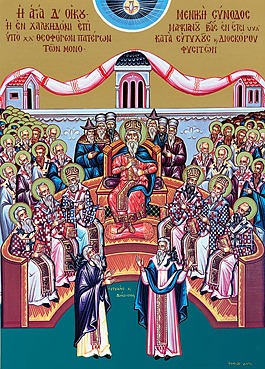
chalcedonAfter much controversy and struggle in the Church, the Council of Chalcedon (451 AD) put out a formal definition on person of Christ, regarding his full divinity, humanity, and the union of the two natures. While not exhausting the depth and beauty of the person of Christ, it lays down important boundaries within which theologians must stay if they are to properly teach the glory of the Son who took on flesh for our salvation.

Chalcedon has stood as the bulwark of orthodox-catholic Christology across traditions for a millenia and a half, and yet, while lengthy expositions of it are available, it still takes some time digging to find a good, clean summary explanation of what the Definition actually says. That’s why I was pleased to find this passage in Calvin’s comments on John 1:14, “and the Speech* (Word) became flesh, and dwelt among us”, in which he briefly and clearly expounds the scriptural truth that Chalcedon teaches:

The plain meaning therefore is, that the Speech begotten by God before all ages, and who always dwelt with the Father, was made man. On this article there are two things chiefly to be observed. The first is, that two natures were so united in one Person in Christ, that one and the same Christ is true God and true man. The second is, that the unity of person does not hinder the two natures from remaining distinct, so that his Divinity retains all that is peculiar to itself, and his humanity holds separately whatever belongs to it. And, therefore as Satan has made a variety of foolish attempts to overturn sound doctrine by heretics, he has always brought forward one or another of these two errors; either that he was the Son of God and the Son of man in so confused a manner, that neither his Divinity remained entire, nor did he wear the true nature of man; or that he was clothed with flesh, so as to be as it were double, and to have two separate persons. Thus Nestorius expressly acknowledged both natures, but imagined two Christs, one who was God, and another who was man. Eutyches, on the other hand, while he acknowledged that the one Christ is the Son of God and the Son of man, left him neither of the two natures, but imagined that they were mingled together. And in the present day, Servetus and the Anabaptists invent a Christ who is confusedly compounded of two natures, as if he were a Divine man. In words, indeed, he acknowledges that Christ is God; but if you admit his raving imaginations, the Divinity is at one time changed into human nature, and at another time, the nature of man is swallowed up by the Divinity.

The Evangelist says what is well adapted to refute both of these blasphemies. When he tells us that the Speech was made flesh, we clearly infer from this the unity of his Person; for it is impossible that he who is now a man could be any other than he who was always the true God, since it is said that God was made man. On the other hand, since he distinctly gives to the man Christ the name of the Speech, it follows that Christ, when he became man, did not cease to be what he formerly was, and that no change took place in that eternal essence of God which was clothed with flesh. In short, the Son of God began to be man in such a manner that he still continues to be that eternal Speech who had no beginning of time.

Commentary on John 1:14

The whole section is worth review as Calvin deftly comments on controversies both ancient and contemporary to his own day. Indeed, as challenges and confusions about just who Jesus is continue into our own, students and disciples of the Word would benefit from listening into the disputes of another age. While they’re framed in different ways, they are often-times structurally similar such that hearing the answer discussed in a context less immediate and personally-charged for us, can cast a clearer light for our own days.

Of course, the point of all this is not mere doctrinal correctness, but the life of doxology that follows. Christ is not properly worshipped and glorified, unless his magnificent person is properly taught and displayed according to Scripture.

Soli Deo Gloria 

*Calvin follows Erasmus in rendering the word ‘logos‘ as ‘Speech’ instead of ‘Word’. For his explanation, see his comments here.

The Word of Sauron, The Word of Tolkien, and the Word of God

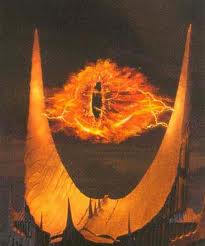
sauronA long time ago, I used to argue with people on blogs. Wait…yeah, I guess I still do. But the story I’m setting up was a long time ago. One of said blogs I argued on was that of my buddy Mike, an old youth pastor of mine who was going the way of the Bell and McLaren (pre-the really, really lame stuff). He’d post some controversial thought to ‘ask a question’ and I’d be the little gadfly college philosophy student who’d jump in and jostle with him. (Also, this was pre-Reformedish days. I would have laughed in your face if you’d have told me in 6 or 7 years I’d be quoting Calvin.)

In any case, he had raised the issue of Scripture one of those posts. Among other questions he was asking whether ‘all’ of the Bible was the Word of God, or only some of the parts, especially those where Divine Speech is specifically denoted, such as in the Prophets. Are the horrifying narrative sections, or the sections where the thoughts and emotions of the prophets, the psalmists, or the god-hating pagans with speaking parts, are speaking truly God’s Word?

In response to this, I came up with an analogy, on the fly, once again Lord of the Rings-related, to answer how I thought, at a minimum, even those sections could be considered the ‘Word of God.’ Once again, remember this is my 21-year old, still-really-piecing-it-together self:

“One way that I think about the way that the whole Bible is the Word of God, is thinking about it much like I think about The Lord of the Rings being the word of ‘Tolkien.’ It is at least all the Word of God in that he is its Divine Author. (I don’t mean to imply some kind of dictation theory of Scripture. I think its possible to have more than one author of a text at different levels. See Wolterstorff or Vanhoozer on this.) That said, not every word spoken in the text can be taken as his direct ‘word’ revealing his thoughts and desires in normative sense–certainly not those uttered by Sauron or Saruman. But, at the same time, those words are there in the text at Tolkien’s prerogative and are part of the overall “Word” that he speaks through the text and so can be taken as his Word.

In the same way, the words of the pagans in Scriptures are God’s Word in the same way that Sauron’s words are Tolkien’s word. There is a way that Tolkien can show us something about or say something about the nature of evil, through the evil words and actions of Sauron, which Tolkien himself would never do or say. In this way, the words and actions are properly Sauron’s, but they are also Tolkien’s in the context of the larger story he is authoring. In an analogous way God says things through these texts in a way that accounts for and does not reduce the multiple human voices, genres, etc, but also accomplishes his specific purposes in the world through the Text as its over-arching Author. Of course, this is an analogy and it kind of breaks down, but I think captures part of the picture.

A few years on, I’d probably massage a few phrases here and there, but in the main, I still find the analogy useful. God’s authorship of Scripture is a nuanced and layered one. That I affirm the Bible as God’s Word in its totality, does not mean I’m proposing a flat reading of the text, that fails to take into account narrative or genre dynamics. Far from it. In fact, it means I have to take care to read it even more carefully, not brushing past or carelessly dismissing any of God’s words, in order to discern just what exactly the Spirit is communicating through the inspired Word.

Soli Deo Gloria

The Cure that Killed the Patient (Or, Sorry Zahnd, Marcionism isn’t a Better Option)

tumblr_mr9zzaTmj01rj8v6zo1_400A while back John Piper put out a video that defended God’s right to judge the Canaanites by the hand of the Israelites in the conquest narratives of the OT. He said something along the lines of “God is God, he made you and doesn’t owe you jack, so if he takes your life, you really have nothing to complain about. Also, God can use whom he pleases to do so.” Roughly.

Predictably, some people got mad. I mean, I get that. It’s a tough subject and any answer is going to be kind of awkward (although, honestly, at this point Piper could say that God loves kittens and somebody would snark, “But only elect ones, right?”). Beyond just general Facebook furor when it hit, it recently provoked a frontal-assault/response from author and pastor Brian Zahnd. For those who don’t know, Zahnd has been a rising voice on the Evangelical/Post-Evangelical Left since his book “Beauty Will Save the World” came out last year. I actually read it and loved it, even if I did have some qualms about the pacifism peeking out here and there.

Well, pacifist though he may be, Zahnd came out guns blazing with accusations of voluntarism against the monstrous God of Calvinism, and, just the slightest bit of Muslim-baiting in his provocatively titled, “John Piper and Allahu Akbar.” As you might have picked up, I didn’t love this post quite as much as the book and I’ll get to why in a minute. But first, a few quick caveats.

To be clear, I don’t particularly care to defend Piper’s views here as he is a big boy who can defend himself. Nor is this is denial that the OT narratives involving the conquest and destruction of the Canaanites require some serious consideration. They do. Actually, while we’re on the subject, I’d commend Paul Copan’s work on the subject in the book “Is God a Moral Monster?” or this summary article paying attention to historical, genre, and canonical considerations here. Finally, I too am very concerned about the misuse of Scripture to promote violence.

What I do want is to look at is Zahnd’s reponse, which, to mind, left something to be desired in terms of theological honesty as well as, well, ‘soundness of teaching’? (I don’t want to say orthodoxy, given his clear, robust Nicene and Chalcedonian faith.) Yes, I’m putting on my argumentative Reformed hat again, which I do try to stay away from, but, in all fairness, Zahnd shot first.

Well, without further ado, here are a few points in no particular order.

Yeah, never taught that.

Yeah, never taught that.

Calvin’s “Ism”

Zahnd found a cute short-hand for Piper’s theology of sovereignty, or rather, that of “Calvin’s disciples”, which he dubbed “Calvin’s Ism.” He then proceeded to rail on it, lamenting the way Piper and others would go to such great lengths to defend the “Ism” to the point of creating a monstrous voluntaristic/nominalist God whose will is what it is, simply because it is, and so forth. Don’t you know that we should look at Jesus, not what Calvin thought about Jesus?! Away with such Greek-philosophy-influenced, metaphysical barbarisms!

scumbag girardIt’s typical anti-Calvinist boilerplate that fires up the troops and so forth, so I get it. As one of “Calvin’s Disciples” though, I simply wanted to stop and point out that, as a matter of historical fact, Calvin strongly repudiated the overly-voluntaristic and nominalist tradition popular in his day at the Sorbonne flowing from theological giants like Scotus and Ockham. (Incidentally, I always find it funny when guys who basically riff off of French social theorists like Rene Girard’s scapegoating theory when it comes to the Gospel, have the gall to call out “Greek philosophical categories” in more traditional theology.)

Calvin explicitly rejected a view of God’s unrestrained will, or absolute power, divorced from God’s justice or God’s goodness. While he unabashedly defends God’s complete sovereignty over human history, he simultaneously condemns “that absolute will of which the Sophists babble, by an impious and profane distinction separating his justice from his power.” (Institutes 1.17.2) That’s just one among many examples.

Again, it’s a fun phrase, and when you’re driving the punch-line home, why not pick a baddie to rip on your fanbase already doesn’t like? Calvin’s perfect for that, especially since most people haven’t actually read him much. But, in this case, Zahnd should probably find another whipping boy to pin the voluntarism charge on.

Killing is Not Always Murder

Moving more to the point, Zahnd tells us that God could never have ordered the conquest and judgment of the Canaanites in the way the narratives portray it because that would involve killing which is murder and God would never order murder.

So for some this next point might seem basic: while all murder is killing, not all killing is murder. For others, this is a basic false distinction that they rejected as un-biblical a long time ago.

I’ll just say that a prima facie reading of the Scriptures, especially the OT legal code (Exod. 21), shows that while God hates human death, the law that he handed down seemed to recognize a distinction between killing and murder. Actually, very early on in the narrative of the Torah, we find out that the reason he allows for some killing is precisely because he hates murder (Gen. 9:6). Murder is unjustifiable, but executions and judgments seemed to be accounted for and even commanded by God himself in various places in the OT law and the subsequent narrative. Of course, that raises the issue of the reliability of the OT on this point.

Which brings us to the really big issue with Zahnd’s post.

Marcionism isn’t a Better Option 

See, Zahnd says we shouldn’t let something like the Old Testament slow us down when we’re thinking about these things:

And don’t let the Old Testament work you into a corner. You don’t need to defend the Old Testament to the extent that you find it necessary to justify genocide. God forbid! We can simply say this…

The Old Testament is the inspired telling of the story of Israel coming to know their God. Along the way assumptions were made and they didn’t get everything right. Keep reading the Bible until you come to Jesus and then center your reading of all Scripture in the light of Christ.

This is a perfect example of what Andrew Wilson has called the “New Marcionism“, which, while not explicitly repudiating the OT the way Marcion did, insists on seeing such a radical discontinuity between the God we see testified to in the OT and that of the NT that it has much the same effect.

Let me unsympathetically paraphrase Zahnd for you to see the problem: “The ancient Israelites who wrote the Holy Scriptures got some stuff wrong, but we know better now that Jesus came. We know that Jesus would never order something like that, so we know that God didn’t order something like that, so just don’t trouble yourself about it. The verses are just wrong. I mean, sure, Jesus said that the Scriptures all pointed to him (John 5:39), and the law is to be perfectly fulfilled (Matt. 5), and we can assume he read those parts, but he couldn’t possibly have meant all of it. Sure we have parallels in the NT with Revelation and God raining down judgment, etc. not to mention Jesus himself casting down judgment of his own, but again, don’t let that trouble you. Nevermind the deeply pervasive theology of God the Warrior who goes before Israel in battle that informs much of the OT, and depends on some of those “mistaken assumptions”–just try and skip those bits. I mean don’t worry that this even figures into Luke’s telling of Acts as a conquest narrative. Just squint until you see it properly. God wouldn’t do anything like that. I mean, don’t bother trying understand the difference between God’s administration of covenant justice in Israel v. the Church because of Christ’s ushering in a new phase in redemptive-history. It’s not that the same God can manifest his eternally good and beautiful character in consistent, but historically-distinct ways. We have the much easier option of saying the Israelites just got it wrong. Simple as that. Don’t worry about what that does to undermine the authority of the OT and its ability to actually point to Jesus Christ. Please don’t trouble yourself with the way this sort of crypto-Marcionism might spill into the subtle anti-Semitism of viewing the Old Testament as an inherently inferior text like the old-school German Liberal scholars who made this sort of argument popular back in the early part of the 20th Century. I mean, no big deal.”

In a dispute with the Pharisees in John 10:35, Jesus tells us that the scriptures cannot be “broken.” The Greek word there is luo which can be translated “to destroy, to tear down, the break to pieces” (Louw-Nida 20:35).  Essentially, it can’t be ignored, released, explained away, or rendered null or void. Except, that’s exactly what Zahnd suggests we do with those uncomfortable bits.

On ‘Christocentric’ Readings (Or, The Cure that Killed the Patient)  

Here’s the thing, when your “Christocentric” reading of the Scriptures leads you to ignore or deny parts of Scriptures the way Christ says shouldn’t happen, you might be doing it wrong. Realize that this isn’t about whether we’re going to read the Bible in light of Jesus, but about how. Does the revelation of Jesus Christ crucified and risen shed light on and transfigure the testimony of God’s dealing with Israel, or simply deny, or downgrade its validity by cutting chunks out?

Of course, this goes to the deeper theological question who we’re going to allow God to be? Will we allow him to reveal himself as a God who, though simple in essence, is narratively-complex in his self-rendering in the history of Israel?  “The Lord, the Lord, a God merciful and gracious, slow to anger, and abounding in steadfast love and faithfulness, keeping steadfast love for thousands, forgiving iniquity and transgression and sin, but who will by no means clear the guilty, visiting the iniquity of the fathers on the children and the children’s children, to the third and the fourth generation.” (Exod. 34:6-7) Do we let Jesus be both the one who longs to shelter Jerusalem under his wings to save them, all the while forcefully proclaiming God’s impending, violent, judgment on their sins (Matt 23:29-39)? Do we allow for the full picture of Jesus to emerge, or the one we’ve shoved into our pacifistic Procrustean bed, and shave off the verses that don’t fit?

Tom needs a drink after that.

Tom needs a drink after that.

While some of us are tempted to take Zahnd’s path of essentially rejecting prior revelation as the mistaken assumptions of our spiritual fathers, Might I suggest a surer, admittedly less comfortable, course? It is a route that N.T. Wright offers up in his answer to Wilson on the issue of the New Marcionism:

“There are many many things that God does, has done or will do which are not waiting for my approval or sanction before he does them. You know that line, “Many people want to serve God, but usually only in an advisory capacity.” Bonhoeffer said that putting the knowledge of good and evil before the knowledge of God is the primary sin in Genesis 3. They go for the knowledge of good and evil rather than what God says. Now that could just be an escape; it could just be throwing up our hands and saying we don’t know anything about God (when the whole point of the gospel is that we do know who God is, because of Jesus). However, if it’s the crucified Jesus, and if the cross means what it means in the light of the whole history of Israel, which is focused onto that, then … these narratives are the way in which all of those horrible, puzzling ambiguities, and all the awful things that happen – like Jesus saying, “what about those eighteen on whom the tower of Siloam fell?” – there’s a sense that the cross gathers up all those puzzling, tragic horrible fragments of life, and says swoosh this is where it’s all going.

“I hold this within the framework I articulated this morning, which is to say: from the call of Abraham onwards, what God is committing himself to do is to act to bring about the restoration of the world, but to act through deeply flawed human beings, who constantly need to be reminded that they’re deeply flawed. That then produces all kinds of (to our mind) ambiguities. And I see all of it coming together in the cross. The cross is the moment when I see Israel’s God performing the salvific event, which is simultaneously the worst and most blasphemous act of judicial, theocidal murder than one can ever imagine. And somehow the cross itself says: these things are now reconciled.”

Of course there’s more to say, but I’ve already said too much for what’s an allegedly short blog post. (May God forgive my lies.) The end of the matter is that while Zahnd may find Piper’s alleged voluntarism to be a gross misrepresentation of Jesus by distortion, his own neo-Marcionism leaves us with a highly-abridged Bible, and therefore an abridged Jesus, which is hardly an improvement. While offering a solution to the Bible’s problematic texts, Zahnd is inadvertently administering the kind of cure that kills the patient.

Soli Deo Gloria

Vanhoozer’s 10 Theses On “Remythologizing” in Plain(er) English

remthologizingOne of the things I enjoy most about college ministry is that I’m often forced to think through whether I actually understand all the nerdy, academic theology I read. Exhibit A: Kevin Vanhoozer’s Remythologizing Theology: Divine Action, Passion, and Authorship is easily one of the top five most nerdy, theological texts I own. I’ve read it twice and constantly find myself coming back to it, even though it’s not something I’d teach a college Bible study through.

Case in point: just last week I happened to mention the text around one my college students and she immediately wanted to know what “remythologizing” was.

I mean, when someone asks you about Vanhoozer, what are you supposed to do? Ignore it?

That launched us into an hour-long discussion explaining the difference between systematic theology and biblical theology, Bultmann and demythologizing, the confluence of God, scripture, and hermeneutics that Vanhoozer calls “first theology” and so much more. (She asked very good questions.) In the middle of this crash course, I ended up talking through Vanhoozer’s “10 Theses on Remythologizing.”

Inspired by Lewis’ dictum that, if you can’t put it in common English, you probably don’t know it, I attempted to translate the theses into normal-person speak for my intelligent, but non-expert student.

Given that not many people have read this very important text yet–and it is very important text, one of the most important in the last 20 years, probably–I figured I’d attempt a command performance of the on the spot translation summary act I did for my student the other night, only in print, and maybe not as sloppy. Maybe. I’ll essentially be trying to translate Vanhoozer’s own elaborations on the theses, in plain(er), Rishmawy-language.

Ten Theses On Remythologizing
Briefly, in many ways Vanhoozer’s project is kind of a counter-point to Bultmann’s program of ‘demythologization’ that de-storifed (mythos is story) the Gospels into timeless existential truths. In contrast, Vanhoozer’s aim is to take seriously the shape and form of the story of Scripture as God’s own communication to us of Who he is, while also avoiding Feuerbach’s notion that all god-talk is simply human projections of our best attributes onto the screen of eternity. So Vanhoozer puts forward his own program of “remythologizing” that he initially summarizes in these ten theses.

One key term to know is “theodrama”, which simply smashes “theos” and “drama” together in order to speak of the divine actions in redemptive history (God doing stuff in the story of the Bible). When Vanhoozer says, “theodramatic”, it basically means “having to do with God doing and saying stuff in the Bible.”

The italicized quotations are his, and again, the rest is my attempt at translation:

1. “Remythologizing is not a “fall back into myth” but a spring forward into metaphysics.” (27) This is not about mythologizing the text, taking us back to all-too-human gods of myth, but taking seriously the mythos, the plotof the biblical storyline to see what it reveals to us about the nature of God and the world. What must the God who acts in this story be like in order to do and say the kinds of things we see in the biblical narrative. To do that, we have to pay attention to the narrative very closely.

2. “Remythologizing means recovering the “who” of biblical discourse.” (28) At its heart, remythologizing is a project focused on the main character of the drama, God, who presents himself to us in the Scriptures through Word and Spirit. What attributes and characteristics does this God show himself to have in light of what he says about himself?

3. “Remythologizing means attending to the triune “who” of communicative action.” (28) Remythologizing is necessarily trinitarian theology because the one doing the saying in the narrative is Father, Son, and Holy Spirit (or, Father, Word, & Breath). That will shape the way we understand God’s self-communication.

4. “Remythologizing conceives the God–world relation in primarily communicative rather than causal terms.” (28) Instead of more classical categories like ‘causality’, which has some more physicalist connotations, Vanhoozer wants to rethink God’s relation to the world on the analogy of communication. The God of Scripture is a speaking God who brings us the world into being through speech and saves it through his Word. That should shape the way we conceive things.

5. “Remythologizing means rethinking metaphysics, epistemology, and ethics alike in theodramatic terms.” (29)  Instead of trying to shove the story of the Gospel into some pre-made grid like modern science, history, or secular metaphysics, Vanhoozer wants us to do things the other way around. Instead, the story of the Gospel is the criterion by which we judge all else. In fact, it generates its own metaphysical categories around God’s communication made flesh, Jesus Christ.

6. “Remythologizing means faith seeking, and demonstrating, theodramatic understanding through fitting participation in the triune communicative action.” (29) Theology is not a neutral affair. To understand God’s actions in Christ truly, there is an active element. I must be trying to situate myself within the story appropriately for this work to be properly undertaken. (This was a tough one.)

7. “Remythologizing means taking Christ, together with the Spirit-breathed canon that the living Word commissions, as the chief means of God’s self-presentation and communication.” (29) “Long ago, at many times and in many ways, God spoke to our fathers by the prophets, but in these last days he has spoken to us by his Son” ( Heb. 1:1–2). Remythologizing pays attention both to the grand story of Scripture and the Incarnation at the center, as well as the various genres, modes, and methods God has used within it to communicate himself to us. In fact, the Scriptures not only report God’s communication, but are, in fact, part of the action.

8. “Remythologizing is a form of biblical reasoning, a matter of thinking about the subject matter along the various forms of biblical discourse that present it.” (29) It’s not a matter of thinking or reading the Bible, but thoughtfully paying attention to the way the Bible teaches us to think. For instance, paying attention to the particular way a metaphor is used to communicate truth as opposed to a straightforward syllogism.

9. “Remythologizing means attending to biblical polyphony and recognizing the dialogical nature of theodramatic testimony and theological truth.” (30) God isn’t a boring communicator and the subject matter is too grand to be captured in simple fashion. Vanhoozer’s project is about paying attention to all the different ways and means, as well as angles (history, eschatology, ontology) and perspectives (divine, human, powers) from which the truth is communicated in order to “do justice” to the diverse voices in Scripture. Remythologizing shouldn’t result in flat theology.

10. “In sum, remythologizing is best defined in contrast to demythologizing as a type of first theology.” (30) First theology is how your doctrine of God, Scripture, and hermeneutics all play into one another. Remythologizing is Vanhoozer’s proposal for how that all should go together in light of the triune God’s communicating activity in the theodrama of Scripture.

Of course, Vanhoozer does much more than just put forward a methodology in this work. He shows you what he means by all of this in the process of doing some real theology involving close reading of texts, addressing issues in the doctrine of God in like the Creator/creature relationship as well as God’s impassibility, developing a doctrine of the Trinity along the lines of communicative categories, and bridging the gap between Thomism and Barthianism.  Among other things.

The long and the short of it, though, is that remythologizing is a renewed program of thinking about God on the basis of what God has said and done in Jesus Christ and the Scriptures in the power of the Spirit. In many ways, it’s simply a retooling, a new articulation of a very old approach. Of course, as Pascal says, “Let no one say I have said nothing new; the arrangement of the material is new. In playing tennis both players play the same ball, but one plays it better.”

Vanhoozer plays the ball quite well in our postmodern context and theologians of all stripes would do well to learn from this master theological re-arranger.

Soli Deo Gloria