“Swimming the Tiber” is a euphemism for Roman Catholic conversion, as it is the river identified with the Vatican.
Q. What is your only comfort in life and in death?
A. That I am not my own,but belong—body and soul, in life and in death— to my faithful Savior, Jesus Christ. He has fully paid for all my sins with his precious blood, and has set me free from the tyranny of the devil. He also watches over me in such a way that not a hair can fall from my head without the will of my Father in heaven; in fact, all things must work together for my salvation. Because I belong to him, Christ, by his Holy Spirit, assures me of eternal life and makes me wholeheartedly willing and ready from now on to live for him.
Heidelberg Catechism Question and Answer 1
Commenting on the pastoral nature of the creeds and catechisms, Carl Trueman highlights a couple of the questions and answers in the Heidelberg Catechism, especially the way Q&A 1 highlights the heart of the Reformation:
Question 1 shows the glorious Reformation Protestant insight into the fact that assurance is to be the normal experience of every Christian believer and not merely the preserve of a few special saints who have been given extra-ordinary insight into their status before God, as was the medieval Catholic position.
This is perhaps one of the great Protestant insights of the Reformation. We live in an age where conversion to Roman Catholicism is not an uncommon thing among those who have been brought up as evangelicals. There are many reasons for this: some speak of being attracted by the beauty of the liturgy in comparison with what is often seen as a casual and irreverent flippancy in evangelical services; others like the idea of historical continuity, of knowing where the church has been throughout history; still others find the authority structure to be attractive in an age of flux and uncertainty. Whatever the reasons, most Protestants would concede that Rome has certain attractions. Nevertheless, the one thing that every Protestant who converts to Rome loses is the assurance of faith. –The Creedal Imperative, pg. 124
Lest people think Trueman is exaggerating, it must be remembered that Cardinal Bellarmine is reported to have written that assurance is the greatest of all Protestant heresies. Indeed, discussing the subject of assurance with one of my brilliant Catholic professors was one of the most challenging conversations I had in my undergaduate degree. She asked me repeatedly–not threateningly, but forcefully, the way a good philosopher should–how could I be so sure that I was going to be saved? It seemed so arrogant and, well, assured. I’m not sure I gave her the best answer I could have at the time–I mean, I was 20. Ironically though, I realized I was more assured of her salvation than she was.
Trueman continues:
The insight of the Reformation on assurance was key, theologically and pastorally. And, given that it is one thing that every convert to Roman Catholicism must lose, it’s worth noting its priority in the Heidelberg Catechism. The answer is beautifully phrased; and yet if one ceases to be a Protestant, one must cease to claim HC 1 as one’s own. That is a very high price to pay. Speaking for myself, all of the liturgical beauty of Rome, all of the tradition, all of the clarity of the authority structure (and the clarity is often, I think, more in the eye of the beholder than the Church itself) cannot compensate for the loss of the knowledge that I know I have been purchased by the precious blood of Christ that conversion to Rome requires. –Ibid, pg. 125
To be clear, I am not saying that my Roman Catholic brothers and sisters are not saved, or are not actually united to Christ, or can’t experience the Spirit’s wonderful assurance; I know far too many beautifully Catholic people, including my professor, to make that mistake. I am pointing out that formally-speaking, I couldn’t claim it in the sense that the catechism teaches it.
That’s far too precious a thing for me to risk in those waters.
For every high priest chosen from among men is appointed to act on behalf of men in relation to God, to offer gifts and sacrifices for sins. He can deal gently with the ignorant and wayward, since he himself is beset with weakness. Because of this he is obligated to offer sacrifice for his own sins just as he does for those of the people. And no one takes this honor for himself, but only when called by God, just as Aaron was. (Hebrews 5:1-4)
Reading through Hebrews this morning I was struck by this passage addressing the work of Christ, our great High priest whose ministry supersedes and fulfills that of the OT Levitical priests. In order to do so he outlines various functions of the OT priests in order to compare and contrast the two. I consulted Calvin, as I’ve been wont to do of late, to see what light he could shed on the matter.
Careful reader that he is, Calvin notes at least 5 truths about priests to be noted in the passage:
He first says that the priests were taken from among men;
secondly, that they did not act a private part but for the whole people;
thirdly, that they were not to come empty to appease God, but furnished with sacrifices;
fourthly, that they were not to be exempt from human infirmities, that they might more readily succor the distressed;
and lastly, that they were not presumptuously to rush into this office, and that then only was the honor legitimate when they were chosen and approved by God.
Building on these observations, he goes on to point out 5 truths this passage teaches us about Christ’s priestly ministry on our behalf:
Christ is a True Man“Taken from among men, etc. This he says of the priests. It hence follows that it was necessary for Christ to be a real man; for as we are very far from God, we stand in a manner before him in the person of our priest, which could not be, were he not one of us. Hence, that the Son of God has a nature in common with us, does not diminish his dignity, but commends it the more to us; for he is fitted to reconcile us to God, because he is man..”
Christ is a Man for Others “For men, etc…the priest was not privately a minister for himself, but was appointed for the common good of the people. But it is of great consequence to notice this, so that we may know that the salvation of us all is connected with and revolves on the priesthood of Christ. The benefit is expressed in these words, ordains those things which pertain to God…what the Apostle had in view is the same, namely, that we have no intercourse with God, except there be a priest; for, as we are unholy, what have we to do with holy things? We are in a word alienated from God and his service until a priest interposes and undertakes our cause.”
Christ is a Man for Others Offering Gifts “That he may offer both gifts, etc. The third thing he mentions respecting a priest is the offering of gifts. There are however here two things, gifts and sacrifices; the first word includes, as I think, various kinds of sacrifices, and is therefore a general term; but the second denotes especially the sacrifices of expiation. Still the meaning is, that the priest without a sacrifice is no peacemaker between God and man, for without a sacrifice sins are not atoned for, nor is the wrath of God pacified. Hence, whenever reconciliation between God and man takes place, this pledge must ever necessarily precede. Thus we see that angels are by no means capable of obtaining for us God’s favor, because they have no sacrifice. The same must be thought of Prophets and Apostles. Christ alone then is he, who having taken away sins by his own sacrifice, can reconcile God to us.”
Christ, Though Free from Sin, is a Man who Can Sympathize “Who can, etc….the Apostle before taught us that mankind are united to God in the person of one man…but now he refers to another thing…that the priest ought to be kind and gentle to sinners, because he partakes of their infirmities. The word…simply means one capable of sympathy. All the things which are here said of the Levitical priests do not indeed apply to Christ; for Christ we know was exempt from every contagion of sin; he therefore differed from others in this respect, that he had no necessity of offering a sacrifice for himself. But it is enough for us to know that he bare our infirmities, though free from sin and undefiled. Then, as to the ancient and Levitical priests, the Apostle says, that they were subject to human infirmity, and that they made atonement also for their own sins, that they might not only be kind to others when gone astray, but also condole or sympathize with them…At the same time, though ever free from sin, yet that experience of infirmities before described is alone abundantly sufficient to incline him to help us, to make him merciful and ready to pardon, to render him solicitous for us in our miseries. The sum of what is said is, that Christ is a brother to us, not only on account of unity as to flesh and nature, but also by becoming a partaker of our infirmities, so that he is led, and as it were formed, to show forbearance and kindness…
Christ is a Man by the Call of God – And no man, etc. There is to be noticed in this verse partly a likeness and partly a difference. What makes an office lawful is the call of God; so that no one can rightly and orderly perform it without being made fit for it by God. Christ and Aaron had this in common, that God called them both; but they differed in this, that Christ succeeded by a new and different way and was made a perpetual priest. It is hence evident that Aaron’s priesthood was temporary, for it was to cease. We see the object of the Apostle; it was to defend the right of Christ’s priesthood; and he did this by showing that God was its author…Christ then is a lawful priest, for he was appointed by God’s authority…”
ibid, Commentary 5:1-4
According to Hebrews then, this is the Christ who is our Priest. He is the truly human one; the one who comes for us, not for himself alone; the one who has offered up a sacrifice for us; the one sympathizes with us in our weaknesses and infirmities; the one who comes by the call of God the Father, in the power of the Spirit. This Christ is indeed worthy of all our praise and worship.
Difficult translation sections are included in the ordination exams of various denominations. Candidates are required to show their proficiency in both Greek and Hebrew, in order to demonstrate their competence in handling the texts they are to preach from the Word of God.
C.S. Lewis thought translation sections were a good idea, but recommended a different sort:
In both countries an essential part of the ordination exam ought to be a passage from some recognized theological work set for translation into vulgar English–just like doing Latin prose. Failure on this paper should mean failure on the whole exam. It is absolutely disgraceful that we expect missionaries to the Bantus to learn Bantu but never ask whether our missionaries to the Americans or English can speak American or English. Any fool can write learned language. The vernacular is the real test. If you can’t turn your faith into it, then either you don’t understand it or you don’t believe it.
— C.S. Lewis, ‘Version Vernacular’, The Christian Century vol. LXXV (31 December 1958) pg. 1515, reprinted in God in the Dock, pg. 338
Nearly 60 years ago, before all the talk about contextualization was hip, and Lesslie Newbigin taught everyone that Western Culture was a mission-field too, Lewis was advocating for training in basic cultural literacy on the part of pastors and preachers. He saw the need to learn how to speak “American” and “English”.
This is one of the two or three keys to understanding his appeal and genius: Lewis was a brilliant translator. It’s only years (and a number of heavy theological treatments of the subject) after reading Lewis’ treatment of the Trinity at the end of Mere Christianity that I can appreciate its disguised brilliance. It’s plainly-stated Athanasian and Nicene orthodoxy for beginners. As an absolute statement, it might be bit of a stretch to say that if it can’t be put in the vernacular, it probably isn’t understood or believed (cf. certain finer points of trinitarian doctrine such as the filioque, etc.). Still, as a general test for how well you actually grasp most of your professed theology, I’ve found it quite helpful. Teaching basic catechetical courses to youth or new believers is often a more challenging proposition than writing a paper for grad-level seminary courses.
Theologically-minded Protestants especially need to take heed of this. It’s fine to celebrate Luther, Calvin, Tyndale and the rest of the Reformers for giving the Bible back to the congregation through their vernacular Bible translations and worship. We need to be careful we don’t take it away from them again in rarified preaching filled with abstract, unexplained theological jargon. I have no problem with doctrinal preaching or using big words like ‘justification’ or even ‘perichoresis.’ They are good and fine and necessary. We just need to be careful we regularly use a lot of little words to explain them for those folks without seminary training. To insist that our hearers always come up, unaided, to your theological level is “shameful”, and an implicit denial of the Gospel of a Word who comes among us by taking on our flesh–1st Century Jewish flesh, to be exact.
Pastors, as you prepare to teach and preach to your people, work on your Greek, brush up on your Hebrew, but please, please, for the sake of the Gospel and your people, make it a priority to practice your ‘American.’
So, I wrote a piece a while back on the way looking at our lives in the narrative key shapes the way we understand our moral situation. After some tuning up and heavy editing, Matthew Lee Anderson was kind enough to give me the honor of publishing it over at Mere Orthodoxy. You can read it HERE.
Alasdair MacIntyre is widely credited with restoring the category of ‘story’ or ‘narrative’ to the forefront of the discussion in meta-ethics. In his influential work After Virtue (1981)he set out his argument for the bankruptcy of most modern ethical theories such as utilarianism and Rawlsian contractarianism and the necessity of recovering an Aristotelian-Thomistic virtue-ethics set within a narrative framework. Among other things, MacIntyre argues that the virtues, those moral practices and habits that characterize the just person, only make sense within a narrative framework because all human action is essentially historical in character–it is historically-enacted and historically-motivated. That is an inescapable feature of human life–whether pagan, post-Enlightenment liberal, or orthodox Christian, we live out of the stories and narratives we tell ourselves. Even the most postmodern among us, suspicious of the various master narratives told to us by modernity, are still living in the sort of story that includes moderns trying to control us through master narratives. Indeed, it is commonly suggested that instead of the idea of the “worldview”, a narrative-identity is a more useful conception for understanding the comprehensive perspective through which we approach moral action in the world.
Now, none of this is all that new. Why bring it up? Simply to introduce a few loosely connected quotes and notes on the importance of narrative for Christian reflection on the moral life that ought to be kept in mind. One is cautionary, the other couple are complementary and, after thinking on them, can be classified under the rubric of Creation, Sin, and Redemption.
1. The Story is About Something (Creation) – First the caution. Oliver O’Donovan in his Resurrection and the Moral Order alerts us against the sort of historicisms which take this emphasis on narrative and history to the point of forgetting that the story is about something. In essence, the denial of the category of ‘nature’ or creation as a relevant one for moral reflection:
We cannot object to the idea that history should be taken seriously. A Christian response to historicism will wish to make precisely the opposite point: when history is made the categorical matrix for all meaning and value, it cannot be then taken seriously as history. A story has to be a story about something; but when everything is a story there is nothing for the story to be about. The subject of a story must be something or someone of intrinsic value and worth; if it is not, the story loses all its interest and importance as a story. The story of what has happened in God’s good providence to the good world which God made is ‘history’ in the fullest sense. But when that world is itself dissolved into history…then history is left without a subject, so that we have no history any more, but only…’process’. And then again, the story of the world as Christians have told it has its turning-point in the saving act of God in Jesus Christ. Through that crisis it is uniquely determined towards its end. But when every determination to every end is understood equally as a determination to the end of history, the critical moment of the story is lost, the turning-point forgotten.
-Oliver O’Donovan, Resurrection and the Moral Order: An Outline for Evangelical Ethics, pg. 60
O’Donovan is getting at the point that creation, as a whole and in human natures as created, is the necessary pre-requisite for history as the stage of moral action–it is the set-up. Unless the human being is a certain sort of thing before the action, and the world is a certain kind of place, the things that happen within it lose their meaning. Without creation as the “theater of God’s glory”, to use Calvin’s phrase, there can be no drama of redemption.
2. You Are Not the Only, or Main, Author/Character (Sin) – Although it wasn’t likely his intention, a quote from MacIntyre himself sheds some light on the nature of sin:
I spoke earlier of the agent as not only an actor, but an author. Now I must emphasize that what the agent is able to do and say intelligibly as an actor is deeply affected by the fact that we are never more (and sometimes less) that the co-authors of our own narratives. Only in fantasy do we live what story we please. In life, as both Aristotle and Engels noted, we are always under certain constraints. We enter upon a stage which we did not design and we find ourselves as part of an action that was not of our making. Each of us being a main character in his own drama plays subordinate parts in the dramas of others and each drama constrains the others. In my drama, perhaps, I am Hamlet or Iago or at least the swineherd who may yet become a prince, but to you I am only A Gentleman or at best Second Murderer, while you are my Polonius or my Gravedigger, but your own hero. Each of our dramas exerts constraints on each others’s making the whole different from the parts, but still dramatic.
Alasdair MacIntyre, After Virtue 2nd Ed., pg. 213
In drawing attention to the narrative shape of our lives, there comes the realization that, in some sense, we are not just agents but authors. In a theological context this comes with a serious qualification, though–given the doctrine of creatio ex nihilo and God’s sustaining providence we are sub-authors at best. MacIntyre reinforces the point by calling our attention to the fact that at the merely human level my authorship is not total or complete. I am a sort of Mad-libber who inserts my responses at key points in the story that already has particular parameters beyond my control. This begins to expose the narcissistic madness we engage in when we claim credit for the blessings in our lives. Most of the good that comes our way is not in any way attributable to our own wonderful moral character, at least not by comparison to others. The fact that you’re reading this blog on a computer right now has more to do with the fact that you were born into a society in which computers are easily-accessed and not in the 5th Century China, than your own stellar work ethic. The resulting story of my life is, yes, something I’m responsible for, but at the same time, not something I can claim credit for. Paul asks, “What do you have which you did not receive?” (1 Cor 4:7) And yet, that’s precisely what sin is: claiming credit for someone else’s work. It is our willfully blind, ungrateful denial of the Author of our existence, who determines the times and the places in which we will play our parts in his story. (Acts 17:26)
MacIntyre also begins to show us the way this false sense of authorship leads to conflict with our neighbors. At the end of the day, in our arrogance and pride we are convinced that we are both the author and the main character in the epic which everybody else plays a bit part or supporting role. Most conflict comes when you find out that the story doesn’t revolve around you, or when you clash with your neighbor because he’s trying to accomplish his own heroic ends at your expense, and not playing the bit role you’ve assigned him. What else should we expect when two sinners, who’ve rejected any acknowledgment of the true Author or story-line, begin to encounter the “constraints” imposed by the dramas of others?
3. The Power is in the Story (Redemption) – This one is for preachers and pastors. Nearly 60 years before MacIntyre wrote After Virtue, J. Gresham Machen was criticizing the Liberals of his day, among other things, for misunderstanding the nature of Christian moral exhortation. In denying or radically reducing the basic outlines of the gospel narrative into generalized moral principles, “a life”, they robbed it of its power to result in real moral change:
From the beginning Christianity was certainly a life. But how was the life produced? It might conceivably have been produced by exhortation. That method had often been tried in the ancient world; in the Hellenistic age there were many wandering preachers who told men how they ought to live. But such exhortation proved to be powerless. Although the ideals of the Cynic and Stoic preachers were high, these preachers never succeeded in transforming society. The strange thing about Christianity was that it adopted an entirely different method. It transformed the lives of men not by appealing to the human will, but by telling a story; not by exhortation, but by the narration of an event. It is no wonder that such a method seemed strange. Could anything be more impractical than the attempt to influence conduct by rehearsing events concerning the death of a religious teacher? That is what Paul called “the foolishness of the message.” It seemed foolish to the ancient world, and it seems foolish to liberal preachers today. But the strange thing is that it works. The effects of it appear even in this world. Where the most eloquent exhortation fails, the simple story of an event succeeds; the lives of men are transformed by a piece of news.
– J. Gresham Machen, Christianity and Liberalism, pg 42
The Christian call to repentance is not simply a challenge to live differently or adopt some new moral principles. It is fundamentally a call to embrace the drama of redemption that God has authored in Christ as a new story to live by–and that only happens as the Holy Spirit enlightens our hearts through the preaching of the Gospel. Preaching aimed at real transformation can never degenerate into mere moral exhortation because at the end of the day, the power is in the story.
For a long time now Paul’s discourse at the Areopageus in Acts 17:16-31 has been a favorite text of mine. As a philosophy student in college I loved the picture of Paul debating with the philosophers of his day, quoting their poets and philosophers, and engaging the best of their thought in order to clear the way for the proclamation of the Gospel. I’ve long seen it as a model for understanding how to properly contextualize and challenge the thought of the culture while at the same time maintaining a faithful witness to Christ.
It wasn’t until a couple of years ago that I found out about a certain line of interpretation, particularly in some hyper-Reformed circles, that sees this whole engagement as a failure. The idea is that Paul here, instead of engaging in some straightforward Gospel-preaching like he does in other places, makes the mistake of trying to make the Gospel presentable to the philosophers, ends up getting laughed out of court, and from there on resolves to “know nothing but Christ and him crucified.” (1 Cor 2:1-5) Silly Paul, philosophy is for pagans!
Now I’ve always thought this was a forced interpretation. Then again, what do I know? D.A. Carson on the other hand, well, he’s got an actual case for it:
There are good reasons for rejecting this false reading:
This is not a natural reading of Acts. As you work your way through that book, you do not stumble upon some flag or other that warns you that at this Paul goofs. This false interpretation is achieved by putting together an unnatural reading of Acts with a false reading of 1 Corinthians 2.
The theology of the Areopagus address is in fact very much in line with the theology of Paul expressed in Romans.
The Greek text at the end of Acts 17 does not say that “a few men” believed, as if this were a dismissive or condemning assessment, but that “certain people” believed. This expression is in line with other summaries in Acts.
In Athens Paul had already been preaching not only in the synagogue to biblically literate folk, but to people in the marketplace who were biblically illiterate (Acts 17:17). What he had been preaching was “the good news” (Acts 17:18), the Gospel.
Transparently Paul was cut off in Acts 17 before he was finished. He had set up the framework in which alone the Gospel is coherent: one transcendent God, sovereign, providential, personal; creation; fall into idolatry; the flow of redemptive history; final judgment. He was moving into Jesus’ resurrection, and more, when he was interrupted.
Paul was not a rookie. He had been through twenty years of tough ministry (read 2 Cor. 11), much of it before pagan biblical illiterates. To suppose that on this occasion he panicked and trimmed the Gospel is ridiculous.
Acts 17 shows that Paul thinks “worldviewishly.” Even after 1 Corinthians 2 Paul still thinks worldviewishly: 2 Corinthians 10:5 finds him still striving to bring “every thought” into submission to Christ–and the context shows this refers not to simply isolated thoughts but to entire worldviews.
1 Corinthians 2:1-5 does not cast Paul’s resolution to preach nothing but the cross against the background of Athens (as if he were confessing he had failed there, but against the background of Corinth, which loved eloquence and rhetoric above substance. The apostle does not succumb to mere oratory: he resolves to stick with “Jesus Christ and him crucified.”
-D.A. Carson, For the Love of God Vol. 2, February 15
Kids, the moral of the story is that Paul isn’t confessing a ministry flub in 1 Corinthians 2, and repenting of his foolish decision to engage with the philosophers in a contextually-specific way. So if you’ve ever thought that it helps to know and be able to discuss the actual thought-processes of your neighbors and peers in order to present the Gospel to them effectively, don’t worry, so did Paul.
Historical myopia is a perennial danger to Church, especially in the area of theology. Every generation has its own particular, culturally-conditioned ways of talking about the Gospel, even when it works from the same biblical texts and recites the same creeds. In our own sin and shortsightedness, we have themes we love to highlight and those topics we’d rather not bring up in polite company. This is why every once in a while it’s good to stop, expand our vision, and listen to Christians of other generations expound or summarize the faith, especially the giants, those respected teachers known for speaking well for the Church as a whole.
On that note, here’s St. Irenaeus, the first great church theologian of the post-Apostolic period, laying out the Church’s faith in contrast to the convoluted Valentinian Gnostic system:
The Church, though dispersed through our the whole world, even to the ends of the earth, has received from the apostles and their disciples this faith: [She believes] in one God, the Father Almighty, Maker of heaven, and earth, and the sea, and all things that are in them; and in one Christ Jesus, the Son of God, who became incarnate for our salvation; and in the Holy Spirit, who proclaimed through the prophets the dispensations of God, and the advents, and the birth from a virgin, and the passion, and the resurrection from the dead, and the ascension into heaven in the flesh of the beloved Christ Jesus, our Lord, and His [future] manifestation from heaven in the glory of the Father “to gather all things in one,” and to raise up anew all flesh of the whole human race, in order that to Christ Jesus, our Lord, and God, and Saviour, and King, according to the will of the invisible Father, “every knee should bow, of things in heaven, and things in earth, and things under the earth, and that every tongue should confess” to Him, and that He should execute just judgment towards all; that He may send “spiritual wickednesses,” and the angels who transgressed and became apostates, together with the ungodly, and unrighteous, and wicked, and profane among men, into everlasting fire; but may, in the exercise of His grace, confer immortality on the righteous, and holy, and those who have kept His commandments, and have persevered in His love, some from the beginning [of their Christian course], and others from [the date of] their repentance, and may surround them with everlasting glory. -St. Irenaeus of Lyons, Against Heresies, 1.10.1
A couple of years ago Rob Bell wrote a little book about Heaven, Hell, and all that God stuff. You might have heard of it. If you haven’t, don’t worry about it–he didn’t say anything new. (Or necessarily very good. I’ll be honest, even though I was a Bell fan in college, I was pretty disappointed with that last one.) In any case, it kicked off a little bit of a crap-storm in the Evangelical world. Well, actually, it was the online theological storm of the century. There were pre-emptive tweets by Evangelical megastars, negative reviews, glowing recommendations, counter-reviews, charges of heresy, charges of heresy-hunting, gangs roaming the internet with clubs watching for signs of dissent or support, refugee camps, and basically all that is unholy in the blogosphere.
At the same time, some good conversations and decent theology got out too.
Now, thankfully this all went down before I had a blog up and running. Given the amount of Facebook conversations I was involved in during that whole imbroglio, I praise God that in his providence that he spared me from my own immaturity. It seems though, that Rob Bell has written another book. It’s about God, or at least, What We Talk About When We Talk About God. Well, here’s the trailer:
Before I read it, or anybody else reads it, or writes a review, or tweets some 140-character gem and the whole blogging world explodes with outrage and applause, I have a few thoughts to offer up to the online world, both within my own Reformedish tribe, as well as those outside it:
1. Calm Down – First things first–calm down. Whoever you are, turn it down a notch. If you’re a Bell fan, slow your roll. No, he’s not going to unveil the secrets of the universe. It’s not revolutionary or visionary. He’s probably just written down something somebody else has written in a printed blog format
with
oddly-spaced lines that
emphasize some
point
that you’ve never heard of because you’re not reading
academically-hip
theological literature
like he
does.
If you’re a Bell critic, especially if you’re Reformed, calm down. Realize that if you really believe the confessions, none of what he writes means God isn’t actually sovereign, won’t take care of his church, or that the whole church will drift into heresy and death because of it. Yes, given the last book, you will probably not like a lot of this one. Yes, many people will read it and agree to propositions about and perceptions of God you find to be unworthy and un-scriptural. Yes, you might have plenty of correcting to do. But once again, this has been the situation of the Church for the last 2,000 years. It will survive one book.
In fact, just take a minute to recover by reading Romans 9 or some of the Institutes. There. Feel better?
Okay, let’s move on.
2. Read First, Shoot Later (Or, Don’t Shoot, Pray Before You Write) – This one’s mostly for critics–read the book before you say anything super-critical about it. Seriously. It doesn’t help to declaim something as full of heresy and beyond the pale if you’ve never read the dang thing. Also, when you do read it, do it with the spirit of generosity, trying your best to love your neighbor as yourself, reading as sympathetically as you’d like to be read. Don’t caricature or misquote, or uncharitably misrepresent. You might still find a whole bunch of stuff you don’t like–stuff that troubles and disturbs you so that you feel the need to correct in print. That’s fine. I believe firmly that any publicly-promulgated doctrine or false teaching needs to be corrected publicly for the health and life the church. Jesus and the apostles hated heresy, so if there is any, by all means, declaim away. That said, remember that it needs to be done in a spirit of love and with the integrity that flows from the Gospel. Our polemics may be passionate, but they should always be principled and never be putrid. Truth cannot be championed by dishonesty, and especially if you’re a pastor, remember that you’re setting an example for your hearer/readers. The way you react often sets the tone for your people, as well as the watching world. As the old hymn goes, they will know us by our love. Love doesn’t exclude disagreement and confrontation, but it should change the way it goes down. Pray before you hit ‘publish’ on that blog.
3. Try to Understand the Other Team – I hate to call them teams, but yes, in issues like this, realistically the theological spectrum ends up splitting into opposing teams who drive the conversation, with some people trying to occupy the center but usually leaning one way more than the other. I’ll just say that both sides need to strive to understand the other’s concerns. For instance, if you read Love Wins and you didn’t for an instant sympathize with the criticisms that Bell was launching against some traditional doctrines, I’m just going hazard a guess that you’re probably not an effective evangelist, because he was hitting at legitimate (or at least common) theological and cultural concerns. I’m not saying he gave the right answers, but if you can’t understand why those answers resonated with so many in our culture, then you’re not going to be able to thoughtfully and compassionately provide the answers you deem to be the biblical ones with any kind of charity or grace to those without as clear of a theological vision as you. At the other end of things, if you were a Bell fan and you absolutely loved the book, and were unable to see the criticisms as anything more than insecure heresy-hunting conducted by narrow-minded gate-keepers, then I’d hazard a guess that you might be suffering from a sort of reverse-theological boundary keeping, which immediately privileges anything deemed to be “unorthodox” by the Evangelical majority. If you can’t see why more thoughtful, sensitive believers of a more “conservative” bent might have felt attacked or caricatured in that book, you probably won’t be someone who can graciously and thoughtfully correct them on what you deem to be their theological deficiencies.
4. Criticism Is Not Inherently Narrow-minded Oppression – Expanding on that last point, realize that we wouldn’t have half of the New Testament if the apostles like Paul, John, or Peter weren’t passionate about correcting errors both in doctrine and practice. Colossians is an attack on syncretistic theology of a Jewish-Hellenistic sort that threatened to lead the Colossian believers back into a beggarly superstition, trusting in various intermediaries instead of the supremacy of Christ. Galatians combats the Judaizing failure to recognize the eschatological shift in redemptive-history brought about by Jesus’ life, death, and resurrection due to nationalistic self-righteousness, which threatened to split the community between Gentiles and Jews. John combats love-denying proto-Gnosticism that, again, tears at community. The list could easily go on. The NT authors pursued public false teaching with passion because they knew that there was a real link-up between sound doctrine and a life-giving love of God in their flocks. The point is, Bell fans need to realize that when he writes a book publicly expounding a theological position that sets itself in direct, or even tacit, opposition to a large portion of the theological populace, criticizing and writing it off, it is not unreasonable to expect some push-back–not because his theology is necessarily heretical. It might not be. But even if it is merely perceived as such, understand that it might be very real, pastoral concern that drives the criticism, not personal animosity or jealousy. Because he’s a teacher, even if he’s just “asking questions”, (there’s a way of “asking questions” that’s really answering them), every public word is held to account. (James 3) My point is, not every criticism is narrow-minded oppression of theological diversity, but might be real pastoral accountability being exercised, even if you think it’s mistaken.
5. Cling to What is Good, Hate What is Evil – Depending on which translation you use, Romans 12:9 might place the “hate what is evil” or the “cling to what is good” first. In this case, as a word to the initially apprehensive, I would say go in with an attitude that seeks to learn or discern whatever good you can from the book before you find the less-than-good. Of course, be like the Bereans and test everything against the scriptures. (Acts 17:11) If you find something in there that doesn’t line up, reject it. That’s a given. Still, it bears repeating that before you go hunting for everything that’s wrong with it, try to find the good you can affirm on the basis of God’s self-revelation in Christ and the scriptures. If for no other reason than to be able to have a fruitful conversation with someone who actually enjoyed the book, you need to be able to affirm the good before you move to critique the bad.
I don’t expect that this is the only thing I’ll say on the whole issue. I might even write one of those critical or, I wish, glowing reviews. (I’d love to love this book.) But for now, before I’ve read a single word, here’s what I’ve got to say. I pray it blesses God’s church, bringing more light than heat.
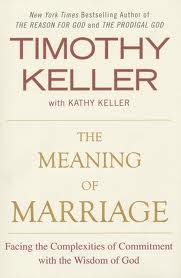
Seriously, I cannot recommend this book enough whether you’re single, dating, married, newly-married, divorced, or an infant. Read it.
I ended the last post asking “What does love have to be if it’s something I can promise?” How is it different than the poetic love that Kierkegaard is speaking of? In this post I’ll lay out three differences between poetic and covenantal love, largely drawn from Keller’s The Meaning of Marriage.
1. More Action than Emotion – If poetic love is primarily an affair of the emotions that just sweeps you up in a passion, covenantal love is primarily an action. Paul assumes this when commands husbands to love their wives. (Eph 5:25) You can’t command feelings, but you can command activities. Saying “I love you” or “I do” with a covenantal love in view, is committing yourself to “BE” and “DO” certain things for a person. It is a decision to sacrificially commit yourself fully and wholly in loyalty to another person, putting their welfare, joy, and life above your own. When I promised to love my wife, I didn’t promise “I will always feel warm fuzzies towards you.” I promised, “I will be a husband to you–I will care, pray, show affection, be there when you need me, support you, cling to you, and will your good.”
Now, of course it does involve emotion, but often-times what I find is that these emotions can actually flow from the actions. For example, it might be a date night with my wife bit I’m tired and just want to stay home and watch TV to decompress after a long week. Making the decision to go through the trouble of getting ready, getting dressed, shaving (my neck–because neck beards are unnacceptable), and getting in the car when I don’t really feel like it, surprisingly can lead towards actually feeling like it. The loving action stirs up my loving emotion so by the time we’re on the road, I’m actually excited for the night out with my wife. That’s a microcosm of what can happen in marriage as a whole, when the decision to act in loving ways is made independent of a current emotional basis, the emotion often follows.
2. Other-centered not Self-centered – The next difference is what love is centered on. Aside from the fact that it’s unstable, our culture’s understanding of love is essentially self-centered. It’s consumeristic in that it basically says, “As long as you fulfill me, please me, tickle my fancy, then I’m here. As soon as the buzz fades, I leave.” If love is primarily about an emotion felt, then you only ‘love’ the person when they are producing feelings in you. Actually, that’s why you’re loving them. The point is, in this view, love is a potent emotion that the other person inspires in you because of what they do for you, who they are–it’s primarily a selfish experience about you, your wants, your desires.
By contrast, in the Bible love is not primarily about what I get out of the person or what I feel about the person, but about what I am willing to give to the person. Am I willing to give them time, faithfulness, exclusivity? I know how much I love someone by how much I am willing to put their needs ahead of my own, not necessarily how much I “feel” about them. In consumer love, the self is placed before the relationship: the point is you’re in it to get something out of it. In covenant love, the relationship is placed before the self. In fact, the point is, covenant love is a union where I so identify myself with you, that your needs become my needs, your wants are my wants even when they’re not what I personally want. I am so bound to you that I desire to serve you just like I serve me. Covenant love doesn’t tally. It doesn’t keep records because when I give to you, in love I have identified your needs as my own. Now, how beautiful is this? Two people who have so placed the needstrying to sacrifice, two people trying to out-serve each other, two people out for each other’s joy instead of two people out for their own joy.
3. Vertical v. Horizontal– This brings us to the final difference. If love is primarily an emotional thing, if the reason I go to the other, serve, the other, etc. give emotion to the other is because of the way we make each other feel, then this is essentially a consumer transaction. We are paying each other in warm fuzzies. If that’s the case, then it makes sense to think about marriage as basically something that’s just happening between you and your spouse and to be honest, I don’t know if that’s going to work out for very long. Unfortunately, in most marriages there comes a time when I just can’t say, “I love you” because I don’t feel it. In the hardness of my heart, I’m going to be tempted to say, “You’re not worth it” or “I just don’t have the strength.”
This is where Kierkegaard’s “love transformed by the eternal” comes into play–what if love was not just between two people, but between two people and God? See, when we promise, when we say “I do”, we’re promising God not our spouse. So, when I’m serving my wife, I’m serving my God. When I’m loving my wife, I’m loving God. I can’t separate the two. Of course, the inverse means that to break faith with spouse is to break faith with God at the same time. This is at the core of why God has something to say about divorce and marriage–as a covenant partner it is His business.
At first this sounds threatening, but in reality, it should be encouraging. If it’s not just me and the sinner I married, then I have a shot. When that day comes when you look at your spouse and you, in the hardness of your heart, might say, “You’re not worth this”–putting my relationship in the context of my relationship with God gives me the strength to love when it’s hard, stick it out when it’s painful, and be faithful anyways. When it’s not just me and another sinner trying to tell each other we’re worth it, it’s a lot easier: Why? Because God is always worth it. Even more than that, it’s not just me and another sinner trying to pull this off on our own strength. If you understand that love has a vertical dimension to it, it means that you can call on God to sustain your love. He has a vested interest in this because ultimately, at the core of who God is and what God has done is the reality covenantal love.
Good News, There is Love
This is something we cannot let our hearts forget: the Gospel is a story about covenantal love. Since we live our lives, and even our marriages, out of the stories we tell ourselves, we need to remind ourselves daily that there is story above all stories–a true story about one, Jesus Christ, who saw his bride and said, “It’s not about me.” He was not drawn to her because she was so awesome that she created all kinds of warm feelings in him out of her own worthiness. Instead, He decided to love her despite her unworthiness. He decided to bind himself and make a covenant with her; to put her needs ahead of His own; to serve her and not himself; to give rather than receive; to be trustworthy and faithful when she was untrustworthy and faithless; to unite himself with her so much that her needs became his needs, and her sins became his sins, and in order to keep the covenant, her death became his death, so that His life could be her life. It is this story that needs to set the framework within which we understand love and marriage. Once again, as in all things, the Gospel of a God who proves his own covenantal love for us in the death of Christ for sinners changes everything. (Rom 5:8)
Orthodoxy on the person of Christ isn’t a guarantee of true, biblical fidelity. You can sign off on Nicea and the Chalcedonian definition, publicly denounce the biggie heresies like Docetism (Jesus wasn’t really human) and Ebionitism (Jesus wasn’t really God), and still miss the Jesus of the Gospels. In his very helpful book on spiritual warfare, Clinton Arnold lists 12 versions of Jesus we’re prone to fall for in the “conservative” North American church, which distort our thinking and rob us a full and vital life of discipleship with Jesus Christ:
The Jesus without a body: there are plenty of Christian individualists who feel no need to be connected or accountable to the body of Christ. These are people who are “fingers” or “eyeballs” and prefer floating about doing their thing in a disembodied state.
The Jesus who is far, far away: this is the view held by Christians who practically conceive of Christ as so remote from their life issues that they focus only on sharing their griefs and discussing their problems without any meaningful attempt to draw on Christ’s strength.
The Jesus superseded by angels: Jesus is so austere, demanding and inaccessible that it is better to get in contact with our guardian angels. They watch out for us and are right there to help us if we should call on them.
The Rambo Jesus: Jesus is blowing away the devil all over the place right now in his victorious church. All we have to do is use his name to tear down anything that gets in our way. This “commando Christology” sees the devil behind every bush.
The healthy, wealthy Jesus: Jesus wants us all to kick back and enjoy all this life has to offer. With enough faith, we can claim for ourselves enormous wealth and freedom from illness. I will never forget when my wife was becoming acquainted with a new co-worker at the time when I was finishing seminary. When my wife mentioned to this lady that I was preparing for ministry, the young lady retorted, “Wow, you guys are gonna be rich. My pastor has two Mercedes and…”
The Jesus who is my pal: Jesus is a cool friend who makes me feel real good about myself. This view ignores the fact that the Spirit of Jesus comes to bring conviction about patterns of sinful behavior and to promote holiness and integrity in our lives. It also minimizes Jesus’ identity as the transcendent God, Creator of heaven and earth, worthy of worship, honor, and profound respect.
The Jesus who did not suffer: Although the New Testament says that “since Christ suffered, arm yourselves also with the same attitude” (1 Peter 4:1), there is a great segment of Christianity that thinks all suffering is from the devil. We must remember that we live in the present evil age. Suffering and evil are awful facts of life until Christ returns and once and for all deals decisively with the problem of evil and brings his people into the full experience of the kingdom of God. Until then, we do not seek suffering. Ye when we encounter hardships, we have access to the strength, peace, and joy of Christ can give even in the midst of suffering.
The Jesus with no mission: this is the view of Jesus that holds that he entrusted his people with no task around which to unite themselves, commit their resources, and work. Jesus essentially came to provide forgiveness of sins, for which we are to be grateful and get on with our lives.
The Jesus with no heart: Jesus had no social conscience and was unmoved by the plight of the poor, the oppressed, and the outcasts of society.
The Jesus who did not die for all our sins: there are some Christians who believe that they will definitely pay for some of the bad things they have done. I have had more than one person tell me, “Clint, you just don’t know some of the things I’ve done. Jesus could not possibly forgive me for that. I’ll pay for it.” Satan wants nothing more than make Christians believe this lie. Unfortunately, I am convinced that many Christians do secretly believe it. This awful stronghold needs to be torn down with the truth of Colossians 2:14 “He forgave us all our sins.”
The unforgiving Jesus: Jesus is so stern and severe that he does not easily forgive. When he looks at me, he recoils at the sight of my filth.
The Jesus who does not discipline: at the other end of the spectrum are those who believe they can entangle themselves in sin with minimal consequences. They emphasize the love and grace of the Lord Jesus to the exclusion of his discipline of believers who err and fall into sin. Jesus counseled the mediocre church of Laodicea, “Those whom I love I rebuke and discipline. So be earnest, and repent” (Rev. 3:19)



 Reformedish