Are You Hungry Enough?

please-sirHave you ever been without food for long? I can’t say I have too often. I’ve fasted here and there for doctors appointments, but honestly, I’m usually nibbling on something every so often. Most of us are the same–except for those times when something has our attention, right? You know those moments when you’re so absorbed in a project, playing a game, or reading a book that you forget to eat? Or maybe something so urgent has come up, that you simply don’t have time to stop and eat? There are those occasions when, in a sense, another hunger leads you to forget bodily hunger for a while as you try to satisfy the deeper hunger you have.

This is what Calvin says is going on in the feeding of the 5,000 in John:

Here we see, in the first place, how eager was the desire of the people to hear Christ, since all of them, forgetting themselves, take no concern about spending the night in a desert place. So much the less excusable is our indifference, or rather our sloth, when we are so far from preferring the heavenly doctrine to the gnawings of hunger, that the slightest interruptions immediately lead us away from meditation on the heavenly life. Very rarely does it happen that Christ finds us free and disengaged from the entanglements of the world. So far is every one of us from being ready to follow him to a desert mountain, that scarcely one in ten can endure to receive him, when he presents himself at home in the midst of comforts. And though this disease prevails nearly throughout the whole world, yet it is certain that no man will be fit for the kingdom of God until, laying aside such delicacy, he learn to desire the food of the soul so earnestly that his belly shall not hinder him.

-Commentary on John 6:2

Calvin’s words cut deep here. These people were willing to sleep outside, weather the elements, go without food or drink, just to hear Jesus speak a few words. I can’t remember the last time I just sat, engulfed in the text, so drawn to Jesus that I could have tuned the world out, suffered discomfort without notice, as long as I could feast on the Word. Instead, I’m lucky if I make through my reading without a quick jump onto Twitter, or a break for a snack, or…you get the picture. I’m hungry all the time, but never hungry enough for the one thing that counts.

Thing is, and I don’t mean to assume here, but I’m fairly certain I’m not the only one out there with this. If Calvin’s complaining about this circa 15-whenever-he-wrote-this, I can’t imagine the situation’s improved. No, we live in a distracted age–even more, we live in an age where everything is offered up to satiate our needs. The problem is, most of it’s cotton-candy and we consume so much of it, our palates are ruined for the life-giving nourishment of the Gospel.

Take a moment and ask yourself “Am I hungry enough?” And then, if you’re like me, ask God to give you a hunger–the proper hunger that would lead you to a desert mountain to follow him, to know him, to hear from him. Or, at least one strong enough to ignore your cell-phone for 15 minutes and pray in the midst of all the distracting cotton-candy delicacies of modern life.

Soli Deo Gloria

John’s the Odd Kid in the Corner

kid in the cornerThe Gospels are each unique. That’s one of the big takeaways I had from seminary. Matthew, Mark, Luke, and John all had one goal: tell the gospel of Jesus. That said, they went about that goal in different ways, working with overlapping material, as well as different material, with editorial work that reflects their different audiences and short-term purposes (which scholar debate about endlessly so I won’t even try to wade into that right now.)

All that said, John’s bit more unique. The other three are typically known as the synoptic Gospels because they all share a ton of material, and seem to follow a similar timeline with expanded sections here and there. John kinda does his own thing. He’s got these long expanded meditations, speeches, and limited action. He’s like the odd kid in the corner staring at bark, wondering what it’s made of, when the other three are out on basketball court running about.

Calvin tries to capture this difference in his opening to the commentary on John:

Yet there is also this difference between them, that the other three are more copious in their narrative of the life and death of Christ, but John dwells more largely on the doctrine by which the office of Christ, together with the power of his death and resurrection, is unfolded. They do not, indeed, omit to mention that Christ came to bring salvation to the world, to atone for the sins of the world by the sacrifice of his death, and, in short, to perform every thing that was required from the Mediator, (as John also devotes a portion of his work to historical details;) but the doctrine, which points out to us the power and benefit of the coming of Christ, is far more clearly exhibited by him than by the rest. And as all of them had the same object in view, to point out Christ, the three former exhibit his body, if we may be permitted to use the expression, but John exhibits his soul. On this account, I am accustomed to say that this Gospel is a key to open the door for understanding the rest; for whoever shall understand the power of Christ, as it is here strikingly portrayed, will afterwards read with advantage what the others relate about the Redeemer who was manifested.

–Commentary on John, Preface

While recent literary theory and technique have shown the way that the other Gospel-writers were still doing some deep, meditative theology in their Gospels, there’s something special about dwelling at length on John’s account. As Calvin hints, staring deep into the eyes of Jesus in John, helps you understand his acts and words in the other Gospels.

In other words, spend some time with the odd kid in the corner. Just like in real life, this can pay off.

Soli Deo Gloria

There are so many awesome resources on John, but here are two I’ve found beneficial:
John for Everyone Part 1 Part 2 by N.T. Wright – While he’s got some quirky takes here and there, Wright does a beautiful job grounding John’s unique Gospel in 1st Century history, unlike some others, and keeps it quite readable.
The Gospel According to John by D.A. Carson – Scholarly enough, but very pastoral, Carson’s commentary is also well-rooted in history. Great for preaching and paper-writing.

6 Reasons to Dig Into Calvin’s Commentaries (TGC)

commentaries-slideReading John Calvin’s Institutes after seminary, in the midst of some trials, was easily one of the most theologically formative seasons in my life. Finally encountering the titan’s thought face to face (so to speak) after years of only encountering the stray quote, paean of praise, or jeremiad of condemnation was eye-opening as well as spiritually comforting as he pointed me, page after page, to the goodwill of my fatherly God in Christ. At a less personal level, the four books of the Institutes impressed me in terms of their economy, depth, clarity, scope, scriptural insight, and continual pastoral relevance. I’m probably preaching to the choir here.

But Calvin fans, old and new, don’t always appreciate that the Institutes form a relatively small portion of his corpus. A brilliant systematician and teacher, he was first and foremost a biblical commentator who produced nearly verse-by-verse commentaries on the majority of the books of the Bible.

Recently, I’ve set myself to the task of slowly reading through some of Calvin’s commentaries as part of my devotional time, commenting on them week by week. After a few months, I’ve become convinced it would be a tragedy if these texts were neglected, especially by younger newcomers to the Reformed tradition like myself. They are a treasure trove for the life and ministry of the pastor as well as the lay believer.
Tim Keller gave us a few reasons to read through the Institutes a few months ago, and I couldn’t have agreed more. I’d like to simply piggy-back off of that and offer six reasons why you ought to dig into Calvin’s commentaries as well.
You can go read those reasons over at The Gospel Coalition.
Soli Deo Gloria

When God is Like Alfred Hitchcock

hitchcock3 (1)If there’s one thing I hate, it’s not knowing things.  Well, certain things. Some things I genuinely don’t care about, but usually, since I’m kind of narcissistic, I like knowing what’s going on. This is frustrating because there’s a lot that I don’t know and never will. I am small, limited, and, at times, quite foolish. Also, I’m only 27–that’s the definition of not knowing a bunch of stuff about life (aside from being 19, which is a particularly ignorant year in your life, precisely because you’ve got a year of college under your belt so you have the illusion of knowledge, while still not really knowing anything).

This is part of why I read Calvin–he reminds me of truths that keep me sane. In John 2:17, we are told that the disciples remembered a passage of Scripture that applied to Jesus when he was clearing out the Temple (“zeal for your house…”). Calvin moves to address the fact that some people might be perplexed as to how the disciples could have remembered a passage whose meaning they couldn’t have originally known. Calvin says that we shouldn’t be surprised at this, because the Holy Spirit revealed it to them after much after the fact. I mean, that is the Spirit’s job, to reveal Christ.

After making this comment, he moves on to make a general point about God’s revelation:

And, indeed, it does not always happen that the reason of God’s works is immediately perceived by us, but afterwards, in process of time, He makes known to us his purpose. And this is a bridle exceedingly well adapted to restrain our presumption, that we may not murmur against God if at any time our judgment does not entirely approve of what he does. We are at the same time reminded, that when God holds us as it were in suspense, it is our duty to wait for the time of more abundant knowledge, and to restrain the excessive haste which is natural to us; for the reason why God delays the full manifestation of his works is, that he may keep us humble.

–Commentary on John 2:17

The line that kills me is “when God holds us as it were in suspense.” In authoring the grand drama of redemption, God can be like Alfred Hitchcock–at least when it comes to my bit of the story.

Of course, he has that right. He’s the producer, director, author, main character, and editing team all rolled into one. I don’t have the right to demand God to answer me or explain himself to me. I still watch cartoons, forget to brush my teeth sometimes, and laugh at jokes a junior higher would roll his eyes at. I am not the pinnacle of knowledge and wisdom. And so it’s good that I remember that God’s time-table of revelation might be a little different than mine. My place isn’t to sit in judgment on God’s works, or God’s decision to inform me about his works, but to humbly and patiently wait for God to reveal what he deems fit and the right time.

I make no bones about the fact that this is a simple post with a simple point. That said, sometimes simple is best. All too often we are tempted to forget the simple truth of God’s transcendent goodness and wisdom, leading to all sorts of dismay and folly. Which, I suppose, is one of the reasons God keeps us in suspense about some things. Try and remember that today. Go read Job 38-42 or something.

That said, God has not kept us completely in the dark. Kind of like the blanket you cover your face with in the middle of a scene you just can’t take, he has provided a focus for us in those moments where the suspense is killing you: his unfailing love and grace towards us through Jesus Christ in the Gospel.

Soli Deo Gloria

Calvin Explains Chalcedonian Christology in Two Paragraphs

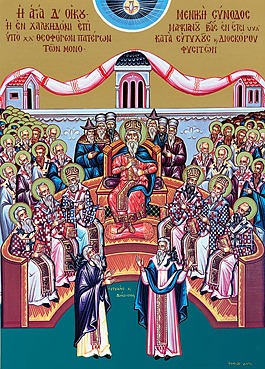
chalcedonAfter much controversy and struggle in the Church, the Council of Chalcedon (451 AD) put out a formal definition on person of Christ, regarding his full divinity, humanity, and the union of the two natures. While not exhausting the depth and beauty of the person of Christ, it lays down important boundaries within which theologians must stay if they are to properly teach the glory of the Son who took on flesh for our salvation.

Chalcedon has stood as the bulwark of orthodox-catholic Christology across traditions for a millenia and a half, and yet, while lengthy expositions of it are available, it still takes some time digging to find a good, clean summary explanation of what the Definition actually says. That’s why I was pleased to find this passage in Calvin’s comments on John 1:14, “and the Speech* (Word) became flesh, and dwelt among us”, in which he briefly and clearly expounds the scriptural truth that Chalcedon teaches:

The plain meaning therefore is, that the Speech begotten by God before all ages, and who always dwelt with the Father, was made man. On this article there are two things chiefly to be observed. The first is, that two natures were so united in one Person in Christ, that one and the same Christ is true God and true man. The second is, that the unity of person does not hinder the two natures from remaining distinct, so that his Divinity retains all that is peculiar to itself, and his humanity holds separately whatever belongs to it. And, therefore as Satan has made a variety of foolish attempts to overturn sound doctrine by heretics, he has always brought forward one or another of these two errors; either that he was the Son of God and the Son of man in so confused a manner, that neither his Divinity remained entire, nor did he wear the true nature of man; or that he was clothed with flesh, so as to be as it were double, and to have two separate persons. Thus Nestorius expressly acknowledged both natures, but imagined two Christs, one who was God, and another who was man. Eutyches, on the other hand, while he acknowledged that the one Christ is the Son of God and the Son of man, left him neither of the two natures, but imagined that they were mingled together. And in the present day, Servetus and the Anabaptists invent a Christ who is confusedly compounded of two natures, as if he were a Divine man. In words, indeed, he acknowledges that Christ is God; but if you admit his raving imaginations, the Divinity is at one time changed into human nature, and at another time, the nature of man is swallowed up by the Divinity.

The Evangelist says what is well adapted to refute both of these blasphemies. When he tells us that the Speech was made flesh, we clearly infer from this the unity of his Person; for it is impossible that he who is now a man could be any other than he who was always the true God, since it is said that God was made man. On the other hand, since he distinctly gives to the man Christ the name of the Speech, it follows that Christ, when he became man, did not cease to be what he formerly was, and that no change took place in that eternal essence of God which was clothed with flesh. In short, the Son of God began to be man in such a manner that he still continues to be that eternal Speech who had no beginning of time.

Commentary on John 1:14

The whole section is worth review as Calvin deftly comments on controversies both ancient and contemporary to his own day. Indeed, as challenges and confusions about just who Jesus is continue into our own, students and disciples of the Word would benefit from listening into the disputes of another age. While they’re framed in different ways, they are often-times structurally similar such that hearing the answer discussed in a context less immediate and personally-charged for us, can cast a clearer light for our own days.

Of course, the point of all this is not mere doctrinal correctness, but the life of doxology that follows. Christ is not properly worshipped and glorified, unless his magnificent person is properly taught and displayed according to Scripture.

Soli Deo Gloria 

*Calvin follows Erasmus in rendering the word ‘logos‘ as ‘Speech’ instead of ‘Word’. For his explanation, see his comments here.

‘Substance’? ‘Hypostasis’? But Those Words are Un-Biblical!

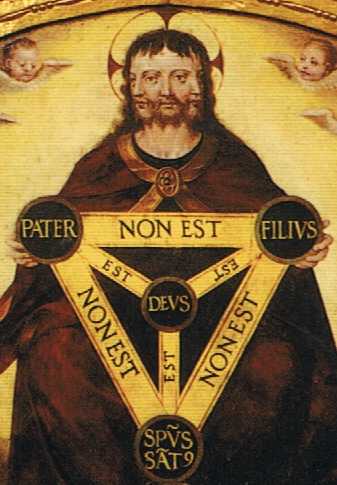
MostHolyTrinityStudying church doctrine can be a challenging endeavor for many of us, even those of us with a deep knowledge of Scripture and a desire to grow deeper in the faith. One issue that comes up frequently for students of a more Biblicist bent is: why all of those goofy, non-biblical words?

I mean, if you’re not familiar with, say, trinitarian theology you end up with all kinds of Greek and Latin words like ‘substance’ or ‘hypostasis’, ‘persona’, and later on, ‘perichoresis’, and so forth. They start to make sense once you’ve read someone explain them about 20 times. Thing is, though, most of those words don’t show up in our translations of the Bible, and when they’re there, they seem to be used in different ways. Or, heck, the word ‘trinity’ doesn’t show up at all. Shouldn’t we be ‘biblical’ in the way that we speak and think of God? How can we do so with terminology taken from surrounding Greek and Latin philosophy and thought?

Calvin tells us that he wrote the Institutes partially so that he wouldn’t have to go into extended doctrinal discussions in his commentaries. Welp, that didn’t really slow him down from writing 4 or 5 pages on John 1:1, expositing the text and defending it from various heretics old (Sabellian, Arian), and new (Servetus.) In the middle of this fascinating discussion, he touches on the issue of non-biblical language.

Now, conservative Reformer that he is, not given to excess or speculation, you might think he would want to do away with all of this jargony mess. Thankfully, he was smarter than that:

I have already remarked that we ought to be sober in thinking, and modest in speaking, about such high mysteries. And yet the ancient writers of the Church were excusable, when, finding that they could not in any other way maintain sound and pure doctrine in opposition to the perplexed and ambiguous phraseology of the heretics, they were compelled to invent some words, which after all had no other meaning than what is taught in the Scriptures. They said that there are three Hypostases, or Subsistences, or Persons, in the one and simple essence of God. The word; ὑπόστασις (Hypostasis) occurs in this sense in Hebrews 1:3, to which corresponds the Latin word Substantia, (substance) as it is employed by Hilary. The Persons (τὰ πρόσωπα) were called by them distinct properties in God, which present themselves to the view of our minds; as Gregory Nazianzen says, “I cannot think of the One (God) without having the Three (Persons) shining around me.”

–Commentary on John 1:1

He points out what Fathers like Athanasius and Augustine had before him: heretics can use ‘Biblical’ language too and use it in ‘ambiguous’, ‘perplexed’, and non-Biblical ways. For that reason, the Fathers were compelled to take language and deploy new words in order to save the meaning of the Biblical record. These were new words used to say more clearly in a foggy and confused time, what Scripture was saying. They did not do this at random or haphazardly. Nor did were they careless to leave undefined, or distinguish the sense in which they used the term from other possible senses.

I think it was N.T. Wright who somewhere used Copernicus as an analogy: say Copernicus had never given a term to his system at which the sun was the center of the universe instead of the earth, and 200 years later someone came along and dubbed it ‘heliocentric.’ Have they misrepresented Copernicus by using that new term that he did not? By no means. They simply gave it a new name in order to keep it clear. In the same way, the Fathers of the Church, guided by the Spirit, in conformity with the Word, developed ways of speaking that preserve and protect the content of Scripture even when not directly drawn from it.

This is the truth that Calvin recognizes and calls us to appreciate here. For that, thoughtful students and spiritual descendants ought to be humbly grateful: both for the work of early teachers like the Fathers, as well as for faithful preservers of the tradition like Calvin.

Soli Deo Gloria 

For more similar thoughts check out:

B.B. Warfield on the ‘Unbiblical’ Doctrine of the Trinity
Vanhoozer and Calvin on the Creeds and Scripture

Whatever We Ask For?

praying fistWhatever we ask in Jesus’ name, the Father will do for us (John 15:16). That’s what he says. But does he really mean it? Will God really do whatever we ask for in Jesus’ name? I’ve asked for plenty of things in my days and closed my prayers with “in the name of Jesus, Amen” and got diddly-squat. I know I’m not alone in this. So what gives?

We have to take care to understand what Jesus means by asking in ‘in my name.’ The whole statement tells us that as long as his ‘words abide in you’, then whatever you ask for in his name will be done for you. What does it mean for Jesus’ words to abide in us?

Well, here’s what Calvin says:

If my words abide in you. He means that we take root in him by faith; for as soon as we have departed from the doctrine of the Gospel, we seek Christ separately from himself. When he promises that he will grant whatever we wish, he does not give us leave to form wishes according to our own fancy. God would do what was ill fitted to promote our welfare, if he were so indulgent and so ready to yield to us; for we know well that men often indulge in foolish and extravagant desires. But here he limits the wishes of his people to the rule of praying in a right manner, and that rule subjects, to the good pleasure of God, all our affections. This is confirmed by the connection in which the words stand; for he means that his people will or desire not riches, or honors, or any thing of that nature, which the flesh foolishly desires, but the vital sap of the Holy Spirit, which enables them to bear fruit.

–Commentary on John 15:16

To ask for something in Jesus’ name is to ask for it in a way consistent with the Gospel. As soon as we try to seek Jesus or the life that Jesus has for us apart from the revelation of the Gospel, we are ‘seeking Christ separately from himself.’ In other words, we are looking for a Jesus that isn’t the real Jesus, or a blessing that isn’t consistent with his will.

What does that mean for our prayers? Far too often our prayers are not shaped by the Jesus we find in the Gospel, so we ask for silly and frivolous things. Or, we ask for things in a fleshly, anti-god way. Much as a child of 5 will ask for things they couldn’t possibly handle in a right or responsible way (say, a jet-plane), we ask our heavenly Father for things that he knows would wreck us (that job, that girl, that paycheck, that school). And it’s not that these things are always inherently wrong, but they are wrong for us in that they will lead us away from Christ and so God does not give them. He’s a good father like that.

Instead, when we are seeking things in the name of Jesus, what we’ll namely be searching for is true life of Jesus, which is the Spirit of Life. It is those requests—those that lead to holiness, beauty, righteousness, and glory–that the Father will unfailingly give us.

Soli Deo Gloria

Speech-Acts and the Peace of Jesus

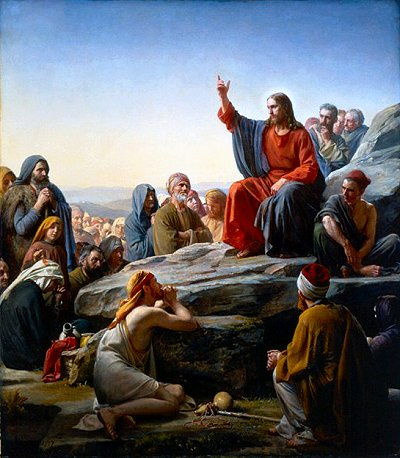
Jesus talkingOne of the most interesting and useful concepts I picked up in my philosophy undergrad is the idea of a ‘speech-act.’ Speech-act philosophy takes as its basic insight that language isn’t just about representing thoughts, or making simple statements of fact, but that, we actually do things with our words. There are words that we say in order to accomplish or bring about a new state of affairs. There are innumerable examples of this sort of thing (promising, lying, etc.) and all sorts of distinctions that philosophers can, and have made, but we see the basic point that, some words can be more efficacious than others.

The classic example of this is the minister’s words in a wedding. ‘I now pronounce you man and wife’ doesn’t just state the fact, but actually creates the fact. Before that statement, the two are merely engaged, but after that, they are married.

Now, of course, theologians have taken this and done all sorts of things with this over the years. For instance, we can see that a number of very important theological concepts can be understood and refined with the concept of speech-acts. When God justifies us, he is making a strongly declarative statement that, not only asserts that we are just and righteous in God’s sight, but in fact, actually brings about that situation. Or, again, God’s pronouncement of forgiveness is a constitutive speech-act. God saying ‘I forgive you’ creates the situation in which you are a forgiven person. Actually, push back farther and you’ll realize that we’re dealing with a God who speaks the world into existence (‘let there be light…’ Gen. 1). Kevin Vanhoozer and Nicholas Wolsterstorff have done extensive work with this, but, it’s safe to say it’s a fairly common concept in Biblical interpretation nowadays.

Why bring all this up? Well, the idea of speech-acts came to mind as I was going through my recent study in John’s Farewell Discourses in Calvin’s commentaries. Commenting on Jesus’ words “Peace I leave with you; my peace I give to you. Not as the world gives do I give to you. Let not your hearts be troubled, neither let them be afraid” (John 14:27), Calvin says:

By the word ‘peace’ he means prosperity, which men are wont =to wish for each other when they meet or part; for such is the import of the word peace in the Hebrew language. He therefore alludes to the ordinary custom of his nation; as if he had said, ‘I give you my Farewell.’ But he immediately adds, that this peace is of far greater value than that which is usually to be found among men, who generally have the word peace but coldly in their mouth, by way of ceremony, or, if they sincerely wish peace for any one, yet cannot actually bestow it. But Christ reminds them that his peace does not consist in an empty and unavailing wish, but is accompanied by the effect. In short, he says that he goes away from them in body, but that his peace remains with the disciples; that is, that they will be always happy through his blessing.

Commentary on John 14:27

…his peace does not consist in an empty and unavailing wish, but is accompanied by the effect.” Calvin reminds us that when Jesus speaks ‘peace’ to us, he’s an effective speaker. When we wish each other peace, if we actually mean it, it’s just that–a wish. We’re not in a place to grant our own wishes. When Jesus speaks peace, he’s an authoritative speaker who can actually bring that peace into our lives–in fact, by speaking it, he brings it. He can do this because, as Paul says elsewhere, Jesus is, in himself, our peace (Eph. 2:14).  He is the one who brought about the reconciliation that is the foundation of peace in his cross and resurrection in our place, so that, united to him by faith, we have the peace that he himself is (Col 1:20-22).

In other words, when Peter said, “Lord, to whom shall we go? You have the words of eternal life”, he wasn’t just blowing smoke.

Soli Deo Gloria 

The Cure that Killed the Patient (Or, Sorry Zahnd, Marcionism isn’t a Better Option)

tumblr_mr9zzaTmj01rj8v6zo1_400A while back John Piper put out a video that defended God’s right to judge the Canaanites by the hand of the Israelites in the conquest narratives of the OT. He said something along the lines of “God is God, he made you and doesn’t owe you jack, so if he takes your life, you really have nothing to complain about. Also, God can use whom he pleases to do so.” Roughly.

Predictably, some people got mad. I mean, I get that. It’s a tough subject and any answer is going to be kind of awkward (although, honestly, at this point Piper could say that God loves kittens and somebody would snark, “But only elect ones, right?”). Beyond just general Facebook furor when it hit, it recently provoked a frontal-assault/response from author and pastor Brian Zahnd. For those who don’t know, Zahnd has been a rising voice on the Evangelical/Post-Evangelical Left since his book “Beauty Will Save the World” came out last year. I actually read it and loved it, even if I did have some qualms about the pacifism peeking out here and there.

Well, pacifist though he may be, Zahnd came out guns blazing with accusations of voluntarism against the monstrous God of Calvinism, and, just the slightest bit of Muslim-baiting in his provocatively titled, “John Piper and Allahu Akbar.” As you might have picked up, I didn’t love this post quite as much as the book and I’ll get to why in a minute. But first, a few quick caveats.

To be clear, I don’t particularly care to defend Piper’s views here as he is a big boy who can defend himself. Nor is this is denial that the OT narratives involving the conquest and destruction of the Canaanites require some serious consideration. They do. Actually, while we’re on the subject, I’d commend Paul Copan’s work on the subject in the book “Is God a Moral Monster?” or this summary article paying attention to historical, genre, and canonical considerations here. Finally, I too am very concerned about the misuse of Scripture to promote violence.

What I do want is to look at is Zahnd’s reponse, which, to mind, left something to be desired in terms of theological honesty as well as, well, ‘soundness of teaching’? (I don’t want to say orthodoxy, given his clear, robust Nicene and Chalcedonian faith.) Yes, I’m putting on my argumentative Reformed hat again, which I do try to stay away from, but, in all fairness, Zahnd shot first.

Well, without further ado, here are a few points in no particular order.

Yeah, never taught that.

Yeah, never taught that.

Calvin’s “Ism”

Zahnd found a cute short-hand for Piper’s theology of sovereignty, or rather, that of “Calvin’s disciples”, which he dubbed “Calvin’s Ism.” He then proceeded to rail on it, lamenting the way Piper and others would go to such great lengths to defend the “Ism” to the point of creating a monstrous voluntaristic/nominalist God whose will is what it is, simply because it is, and so forth. Don’t you know that we should look at Jesus, not what Calvin thought about Jesus?! Away with such Greek-philosophy-influenced, metaphysical barbarisms!

scumbag girardIt’s typical anti-Calvinist boilerplate that fires up the troops and so forth, so I get it. As one of “Calvin’s Disciples” though, I simply wanted to stop and point out that, as a matter of historical fact, Calvin strongly repudiated the overly-voluntaristic and nominalist tradition popular in his day at the Sorbonne flowing from theological giants like Scotus and Ockham. (Incidentally, I always find it funny when guys who basically riff off of French social theorists like Rene Girard’s scapegoating theory when it comes to the Gospel, have the gall to call out “Greek philosophical categories” in more traditional theology.)

Calvin explicitly rejected a view of God’s unrestrained will, or absolute power, divorced from God’s justice or God’s goodness. While he unabashedly defends God’s complete sovereignty over human history, he simultaneously condemns “that absolute will of which the Sophists babble, by an impious and profane distinction separating his justice from his power.” (Institutes 1.17.2) That’s just one among many examples.

Again, it’s a fun phrase, and when you’re driving the punch-line home, why not pick a baddie to rip on your fanbase already doesn’t like? Calvin’s perfect for that, especially since most people haven’t actually read him much. But, in this case, Zahnd should probably find another whipping boy to pin the voluntarism charge on.

Killing is Not Always Murder

Moving more to the point, Zahnd tells us that God could never have ordered the conquest and judgment of the Canaanites in the way the narratives portray it because that would involve killing which is murder and God would never order murder.

So for some this next point might seem basic: while all murder is killing, not all killing is murder. For others, this is a basic false distinction that they rejected as un-biblical a long time ago.

I’ll just say that a prima facie reading of the Scriptures, especially the OT legal code (Exod. 21), shows that while God hates human death, the law that he handed down seemed to recognize a distinction between killing and murder. Actually, very early on in the narrative of the Torah, we find out that the reason he allows for some killing is precisely because he hates murder (Gen. 9:6). Murder is unjustifiable, but executions and judgments seemed to be accounted for and even commanded by God himself in various places in the OT law and the subsequent narrative. Of course, that raises the issue of the reliability of the OT on this point.

Which brings us to the really big issue with Zahnd’s post.

Marcionism isn’t a Better Option 

See, Zahnd says we shouldn’t let something like the Old Testament slow us down when we’re thinking about these things:

And don’t let the Old Testament work you into a corner. You don’t need to defend the Old Testament to the extent that you find it necessary to justify genocide. God forbid! We can simply say this…

The Old Testament is the inspired telling of the story of Israel coming to know their God. Along the way assumptions were made and they didn’t get everything right. Keep reading the Bible until you come to Jesus and then center your reading of all Scripture in the light of Christ.

This is a perfect example of what Andrew Wilson has called the “New Marcionism“, which, while not explicitly repudiating the OT the way Marcion did, insists on seeing such a radical discontinuity between the God we see testified to in the OT and that of the NT that it has much the same effect.

Let me unsympathetically paraphrase Zahnd for you to see the problem: “The ancient Israelites who wrote the Holy Scriptures got some stuff wrong, but we know better now that Jesus came. We know that Jesus would never order something like that, so we know that God didn’t order something like that, so just don’t trouble yourself about it. The verses are just wrong. I mean, sure, Jesus said that the Scriptures all pointed to him (John 5:39), and the law is to be perfectly fulfilled (Matt. 5), and we can assume he read those parts, but he couldn’t possibly have meant all of it. Sure we have parallels in the NT with Revelation and God raining down judgment, etc. not to mention Jesus himself casting down judgment of his own, but again, don’t let that trouble you. Nevermind the deeply pervasive theology of God the Warrior who goes before Israel in battle that informs much of the OT, and depends on some of those “mistaken assumptions”–just try and skip those bits. I mean don’t worry that this even figures into Luke’s telling of Acts as a conquest narrative. Just squint until you see it properly. God wouldn’t do anything like that. I mean, don’t bother trying understand the difference between God’s administration of covenant justice in Israel v. the Church because of Christ’s ushering in a new phase in redemptive-history. It’s not that the same God can manifest his eternally good and beautiful character in consistent, but historically-distinct ways. We have the much easier option of saying the Israelites just got it wrong. Simple as that. Don’t worry about what that does to undermine the authority of the OT and its ability to actually point to Jesus Christ. Please don’t trouble yourself with the way this sort of crypto-Marcionism might spill into the subtle anti-Semitism of viewing the Old Testament as an inherently inferior text like the old-school German Liberal scholars who made this sort of argument popular back in the early part of the 20th Century. I mean, no big deal.”

In a dispute with the Pharisees in John 10:35, Jesus tells us that the scriptures cannot be “broken.” The Greek word there is luo which can be translated “to destroy, to tear down, the break to pieces” (Louw-Nida 20:35).  Essentially, it can’t be ignored, released, explained away, or rendered null or void. Except, that’s exactly what Zahnd suggests we do with those uncomfortable bits.

On ‘Christocentric’ Readings (Or, The Cure that Killed the Patient)  

Here’s the thing, when your “Christocentric” reading of the Scriptures leads you to ignore or deny parts of Scriptures the way Christ says shouldn’t happen, you might be doing it wrong. Realize that this isn’t about whether we’re going to read the Bible in light of Jesus, but about how. Does the revelation of Jesus Christ crucified and risen shed light on and transfigure the testimony of God’s dealing with Israel, or simply deny, or downgrade its validity by cutting chunks out?

Of course, this goes to the deeper theological question who we’re going to allow God to be? Will we allow him to reveal himself as a God who, though simple in essence, is narratively-complex in his self-rendering in the history of Israel?  “The Lord, the Lord, a God merciful and gracious, slow to anger, and abounding in steadfast love and faithfulness, keeping steadfast love for thousands, forgiving iniquity and transgression and sin, but who will by no means clear the guilty, visiting the iniquity of the fathers on the children and the children’s children, to the third and the fourth generation.” (Exod. 34:6-7) Do we let Jesus be both the one who longs to shelter Jerusalem under his wings to save them, all the while forcefully proclaiming God’s impending, violent, judgment on their sins (Matt 23:29-39)? Do we allow for the full picture of Jesus to emerge, or the one we’ve shoved into our pacifistic Procrustean bed, and shave off the verses that don’t fit?

Tom needs a drink after that.

Tom needs a drink after that.

While some of us are tempted to take Zahnd’s path of essentially rejecting prior revelation as the mistaken assumptions of our spiritual fathers, Might I suggest a surer, admittedly less comfortable, course? It is a route that N.T. Wright offers up in his answer to Wilson on the issue of the New Marcionism:

“There are many many things that God does, has done or will do which are not waiting for my approval or sanction before he does them. You know that line, “Many people want to serve God, but usually only in an advisory capacity.” Bonhoeffer said that putting the knowledge of good and evil before the knowledge of God is the primary sin in Genesis 3. They go for the knowledge of good and evil rather than what God says. Now that could just be an escape; it could just be throwing up our hands and saying we don’t know anything about God (when the whole point of the gospel is that we do know who God is, because of Jesus). However, if it’s the crucified Jesus, and if the cross means what it means in the light of the whole history of Israel, which is focused onto that, then … these narratives are the way in which all of those horrible, puzzling ambiguities, and all the awful things that happen – like Jesus saying, “what about those eighteen on whom the tower of Siloam fell?” – there’s a sense that the cross gathers up all those puzzling, tragic horrible fragments of life, and says swoosh this is where it’s all going.

“I hold this within the framework I articulated this morning, which is to say: from the call of Abraham onwards, what God is committing himself to do is to act to bring about the restoration of the world, but to act through deeply flawed human beings, who constantly need to be reminded that they’re deeply flawed. That then produces all kinds of (to our mind) ambiguities. And I see all of it coming together in the cross. The cross is the moment when I see Israel’s God performing the salvific event, which is simultaneously the worst and most blasphemous act of judicial, theocidal murder than one can ever imagine. And somehow the cross itself says: these things are now reconciled.”

Of course there’s more to say, but I’ve already said too much for what’s an allegedly short blog post. (May God forgive my lies.) The end of the matter is that while Zahnd may find Piper’s alleged voluntarism to be a gross misrepresentation of Jesus by distortion, his own neo-Marcionism leaves us with a highly-abridged Bible, and therefore an abridged Jesus, which is hardly an improvement. While offering a solution to the Bible’s problematic texts, Zahnd is inadvertently administering the kind of cure that kills the patient.

Soli Deo Gloria

Jesus is the Beginning, the Middle, and the End

way“I am the way, the truth, and the life” is Jesus’ (in)famous reply to Thomas’ request for directions to the Father (John 14:6). The text has been in dispute ever since, especially in light of disputes about salvation, exclusivism/inclusivism, and the sole Lordship of Christ.  What does it mean for Jesus to be the “way, the truth, and the life”? How can a person be a life? Or a way? Or the truth? How are they connected?

Once again, Calvin cuts to the core of the matter and sheds an illuminating (and worship-inspiring) light on the text:

The way, the truth, and the life. He lays down three degrees, as if he had said, that he is the beginning, and the middle, and the end; and hence it follows that we ought to begin with him, to continue in him, and to end in him. We certainly ought not to seek for higher wisdom than that which leads us to eternal life, and he testifies that this life is to be found in him. Now the method of obtaining life is, to become new creatures. He declares, that we ought not to seek it anywhere else, and, at the same time, reminds us, that he is the way, by which alone we can arrive at it. That he may not fail us in any respect, he stretches out the hand to those who are going astray, and stoops so low as to guide sucking infants. Presenting himself as a leader, he does not leave his people in the middle of the course, but makes them partakers of the truth. At length he makes them enjoy the fruit of it, which is the most excellent and delightful thing that can be imagined.

Commentary on John 14:6

These are not primarily words of divisive exclusion (although they do testify to Jesus’ exclusive role as Savior), but of assuring grace.  We might be tempted to look to our own plans, prayers, righteousness, special knowledge, inner strength, or find multiple mediators.Jesus here is telling us that he is the beginning, middle, and end of our salvation. It’s not just that we can’t turn anywhere else, but that by the mercy of God, we don’t need to.

When it comes to gaining the life that is truly life, there’s no way around, or above, or away from Jesus.  He himself is the source of that life. We don’t start by Jesus and do the rest ourselves, or move on to something deeper to get to life. No, at every step of the way, it is Jesus moving us along. He is the one who recreates us, brings us to participate in the truth that leads to life, and guides us by the hand to that life that we would not be able to find on our own strength.

Soli Deo Gloria