5 Best Reformedish Books of 2014

The year of our Lord 2014 has been a great year of reading for me. I can only think of a couple of duds in the pile of books I’ve had the fortune of getting my hands on and cruising through. This means one thing: picking this year’s Top Reformedish books of 2014 was a difficult task. There were a great number that I thought of and considered for this. As it happened, though, there were a few standouts I would like to highlight and commend to you for your reading pleasure and edification.

A couple of notes before I proceed, though.

First, I am not including Herman Bavinck’s Reformed Dogmatics here simply because I have an article coming out on it later this month, and because it sits in a category all by itself. It is not a book of 2014. It is a work that transcends the years and decades.

Second, it just so happens that all of the books I’m highlighting I have actually already reviewed. Where relevant, I will simply note, excerpt, and forgo any more summary.

Finally, this list is not in any particular order. I am a notoriously bad ranker and decision-maker. Just ask my wife.

faith speaking understanding1. Faith Speaking Understanding by Kevin Vanhoozer. I’ve reviewed Vanhoozer’s book at The Gospel Coalition. This is some of what I said:

Let me put it this way: if Drama of Doctrine and Remythologizing Theology had a child, it would be Faith Speaking Understanding. Though intended as a briefer, less intimidating introduction to and practical application of his theodramatic theology for pastors and serious students, it isn’t a mere rehash of the last two works. As Vanhoozer explains, Faith Speaking Understanding is “an upstart sibling with a swagger of its own, namely a full-fledged proposal for the role of theology in the church’s task of making disciples” (xv).

Swagger it may have, but it’s swagger mediated through Vanhoozer’s inimitable style, irenic tone, and jovial spirit. Vanhoozer’s prose is a joy to read—a seamless movement between biblical and theological reflection (as evidenced by the extensive and helpful indexes of Scripture and theology) that is robustly catholic and winsomely evangelical.

calvin2. Calvin on the Christian Life by Michael Horton. I also reviewed this for The Gospel Coalition. Here’s what I said there:

In the history of the church, particularly its Western Protestant wing, few theological lights shine brighter than John Calvin’s. The Reformer par excellence, he stands out for his theological acumen, systematic comprehensiveness, and care as a biblical exegete. Beyond Calvin the theologian and biblical scholar, though, there was Calvin the pastor—the man passionately concerned that all of human life be lived before God (coram Deo) and in light of the gospel. Though it’s often presented this way in history textbooks, the Reformation wasn’t simply an academic theological debate about justification and the thoughts we think on a Sunday morning, but rather a total restructuring of Christian life and practice. It was about, as James K.A. Smith puts it, the “sanctification of ordinary life.” For that reason Calvin was concerned not only with teaching doctrine, but also with the life of piety flowing from that doctrine.

This is the Calvin that theologian and Westminster Seminary (California) professor Michael Horton introduces us to in his new volume on Calvin and the Christian Life. With an engaging blend of biography, theology, and commentary, and with copious reference to Calvin’s Institutes, commentaries, tracts, and key secondary literature, Horton takes us on a whirlwind tour through the Reformer’s thought as a whole.

age of atheists3. The Age of Atheists by Peter Watson. There’s a bit of a theme here in that I also reviewed this for The Gospel Coalition. Here’s what I said there:

In The Age of Atheists: How We Have Sought to Live Since the Death of God Peter Watson hopes to change the narrative by pushing back on Taylor’s impoverishment thesis. In this massive and thoroughly entrancing work of intellectual and cultural history, the prolific London-based author aims to recount hitherto-untold drama of the multifarious and rather “thick” ways we’ve tried to “live without God” ever since we discovered his death about 120 years ago.

Beginning with Nietzsche himself, Watson focuses on the lives, stories, and theories of those who haven’t merely lamented the loss of God but pushed through to find meaning—or rather “meanings”—of a more humble sort on the other side. Jumping from Europe to America to the Isles, Watson presents us with a cascading torrent of names (the back cover alone is plastered with them)—whether poet, philosopher, novelist, dancer, psychiatrist, or theologian—all of whom offered visions of life beyond traditional religious belief. The overall effect is to overwhelm you with the wealth of non-theistic options to meaning and fulfillment. To put it bluntly, Watson wants to show us we have more options than glum Dawkinsism or Jesus.
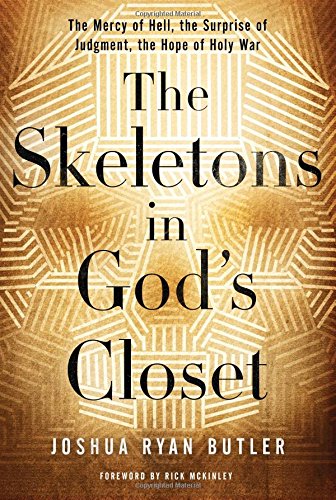
skeletons4. The Skeletons in God’s Closet by Joshua Ryan Butler.  And again, this is one I reviewed at The Gospel Coalition. Here’s some of what I said there:

The Skeletons in God’s Closet has the potential to be a game-changer for a lot of struggling Christians and skeptics. Thoroughly orthodox, Butler also speaks in a language and with the sensibility of someone who can still step out of his Christian shoes to hear, think, and feel the tension from the outside. In a lot of ways, it’s the book Love Wins tried to be but failed due to doctrinal drift. Instead, by helping readers walk through the difficult texts in Scripture, Butler sets out for them a broader vision for the beautiful character of a God who doesn’t give a doctrinal inch. Is it perfect? No. Would I have hit a couple of themes harder, or connected a couple of dots differently? Probably.

Still, Butler has done the church a magnificent service by showing a postmodern world that doctrines like hell and holy war aren’t about a God whose malevolence has to be restrained. Instead, The Skeletons in God’s Closet shows us a God who is good down to his bones, and utterly committed to loving and saving his world in Christ.

crucified king5. Tie: The Crucified King by Jeremy Treat and Atonement, Law, and Justice by Adonis Vidu.  I did not review these two at The Gospel Coalition. Still, I have already talked briefly about these two works here:

On The Crucified King:

In one sense, I found it to be a gravely disappointing book. It’s disappointing because Treat has written the book I wanted to write on the subject. Giving equal attention to biblical theology and systematic categories, Treat reunites what never should have been divorced in much modern theology: kingdom and cross as well as Christus Victor and penal substitution accounts of the atonement.

viduOn Atonement, Law and Justice:

Vidu aims to provide an account of the history of atonement theology down into the present that presents theologians against the background of the various legal and political theories dominant at the time. In this way, we can begin to appreciate better the way these theological concepts shaped and were shaped by their native settings. Five judicious, careful, and lucid chapters are devoted to the descriptive task, focusing on Patristic, Medieval, Reformation, modern, and contemporary periods…What’s more, along the way, he corrects a number of common misunderstandings and caricatures of historic positions.

If I went on to cite runners-up and honorable mentions, we’d be here for a while. It’s been a good year for books. I hope this list finds you in time for you to update your Amazon.com wishlist for last-minute purchases. If not, it ought to give you an idea of how to use your spare gift cash.

Soli Deo Gloria

The Skeletons in God’s Closet (TGC Book Review)

skeletonsJoshua Ryan Butler. The Skeletons in God’s Closet: The Mercy of Hell, the Surprise of Judgment, and the Holy of Holy War. Nashville, TN: Thomas Nelson, 2014. 384 pp. $15.99.

Hell. Judgment. Holy war.

For many critics and struggling Christians, these aspects of biblical teaching represent all that is darkest about religion. They give rise to the questions that haunt them at night and linger in the back of their prayers, causing them to doubt they can pray to a merciful God. They are the secret skeletons in God’s closet that have to be denied, or at least hidden away, if we are still to believe him at all. A loving God cannot condemn people to eternal torment, or exclusively judge those in other religions, or send one nation to invade and conquer another. Many of us simply sense in our gut that either God is not like this or God is not real.

In The Skeletons in God’s Closet: The Mercy of Hell, the Surprise of Judgment, and the Hope of Holy War, Joshua Ryan Butler argues the provocative thesis that these are teachings not skeletons in God’s closet—indeed, they are evidence that he is goodness all the way down to his bones. The pastor of global outreach at Imago Dei Church in Portland, Oregon, Butler writes as one who came to faith in Christ and found hope but was then faced with the shock of a Bible that didn’t fit his initial ideas of love, goodness, and justice. But in the course of looking at the bigger story of Scripture, wrestling with theology, working against global oppression, serving on missions to rescue girls stuck in sex trafficking, and spending time in Native American reservations, he began to find in doctrines like divine judgment both hope and healing for creation’s brokenness and human evil.

Taking these biblical, theological, and practical dimensions and using persuasive, clear, and even poetic arguments, Butler weaves them into one seamless tapestry. His ability to exposit Scripture in light of scholarship and everyday personal and political realities—and to do so with theological depth—allows him to cut through so many damaging and damnable caricatures that hold people back from trusting in the fundamental goodness of God.

So what exactly does Butler say about hell, judgment, and holy war?

You can read the rest of my review at The Gospel Coalition. And really, go buy the book. It’s that good and that important.

Soli Deo Gloria

Faith Speaking Understanding by Kevin Vanhoozer (TGC Review)

Kevin J. Vanhoozer. Faith Speaking Understanding: Performing the Drama of Doctrine. Louisville, KY: Westminster John Knox, 2014. 298 pp. $22.42.

“The drama is in the dogma,” Dorothy Sayers once said. It seems no evangelical theologian has more enthusiastically taken to heart her statement than Kevin Vanhoozer, research professor of theology at Trinity Evangelical Divinity School outside Chicago.

Building on the foundation laid by H. U. Von Balthasar in his multi-volume series Theodrama, over the past 12 years Vanhoozer has put forward and developed his own “theatrical” approach to doctrine and theology.

Project Continues

Beginning with The Drama of Doctrine (Christianity Today’s 2006 book of the year in theology), Vanhoozer argued that the category of “drama” is well suited to conceptualizing a theology that takes its cues from the gospel. Doctrine, on this model, is the stage direction that enables disciples to participate rightly in the drama of the gospel. Doctrine does this by rightly identifying the dramatis personae (God, Christ, Israel, and so on), the shape of God’s (theos) actions (drao = to act, drama) that come before (creation, election, Jesus, church, consummation), and in that light, our role in local community performances as the company of the church on the stage of the world.

Vanhoozer followed that up a few years later in his groundbreaking Remythologizing Theology (2010), putting his theory into practice by engaging in some 500 pages of theology proper. Essentially it was a call for theology to reorient itself to speaking of God’s being on the basis of his dramatic doings revealed in Scripture.

Despite their wide acclaim, however, the size, complexity, and price tag of these works has prevented many pastors outside the academy from been exposed to Vanhoozer’s work. This is a shame because—and I know this is a bold statement—these are two of the most important works of evangelical theology written over the past 15 years. The Drama of Doctrine saved my theology of revelation and Scripture in the emergent years, and Remythologizing Theology did the same for my doctrine of God. If I could force every seminary student to closely read and digest those two books, the church would be saved a lot of theological grief.

Enter Vanhoozer’s newest work, Faith Speaking Understanding: Performing the Drama of Doctrine. Let me put it this way: if Drama of Doctrine and Remythologizing Theology had a child, it would be Faith Speaking Understanding. Though intended as briefer, less intimidating introduction to and practical application of his theodramatic theology for pastors and serious students, it isn’t a mere rehash of the last two works. As Vanhoozer explains, Faith Speaking Understanding is “an upstart sibling with a swagger of its own, namely a full-fledged proposal for the role of theology in the church’s task of making disciples” (xv)

Please go read the rest of my review over at TGC and then go buy the book. It’s that good. 

Soli Deo Gloria

PROOF Review (TGC)

proofDaniel Montgomery and Timothy Paul Jones. PROOF: Finding Freedom Through The Intoxicating Joy of Irresistible Grace. Grand Rapids, MI: Zondervan, 2014. 224 pp. $16.99.

Grace. There are few words more cherished in the evangelical idiom. Step into our churches and you’ll probably hear the word every Sunday. You’d even think the word would be seared into the American consciousness. I mean, everyone knows that God shed his grace on America, and who couldn’t sing a few bars of “Amazing Grace”?

And yet for all that familiarity, Daniel Montgomery and Timothy Paul Jones contend, most of us tend to live a graceless existence where performance and conditionality determine everything, threatening to thrust us into the cauldron of faith-killing despair. If we truly understood the beauty of the astonishing grace of the biblical gospel, it would make us stagger like drunken men intoxicated on the highest-proof spirits we could lay our hands on. In their pastoral, lively, and accessible book PROOF: Finding Freedom through the Intoxicating Joy of Irresistible Grace, they aim to get us tipsy by presenting us with a God who is sovereign, gracious, and mighty to save—far beyond the Cosmic Butler/Therapist of our imaginations.

You can read the review HERE.

Soli Deo Gloria

Economic Shalom–Bolt’s Theology of the Market Beyond Biblicism

boltEconomics is complicated. Establishing a Christian approach to economics seems even more daunting a task, especially given the amount of ink that’s been spilled when it comes to a Christian approach to money and wealth. Trying to wade into the conversation without any sort of guide then, can be overwhelming. As someone who has only begun to stumble towards developing my own thought in this area, I was delighted to receive a copy of John Bolt’s new little volume in the Acton Institute’s series of primers on faith and work, Economic Shalom: A Reformed Primer on Faith, Work, and Human Flourishing.

Though the cover’s a bit drab and uninspiring, the writing is not. Bolt manages to deliver an accessible, lively introduction to basic economics in what amounts to an “unapologetic defense of a free market economy set within a democratic liberal polity” (pg. 171) from a Reformed theological perspective. I emphasize “a” Reformed perspective for two reasons. First, Bolt explicitly draws from a primarily from the Dutch Reformed tradition, most specifically from the thought Neo-Calvinists like Herman Bavinck and Abraham Kuyper. Also, as is evident in his arguments against them, there are other Reformed voices who would probably disagree with his construal.

Now, while I don’t have the time give it the justice of a full review, I did want to highlight the couple of key strengths that make this a valuable resource for those looking to give deeper thought to the issues of faith and economics.

The primary strength of Bolt’s proposal is try to move us past the simple biblicism that tends to run rampant in these theological discussions. In the first chapter, he disposes of the idea that there is clearly one “biblical economics” that can be cleanly read off the surface of the text. He does so partially by surveying the economic thought of three major christian ethicists, Walter Rauschenbusch, Ronald Sider, and David Chilton, using essentially the same biblicistic assumptions, end up with a wide variety of contradictory economic proposals ranging from interventionist socialism to theonomic libertarianism.

Instead, he holds up the thought of Herman Bavinck, who put forward a more chastened reading of Scripture that takes into account it’s salvific purposes:

A Reformed approach to the Bible resists reading it in a flat manner as so many disparate bits and pieces of inspired, useful knowledge that can be picked up here and there as we have need of them. A Reformed handling of Scripture does not treat it as a manual for child-rearing one day and a textbook for financial management the next. It is a mistake to go to the Bible for scientific knowledge, a point John Calvin already made in his Genesis commentary when he observed that the words “let there be a firmament” (1:6) are meant not for the sophisticated mean of learning but “for all men without exception” and can be understood even by the “rude and unlearned.” Calvin then added: “He who would learn astronomy, and other recondite arts, let him go elsewhere.” Two important aspects of Reformed hermeneutics are illustrated here: The first is the perspecuity of Scripture, the conviction arising from the priesthood of all believers that Scripture’s essential message can be grasped by all who have been renewed by the Holy Spirit. Reformed people do not rely on a priestly caste of theologians to tell them how to read the Bible. Second, though the Bible is relevant for every dimension of human life, it has a very specific and well-defined purpose: “that by believing you may have life in his name” (John 20:31). The Bible is a salvation book and not an economics textbook or social renewal manual. And it is with this particular focus on salvation that Bavinck addresses the question of the Bible’s relevance for economics. (pg. 15)

Instead of piling up a bunch of verses and trying to see which specific commands can be cleanly mapped onto the current political system, Bavinck proposes we recover the main spiritual purpose of the Scriptures–the restoration of fallen man to God through the Gospel. From there, humans begin to be restored to their proper relationships with each other and are enabled to begin taking up the form of life rooted in God’s creational norms. Where do we go to find those norms? Well, back to the Scriptures, but now, we don’t go looking for particular commands, but the general principles that underlie and inform them. For this reason, Bavinck won’t speak directly of a “biblical economics”, but rather an economic system that is consistent with Scripture.

While not slavishly following Bavinck at all points, Bolt’s approach is broadly consistent with it. He offers up a defense of the ordered liberty of free-market capitalism as consistent with a broad biblical theology we find in Scripture: creation bursting with potential awaiting cultivation; the freedom and vocation the of Imago Dei; the universal sinfulness of humanity after the Fall; our epistemic limitations as finite creatures; the providence and sovereignty of God in the allocation of resources; biblical principles of work and charity from the wisdom literature; a conception of justice as opportunity and the restraint of evil; the truth of our redemption through Christ; an amillenial eschatology that eschews over-reach or pessimism. It is in light of these principles that he draws on the work of economists to deal with the market, consumerism, ordered liberty, and social inequality.

I’ll be brief about the second strength, as it follows directly from the first: Bolt demonstrates a humble restraint in his judgments on a where rhetoric typically runs wild. Because of this, Bolt goes about explaining basic economic concepts, demonstrating their compatibility with Scriptural principles, and dealing with common Christian objections to a market economy with sanity and grace. While it’s easy to imagine a number of robust challenges to Bolt’s account, it won’t be on account of undue dogmatism or a lack of Christian charity.

All of that to say, I would warmly commend Economic Shalom to anyone tired of simplistic accounts, both on the Right and the Left, theologically and politically. Bolt has done the Church a service writing it.

Soli Deo Gloria

Unapologetic by Francis Spufford (TGC Review)

unapologeticFrancis Spufford. Unapologetic: Why, Despite Everything, Christianity Can Still Make Surprising Emotional Sense. New York: HarperOne, 2013. 240 pp. $25.99.

Friedrich Schleiermacher wrote his classic treatise On Religion: Speeches to Its Cultured Despisers at the behest of his radically irreligious friends—emancipated thinkers who wanted to know how he could share so much of their intellectual world and yet be an ordained, believing Christian. The result was a novel, innovative phenomenology of religion that aimed at rendering religion intelligible to a large swath of modern, intellectual Europe, and which influenced liberal Christian theology for generations.

In many ways Francis Spufford’s unique, hilariously pugnacious, and vivaciously argued tour-de-force Unapologetic: Why, Despite Everything, Christianity Can Still Make Surprising Emotional Sense could be considered a version of that same project. Only this time the book aims at “awkward” post-Christian Brits who have trouble making sense of why an emotionally competent adult would embrace belief in a sky-fairy and so forth.

Before you’re too put off, though, unlike Schleiermacher or Spong-style modern liberals, Spufford knows that big doctrines like the incarnation and the actual events of history (cross and resurrection) matter as issues of truth. He’s not offering some soggy song about the power of metaphors. The emotions must somehow connect to reality. Still, though he engages in some humorous polemics against Dawkins & Co., it’s not a traditional, philosophic apologetic for the truth-claims of the Christian faith—he doesn’t think that can really be done. Rather, it’s more of a Pascalian wager in the sense that, assuming we can’t know either way, there is real satisfaction and dignity in belief. It’s a brief, pop phenomenology of the Christian faith that tries to help the non-religious understand what it’s like from the inside.

Check out the rest of my review over at The Gospel Coalition.

Top Five Reformedish Books of 2013

AD: I use Grammarly to check plagiarism because what if I go on the Janet Mefferd Show? 

Once again it is time for my annual “Top Five Reformedish Books” of the year. This is actually a horrible post to write. I read a lot of good books this year. Many of them deserve to be on Top Five book lists somewhere. For me, though, these particular five distinguished themselves. Now, unlike some other lists, I am not simply choosing from books published in 2013, but rather from ones that I’ve read in 2013. I am still catching up on 20 centuries of thought, you know. Well, without further ado, here they are:

death by livingDeath By Living: Life Was Meant to Be Spent by N.D. Wilson – I’ve already reviewed this over at the Gospel Coalition where I said:

For return readers looking for quick comparison between Notes and Death, I’d say that if the last one changed the way I thought, this one might change the way I live. Notes invites you to embrace God as the sovereign, beyond-imagining author of this ridiculously unexpected universe. Death challenges you to live as a character, or rather, as a sub-writer of enfleshed, breathing words. Big ones. Interesting ones. Once again, you’ll find yourself in a well-shaken cocktail of poetic memoir, philosophy, theology, sharp wit, polemical fisticuffs, hilarity, and exhortation in the form of a paean to the grace of a life well-lived in the shadow of eternity. For the newcomer, you may want to strap in first.

walking with GodWalking With God Through Pain and Suffering by Timothy Keller – I’ve read a number of books on the subject, especially in my undergrad in philosophy, and I have to say, it is going to be the new classic on the subject. Unlike other works on the subject, it is not only pastoral, or only philosophical, or only theological, but approaches the issue of suffering from all of these angles and more. Keller brings sociology, literature, theology, philosophy, and, of course, the Scriptures, to bear on the seemingly intractable burden of suffering and evil. I’ll go out on a limb and say this is his best book yet. Given that you and everyone you know will encounter pain and suffering in this world, everybody should go out and pick up this book.

people and placePeople and Place: A Covenant Ecclesiology by Michael Horton – This is the fourth volume of Horton’s dogmatics examining traditional doctrinal loci from the standpoint of a retooled covenant theology. Building on the work of Farrow, Volf, and others, Horton offers an instructive treatment of the origin of the Church, the sacraments, the classic marks of the Church, and her mission in the world. Of course, eschatology figures prominently in the discussion, and there is an excellent discussion of Scripture and tradition towards the front-end. As always, Horton is in constant conversation with Roman Catholic ecclesiologies, Barth, Radical Orthodoxy, Stanley Grenz, and general Evangelicals setting up a clear, irenic, and charitable contrast. While some discussions are a bit thick for the non-specialist, I highly recommend it to anybody interested in the ecclesiological discussions of the day, especially if you’re looking for a Reformed account that can play alongside the big boys like Ratzinger (RC) and Ziziouslas (EO).

athanasius leithartAthanasius by Peter Leithart – I decided to get down to business and read Athanasius’ Four Discourses Against the Arians this year, so I picked up Leithart’s volume as a bit of a guide. As usual, I was not disappointed. Paying close attention to Athanasius’ metaphysical categories and scriptural exegesis, Leithart cleanly and clearly expounds the good bishops’ beautiful Trinitarian and Christological theology, bringing it into living conversation with theologians at work today. Not only is Leithart an able interpreter of Athanasius’ polemical and pastoral theology, he sets the discussion in lively account of his theo-political controversies. For anybody interested in Athanasius, or the conversation around the ‘theological interpretation’ of scripture, it’s a great place to take the plunge.

paul and the faithfulness of GodPaul and the Faithfulness of God by N.T. Wright – I’ve waited for this book for a few years now. While I’m only through the first volume (weighing in at 570 pages), I can safely say this is the Paul book of the decade. It will be impossible to write about Paul from now on without engaging Wright’s arguments in this sprawling masterpiece. Beyond that, what can I say? It is the most grossly comprehensive thing I’ve ever seen on the subject. It’s Wright at the height of his powers: asking the big questions, giving even bigger answers; setting Paul in his 1st Century context against various backgrounds (2nd Temple Judaism, Roman, Greek); engaging New Perspectives and Old Perspectives; telling stories and arguing for stories; close exegesis and sweeping overviews from 20,000 feet; actantial analyses for days. No, you don’t agree with everything he says, but that isn’t why you read Wright, now is it?

Honorable Mentions:

Sources of the Self: The Making of the Modern Identity by Charles Taylor

The Word of God for the People of God by J. Todd Billings

Union with Christ by Robert Letham

Soli Deo Gloria

Reconsidering Justification with Stephen Westerholm (Book Review)

westerholmIt’s one of the odd quirks of my theological education that the New Perspective on Paul and justification is actually the first perspective on Paul I really heard when I came of age theologically. Yes, I’d grown up with sermon-level understandings of the Old Perspective, but my first book on Paul was N.T. Wright’s What St. Paul Really Said and in seminary I read James Dunn’s 700-page Theology of the Apostle Paul cover to cover in my course on Pauline theology. Add to that numerous follow-up articles and works, not least an overload of Wright (I’ve read most of what he’s written on Paul with the exception of his new volume, which I’m only 1/4 of the way through), and it’s safe to say that I’ve been familiar with the main lines of thought among some of the dominant voices in the New Perspective.

Now, of course, I’ve read some Old Perspective scholars as well. I’ve done a little time with R.B. Gaffin, Simon Gathercole, and D.A. Carson, and my favorite current interpreter of Paul with respect to the justification debates is Michael Bird, something of a Reformed mediating figure. Still, when I ran across Stephen Westerholm’s slim (only 100 pages) little volume Justification Reconsidered: Rethinking a Pauline Theme I was intrigued, so I took a little break from Wright’s big beast and gave it a go.

What caught my attention was Westerholm’s aim to:

…engage with scholars who have posed fresh questions, and proposed fresh answers regarding the familiar texts in which Paul speaks of justification. Though many of have been convinced by their interpretations, my own reinvigorated reading of Paul has led me, in these particular instances, rather to question the claims of the revisionists; I attempt here to explain why. By now a generation of scholars has arisen for whom the more recent proposals represent the only way of reading Paul to which they have been seriously exposed. I trust they may find, in reading these pages, that older interpreters saw aspects of the texts they have missed, or construed them in ways more faithful to Paul. –pg. vii

In other words, Westerholm is looking to register a bit of a minority report on the justification conversation and argue for the viability of older views on certain questions in the face of a somewhat “settled” consensus, or dealing with controversial but influential views in modern scholarship. In essence, it’s a streamlining and update of his earlier work Perspectives Old and New on Paul: The “Lutheran” Paul and His Critics

To do so, he write six chapters, each dealing with a key issue up for grabs in the debate, while focusing on a representative or key scholar whose writings influence the discussion, and, of course, a rigorous analysis of the main texts in question.

  • Chapter 1: In the first chapter, he challenges Krister Stendahl’s contention that modern interpreter’s have been too long in the hold of Western societies quest to find a “gracious God”, instead of focusing on the real issue for Paul, table fellowship between Jew and Gentile.
  • Chapter 2: From there he moves on to modify on E.P. Sanders’ thesis about grace and works in Judaism, arguing that he’s offered a helpful corrective against the notion of “legalistic” Judaism, but has nonetheless confused Paul’s fundamental argument about grace and works.
  • Chapter 3: Westerholm then engages in a discussion about Pauline anthropology focused on Heiki Raisanen’s thesis that Paul is a bit inconsistent about whether humans can or cannot do good.
  • Chapter 4: From there, in one of the longer chapters in the book, N.T. Wright comes under fire with respect to the language of “righteousness” and “justification.” Westerholm argues essentially that he has unjustifiably restricted it to covenant duties and inclusion, instead of a broader concept of righteousness as “doing what one ought to do”, and corresponding notion of justification as acquittal.
  • Chapter 5: Wright’s buddy James Dunn figures prominently in chapter five as Westerholm seeks to establish the meaning of the phrase “works of the Law” as meaning more than just “boundary markers” keeping Jews and Gentiles apart in their little air-tight spaces.
  • Chapter 6: Finally, in a brief little chapter before the summary conclusion, he touches on Douglas Campbell’s controversial critique of “justification theory”, taking issue with his Neo-Marcionite split between a God of justice and a God of deliverance.

Now, given this brief outline of the chapters, it would be an understandable mistake to suppose Westerholm is simply trying to repristinate Pauline theology from about 50 years ago, or 500 years ago for that matter. It would be a mistake nonetheless. Westerholm takes on a number of the insights of the last 50 years of Pauline scholarship in order to nuance and fill out the Old perspective, in which case, you shouldn’t expect a simple rehash of Luther or Calvin.

Highlights – While the whole thing is worth a perusal, for my money the strongest chapters were the first couple of chapters on the “peril of modernizing Paul”, Judaism and grace, and Pauline anthropology. For example, in pushing back on Stendahl’s idea that the Western focus on “finding a gracious God” is a modernizing distortion, among other points, Westerholm points us to Paul’s earliest letter, 1 Thessalonians, which has no mention of justification or the issue of table-fellowship. Right in the first chapter, Paul describes the conversion of the Gentiles thus: “you turned to God from idols to serve the living and true God, and to wait for his Son from heaven, whom he raised from the dead, Jesus who delivers us from the wrath to come” (1:9-10). Through some convincing analysis of this text, among others, Westerholm makes that case that for denizens of ancient Gentile culture used to looking for ways to avert the wrath of the gods, it seems eminently reasonable that the opportunity to find a gracious God through Christ would have been quite appealing. They wouldn’t have been to worried about getting into the Jewish covenant, but the desire for reconciliation makes all sorts of sense. In fact, he pushes further to argue that those who would sideline this “vertical” concern in order to focus on the “horizontal” one, are, in fact, in peril of modernizing Paul themselves.

Quibbles – Of course, I did have a number of quibbles. For instance, against Wright, he definitely makes the case that we can’t reduce righteousness to strict covenant keeping, or covenant-faithfulness. That said, he goes too far when he sets it off from the covenant almost entirely. Westerholm wants us to see keeping covenant obligations as simply one instance of righteousness, or “doing what one ought to do”, instead of the instance par excellence that gives the specific shape that informs the biblical account as a whole. Also, he completely denies the idea that justification has anything to do with covenant inclusion. This is probably linked to my chief frustration, which is that he basically ignored the place of union with Christ, a key element to understanding the relationship between justification and covenant (see Horton or, especially Bird here.) A further issue that probably plays into this is Westerholm’s repeated emphasis on the fact that justification is but one metaphor among many for salvation in Paul. Given that, it makes sense that he makes less of an attempt to work out the connection between covenant and justification. I also, would have liked to see more engagement with Campbell’s volume as that final chapter ends up being a bit of a tease.

Still, that said, it’s a helpful little volume. For those looking to to engage Paul’s gospel of justification from all perspectives, Westerholm’s work is a great place to start–or reconsider–your studies. 

Soli Deo Gloria

You Were Made For More Than Safety — “Risky Gospel” by Owen Strachan (Review for Christianity Today)

strachanExodus tells us that God saved Israel that it might “serve/worship” (avodah) him (Ex. 7:16; 8:1; 9:1). Contrary to what we might think, the Israelites weren’t set “free” to go off, settle in, and have a safe, pleasant life according to their own whims. God had particular, sometimes difficult, purposes for them. God’s redemption aimed at creating a people to boldly worship, serve, and represent him before the nations (Ex. 19:5-6). In Risky Gospel: Abandon Fear and Do Something Awesome, Owen Strachan, assistant professor of Christian theology and church history at Boyce College and executive director of the Council on Biblical Manhood and Womanhood (CBMW), revives this message for a modern Christian audience. Framing our situation with Jesus’ parable of the talents (Matt. 25:14-30), he invites us to do more than accept life in a fallen world, hoping not to screw up too badly before the master returns.

Instead of living “safe,” miserly lives as the wicked servant did, we are called to go out, fulfill the creation mandate, and “take dominion” of the world (Gen. 1:26-30)—in other words, “build something awesome.” For this, we’ll need a willingness to take up our crosses and risk discomfort, failure, and pain in order to boldly do great things for the glory of God.

Sadly, instead of bold worshippers, Strachan sees a landscape filled with Christians who are tired, scared, defeated, and satisfied with small, pointless pursuits; we’re living our “stressed life now.” To use Andy Crouch’s language of “gestures” and “postures” (Culture Making, pp. 90-96), Christians have been flinching, slouching, and playing it safe for so long, we’ve developed a sort of scoliosis of the soul. In other words, we’re stuck. Stuck in weak prayer lives. Stuck in our parents’ basement. Stuck in suburban monotony. Stuck in marriages we’re scared to actually try at and are tempted to bail on. Stuck trying to merely hunker down and survive the Christian life. Well, as a good doctor would, Strachan endeavors to apply the medicine of the gospel to straighten our spines, and walk with the upright boldness of people who know the trustworthiness of God.

You can read the rest of my review over at Christianity Today

A Few Looks At Crouch’s “Playing God”

playing godAndy Crouch, executive editor at Christianity Today and author of Culture Making, just released his new book on power called Playing God: Redeeming the Gift of Power. I haven’t read it yet, but apparently his thesis is that we’ve been given some shallow thinking on the topic lately, so Crouch wants us to re-examine our views of God’s gift of power in light of our creation in the Image of God and the redemption of that Image in Christ. Personally, I coudn’t agree more. Ever since reading James Davison Hunter’s critique of the Religious Right, Left, and Neo-Anabaptist rhetoric of power in To Change the World, I find myself constantly chafing at the inadequate ways we’ve been trained to conceive and exercise it as Christians.

While I haven’t read Crouch’s book yet, I have found some stimulating reviews floating around the web worth checking out.

First, Justin Taylor interviews Crouch over at the Between Two Worlds blog:

Taylor: The concept of flourishing is crucial for your book. What does it mean to flourish, and why is power such a key means and threat for the promotion of human flourishing?

Crouch: I think of flourishing as fullness of being—the “life, and that abundantly” that Jesus spoke of. Flourishing refers to what you find when all the latent potential and possibility within any created thing or person are fully expressed. In both Culture Making and Playing God I talk about the transition from nature to culture as a move from “good” to “very good.” Eggs are good, but omelets are very good. Wheat is good, but bread is very good. Grapes are good, but wine is very good. Et cetera. And the Bible has a third category, which is glory, which I would define as the magnificence of true being, a kind of ultimate flourishing. It is significant that the New Jerusalem will be full both of the glory of God—the magnificence of God’s true being fully known, experienced, and worshipped—and “the glory and honor of the nations”—which I take to mean the fruits of human culture brought to their deepest and fullest expression.

The interesting thing is that flourishing never happens by accident. Intentionality is always involved. And for most parts of creation, intelligent, attentive cultivation is required for things to flourish. If wine is one “very good,” flourishing expression of the grape, well, you don’t get wine if you just let it ferment on its own—you get vinegar, or worse. Wine only comes with tremendous skill, patience, and indeed creativity.

And this is why power is so intimately connected to flourishing—flourishing requires the exercise of true power, power that is bent on creating the best environment for someone or something to thrive. And while human flourishing is of paramount importance, the witness of Scripture seems to be that we human beings are here not just for our own flourishing, but for the flourishing of the whole created order. I think this is why Paul says the creation is “groaning for the revealing of the sons of God”—that phrase “sons of God” (which of course includes redeemed image bearers both male and female) is meant to signal true authority and dominion. If the true “sons of God” were to be revealed, the creation would flourish in ways we only dimly glimpse now.

James K.A. Smith forwards the discussion in his review over at Comment, especially when he  notes the ‘different story’ Crouch is telling about power:

Crouch reads cultural phenomena in order to discern the spirit that animates them, the worldview that undergirds them. “The premise of the Western,” for example, “as with the Nietzschean strain in literature from Lord of the Flies to The Hunger Games, is that when you strip away the trappings of civilization, you will find raw, primal conflict, bodies in competition to occupy all space.” In the face of this, Crouch asks the most fundamental question: “What is the deepest truth about the world? Is the deepest truth a struggle for mastery and domination? Or is the deepest truth collaboration, cooperation, and ultimately love?”  His reply is no less foundational: “I want to argue,” he emphasizes, “that Nietzsche’s ‘idea’ can be countered, point by point, with a very different vision of ultimate reality.”

This tack is just right: it goes to the root to recognize that how we conceive power comes down to fundamentally different mythologies, different faith-stances. What you think about power is always and ultimately rooted in some confession. In this sense, Crouch’s critique and counter-narration unwittingly replays—in much more accessible prose—precisely John Milbank’s critique of Nietzsche in his landmark book, Theology and Social Theory (especially chapter 10). A Christian understanding of power begins from a fundamentally different confessional standpoint. We refuse the myth that collapses power into violence and domination. We affirm a fundamentally different story in which power is a creative gift, and when we exercise that power rightly, we image God and love our neighbour.

Finally, towards the end of his review over at the Gospel Coalition,  John Starke addresses what Crouch’s ‘good news’ about power has to do with our view of institutions:

But I thought institutions frustrated creativity and cultivation. Isn’t that what we’re led to think? Crouch recognizes institutions can make that mistake. He also recognizes institutions can cultivate a culture of injustice and oppression. But institutions provide, he contends, roles (think “father” in the institution of the family), arenas (think “galleries” for art), and rules (think “regulations” for day traders on Wall Street) where image bearers can flourish as fathers, artists, and bankers. The power of institutions is to distribute power for comprehensive flourishing, not merely private thriving.

The most helpful and intriguing part of Crouch’s book is his formula for what makes institutions that leave behind cultural significance. They must have four ingredients (artifacts, arenas, rules, and goals) and three generations (e.g., Abraham, Isaac, and Jacob). This is a helpful guide as he then turns to churches and church leaders who have “poured their energies into creating forms of church life that serve just a single generation.” Crouch sees institutions as something of a remedy for churches and other organizations to flourish across space and time, to be a blessing to our children’s children.

I don’t know about you, but it looks like I’ve got another book to read.

Soli Deo Gloria