John’s the Odd Kid in the Corner

kid in the cornerThe Gospels are each unique. That’s one of the big takeaways I had from seminary. Matthew, Mark, Luke, and John all had one goal: tell the gospel of Jesus. That said, they went about that goal in different ways, working with overlapping material, as well as different material, with editorial work that reflects their different audiences and short-term purposes (which scholar debate about endlessly so I won’t even try to wade into that right now.)

All that said, John’s bit more unique. The other three are typically known as the synoptic Gospels because they all share a ton of material, and seem to follow a similar timeline with expanded sections here and there. John kinda does his own thing. He’s got these long expanded meditations, speeches, and limited action. He’s like the odd kid in the corner staring at bark, wondering what it’s made of, when the other three are out on basketball court running about.

Calvin tries to capture this difference in his opening to the commentary on John:

Yet there is also this difference between them, that the other three are more copious in their narrative of the life and death of Christ, but John dwells more largely on the doctrine by which the office of Christ, together with the power of his death and resurrection, is unfolded. They do not, indeed, omit to mention that Christ came to bring salvation to the world, to atone for the sins of the world by the sacrifice of his death, and, in short, to perform every thing that was required from the Mediator, (as John also devotes a portion of his work to historical details;) but the doctrine, which points out to us the power and benefit of the coming of Christ, is far more clearly exhibited by him than by the rest. And as all of them had the same object in view, to point out Christ, the three former exhibit his body, if we may be permitted to use the expression, but John exhibits his soul. On this account, I am accustomed to say that this Gospel is a key to open the door for understanding the rest; for whoever shall understand the power of Christ, as it is here strikingly portrayed, will afterwards read with advantage what the others relate about the Redeemer who was manifested.

–Commentary on John, Preface

While recent literary theory and technique have shown the way that the other Gospel-writers were still doing some deep, meditative theology in their Gospels, there’s something special about dwelling at length on John’s account. As Calvin hints, staring deep into the eyes of Jesus in John, helps you understand his acts and words in the other Gospels.

In other words, spend some time with the odd kid in the corner. Just like in real life, this can pay off.

Soli Deo Gloria

There are so many awesome resources on John, but here are two I’ve found beneficial:
John for Everyone Part 1 Part 2 by N.T. Wright – While he’s got some quirky takes here and there, Wright does a beautiful job grounding John’s unique Gospel in 1st Century history, unlike some others, and keeps it quite readable.
The Gospel According to John by D.A. Carson – Scholarly enough, but very pastoral, Carson’s commentary is also well-rooted in history. Great for preaching and paper-writing.

Why You Can’t Pit Jesus Against His Bible (@TGC)

Every so often, the champions and foes of “Red Letter” Christianity break out their arguments, sharpen them up, and take to the internet. Champions say we’ve ignored the words of Jesus—highlighted in some modern Bibles with red lettering—for far too long. They want us to take up the radical call to discipleship Jesus issued in the Sermon on the Mount. The foes say that even printing these words in red creates a false, canon-within-a-canon that distorts the Scriptures.

it_is_finishedOf course, there is a good sense in which we ought to give heightened priority to the words and deeds of Jesus. Unfortunately, some other self-described, “Red Letter” Christians do more than them priority. Instead, they contrast and even set in opposition the words of Jesus from the writings of Paul, or some other similarly ill-tempered and unprogressive disciple. While problematic, that approach is even less concerning than the tendency to pit Jesus against the Bible he grew up with: the Old Testament. Jesus’ words and character are contrasted with the Old Testament law, or the various commands of God scattered throughout the narrative sections of the Torah. So where Jesus and the Old Testament seem to conflict on violence, neighbor-love, sexuality, or some other hot topic, go with Jesus, they say. If you have to pick between red or black letters, go with red.

At the risk of kicking off another round of ‘robust dialogue’, here are three reasons why that approach doesn’t really work.

You can read the reasons over at The Gospel Coalition.

Joseph, Crappy Jobs, and Working for the Glory of God (The Story Notes #4)

josephMy church is, across all departments, going through The Story, a chronological, abridged edition of the Bible that takes you through the story of Scripture from Genesis to the end of Acts in 31, novel-like chapters. It’s a fun project that’s challenging me to deal with narrative sections, teach large chunks at a clip, and point my kids to Christ throughout the whole redemptive-historical story-line of the text.

That said, it seemed worth it to start posting my notes for these talks on a regular basis. It might happen every week, or not, depending on how helpful I think it is, or time constraints. My one request is that you remember these are pretty rough notes and I’m teaching my students, not a broader audience.

Text – Genesis 39-

One of the big questions that a lot of us start asking in college, or should, is “How do we work in the secular world, maybe in difficult situations?” Right? A lot of us are getting our first jobs, or we’re thinking about what to study, and what career to go into. We’re starting to realize that if you don’t know how to live out your faith at work, then there’s about 40 or 50 hours of your week where you’re just saying, “Well God, I’ll check back in with you when I’m off the clock.” For followers of Jesus, that just won’t work. Jesus claims all of our lives, including our work lives. So how do you work as a Christian?

What’s more, how do we do it when it’s difficult? When your boss is a tool? When you’re at a job you hate? When your co-workers don’t love Jesus? When you’re kind of wondering why you’re even there?

 Well, while there’s a lot to say, tonight we’re going to talk about the story of Joseph and see the way trusting in God’s purposes allows us to engage the world at work for his glory.

To see this, let’s set up the story.

The Story – Here’s the set-up. so, last week we talked about Abraham. Abraham had Isaac who then had a son named Jacob. Jacob was a busy man who ended up with twelve sons. Joseph is one of Jacob’s sons. In fact, he was his favorite son and he made it very clear (special coat, privileges, etc), so much that his brothers became jealous of him. Now, Joseph was kind of an arrogant young idiot and even told them he had vision where he’d basically be ruling over them.

Well, later on they had a chance to get rid of them and so when they were far away from the house, and Joseph was coming to check up on them, they jumped him. Initially they were going to kill him, but instead, they ended up selling him into slavery. They took some of his clothes, tore ‘em up and bloodied them to make it look like a wild animal had eaten them.

Some time after that, he’s sold into the house of a very wealthy official in Pharaoh’s household named Potiphar, which is where we picked up the story in chapter 39 and we start to learn some things.

The Options — See, at this point, He was living in a new land, pagan, with a slave-owner boss who worshipped other gods. What we see is that Joseph avoided two basic options that we’re tempted to fall into, but opted for a third that comes from trusting in God. So what are these options?

Christians Don’t Slack — The first option would be to kind of slack off and shut-down. When you find yourself in a difficult situation, or interacting with non-Christians, you kind of do what you have to to get by, not more, not less, but just kind of half-it. A lot of Christians think that work in secular environments is just something you have to put up with. They refuse to participate, or accept positions of power because they think that working with non-Christians, or doing good at something other than churchy things is inherently sinful or inferior. Or maybe the situation is just so frustrating they get better and don’t work for that reason.

This is not what we see Joseph do. Joseph didn’t sit there getting bitter, cursing God for the situation and then just waiting it out.  See, it says that he worked and the Lord prospered his hand in all that he did. Now, if the Lord was prospering his hand, this doesn’t mean that he just kind of sat there and God worked it out. Clearly, Joseph applied himself to the best of his abilities and talents on behalf of his master. Despite being a pagan and his owner, Joseph worked to serve him and do the best job he could.

Christians are to work hard and do well in their jobs. We shouldn’t just punch our cards, and wait until the hours are done. Paul tells servants in Colossians that they should do their work as if they were working for Jesus himself. WE are to put our best foot forward, to try, to strive, to do a good job.

Christian Don’t Compromise – On the flipside, Joseph also avoids the other option: selling out. There are going to be times at work where it’s tempting to compromise. You may want to start giving in to the culture. It may be shady business deals. Or maybe its cheating your boss. Or maybe it’s just the general atmosphere of immorality. Whatever it is, the temptation is to just fit in and get cozy at the cost of your reputation and your relationship with God. Maybe you just figured all you can do is make the best of it because God has let you down, to you settle into the atmosphere of sin.

This is not what you see Joseph do either. Look at the situation with Potiphar’s wife. She’s coming on to him. She sees he’s young an attractive and she’s kind of a cougar, so she wants him. And, really, how easy would it have been for Joseph to give in? It probably would have been fun. What’s more, it might have benefited him short-term with his position. She might have put in a good word with her husband to set him free or give him more privileges, etc.

But he refuses to compromise and runs out the door on that. He says here quite clearly that he would not dishonor God or betray his master’s trust that way. He clings to his integrity and strives to honor God in what he’s doing. This is our call as Christians. We are to stand firm, not give in to the culture or sell out our integrity.

Being honest won’t always work out immediately either as you can see. She lies about him and gets him thrown in prison. You’re going to have these moments where being honest might not be the ‘smart’ thing to do, and yet the call is to stay firm and not compromise in our jobs.

Christians Glorify God by Bless Others – So what is driving Joseph? What is this third way? If it’s not shutting down, or selling out? What is his goal? What is his call? It is glorify God in his work. That’s what we see here, over and over again, as well as what we see in the rest of the story.

Summarizing some of the story ahead, you’ll see that once he’s in prison, he’s actually placed in a position of authority again. The jailer actually ends up trusting him so much he’s put in charge of the prisoners. While in there, he meets two of Pharaoh’s servants: the baker and the cupbearer. Both of them have dreams and he ends up interpreting the dreams for them: the baker would die and the cupbearer would return to his position. And that’s what happened. The cupbearer ends up getting out of prison and returning to his station right next to the Pharaoh.

Years later, the Pharaoh has a freaky weird dream about some skinny cows eating fat cows and it’s all very bizarre. None of Pharaoh’s wise men are able to decipher it and it’s at that point that the cupbearer remembers Joseph and his ability to interpret dreams. He brings him out of prison, where he is able to decipher the meaning of the dreams. They foretold seven years of crop abundance followed by seven years of famine. He then advised that the Pharaoh prepare by saving up during the fat years for the lean years.

And Pharaoh said to his servants, “Can we find a man like this, in whom is the Spirit of God?” Then Pharaoh said to Joseph, “Since God has shown you all this, there is none so discerning and wise as you are. You shall be over my house, and all my people shall order themselves as you command. Only as regards the throne will I be greater than you.” (Gen. 41:38-40)

Pharoah trusted in Joseph and because of his wisdom he took him and put him in charge of his empire. He was second only to Pharaoh. In other words, he went from the pit to the palace and from there, he administered Pharaoh’s kingdom wisely. And there he worked hard, and didn’t compromise either. But this shows us something else.

See, not only was he a hard worker and didn’t compromise, the wisdom of God helped him do things the people around him could not. See, this pointed ahead to what Israel was supposed to do in the world. God’s people have always been called to show the world what God is like through the wisdom he gives us. So, there might be times where the lessons of grace will give you extra peace, or graces, or care with a co-worker, or something like that which will give you an opportunity to be a light in the darkness for the name of Jesus.

And that  should be our goal: to glorify Jesus in the way we do our job with the wisdom of the Gospel

Christians Trust in God’s Sovereignty How do we do this in difficult situations, though? How do we have the perspective we need to be faithful in trials, to work hard, to not compromise and not give up hope? To testify to God’s wisdom for the world? By trusting you are where you are by God’s wisdom. This is what we see this later in Joseph’s story.

See, Joseph was raised to the palace, meanwhile when the famine hit, his own family was still back in Canaan, where the famine had no relief. So the brothers came down to Egypt to buy food and after an interesting chain of events, they were all reunited, and Jacob and his family were moved down to Egypt under the protection of Joseph where they grew and were prosperous.

In two speeches, Joseph testifies in his belief that God was in control the whole time. In chapter 45:5-7, he’s telling his brothers about what has happened and that they should not be afraid of him because he wasn’t angry anymore. He says to them,

““I am your brother Joseph, the one you sold into Egypt!  And now, do not be distressed and do not be angry with yourselves for selling me here, because it was to save lives that God sent me ahead of you. For two years now there has been famine in the land, and for the next five years there will be no plowing and reaping. But God sent me ahead of you to preserve for you a remnant on earth and to save your lives by a great deliverance.”

Later, after Jacob dies, they are again afraid that Joseph will take his revenge and so he has to reassure them and he says to them in 50:19-20:

But Joseph said to them, “Don’t be afraid. Am I in the place of God? You intended to harm me, but God intended it for good to accomplish what is now being done, the saving of many lives.

See, Joseph knew that God was in control and that he was working things out according to his plans. God was using the evil of his brothers and Joseph’s years to prepare  a way to save a great many lives, not only of Joseph and his brothers, but of many of the nations around him.  And, and, in the future, the bloodline Joseph preserved through his brothers, was that of the Messiah, the savior of the World.

Of course, Joseph had no idea at the time what redemptive purpose God had for him at the time. He only knew that God did have them, which is why he was able to serve without despair, or bitterness, and yet still work to glorify God. Only if you believe that God is at work in your work, that he has a plan for you can you follow after him.

Christians Look at Jesus– Of course, once again, we’re in a much better position to trust in God’s purposes for us at work because we’ve seen, not only Joseph, but the greater Joseph–Jesus Christ. Jesus was the perfect brother who went to work in a foreign land, not because he was forced to, but willingly. He was not made, but made himself a slave for his brothers. He worked in far worse conditions, amongst a people who rejected him, told lies about him, and threw him, not only into a pit, but the pit of hell itself on the Cross. But from there, that greater depth, he rose to a greater height, in the resurrection and ascension, he rose to heaven itself so that he might pass on riches, life, and health of salvation to those of us starving in sin.

This is what we see in the Gospel, and so even more than Joseph, we are able to trust in God’s purposes for our lives, even at work. As always, there are a number of take-aways to think about tonight:

Maybe God’s call is to quit slacking at work. Or, stop our compromise morally and spiritually. Or, it is to pick our head up and look for opportunities to bless those around us for the Glory of God. Whatever it is, know you’ve been called for God’s purpose wherever you are, serve as to the Lord, trust in God’s plans despite our lack of sight, and marvel at God’s ability to work that all out.

Soli Deo Gloria

Abraham and the Sacrifice of Faith (The Story Notes #3)

My church is, across all departments, going through The Story, a chronological, abridged edition of the Bible that takes you through the story of Scripture from Genesis to the end of Acts in 31, novel-like chapters. It’s a fun project that’s challenging me to deal with narrative sections, teach large chunks at a clip, and point my kids to Christ throughout the whole redemptive-historical story-line of the text.

That said, it seemed worth it to start posting my notes for these talks on a regular basis. It might happen every week, or not, depending on how helpful I think it is, or time constraints. My one request is that you remember these are pretty rough notes and I’m teaching my students, not a broader audience.

abraham and isaacText: Genesis 22 (Also, 12, 15)

One of the most terrifying and significant stories in western world, is God’s testing of Abraham with the sacrifice of Isaac. Soren Kierkegaard wrote a whole book about it, meditating on the ethical issues involved in obeying the command of God to sacrifice your child. What does faith look like in that situation? What horror must Abraham have felt as he thought of killing his own child. What a terrible ‘test’ that must have been.

Now, the word ‘test’ can mean test, or trial, or tempt. So, God is putting Abraham through a trial. It’s a trial of faith. A trial of sacrifice. God wants to teach Abraham, and us, something in this test. I’ll just say that Abraham was shocked by the test as well, but probably not for the same reasons as Kierkegaard was.

Sacrifice in the Ancient Near East – See, Abraham grew up in a world of child sacrifice. A lot of the neighboring gods had demanded them. Chemosh and Molech were two that famously consumed child after child after child. Abraham had probably grown up with neighbors who had offered up their children to the flames. We have archeaological digs with pits full of the bones of little children. What’s more he’d only been following this new God, for a while now. He still didn’t know much of his character. He knew he was surprising and powerful, but how different was he from the other gods? The Bible hadn’t been written yet, so he didn’t know that this God actually hated child-sacrifice. As horrifying as it sounds, with the pagan background that he had, I don’t feel that Abraham was shocked because of the kind of request it was.

What’s more, he knew he was a sinner. More than a couple of times, he had been a coward and tried to pimp out his wife. He had been an idolater for so long that he understood the principle involved in atoning for his life with the life of his firstborn son. If I had to guess, though he loved his son as any normal father would, perhaps even more because of how long he had to wait, the request wouldn’t have horrified him for the same reasons it horrifies us.

No, you see, I think the weird thing for Abraham, the thing that would have been running through his mind during those days of walking towards Moriah, would have been the promises. What would this mean for God’s promises?

The Call – Go to the beginning of Genesis chapter 12:1-3. See, after all that had come before, after creation, the fall of Adam and Eve there was a lot of history. Things went from bad to worse. Sin filled the earth and God caused a flood and only left few survivors to start over with. From there, humanity grew again, spread over the earth, and God began to set in motion a plan to fulfill his promise to Eve that one day he would save everything. He decided to start this plan by picking Abram, an idolater who had a wife who couldn’t conceive children.

The Lord had said to Abram, “Go from your country, your people and your father’s household to the land I will show you. “I will make you into a great nation,  and I will bless you;I will make your name great, and you will be a blessing. I will bless those who bless you,and whoever curses you I will curse and all peoples on earth will be blessed through you.”

He told him to leave his family, and strike off and that one day, he would bless him in such a way that his blessing would bless the whole world. He would make his name great. So, Abraham struck out in faith and, yes, went on a good many adventures. One thing to note here is that God chose Abraham explicitly, not just for his own sake, but so that through him, somehow God would bless the wider world around him. God always blesses us to be a blessing to others. His particular choice of Abraham was always part of a global plan to bless all.

The Covenant – Now, beyond that first promise, came a second promise. As we said, Abraham was childless and so he expected that his servant would one day inherit all that he had been blessed with by God. At one point God comes to him and tells him he will bless him even more, but Abraham’s skeptical. “What can you give me since I don’t have a child?’

God at this point makes another great promise to him in Genesis 15:

4 Then the word of the Lord came to him: “This man will not be your heir, but a son who is your own flesh and blood will be your heir.” 5 He took him outside and said, “Look up at the sky and count the stars—if indeed you can count them.” Then he said to him, “So shall your offspring be.”

6 Abram believed the Lord, and he credited it to him as righteousness.

So here, he promises not only that he’d bless him, but he’d give him progeny, so many descendants that we wouldn’t even be able to count them. Abraham believes him, and the text says that it’s counted to him as righteousness.

Then, he goes through this weird ceremony where God has him cut up a bunch of animals, line them up in two lines with a corridor between the halves. Usually this was a covenant ceremony where both parties would walk through the animals and basically agree, “If I bail on this covenant, let me be cut in half like these animals.” Here’s the thing, God puts Abraham to sleep and then shows him a vision of himself going between the animals alone. God basically takes a death-curse on himself–if He doesn’t fulfill the covenant, then he accepts a curse. (Gen. 15:8-21) He tells Abraham to have the sign of the covenant be circumcision, yes, but basically he just promises “If I don’t make this happen, let me be cut in half.”

From there, it’s years and years of waiting. Abraham tries to take things into his own hands and has a kid with a servant girl. God says, ‘no, that’s not the one. Sara will give you a child.’ And guess what? She does. After years, I mean, decades of waiting, God fulfills his promise to Abraham and gives him a son, Isaac, a name which means laughter because the thought of having a kid that late in life had caused them to laugh at the idea when God told them. Then God laughed them.

At that point Abraham had to be thinking “This, this is how it’s going to happen! Isaac! I get it now!” But then, Genesis 22.

What now? This, this is what I think was provoking confusion in Abraham’s heart. God had come through before. Why was he threatening his promise now? How is he going to bless the earth through his line if his line is dead?

Have you ever been in a place like that? In one of those situations where you’re looking up at God and thinking, “What the heck? How is this going to work? What are you doing? This isn’t what you said? You’re killing your promise and it makes no sense. Why would you ask me to give this up? Why would you take this from me? What purpose could this serve?”

So What Did Abraham Learn? Tests are about learning. Trials are about showing. So what did Abraham learn? What was this test about?

Read rest of Gen. 22

How Much Do I Love Him? Realize, to us this is horrifying, but here, God is asking him, ‘Will you sacrifice as much for me as your pagan neighbors will for their pagan gods?’ If you were worshipping those things, you would. Will you do that for me? What do you love more? What holds your heart? Because if he’s not willing to sacrifice it, then God is not as important. One thing he wants us to ask ourselves, what is most important?

Faith Rests in God’s Promises and Past Actions Now, in light of all of this, what was Abraham’s response? He said, “Here I am, Lord.” When Adam hid at the Lord’s call, Abraham answered with a faithful response. But how? How was he able to make that choice? Well, it seems to me that the text says in  Romans and Hebrews tell us that “Abraham reasoned that God could even raise the dead.”. So while God’s promises were what was confusing about the situation, they were also what allowed him to be obedient.

See, it seems that Abraham reasoned, ‘Well, if God promised, and he’s come through on his promises in the past, despite the fact that there was no way life could come from our dead bodies, he’ll make life come from the dead again.’ Abraham trusted in God’s character and God’s promises despite his confusion at God’s request. God proved himself in the past, so he trusted him for the future.

He Rewards Faith? The next thing we see is that God rewards faith. Gen 22: 16 “I swear by myself, declares the Lord, that because you have done this and have not withheld your son, your only son, I will surely bless you and make your descendants as numerous as the stars in the sky and as the sand on the seashore…through your offspring all nations on earth will be blessed, because you have obeyed me.

You have to realize that at some point, God will probably test you. There will be something that you will be challenged to give up. Some way that you’ll be asked to follow God that will test whether you love that thing more than him. What this text shows us is, not that God won’t ever take it, but that you can trust him when he does. He’s looking to bless you in the sacrifice.

Either to replace it with something better, to prepare you for something greater, or to take something that will destroy you.

Ultimately Our Sacrifice Isn’t The One that Counts: What else does Abraham see? That God is the one who provides his own sacrifice. See, there are all kinds of linguistic issues here, but there is a deep pun going on “Abraham saw the place of sacrifice (v. 4); God will provide (see) a lamb (v.8); Abraham saw a ram (v.13); Yahweh provides (lit. “sees,” v. 14a); and Yahweh appears (“makes himself seen,” v. 14b).”[1] What’s more, the land of Moriah (land of vision) is also linguistically linked to the word.

The long and the short of it is that God shows himself to Abraham as the one who provides his own sacrifice. “You’re not the one making the big sacrifice for me, I’m the one who provides it for you.” Now, this should have been obvious given that so far, God has just been promising, promising, promising and so here, once again, God takes the responsibility.

The Great Sacrifice Now, there is a big difference here for us than there was with Abraham. Abraham was able to see God’s promises and had received his blessing and had his word, yes. But, what he didn’t have that we do is the surer promises of having seen Christ. See, we know in a way that Abraham could only dimly, that God had already made the great sacrifice.

But, of course, with Christian eyes and ears we can’t help but see that this is pointing ahead to something truer, something deeper: “For God so loved the World that he have his only-begotten Son.” Abraham points ahead to the great sacrifice when God provides the ram, the true Lamb who takes away sin. Only this time, it is God’s own Son of promise, the Only Son of God who goes under the Knife for sin. This is what we see, that Abraham could not.

And the crazy thing is, in doing so, this is how the promise to Abraham was eventually fulfilled. Paul tells us that God’s promises to Abraham were fulfilled, not only in physical nation of Israel that expanded to fill and make a great nation, but ultimately in his descendant, Jesus Christ, the one through whom all the families of the earth are blessed, and through whom he has descendants of all nations that outnumber the stars of the sky.

I could draw out the implications of this text for pages here, but at the end of the day:We can trust, we can give, we can sacrifice because the Son trusted, gave, and sacrificed himself for us.

Soli Deo Gloria

Why I’m Excited About N.T. Wright’s Big New Book: Paul the OT Theologian, Greek Culture, and the Roman World

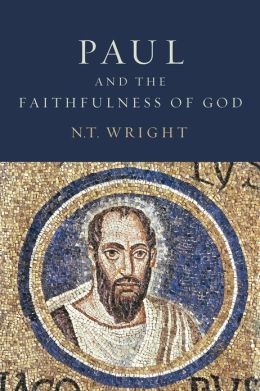
paul and the faithfulness of GodN.T. Wright is releasing his big book on Paul Paul and the Faithfulness of God in his ‘Christian Origins and the Question of God’ series. It’s so big, that, in fact, it’s two books on Paul, each of which could be two books (2 volumes weighing in at 1700 pages.) Now, of course, this is the only excuse that I’ll accept given how long he’s taken to write it (10 years since RSG). In any case, I’m beyond excited to read this beast for multiple reasons, but as I was scanning through the table of contents (posted online), I was reminded of one of the biggest reasons I love reading Wright: he refuses to limit Paul’s horizons. His first volume is a few hundred pages simply tracing NT background in multiple fronts: Greco-Roman philosophy, Rome, and the OT/2nd Temple Judaism. He doesn’t get to Paul’s theology proper until the second volume!

See, for some Pauline scholars it’s all about Greece. Paul is a Hellenized Jew who is engaging and appropriating language and thought from the world around him to speak of Christ to the Greeks. For others, it’s all about Rome, and Paul is preaching a serious, counter-imperial Gospel that cuts to the heart of Roman political culture. And still, for others, he is chiefly an OT theologian, transformed by Christ, who is engaged in demonstrating Jesus as the Jewish Messiah who fulfills all the prophecies and, bringing about reconciliation with the Gentiles. For Wright it’s about Paul the OT theologian, transformed by Christ, apostle to the Gentiles, engaging Rome, and the surrounding Hellenistic culture with the Gospel of Jesus.

‘Gospel’ Backgrounds: Isaiah or Rome?
You can see this approach at work in an article of his on the gospel in Galatians. He notes that typically, exegetes have wanted to understand Paul’s use of the word ‘gospel’ (euangelion) in relation one of two backgrounds: Isaiah or Rome. Wright notes that the approaches are favored usually either by those who see Paul primarily as a Jewish thinker, or a Hellenistic one, respectively.

Gospel in Isaiah
In the septuagint, the Greek translation of the OT, the prophet Isaiah declares:

Get you up to a high mountain,
O Zion, herald of good tidings (ho euangelizomenos Zion);
lift up your voice with strength,
O Jerusalem, herald of good tidings (ho euangelizomenos Ierosaleme)
lift it up, do not fear;
say to the cities of Judah,
‘Here is your God!’ (40.9)

How beautiful upon the mountains
are the feet of the messenger who announces peace,
who brings good news,
who announces salvation.
who says to Zion, ‘Your God reigns’. (52.7)

These passages talking about God returning to Zion as king, the return from Exile, the defeat of Israel’s enemies (Babylon, etc), and so forth. They are majestic passages of national hope that were taken up in the 2nd Temple period (Wright cites a number of texts here) as foretelling a future day of salvation and good news where God would return and become King in their midst. And, of course, it’s easy enough to see how Jesus fits in as the fulfillment of all of this.

Gospel in Rome
Of course, there’s a pretty good case to be made for the Roman context as well. To quote Wright directly and save myself some time:

In the Greek world, ‘euangelion‘ is a technical term for “news of victory”’. More specifically, it refers to the announcement of the birth or accession of an emperor. Not least at the time of Augustus, who became the first Roman emperor following a long period of civil war, the coming of a new ruler meant the promise of peace, a new start for the world:

The providence which has ordered the whole of our life, showing concern and zeal, has ordained the most perfect consummation for human life by giving to it Augustus, by filling him with virtue for doing the work of a benefactor among men, and by sending in him, as it were, a saviour for us and those who come after us, to make war to cease, to create order everywhere. . . ; the birthday of the god [Augustus] was the beginning for the world of the glad tidings that have come to men through him. . .

In which case, you can see where the whole counter-imperial thing comes from. In this view, Paul’s gospel is: “These things are not true of Caesar, but of Jesus, the world’s true Lord, whose birth was real good news.”

Yes and Yes
Now, I’ll have to admit, both of these answers were tempting to me while I was younger. As a good Evangelical boy, I knew Jesus was the fulfillment of OT prophecy even if I hadn’t read too many of them. Then, when I was a bit older, all of the counter-Imperial stuff made a lot of historical sense as well, plus it sounded awesome. (I’ll just be honest, when you’re 20, being against Empire is sexy.) In fact, it’s what I favored most, until the last few years when I really started to see just how deep the Old Testament thread ran, especially with works by G.K. Beale and such. Not that I’d rejected seeing Paul’s gospel engaging with the wider thought-world, but it hasn’t been a focus.

Still, reviewing this passage reminded me of why I fell in love with Wright as an exegete and historian, and why I’m looking forward to this new book:

Which of these backgrounds, then, is the appropriate one against which to read the New Testament evidence? Is ‘the gospel’, for Paul, an Isaianic message or an Imperial proclamation? I suggest that the anti-thesis between the two is a false one, based on the spurious either-or that has misleadingly divided New Testament studies for many years

Yes, he just called out a false either/or (which is a great way to make me your fan) in NT studies, and moves on to a constructive solution that has the best of both worlds.

Wright pushes us to understand Paul as the OT theologian who takes the Gospel of Isaiah and uses it to answer the Gospel of Rome. He points out that the 2nd Temple Jews didn’t live in ‘water-tight’ worlds closed off from the surrounding cultures, nor the OT Jews for that matter. The Gospel of Isaiah was always about God’s true Kingship over and against the pagan rulers like Babylon, and later, for 2nd Temple thinkers, Greece and Rome. What’s more, the false bracketing between ‘religious’ and ‘secular’ that often underlay efforts to split the two backgrounds, makes no sense when Emperors and Kings are claiming divine honors.  Again, it was always about the Servant King who would come to conquer Israel’s enemies and reestablish God’s rule where the pagan pretenders were claiming what was his alone.

So, with that in mind, how much of a stretch is it to see Paul, the OT theologian and 2nd Temple thinker, applying the Gospel of Isaiah, in a fresh and Christ-centered way, to the Gospel of Rome? In other words, (and I think I’m stealing this from Wright), you have to imagine Paul with both feet planted firmly in the OT, staring out at the Greco-Roman world, proclaiming the Gospel of Jesus the Lord promised to Israel to a world that thought it already had one.

As Wright puts it:

The more Jewish we make Paul’s ‘gospel’, the more it confronts directly the pretensions of the Imperial cult, and indeed all other paganisms whether ‘religious’ or ‘secular’. It is because of Jewish monotheism that there can be ‘no king but god’…The all-embracing royal and religious claims of Caesar are directly challenged by the equally all-embracing claim of Israel’s god. To announce that YHWH is king is to announce that Caesar is not.

Basically Paul was saying, “You think your Caesar is the King who brings salvation? I’ve got real good news for you, one that’s been promised for ages, Jesus, the Servant King of Israel is the one whose rule brings true salvation.”

That works nicely doesn’t it?

Paul’s Gospel and Ours
This is part of why I like reading Wright on Paul. Despite my qualms, which are real enough, on what he has to say about justification, (I prefer Michael Bird’s Reformed-Hybrid view) he is still one of the most faithful, creative, thorough, and helpful exegetes of Paul out there. He gets that while Paul was an apostle called to deliver the Gospel with divine authority, he was still a genius who expounded it with great intricacy and care. What’s more, he’s not just a dry academic, but a churchman who wants to present pastors with a vision of how to preach this stuff. In a sense, his vision of Paul as OT theologian looking to proclaim the biblical Gospel of Jesus to the pagan world around him, helps him present Paul as a model for pastors looking to do the same thing today.

If you’d like to learn more about the upcoming book, I’d suggest this interview with Michael Bird and N.T. Wright.

Soli Deo Gloria

Creation, Covenant, Curse, and the Seed of the Woman (The Story Notes #2)

My church is, across all departments, going through The Story, a chronological, abridged edition of the Bible that takes you through the story of Scripture from Genesis to the end of Acts in 31, novel-like chapters. It’s a fun project that’s challenging me to deal with narrative sections, teach large chunks at a clip, and point my kids to Christ throughout the whole redemptive-historical story-line of the text.

That said, it seemed worth it to start posting my notes for these talks on a regular basis. It might happen every week, or not, depending on how helpful I think it is, or time constraints. My one request is that you remember these are pretty rough notes and I’m teaching my students, not a broader audience.

Last week we talked about Genesis 1 and the picture it gives us of the God who stands at the beginning, middle, and end of the story. If last week was the first act (Creation), we’re going to dive in and look at that act again from another angle, as well as the second act, the Fall and where we fit into things.

the-garden-of-edenGenesis 2-3

I don’t know if you’ve noticed this, but vacation is good for about a week, maybe two. After that we start to go stir-crazy. Something in us desires to do something with actual meaning and purpose. We need to take something up, a cause, a piece of wood to carve, or an idea to flesh out with pen and paper, but we need to do something. We’re task-oriented beings at core. That’s part of what this text is about. It’s about our purpose, our place here in the cosmos.

But first, to understand the human task, you have to understand the human set-up.

God Sets Us Up in The Garden – Remember last week we said that God created the world and everything in it as his Temple, the place where he would dwell with his people? Well, these first sections describe the Garden of Eden as a Temple. It’s got everything that is needed for the Temple, including gold, onyx, the right kind of wood, water, garden stuff. Actually if you follow the language used of the Temple and the Tabernacle in the Law, if you read it, it all mirrors the language we find here in the Garden. The Temple was supposed to mirror the Garden in that it was the place that God dwelt and the Garden was a sort of proto-temple.

Now, beyond that, it’s a sweet set-up. God gives us EVERYTHING. There is food, there is beauty, there is companionship between the man and the woman. It truly is the definition of paradise (minus the resort hotel.) But…that doesn’t mean God put them there to sit around.

For a Task – We see that God makes man and woman, male and female in his Image in Genesis 1. That means that there is something about humans that distinguishes us from the animals and puts us in a place of authority whereby we are to run the world the way God would as his representatives. Well, the same thing is true here in Genesis 2.  That’s what the naming the animals thing was about. It’s Adam assuming his authority, to rule the creation. In other words, he’s starting his job.

What that means is that central to our identity is work. This is weird for a lot of us.

N.D. Wilson points out that a lot of us think that if we were just born into the garden, life would be easy. We think that work is there only because of the fall and sin. That’s not true. This is Genesis 2. Sin hasn’t happened yet. Life as God intended it is good, but part of the good life, is good work. We are inherently task-oriented beings, called to be God’s priest-kings. It makes sense, though, right? God works, so we work. We are made for relationship, yes,  but we’re also made for a job. Two jobs, in fact.

Priest-Kings – First, we are to spread the Kingdom of God or God’s Garden-Temple and second, we are to keep it free from the serpent. Adam is placed in the garden to “cultivate (abad)” and “keep (samar)” it (Gen 2:15). The same two words are translated elsewhere “serve” and “guard”, and when they appear together, they are either referring to Israelites serving or obeying God’s word, or more usually, to the job of the priest in guarding and keeping the Temple. (Num. 3:7-8; 8:25-26; 1 Chron. 23:32) .  In those days, the task was to keep God’s garden ordered, and some theologians (e.g. G.K. Beale) argue, to expand it into the deserted areas, sort of advancing the Kingdom of God as we went. God forms and fills the earth, so we do as well.

Next, we were also born to a fight. We forget that before we fell, we had an enemy. Before we sinned, we had an opponent, the Serpent, or the one the serpent represents, Satan.  See, just as the priests were supposed to keep the Temple precincts clean from pollution Adam’s job was to keep the garden free and clean from the corrupting elements of the Serpent, the Dragon.

This is why our hearts resonate when we see these stories about a task, an adventure, a goal, a fight, a great job to build, or grow, or make beautiful all things. It’s what we were created for. We were made to expand the Garden, to create culture, to fight evil and spread beauty throughout God’s world, just as God does.

The Structure of the Job (Covenant) – Now, there was a structure to the task. See, if we look at the text, it actually shows us that our relationship with God was structured like an ancient covenant treaty. What’s that? Well, it’s kind of an established relationship between a Sovereign King, and a sub-king. The King would protect and bless the sub-king and the sub-king would be loyal and serve the great king. If you compare the text to the ancient copies of these treaties, there is a marked structural similarity:

Now, these are the typical features and how it matches up with what we see in Genesis 2:

  1. Parties Named (the Lord God and the humans)
  2. History of relations (Here’s God giving you everything)
  3. Stipulations (Keep the Garden, Don’t eat from the Tree)
  4. Blesses and Curses for obedience (Tree of Life and eventual immortality, Curse of death)

So, Adam and Eve are the sub-kings promised blessing for obedience and cursing for disobedience. The idea is “you will have eternal Sabbath and life if you keep the garden, obey God’s commands and enjoy all that you’ve been given. But, If you disobey and eat from the tree of the knowledge of good and evil, you’re breaking covenant and bringing death on yourself.” Sounds pretty simple right? Good deal? Yeah, it was. Until this happened.

Re-read Chapter 3:1-11

The Lie and the Fall –  We don’t have time to go into all of this, but what was the Serpent’s basic lie? “God is holding out on you. If you’re going to have the life you deserve, the one you need, you’ll have to take it for yourself apart from God’s command.” This is absurd on multiple levels. In light of what we just read, the idea that God is holding out is ridiculous, right? He gave us everything plus the promise of eternal life, right? But we fell for it. We still do. We still believe if life is going to be good, we need to take control and take what we need for ourselves.

That’s kind of what the tree of the knowledge of good and evil is about.  Some think that eventually we would eat from it, when we were ready and had proved faithful, at the time that God appointed. But for now, it remained a test: whether we are going to trust God for our knowledge and life, or if we are going to try and rule our own lives as if we were the great king, instead of just the sub-kings who learn from God what is right and wrong. Will we rule as God would, or will we make up our own rules and take what we think he’s holding out on us?

The Fallout – Now, what could have happened was God could have just killed us right there.  I mean, that’s what he said. That would have been justice. But, but…God is gracious. You might not see it, but what God says next is actually grace.

(Read the curse, Gen. 3:14-24)

Everything is cursed because of them, human relationships, our ability to take delight in our work, and nature itself. In a sense, as they were the King and Queen, like the first link a chain, their fall, their disconnection from God took everything down with them. Now, the grace of this is that, well, again, he didn’t just end it. He let life go on when he could have snuffed it out there.

The second grace is that God frustrates all of our possible attempts of living our lives apart from him. If relationships were perfect, we could make them into gods. If work was perfect, we could make it into a god, that we trust for our happiness and joy. God looks at us and says, ‘I will not let you settle for less. You will try to worship created things, but I will frustrate your efforts to rob yourself of your thirst for a knowledge of me.’ That is grace.

The Hope – Now, looking at things, how do things go forward? God gave them a task, but history has stopped. They believed the lie and fell into sin. They were supposed to keep the garden and defeat the snake, but now they’ve been kicked out of the Garden and been defeated by the snake. God didn’t end it, but on their own, it was still hopeless. On their own, they were out on their luck.

So where does the story go from here? How does it move forward, when Adam stopped it up with sin? With God’s word. That’s how it always works. Creation happened at God’s word and so does the rest of the story.

Curse to the Snake, Promise to the Woman – There is a line here in the pronouncement of God to the snake that is a curse to the snake, but promise to the woman. It says that the ‘seed of the woman’ will crush the Serpent’s head. See, now that’s a weird promise because everywhere else in scripture, ‘seed’, which refers to an heir or progeny, is related to a man. So, it would be ‘Adam’s seed’, or ‘Joseph’s seed.’ But here, it is the seed of the woman who would conquer the Serpent.

Now, back then it could have only been a tantalizing mystery, but for us today, this side of Jesus, we realize that the Seed of the woman refers to Mary’s Son, the great descendant Son of Adam and Eve. Jesus is the who comes to rescue us from the plight we were in.

Jesus is the hope of Adam and Eve and the rest of the world. We’ll continue to see this later on, but Jesus is the new Adam who does right all that Adam did wrong. He is the priest who spreads the presence and kingdom of God throughout the world, like Adam was to do in the Garden. He is the king who defeats Satan the Serpent, and rids the world of his pollution.

And how does he do it? He does it by suffering the curse for us. See, it says that the serpent will bruise his heel.  When Jesus went  to the Cross, the Serpent was going for his heel. But he didn’t know that by going to the Cross Jesus was lifting his heel up to crush his head. The irony is that on the Cross, Jesus suffered the judgment that our sin deserved, the curse that God said would come on Adam. By doing so, he  suffers it in our place and then, passes on the blessings that He actually earned by obeying what Adam was supposed to. This is what we call substitution. Jesus gets what we deserve and we gets what he deserves. In this way, he overcomes the Serpent’s lies and tricks that lead us to death, and gives us life.

This is grace. This is salvation. This is our hope.

Wrap-up – I don’t know where you’re at tonight, but I do know this: you were made for a task. God put you here for a purpose, but like our spiritual parents, you and I have believed the lie that God was holding out on us and have brought death into our lives by trying to get happiness for ourselves. The challenge might be different for all of us tonight:

  1. Stop believing the lie that you need to provide life for yourself and believe that God is good and has given you all you need in Jesus.
  2. Get up and realize that you were made for more than you’ve settled for. You were created for a task, for a fight, for a life that reflects God’s will for the world.
  3. Trust that Jesus has defeated our enemies, taken the curse, and that you’re not disqualified from that calling.

Or again, maybe the challenge is just to worship the great Priest-King, and praise him for his glorious victory over the Serpent, the Dragon. He has conquered through the curse and crushed our enemies’ head!

Soli Deo Gloria

Jesus’ Favorite Book

torahSadly, for orthodox Christians who would readily confess Christ’s divinity and humanity, it’s very easy to forget Jesus was a real person sometimes. By that I mean that he probably had a lot of the normal personal tastes, likes, dislikes, and so forth, that we would think of. He probably had dishes that Mary made he was particularly fond of, or stories Joseph told that he loved best, or friends up the street he would duck out to go play with. You might even imagine that there were spots he loved to go think, or hide away, much as we all do.

That we forget this is tragic because it robs us of part of the glory of the Gospel that God became man, a specific man, at a particular time and place, who could fully identify with the experience of being a human person.

I was reminded of this the other day when I ran across a remarkable quote by Christopher Wright in David Murray’s book Jesus on Every Page on Jesus and the Old Testament.  He quotes Wright at length:

In the midst of the many intrinsically fascinating reasons why Old Testament study is so rewarding, the most exciting to me is the way it never fails to add new depths to my understanding of Jesus. I find myself aware that in reading the Hebrew Scriptures I am handling something that gives me a closer common link with Jesus than any archaeological artifact could do. For these are the words he read. These were the stories he knew. These were the songs he sang. These were the depths of wisdom and revelation and prophecy that shaped his whole view of ‘life, the universe and everything.” This is where he found his insights into the mind of his Father God. Above all, this is where he found the shape of his own mission. In short, the deeper you go into understanding the Old Testament, the closer you come to the heart of Jesus. (After all, Jesus never actually read the New Testament!)

–Christopher J.H. Wright, Knowing Jesus Through the Old Testament, pg. ix

I’d never really thought about it that way, but the Bible was Jesus’ favorite book. (Now, being a peasant, I’m not sure that he had access to many others, but that doesn’t change the point.) When you’re reading the Old Testament, you’re reading words that Jesus read, sang, prayed, dwelt on, meditated over, struggled with, memorized, and loved.

When we were dating, McKenna and I made up a list of movies we wanted the other to see because they were particularly important to us. Watching those movies together was as experience we wanted to have with each other, yes because we liked the movies, but at a deeper level, because we felt that they revealed something about us to each other. In a similar way (alongside of the theologically-thicker ways), when you dive into the Old Testament, you’re learning something the very human Jesus who walked the earth 2,000 years ago. As Wright points out, this is just one more reason for us to dive into the Old Testament.

Of course, the joy of that is that is not to feel closer to someone who lived and loved a very long time ago. The still very-human, though resurrected and ascended, Jesus still loves those texts, has revealed himself in them, and promises to give himself to us through them if we will only meet him there.

Soli Deo Gloria

Calvin Explains Chalcedonian Christology in Two Paragraphs

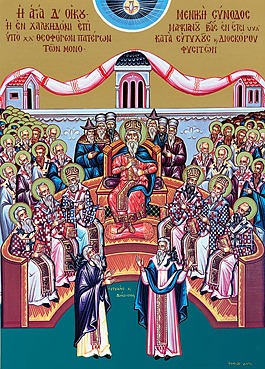
chalcedonAfter much controversy and struggle in the Church, the Council of Chalcedon (451 AD) put out a formal definition on person of Christ, regarding his full divinity, humanity, and the union of the two natures. While not exhausting the depth and beauty of the person of Christ, it lays down important boundaries within which theologians must stay if they are to properly teach the glory of the Son who took on flesh for our salvation.

Chalcedon has stood as the bulwark of orthodox-catholic Christology across traditions for a millenia and a half, and yet, while lengthy expositions of it are available, it still takes some time digging to find a good, clean summary explanation of what the Definition actually says. That’s why I was pleased to find this passage in Calvin’s comments on John 1:14, “and the Speech* (Word) became flesh, and dwelt among us”, in which he briefly and clearly expounds the scriptural truth that Chalcedon teaches:

The plain meaning therefore is, that the Speech begotten by God before all ages, and who always dwelt with the Father, was made man. On this article there are two things chiefly to be observed. The first is, that two natures were so united in one Person in Christ, that one and the same Christ is true God and true man. The second is, that the unity of person does not hinder the two natures from remaining distinct, so that his Divinity retains all that is peculiar to itself, and his humanity holds separately whatever belongs to it. And, therefore as Satan has made a variety of foolish attempts to overturn sound doctrine by heretics, he has always brought forward one or another of these two errors; either that he was the Son of God and the Son of man in so confused a manner, that neither his Divinity remained entire, nor did he wear the true nature of man; or that he was clothed with flesh, so as to be as it were double, and to have two separate persons. Thus Nestorius expressly acknowledged both natures, but imagined two Christs, one who was God, and another who was man. Eutyches, on the other hand, while he acknowledged that the one Christ is the Son of God and the Son of man, left him neither of the two natures, but imagined that they were mingled together. And in the present day, Servetus and the Anabaptists invent a Christ who is confusedly compounded of two natures, as if he were a Divine man. In words, indeed, he acknowledges that Christ is God; but if you admit his raving imaginations, the Divinity is at one time changed into human nature, and at another time, the nature of man is swallowed up by the Divinity.

The Evangelist says what is well adapted to refute both of these blasphemies. When he tells us that the Speech was made flesh, we clearly infer from this the unity of his Person; for it is impossible that he who is now a man could be any other than he who was always the true God, since it is said that God was made man. On the other hand, since he distinctly gives to the man Christ the name of the Speech, it follows that Christ, when he became man, did not cease to be what he formerly was, and that no change took place in that eternal essence of God which was clothed with flesh. In short, the Son of God began to be man in such a manner that he still continues to be that eternal Speech who had no beginning of time.

Commentary on John 1:14

The whole section is worth review as Calvin deftly comments on controversies both ancient and contemporary to his own day. Indeed, as challenges and confusions about just who Jesus is continue into our own, students and disciples of the Word would benefit from listening into the disputes of another age. While they’re framed in different ways, they are often-times structurally similar such that hearing the answer discussed in a context less immediate and personally-charged for us, can cast a clearer light for our own days.

Of course, the point of all this is not mere doctrinal correctness, but the life of doxology that follows. Christ is not properly worshipped and glorified, unless his magnificent person is properly taught and displayed according to Scripture.

Soli Deo Gloria 

*Calvin follows Erasmus in rendering the word ‘logos‘ as ‘Speech’ instead of ‘Word’. For his explanation, see his comments here.

Genesis 1: Meet the Author (The Story Notes)

My church has begun a church-wide, across all departments, study through The Story, a chronological, abridged edition of the Bible that takes you through the story of Scripture from Genesis to the end of Acts in 31, novel-like chapters. That’s what I’ll be teaching through with my college student for the next 9 months or so. It’s a fun project that’s challenging me to deal with narrative sections, teach large chunks at a clip, and point my kids to Christ throughout the whole redemptive-historical storyline of the text.

That said, it seemed worth it to start posting my notes for these talks on a regular basis. It might happen every week, or not, depending on how helpful I think it is, or time constraints. My one request is that you remember these are pretty rough notes and I’m teaching my students, not a broader audience.

Well, with that intro out of the way, here’s Genesis 1.

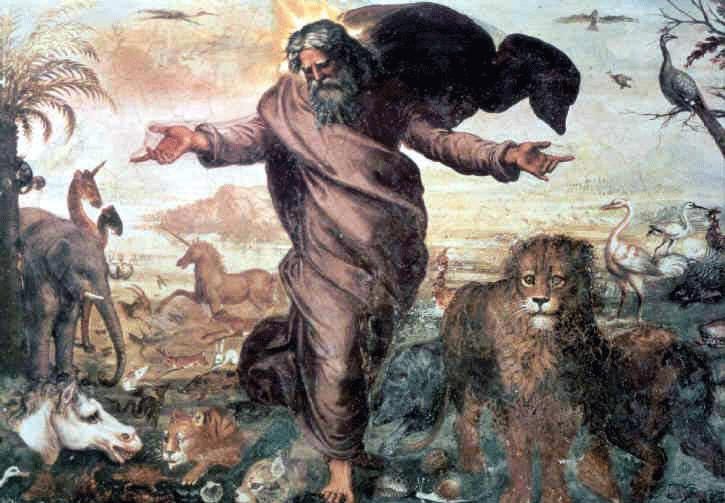
God-creating-creatures-by-RText: Genesis 1:1-2:3

Alright,  I’d like to have some nice fluffy intro, but there is so much to say here and  I can’t, which I hate so I’ll just start in. Note right off the bat, this is a beautifully-structured passage. Read it out loud like we just did and you notice it is a carefully constructed, poetic, balanced presentation whose structure has been arranged, measured, and given a rhythm and weight to it. This is not strictly Hebrew poetry, but it’s not just prose either. You’ll notice the repetition of key words and phrases over and over again with minor variations here.

There is a careful structure here built around sevens, which I wish I could go into in detail here, but let me ask you, which word stood out the most in that passage? What dominated it? There’s a lot of repetition and rhythm, but what was the center, the core, the heart of the passage?

“God”, right? I don’t know if any of you counted, but the word “God” is repeated 35 times, a multiple of 7, the number of perfection in Scripture. So, if you weren’t sure what the passage was about, very clearly, right out the gate, you see that, while there’s a lot going on, and we’ll get to some of it, at the center of the passage. and actually, the beginning and the end, stands God.

I make this point bluntly at the beginning because we’re going through the Story of the Bible and one thing you have to get clear if you’re going to understand it is just who the main character is and what is he like. If you think Gollum is the main character of LOTR you will be quite confused and disappointed at the ending, and well, throughout the novels. Or, if you understand that Frodo is the main character, but are under the impression that he is a wizard instead of a hobbit, you’ll be confused as to why he doesn’t magic himself out of certain situations. In the same way, if you miss that God is at the center of the story, and exactly what kind of God you’re dealing with, you’ll be rather confused as you read along.

So, it matters to know that this passage, and indeed, the series as a whole, is about God. This is what we’re trying to get out of this series: a knowledge of who God is, and really of God himself. Now, this passage presents to us a bit about who God is, by showing us the big thing that God ‘does’ to get the whole story going. And it tells us some key things about him that I just want us to start off with:

1. There is one God, ruler of all. – Against the ‘gods’ of the pagans and the polytheistic world, the Hebrew Scriptures testify to one God, sovereign ruler of all. In the Ancient Near East, the dominant creation myth had two gods fighting (Marduk and Tiamat), with Marduk coming out on top, killing Tiamat and creating the world out of her dead body, and human slaves out of her blood, with a pantheon of support gods behind him. In opposition to this, Genesis gives us a picture of a single God who simply commands things into existence. There is no cosmic battle, or fight, but the simple ordering of King God’s world. The stars, the moon, the sun that your neighbors worship? Those are lamps and clocks that Yahweh hung up in the sky. He is incomparable and unique. There is nothing and no one like him.

2. He is the Creator, not the creation. – God made stuff, he is not the stuff. Unlike some strands of modern New Age thought that says that God is the universe, we see that God made the universe. It all bears his mark, but he is not contained within it. Which is why he knows it inside out and is all-powerful over it. He made time and space so he is not contained by time and space. There is no limit to him. He is present to us here and now, but is not limited to here and now.  Something else that flows from this, is that the stuff is HIS stuff. All of it. Also, the stuff is good because he made it. The world is not something to be scared of, but enjoyed as his creation. (Next week we will talk about the fall and how things go bad.)

3. God is a Speaking, Communicating God – How does God make the world? God creates all things by speaking it into existence. He is, essentially, a communicator even in the way he creates. He ‘makes common’ the quality of existence to things that don’t exist yet. This also means that he is a God who can make himself known to us. We get skeptical about this nowadays because of our smallness, and our sinfulness, which is real. We start to doubt that we could ever really know what God is like, especially since so many people have different ideas about God. All we have are guesses.

Now, that sounds humble enough at first, but it denies what we see here in the text: that if God is a God who can effectively bring the world into existence through his words, so he can make himself known to us through his words. No, we can’t figure him out on our own, but God can make himself known to us.  And, in fact, part of our being made in his Image means that we can understand him when he does (apart from sin.)

4. God is Triune – This one is really the most important and undergirds and is revealed in the others. The sovereign King God who alone exists and is not creation but speaks it into existence has revealed himself as the Triune God: Father, Son, and Holy Spirit. To see this, we only get hints here in the text (The Spirit, hovering) but if you turn to John 1:1, you read “In the beginning was the Word, and the Word was with God, and the Word was God. He was in the beginning with God. All things were made through him, and without him was not any thing made that was made. (John 1:1-3, ESV)”

We see that the one God who is before all things and made all things, made it through his Word and Spirit. The fact that the world was made through the Spirit and By the Word, means that they are not the world–they are eternal God alongside the Father. See, from all of eternity, God has been Father, Son, and Holy Spirit, delighting in perfect community. This tells you something about why God created: he didn’t need us. He was perfect and complete, full of joy, love, and endless life. He was not lonely or needy. He did not make us to amuse himself or because eh needed help with things. His life is perfect apart from us. He created the world with a good purpose, though, to share himself with us.

5. God is a God of purpose and that Purpose is to Dwell With Us – To dwell with us. God created all things with a rhythm, a pattern, a meaning, an order (6 days). We saw that earlier. What I didn’t go into yet, was the two-part structure of the first 6 days of Creation. See, if you pay attention closely, you’ll see that what God does in the passage is first, create creation kingdoms (Light & Darkness, Waters & Skies, Land), and then, the next three days he creates creation kings who ‘rule’ or keep the areas (Sun & moon, Fish & birds, animals & Humans.).

More importantly, what we have to see is that the picture we’re getting is of God the King, constructing a palace, a Temple to dwell in and ‘rest’ on the ‘Sabbath’ of creation as the Creator King.  This is what anybody in the ancient Near East would have heard. At the end of those stories, the king god would always set up shop in their palace-temple and begin their rule. Here, we see the Creator King has finished establishing his kingdom and setting up his sub-rulers and so now he will dwell in his palace-temple. In this case, the whole world. (For more on this, see here.)

The idea is to dwell in the Temple of Creation with his creations. This is, in fact, why he creates us. The idea is that he wants to dwell with us to share himself with us and bless us. For us to enjoy him, know him, and enjoy the world that he made in the way that he intended us to.

That said, we are not the point of this text. We’re important. We come at the crown, we’re significant, more so than the rest of the creation, but let’s be honest, we’re still not the point. God is. We exist for God, by God, to God, in God’s Image. He makes all things and provides all things for us, but we are his. We are supporting characters.

And here’s the Problem – We tend to forget all of this. We tend to put ourselves at the center of the story, time and time again. We’ll talk about that next week in more detail when we come to the story of Adam and Eve and the fall. Still, we tend to put ourselves at the center of the story which screws with our ability to see the story for what it is. All of the problems we encounter become our problems to solve. All of the blessings in our life are our gifts to ourselves. All the purpose we have is whatever we’ve chosen for us. All of the good, the bad, the ugly, the weird, etc. is now on us or for us and to us, and the whole thing starts to lose it’s shape.

The biggest tragedy of all is that when we put ourselves at the center, we lose our ability to see GOD for who he is. It’s like losing the north star at sea, or forgetting who you’re married to, or losing equilibrium and living your life off-balance. When you lose sight of God, your life starts to lose shape.

In the Beginning –  This is what Jesus came to do: to put God back at the center of the story for us.

The true light, which gives light to everyone, was coming into the world. He was in the world, and the world was made through him, yet the world did not know him. He came to his own, and his own people did not receive him…And the Word became flesh and dwelt among us, and we have seen his glory, glory as of the only Son from the Father, full of grace and truth…No one has ever seen God; the only God, who is at the Father’s side,he has made him known.(John 1:9-11, 14, 18 ESV)

This God makes himself known, not just in general, but in one way. It’s not just ‘god’ but the God of Jesus Christ. He is the one through whom God made the world. And what we see here in John is that his purposes for Creation are reaffirmed through the life and ministry of Jesus Christ, the incarnate Son. He came to the world he made, and although we denied him, he decided to dwell with his creation that he made.

I don’t know what you needed to hear tonight. Maybe you needed to be reminded that you don’t set the grid for your life? That you are not the one setting the agenda? Maybe you needed to remember that God is bigger than your problems? Maybe you need to remember that the God who made all things can re-create the broken pieces? Maybe you need to be reminded that God’s purpose in Christ is to dwell with you? Or maybe, just maybe, you just need to take this time to worship, praise and adore something greater than yourself.

Listen to the Spirit speaking of the Son who points us to the Father, says in his written Word. Amen.

Soli Deo Gloria

‘Substance’? ‘Hypostasis’? But Those Words are Un-Biblical!

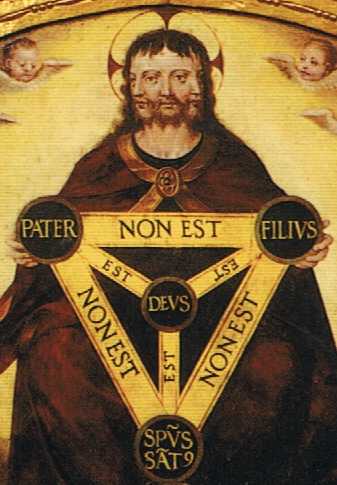
MostHolyTrinityStudying church doctrine can be a challenging endeavor for many of us, even those of us with a deep knowledge of Scripture and a desire to grow deeper in the faith. One issue that comes up frequently for students of a more Biblicist bent is: why all of those goofy, non-biblical words?

I mean, if you’re not familiar with, say, trinitarian theology you end up with all kinds of Greek and Latin words like ‘substance’ or ‘hypostasis’, ‘persona’, and later on, ‘perichoresis’, and so forth. They start to make sense once you’ve read someone explain them about 20 times. Thing is, though, most of those words don’t show up in our translations of the Bible, and when they’re there, they seem to be used in different ways. Or, heck, the word ‘trinity’ doesn’t show up at all. Shouldn’t we be ‘biblical’ in the way that we speak and think of God? How can we do so with terminology taken from surrounding Greek and Latin philosophy and thought?

Calvin tells us that he wrote the Institutes partially so that he wouldn’t have to go into extended doctrinal discussions in his commentaries. Welp, that didn’t really slow him down from writing 4 or 5 pages on John 1:1, expositing the text and defending it from various heretics old (Sabellian, Arian), and new (Servetus.) In the middle of this fascinating discussion, he touches on the issue of non-biblical language.

Now, conservative Reformer that he is, not given to excess or speculation, you might think he would want to do away with all of this jargony mess. Thankfully, he was smarter than that:

I have already remarked that we ought to be sober in thinking, and modest in speaking, about such high mysteries. And yet the ancient writers of the Church were excusable, when, finding that they could not in any other way maintain sound and pure doctrine in opposition to the perplexed and ambiguous phraseology of the heretics, they were compelled to invent some words, which after all had no other meaning than what is taught in the Scriptures. They said that there are three Hypostases, or Subsistences, or Persons, in the one and simple essence of God. The word; ὑπόστασις (Hypostasis) occurs in this sense in Hebrews 1:3, to which corresponds the Latin word Substantia, (substance) as it is employed by Hilary. The Persons (τὰ πρόσωπα) were called by them distinct properties in God, which present themselves to the view of our minds; as Gregory Nazianzen says, “I cannot think of the One (God) without having the Three (Persons) shining around me.”

–Commentary on John 1:1

He points out what Fathers like Athanasius and Augustine had before him: heretics can use ‘Biblical’ language too and use it in ‘ambiguous’, ‘perplexed’, and non-Biblical ways. For that reason, the Fathers were compelled to take language and deploy new words in order to save the meaning of the Biblical record. These were new words used to say more clearly in a foggy and confused time, what Scripture was saying. They did not do this at random or haphazardly. Nor did were they careless to leave undefined, or distinguish the sense in which they used the term from other possible senses.

I think it was N.T. Wright who somewhere used Copernicus as an analogy: say Copernicus had never given a term to his system at which the sun was the center of the universe instead of the earth, and 200 years later someone came along and dubbed it ‘heliocentric.’ Have they misrepresented Copernicus by using that new term that he did not? By no means. They simply gave it a new name in order to keep it clear. In the same way, the Fathers of the Church, guided by the Spirit, in conformity with the Word, developed ways of speaking that preserve and protect the content of Scripture even when not directly drawn from it.

This is the truth that Calvin recognizes and calls us to appreciate here. For that, thoughtful students and spiritual descendants ought to be humbly grateful: both for the work of early teachers like the Fathers, as well as for faithful preservers of the tradition like Calvin.

Soli Deo Gloria 

For more similar thoughts check out:

B.B. Warfield on the ‘Unbiblical’ Doctrine of the Trinity
Vanhoozer and Calvin on the Creeds and Scripture