Gratitude: Leithart’s History of Western Philosophy According to Grandma’s Tureen

gratitudeI love a good intellectual history when I can get my hands on one. Intellectual histories, if done right, give you a solid blend of philosophical (theological, etc) engagement, history, and joy of a well-told story. That’s exactly what Peter Leithart delivers in his recent (2014) offering Gratitude: An Intellectual History. Many will know that the idea of “the Gift” has gotten a lot of attention over the 20th Century in philosophy, anthropology, and related fields. When anthropologist Marcel Mauss “rediscovered” the reciprocity involved in the process of gift-giving in the tribal culture of Polynesia and Melanesia, he kicked off a chain of reflection on the conditions and reality of the gift. What goes into making a gift a gift? What are the ties implied in the giving of the gift? Contemporaries tend to think of gifts as, of necessity, having “no strings attached.” But if every gift implies an obligation, a “debt” of gratitude, can there every truly be such a thing as a gift?

Leithart noticed a gap in the literature. While there’s no end of resources on the gift, there’s little that’s focused on the corresponding category: gratitude. Gifts and gratitude go together. But just exactly what that means, it turns out, has been a matter of debate and controversy over the centuries in the West. Gratitude hasn’t always been simply an issue of thank you cards after your wedding—indeed, it probably never has been simply an issue of anything. The circle of gifts and gratitude have made the world go round, encompassing everything from the deepest questions of political theory, interpersonal ethics, and the nature of the divine-human relationship itself. Paul, lest we forget, says ingratitude–not acknowledging God’s gifts for what they are–is at the heart of human rebellion against God (Romans 1).

Taking an expansive view, Leithart, then, aims to tell the story of the Western history’s various political, philosophical, theological, and cultural orientations towards the nature of gift and the corresponding enactment of gratitude. Guided by Leithart’s steady hands, we are led through a movement from circles of honor in ancient Greece and Rome, to the ingratitude of Jesus, on to the patron(age) saints of the Middle Ages, the disruptive ingratitude of the Reformers, an attempt to bend the circles into straight lines in modernity, and up through the methodological ingratitude of postmodernity. Summarizing this engagement is beyond me. That said, it’s not beyond Leithart to summarize himself. And that’s exactly what he does at the end of the work, using a delightful thought experiment: Grandma’s gift soup tureen.

Leithart asks us at the beginning of the book to enter into the dilemmas of gift of gratitude by imagining this situation:

Imagine that your beloved grandmother gave you a rather ugly soup tureen as a wedding gift. Seeing as you have no use for the tureen, how ought you respond? You would, of course, write an appropriately deceptive note of thanks, but what then? Would you box the tureen away and never use it? Would you use it to feed the cat? What if Grandma were coming for dinner? Would you let her see you using her gift to feed the cat?…Variations on the hypothetical can be spun out further…but the point is clear enough. Gifts, especially from a respected giver, carry something of the giver with them. (16-17)

Gifts carry a responsibility, then, of showing proper gratitude and an ethic that is associated with it.

With this in mind, Leithart decides to summarize his story by playfully imagining what a variety (though not the totality!) of the figures treated in his narrative would tell you about how to respond to Grandma’s ugly, gift tureen:

  • Aristotle would warn you that receiving the tureen puts you in a position of inferiority and that, if you want to be a virtuous and independent person, you should pay Grandma back with a bigger gift as soon as possible. Then forget you ever received the gift in the first place.
  • Cicero would tell you to follow accepted custom, take the gift, look for a chance to reciprocate, and expect that your good offices will advance your political career.
  • Seneca would encourage you to exaggerate the quality and beauty of the gift, to appear at Grandma’s door every morning to accompany her on her way to the grocery store, loudly celebrating her generosity at every stoplight. He would encourage you to look for the right time and way to repay her.
  • Jesus and Paul would tell you to honor and love Grandma, thank God with sincerity, and move on.
  • The Beowulf poet would encourage you to pass out soup tureens to your employees to display your largesse.
  • Calvin and Luther would tell you to thank God, while recognizing you do not deserve the tureen or your grandmother’s love. They would remind you that grace is a gift that can never be repaid.
  • Hobbes would tell you that you should receive the tureen in such a way that Grandma will never regret having given it to you, which means, do not use it to feed the cat.
  • Locke would say that you should thank her and show esteem for her, so long as her gift was not an attempt to influence your decision to vote Democrat.
  • Adam Smith would tell you that gratitude is a proper sentiment in response to something that give pleasure, like a tureen.
  • Kant would tell you that since Grandma gave first, you are obligated to her by a sacred duty, a debt that can never be repaid.
  • Kierkegaard would remind you that we are to thank God even in suffering.
  • Nietzsche would urge you to show gratitude especially if the tureen is ugly, to show Grandma how powerless she is to harm you.
  • Heidegger would mumble something incomprehensible in German, hike up his lederhosen, and leave with Nazi salute.
  • Mauss would be at the head of a gaggle of anthropologists warning you that there is no such thing as a free gift, that Grandma might return later to reclaim her property, and that her display of generosity is likely a power play intended to put you in her debt.
  • Derrida would say that you soiled the gift as soon as you said thank you.
  • Marion would strip the tureen to its essence of pure givability, and you and Grandma would both disappear into phenomenological vapor. (217-128)

And there you have it: the history of Western thought on gratitude, served up in Grandma’s tureen. If this hasn’t whet your appetite, I’m not sure what else I can say. I suppose I’ll say this: Peter Leithart has written first-rate book. It’s a gift for which I’m very grateful. (To God, of course.)

Soli Deo Gloria

People Disagreed With Jesus About the Bible Too

Jesus talking“Yeah, but there are so many interpretations of that text, so many denominations claiming that Scripture for their own, you can’t really say there’s a wrong way of reading it.”

If you’ve been in a Bible study or spent more than about 10 minutes surfing pop theology writings, you have probably run across a claim of this sort. The idea is that with so many different readings of Scripture, it’s either arrogant or hopeless to think we can come to a determinate, or correct understanding of it. In other words, the mere fact of interpretive disagreement ought to put us off from claiming very much for our interpretations of Scripture.

This sort of charge can take a couple of different forms.

First, someone can go full-blown, radical skeptic and just say that the text has no inherent, determinate meanings, only uses. Or maybe that it’s a springboard for our own thoughts about God and Jesus and so forth, but no more. In this view, the plasticity, the squishiness, if you will, of interpretation lies within the text.

Second, someone can say that the text means something(s), but the problem lies with us as readers. Given the variety of interpretations, it’s arrogant to claim that we know what it says. We’re fallen, finite, and therefore dubious readers. We ought not claim too much for ourselves. Now, I’ll come back to this, because it’s important to note there’s something to this point. We are sinners and that does affect things.

Here’s the main problem with these views when taken too far, though: Jesus’ own use of Scripture.

Over and over again in his disputes with the Pharisees and the Sadducees, Jesus appealed to the Scriptures in order to refute his opponents. One classic text is his debate with the Sadducees over whether there is marriage at the time of the Resurrection or not. They posed a “gotcha” question in order to trap him–which is always silly when you’re dealing with Jesus–and here’s his reply:

But Jesus answered them, “You are wrong, because you know neither the Scriptures nor the power of God. For in the resurrection they neither marry nor are given in marriage, but are like angels in heaven. And as for the resurrection of the dead, have you not read what was said to you by God: ‘I am the God of Abraham, and the God of Isaac, and the God of Jacob’? He is not God of the dead, but of the living.” And when the crowd heard it, they were astonished at his teaching. (Matthew 22:29-33)

The money quote is that line: “you know neither the Scriptures nor the power of God.” Jesus accuses them of being wrong precisely because they’re misreading the text that they apparently should have understood. And this isn’t the only time he says this sort of thing. Jesus constantly accuses his opponents as well as his disciples with missing what they should have seen in the text (Mark 7:13; Luke 24:25–26; John 5:39-40).

Jesus’ use of Scripture, then, presumes that the words of the Bible have a determinate meaning (which can be complex!) that can be read and discerned. Jesus isn’t flustered, or worried, nor does begin to expound a radical interpretive skepticism, simply because his opponents disagree with him. He just says they’re wrong because they got the text wrong. They didn’t know how to read it. He did.

That, at least, is rules out the first form of the objection.

You may still try to appeal to the second form, though. And as I said, there’s something to that one. Jesus speaks very clearly about human sin, blindness, and hardness of heart as obstacles that hinder reception and proper interpretation of the Bible. But to stop there ignores a number of realities, a couple of which we can only gesture at.

First, again, Jesus himself does appeal to Scripture in his arguments in such a way that presumes that, then and there, some of his hearers should be able to follow his argument.

Second, pushing deeper, we have to place our thoughts on interpretation within the broader sweep of Jesus’ work of salvation. Jesus doesn’t simply redeem our inner, spiritual souls, nor only our physical bodies, but also our created intellects. We forget that Jesus came to be the light that gives sight to the blind–and not only to those physically, but spiritually blind (Isa. 29:18; John 9). He does so by shining out as the Incarnate, Crucified, and Resurrected one, whose whole purpose was to be the one who reconciles and shows us God’s truth, by being God’s Truth with us (Matthew 1:23), who overcomes the darkness that did not recognize it (John 1).

Third, connected to this, Jesus commissions his apostles to preach and teach the gospel, making disciples on his authority, in his personal presence through the Holy Spirit (Matthew 28:18-20; Acts 1:7-8). As Jesus said to his disciples, to some it has been granted to know the mysteries of the kingdom of heaven (Matthew 13:11) through the preaching of the Word. He empowered those apostles to preach a Word which, through the work of the Spirit, overcomes even sinful resistance, lightening even darkened minds and hearts (Eph. 1:17). That is the same apostolic Word which is inscripturated in the New Testament. 

All of this is why we are commended to follow the example of the Jews in Berea, who we’re told were more noble than many other communities Paul encountered. Why? Because in their eagerness, they examined “the Scriptures daily to see if these things were so” (Acts 17:11). The Bereans are not berated as arrogant, proud, or interpretively naive. They are faithful in their desire to do the hard work of trusting that in the Scriptures God has spoken in a way that he can be heard if we would but listen.

None of this, of course, removes the difficulties involved with the reality of plurality in interpretation. It does put the brakes on us simply tossing our hands up in the air every time we come upon a disputed verse or issue. There is truth in the text and we can know it. Why? Because Jesus said so.

Soli Deo Gloria

7 Things Hebrews Says About Jesus (Or, Condensed Christology)

christ pantokratorThe New Testament is chock-full of stunning passages on the nature of Christ. Capable of standing alongside such texts as John 1:1-17 or Colossians 1:15-20, we face the opening lines of the epistle to the Hebrews 1:1-4. While we don’t know who the author of Hebrews was, nor the exact time and setting of the letter, it’s very clear that he had one key purpose in writing to the churches: strengthen, secure, and refocus their faith in the supremacy and sufficiency of Jesus Christ.

In order to do so, he’ll engage in lengthy arguments about his supremacy to angels, Moses, the Priesthood, his better covenant, and more, at length. Unlike other authors, though, he doesn’t slowly work his way around to the conclusion. No, he hits them with both barrels in his opening shot:

Long ago, at many times and in many ways, God spoke to our fathers by the prophets, but in these last days he has spoken to us by his Son, whom he appointed the heir of all things, through whom also he created the world. He is the radiance of the glory of God and the exact imprint of his nature, and he upholds the universe by the word of his power. After making purification for sins, he sat down at the right hand of the Majesty on high, having become as much superior to angels as the name he has inherited is more excellent than theirs. (Hebrews 1:1-4)

Engaging in a full-blown exegesis of this text is far beyond me–at least in a short post–but I did want to highlight some of the key points of astonishingly comprehensive-yet-condensed Christology. Here are, then, seven things the author of Hebrews says about Christ.

  1. Son. The first thing that the author notes is Jesus is “his Son.” Now, in what exact sense Christ is the “Son” here will be filled out in a couple of the other qualities which he ascribes to him. But whatever else he says, the title under which he possesses all these other categories and accomplishes all of his works is as the Son.
  2. Revealer. Secondly, the Son is the ultimate capstone of God’s self-revelation. In former times, God spoke in various ways, through prophets, through poets, historians, and the other authors of Scripture, inspired by God. But now God speaks–God communicates God’s will, God’s works, and God’s wisdom–in the person of the Son. He is the culmination–though, not the denial!–of all that God has spoken before.
  3. Heir of All Things. It is this Son who has been appointed the “heir of all things.” What could this mean? Well, the Son is Son, in one sense, according to the flesh. As the Psalms testify (2, 110), he is the Royal Son of David, heir to the throne of Israel, the blessings of the covenant, and even more, the true Son of Adam, heir to the kingdom of the whole world.
  4. Creator. Next, this Son who has been appointed heir of all things according to his humanity seems to have a deeper claim on the world: he is the agent through whom God “created the world.” Note the echoes here of God’s Wisdom (Proverbs 8). With that reference in mind, we see the author of Hebrews says something fascinating. Just like the John (1:1-3) and Paul (Col. 1), he operates with the clear, Jewish delineation between the Creator and the creation, but also just like them, he has the Son on the Creator side of the line. The logic is clear: if the world was made through him, what is he not? Any other thing in the world. No, he is their Creator.
  5. Radiance of Glory and Imprint. The Son, we are told, is the radiance, the shining, the “refulgence”, of the glory of God. This is part of his role as Revealer. Of course, in Scripture, God’s glory and God’s person are irrefragably bound up together as a the sun is with the rays of light pouring forth from it. The Son reveals God’s glory precisely because he is the “exact imprint”, the one who has the very “form” and shares the “nature” of God (Phil. 2).
  6. Sustainer. In case you’re still a bit skeptical, we also learn that the Son is the one who “upholds the universe.” How? By “the word of his power.” The Son, then, is not only the one who brings the world into existence, he sustains it in existence at every moment. He is the source of its coherence, integrity, and continued being (again, cf. Col. 1:15-16). Hebrews has a Christologically-focused doctrine of providence.
  7. Purifier. Beyond the work of creation, providence, though, stands that of salvation. This condensed Christology turns out to be short-hand account of the entire economy of redemption. The Son is, in a way that will be filled out at length in the rest of the letter, the one who “makes purification for sins” for his brothers and sisters. He does this both through what he is (the true Priest and Mediator), but also in his work, presenting a better sacrifice to remove the stain of sins, as well as sealing a better covenant in his blood. All of this is confirmed in his being “seated at the right hand of Majesty on high” having completed his work once and for all.

All of these titles and works could be expounded for pages, filled out with multiple Scripture references, and derive multiple spiritual applications from each. For now, though, I simply want to note just how high a view of Christ we are given in these verses.

Jesus, the Son, is the agent of revelation, creation, providence, and salvation–all divine works. Alongside key passages in John, Paul, and Revelation, it’s quite easy to see how the Fathers at Nicaea and Chalcedon came to the conclusions about the person of Christ that they did. It wasn’t a matter of Greek, philosophic, metaphysicalisation (if that’s even a word) of the Gospel. Rather, it was simply an effort to expound and explain the already-dense, theologically-thick testimony to the glory of Christ given in the pages of the New Testament centuries earlier. 

Soli Deo Gloria

Mere Fidelity: Karen Swallow Prior talks Animals

Mere FidelityI couldn’t be there because of a scheduling conflict, but for this week’s Mere Fidelity episode, Matt Lee Anderson, Andrew Wilson, and Alastair Roberts are joined by our friend Karen Swallow Prior (the author of the recent biography of Hannah More, Fierce Convictions and Chief Executive Director of the Evangelical Intelligentsia). They discuss the recent evangelical statement on the welfare of animals by the Every Living Thing Campaign. Apparently Roberts goes a bit wild, citing poetry, defending cat videos, and who knows what else. It’s a real animal house.

As always, we hope you enjoy and are edified.

Soli Deo Gloria

Reading with the Principle of Charity in the Republic of Language

charityReading is an activity which, common as it is, requires some reflection to be done well. This is especially the case when dealing with reading arguments in difficult or possibly indeterminate texts. While many technical principles can be developed in connection with various kinds of texts in different genres, some principles can be seen to apply across genres, especially since they concern the morality of reading texts.

Many of us haven’t stopped to consider reading as a moral act, but it is deeply so. Reading is a communicative act involving author(s), text(s), and reader(s). While I can’t delve deeply into it, one helpful image from (surprise, surprise) Vanhoozer is that of being a “citizen” of language. Language is our common realm, the kingdom, the republic within which we live and move and having our social being. As such, there are rights and responsibilities within it for both speakers and hearers, in order that we do justice to one another as fellow citizens. Once the image is in place, it’s fairly intuitive to begin filling it in.

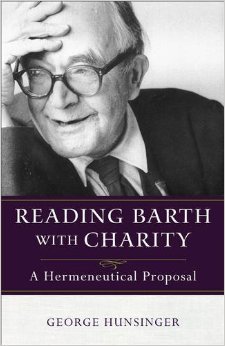
In his recent work Reading Barth with Charity: A Hermeneutical Proposal (pp. xii-xiii), George Hunsinger draws our attention to the recent appeal to one such principle, the “principle of charity”, in reading texts in recent analytic philosophy. Hunsinger says there’s no single, definitive account of it, but he helpfully summarizes the main lines of it for us:

  • The principle of charity seeks to understand a point of view in its strongest form before subjecting it to criticism. A suspension of one’s own beliefs may be required in order to attain a sympathetic understanding.
  • One assumes for the moment that the ideas under consideration, regardless of how difficult they may seem, are both true and internally coherent. The emphasis falls on seeking to understand the texts as they stand rather than on picking out difficulties or contradictions.
  • If apparent contradictions are found, an active attempt is made to resolve them. Donald Davidson has suggested, for example, that the principle of charity means attempting to maximize sense and optimize agreement when it comes to doubts about the inner coherence or factual veracity of the viewpoint under consideration.
  • If it is possible to resolve apparent contradictions (or ambiguities) through a sympathetic interpretation, a presumption exists in favor of that interpretation. A presumption exists by the same token against any interpretation that resorts to the charge of inconsistency without attempting to resolve apparent contradictions.
  • Only if no successful interpretation can be found is one entitled to conclude that a viewpoint is inconsistent or false. Critique is always possible but only after an adequate effort has been made for an interpretation that does not call a viewpoint’s truth or coherence into question precipitously.,
  • The attempt to maximize intelligibility through the resolution of apparent contradictions is related to a corollary, which is called “the principle of humanity.” As Daniel Dennett explains, one should attribute to the person whose views one is considering “the propositional attitudes one supposes one would have oneself in those circumstances.”

That about sums up what I’ve seen of the principle, especially in analytic discussions. This is true both in philosophy and theology. I can recall a number of sections in Alvin Plantinga’s work where he’ll consider an opponent’s position in two or three possible forms, at times even strengthening their arguments, before going on to refute them nonetheless. This principle can also be seen Oliver Crisp’s habit–which has proved confusing to some–of considering and strengthening a number of positions he doesn’t actually hold.

For myself, I think there’s something deeply Christian and honest about the principle of charity. It’s a form of Christian virtue; an exercise in loving your neighbor as yourself within the republic of language. We would want others to extend to us the benefit of the doubt, strenuously work through our arguments, and imaginatively attempt to enter into our concerns and intuitions in order to come to understand why we’ve come to hold what we hold. This is an angle on what Matthew Lee Anderson has called “intellectual empathy.”

What’s more, considering arguments in this manner can help clarify the actual issues at stake in a given conversation. Doing your interlocutor the favor trying your best to make sense of their position means that when you do actually get around to arguing against it, it can only be that much stronger of an argument. Or, it may be that it’s only then you see the person actually has a solid point!

That said, a friend of mine has also argued it’s important that this principle be weighed or balanced against the principle of accuracy. In the picture above, there is a danger that in your attempt to actually be charitable, you end up inadvertently misrepresenting your opponent anyways. Due to your own unavoidable intuitions, it may be you end up saying, “Well, they couldn’t possibly mean that, because that doesn’t make sense,” when, in fact, that’s exactly the position they do hold. Sometimes the benefit of the doubt becomes dubious. And that is a case where, despite your charitable intentions, the truth is not actually served.

All the same, I know for myself, consciously striving to be charitable in my pursuit of accuracy curbs my natural tendency to read with my own blinders on. In other words, striving for charity slows me down enough to achieve accuracy. Of course, I struggle and fail–quite spectacularly, at times. Yet I would propose that principles of moral interpretation such as that of charity have become all the more pressing to adopt and practice as our internet age has pressed even more of our communication to be textually-mediated. We are constantly reading, interpreting, and engaging with the texts of other authors, other citizens of language like ourselves. If we fail to practice charity in interpretation, one of our most socially and morally formative practices, it can’t help but bleed out into other areas of our thought and life.

So then, to wrap up another post that’s gone far longer than I had intended, practice charity in all your reading. Beginning with this post.

Soli Deo Gloria

The Adamantine, Invincible, Invulnerable Love of God

sondereggerLove is patient and kind; love does not envy or boast; it is not arrogant or rude. It does not insist on its own way; it is not irritable or resentful; it does not rejoice at wrongdoing, but rejoices with the truth. Love bears all things, believes all things, hopes all things, endures all things. (1 Corinthians 13:4-7)

At the current moment, the dominant attribute in our common talk of God is typically love. Love is also at the center of a number of recent academic treatments of the doctrine of God and especially a number of the revisions of that doctrine in the 20th Century. What’s more, that God is centrally and fundamentally love is taken by many to mean that God is relational.

And for Trinitarians, that shouldn’t be too much of a problem. God is relational all the way down. But one of the great burdens of Kevin Vanhoozer’s work Remythologizing Theology is to show that the current model of a relational God meant to replace “classical theism” does what all onto-theologies do–take a metaphysical concept from without Scripture and read Scripture’s witness to God in that light. In this case, we take modern definitions of relationality as necessarily including mutuality, vulnerability, and so forth, and in that light, deliver us into the hands of a suffering and empathetic God. Here is much of the thrust behind various process, panentheist, and Open theist models on offer. 

The question we’re to ask, though, is whether or not this is the understanding of relationality and love we are given to understand as we read the broad sweep of the Scriptures as well as its individual pages. Here, of course, is not the place to understand such an examination. Still, I was reminded of this issue when I ran across this stunning exposition by Katherine Sonderegger of Paul’s “Love” hymn in 1 Corinthians 13. I’ll quote it at length:

This is Love. Now it seems to me that this passage lies so close to hand, remains so familiar from every wedding and so many burials, that we overlook one of its most striking features. The love praised here, the more excellent way, does not envision an object at all–how odd that we read it at weddings!–nor does it speak of mutuality, indeed of passibility, in any fashion. St. Paul’s love is supremely invulnerable, impervious to another we might dare say. Perfect love is invincibly objectless, immutual, perdurant. It never ends–it alone is eternal against all the gifts of the Spirit, prophecy, and tongues and knowledge. It is adamantine.

Paul picks out with two quick strokes the positive traits of love, patience and kindness. Surely a quiet evocation of hesed. God’s loving-kindness! Then the apostle turns to what we might think of as love’s negative predicates: it is not envious or proud or coarse; not ill-tempered, variable, stubborn; not immoral, sadistic, cruel, and petty; not weak. Love is recognized in its ready delight for the truth, the good; they are twins. In all its ways, love remains unflinching, undeterred. It is supremely confident, twinned with hope and trust. Love has been prised loose from all self-seeking, from the burdens, sometimes frightful, so often small and miserable, that infect our loving, from the anger and resentment that course through our most ardent loves, from the submission to what we call facts in this proudly “realistic” life of ours–ingratitude, unsuitability, meanness. Love, Paul tells us, simply withstands, endures, triumphs. It abides as the greatest, the uncontested, the supreme. Love is self-same, thoroughly itself, constant, unswerving, true.

Who cannot see, in all these things, that love, this perfect Love of the apostle Paul, is simply another Name for God? God alone is this Love, this more excellent way–we could hardly expect anything else. God’s passionate Love, Paul tells us, is invulnerable in just this particular way to us and to our loveless ways; supremely independent of us and our indifference; utterly triumphant over our blindness, instability, and infidelity; zealous for the right; eternal. This is Divine Nature, personal Passion, victorious Love. Wrath for the good. It is the One Love triumphant over every defilement, injustice, and cunning: it defends the orphan and the little one with fiery Mercy, raging Justice. This Divine Love waits on no one, needs nothing, bends to no condition or limit. Love that is God scorches through the infinite spheres, boundless, eternal Holiness. Love crowns the Divine Perfections; it abounds.

Systematic Theology, Volume 1, The Doctrine of Godpp. 495-497

Before commenting, for those interested, yes, this sort of tremendous, cavernous, doxological prose is lavishly scattered throughout the whole of her work. It’s a beautifully executed work, in that sense. Rigorous though it is, nothing could be further from the stereotype of a “dry” academic work than Sonderegger’s elegant volume.

Now, the context of this passage is Sonderegger’s challenge to the common claim that love requires an object. In the hands of most theologians looking to avoid a needy, co-dependent God, or the idea that God only becomes loving upon creating something other than himself, this leads us to the conclusion that in order to properly expound the love of God we must turn to the doctrine of the Trinity. Only the God who is perfectly, Father, Son, and Spirit can be Love in the fullest sense, with a life that is perfect, complete in itself and for itself before all of creation.

Sonderegger wants to claim that we can think of love monotheistically according to God’s oneness (though not contrary to His threeness). To this–as Sonderegger herself might put it–we must gently but firmly say, “No.” Ultimately, I do think the Love that God is, can only be properly thought through on trinitarian grounds. While Sonderegger speaks of the lack “mutuality” in the passage, that may be, but there is a certainly a directional “communicativity” that seems to imply an object. 

What’s more, Sonderegger also wants to affirm emotions or affections as something we can speak of God. Still, that shouldn’t be taken in the modern, passibilist sense. I think she’d want to sign off on something along these lines, in order to affirm much of what the tradition has held, while not running roughshod over the language of Scripture.  

All the same, Sonderegger has put her finger on something in this passage. Paul gives us this striking picture of love that is good news precisely because of its imperviousness. Love, here, is not trumpeted as the exposed, hyper-sensitive, vulnerability that our culture puts a premium on. It is fullness; an overflowing invulnerability that is unflappable in its will to communicate the good to those who have spurned it. In this passage we are presented with an analogue to the Love found in God’s sovereign determination to give his life, life, and very Self to his creatures, despite any obstacles to contrary. It is precisely this kind of adamantine love that can sustain the movement of the God in the flesh, in order to assume all that is changeable, passible, and vulnerable, in order to redeem it on our behalf. 

Soli Deo Gloria