I love reading about the Trinity. Between the Trinity and the Cross, you have the core of my theological interests. I’ve been reading about the Trinity on and off since the end of college. While I can’t say I’m an expert or that I’ve read everything out there, or even all of the essential works, I can say I’ve read a few. Ironically though, up until a year or two ago, I didn’t know of any that I could recommend to somebody looking to get started on the subject. Now, I have three. They’re listed in order of ease and immediate accessibility, but all of them are in the novice-intermediate category. I commend them to any who are interested.
Our Triune God: Living in the Love of the Three-in-One (2011) — Philip Graham Ryken and Michael Lefevre provide a wonderful little work chock-full of insights into the workings and ways of our gloriously Triune God. Unlike a lot of other works on the Trinity, instead of going through a long digression into the historical development of the doctrine, or the various key figures and disputes by which we arrived at Nicene Orthodoxy, it cuts to the chase, going straight to the Biblical material, showing that very warp and woof of the Bible is Trinitarian through and through. After a quick little introduction, Ryken and Lefevre immediately plunge into a very readable-yet-penetrating exposition of Ephesians 1, laying out the Trinitarian shape of salvation, making it quite clear that the Christian Gospel is unintelligible apart from the workings of the Father, Son and Holy Spirit. From there, we enter a number of illuminating discussion on the Trinity and the practical life, apologetic sections dealing with the consistency of Trinitarian doctrine with Old Testament revelation, and a delightful chapter on the impact this has for the way we think about life in community. It is a short work, less than 130 pages, but out-sized in terms of actual content. I highly recommend this for readers with any level of theological education.
The Deep Things of God: How the Trinity Changes Everything (2010) 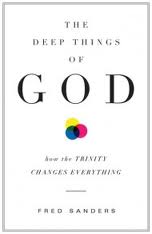 — Fred Sanders just nails it with this book. I read it a couple of years ago with great appreciation and was surprised once again at it’s richness this summer while working through it with a few of my college students. Sanders is an Evangelical who wants the rest of his brethren to understand that when we’re talking about the Trinity, we’re not wandering into enemy-occupied territory–Evangelicals are Trinitarians because Evangelicals are Gospel-people. These “Deep Things of God” are not a subject foreign to the practical, Gospel Christianity preached from the pulpit every Sunday, but absolutely central to it. In order to make his case, Sanders takes us through some very helpful discussions of theological method and doctrine of God proper. He then sets about connecting the dots between the central Gospel message and the eternal, Trinitarian reality underlying great Gospel truths such as the Incarnation, Atonement, Union with Christ, and the Grace of Adoption. He also has excellent chapters on the way Evangelical approaches to the Bible and practices of prayer simply don’t make sense outside of a properly-Trinitarian framework. Really, the chapter on prayer, “Praying with the Grain”, is quite eye-opening. Again, as with Ryken and Lefevre, Sanders takes us into to Scripture in order to make his case. While not quite as easy for the absolute novice, I strongly commend this work to anybody interested not only in the Trinity, but how to think theologically. Sanders is an excellent guide.
The Triune God; An Essay in Post-Liberal Theology (2007) — William C. Placher has quickly become one of my favorite theologians to engage with. As a student of Hans Frei, he does Trinitarian theology from a post-liberal perspective, with an emphasis on narrative theology, as well as a keen appreciation for insights of philosophers such as Kierkegaard, Wittgenstein, and Levinas, especially when it comes to the problem of too-quickly speaking about God. At the same time, he exhibits that wonderful Reformed Catholic sensibility by doing theology in conversation with Calvin, Edwards, Barth, Aquinas, the Cappodocians, and Balthasar in a way that is intellectually-sophisticated, yet remarkably readable. Placher constructs a contemporary, orthodox, Trinitarian theology, rooted in Scripture while organically incorporating the best of the tradition. He does so with a special eye on the epistemological issues involved with speaking fittingly of the transcendent and holy God, who nonetheless draws near to us in Jesus Christ, and blesses us with understanding through the agency of the Holy Spirit. While I don’t embrace all of his assumptions about scripture, not being a post-liberal myself, I find Placher to be a first-rate chaperon into the company of serious theologians, navigating the reader through various theological mine-fields in such a way that those uninitiated aren’t even aware of the skill with which they are being guided. Again, this is a slight step up from Sanders’ work in terms of rigor, still, I would say that it is not beyond the serious newcomer to Trinitarian theology.
Soli Deo Gloria
 Reformedish