The Myth of ‘Magic Neutral Time’ (TGC)

BackSoon“The Myth of Magic Neutral Time” is the sort of goofy phrase you come up with in college ministry to make basic concepts of spiritual life stick for your students. Sometimes you can’t just come out and say stuff–it’s like you have to trick the truth into them.

In any case, this particular neologism struck me in a conversation with my friend Katie. We were discussing the frustrating phenomena of future college freshmen who plan on ‘taking a break’ from their faith to just go off and ‘have a little fun for a while.’ Now, this is idiotic for several reasons. But to see why, let’s first explain the myth of Neutral Time.

The Myth of Neutral Time – I always tell my students that they need to be aware of the myths, the stories, that they tell themselves about reality because the story you think you’re in determines the character you become. Neutral time is a particularly popular story. It goes something like this:

“I’ve been a good kid in high school. I’ve done my homework, been to Bible study, and didn’t screw around too much or anything. Now though, now I really want to go out and enjoy myself a bit. The ‘college experience’ is calling and I can’t be expected to go to college and not let loose a little bit. I mean, I really love Jesus and my faith will always be a big part of my life, but you know, I’ll just go off for a bit, maybe a semester or two, have my fun, and then be back around. You’ll see.”

There are number of assumptions underlying this story, but the main one seems to be that faith is this unchanging, timeless, perennial thing. Your walk with Jesus is something you can just leave alone for a while, and then, once you’ve done your own thing for a bit, you can just pick up again. No big deal. Calling ‘neutral time’ is like calling time-out so you can go the restroom or take a break in the middle of the game—when you come back the score, time, and possession is just like where you left of last.

You can read about the foolishness of this approach by clicking on The Gospel Coalition.

Meditation and Communion with God: Contemplating Scripture in an Age of Distraction (Book Review)

meditation and communion with GodMeditation is viewed with suspicion within many wings of modern Protestantism today. Begin to mention the spiritual discipline of contemplation and immediately accusations or apprehensions that one has imported or smuggled in foreign notions from Eastern philosophies, Buddhism, or less-than-Evangelical mystical pieties start to be leveled. Indeed, at times this isn’t too far off the mark. In our pluralistic culture there is much that passes for Christian spirituality is little more than cleverly-disguised syncretism. And yet, it would be a mistake to miss the need to recover the contemplative dimension to Christian spirituality in our stressed-out, surface-level, consumeristic North American Christianity.

This is why I have been so blessed as I read John Jefferson Davis’ recent work Meditation and Communion with God: Contemplating Scripture in an Age of DistractionIn this short, but rich essay, Davis argues and provides a theological foundation for a robust practice of contemplating scripture within an orthodox Evangelical framework. Instead of the mind-emptying techniques rooted in Advaita Hinduism, or Zen Buddhism, Davis wants to present a vision of the soul-expanding practice of deeply contemplating the riches of biblical truth in such a way that actually mediates the life of God himself in union with the Son by the power of the Spirit of the Age to Come.

Six Reasons

Aside from the fact that the Reformed tradition, especially Puritanism, has long had a rich tradition of scriptural contemplation including such lights as John Owen, Thomas Watson, William G.T. Shedd, and others, Davis notes six current factors which make recovering a practice scriptural contemplation urgent and beneficial:

  1. Renewal of interest in spiritual disciplines within Evangelicalism. (pg. 10)
  2. Growing interest in Eastern practices of meditation within a pluralistic context. (pg. 13)
  3. Widespread biblical illiteracy in North American churches. (pg. 18)
  4. Our growing awareness of the effects of the digital age on attention spans and reading habits. (pg. 21)
  5. New research on the effects of meditation on the brain and personal health. (pg. 25)
  6. Trend in biblical and systematic theology which have yet to be integrated into a theology of contemplating Scripture. (pg. 28)

As I read Davis outline his case, I found myself vigorously nodding in agreement, particularly as I thought of my own ability to simply sit down and read the book without compulsively checking my social media. If there is one thing our “distracted” age needs, it is something that forces them to sit down, breath, and think. I don’t think anybody would dispute that. The question becomes then, what are these theological foundations?

Three Themes

Davis devotes most of the rest of the essay to developing a theology of contemplation in light of three key theological developments:

  1. Inaugurated Eschatology (pp. 34-41)- NT scholars for the past couple of generations have highlighted eschatology as the warp and woof of the theology of the NT. Jesus preached the inbreaking kingdom of God which was “now” here and “not yet” fully consummated. Paul taught that through the Resurrection of Jesus Christ, the powers of the New Age had broken into the Old Age of sin and darkness and were available to us in the Spirit. The Old Covenant having been fulfilled, judgment rendered, victory accomplished, the Spirit is now poured out on all flesh drawing us near into a new access to the Father by grace.
  2. Union with Christ (pp. 41-51)- Connected to this is a renewed emphasis on the reality of our union with Christ. The idea that salvation ought to be thought of in terms of our current union with Christ saves us from a purely-future notion of redemption. Even now we are united to the risen Christ and all of his saving benefits, even though we are not yet fully like him. The Holy Spirit unites us to Christ in faith and makes us present to him, even though we are separated in space and time because of the inbreaking of the New Age.
  3. Trinitarian Theology (pp. 51-55) – Finally, the 20th Century renaissance of trinitiarian theology has reminded us of a few key realities: knowing God as he truly is–Father, Son, and Holy Spirit–can only help remind us of the fact that we can have personal relations with this personal God (1); having been made in the image of the Triune God, we are inherently relational beings which has implications for our ideas of personal existence and knowing (2); salvation is inherently trinitarian in nature as we are being brought into the life of the Triune God (3).

The Results

Building on these Davis develops them into a re-hauled “inaugurated ontology” that generates insights into our theology of God, cosmos, humanity, salvation, epistemology, and scripture that sets up a new way of understanding what is going one when we read the Bible. We are actually being brought into the presence of and communion with the Triune God through the power of the Spirit who unites us to the Risen Christ. This brief theological outline forms the basis of his rehabilitation of the Medieval Church’s practice of the four-fold interpretation of Scripture, which he believes ought to play an important role in the life of the church, especially in spiritual contemplation of scripture, even while we hang on to the real insights gained by the Reformers’ renewed emphasis on the “literal” sense of the text. Finally, after all of this, he includes a section outlining an actual approach towards a scriptural meditation which includes exercises in “whole-brain” reading and prayer.

A Couple of Final Words

While I’ve enjoyed this book immensely, I’d just add a few words of caveat and warning: this isn’t the easiest book. It’s not the hardest, either. Just realize that it isn’t just a nice little handbook on contemplation. Some background in theology and biblical studies will be helpful in reading it. Also, he has some interesting little philosophical sections on the idea of the self and its location in space; they’re fine as far as they go, but don’t worry about skipping them.

I tell you this now because overall this is an excellent little book. Davis has done the church a real service in working through some of the real theological issues involved in contemplation. Davis’ work assures us that we can be confident that Christ is really present to us, by the power of the Spirit of the New Age, in the reading of Scripture. Slow, prayerful meditation on the Biblical text can be a real means of communion with the Triune God.

Soli Deo Gloria

10 Theses on Union With Christ

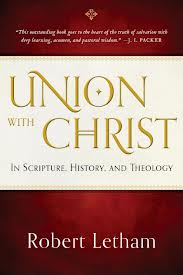
unionI finished Letham’s work on union with Christ last week, but I wanted to return to it one last time. Letham has a fascinating chapter entitled “Union with Christ and Transformation”  in which he examines the relationship between union with Christ and Eastern and Reformed conceptions of deification. At the end of the chapter, he lists and expounds 10 theses on union which summarize much of his findings with respect to the transformative aspect of union:

  1. The union we enjoy with Christ is more real and more fundamental that the union we have with members of our own body” (pg. 123) By this he means that our union with Christ is of such a nature that any analogy ultimately falls short of the reality. Legal, organic, familial, and structural metaphors all convey some of the truth, but none fully captures the fullness of the saving union with our savior.
  2. This is not a union of essence–we do not cease to be human and become God or get merged into God like ingredients in an ontological soup. This is is not apotheosis.” (pg. 123) This union is not to be taken pantheistically. Even the patristic dictum, “God became man so that we might become god” must be taken within the context of a strong acknowledgment of the Creator/creature distinction. If anything, the point is that we become more fully human than we ever were before.
  3. We do not lose our personal individual identities in some universal generic humanity.” (pg. 123) Just as the one God is distinctly three from all of eternity, and the humanity of the Son is not destroyed, but elevated in the incarnation, so in our union with Christ, our identity is not destroyed or collapsed into his. We are one by the power of the Holy Spirit, but we remain who we are.
  4. Union with Christ comes to expression in, and is cultivated by, the Word and the sacraments.” (pg. 124) Through the efficacious preaching of the Word, the Holy Spirit calls us to life and faith (1 Pet. 1:23; Jas. 1:18; Rom. 10:9-17).  Those brought to life through the Word are sustained through feeding, by the mysterious activity of the Spirit, on Christ’s flesh and blood (John 6:63).
  5. The body and blood of Christ are not materially, corporeally, or physically present in the Lord’s Supper.” (pg. 125) Unlike Roman Catholic, and to some extent Lutheran, accounts. We truly are given Christ, united with Christ, not physically but by the action of the Holy Spirit who mediates his presence truly.
  6. In the Lord’s Supper we are lifted up by the Holy Spirit to feed on Christ.” (pg. 126) Here Letham builds on Calvin’s spatial language with reference to the Ascension. The Holy Spirit joins us to Christ’s person in the Supper by way of faith receiving his promises. Horton has suggested elsewhere that the spatial language be replaced by eschatological language. In the Supper, the Spirit makes present Christ’s resurrection life of the New Age in the life of the believer.
  7. We are not hypostatically united to the Son.” (pg. 126) The incarnation is unique; the Son takes on humanity only once. The Spirit indwells many, united them to Christ and bringing them into the fullness of life in Christ. We are not to confuse the types of unions involved.
  8. We are united with Christ’s person.” (pg. 126) At the same time, union is not only indwelling, but is rooted in the incarnation of the Son who thereby makes himself one with us according to our humanity. This is a tricky that I’m not quite sure I’ve grasped (not that I have the others). but it’s not only that we are in fellowship with God, communing with him, but are actually united with him, the Godman. It’s a mystical, metaphysical, transformative reality that ought not be downplayed.
  9. It is effected and developed by the Holy Spirit through faith, in and through the means of grace…” (pg. 127) Union with Christ isn’t an individualistic thing, but “churchly.” It happens through the everyday stuff of the life of the church: the breaking of bread, the scriptures, the community, and prayer by which the Spirit has promised to meet us.
  10. “It will eventually lead to our being ‘like Christ’ (1 John 3:1-2).” (pg.128)  God wants to make us more like himself. For right now we are “partakers of the divine nature” (2 Pet. 1:4), by being set free from sin and the inevitable curse of death. When Christ returns though, we will be glorified like him. United with him, how can the body not eventually be made like the head?

Of course, each of these points could be, and are in the book, expanded upon at length. For now they chart a course through the deep theological waters we enter in when considering the riches of our union with Christ.

Soli Deo Gloria

In Christ It’s All There

puzzle pieceAll of us come to God at one point or another for some sort of help; we have a need, problem, guilt, angst, or longing we think he might be able to deal with. Some of us find it and some don’t. The difference between the Christian and the seeker who eventually walks away is whether we come to see, as Calvin put it, that there is no benefit from God that isn’t attached to Christ, “as if he alone did not contain all things in himself.”

In order to show the futility of such thinking Calvin’s comments expansively on 1 Corinthians 1:30 (“And because of him you are in Christ Jesus, who became to us wisdom from God,righteousness and sanctification and redemption”) and demonstrates that the sum of our salvation–our righteousness, wisdom, holiness, and redemption–are only had in Christ. Christ does not simply give these differing elements to us as separate gifts, but rather, he gives us himself, he unites us to his glorious person and in him we have and become all of these things. They are not infused from without or accounted to us in an external, extrinsic fashion, but are made ours because we have been knit by the Spirit through faith into Christ’s living body:

  1. First, he is made unto us wisdom, by which he means, that we obtain in him an absolute perfection of wisdom, inasmuch as the Father has fully revealed himself to us in him, that we may not desire to know any thing besides him. There is a similar passage in Colossians 2:3: “In whom are hid all the treasures of wisdom and knowledge.” Of this we shall have occasion to speak afterwards when we come to the next chapter.
  2. Secondly, made unto us righteousness, by which he means that we are on his account acceptable to God, inasmuch as he expiated our sins by his death, and his obedience is imputed to us for righteousness. For as the righteousness of faith consists in remission of sins and a gracious acceptance, we obtain both through Christ.
  3. Thirdly, he calls him our sanctification, by which he means, that we who are otherwise unholy by nature, are by his Spirit renewed unto holiness, that we may serve God. From this, also, we infer, that we cannot be justified freely through faith alone without at the same time living holily. For these fruits of grace are connected together, as it were, by an indissoluble tie, so that he who attempts to sever them does in a manner tear Christ in pieces. Let therefore the man who seeks to be justified through Christ, by God’s unmerited goodness, consider that this cannot be attained without his taking him at the same time for , or, in other words, being renewed to innocence and purity of life. Those, however, that slander us, as if by preaching a free justification through faith we called men off from good works, are amply refuted from this passage, which intimates that faith apprehends in Christ regeneration equally with forgiveness of sins...
  4. Fourthly, he teaches us that he is given to us for redemption, by which he means, that through his goodness we are delivered at once from all bondage to sin, and from all the misery that flows from it. Thus redemption is the first gift of Christ that is begun in us, and the last that is completed. For the commencement of salvation consists in our being drawn out of the labyrinth of sin and death; yet in the meantime, until the final day of the resurrection, we groan redemption, (as we read in Romans 8:23.) If it is asked in what way Christ is given to us for redemption, I answer — “Because he made himself a ransom.”

Commentary on 1 Corinthians 1:30

Calvin concludes that in the end, “we must seek in Christ not the half, or merely a part, but the entire completion. For Paul does not say that he has been given to us by way of filling up, or eking out righteousness, holiness, wisdom, and redemption, but assigns to him exclusively the entire accomplishment of the whole.” This is why we place our faith in Christ alone. God can deal with our issues, but he does it through Christ. The Christian is the one who looks to Christ and finally confesses with Peter, “Lord, to whom shall we go?” (John 6:68)

In Christ it’s all there.

Soli Deo Gloria

The Gospel–It’s a Union Thing

One more bit from Letham:

Indeed, the Christian faith can be summed up as, inter alia, a series of unions. There is the union of the three persons in the Trinity, the union of the Son of God with our human nature, the union of Christ with his church, the union established by the Holy Spirit with us as he indwells us. Each of these unions preserves the integrity of the constituent elements or members, being at once a real union and simultaneously not absorbing the one into the other.

Union with Christ: In Scripture, History, and Theology, pp. 37-38

You could spend the rest of your Christian life simply studying the various unions mentioned by Letham and still not come to the end of the grace and glory of the Gospel. The Triunity of God alone ought to, and will, delight us for all eternity, before we even get to the unions whereby God includes us in that life, becomes our brother, makes us part of the church, or sets us free from sin. Simply put: the Gospel is a union thing.

Soli Deo Gloria

Letham on Union with Christ and Salvation

unionRobert Letham briefly summarizes the connection between union with Christ and our justification, sanctification, and resurrection:

Union and Justification

According to Paul in Romans 5:12-21, just as Adam plunged the whole race into sin and death because of their relationship of solidarity with him, so the second Adam brings life and righteousness to all who sustain a relationship of solidarity with him

If, because of one man’s trespass, death reigned through that one man, much more will those who receive the abundance of gracee and the free gift of righteousness reign in life through the one man Jesus Christ. (Rom. 5:17 ESV)

Here Paul reflects on his previous statement of the one way of salvation from sin by the propitiatory death of Christ, which avails for all who believe (Rom. 3:21ff). Justification is received only by faith and is grounded in what Christ did once for all in his death and resurrection (4:25).  Paul’s point is that we are not addressed merely as discrete individuals; instead, we are a team of which we all were members. His sin plunged the whole team into sin, ruin, death, and condemnation. What Christ did for us was also done as the head of a team of which we are a part. He did it on our behalf, for us–and God reckons it to our account as a result of our being united, through faith, with him as the head of the team. Our justification is therefore grounded on union with Christ.

Union and Sanctification

In Romans 6:1ff, in answer to charges that his gospel encourages moral indifference, Paul insists that believers, the justified, live to Christ and do not give themselves over to sin.  This is because they died with Christ to sin and rose again to new life in his resurrection. Not only did Christ die and rise again for them, but they died and rose with him. Union with Christ is the foundational basis for sanctification and the dynamic force that empowers it. As Paul says, “Do you not know that as many were baptized into Christ Jesus were baptized into his death; we were buried with him through baptism into death, so that as Christ was raised from the dead through the glory of the Father so we too should live in newness of life” (6:3-4).

Union and Resurrection

Paul argues in 1 Corinthians 15 that the resurrection of Christ and the future resurrection of his church is one reality (vv. 12-19). Paul argues back and forth from one to the other. If Christ is not raised, there can be no resurrection of believers. If there is no general resurrection, Christ cannot have been raised himself. The two stand together. In fact, Christ has been raised–and so, therefore, will we be. Christ is the firstfruits of the resurrection of believers at his return (vv. 19-23). Not only is his resurrection first in time, but as firstfruits, it is of the same kind as the full harvest. Hence, it is the guarantee not only that the full harvest will be gathered but that both his resurrection and ours are identical. From this it is clear that the resurrection of believers at the parousia is a resurrection in Christ. The resurrections are effectively the same…Christ resurrection and the resurrection of the righteous, separated by indefinite time, are identical because the later occurs in union with the former.

Union with Christ: In Scripture, History, and Theology, pg. 5-7

Each of those points could be expanded upon at length, but this brief summary gives us a glimpse into the way the biblical record places our union with Christ at the blazing center of our salvation through Christ. There is no Gospel without union.

Soli Delo Gloria

Top 5 Reformedish Books of 2012

Everybody else is doing one so I figure I will too. I must note that my “Top 5” of 2012 were not all published in 2012—I may just have happened to read them this last year. Also, they appear in no particular order:

  1. A Shot of Faith to the Head: Be a Confident Believer in an Age of Cranky Atheists by Mitch Stokes – I’ve already reviewed this book here. Read it if you want the run-down.
  2. union with christUnion with Christ: Reframing Theology and Ministry for the Church by J. Todd Billings – Union with Christ is an essential theme and doctrine in Christianity, particularly within the Reformed tradition. In conversation with Augustine, Calvin, Bavinck, Barth, and others, Billings does some serious, but readable theological work, expounding the deep implications for theology and ministry of our union with Christ. For under 200 pages Billings’ scope is wide, covering everything from salvation to theological epistemology, the doctrine of God, Christology, the Lord’s Supper, social justice, and paradigms for mission. It also functions as an excellent, irenic introduction Calvin and the Reformed tradition as a whole. I cannot recommend this book highly enough.
  3. Meaning of MarriageThe Meaning of Marriage by Timothy and Kathy Keller – What can I say? It’s a Tim Keller book on marriage. That means it’s going to be well-researched, relevant, biblical, practical, theological, very readable, and, of course, gospel-centered. I’ve recommended this book to just about everybody: college students, engaged couples, newly-weds, oldly-weds, pastors, and marital experts. The great thing is that what you learn in this book won’t just teach you about marriage, it will teach you about all of your relationships, and most of all, the way the good news of Jesus Christ really does change everything.
  4. Lord and servantLord and Servant: A Covenant Christology by Michael Scott Horton – While this book was probably one of the most fun for me to read this year, it was also one of the nerdiest. Lord and Servant is the second in Horton’s quadrilogy of dogmatics and maybe the most important. In this series, he sets out to explore various classic theological topics letting the biblical notion of covenant–with its all-important Creator/creature distinction—and the eschatological story-line of the Bible shape the discussion. Much like the others, he’s working with some very high level theological and exegetical tools, interspersing and engaging with contemporary philosophical theology (Radical Orthodoxy), biblical studies (N.T. Wright), and patristics (Irenaeus) with insights from Calvin and the post-Reformation dogmatic tradition. As the subtitle indicates the end-goal of the work is Christology, but Horton does so much more in this volume with significant sections on: the doctrine of God, anthropology, Christology proper, and the contemporary atonement discussion. Horton has some of the finest discussions I’ve seen on the contemporary doctrine of God debates, as well as a thoroughly Reformed proposal for understanding the atonement in its fullness that beautifully incorporates insights from other traditions, as well as from its critics. In fact, the atonement discussion is worth the price of the book alone. Although this is admittedly not easy reading, for anybody with a taste for serious theology, it is a must.
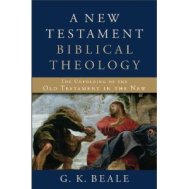
  5. New Testament Biblical TheologyNew Testament Biblical Theology: The Unfolding the Old Testament in the New by G.K. Beale – It was almost a tie for me between this volume and Beale’s earlier one The Temple and the Church’s Mission: A Biblical Theology of the Dwelling Place of God. At a whopping 967 pages of text, excluding indexes, it is hard to convey the truly colossal accomplishment of Beale’s magnum opus. Beale doesn’t set out to write your typical New Testament Theology with summaries of the Pauline corpus, or the Gospels, with a minor constructive chapter at the end. Instead, Beale gives us a truly Biblical theology focusing on the major redemptive-historical storyline of scripture, showing the way the promises in the OT of a New Creation Kingdom are inaugurated and fulfilled through the life, death, and resurrection of Jesus Christ. Not only does he trace the fulfillment of the OT storyline in the NT, but he does so in light of Second Temple Jewish background material, and with an eye towards contemporary theological discussions. On top of it all, this stuff preaches!! Pastors, seminarians, biblical scholars, and students would do well to purchase this and work their way slowly through it, page by page. There is a wealth of biblical riches here.
  • Honorable Mention: Christianity and Liberalism by J. Gresham Machen – Written at the height of the Fundamentalist/Modernist controversy, Machen aims to set out a clear choice between classic Christianity, the faith essentially shared for 2,000 years across Protestant, Catholic, and Orthodox lines, and that of the Modern theological liberalism that was prevailing in his day. I finally hunkered down to read it these last couple of weeks and have been stunned at the relevance this work still has nearly 90 years after it was written. Get this book, if only for the fact that you can download it for free.

So if you’re looking for something to read in the 2013 year, you may want to start with one of these. All of them will faithfully point you to Christ and help you love God with all of your heart, soul, strength, and mind.

Soli Deo Gloria

P.S. There are a couple that probably should be on here, but this thing was taking too long so they’ll make next year’s: Tim Keller’s Center Church and Ross Douthat’s Bad Religion.