Luna Lovegood on Why You Need Church (Or, the Spiritual Wisdom of Harry Potter)

LunaMcKenna and I received the Harry Potter films on Blu-Ray for Christmas this year, so, of course, we’ve been watching one every couple of days. As we’ve made our way through the years, I’ve been reminded of why I loved the books. I’ll come clean and say I was late to the game when it came to the Harry Potter franchise. I put off reading the books for a long time, and then blazed through them in a month and a half right after seminary. (I was suffering from a serious fantasy fiction-deficiency.)

Of course, even when watching/reading Harry Potter, I can’t turn off the theology-grid, so it’s been interesting for me to see how much spiritual wisdom there is to be found in both the books and the films. It’s not too surprising given Rowling’s confessed Christian beliefs. I was particularly struck by a conversation in the 5th film, Harry Potter and the Order of the Phoenix between Harry and Luna (Looney) Lovegood, an eccentricly spacey, but insightful classmate of Harry’s at Hogwarts. He’s feeling particularly discouraged about his situation, having been the victim of a smear campaign seeking to discredit his claims that the dark Lord Voldemort (He-Who-Must-Not-Be-Named), the satanic antagonist of the series, had returned and was seeking to take over the wizarding world again:

Luna Lovegood: [about her father] We believe you, by the way. That He-Who-Must-Not-Be-Named is back, and you fought him, and the Ministry and the Prophet are conspiring against you and Dumbledore.
Harry Potter: Thanks. Seems you’re about the only ones that do.
Luna Lovegood: I don’t think that’s true. But I suppose that’s how he wants you to feel.
Harry Potter: What do you mean?
Luna Lovegood: Well if I were You-Know-Who, I’d want you to feel cut off from everyone else. Because if it’s just you alone you’re not as much of a threat.

To anyone with ears to hear, it isn’t hard to discern this bit of insight into the nature of spiritual warfare. I’m not a “there’s a demon hiding under every bush”, kind of guy, but still, Jesus took the reality of the demonic seriously, as do the rest of the NT writers, in which case we ought to as well.

One thing to keep in mind is that while the devil is a roaring lion, looking to devour his prey, and shipwreck your faith, (1 Pet. 5:8) he doesn’t always do it in an obvious, open fashion. As Luna points out about Lord Voldemort, one of the easiest ways for him to tear at you is to isolate you, to whisper lies that you’re all alone, that nobody cares, that you will go unvindicated, that you must ultimately care for yourself, rather than trust in the one who holds your life in his hands–which, of course, is the root of sin. And it’s easy to get discouraged, isn’t it? It’s easy to believe lies. Our guilty hearts and consciences are only too ready to fall for them, especially when they’re so believable. He is the father of lies, you know. (John 8:44)

This is one of the many reasons we go to church. Without it, the lies creep in and take root. Christianity is not, and never has been, a Lone-Ranger faith, where you and Jesus are off fighting the whole world together. No, Jesus founded a community. He said to the community of disciples that he would be with them to the end of the age. (Matt 28:20) You can’t do this by yourself and you were never intended to.

Instead, the author of Hebrews warns us to not neglect meeting together, so that we may “encourage one another”, especially in light of the approaching Day of truth. (Heb. 10:25)  It is only through hearing the regular preaching of the Word, receiving the Gospel in the sacraments, and the community itself that the evil one’s lies are vanquished in our hearts. It is through the church that we are reminded that we have full assurance to approach the Lord in faith, because of blood of Jesus. (Heb. 10:19, 22) The church is how we know we’re not alone.

Soli Deo Gloria

Christians Are Book People (Seriously, We Were Into Books Before Everybody Else Was)

booksChristians are book people. Many of us have heard the claim before and it makes a certain sense. Christians worship a speaking God–an authoring God who reveals himself in the script of history as well as in the scriptures. That being the case, they ought to care about the written word. Now, being an avid reader myself, I’m inclined to agree. Still, we might wonder at times if the claim’s been exaggerated, especially given the fact that a vast portion of Christians throughout history have been illiterate. Apparently not. According to Robin Lane Fox we’ve been book people from the beginning:

…from a very early date there were Christians able to communicate with the literary culture of their age. As a “religion of the book,” Christianity had a particular relationship with texts. In Rome, several paintings in the burial chambers of the catacombs show Christian arriving at the Last Judgement clutching their books. When the governor of Africa asked a group of Christian prisoners what they had brought with them to court, they replied, “Texts of Paul, a just man.” One of the fundamental contrasts between pagan cult and Christianity was this passage from an oral culture of myth and conjecture to one based firmly on written texts. In the first communities, there had already been a significant break with contemporary habits of reading: Christians used the codex, or book, for their biblical texts, whereas pagans still vastly preferred the roll. The Christian codex was made of papyrus, not parchment. It was more compact and better suited to people on the move, and it was an easier form in which to refer to and fro between texts. This Christian revolution lies at the beginnings of the history of the modern book; for scriptural texts, on present evidence, it seems to have been universal…Gradually, this concern for the book extended to pagan culture too.
Pagans and Christians, pg. 304-305

A few take-aways from early Christian history:

  1. We are book people. I mean, not to be a hipster about it, but we were reading books before everybody else got into them.
  2. Building a personal library is the Christian thing to do. I do not have a book problem. 😉
  3. Apparently the NRA stole “..from my cold, dead hands.”
  4. On a more serious note, the early Christians knew where their strength and hope was: the word of God. When facing the judgment of men, or of God, they clung to the promise of the Gospel in the scriptures. May we do the same.

Soli Deo Gloria

Quick-Blog #13: Try Reading It Out Loud

Out LoudMy dad used to always tell me to try reading my papers out loud in high school in order to proof-read them. Sometimes hearing yourself say it helps you figure out what’s wrong with an awkward sentence, or figure out where a comma belongs. It’s advice I still try to follow today. Sometimes.

I was reminded of that little nugget of wisdom as I was reading R.T. France’s commentary on The Gospel of Mark. Scholars have remarked over the years on the inelegant and choppy style of Mark’s prose in comparison with the other Gospels. Mark has a lot of abrupt transitions and repetitive phrases, and the Greek is really, in many ways, elementary. For instance, if you’re familiar with the KJV translation, there’s a frequent use of the word “and”, that gets smoothed out in more recent, less literal renditions because of its seeming pointlessness. In the past this has served to sideline Mark as less sophisticated theologically or literarily.

France explains that recently it’s been noticed that Mark’s writing style probably served a different purpose, causing scholars to re-evaluate their earlier judgments:

It may seem obvious that a book is intended to be read. But modern scholars are apt to forget that in the ancient world not very many people could read. It has been recently estimated that literacy in the ancient Mediterranean world was ‘probably no more than 10 percent, although the figure may have risen to 15 or 20 percent in certain cities’. Unless Mark’s work was designed only for the benefit of the small minority who could read, he must have reckoned on its being experienced by most of his target group as an oral text, read aloud probably in meetings of the local church; E. Best describes it as ‘preaching’. Recent scholarship has increasingly recognized this factor, and it is relatively common these days to hear Mark discussed as an oral text, or at least as a text intended in part for oral presentation.

–The Gospel of Mark, pg. 9

France then goes on to point out how these for various features of the text mentioned above, as well as others, can be accounted for when taking into mind the aim of helping a hearer. Instead of Mark, the sub-literate writer, we are given Mark the master storyteller, Mark’s approach creates dramatic tension, is accessible to the largely uneducated 1st-Century congregation, and enables his hearers to keep the narrative in mind when there wasn’t a readily available text to flip back and forth to consult.

There are a lot of things that could be said about this little tidbit. I’ll limit myself to a two quick points:

  1. If you get bored reading the Bible, try reading some of it out loud. Most of it was written in an oral culture and was intended to be heard. Paul’s letters were supposed to be read to the congregations. The Psalms were read in worship. The Prophets consist largely of sermonic oratory. The point is, some of this stuff really sticks and shines when you hear it.
  2. Preachers, read the Bible our loud to your people in your sermons. They’re meant to hear it–large chunks of it. That’s where the liturgical churches get things right. It’s okay for your people to hear the Scriptures without you breaking down every detail of the grammar for them. Also, read them with passion. I heard Albert Tate speak up at Forest Home camp this last year with my college students and, aside from being a stud preacher, that man read the Scriptures like they meant something, not just as a set-up for his sermon. Often-times the it’s more important for your people to catch your attitude of reverence and passion about the Word, than your specific insights about it.

So, for what it’s worth: try reading it out loud.

Soli Deo Gloria

Is Christianity Individualistic or Collectivist? “Yes” – C.S. Lewis and J. Gresham Machen

Americans like feeling unique and special--being one innovator who sticks out from the crowd.

Americans like feeling unique and special–being one innovator who sticks out from the crowd.

People have often wondered whether Christianity was more of an individualistic religion, with an emphasis on the person, or collectivistic, with a emphasis on the whole race or community. At different points in history the church has emphasized one over the other and then had the pendulum swing turn back on them within a generation or two. In fact, we’ll probably see something like that happen in our own day as churches begin to realize they need to stop feeding into the rampant, modern individualism of our consumer culture. In any case, the answer, as usual, lies somewhere in-between, or rather, off the grid.

With characteristic clarity J. Gresham Machen and C.S. Lewis both answered the question for their own generations in ways that are still relevant to ours.

I offer you Machen’s answer first with an important note–the ‘liberalism’ he is speaking of is not the current, political liberalism, but rather the theological liberalism of the early 20th Century:

It is true that historic Christianity is in conflict at many points with the collectivism of the present day; it does emphasize, against the claims of society, the worth of the individual soul. It provides for the individual a refuge from all the fluctuating currents of human opinion, a secret place of meditation where a man can come alone into the presence of God. It does give a man courage to stand, if need be, against the world; it resolutely refuses to make of the individual a mere means to an end, a mere element in the composition of society. It rejects altogether any means of salvation which deals with men in a mass; it brings the individual face to face with his God. In that sense, it is true that Christianity is individualistic and not social.

But though Christianity is individualistic, it is not only individualistic. It provides fully for the social needs of man.

In the first place, even the communion of the individual man with God is not really individualistic, but social. A man is not isolated when he is in communion with God; he can be regarded as isolated only by one who has forgotten the real existence of the supreme Person. Here again, as at many other places, the line of cleavage between liberalism and Christianity really reduces to a profound difference in the conception of God. Christianity is earnestly theistic; liberalism is at best but half-heartedly so. If a man once comes to believe in a personal God, then the wow ship of Him will not be regarded as selfish isolation, but as the chief end of man. That does not mean that on the Christian view the worship of God is ever to be carried on to the neglect of service rendered to one’s fellow-men − ”he that loveth not his brother whom he hath seen, is not able to love God whom he hath not seen” − but it does mean that the worship of God has a value of its own. Very different is the prevailing doctrine of modern liberalism. According to Christian belief, man exists for the sake of God; according to the liberal Church, in practice if not in theory, God exists for the sake of man. But the social element in Christianity is found not only in communion between man and God, but also in communion between man and man. Such communion appears even in institutions which are not specifically Christian.

J. Gresham Machen, Christianity and Liberalism, pg. 137-138

And now C.S. Lewis on the twin errors of ‘Totalitarianism’ (Collectivism) and individualism:

The idea that the whole human race is, in a sense, one thing —one huge organism, like a tree—must not be confused with the idea that individual differences do not matter or that real people, Tom and Nobby and Kate, are somehow less important than collective things like classes, races, and so forth.

Indeed the two ideas are opposites. Things which are parts of a single organism may be very different from one another: things which are not, may be very alike. Six pennies are quite separate and very alike: my nose and my lungs are very different but they are only alive at all because they are parts of my body and share its common life. Christianity thinks of human individuals not as mere members of a group or items in a list, but as organs in a body—different from one another and each contributing what no other could. When you find yourself wanting to turn your children, or pupils, or even your neighbours, into people exactly like yourself, remember that God probably never meant them to be that. You and they are different organs, intended to do different things.

On the other hand, when you are tempted not to bother about someone else’s troubles because they are “no business of yours,” remember that though he is different from you he is part of the same organism as you. If you forget that he belongs to the same organism as yourself you will become an Individualist. If you forget that he is a different organ from you, if you want to suppress differences and make people all alike, you will become a Totalitarian. But a Christian must not be either a Totalitarian or an Individualist.

I feel a strong desire to tell you—and I expect you feel a strong desire to tell me—which of these two errors is the worse. That is the devil getting at us. He always sends errors into the world in pairs—pairs of opposites. And he always encourages us to spend a lot of time thinking which is the worse. You see why, of course? He relies on your extra dislike of the one error to draw you gradually into the opposite one. But do not let us be fooled. We have to keep our eyes on the goal and go straight through between both errors. We have no other concern than that with either of them.

-C.S. Lewis, Mere Christianity, Bk. 4, 6

So, is Christianity collectivistic or individualistic? Machen and Lewis answer: Yes, and so much more.

Soli Deo Gloria

All Things to All People? Really, Paul?

If you’ve heard more than 1 or 2 sermons on evangelism or outreach you’ve probably heard Paul’s declaration: “I became all things to all people so that by all possible means I might save some.” (1 Cor 9:22) Paul here makes the point that he has used his freedom in Christ, not for selfish gain, but in order to identify as far as possible with people in all cultural, racial, and socio-economic categories in order to present the Gospel to them. We would expect no less from the Paul who says that, “there is neither Jew nor Gentile, neither slave nor free, nor is there male and female, for you are all one in Christ Jesus.” (Gal. 3:28)

Paul preachingPaul was about reaching everybody and so should we be. Right. I think a lot of us might pay lip-service to this but we don’t understand the real scope of who Paul interacted with–the fact that for Paul this wasn’t just a preacher’s hyperbole, but a straight-forward description of his practice. Historian Robin Lane Fox gives us an eye-opening summary of Paul’s ministry in his magisterial account of the Christianization of the Roman Empire:

Paul admitted to being “all things to all men,” and our best account of a Christian mission, the Acts of the Apostles, bears him out. Paul’s churches included slaves and people who needed to be told “not to steal”: Paul himself referred to the “deep, abysmal poverty” of his Christians in Macedonia. Yet his converts also included people “in Caesar’s household,” slaves, presumably, in the service of the Emperor. At Corinth, he converted Erastus, the “steward of the city,” another eminent post which was often help by a public slave: it is quite uncertain whether this man could be the Erastus whom a recent inscription in Corinth’s theatre revealed as a freeborn magistrate, the aedile of the colony. He attracted women of independent status and a certain property, people like Phoebe, the “patroness” of many of the Christians at Corinth, and Lydia, the “trader in purple,” a luxury commodity. These women ranked far below the civic, let alone the Imperial aristocracies. But Acts adds a higher dimension which we might not otherwise have guessed: Paul was heard with respect by one member of Athen’s exclusive Areopagus and by the “first man of Malta.” He received friendly advice from “Asiarchs” in Ephesus, men at the summit of provincial society, where they served at vast expense as priests in the Imperial cult. On Cyprus, he impressed the Roman governor, Sergius Paulus, by a miracle which he worked in his presence.  —Pagans and Christians, pg. 293

Paul’s boast was not empty; his contacts range from prisons to palaces. Now, aside from having Jesus come to personally knock him off his horse and commission him to preach the Gospel, Paul was a uniquely gifted man. Orthodox, brilliant, and cosmopolitan he was able to relate to the upper echelons of intellectual culture and society with ease. No doubt this is what impresses many of us–it should. Not all Christians can interact at the high levels at which Paul did. God calls and equips some of us for these extraordinary levels of witness and that deserves a special appreciation for the gifting and sacrifice that requires.

What ought to be even more fascinating in the example of Paul though, is that a man of such native talent and ability did not count it beneath him to pastor people who “needed to be told ‘not to steal’.” Part of what captivates us about Paul’s high-level contacts is that we would love to rub shoulders with the elite, the rich, the social movers and shakers. It’s a glamorous ministry to most of us. (Of course, Paul got a lot of these opportunities after getting arrested or having the tar beat out of him, so it wasn’t that glamorous.) Still, much, if not most, of his ministry was not to the social elite but to the outcast–both racially (Gentiles), and socially (slaves, barbarians, etc.) He humbled himself, made himself as nothing, going to dregs of society in order to share the Gospel. Of course, in this he was only following his master. (Phil 2:6-9)

That’s something for us to consider in this new year: am I striving to become the kind of person of whom it could be said “she became all things to all people” for the sake of the Gospel? Even of the poor? Even of the dregs? Even of the outcast? Are our churches the kinds of places where pastors need to be continually reminding people “not to steal”? Who is welcome among us? Who catches our attention as an object of God’s grace in the Gospel? Have I been humbled by the Gospel enough to follow Paul, who followed Christ?

For those of us struggling with this, it might be helpful to recall Paul’s words to the Corinthians when they were getting too big for their britches:

For consider your calling, brothers: not many of you were wise according to worldly standards, not many were powerful, not many were of noble birth. But God chose what is foolish in the world to shame the wise; God chose what is weak in the world to shame the strong; God chose what is low and despised in the world, even things that are not, to bring to nothing things that are, so that no human being might boast in the presence of God. And because of him you are in Christ Jesus, who became to us wisdom from God, righteousness and sanctification and redemption, so that, as it is written, “Let the one who boasts, boast in the Lord.”

1 Corinthians 1:26-31

Soli Deo Gloria

Preaching A and B (Or, How Preaching is Like Feeding Your Kids Vegetables)

I don't think I was ever this cute--my mom says I was cuter.

I don’t think I was ever this cute–my mom says I was cuter.

I didn’t like eating broccoli as a kid. I don’t think any kid does. In fact, I distrust people who tell me they’ve always liked it. I mean, I’ve made my peace with it over the years–I had freakishly high cholesterol for some reason, so my parents fed it to me almost every night–but you never really like broccoli. That’s why parents usually try to find some way of feeding it to their kids. It’s good for them, but they won’t willingly eat it. It has to be fed to them.

Biblical truth is like that sometimes. There are a number of doctrines that we need to believe for our spiritual health, for us to have a correct view of God, the Gospel, and our lives, that aren’t particular appealing to us given our life-circumstances, intellectual history, etc. This is true not just at a personal level, but also at a cultural level. Certain aspects of biblical truth are just going to be harder to swallow in each culture given the dominant paradigms within them. For instance, in our relativistic-individualist culture teaching about truth and authority won’t be particularly popular. Still, we need to understand the nature of truth and God’s authority or our lives will go off the rails. Or again, the doctrine of God’s judgment is ridiculous, harsh, and arbitrary to the vast majority of Americans and secular Westerners, but it’s a core biblical teaching we need to understand if we are to understand the Gospel of the Cross, the Kingdom, or God’s promised salvation.

So, how do we preach and teach these truths in our culture in a way that they’re received and heard?

Keller on Preaching A and B
KellerPreaching to skeptical Manhattanites Tim Keller’s become a bit of an expert on this sort of thing. In his book Center Church he says that preachers need to be able to distinguish two types of beliefs in our culture: “A” beliefs and “B” beliefs. “A” beliefs are those bits of biblical teaching that people in the culture already hold by common grace. For instance, after a couple thousand years of Christian influence, our Western culture places a premium on forgiveness, or on the notion of human rights, so they readily accept those parts. Still, there are “B” beliefs in the culture, beliefs that function as ‘defeaters’ that make other Christian doctrines seem implausible and problematic as we pointed out above. (pg. 123-125)  You’ll have to do some thinking and research on this because these will change from culture to culture.

Keller says there are two things we need to do once we’ve identified those two sets:

  1. First, we need to make sure and affirm the “A” doctrines. God’s common grace has given people in the culture real wisdom, real truth, and we need to be as positive about them and preach them as forcefully as we can and show them that, in fact, we believe these truths even more strongly. “You believe in human rights? Great! So do we, but even more strongly because of the doctrine of the Image of God.” We do so first because they are scriptural. I mean, we should be talking about forgiveness, the Image of God, and grace anyways. Beyond that though, these ‘A’ doctrines form points of contact with our culture that enable us to gain a hearing within it.
  2. The second thing we need to do is challenge the “B” doctrines that make the Christian faith implausible. We need to engage our hearers to show them that their doubts are rather doubtful, or more problematic than they realize. One of the ways we do this is on the basis of the “A” doctrines we already identified and affirmed. The goal is to show that their “B” beliefs are inconsistent with their “A” beliefs. This is why it’s particularly important to emphasize the “A” doctrines. Keller uses an illustration about trying to make rocks float. Logs float and rocks sink. If you’re going to get rocks and logs across a river, you have to lash the logs together and put the rocks on top and “float” them across. In a sense, the same thing is true with doctrines. Your goal in preaching is to connect the dots between doctrines that people like, their “A” beliefs, to the ones that they’ve rejected on the basis of their faulty “B” beliefs.

Making it Concrete
What does this look like? Well, an “A” belief we’ve already identified is that of human rights. Our culture has a particularly keen sense of the rights and worth of the individual. Despite the abuses and confusion surrounding the issue, I think that’s a good, biblical insight. As we already said, the Image of God gives us good reason for affirming basic human rights. Now, a “B” belief that our culture holds which undermines basic Christian doctrines such as sin, judgment, God’s authority, etc. is the pervading moral relativism that relegates moral judgments to the sphere of mere personal opinion. Our culture strongly assumes that everyone has the right to make their own judgments about what is acceptable behavior, and that no one view can claim to be the “right” one. It’s a matter of individual preference. But “A” and “B” can’t both be true. If you want a robust notion of human rights, you can’t keep your relativism. If you think the Civil Rights movement was a good thing, a right thing, a thing that ought to have happened, not just something that suits your particular fancies, then you can’t consistently be a relativist.

Again, I remember having a conversation with my friend a few years ago on how to preach the difficult doctrine of the wrath of God. In a traditional Reformed fashion he argued that God’s holiness and righteousness require his wrath against evil and that’s generally how he approached it. Now, I think he’s basically right, but still, when it comes to preaching I favor recent approaches like that of Miroslav Volf who argues for it from the reality of God’s love. He points out that most of us will concede God is a God of love, but if God does not have wrath and judgment against the creation-destroying sin we participate in, he can’t truly be love. A God who doesn’t strongly reject and judge that which destroys the objects of his affection, can’t really be said to love them. To have a God of love, you need a God of judgment.

Or again, our culture is currently rediscovering community. We realize that we need each other–we don’t function well as islands. That’s a thoroughly biblical thought, taught over and over again in the Gospel. At the same time, our radical individualism and worship of the autonomy of the sovereign individual makes any idea of standards of belief or practice very distasteful. No one has the right to tell me there is a “right” and a “wrong” way to believe and act that I don’t determine for myself. The problem is that any community, even the most inclusive and anti-authoritarian, if it is to remain stable and safe, needs standards and norms governing its shared life.  If you want community, any kind of community, you’re inevitably going to have to accept norms of belief and practice.

Examples like this abound (cf. Paul at the Areopagus in Acts 17 for a biblical model) but to sum up, in preaching and teaching you move to establish “A” because its right, but also because it is your best way of undermining “B”, enabling you to teach counter-intuitive but necessary truths to your people.

Conclusion
This is why preaching is like feeding your kids vegetables. Often-times the only way you can get your kids to eat their vegetables is to feed it to them clothed in other food, or connected to some promised dessert. To many these suggestions might seem like over-pragmatic suggestions to water down the Gospel. They’re not. God’s truth ought to be proclaimed and I’d never ask anybody to not speak the difficult truth. I think it’s perfectly fine to affirm God’s holiness, righteousness, and justice in and of themselves, especially in theological discussion. I’m just saying it’s better to not adopt the “you’re gonna sit there and you won’t eat anything else until you eat these” school of preaching.

The point, as always, is to “preach Christ and him crucified” like Paul, knowing that our words will be foolishness to the Greeks and an offense to the Jews (1 Cor 1-2). At the same time, like Paul, we should care about getting our hearers to listen to us so that they might come to know the beautiful Gospel of Christ.

Soli Deo Gloria

For the Love of God Read Your Bible This Year

The title of the blog’s a little cheeky.

On one level I’m quite serious–in order to love God better, it’s a good idea to read your Bible this new year. Now, don’t get me wrong, I’m not saying that reading your Bible will silver-bullet style immediately kill sin and light up your heart for Jesus. I mean, the Holy Spirit could do that, but typically not so much. Instead, you might think of it more like a balanced diet or vitamins. Eating one good meal or taking 2 or 3 vitamins won’t help much if 99% of your diet sucks. Still, day after day, week after week, month after month, getting the right nutrients and supplements will improve your health.

bibleIn a somewhat similar fashion, daily engagement with the scriptures, starting with something like just 5-10 minutes a day will, over time, give you a greater appreciation for the story of Bible, knowledge of God, Jesus Christ, your sin, the power of the Spirit, the sweep of salvation, and the Gospel message that saves. And really, that’s what changes your heart, what fills it with love for God in light of who He is and what He has done–the Spirit applying the Gospel of Jesus to your heart as you engage with it. Diving deep into the Gospel, meeting Jesus, is what will save you from the million different ways you try to sinfully save yourself throughout the day (money, sex, power, busyness, etc.). Being daily reminded of his glory, of his patient dealings with Israel, the eternal scope of his love, the suffering and triumphant Savior, the falseness of idols in comparison with his matchless beauty–all of these things are what will, over time, overwhelm sin with love.

Now, many of us know this but we struggle knowing how to go about reading our Bible more each year. We start out thinking we’re going to read it through cover to cover, but right about the time the Israelites are wandering in the desert, dying of thirst, we give up, or wish we could join them. Leviticus seems like it was written as part of the judgment on that first sinful generation.

Part of the problem is that we don’t have a guide, or a good plan to lead us through the wilderness sections of scripture, or even to know what we should be enjoying in its oases. We want to, but we don’t know where to start, and when we start, we don’t know what we’re reading. The spirit is willing, but the flesh is weak. O who will save me from this reading of death?!

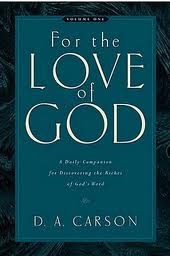
Love of GodEnter D.A. Carson
This last year my wife and I went through the first volume of D.A. Carson’s For the Love of God daily devotional based on the Murray M’Cheyne reading program and it’s been great. Robert Murray M’Cheyne designed a daily reading program that, at about 4 chapters a day, gets you through the New Testament and Psalms twice and the Old Testament once in the course of a year. So, for instance, January 1 begins with Genesis 1, Matthew 1, Ezra 1, Acts 1. It goes on from there. Originally the first two columns were labeled “family” intended to be read with the whole family, and the second two columns were “private” for personal devotion. It’s not necessarily the lightest program, but the arrangement is much better than most of the chronological reading programs or even some of the mixed year-long Bible programs.

With Carson’s devotional, you get a about a page of highly-readable biblical, theological, and pastoral commentary on one of the chapters by a top-notch theologian and scholar. Really, I compare the notes you get in this little devotional to the top-level commentaries sometimes and it’s amazing how he is quickly and, in an understandable fashion, making available the best scholarship and then moving to apply it to your daily life. I can’t begin to tell you how much I have enjoyed and personally benefited from both the daily Bible reading and Carson’s commentary. The arrangement of the chapters is helpful because it keeps you going through whole books of the Bible as they were intended to be read, instead of the “open and point” method that lands you reading a random chapter in Zechariah, leading you to think the prophet was on acid. Also, usually at least 2 of the chapters are in non-boring books, so you never have to truck through Leviticus all by itself.

No Sweat
Many of you might be intimidated at the thought of 4 chapters a day. Realize that’s only about 20 minutes total which can be broken up throughout the day if you have to. Still, that’s about 2% of the time you probably spend on facebook in a given day, so you have more time than you think. Also, you may choose to simply go through one book of the daily readings and whatever chapter Carson happens to be commenting on that day. Know that you might might miss a day. Or a week. Or a month. That’s fine, but just get back to it when you remember. When I asked my wife if we wanted to do volume 2 this year she said yes, because even though she didn’t get to it every day, she still had read more of her Bible this year than in any year prior. Sounds good to me.

Finally, if you’re worrying about dropping that 10 bucks on something you haven’t cruised through, or period, then you should know that D.A. Carson’s blog over at the Gospel Coalition is actually just his daily devotion. This last year they’ve been posting through volume 2, so next year will be volume 1 again. So, you can go check it out, or just use the blog as your daily devotional. You can even do it on your computer at work (on your break or lunch, of course).

The point of all of this is, for the love of God, read your Bible this year. It’s worth it and it just became a whole lot easier.

Soli Deo Gloria

Why We Need Christmas

Jesus 3Christmas is about revelation, God coming down and making himself savingly known to us. In one of my all-time favorite articles entitled “Why We Need Jesus” Michael Horton reminds us why this is exactly what we need if we’re ever going to encounter a gracious God:

The Incarnation presents to us the odd truth that the particular is not a shadow of the universal, on a lower rung of creaturely things. Rather, the gospel says the most particular thing—a Jewish rabbi in first-century Palestine—is the universal. And we can’t reason, intuit, or experience our way to this reality; we can only meet it first as history.

We hold to this claim for important reasons. First, our “search for the sacred” is warped by idolatry. God is incomprehensible in his essence: immortal, invisible, eternal, unapproachable Light (1 Tim. 6:15-16), the sight of whose face we cannot survive (Ex. 33:20). God doesn’t contradict reason, but transcends it infinitely (Isa. 55:8-9; Rom. 11:33).

If this were all we knew, then we might throw up our hands and conclude with the radical mystics and skeptics that we cannot really know God, at least in a rational way that we can put into words.

However, Scripture tells us more: God stoops to our capacity, accommodating our understanding. We know him according to his works, not his essence. We know that God is merciful, for example, because he has acted mercifully in history and revealed these actions as well as their interpretation through prophets and apostles. We cannot discover God in his hidden essence. And yet, we find him where he has descended to us, in the humility of a feeding trough, a cross, and frail human language.

You can, and should, read the rest of the article here. Not only is it a great article about the mystery of Christmas, but it functions as an introduction to a Reformed doctrine of revelation, as well as Michael Horton’s theology in particular.

Soli Deo Gloria

The Crib Leads to the Cross (Or, the Fathers on the Incarnation and Passion)

At Christmas we celebrate the advent of our Lord, the mystery of Incarnation of the Son of God.  For those of us with a theological bent, it raises a question that theologians have asked for centuries: if not for sin, would the Son have become incarnate anyways? Or, is the Incarnation the central act of salvation or the Passion? Christ’s birth or Christ’s death? Which is logically prior? Obviously they’re both important, but the way you answer this question has implications for other doctrines down the line and there are good arguments on both sides.

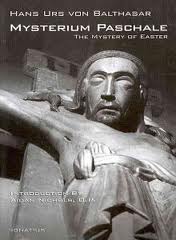
Mysterium paschaleCatholic giant Hans Urs Von Balthasar addressed this question in one of the most fascinating atonement theologies of the 20th century, his Mysterium Paschale: The Mystery of Easter, a meditation on the Triduum Mortis, the three days of Christ’s atonement: Good Friday, Holy Saturday, and Resurrection Sunday. Honestly, even though I’m not sure I can go for his controversial theology of Holy Saturday, brilliant though it is, most Evangelicals could stand to read his section on Good Friday–it’s worth the price of the book alone.

Before getting to the treatment of the three days, Balthasar argues that the Incarnation is clearly ordered to the Passion and that most attempts to reconcile the two trains of thought are misguided. Yet, the same time, if we look deeply into the Scriptures, the tradition, and the deeper theological logic, we will see that:

…to focus the Incarnation on the Passion enables both theories to reach a point where the mind is flooded by the same perfect thought: in serving, in washing the feet of his creatures, God reveals himself even in that which is most intimately divine in him, and manifests his supreme glory. (pg. 11)

East and West
Balthasar’s biblical arguments and later theological elucidation are both fascinating and convincing. The section that was most eye-opening for me in reading it a few years ago, was his section on the testimony of the tradition, both East and West on this subject matter.

Typically we are told that in the Orthodox East, a greater emphasis was laid on the Incarnation and that the Passion is accidental within the scheme, while the Latin West has placed a greater emphasis on the death on the Cross and so subordinates the Incarnation. Balthasar argues that this is a mischaracterization for “There can surely be no theological assertion in which East and West are so united as the statement that the Incarnation happened for the sake of man’s redemption on the Cross.” (pg. 20) Since this is somewhat uncontroversial of the West, specifically of the East he highlights that in their main theory, “the assuming of an individual taken from humanity as a whole…affects and sanctifies the latter in its totality, except in relation with the entire economy of the divine redemptive work. To ‘take on manhood’ means in fact to assume its concrete destiny with all that entails—suffering, death, hell—in solidarity with every human being.” (ibid.)

The Consensus
He then goes on to substantiate his claim with more citations from the Fathers than I have space to quote here; a number of them in Latin and Greek. I will reproduce only a few:

Athanasius

The Logos, who in himself could not die, accepted a body capable of death, so as to sacrifice it as his own for all.

The passionless Logos bore a body in himself…so as to take upon himself what is ours and offer it in sacrifice…so that the whole man might obtain salvation.

Gregory of Nyssa—

If one examines this mystery, one will prefer to say, not that his death was a consequence of his birth, but that the birth was undertaken so that he could die.

Hippolytus—

To be considered as like ourselves, he took upon him pain; he wanted to hunger, thirst, sleep; not to refuse suffering; to be obedient unto death; to rise again in a visible manner. In all this, he offered his humanity as the first-fruits.

Hilary—

In (all) the rest, the set of the Father’s will already shows itself the virgin, the birth, a body; and after that, a Cross, death, the underworld—our salvation.

Maximus Confessor—

The mystery of the Incarnation of the Word contains, as in a synthesis, the interpretation of all the enigmas and figures of Scripture, as well as the meaning of all material and spiritual creatures. But whoever knows the mystery of the Cross and the burial, that person knows the real reasons, logoi, for all these realities. Whoever lastly, penetrates the hidden power of the Resurrection, discovers the final end for which God created everything from the beginning.

Again, I have left out various citations by figures such as Irenaeus, Tertullian, Ambrose, Gregory Nazianzen, Cyril of Alexandria, Leo the Great, Augustine, and others (pp. 20-22). Still, as Balthasar notes, “These texts show…that the Incarnation is ordered to the Cross as its goal. They make a clean sweep of that widely disseminated myth” that the Greek Fathers, against the Latins, are focused on the Incarnation to the exclusion of the Cross. (pg. 22)

MangerThe Crib leads to the Cross
As interesting of a conclusion as this is for the history of theology, “more profoundly” says Balthasar, “the texts offered here also demonstrate that he who says Incarnation, also says Cross.” (pg. 22) Of course this should come as no surprise. In all these texts the Fathers were only repeating the apostles, “But when the fullness of time had come, God sent forth his Son, born of woman, born under the law, to redeem those who were under the law, so that we might receive adoption as sons” (Gal. 4:4-5),  and our Lord himself who said, “And what shall I say? ‘Father, save me from this hour’? But for this purpose I have come to this hour.” (John 12:27)

As we look to the Crib, we must see the Cross in the background—both holding our Savior in his weakness and humility—the peaceful beginning pointing the agonizing end suffered for our sakes; the cries from the cradle foreshadowing the cries from the Cross. This Christmas, as we gather around to celebrate the mystery of Incarnation, we cannot forget the Passion.

Soli Deo Gloria

“I’m Actually a Better Follower of Jesus Than Most Christians…”

buddy Jesus

This is how most Americans imagine Jesus.

I get into conversations with non-traditional believers and skeptics on a decently regular basis and, given what I do for a living, almost inevitably the subject of  Jesus and Christianity comes up. (“So what do you do, Derek?” “Well since you asked…”)

Depending on who I’m talking to, the conversation goes in one or more of a few familiar directions. One fairly common one goes something like:

“Well, even though I don’t go to church, or pray, or believe Christian dogma, or do anything particularly religious, I am actually a better follower of Jesus than most Christians.You see, I try to follow more closely to Jesus’ teachings on love, grace, forgiveness, and caring about the poor than they do. So really, I’m like Jesus where it counts most.”

What should we think of this claim?

Well, at one level, I’ve no doubt that for many this is true. Christianity teaches that all are created in the Image of God, so even though the Image might be marred or distorted, I have no trouble recognizing that a good many non-Christians live lives filled with beauty, love, compassion, and decency that probably surpasses my own.

Now, if we’re being honest, often this protest comes from a deluded self-righteousness, or as an insecure self-justification. That being said, it’s pretty easy for me to think of a number of very decent, moral, courageous, non-Christian people whose lives may be imitated to great benefit by Christians in their attempt to follow Jesus.

At another level though, this statement is entirely misleading. Once again, J. Gresham Machen points out the main problem with this line of thought:

Jesus is an example, moreover, not merely for the relations of man to man but also for the relation of man to God; imitation of Him may extend and must extend to the sphere of religion as well as to that of ethics. Indeed religion and ethics in Him were never separated; no single element in His life can be understood without reference to His heavenly Father. Jesus was the most religious man who ever lived; He did nothing and said nothing and thought nothing without the thought of God. If His example means anything at all it means that a human life without the conscious presence of God − even though it be a life of humanitarian service outwardly like the ministry of Jesus − is a monstrous perversion. If we would follow truly in Jesus’ steps, we must obey the first commandment as well as the second that is like unto it; we must love the Lord our God with all our heart and soul and mind and strength. –Christianity & Liberalism, pg. 84

See, leaving aside the fact that a great number of the things that Jesus tells us to do are those “religious” things like praying and worshiping with the community, the main problem with this line of thinking is that it rips out the heart of Jesus’ ethics. It focuses mainly on a select group of things that Jesus said to do, but it misses why he says to do them.

Machen calls our attention to the fact that the heart of Jesus’ ethics was his religion, the perfect love of the Father, and a desire to glorify him in all things (Matt 5:16, 48). You can’t read the Sermon on the Mount and escape the constant reference to “the Father” (Matt 5:16, 45, 48; 6:1, 4, 6, 8, 9, 14, 15, 18, 26. 32; 7:11, 21) and the theocentric nature of all of our righteousness. Jesus is remarkably clear that all of his ‘ethics’, his morality, flows from his relationship of loving trust of God; so if you’re truly going to “follow him”, then your obedience has to have a deep love for the Father at the center of it.

The upshot of all this is that simply doing moral things doesn’t mean you’re really “following Jesus”–his own words rule that out. This should be a sobering thought even for Christians. Far too many of us have God’s glory or God’s delight nowhere on our radar when considering our moral choices. In light of Jesus’ words, both the believer and the non-believer who claims to imitate Jesus, should stop and think, “If the glory of the Father, the love of the Father, is at the heart of what Jesus words and actions, why isn’t it at the heart of mine?”

Soli Deo Gloria