What’s So Great About Vanhoozer? (Engaging KJV Part 1)

I don't know what he's thinking right here, but it could probably serve as a Ph.D. thesis.

I don’t know what he’s thinking right here, but it could probably serve as a Ph.D. thesis.

When it comes contemporary systematic theology Kevin J. Vanhoozer is the man. I think I’ve said something like this before, but The Drama of Doctrine single-handedly saved my theology of Scripture when I was in my semi-emerging phase. His recent work Remythologizing Theology: Divine Action, Passion, and Authorship is probably the most important text engaging the doctrine of God and first theology (the confluence of God, scripture, and hermeneutics) that’s come out in the last 10 years. (I’ve summarized Vanhoozer’s summary of what that’s about here.) At least, in my admittedly unqualified opinion.

Imagine my excitement, then, when I got my hands on Southeastern Theological Review‘s volume for Summer 2013, which is dedicated entirely to interacting with Remythologizing. The volume is based on an ETS symposium dedicated to the subject, consisting mainly of four critical essays by Stephen Wellum, Oliver Crisp, and Fred Sanders and is capped off by a final response article by Vanhoozer himself. I’ve been waiting to read some constructive engagement with his work, but since the book is relatively new (only a couple of years old), and has been prohibitively priced (until now), there hasn’t been much.

I’ll just say that for those interested in an introduction to Vanhoozer’s project, or further discussion of the important issues involved, these are excellent essays from top scholars. Vanhoozer’s piece alone is worth the price. In order to encourage readers to either pick up the book, or follow up with the essays, over the next few weeks, I’ll write one post addressing each of the respective essays, probably picking out a key passage framing a critical issue, as well as sections from Vanhoozer’s own response.

What’s So Great About Vanhoozer? For this first week, though, I’d like to summarize a small section from Guest Editor Mark Bowalds’ introductory piece “A Generous Reformer: Kevin Vanhoozer’s Place in Evangelicalism.” Using an early piece in the Vanhoozer corpus, Bowald highlights four key features of Vanhoozer’s theological practice that make him necessary reading for those interested the future of Evangelical theology.

1. “First among these characteristics is his commitment to affirm and promote that quintessential feature of evangelical theology: the unrivalled authority of Scripture and the appropriate and fitting practices of its reading.” (pg. 3) Though nuanced, complex, and catholic (in the best sense), Vanhoozer’s theology unquestionably Evangelical, especially in its orientation to, and robust affirmation of the authority of Scripture. Indeed, anyone who has trucked through Is There a Meaning in This Text?, First Theology, or The Drama of Doctrine has seen his passion for, not only the authority of Scripture in the abstract, but it’s lived practice. For Vanhoozer, theology is not only scientia, but also sapientia, a lived out wisdom that gives the life of the Church its particular form. Scripture is not properly read until it is performed by a company of disciples steeped in the Theo-Drama of the Gospel.

2. “The second feature on display early on is his fearless and insatiable appetite to explore and read broadly and engage positively with diverse traditions and authors.” (pg. 4) Among the many accolades his books could (and have) been awarded with, Vanhoozer’s could probably qualify for that of most interesting bibliographies. For instance, in The Drama of Doctrine, alongside the theological titles of expected theologians (Calvin, McGrath, Webster, Barth, Von Balthasar), you’ll find Jeffrey Knapp’s study Shakespeare’s Tribe: Church, Nation, and Theater in Renaissance England and Stanislavski’s An Actor Prepares. Beyond that, you’ll find these works seamlessly blended with the insights of philosophers such as Wittgenstein, Gadamer, Riceour, Searle, and Habermas. Vanhoozer won’t be limited to the usual suspects when it comes to theological dialogue.

3. “Third, he displays a unique confidence in drawing from this great breadth of material, integrating and weaving it creatively and humorously into dialogue with evangelical thought.” (pg. 4) Following off of this, it must be noted that he engages this diversity well. As Bowald points out, with section titles like “Propositional Paradise Lost? Some problems with the Concept of Revelation”, he’s obviously comfortable playing with the big boys (and girls), and it shows in his delightfully playful literary demeanor. This isn’t mere whimsy, or the sign of an unserious thinker, however, but rather a mode of communication that displays the confidence that Evangelical doctrine ought to engender. Instead of insular jeremiads, or timid, lowest-common denominator forays out into the broader theological world, Vanhoozer displays a creative ease building on and generously critiquing his interlocutors from a generously Evangelical vantage point.

4. “The last noteworthy…aspect of Vanhoozer’s work which emerges from the foundation of these first three, is his willingness to hold on loosely to method.” (pg. 4) As Bowald points out, this feature of Vanhoozer’s thought and practice is often misunderstood. While he definitely has a clear theological method, Vanhoozer is quite comfortable employing various conceptual aids in an ad hoc, bricolage fashion in order to supplement traditional doctrines; a little speech-act theory here, a bit of acting methodology there, and a dash of continental hermeneutics there and you have a retooled doctrine of Sola Scriptura ready for use.  For “serious” theologians, who need there to be a more explicit, linear, link-up between method and articulation, this can be a bit disorienting. (Of course, that’s part of the reason nobody reads them.) Bowald is keen to note, however, that this flows from his humble and generous approach to theological science–a willingness to appropriate and employ whatever insights he can, always in submission to the Word of God.

All of this amounts to a very winsome, irenic, and moderating, yet essentially conservative figure. (In a sense, think Tim Keller, but in systematic theology.) As Bowald notes: “Evangelicals have always been better at building moats than bridges. Evangelical theology tends to be insular and centripetal; Kevin Vanhoozer’s approach to theology is porous and centrifugal.” (pg. 5) All of this goes doubly for the Reformed. Vanhoozer manages to be confessional without being cantankerous, faithful without being fearful. Besides the importance of his constructive answers on the actual material questions he addresses , he is an exemplar of an approach theology interested in reaching, without compromise, beyond the borders of our own little, insular world.

And isn’t that what a truly Evangelical theologian ought to do?

Soli Deo Gloria

Part 2 – Does Diversity of Form Lead to Diversity of Message In Theology?
Part 3 – Is Vanhoozer Still a 5-Point Alvinist?

Speech-Acts and the Peace of Jesus

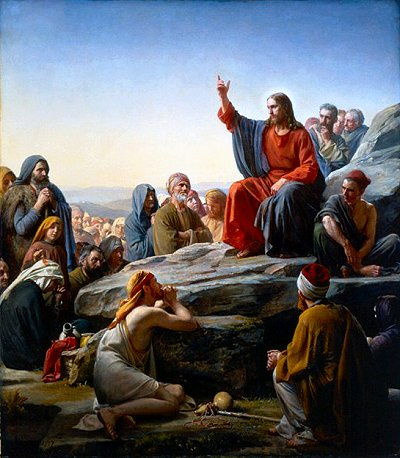
Jesus talkingOne of the most interesting and useful concepts I picked up in my philosophy undergrad is the idea of a ‘speech-act.’ Speech-act philosophy takes as its basic insight that language isn’t just about representing thoughts, or making simple statements of fact, but that, we actually do things with our words. There are words that we say in order to accomplish or bring about a new state of affairs. There are innumerable examples of this sort of thing (promising, lying, etc.) and all sorts of distinctions that philosophers can, and have made, but we see the basic point that, some words can be more efficacious than others.

The classic example of this is the minister’s words in a wedding. ‘I now pronounce you man and wife’ doesn’t just state the fact, but actually creates the fact. Before that statement, the two are merely engaged, but after that, they are married.

Now, of course, theologians have taken this and done all sorts of things with this over the years. For instance, we can see that a number of very important theological concepts can be understood and refined with the concept of speech-acts. When God justifies us, he is making a strongly declarative statement that, not only asserts that we are just and righteous in God’s sight, but in fact, actually brings about that situation. Or, again, God’s pronouncement of forgiveness is a constitutive speech-act. God saying ‘I forgive you’ creates the situation in which you are a forgiven person. Actually, push back farther and you’ll realize that we’re dealing with a God who speaks the world into existence (‘let there be light…’ Gen. 1). Kevin Vanhoozer and Nicholas Wolsterstorff have done extensive work with this, but, it’s safe to say it’s a fairly common concept in Biblical interpretation nowadays.

Why bring all this up? Well, the idea of speech-acts came to mind as I was going through my recent study in John’s Farewell Discourses in Calvin’s commentaries. Commenting on Jesus’ words “Peace I leave with you; my peace I give to you. Not as the world gives do I give to you. Let not your hearts be troubled, neither let them be afraid” (John 14:27), Calvin says:

By the word ‘peace’ he means prosperity, which men are wont =to wish for each other when they meet or part; for such is the import of the word peace in the Hebrew language. He therefore alludes to the ordinary custom of his nation; as if he had said, ‘I give you my Farewell.’ But he immediately adds, that this peace is of far greater value than that which is usually to be found among men, who generally have the word peace but coldly in their mouth, by way of ceremony, or, if they sincerely wish peace for any one, yet cannot actually bestow it. But Christ reminds them that his peace does not consist in an empty and unavailing wish, but is accompanied by the effect. In short, he says that he goes away from them in body, but that his peace remains with the disciples; that is, that they will be always happy through his blessing.

Commentary on John 14:27

…his peace does not consist in an empty and unavailing wish, but is accompanied by the effect.” Calvin reminds us that when Jesus speaks ‘peace’ to us, he’s an effective speaker. When we wish each other peace, if we actually mean it, it’s just that–a wish. We’re not in a place to grant our own wishes. When Jesus speaks peace, he’s an authoritative speaker who can actually bring that peace into our lives–in fact, by speaking it, he brings it. He can do this because, as Paul says elsewhere, Jesus is, in himself, our peace (Eph. 2:14).  He is the one who brought about the reconciliation that is the foundation of peace in his cross and resurrection in our place, so that, united to him by faith, we have the peace that he himself is (Col 1:20-22).

In other words, when Peter said, “Lord, to whom shall we go? You have the words of eternal life”, he wasn’t just blowing smoke.

Soli Deo Gloria 

Vanhoozer’s 10 Theses On “Remythologizing” in Plain(er) English

remthologizingOne of the things I enjoy most about college ministry is that I’m often forced to think through whether I actually understand all the nerdy, academic theology I read. Exhibit A: Kevin Vanhoozer’s Remythologizing Theology: Divine Action, Passion, and Authorship is easily one of the top five most nerdy, theological texts I own. I’ve read it twice and constantly find myself coming back to it, even though it’s not something I’d teach a college Bible study through.

Case in point: just last week I happened to mention the text around one my college students and she immediately wanted to know what “remythologizing” was.

I mean, when someone asks you about Vanhoozer, what are you supposed to do? Ignore it?

That launched us into an hour-long discussion explaining the difference between systematic theology and biblical theology, Bultmann and demythologizing, the confluence of God, scripture, and hermeneutics that Vanhoozer calls “first theology” and so much more. (She asked very good questions.) In the middle of this crash course, I ended up talking through Vanhoozer’s “10 Theses on Remythologizing.”

Inspired by Lewis’ dictum that, if you can’t put it in common English, you probably don’t know it, I attempted to translate the theses into normal-person speak for my intelligent, but non-expert student.

Given that not many people have read this very important text yet–and it is very important text, one of the most important in the last 20 years, probably–I figured I’d attempt a command performance of the on the spot translation summary act I did for my student the other night, only in print, and maybe not as sloppy. Maybe. I’ll essentially be trying to translate Vanhoozer’s own elaborations on the theses, in plain(er), Rishmawy-language.

Ten Theses On Remythologizing
Briefly, in many ways Vanhoozer’s project is kind of a counter-point to Bultmann’s program of ‘demythologization’ that de-storifed (mythos is story) the Gospels into timeless existential truths. In contrast, Vanhoozer’s aim is to take seriously the shape and form of the story of Scripture as God’s own communication to us of Who he is, while also avoiding Feuerbach’s notion that all god-talk is simply human projections of our best attributes onto the screen of eternity. So Vanhoozer puts forward his own program of “remythologizing” that he initially summarizes in these ten theses.

One key term to know is “theodrama”, which simply smashes “theos” and “drama” together in order to speak of the divine actions in redemptive history (God doing stuff in the story of the Bible). When Vanhoozer says, “theodramatic”, it basically means “having to do with God doing and saying stuff in the Bible.”

The italicized quotations are his, and again, the rest is my attempt at translation:

1. “Remythologizing is not a “fall back into myth” but a spring forward into metaphysics.” (27) This is not about mythologizing the text, taking us back to all-too-human gods of myth, but taking seriously the mythos, the plotof the biblical storyline to see what it reveals to us about the nature of God and the world. What must the God who acts in this story be like in order to do and say the kinds of things we see in the biblical narrative. To do that, we have to pay attention to the narrative very closely.

2. “Remythologizing means recovering the “who” of biblical discourse.” (28) At its heart, remythologizing is a project focused on the main character of the drama, God, who presents himself to us in the Scriptures through Word and Spirit. What attributes and characteristics does this God show himself to have in light of what he says about himself?

3. “Remythologizing means attending to the triune “who” of communicative action.” (28) Remythologizing is necessarily trinitarian theology because the one doing the saying in the narrative is Father, Son, and Holy Spirit (or, Father, Word, & Breath). That will shape the way we understand God’s self-communication.

4. “Remythologizing conceives the God–world relation in primarily communicative rather than causal terms.” (28) Instead of more classical categories like ‘causality’, which has some more physicalist connotations, Vanhoozer wants to rethink God’s relation to the world on the analogy of communication. The God of Scripture is a speaking God who brings us the world into being through speech and saves it through his Word. That should shape the way we conceive things.

5. “Remythologizing means rethinking metaphysics, epistemology, and ethics alike in theodramatic terms.” (29)  Instead of trying to shove the story of the Gospel into some pre-made grid like modern science, history, or secular metaphysics, Vanhoozer wants us to do things the other way around. Instead, the story of the Gospel is the criterion by which we judge all else. In fact, it generates its own metaphysical categories around God’s communication made flesh, Jesus Christ.

6. “Remythologizing means faith seeking, and demonstrating, theodramatic understanding through fitting participation in the triune communicative action.” (29) Theology is not a neutral affair. To understand God’s actions in Christ truly, there is an active element. I must be trying to situate myself within the story appropriately for this work to be properly undertaken. (This was a tough one.)

7. “Remythologizing means taking Christ, together with the Spirit-breathed canon that the living Word commissions, as the chief means of God’s self-presentation and communication.” (29) “Long ago, at many times and in many ways, God spoke to our fathers by the prophets, but in these last days he has spoken to us by his Son” ( Heb. 1:1–2). Remythologizing pays attention both to the grand story of Scripture and the Incarnation at the center, as well as the various genres, modes, and methods God has used within it to communicate himself to us. In fact, the Scriptures not only report God’s communication, but are, in fact, part of the action.

8. “Remythologizing is a form of biblical reasoning, a matter of thinking about the subject matter along the various forms of biblical discourse that present it.” (29) It’s not a matter of thinking or reading the Bible, but thoughtfully paying attention to the way the Bible teaches us to think. For instance, paying attention to the particular way a metaphor is used to communicate truth as opposed to a straightforward syllogism.

9. “Remythologizing means attending to biblical polyphony and recognizing the dialogical nature of theodramatic testimony and theological truth.” (30) God isn’t a boring communicator and the subject matter is too grand to be captured in simple fashion. Vanhoozer’s project is about paying attention to all the different ways and means, as well as angles (history, eschatology, ontology) and perspectives (divine, human, powers) from which the truth is communicated in order to “do justice” to the diverse voices in Scripture. Remythologizing shouldn’t result in flat theology.

10. “In sum, remythologizing is best defined in contrast to demythologizing as a type of first theology.” (30) First theology is how your doctrine of God, Scripture, and hermeneutics all play into one another. Remythologizing is Vanhoozer’s proposal for how that all should go together in light of the triune God’s communicating activity in the theodrama of Scripture.

Of course, Vanhoozer does much more than just put forward a methodology in this work. He shows you what he means by all of this in the process of doing some real theology involving close reading of texts, addressing issues in the doctrine of God in like the Creator/creature relationship as well as God’s impassibility, developing a doctrine of the Trinity along the lines of communicative categories, and bridging the gap between Thomism and Barthianism.  Among other things.

The long and the short of it, though, is that remythologizing is a renewed program of thinking about God on the basis of what God has said and done in Jesus Christ and the Scriptures in the power of the Spirit. In many ways, it’s simply a retooling, a new articulation of a very old approach. Of course, as Pascal says, “Let no one say I have said nothing new; the arrangement of the material is new. In playing tennis both players play the same ball, but one plays it better.”

Vanhoozer plays the ball quite well in our postmodern context and theologians of all stripes would do well to learn from this master theological re-arranger.

Soli Deo Gloria

Judge or Expert Witness? Vanhoozer and Calvin on Scripture and the Councils

gavel and bibleKevin Vanhoozer’s Drama of Doctrine: A Canonical-Linguistic Approach to Christian Theology has one of the most sophisticated and nuanced Protestant approaches to the doctrine of sola scriptura and the relationship between scripture and tradition that I’ve encountered yet. As I was perusing through it the other day, I ran across this wonderful little teaser passage on Calvin, scripture, and the councils:

The Reformation was not a matter of Scripture versus tradition but of reclaiming the ancient tradition as a correct interpretation of Scripture versus later distortions of that tradition. The Reformers regarded the early church councils by and large as true because they agreed with Scripture, not because they had authority in and of themselves.

Certain critics of sola scriptura that the Reformers demythologized tradition by chasing the Holy Spirit out of the life of the church into a book. This goes too far. It is preferable to view tradition, like the church itself, as an example of what Calvin calls “external means” of grace. Tradition does not produce its effect ex opere operato; on the contrary, tradition efficaciously hands on the gospel only when it preserves the Word in the power of the Spirit. It is an external aid to faith, but not an infallible one. To speak of the ministerial authority of tradition is not espouse not a “coincidence” but an “ancillary” view of the relationship of Scripture and tradition.

Calvin honors the early church councils precisely because, for the most part, they were governed by word and Spirit: “[W]e willingly embrace and reverence as holy the early councils, such as those of Nicaea, Constantinople, Ephesus I, Chalcedon and the like…insofar as they relate to the teachings of the faith. For they contain nothing but the pure and genuine exposition of Scripture.” (Institutes 4.9.8) However, when one council contradicts another, as Chalcedon contradicted Ephesus II, the church must return to the word as ultimate norm. Church councils have a provisional, ministerial authority. To give them absolute authority, says Calvin, is to forget biblical warnings about false prophets and false teachers (Matt. 24:11; Acts 20:21-29; 1 Tim 4:1; 2 Tim 4:3; 2 Pet. 2:1). Indeed, with regard to Ephesus II–the council that accepted Eutyches’ heresy concerning the person of Christ–Calvin offers a sobering judgment: “The church was not there.” (Ibid., 4.9.8) This haunting observation neatly reverses the medieval formula extra ecclesiam, nulla salusCalvin might well have said: Extra scriptura et pneuma, nulla ecclesiam–“Outside word and Spirit, there is no church.”

Sola Scriptura refers to the practice of attending the Spirit speaking in the Scriptures as the final appeal in doctrinal disputes. How do we recognize the Spirit’s speaking? Church tradition enjoys the authority not of the judge but of the witness. Better: tradition enjoys the authority that attaches to the testimony of many witnesses. In this light, we many view the church fathers and church councils as expert witnesses as to the sense of Scripture in the courtroom drama of doctrine. Neither the Fathers nor the councils sit on the bench; the triune God has the final say. The task of theology is to cross-examine the witnesses in order to offer proximate judgments under the ultimate authority of the presiding judge: the Spirit speaking in the Scriptures.

To practice sola scriptura  is to treat Scripture alone as the “norming norm” and tradition as the “normed norm.” A theology that practices sola scriptura recognizes the ministerial authority of tradition, namely, its ability to nurture individuals in and to hand on the apostolic faith through the church’s corporate witness. Canon may be the cradle of the Christian doctrine, but tradition is its wet nurse. —The Drama of Doctrine: A Canonical-Linguistic Approach to Christian Doctrine, pg. 233-234

Again, that’s merely a teaser–Vanhoozer expands on each of those points at length. He shows us that the practice of sola scriptura is not a necessary recipe for historical ignorance or hopeless subjectivity in interpretation. It is a call to treat expert witnesses with all the due deference they deserve, while recognizing the true judge of the church: God in his Word.

Soli Deo Gloria

Vanhoozer’s 10 Rules for Cultural Interpretation

I don't know what he's thinking right here, but it could probably serve as a Ph.D. thesis.

I don’t know what he’s thinking right here, but it could probably serve as a Ph.D. thesis.

I was planning on doing a couple more posts on Kevin Vanhoozer’s theory and methodology of cultural interpretation. (I still might, partly for my own benefit.) But for now, I’m going to cheat and cut to the end by laying out Vanhoozer’s 1o Guidelines for Everyday Theological Interpretation of Culture. Some of them need some unpacking, but since that would be too much work (and you really should go buy the book anyways), here they are:

  1. Try to comprehend a cultural text on its own terms (grasp its communicative intent) before you “interpret” it (explore its broader social, political, sexual, or religious significance.)
  2. Attend to what a cultural text is doing as well as saying by clarifying its illocutionary act (e.g. stating a belief, displaying a world).
  3. Consider the world behind (e.g. medieval, modern), of (i.e., the world displayed by the cultural text), and in front of (i.e., its proposal for your world) the cultural text.
  4. Determine what “powers” are served by particular texts or trends by discovering whose material interests are served (e.g.. follow the money!).
  5. Seek the “world hypothesis” and/or “root metaphor” implied by a cultural text.
  6. Be comprehensive in your interpretation of a cultural text; find corroborative evidence that makes best sense of the whole as well as the parts.
  7. Give “thick” descriptions of the cultural text that are nonreductive and sensitive to the various levels of communicative action.
  8. Articulate the way of being human to which a cultural text directly or indirectly bears witness and gives commendation.
  9. Discern what faith a cultural text directly or indirectly expresses. to what convictions about God, the world, and ourselves does a cultural text commit us?
  10. Locate the cultural text in the biblical creation-fall-redemption schema and make sure that biblical rather than cultural texts have the lead role in shaping your imagination and hence or interpretive framework for your experience.

Everyday Theology: How to Read Cultural Texts and Interpret Trends, pp. 59-60

Soli Deo Gloria

What’s a Culture and How Does it Work? 4 Functions of Culture According to Vanhoozer

everyday theologyThe notion of culture has been on my mind for a long time now, but after joining the writing staff over at Christ and Pop Culture, I figured it was appropriate to do a little more digging on the notion of culture and cultural analysis. To that end I finally picked up a little volume edited by Kevin Vanhoozer Everyday Theology: How to Read Cultural Texts and Interpret Trends. While there are many volumes out that address the issue of biblical exegesis, there are few that address the crucial task of “cultural exegesis”, the practice of reading culture, interpreting the “signs of the times” (Matt. 16:1-3), in light of God and his revelation. That’s the gap that Vanhoozer and his co-editors (Charles A. Anderson, Michael J. Sleasman) aimed to fill. The volume opens with an programmatic essay by Vanhoozer in which he outlines a theory of culture, as well as a methodology for cultural interpretation. The essays that follow are examples of the method put into practice, with explorations of the check-out line, Eminem, Gladiator, and the blogosphere. In this post I’d like to take a (very) quick look at Vanhoozer’s view of culture and the way it works.

What’s a Culture? (Again)
Working primarily at the levels of what Roger Scruton has identified as “common culture” and “pop culture”, Vanhoozer’s discussion is fascinating and helpful many ways. One important point to note is his dependence on Dilthey’s idea that cultural studies observes the realm of human freedom, spirit, and creation v. that of nature. On this view cultural artifacts are concrete expressions of the human spirit by which our values, beliefs, and aspirations are given objective existence. As such, cultural artifacts such as songs, architecture, poetry, games, literature, and political practices “call not for explanation but for interpretation.” (pg. 22) Hermeneutics is key.

Another distinction he makes is the difference between culture and society; his chosen metaphor to understand the difference is hardware and software. Society is viewed more as the hardware of social institutions that gives shape to the shared life of a people. Culture he says, “is the software that determines how things function and how people relate in a given society. Culture is both system and practice, a means through which visions of the meaning of life (cultural worlds) are expressed, experienced, and explored through the diverse human products (cultural texts).” (pg. 27) So, police are institutional hardware that can be found across cultures, and yet an American “cop” is understood differently than a British “bobby” that usually doesn’t carry a gun. (pg. 23) Same institution, different cultural implementation.

How, then does Vanhoozer define culture? I won’t go into his very long and rewarding discussion, but in the end, Vanhoozer views culture “as a world and work of meaning. Better, culture is made up of “works” and “worlds” of meaning.” (pg. 26) It’s a work because it’s what humans do freely. Cultural objects are intentional creations–texts that communicate meaning. It is a world because these texts “create a meaningful environment in which humans dwell physically as well as imaginatively.” *(pg. 26)On this view,  popular culture is the shared context, practices, and “resources” that shapes and forms our way of life. (pg. 30)

How Does it Work?
The question remains, how does culture do this? Vanhoozer identifies 4 things that culture does to shape our lives.

  1. Culture communicates – First of all, culture is constantly communicating to us in ways both explicit as well as subtle, in a variety of formats, media, advertisements, and cultural artifacts. While there are hundreds of different specific messages aimed at a every discernable area of human life, the over-arching goal is to communicate a vision of the meaning of life, and the embodied form it should take. We mustn’t be naive the way this vision is communicated though. As Vanhoozer notes, “form and packaging” are just as important as content here. (pg. 28) Most cultural communication happens not through propositional argumentation but through allusion, suggestion, and connotation. It gives us pictures and metaphors (“life is like a box of chocolates”) that give rise to broader stories about the world we live in; subtle hermeneutical suggestions that shape the way we interpret our lives.
  2. Culture orients – This gives rise to the next function of culture: it orients us. By providing us with metaphors and models it gives us the inner logic by which we live our lives. “Life is like a baseball game”, “Life is like an episode of X show”, etc. These models also have “evaluative” and “affective” dimensions to them, in that they shape and form our loves and hates, our very sense of right and wrong. (pg. 29) Culture maps the world for us and creates a sense of mood by which we experience life. Moral and social orientation that we previously drew from family, community, and cult, we now draw from popular cultural texts such as movies, shows, song lyrics through which we construct the scripts of our lives. While How I Met Your Mother gives us a script about dating, childhood soccer-fields teach us about the nature of victory and competition. Importantly for Christians, Vanhoozer notes that while in the past culture gave us narratives of faith, we now more often find stories of “broken faith: defiance or anger at God; of fear of an indifferent or oppressive reality; of escape from sorrow over the absent God by finding joy in one’s immediate, mundane life.” (pg. 29)
  3. Culture reproduces -We need to understand that culture spreads. “Culture spreads beliefs, values, ideas, fashions, and practices from one social group to another.” (pp. 29-30) in the past through institutional force or colonization, but now it mostly happens through memetic reproduction. A “meme” is a “cultural unit” analogous to a gene in that it reproduces and passes itself on by means of imitation (mimesis). This could be anything from an idea, a fashion, phrase, song, or practice. The point is that cultural “programming” is spread from person to person, sort of like a virus, as people encounter each other and begin to copy or imitate the cultural behaviors that they see. This can happen institutionally in schools, or through parental instruction, but more often than not it’s happening informally all the time through everyday interactions with friends, online content, and media saturation.
  4. Culture cultivates – Finally, culture “cultivates”–it develops and grows. What does it grow? Well, recalling Dilthey’s point earlier, it cultivates the human spirit. By communicating and creating worlds for us to inhabit, metaphors to live by, or the basic orientation for our lives, culture develops our souls. It gives a vision of the meaning of life for our “hearts”–the seat our willing and acting–to desire and pattern itself against. “In short, culture cultivates character traits–the habits of the heart–and in doing so forms our spirit so that we become this kind of a person rather than that kind.” (pg. 31) The point isn’t that we are helpless against the onslaught of culture’s imagination or affection-shaping power. It is rather that we need to understand that it’s not a question of whether a particular show is educational, but what’s the lesson being taught? (pg. 31) Prolonged exposure to cultural texts presenting us with similar narratives and worlds shape our self-understandings and create a sort of “second nature” for good or ill. (pg. 32) Culture is a spirit-forming reality.

Because of this, Vanhoozer calls Christians to wake up and not simply walk about in culture like “sleep-walkers” unaware of the worlds which they are being invited to inhabit. (pg. 32) We need to be discerning readers both of Scripture and of culture, determining which is exerting a greater force on our hearts, and for what end. What vision of the good life are we buying into? What narratives and metaphors have we adopted? Which works and worlds dominate our imagination? The various little texts provided by marketers and other meaning-makers in pop culture, or the works and world of God as found in his Text?

Soli Deo Gloria

On the Difference Between “Literal” and “Idiot-Literal” Interpretation

literalI’ve already written once before on the issue of a ‘literal’ hermeneutic. I want to take time once again to clarify, from another angle, that there is a difference between a ‘literal’ hermeneutic (method of interpretation) and what I’m calling an ‘idiot-literal’ hermeneutic.

Classic Literal
A classic “literal” hermeneutic was the favored interpretive method of the Magisterial Reformers such as Calvin and Luther, which, at its better moments, has been followed by their Protestant heirs. It also might be called the “historical-grammatical” method because, in a nutshell, its aim is to first understand what the author’s intended use of a given word, sentence, paragraph was in accordance with the historical, cultural, and literary context and usual grammatical rules. As Kevin Vanhoozer has said, “the literal sense is the literary sense.” Interpreting a text ‘literally’ in this sense did not mean ignoring figures of speech, metaphors, analogy, or running roughshod over genres, context, or linguistic anomalies. Essentially, if the biblical author is trying to write history, you read the text like history; if poetry, like poetry; if a letter, then as a letter.

The Magisterial Reformers were, for the most part, humanist scholars trained in rhetoric and an appreciation for literary art, so they championed this sort of exegesis as a corrective against the spiritualizing, or rather allegorizing, interpretive methods favored by some in the Middle Ages, and passed down from some of the Fathers such as Origen and Augustine that could, and I say this with great respect for those classic interpreters, could go off the rails a bit as they found all sorts of hidden, “spiritual” meanings in rather straightforward texts. While the Reformers didn’t rule out certain typological interpretations–for instance it’s fine, and even necessary, to see a figure of Christ when discussing OT sacrifices or King David–they worried that some of the allegorizing that went on led to the Scriptures becoming a “wax nose” of sorts, that could be shaped and reshaped at will. Any typological interpretation must come after and be in line with the original story, or law that was set forth according to its intended purpose. (From what I understand, Thomas Aquinas was actually a champion of rooting the “spiritual” sense in the literal sense as well.) Now, admittedly they weren’t perfect at this themselves, but by and large this was a good move for biblical studies and theology in general.

My point here is to clarify that a “literal” interpretation in the classic sense is not what might be called a “literalistic”, or illiterate approach to the text, but rather it is one concerned with discovering the author’s intended meaning in accordance with sound rules of literary interpretation. Which brings me to our next category: the idiot-literal hermeneutic.

Idiot-Literal
An idiot-literal hermeneutic is the interpretive method that is favored mostly by liberalizing critics for straw-manning conservative  opponents. It consists of finding the most obtuse, ham-handed, or silly interpretation of any given biblical text that fails to recognize a textual or literary clue that we’re dealing with figurative language and holding it up as the necessary reading for anybody holding a “literal” hermeneutic. Often-times it’s linked in these presentations to the doctrine of “inerrancy” (which, for some reason, is usually also caricatured, confused, and conflated with a straight dictation theory of inspiration).

Now, I’m not denying that often-times you can find conservative/fundamentalist interpreters whose readings border on self-caricature. In fact, along with Beale, I do think the time might come when we need to start using the phrase “literate” hermeneutic, or something of that sort in order to distinguish things. Still, I do think it’s important to clarify that just because someone self-identifies as adhering to a “literal” hermeneutic, or because the Reformers held to one, it does not mean they must adopt whatever silliness is imputed to them by their critics on pain of inconsistency.

Conclusions
This was necessarily rough and probably simplistic, but hopefully it sufficed to make my point–a literal reading of the text is not the same as an idiot-literal reading of the text. You haven’t refuted conservative hermeneutical approaches by simply picking the dumbest reading possible and saying, “Here, this is what you have to believe, right?” Also, if you pride yourself on your conservative view of scripture and hermeneutical approach, please don’t play into the caricature–do your homework.

Soli Deo Gloria

PS. For those looking to learn how to read their Bibles better:

1.  How To Read Your Bible For All It’s Worth by Gordon Fee and Douglas Stuart is an excellent place to start.
2.  Introduction to Biblical Interpretation by William W. Klein, Craig Blomberg, and Robbert I. Hubbard Jr. is also excellent, although a bit more advanced.

Quick-Blog #10: Don’t Get Analogy, Don’t Get God (Michael Horton on the Doctrine of Analogy)

If you’re going to study the doctrine of God, you need to understand the doctrine of analogy. It’s that simple.

Honestly, I’ve become convinced of this over the last few years as I moved from my early days as a Jurgen Moltmann fan to my current Reformedish semi-classicalism. (I have no good term for it. Whatever Kevin Vanhoozer is.) If you haven’t stopped reading already, you might be wondering what the doctrine of analogy is.

The doctrine of analogy is a very old one shared by the post-Reformation scholastics with their medieval forebears like St. Thomas Aquinas. In that sense it’s a very “catholic” teaching, shared across the tradition by Catholics and Protestants of various stripes. (I’m not too sure they’d put it this way, but I think the Eastern Orthodox would be fine with it as well.) Michael Horton laid out one of the cleanest summaries of the doctrine I’ve found in an article on the subject of the Reformed theological method. I’ve already quoted it here, but it’s worth high-lighting again:

“All of this leads us, finally, to the doctrine of analogy. When we assert certain predicates of God, based on God’s own self-revelation, we use them in one of three senses: univocally, analogically or equivocally. If we say that the predicate “gracious” means exactly the same thing, whether in God or in a creature, we are using “gracious” univocally. At the other end of the spectrum, if we say that by using that predicate we are ascribing something to God whose appropriateness is unknown to us, we are using it equivocally. If, however, God is said to be “gracious” in a way that is both similar and dissimilar to creatures, we say it is analogical. For instance, when we acknowledge that God is a “person,” do we really mean to say that he is a person in exactly the same sense as we are? When we follow Scripture in using male pronouns to refer to God, do we really believe that he is male? Unless we are willing to ascribe to God (in an univocal sense) all attributes of human personhood, predications must be analogical. Human language cannot transcend its finitude, so when God reveals himself in human language, he draws on human analogies to lead us by the hand to himself. It is correct description, but not univocal description.”

Basically, when you’re saying something about God or reading it in the Bible, whether about his being or his emotions, or something else, you have to insert a little qualifier because you’re comparing the transcendent, uncreated one to something created. Kinda like, “God is good (but not exactly the way you think of good)”, or “God is strong (and that is an understatement so serious you don’t have a category for it)”, or “God is angry (but you can’t think of it like sinful human anger)”, or “God repented (but not in the way that implies he didn’t know what he was doing)”. It’s like, but unlike.

Does this mean we can’t know anything about God? No. As Horton points out, God picks out these human analogies, especially in the Scriptures, to tell us something about himself. We just have to be careful when we pick up these analogies to use them and think of them in the way God intends us to, with the reading clues he gives us. For instance, when God is said to be our Father, we have to stop ourselves from immediately filling that word with everything we learned about fatherhood from our own fathers, but rather we must look to the way he is our Father in Christ, or better, the Father of the Son. That’s the kind of Fatherly love we look for, not the imperfect, possibly too lenient (ie. neglectful), or harsh, or whatever loves we find on earth. Again, it’s like, but unlike.

As always, there’s more to it than that, but this is supposed to be a quick-blog.

Soli Deo Gloria

The Beauty of the Impassible God (Or, Is God an Emotional Teenager?)

For some reason I’ve become interested in the much-maligned doctrine of the impassibility of God over the last couple of years. What is the doctrine you ask? Simply put, it is the idea that God cannot be made to suffer change from without or be overcome with passions. Ever since the early Fathers this has been the standard teaching of the Church: God is not subject to passions. I first found out about this idea in college when reading Jurgen Moltmann’s classic, The Crucified God in which he argues, among other things, that for God to be impassible in light of the world’s suffering and evil would make God wicked. In fact, in light of the cross of Christ where the Godman suffers death and alienation, it’s absolutely blasphemous. Instead, the Bible presents us with a passionate God who suffers alongside of us, who bleeds, who dies, and who understands our pains–because isn’t that what love does? In this account, impassibility is a hold-over from Greek philosophy that crept in and corrupted the pure, Hebrew view of the dynamic, living God of Scripture and turned it into the conceptual idol of the frozen absolute valued by Plato, Aristotle, and the Stoics.

This view, that of the passible God, has become the “New Orthodoxy” that has been growing apace in academic and popular theology since the earliest part of the 20th Century, especially with the rise of process theism, open theism, and panentheism. Impassibility is also generally rejected in various quarters of Evangelical theology that cling to largely traditional doctrines of God, with John Stott citing Moltmann on this point with approval in his great work, The Cross of Christ. Now, given that I first came across the doctrine of impassibility at the tender age of 20, without any real knowledge of historical theology, or most of the reasoning behind the thinking of the Fathers in articulating this doctrine, it’s not hard to imagine that I whole-heartedly rejected it as nonsensical and the silly invention of “Greek” theologians and their systematizing ways.

Luther said that for the Christian all of life is repentance. I’ve come to find out that holds true not only in moral terms, but also intellectual ones. Suffice it to say that after reading some significant criticisms of passibilist criticisms from biblical, theological, philosophical, and historical-theological angles, I’ve come back around to affirming a form of the doctrine of impassibility. Key thinkers who helped me along this path have been Kevin Vanhoozer, David Bentley Hart, and Paul Gavrilyuk.  Kevin DeYoung also has a helpful article summarizing key points.

I’m not going to attempt to cover all the relevant points or even come up with as helpful of a summary case as DeYoung has. I simply wanted to offer up some quick, semi-connected, but inevitably unsystematic correctives of popular perceptions about the doctrine as well as offer some reason to find this doctrine beautiful along the way. In doing so, I will be depending heavily on the account offered in Vanhoozer’s Remythologizing Theology, pp. 387-468. Needless to say, this will be hopelessly incomplete. Any insight that is helpful or intelligent is probably his. Anything silly or reductionistic is probably mine.

Clarifying Thoughts on Impassibility

Not a Rock – It is often charged that the doctrine of impassibility leaves us with an emotionless rock of a God. From the outset it ought to be made clear that to teach that God is impassible is not to deny that God has an emotional life with cares, joys, loves, and so forth. Impassibility does not mean impassivity any more than immutability means immobility. Both are caricatures and misunderstandings of the classical doctrine. Just as the doctrine of God’s immutability or changelessness is not a teaching about a static, stone God, but a God so perfectly overflowing with life that any “change” could only tend towards a lesser state, so the doctrine of impassibility is statement about the perfection of God’s emotional life, his sovereignty over it, not its absence. Anybody who teaches otherwise, both critic and advocate, has been misled on the subject. In the early Fathers, to teach that God was impassible was to teach that God did not have “passions”, or unrestrained feelings ungoverned by reason or will that could simply sweep over him. A passion was thought of as a sort of violent, semi-physical force that could move a person without the consent of their reason or will, or a sinful inclination. To deny that this can happen is to say that God’s emotional life is under his own control and will not erupt violently in irrational or sinful ways. God is not an emotional teenager.

The Bible? – What about those passages in the Bible that talk about God’s very strong feelings about things? What do they point to if God is not a passionate God? Are they “merely” anthropomorphisms that don’t “really” mean what they say? The Fathers and the medieval tradition made a distinction between ‘passions’ and ‘affections.’ An affection is a sort of controlled emotion that is subject to the will and mind of the one having it. It is a rational emotion that does not overcome the person, but is in line with the will. God has affections such as kindness, anger, etc. which he can display. The passages in the Bible talking about God’s anger, kindness, grief, and so forth are pointing to something real in God–his affections, the emotional life of the God of Israel. They are not “mere” anthropomorphisms, even though they are anthropomorphic. They are real descriptions, though not to be taken in a literalistic fashion, of God’s emotional life.

What’s An Emotion Anyway? – One point that clouds this discussion and makes it hard to conceive of God having emotions that are not passions, is that often-times we don’t have a clear understanding of what an emotion is. Kevin Vanhoozer draws attention to the fact that there are various theories on offer as to what an emotion is, but the split is between two basic types: non-cognitivist and cognitivist understandings. Non-cognitivist theories of emotion stress the pre-rational nature of an emotion such as the physical rush associated with fear or anger, which we then attach to cognitive content. Vanhoozer points out a few problems with that. First, God is spiritual, not physical. He cannot have an adrenaline rush with a flush of the face, a flaring of the nostrils, or moistening of the tear-ducts. For us to ascribe emotions to him on this view is to ascribe a body. The second problem with this is that with fear or anger, I feel the rush precisely because of what I believe about a certain situation or action. Third, a lot of emotions “feel” the same physically, like anger and fear, but the only thing distinguishing them is the cognitive content. Fourth, it’s hard to ascribe praise or blame to the way people feel if it’s just a physical reaction. But we seem to think that some feelings are praiseworthy and others are blameworthy. For these reasons, (and a few others), its best to opt for a cognitivist understanding of emotion.

On a cognitivist view, an emotion is a judgment or an attitude that one takes about something.  It is a concern-based, value-laden judgment about a state of affairs. My fear and happiness are flavored understandings about situations or persons that I am concerned with. Given my humanity my loves, jealousy, or fear can be both passions that I suffer as well as affections. We are both patients and agents with respect to them. God has perfect emotions, affections not passions, because his value-laden judgments are true and accurate ones. God’s love, jealousy, wrath, compassion, and kindness are involved judgments, ways of “seeing” with the heart that inclines him towards action of some sort but do not overwhelm him.  They do not incline him towards evil and they cannot sweep over him because they are fully-consonant with his perfect knowledge and will.

At this point some people might be thinking that this makes a sort of sense, but not something you’re willing to buy into too quickly. These highly cognitive emotions seem too distant from our everyday human experience.  In response, Vanhoozer would remind us that “the similarities between God’s emotional life and ours exist in the midst of an even greater dissimilarity, one that marks the infinite qualitative distinction between Creator and creation, Author and hero.” God is God. We might be made in his image, but God’s reality is a whole ontological step up from ours. We should expect things to be a little different up there. Just as God’s sense of personhood will be different than yours given that he exists as Father, Son, and Holy Spirit, while you exist as you, it’s unsurprising that his emotional life is a little beyond us.

Sovereign Relationality – A further consideration connected to impassibility is that there is nothing outside of God that is beyond his control. Those agents or situations about which he feels things are not outside of his will or agency. Given creatio ex nihilo, even with a strong view of libertarian human agency, God is not subject to his human creations. His feelings in relation to them are not things which he must passively suffer but ones which he actively chooses to endure. They are not imposed on him from without, but sovereignly accepted. Passibilists might point to passages like Hosea 11:8, where God speaks to Israel, saying that he cannot bear to be parted from him, that his heart recoils within him at the thought of extinguishing him in judgment. The thought is that here human subjects exert a force and cause a change, or suffering in the emotional life of God from without. It must be remembered that these statements are uttered within the context of a covenant relationship which God freely and sovereignly entered into without force or compulsion. God did not have to save Israel. God did not have to covenant with a people. God was not forced to create. He is under no threat to save. Therefore, the situations that he involves himself in, about which he has these value-laden judgments like anger, sadness, etc, are situations over which he is sovereign and in control.

The Incarnation–Chalcedonian Solutions  – “All this theological logic-chopping and conceptional analysis is fine, but what about the cross? Doesn’t that show that God suffers? What sense does it make to say that God is impassible if Jesus is God and Jesus truly suffers on the cross?” This is where a little Chalcedonian christology comes to the rescue.

The classic answer developed by theologians like Cyril of Alexandria is that while it is appropriate to say that the Son suffered on the cross, we make it clear that God the Son suffered in his humanity, which is capable of suffering. Because we confess the unity of the Godman, that this man, Jesus Christ, truly is the Eternal Son, it is true then, to say that God suffered, but only in the soul and flesh of the Godman. If we begin to take suffering up into the divine nature, then we begin to render the incarnation a pointless gesture. If God can suffer in his own nature, then why assume human nature at all? In a sense, it is true to say that the lover wills to suffer alongside the beloved. But without impassibility we lose the wonder of what God has done in Christ–he who knew no suffering in himself, willed to become as we were so the he could experience it alongside of us. We too often forget that nobody takes Jesus’ life from him–even in his humanity, the Son lays down his life of his own accord. (John 10:18) He is sovereign even over his death and “suffering” at the human hands he empowered to crucify him. (John 19:11) What’s more, he did so, not just to “feel our pain”, but in order to end it. There is some comfort when we read that Christ is a sympathetic high priest who knows of our temptations (Heb 4:15), but as Vanhoozer reminds us, the true comfort of the verse comes when we read that he did not give in to the temptation, but overcame it for our sake in order to cleanse us from our sins giving us free access to the throne of grace. (4:16; Heb 2:17-18)

The Beauty of the Impassible God

In the end, the doctrine of impassibility affirms that God did not incarnate himself of necessity to relieve his own unbearable suffering. His existence as Father, Son, and Holy Spirit is one of perfect, unconquerable, and impassible “light, life, and love.” (Vanhoozer) Instead, in Christ, he freely, willingly, and sovereignly endured suffering, actively making it his own, so that ours would be put to an end. To affirm God’s impassibility is to confess that God’s action in Christ is nothing other than the beautifully gratuitous outpouring of his invincible, unsurpassable, enduring love for his wayward creatures–it’s the foundation of grace itself.

Soli Deo Gloria