Ever heard a kid ask, “Why can’t I do that when you’re always doing it?” I’m sure those of you parents have heard this refrain from your children. Before getting hired at my church, I worked for a few years as a substitute teacher and every so often I’d get this from a kid who wanted to defend using a cell phone or eating in class.
I’d often debate with myself whether or not this was a fair argument. Is it fair for a teacher to use their cell phone in class when a student is forbidden to? What are the reasons for this? Is it fear that phones might be used for cheating? Are they a distraction in the learning process? Are they just inherently wicked? Depending on the answer, it might be an unfair double-standard; I’m pretty sure all the times I ate in front of those hungry children were.
This raises the question, though, “Are there actions that, in virtue of the different roles which students and teachers occupy, are inappropriate for students but are entirely appropriate for their teachers?” I think there are probably a few. For instance, it seems entirely appropriate for a teacher to have possession of the answers of a test out during the administration of a test while it is inappropriate for the students to have the same. Or again, it is entirely appropriate for a teacher to be talking to a student during a test, but not for another student.
Let’s broaden the principle. Is it the case that some actions are appropriate for some people given their role or job, but entirely inappropriate for others given theirs, such that the one can essentially say to the other, “Do not do what you see me doing”? I think that seems reasonable. A parent might say to a child, “Do not use the knife” without being hypocritical. A police officer might enforce restrictions on hand guns while using a gun. In virtue of their different roles, the parent is allowed to do what the child is not and the police officer is allowed to carry what the average civilian is not.
One more question: Is it possible that one person, trying to abide by the same principle as another, might have to do exactly what they have forbidden the second from doing precisely because of their different roles? Think of a chemistry professor who, in the interest of student safety, handles dangerous chemicals that he has expressly forbidden his students from handling. Think of a mother who, in the interest of fairness, forbids her older children from punishing their younger siblings for their faults because that is her job. She knows they won’t be able to do it properly, so she does it herself. In both cases, one person forbids another from taking an action that they themselves will take for exactly the same reason. The action itself is not inherently wicked or wrong–it is wrong for some given their position or abilities, while it not for others.
The Objection: Is God Unfair?
Why this digression into the fairness of in-class cell phone usage by substitute teachers? Last week I posted a little piece on penal substitutionary atonement (PSA), the teaching that part of what Jesus did on the cross was to suffer the judgment of God for sins in our place thereby saving us from having to bear the penalty ourselves. This sparked some off some friendly (and some not-so-friendly) conversation about the doctrine; apparently there are a number of people who don’t think to highly of this teaching.
Now, I have to admit, this area of Christian theology is one of those that I’ve done a fair bit of reading on, for an amateur theologian. I think I’ve heard most of the classic arguments against penal substitution that are out there (it’s unbiblical, it supports violence, it’s a hold-over of primitive deities, it’s the product of Calvin’s legalistic mind, there is no possibility of moral transfer, it’s a legal fiction, etc.). I think there are answers to all of these so I don’t plan on going into most of those today. There is one increasingly common type of argument against the doctrine that came up in the conversations that goes something like this:
God tells us to forgive one another and not to demand retribution. Jesus says to turn the other cheek, bless those who curse you, forgive those who hate you, and love those who harm you. If that’s the case, then how is it that we can conceive of God demanding retribution for sin and, specifically, imagine that this is what is happening on the cross of Jesus? Isn’t that God doing exactly what he tells us not to do? Isn’t that hypocritical and immoral?
As one blogger recently put it, “Here’s a simple rule of thumb: if your theory of the cross completely contradicts everything Jesus stood for and taught… it’s probably wrong. It’s sad that I need to say this, but the gospel is rooted in love of enemies, not in retribution. Retribution is the opposite of forgiveness. So the idea that the entire work of Jesus was to fulfill the demands of retribution is simply absurd.” Finally, one of my recent interlocutors put it this way, “But if the cross is about retribution, punishment, then God teaches us to “do as I say, not as I do.“”
No, God is God
What can be said about this? Is penal substitution an instance of God saying “do as I say, not as I do?” Would this make God inconsistent or unfair? I won’t give an exhaustive answer to the various missteps and mistakes in this sort of thinking (particularly the false dichotomy between “retributive” and “restorative” justice, which I plan on dealing with in a future post), but I will offer up a few clarifying points on the thought that God can do things that we can’t:
Only God is God In general, there are a number of things that are appropriate for God to do given his role as God, King, Judge, Creator of all the earth, that it is not permitted for me to do in my role as human, created thing, sinner, and so forth. For instance, it is entirely appropriate for God to seek and receive worship. In virtue of his infinite perfections, his beauty, his glory, his majesty, his love, and goodness, God is absolutely worthy of worship and for him to demand or receive it is simply a right concern for truth. On the other hand, it is wicked for us to receive worship or to seek it. I am a created thing as well as a sinner, and therefore I am not worthy of worship. For anyone to worship me would be to perpetrate a lie. In fact, the reason we are not to receive worship is because it is God’s prerogative and his alone. At this point it would be the height of silliness for someone to look at God and say, “Well, you’re always seeking worship and yet you tell us not to seek worship or receive praise. What’s the deal?” The deal is that, looking at things realistically, you’re an unworthy ant, and God is God. This is at least one place, and there are a number others, where God is allowed to say, “Do as I say, not as I do…because I am God and you are not.”
Only God is Judge Turning to the subject of judgment, punishment, and retribution we find Paul writing, “Repay no one evil for evil, but give thought to do what is honorable in the sight of all. If possible, so far as it depends on you, live peaceably with all. Beloved, never avenge yourselves, but leave it to the wrath of God, for it is written, ‘Vengeance is mine, I will repay, says the Lord.’ “(Romans 12:17-19) In this particular passage Paul says not to inflict judgment on your enemies, not because God never does that sort of thing, but because he’s said that’s the sort of thing only He should do. The explicit logic of the text is, “Don’t do that. It’s my job. I don’t want you taking vengeance. Vengeance is mine.” Paul wasn’t squeamish about this sort of logic the way a number of anti-PSA advocates are because it’s all over the Old Testament. The Law (Exod. 20:5), the Psalms (Ps. 75:7), and the Prophets (Ezek. 5:8) tell us that God is the judge of the world and so it is his particular job to take care of things, vindicate whoever needs vindicating, rewarding those who should be rewarded, and punishing those who ought to be punished. He is the sovereign Lord of the world with the authority and might to execute judgments. (Ps. 94) There is no thought that judgment or punishment is inherently wicked in the Hebrew Bible, especially in the hands of the righteous Lord of all the earth. Unless we want to slide into a crypto-Marcionism that pits the God of the OT against the God of the NT, we have to factor that into our thinking. There is a difference between being Christo-centric and Christo-reductionistic in a fashion that looks at Jesus without setting his life, death, and resurrection within the context of the whole canon and God’s revelation of himself to Israel. But even just looking to Jesus, we see that indeed, his heart longs to shelter Jerusalem under his wings to save them, but this comes only in the context of his recognition and proclamation of judgment on their sins. (Matt 23:29-39)
We Can’t Handle It Why might God call us to forego retribution and not give vent to our wrath against others, when he apparently is allowed to? One reason that comes to mind is that we might not be suited to the task. Just as the mother does not allow her slightly older children to punish the younger because their own judgment is faulty, God does not allow us to exercise that kind of judgment because we are not able to do so righteously. Our judgments are flawed and provisional, while His are perfect and definitive; ours are infected by sin, while His are holy. That seems like a perfectly good reason for God to tell us not to do something that He himself does without imagining that the action is inherently wrong.
Another reason we are not suited to it is because we can’t handle it. Just as the chemistry professor forbids his students from handling the dangerous chemicals, God might forbid his children from handling vengeance. If we take vengeance upon ourselves, seeking retribution, and administering our own judgment we are liable to get sucked in. Given our sin-sick souls it is easy to see righteous anger and a passion for justice be overwhelmed by selfish pride and drawn into hate, bitterness, and malice. God is perfect love. His judgments flow from a heart free of corruption that cannot be overwhelmed by sinful passions.
How Does God Forgive? Coming to the issue of forgiveness and judgment: It is true that God tells us to forgive without seeking vengeance. Is it then wrong for him to lay the judgment for our sins on Christ in effecting our forgiveness? Two points come into consideration here:
a. Forgiveness at its most basic level is the generous release of an acknowledged debt. In commercial terms, which is where we derive the image in the NT, it is saying, “You owe me this, but I’m not going to make you repay.” Transferring it to the moral realm, “That was wrong, but I’m not going to make you suffer for it.” For us to forgive someone is for us to not make them pay or suffer for an acknowledged wrong-doing. Taking into consideration God’s role in the universe, it is entirely reasonable to think that God’s forgiveness will look slightly different from ours. As we’ve already noted, God is King and Judge of the world. Part of his faithfulness to creation is to execute justice within it, to maintain the moral order he has established–which is not some impersonal justice, but one that is reflective of his own holy nature–in essence, to make sure that payment is rendered and that wrong-doing is punished. Justice involves more than that, but certainly not less.
Given this, forgiveness cannot be a simple affair of “letting it go”, or passing it over for God. His own character, his holiness, his righteousness, his justice means that he cannot treat sin as if it did not happen. The cross is the way that God makes sure payment is rendered, that sin is punished and yet still forgive sinners by not making them pay for sins themselves. PSA is not a denial that God forgives, but an explanation of how God forgives justly. It is how He, as King of the universe, goes about lovingly forgiving His enemies who deserve judgment. He suffers the judgment in himself. Realize, this whole explanation is articulated within a Trinitarian framework in which the Father, Son, and Spirit are all cooperating to achieve atonement. The Father is not pitted against the Son because the Father sends the Son in love and the Son, out of love, voluntarily comes in the Spirit to offer up his life in our place. The Son suffering judgment on the cross is God forgiving us.
b. The second thing to recognize is that our forgiveness comes after his forgiveness, on the basis of Christ’s atoning work. We can let things go, forgive as we’ve been forgiven, forgo vengeance, and avoid retribution because we know that these things are safely in God’s loving hands. We don’t have to exact payment. Justice for the sins I suffer are handled the way my own sins are handled–either on the cross, or at the final assize.
Conclusions
These reflections are far from exhaustive or adequate to the subject matter. Much more could be and has been said on the subjects of forgiveness, substitution, justice, and the cross. In this piece I simply wanted to make one small point: sometimes it’s okay for God to tell us not to do something that he himself does. Executing judgment is one of those things.
Soli Deo Gloria
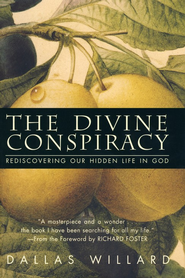 It’s really a good question and one that I hadn’t considered until encountering Dallas Willard’s masterpiece The Divine Conspiracy in college. I had not thought about it in a while until Dr. Todd Hunter came to guest-teach at our church this Sunday. He was making the basic point that unless we actually consider Jesus to be a competent instructor about life and reality, we will never actually listen to him and follow him. This called to mind one of my favorite passages in The Divine Conspiracy where Willard calls our attention to the simple fact that Jesus is really smart:
 Reformedish