Calvin Explains Chalcedonian Christology in Two Paragraphs

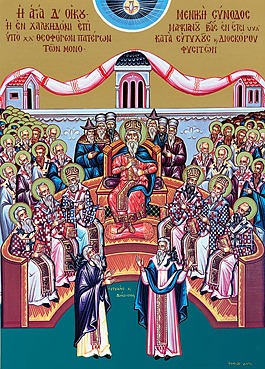
chalcedonAfter much controversy and struggle in the Church, the Council of Chalcedon (451 AD) put out a formal definition on person of Christ, regarding his full divinity, humanity, and the union of the two natures. While not exhausting the depth and beauty of the person of Christ, it lays down important boundaries within which theologians must stay if they are to properly teach the glory of the Son who took on flesh for our salvation.

Chalcedon has stood as the bulwark of orthodox-catholic Christology across traditions for a millenia and a half, and yet, while lengthy expositions of it are available, it still takes some time digging to find a good, clean summary explanation of what the Definition actually says. That’s why I was pleased to find this passage in Calvin’s comments on John 1:14, “and the Speech* (Word) became flesh, and dwelt among us”, in which he briefly and clearly expounds the scriptural truth that Chalcedon teaches:

The plain meaning therefore is, that the Speech begotten by God before all ages, and who always dwelt with the Father, was made man. On this article there are two things chiefly to be observed. The first is, that two natures were so united in one Person in Christ, that one and the same Christ is true God and true man. The second is, that the unity of person does not hinder the two natures from remaining distinct, so that his Divinity retains all that is peculiar to itself, and his humanity holds separately whatever belongs to it. And, therefore as Satan has made a variety of foolish attempts to overturn sound doctrine by heretics, he has always brought forward one or another of these two errors; either that he was the Son of God and the Son of man in so confused a manner, that neither his Divinity remained entire, nor did he wear the true nature of man; or that he was clothed with flesh, so as to be as it were double, and to have two separate persons. Thus Nestorius expressly acknowledged both natures, but imagined two Christs, one who was God, and another who was man. Eutyches, on the other hand, while he acknowledged that the one Christ is the Son of God and the Son of man, left him neither of the two natures, but imagined that they were mingled together. And in the present day, Servetus and the Anabaptists invent a Christ who is confusedly compounded of two natures, as if he were a Divine man. In words, indeed, he acknowledges that Christ is God; but if you admit his raving imaginations, the Divinity is at one time changed into human nature, and at another time, the nature of man is swallowed up by the Divinity.

The Evangelist says what is well adapted to refute both of these blasphemies. When he tells us that the Speech was made flesh, we clearly infer from this the unity of his Person; for it is impossible that he who is now a man could be any other than he who was always the true God, since it is said that God was made man. On the other hand, since he distinctly gives to the man Christ the name of the Speech, it follows that Christ, when he became man, did not cease to be what he formerly was, and that no change took place in that eternal essence of God which was clothed with flesh. In short, the Son of God began to be man in such a manner that he still continues to be that eternal Speech who had no beginning of time.

Commentary on John 1:14

The whole section is worth review as Calvin deftly comments on controversies both ancient and contemporary to his own day. Indeed, as challenges and confusions about just who Jesus is continue into our own, students and disciples of the Word would benefit from listening into the disputes of another age. While they’re framed in different ways, they are often-times structurally similar such that hearing the answer discussed in a context less immediate and personally-charged for us, can cast a clearer light for our own days.

Of course, the point of all this is not mere doctrinal correctness, but the life of doxology that follows. Christ is not properly worshipped and glorified, unless his magnificent person is properly taught and displayed according to Scripture.

Soli Deo Gloria 

*Calvin follows Erasmus in rendering the word ‘logos‘ as ‘Speech’ instead of ‘Word’. For his explanation, see his comments here.

Whatever We Ask For?

praying fistWhatever we ask in Jesus’ name, the Father will do for us (John 15:16). That’s what he says. But does he really mean it? Will God really do whatever we ask for in Jesus’ name? I’ve asked for plenty of things in my days and closed my prayers with “in the name of Jesus, Amen” and got diddly-squat. I know I’m not alone in this. So what gives?

We have to take care to understand what Jesus means by asking in ‘in my name.’ The whole statement tells us that as long as his ‘words abide in you’, then whatever you ask for in his name will be done for you. What does it mean for Jesus’ words to abide in us?

Well, here’s what Calvin says:

If my words abide in you. He means that we take root in him by faith; for as soon as we have departed from the doctrine of the Gospel, we seek Christ separately from himself. When he promises that he will grant whatever we wish, he does not give us leave to form wishes according to our own fancy. God would do what was ill fitted to promote our welfare, if he were so indulgent and so ready to yield to us; for we know well that men often indulge in foolish and extravagant desires. But here he limits the wishes of his people to the rule of praying in a right manner, and that rule subjects, to the good pleasure of God, all our affections. This is confirmed by the connection in which the words stand; for he means that his people will or desire not riches, or honors, or any thing of that nature, which the flesh foolishly desires, but the vital sap of the Holy Spirit, which enables them to bear fruit.

–Commentary on John 15:16

To ask for something in Jesus’ name is to ask for it in a way consistent with the Gospel. As soon as we try to seek Jesus or the life that Jesus has for us apart from the revelation of the Gospel, we are ‘seeking Christ separately from himself.’ In other words, we are looking for a Jesus that isn’t the real Jesus, or a blessing that isn’t consistent with his will.

What does that mean for our prayers? Far too often our prayers are not shaped by the Jesus we find in the Gospel, so we ask for silly and frivolous things. Or, we ask for things in a fleshly, anti-god way. Much as a child of 5 will ask for things they couldn’t possibly handle in a right or responsible way (say, a jet-plane), we ask our heavenly Father for things that he knows would wreck us (that job, that girl, that paycheck, that school). And it’s not that these things are always inherently wrong, but they are wrong for us in that they will lead us away from Christ and so God does not give them. He’s a good father like that.

Instead, when we are seeking things in the name of Jesus, what we’ll namely be searching for is true life of Jesus, which is the Spirit of Life. It is those requests—those that lead to holiness, beauty, righteousness, and glory–that the Father will unfailingly give us.

Soli Deo Gloria

Either Way You’re Gonna Get Cut

vine“I am the true vine, and my Father is the vinedresser. Every branch in me that does not bear fruit he takes away, and every branch that does bear fruit he prunes, that it may bear more fruit.” -John 15:1-2

Jesus tells us here that, whether you bear fruit or you don’t bear fruit, either way, you’re gonna get cut. “Come again?” If you’re someone just sitting in church, hearing the Gospel but not responding, not growing, not developing the faith and showing no signs of spiritual life you’re going to be cut by the Lord. AND, if you’re someone who has responded in faith, is growing, developing, deepening in your love by the Spirit’s power, and showing the good fruit of good works, you’re going to be cut by the Lord. This is straight from Jesus’ mouth.

The Gardener, The Vine, and the vines
But why? Because God is a Gardener, the Great Vine-dresser attending to the health and growth of the Church which draws its life from the Son, the True Vine. To get where this is going, you have to understand the image of the vine. The image Jesus uses here is one drawn from the OT. Israel is often compared to a vine that gives or does not give the fruit of true obedience. Here, Jesus tells us that he is the True Vine, the one that Israel was always supposed to be. He will do all that Israel should have done and be all that Israel should have been.

Now, building on that, he compares as branches that have been grafted onto a good vine. As Calvin reminds us, Jesus is using this image to tell us “that the vital sap — that is, all life and strength  — proceeds from himself alone. Hence it follows, that the nature of man is unfruitful and destitute of everything good; because no man has the nature of a vine, till he be implanted in him.” (Commentary on John 15:1)  On our own, we can do some relatively (outwardly) good things, yes, but to work truly spiritual works, those that are pleasing to the Father, producing true fruit, we need to be dependently drawing on the grace of the Son. In other words, the goodness of the Messiah only flows to us as we’ve been made a part of his people, being united by faith with Christ.

Here’s the thing, when you’ve been around long enough, you start to see that there two kinds of branches appearing to be connected to the vine. There are some branches that bear fruit and some that apparently have only been outwardly grafted on. Some people have joined up with the Messiah outwardly, but never started to draw life from him. Instead, at best they’re harmlessly taking up space on the branch, or at worst, they’re impeding the growth of the other branches. Others have taken hold of Christ by faith, or rather been grasped by Christ, and they’ve begun to take on the character of the original vine and are producing real fruit.

Thing is, as a good gardener, God cuts both. The dead branches get cut to clear them away for the health of the whole. If it’s not growing and giving off fruit, it’s dead wood.  The live vines he prunes so that they might give more fruit.

The Cutting Tool
Now, the interesting thing is that he uses the same tool to do it: adversity. It doesn’t say this explicitly in the text, but I think it’s a legitimate inference from the surrounding context. Jesus is preparing his disciples to deal with his absence. He talks to them about the comfort of the Holy Spirit, their need to remain in him, the opposition they’re going to face in life because of his name, and so forth. One of the main themes of the Farewell Discourses (John 14-17), is comfort in the face of adversity.

Adversity will often-times reveal the character of our faith; is it merely superficial, that of dead branches, or deep and true, one that draws life from the vine? How do we react when the bills start stacking up? Or marriage stresses? Or a difficult semester? Maybe a break-up? Divorce? Death? An unruly child? A church community divided against itself? Hostility from co-workers? Unrelenting health issues? I could go on for pages here, but you all know the adversity that life brings–the cuts.

And the cuts reveal the character. So, when adversity hits, do we get bitter, or cling harder? Do we shake our fist up at God for “failing” to give us what he never promised, or dig deeper into the gospel-blessings that he has provided for us in Christ? Do we feel robbed by God, or held by God? Does our faith deepen and grow, or die and grow cold? Do we strive for greater obedience and hope, or plunge ourselves into rebellious apathy? Will the cut lead to death, or deeper life? The same cut, the same adversity reveals the nature of the branch.

Believers need to know that Jesus never promises protection from the ordinary troubles of life, or the particular problems that attend with following him in the world. They need to understand that, so when the Gardener’s pruning tools go to work they accept it as the perfecting work of God in their life, instead of his careless abandonment. Again, either way, you’re gonna get cut–but for the person who has truly been in-grafted, they can know that the cuts come from the good hand of the master Vine-dresser whose aim is to cut away the dead parts of your life. We need those cuts so that the new, true life of Christ can flow more freely and result in even great fruits of righteousness and life. Trust the Gardener when the cut comes and remain in the Vine.

Soli Deo Gloria

Jesus Wasn’t a Stoic (Or, the Difference Between Socrates and Christ)

spok

Spock, the perfect Stoic. Kinda, not really.

It’s often remarked that the Christian moral ethic we see in the New Testament and the Fathers shares a great deal of similarities with Ancient Greco-Roman philosophies on offer at the time such as Platonism, and especially Stoicism. And it’s true, that superficially, there are. I remember in one early medieval philosophy class, reading Augustine’s comments on how much closer to Christianity the Stoics were as opposed to the Epicureans, who were universally condemned by the Fathers, (and, well, anybody not Epicurean).

That said, while many of the moral precepts are shared across the two systems, Christianity and Stoicism, their moral grounding, or logic, are structurally in different universes. Charles Taylor highlights this difference with respect to “affirmation of ordinary life” and the two systems’ “asceticism” or ethics of self-denial:

Christianity, particularly in its more ascetic variants, appears a continunation of Stoicism by other means, or (as Nietzsche sometimes says) a prolongation of Platonism. But for all the strong resemblances to Stoicism–for instance, its universalism, its notion of providence, its exalting of self-abnegation–there is a great gulf. In fact, the meaning of self-abnegation is radically different. The Stoic sage is willing to give up some “preferred” thing, e.g. health, freedom, or life, because he sees it genuinely as without value since only the whole order of events which, as it happens, includes its negation or loss, is of value.  The Christian martyr, in giving up health, freedom, or life, doesn’t declare them to be of no value. On the contrary, the act would lose its sense if they were not of great worth. To say that greater love hath no man than this, that a man give up his life for his friends, implies that life is a great good. The sentence would loses its point in reference to someone who renounced life from a sense of disenchantment; it presupposes he’s giving up something.

Central to the Judaeo-Christian notion of martyrdom is that one gives up a good in order to follow God. What God is engaged in is the hallowing of life. God first called Israel to be a “holy nation” (Exodus 19:6). But the hallowing of life is not antithetical to its fulness. On the contrary. Hence the powerful sense of loss at the heart of martyrdom. It only becomes necessary because of sin and disorder in the world…to turn to the paradigm Christian case, that Christ’s teaching led to his crucifixion was a consequence of evil in the world, of he darkness not comprehending the light. In the restored order that God is conferring, good doesn’t need to be sacrificed for good. The eschatological promise of Judaism and Christianity is that God will restore the integrity of the good.

This is, of course, what makes the death story of Jesus so different from that of Socrates, however much they have been put in parallel. Socrates tries to prove to his friends that he is losing nothing of value, that he is gaining a great good. In his last request to Crito, to pay his debt of a cock to Asclepius, he seems to imply that life is an illness of which death is the cure (Asclepius being the god of healing whom one rewards for cures.) Socrates is serenely troubled. Jesus suffers agony of soul in the garden, and is driven to despair on the cross, when he cries, “Why hast thou forsaken me?” At no point in the Passion is he serene and untroubled.

-Sources of the Self: The Making of the Modern Identity, pp. 218-219

In Christianity, the world is good and so are the world’s goods. God made them and to suffer their loss is true suffering. While there is evil in it, and the satan works corruption throughout it, creation is still of inestimable value.  And so, self-denial, when it involves something other than sin, is not a denial of the goodness of those things we give up.

This is why Jesus was not a Stoic. When he gave up his life for us on the Cross, he was truly giving something up–it was a real sacrifice. This was no mere, cost-less martyrdom for the truth, but a painful, arduous self-giving for our sakes. In giving his life, he was affirming the value of life and working to restore it to its intended glory. But, of course, this leads us to the truth of the Resurrection. Christ’s sacrifices of the good for us was total, but not final. It was not an end in and of itself, but a means to a greater end–the redemption of creation.

The same is true for us at a microcosmic level. We sacrifice all things, excepting sin, with a knowledge that, while a real loss, all that was good about it will be received from God’s hand once again: “And everyone who has left houses or brothers or sisters or father or mother or children or lands, for my name’s sake, will receive a hundredfold and will inherit eternal life.”(Matthew 19:29) That actually puts Christians in the ironic position of being able to more readily sacrifice natural goods–for others, for righteousness sake, etc.–while still appreciating them in a way that a Stoic never could. We should enjoy them with great joy while we have them, grieve them when lost, joyfully anticipate their restoration in the glory to come.

All that to say, Jesus wasn’t a Stoic–neither are his followers.

Soli Deo Gloria

Director, Soul, and King: The Word

directorReading the early Fathers gives you a sense that they were smitten by the wonder of God’s creative glory. Ireneaus was one of the first and greatest theologians of the significance and grandeur of God’s works. Following on his heels comes Athanasius’, waxing eloquent on the subject in his work Contra Gentes. In his argument against the pagan gods, he points to the magnificent order of the universe as evidence that they could only be the result of a single, purposive God according to Wisdom–the Word Himself.

Master teacher that he is, Athanasius gives us three similes to explain how the Word gives order to the Universe:

  1. Director – “And for so great a matter to be understood by an example, let what we are describing be compared to a great chorus. As then the chorus is composed of different people, children, women again, and old men, and those who are still young, and, when one, namely the conductor, gives the sign, each utters sound according to his nature and power, the man as a man, the child as a child, the old man as an old man, and the young man as a young man, while all make up a single harmony…”
  2. Soul – “or as our soul at one time moves our several senses according to the proper function of each, so that when some one object is present all alike are put in motion, and the eye sees, the ear hears, the hand touches, the smell takes in odour, and the palate tastes,—and often the other parts of the body act too, as for instance if the feet walk..”
  3. King – “or, to make our meaning plain by yet a third example, it is as though a very great city were built, and administered under the presence of the ruler and king who has built it; for when he is present and gives orders, and has his eye upon everything, all obey; some busy themselves with agriculture, others hasten for water to the aqueducts, another goes forth to procure provisions,—one goes to senate, another enters the assembly, the judge goes to the bench, and the magistrate to his court. The workman likewise settles to his craft, the sailor goes down to the sea, the carpenter to his workshop, the physician to his treatment, the architect to his building; and while one is going to the country, another is returning from the country, and while some walk about the town others are going out of the town and returning to it again: but all this is going on and is organised by the presence of the one Ruler, and by his management…”

Against the Heathen, -§43

Of course Athanasius notes that these pictures are “inadequate”, and “yet with an enlarged idea” they serve to illumine the way God sustains the creative rhythm of reality through his Word–“For with the single impulse of a nod as it were of the Word of God, all things simultaneously fall into order, and each discharge their proper functions, and a single order is made up by them all together.”

In all this he is a student of  the Psalmist who proclaims to us:

1The heavens declare the glory of God,
and the sky above proclaims his handiwork.
2 Day to day pours out speech,
and night to night reveals knowledge.
3 There is no speech, nor are there words,
whose voice is not heard.
4 Their voice goes out through all the earth,
and their words to the end of the world.

Psalm 19:1-4

Let us never cease to marvel at the works of the Word.

Soli Deo Gloria

Some Thoughts on the Superman and Jesus Thing

man of steel 2After months of waiting, I finally watched the Man of Steel in a midnight showing early Friday (or late Thursday) night. My first comment is that the critics are idiots–it was a fantastic movie.  Unsurprisingly given the team of Nolan, Snyder, and Zimmer, this is easily the best Superman movie to date; plot, cast, visuals, emotional complexity, etc. surpass anything that’s been done with the franchise yet.

But I’m not here to write a movie review. Like most films do, it got me thinking about theology. There have been a number of recent articles on difference and similarities between Jesus and Superman. I haven’t read any of them, but I’ve seen them online and the parallels and divergences aren’t hard to imagine–intentionally so with the former.

Superman is a Messianic figure, a son sent by a father from a different world, raised by surrogate parents, come to save us all. He’s not one of us, but he identifies with our cause, fights the battles we can’t against demons too big for merely human strength. He’s a shining beacon of truth, morality, and hope to a people who misunderstand and fear him despite his unrelenting will to save. The film plays this up to the point where its unmistakable, revealing him to be 33 years of age, and even setting him in a church struggling with a decision about whether to sacrifice himself for the planet, with a stained-glass picture of Jesus in the background.

Of course, every Messianic analogy breaks down and it’s easy enough to point that out with Superman. He really isn’t like Jesus in some very important ways–one of the biggest is that he’s not really human. He might identify with our cause and plight, but he doesn’t ever fully share it. Unless he’s exposed to some Kryptonite or Red Sun, he’s impervious to just about anything you throw at him. Jesus knows what it is to feel human fear and pain–he’s wasn’t bullet, or nailproof. Superman doesn’t bleed out and die, but Jesus does.

The flidside is that he’s not fully divine either; Superman is at best a demi-God. His feats of power, strength, speed, flight, and lasers do not entitle him to the title “Creator.” He is not eternal, immutable, immortal, or omnipotent, no matter how potent he is. He is a being among beings but not the source of all being; a superior being perhaps, but still on the ‘creation’ side of the Creator/creature distinction (if that holds in the DC Universe.)

In fact, when you think about it, theologically Superman is more like the Arian picture of Christ. The teacher Arius taught a savior who was not the eternal Son of God, (“there was a time when he was not”), and yet not a normal man either. He was a mediating being, the chief over creation who was yet still a part of it, and not to be thought of as equal to the Father.

Similarly, the salvation he offers us is that of a shining exemplar, not a redeeming Savior. Yes, he sacrifices himself for us and fights the battle we could never fight, against a ruthless enemy we could not beat. And yet, like so many other popular Hollywood Messiah figures, the goal is that one day he can teach us, inspire us, when we’re ready, to live a new a better way. In a sense, he saves, yes by feats of strength and moral courage, but the redemption of mankind will come by imitation. There is no atonement, or conversion, for Superman is the heroic, morally-educative Pelagian Christ.

This isn’t a real knock on the movie, of course, or even the Superman character. It’s not Kal-El’s fault–only Jesus can be Jesus.

And that’s really the point I’ve wanted to make. While all of our heroes, in some way, seem to point us to the ultimate Hero, all of them fall short. Some have pointed out that Batman is fully human like us, knowing our pains and plight, and in that way, he’s really the more Christ-like hero. The problem is that when he dies, he dies. Part of what makes Jesus glorious, and that the Superman myth draws on is our need for a Savior who can rescue us from the curse of death; we need a hero who can’t be held down by it. Down the line I could go, with blockbuster hero after hero pointing out the various ways they either measure up, or fall miserably short.

The key difference that I’ve seen, though, is that not one of the various heroes on offer can truly offer us the redemption we need most–that liberation of the soul that comes when our sins are paid for and the Spirit is poured out in our hearts, setting us free from our bondage to sin. None but the Crucified and Risen one is strong enough offer me the salvation of a conscience cleansed from sin and reconciled with God.

Soli Deo Gloria

Jesus Vindicated (Or, One of My Favorite Tim Keller Sermons)

This last April I had the privilege of finally hearing Tim Keller preach live at the 2013 Gospel Coalition National Conference. I was slightly worried that after all of these years of listening to hundreds of his sermons, it might not be all that great in comparison. I’ll just say it, Keller owned it. Preaching on the Christ’s vindication and resurrection in Luke 24, Keller does in one sermon what most of us do in 4, without it feeling forced. My point in sharing this with you though, isn’t to glorify Keller, but to point you to the Christ he glorifies through the preaching of the Word. So, without any further commentary, here it is:

Jesus Vindicated – Tim Keller (TGC13) from The Gospel Coalition on Vimeo.

Soli Deo Gloria

P.S. If you’d like to see more, the rest of the Gospel Coalition Conference talks are feature HERE at TGC’s website.

Moses = Mini-Israel = Jesus (Or, Theological Inception)

inceptionOne principle of Christian theological interpretation of Scripture is the practice of identifying typology. To over-simplify it, in the flow of redemptive-history, the sovereign God who ordains all things, prefigures the salvation to be accomplished through Jesus Christ by way of types (events, persons, symbols) to which Jesus Christ’s person and works are the anti-type.

For instance, Adam points to Jesus as Second Adam through whom God is creating a new humanity (Romans 5; 1 Corinthians 15). Abraham’s willingness to sacrifice his only son Isaac points to the true Sacrifice of God’s only Son (John 3:16). The Tabernacle and Temple where God dwells with Israel points to the ultimate Tabernacling of God with humanity in Jesus Christ (John 1:14). Once you start to think in these terms, it’s almost impossible not to see Christ on every page of the Scriptures.

A particularly important type of Christ in the OT is Israel’s greatest prophet and deliver–Moses. In various ways, the NT reveals Jesus as the New Moses. Like Moses, Jesus escapes the death at the hands of a murdering king as an infant (Matt 2:13-18); he goes up on a Mount to give a new Law (Matt 5-7), which fulfills the old Law; he also institutes a new covenant that supersedes the old one (Lk 22); he rescues his people in a New Exodus of the Egypt of sin, death, and oppression into the Promised Land of salvation (Col 1:13-14). The list could easily be expanded.

While I’d known about these typological parallels between Moses and Jesus, I was nonetheless struck by this passage drawing out the way that Moses functions as a type and representative of Israel as well:

Moses, who narrowly escapes disaster by being placed in an ark in the River Nile (Exod. 2:1-10)…Moses’ salvation echoes backwards and forwards in the text; backwards to the salvation of humanity from the judgment of the flood by Noah (Gen. 6-8), and forwards to the Israelites’ future escape from the waters of the Reed Sea (Exod 14). Significantly…the figure of Moses, this child born as a type of saviour figure, not only saves Israel but also embodies Israel at times. His rescue from the water prefigures the nation’s salvation from the water; his escape after the death of an Egptian (Exod. 2:11-15) is a prelude to the Israelites flight after the death of many Egyptians (Exod. 12:29-39); his experience of being in the desert for forty years (Exod. 2:21-25) foreshadows the same for Israel (Num, 14:33); his divine encounters before the burning bush (Exod. 3) anticipates Israel before the fire of Sinai (Exod. 19-24).

Stephen G. Dempster, Dominion and Dynasty: A Theology of the Hebrew Bible, pg. 94

Moses is not only a type of Christ, but a type for Israel. Israel, God’s firstborn son (Exod. 4:22) is another type of Christ, who also wanders in the desert for 40 days and is tested (Matthew 4), so on and so forth. Moses is also Israel’s embodiment at times, which is a type for Christ’s representative embodiment of his newly re-formed Israel. We could chase the connections for pages, but what I’m saying is that this is like a theological version of Inception: we have found a type within a type within a type.

The intricacy, beauty, and inter-canonical-coherence of the biblical history of redemption should lead us to awe and worship. While human authors create inter-textual resonances, the sovereign Lord of time creates inter-historical ones.

Soli Deo Gloria

Salvation in Living Color

Rembrandt sketchHebrews 10:1 says that “the law has but a shadow of the good things to come instead of the true form of these realities, it can never, by the same sacrifices that are continually offered every year, make perfect those who draw near.”

Commenting on this truth, Calvin expands on the relation between Law and Gospel given in this verse:

He has borrowed this similitude from the pictorial art; for a shadow here is in a sense different from what it has in Colossians 2:17; where he calls the ancient rites or ceremonies shadows, because they did not possess the real substance of what they represented. But he now says that they were like rude lineaments, which shadow forth the perfect picture; for painters, before they introduce the living colors by the pencil, are wont to mark out the outlines of what they intend to represent. This indistinct representation is called by the Greeks σκιαγραφία, which you might call in Latin, “umbratilem“, shadowy. The Greeks had also the εἰκὼν, the full likeness. Hence also “eiconia” are called images (imagines) in Latin, which represent to the life the form of men or of animals or of places.

The difference then which the Apostle makes between the Law and the Gospel is this, — that under the Law was shadowed forth only in rude and imperfect lines what is under the Gospel set forth in living colors and graphically distinct. He thus confirms again what he had previously said, that the Law was not useless, nor its ceremonies unprofitable. For though there was not in them the image of heavenly things, finished, as they say, by the last touch of the artist; yet the representation, such as it was, was of no small benefit to the fathers; but still our condition is much more favorable. We must however observe, that the things which were shown to them at a distance are the same with those which are now set before our eyes. Hence to both the same Christ is exhibited, the same righteousness, sanctification, and salvation; and the difference only is in the manner of painting or setting them forth.

 –Commentary on Hebrews 10:1

rembrandt-paintingMy wife and I went to the Getty Museum a couple of years ago to see the Rembrandt exhibit. There was a room full of his marvelous sketches, each one distinct and the result of crushing brilliance. I could have studied them for hours to great profit. And yet, when we stepped into the room with his finished products, the difference was unmistakable. Where before was the outline, here was the fullness, the brilliance, the subtle extravagance of his handiwork. Both unmistakably came from the same hand, while the one clearly outshone the other.

Calvin tells us here that in the same way, the Law is good and true, pointing forward to Christ. But the Gospel sets out a salvation in “living colors” that is “graphically distinct”, where there were only “lineaments” before. As different and superior as the sketch is to the finished product, so Christ’s work is from the sacrifices that prefigured it. In fact, I would argue that that even that picture falls short of what Hebrews or Calvin are teaching us here. Instead, as far as the sketch is from the living model, so the shadow of heavenly realities found in the Law, while faithful, inevitably falls short of the beauty of our living, breathing salvation in Jesus Christ.

Soli Deo Gloria

5 Theses On Christ’s Priestly Ministry

christ as priestFor every high priest chosen from among men is appointed to act on behalf of men in relation to God, to offer gifts and sacrifices for sins. He can deal gently with the ignorant and wayward, since he himself is beset with weakness.  Because of this he is obligated to offer sacrifice for his own sins just as he does for those of the people.  And no one takes this honor for himself, but only when called by God, just as Aaron was. (Hebrews 5:1-4)


Reading through Hebrews this morning I was struck by this passage addressing the work of Christ, our great High priest whose ministry supersedes and fulfills that of the OT Levitical priests. In order to do so he outlines various functions of the OT priests in order to compare and contrast the two. I consulted Calvin, as I’ve been wont to do of late, to see what light he could shed on the matter.

Careful reader that he is, Calvin notes at least 5 truths about priests to be noted in the passage:

  1. He first says that the priests were taken from among men; 
  2. secondly, that they did not act a private part but for the whole people;
  3. thirdly, that they were not to come empty to appease God, but furnished with sacrifices;
  4. fourthly, that they were not to be exempt from human infirmities, that they might more readily succor the distressed;
  5. and lastly, that they were not presumptuously to rush into this office, and that then only was the honor legitimate when they were chosen and approved by God.

–John Calvin, Commentary on Hebrews 5:1-4

Building on these observations, he goes on to point out 5 truths this passage teaches us about Christ’s priestly ministry on our behalf:

  1. Christ is a True Man“Taken from among men, etc. This he says of the priests. It hence follows that it was necessary for Christ to be a real man; for as we are very far from God, we stand in a manner before him in the person of our priest, which could not be, were he not one of us. Hence, that the Son of God has a nature in common with us, does not diminish his dignity, but commends it the more to us; for he is fitted to reconcile us to God, because he is man..”
  2. Christ is a Man for Others “For men, etc…the priest was not privately a minister for himself, but was appointed for the common good of the people. But it is of great consequence to notice this, so that we may know that the salvation of us all is connected with and revolves on the priesthood of Christ. The benefit is expressed in these words, ordains those things which pertain to God…what the Apostle had in view is the same, namely, that we have no intercourse with God, except there be a priest; for, as we are unholy, what have we to do with holy things? We are in a word alienated from God and his service until a priest interposes and undertakes our cause.”
  3. Christ is a Man for Others Offering Gifts “That he may offer both gifts, etc. The third thing he mentions respecting a priest is the offering of gifts. There are however here two things, gifts and sacrifices; the first word includes, as I think, various kinds of sacrifices, and is therefore a general term; but the second denotes especially the sacrifices of expiation. Still the meaning is, that the priest without a sacrifice is no peacemaker between God and man, for without a sacrifice sins are not atoned for, nor is the wrath of God pacified. Hence, whenever reconciliation between God and man takes place, this pledge must ever necessarily precede. Thus we see that angels are by no means capable of obtaining for us God’s favor, because they have no sacrifice. The same must be thought of Prophets and Apostles. Christ alone then is he, who having taken away sins by his own sacrifice, can reconcile God to us.”
  4. Christ, Though Free from Sin, is a Man who Can Sympathize Who can, etc….the Apostle before taught us that mankind are united to God in the person of one man…but now he refers to another thing…that the priest ought to be kind and gentle to sinners, because he partakes of their infirmities. The word…simply means one capable of sympathy. All the things which are here said of the Levitical priests do not indeed apply to Christ; for Christ we know was exempt from every contagion of sin; he therefore differed from others in this respect, that he had no necessity of offering a sacrifice for himself. But it is enough for us to know that he bare our infirmities, though free from sin and undefiled. Then, as to the ancient and Levitical priests, the Apostle says, that they were subject to human infirmity, and that they made atonement also for their own sins, that they might not only be kind to others when gone astray, but also condole or sympathize with them…At the same time, though ever free from sin, yet that experience of infirmities before described is alone abundantly sufficient to incline him to help us, to make him merciful and ready to pardon, to render him solicitous for us in our miseries. The sum of what is said is, that Christ is a brother to us, not only on account of unity as to flesh and nature, but also by becoming a partaker of our infirmities, so that he is led, and as it were formed, to show forbearance and kindness… 
  5. Christ is a Man by the Call of God – And no man, etc. There is to be noticed in this verse partly a likeness and partly a difference. What makes an office lawful is the call of God; so that no one can rightly and orderly perform it without being made fit for it by God. Christ and Aaron had this in common, that God called them both; but they differed in this, that Christ succeeded by a new and different way and was made a perpetual priest. It is hence evident that Aaron’s priesthood was temporary, for it was to cease. We see the object of the Apostle; it was to defend the right of Christ’s priesthood; and he did this by showing that God was its author…Christ then is a lawful priest, for he was appointed by God’s authority…”

ibid, Commentary 5:1-4

According to Hebrews then, this is the Christ who is our Priest. He is the truly human one; the one who comes for us, not for himself alone; the one who has offered up a sacrifice for us; the one sympathizes with us in our weaknesses and infirmities; the one who comes by the call of God the Father, in the power of the Spirit. This Christ is indeed worthy of all our praise and worship.

Soli Deo Gloria