That Time Calvin Disagreed with Augustine (Or, How to Read the Fathers Like a Protestant)

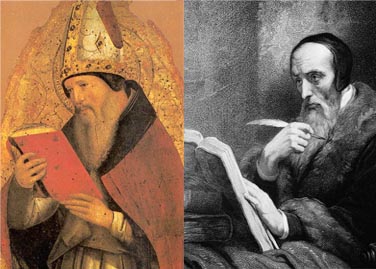
Augustine-JohnCalvinIt doesn’t take a specialist to know that Calvin loved the writings of St. Augustine of Hippo. After the Bible, he quotes Augustine more than anybody else in the Institutes (I think, but don’t quote me on this) more than all the other Fathers combined. Whenever he wanted to establish the antiquity of a doctrine, or its soundness with the interpretation of the Church universal, it’s a safe bet he’s going to pull out an Augustine quote, especially since he was an authority both he and his Roman interlocutors agreed upon.

Calvin’s Quibbles

That said, Calvin wasn’t a slavish admirer of the great bishop as we see here in his comments on the story of Pentecost:

And when. To be fulfilled is taken in this place for to come. For Luke beareth record again of their perseverance, when he saith that they stood all in one place until the time which was set them. Hereunto serveth the adverb, with one accord Furthermore, we have before declared why the Lord did defer the sending of his Spirit a whole month and a half. But the question is, why he sent him upon that day chiefly. I will not refute that high and subtle interpretation of Augustine, that like as the law was given to the old people fifty days after Easter, being written in tables of stone by the hand of God, so the Spirit, whose office it is to write the same in our hearts, did fulfill that which was figured in the giving of the law as many days after the resurrection of Christ, who is the true Passover. Notwithstanding, whereas he urgeth this his subtle interpretation as necessary, in his book of Questions upon Exodus, and in his Second Epistle unto Januarius, I would wish him to be more sober and modest therein. Notwithstanding, let him keep his own interpretation to himself. In the mean season, I will embrace that which is more sound.

-Commentary on Acts 2:1-4

While according him great respect and noting his interpretation, Calvin says that the great Augustine has put forward what he considers to be a less “sober” and “modest” interpretation which he simply cannot follow. So what explanation does he find more plausible?:

Upon the feast day, wherein a great multitude was wont to resort to Jerusalem, was this miracle wrought, that it might be more famous. And truly by means hereof was it spread abroad, even unto the uttermost parts and borders of the earth.  For the same purpose did Christ oftentimes go up to Jerusalem upon the holy days, (John 2, 5, 7, 10, 12,) to the end those miracles which he wrought might be known to many, and that in the greater assembly of people there might be the greater fruit of his doctrine. For so will Luke afterward declare, that Paul made haste that he might come to Jerusalem before the day of Pentecost, not for any religion’s sake, but because of the greater assembly, that he might profit the more, (Acts 20:16.) Therefore, in making choice of the day, the profit of the miracle was respected: First, that it might be the more extolled at Jerusalem, because the Jews were then more bent to consider the works of God; and, secondly, that it might be bruited abroad, even in far countries. They called it the fiftieth day, beginning to reckon at the first-fruits.

-Ibid

We see here the difference I’ve mentioned before when it comes to the Reformers and the earlier, especially medieval, hermeneutical tradition; they will usually privilege the ‘literal’/historical-grammatical sense of the text over any spiritualizing, allegorizing, or typological senses. Calvin isn’t opposed to typological interpretation in principle–he engages in quite a bit of it himself and accepts the prefigurement of Pentecost in the sense of first-fruits pointing towards the initial fruitfulness of the Gospel by the Spirit’s power. He’s concerned, though, that the interpretation first be grounded plausibly in the history of the event. In other words, in a text like this, he insists that the intentionality of the human actors be made sense of and that “the profit of the miracle was respected.” Only then may we move on to the typological meaning without it becoming over-subtle.

Now, that said, I myself think Calvin was being a little over-cautious here; Augustine’s got a point linking Pentecost with the giving of the Law, and the Spirit who writes the Law on our very hearts. Part of the point of typology is that God’s authorship of history can transcend even the human actor’s, or author’s original intent, without violating them. Also, given modern studies in the theological dimension to the authorship of the Gospel writers, it doesn’t strike me as improbable that Luke intended for multiple resonances to be in play in the text connected to as rich a concept as Pentecost.

The Moral of the Story

More interesting than the specific interpretation given to the passage however, was Calvin’s treatment Augustine’s interpretation. Here he offers us a model for a Protestant engagement with the interpretive tradition of the Fathers: respectful, but critical listening. He doesn’t do what so many pop-Protestant approaches do and simply ignore the tradition because, “All I need is my Bible.” Calvin knows that the Church, at least some segments of it, has been reading the Bible well enough for a very long time, so he doesn’t need to reinvent the wheel. He knows the arrogance it takes to approach the text in a way that says the Spirit has skipped 20 centuries of interpreters in order to finally reveals the Scriptures to me. In fact, it is precisely through the teachers of the Church that he works most of the time.

At the same time, in order that the Spirit may truly rule through the Word, Calvin reads the Fathers critically–not disrespectfully, but with a knowledge that they are fallible men, who can err just as he might. As you would treat a respected pastor who has faithfully labored over the texts for years, so with the Fathers: pay careful attention to what they have to say, consider deeply, and go back to the text. Indeed, this lesson is valuable, not only for Protestants looking to read the Fathers, but for Protestants looking to read the early Reformers; Calvin teaches me by his disagreement with Augustine that it’s permissible for me to disagree with Calvin!

Soli Deo Gloria

On the Difference Between “Literal” and “Idiot-Literal” Interpretation

literalI’ve already written once before on the issue of a ‘literal’ hermeneutic. I want to take time once again to clarify, from another angle, that there is a difference between a ‘literal’ hermeneutic (method of interpretation) and what I’m calling an ‘idiot-literal’ hermeneutic.

Classic Literal
A classic “literal” hermeneutic was the favored interpretive method of the Magisterial Reformers such as Calvin and Luther, which, at its better moments, has been followed by their Protestant heirs. It also might be called the “historical-grammatical” method because, in a nutshell, its aim is to first understand what the author’s intended use of a given word, sentence, paragraph was in accordance with the historical, cultural, and literary context and usual grammatical rules. As Kevin Vanhoozer has said, “the literal sense is the literary sense.” Interpreting a text ‘literally’ in this sense did not mean ignoring figures of speech, metaphors, analogy, or running roughshod over genres, context, or linguistic anomalies. Essentially, if the biblical author is trying to write history, you read the text like history; if poetry, like poetry; if a letter, then as a letter.

The Magisterial Reformers were, for the most part, humanist scholars trained in rhetoric and an appreciation for literary art, so they championed this sort of exegesis as a corrective against the spiritualizing, or rather allegorizing, interpretive methods favored by some in the Middle Ages, and passed down from some of the Fathers such as Origen and Augustine that could, and I say this with great respect for those classic interpreters, could go off the rails a bit as they found all sorts of hidden, “spiritual” meanings in rather straightforward texts. While the Reformers didn’t rule out certain typological interpretations–for instance it’s fine, and even necessary, to see a figure of Christ when discussing OT sacrifices or King David–they worried that some of the allegorizing that went on led to the Scriptures becoming a “wax nose” of sorts, that could be shaped and reshaped at will. Any typological interpretation must come after and be in line with the original story, or law that was set forth according to its intended purpose. (From what I understand, Thomas Aquinas was actually a champion of rooting the “spiritual” sense in the literal sense as well.) Now, admittedly they weren’t perfect at this themselves, but by and large this was a good move for biblical studies and theology in general.

My point here is to clarify that a “literal” interpretation in the classic sense is not what might be called a “literalistic”, or illiterate approach to the text, but rather it is one concerned with discovering the author’s intended meaning in accordance with sound rules of literary interpretation. Which brings me to our next category: the idiot-literal hermeneutic.

Idiot-Literal
An idiot-literal hermeneutic is the interpretive method that is favored mostly by liberalizing critics for straw-manning conservative  opponents. It consists of finding the most obtuse, ham-handed, or silly interpretation of any given biblical text that fails to recognize a textual or literary clue that we’re dealing with figurative language and holding it up as the necessary reading for anybody holding a “literal” hermeneutic. Often-times it’s linked in these presentations to the doctrine of “inerrancy” (which, for some reason, is usually also caricatured, confused, and conflated with a straight dictation theory of inspiration).

Now, I’m not denying that often-times you can find conservative/fundamentalist interpreters whose readings border on self-caricature. In fact, along with Beale, I do think the time might come when we need to start using the phrase “literate” hermeneutic, or something of that sort in order to distinguish things. Still, I do think it’s important to clarify that just because someone self-identifies as adhering to a “literal” hermeneutic, or because the Reformers held to one, it does not mean they must adopt whatever silliness is imputed to them by their critics on pain of inconsistency.

Conclusions
This was necessarily rough and probably simplistic, but hopefully it sufficed to make my point–a literal reading of the text is not the same as an idiot-literal reading of the text. You haven’t refuted conservative hermeneutical approaches by simply picking the dumbest reading possible and saying, “Here, this is what you have to believe, right?” Also, if you pride yourself on your conservative view of scripture and hermeneutical approach, please don’t play into the caricature–do your homework.

Soli Deo Gloria

PS. For those looking to learn how to read their Bibles better:

1.  How To Read Your Bible For All It’s Worth by Gordon Fee and Douglas Stuart is an excellent place to start.
2.  Introduction to Biblical Interpretation by William W. Klein, Craig Blomberg, and Robbert I. Hubbard Jr. is also excellent, although a bit more advanced.

Were the Westminster Theologians “Proof-texting”?

Eventually in any discussion of good exegesis and theological method, the issue of proof-texting will come up. Proof-texting is that time-honored method of biblical interpretation that consists in citing a verse to justify some theological conclusion without any respect for its context or intended use. If you’re nerdy to care enough about this sort of thing, please keep reading. If not, here’s a video of a cute cat.

Now, as I was saying, proof-texting is often brought up in discussions as a prime example of decontextualized readings–readings that irresponsibly ignore the literary and historical setting of the text. As the popular saying goes, “a text without a context is a pretext for a proof text.” Daniel Treier notes in his article on the “Proof Text” (pp. 622-624) in the Dictionary for Theological Interpretation of the Bible that the charge of “proof-texting” is almost universally negative, and usually aimed at pop-preaching, or increasingly by exegetes at theologians’ handling of texts. Indeed, it’s fairly common to read biblical scholars prattling on in their commentaries about theologians abstractly “theologizing” and “propositionalizing” texts. (Of course, this happens and it shouldn’t and it ought to be called out. Literary and historical contexts must be respected. I’ll just confess I’m annoyed with biblical studies types acting as if attending a Methodist church instead of a Presbyterian one has no effect on their readings, as opposed to those theologians.)

The crew doing some “theologizing” at Westminster Abbey.

In any case, chief among the alleged offenders are the post-Reformation scholastics such as the Westminster Divines (pastors and theologian-types) who wrote the Westminster Confession. Indeed, at first glance the classic confession seems to be a prime example of it. In traditional printings, a quick review of the various chapters will show you very short statements with footnotes listing various single verses allegedly supporting the proposed doctrines. On their own, a number of the verses seem only tenuously connected to the doctrine at hand.

Carl Trueman has an excellent article on the way recent historical work has led to critical re-appraisal of the development of Reformed Orthodoxy and the Post-Reformation scholastics, which, in part, sheds light on their alleged proof-texting:

…the new approach has demonstrated that Reformed Orthodoxy was grounded in exegesis but engaged in constant dialogue with the history of theology. This is in part evident in its eclectic nature but also has direct application to some contemporary issues. For example, one common complaint about the Westminster standards is that they are based upon proof texts. The concern seems to be that Reformed theology has thus been built on simplistic, decontextualized reading of isolated texts. Many, of course, will be aware that the divines themselves did not want the proof texts included and that they were overruled in this by Parliament. That in itself should give pause for thought about how such texts function. Yet [Richard] Muller has explored this issue further and demonstrated that the divines were not only competent exegetes themselves and that Reformed Orthodoxy is exegetically grounded but also that proof texts in the seventeenth century were not intended as simple, blunt answers to complex questions. Proof texts operated rather as exegetical markers, directing the reader to the key verse but doing so in the expectation that the reader would check the classical expositions of that verse.

So, first off, the Westminster Divines didn’t even want the proof-texts included precisely because they were aware of the dangers of poor exegesis and context-less readings. Second, the texts were supposed to be used as pointers to further research, both of the text, and of the deeper history of interpretation. Basically, they wanted readers to do their homework.

Trueman then uses the example of the “covenant of works” to highlight the way this re-appraisal might shape our judgment about historical, Reformed orthodoxy.

One criticism is that the only reference to the pre-Fall arrangement with Adam in the garden as a covenant is Hosea 6:7. The Hebrew is ambiguous and could indeed be read as “like a man.” As such, it seems remarkably slender textual ground upon which to build such a crucial doctrine as the covenant of works. In fact, as Muller has shown through his study of the Westminster Annotations, the divines were well aware of this ambiguity. Their use of the language of covenant to refer to Adam in Eden was not built on this text, but upon Romans 5, which they saw as pointing to the conceptual presence of covenant in Eden, even as it was linguistically absent. Such a point would seem significant in assessing John Murray’s criticism of the covenant of works.*

Were the Westminster divines proof-texting then? In the sense that they are usually accused of, apparently not. Now, does that mean every reading of every text they cited was absolutely perfect? No, but the giants of Westminster probably deserve more credit than they’re typically given on this point.

If I might suggest two take-aways for contemporary biblical types:

1. When criticizing the hermeneutical approaches of different periods, we need to be careful of rushing to judgment. Anyone who’s spent any amount of time in biblical studies knows that the methods are constantly up for debate (form-criticism, redaction-criticism, literary, etc.). Who knows what readings we’ll find silly, mistakenly or not, in 20 years, let alone 200?

2. This also means we probably could take a cue from the Reformed scholastics at this point. They knew that one way of guarding against our interpretations being over-determined by the cultural and literary prejudices of the day, was by being in dialogue, both with the text, and with the history of interpretation. May we humble ourselves enough to do the same. Who knows? We might even want to throw some scholastics into the mix.

Soli Deo Gloria

*For more on the exegetical grounding of the covenant of works, G.K. Beale has some good stuff on the covenant in Gen. 1-3.

Kierkegaard on Interpreting the Text to Death

It is a truism today to say that the Bible needs to be interpreted. In fact, it was a truism back when the Bible was being written that it’s not simply a matter of just “reading” the thing all the time. Even the Bible says that it’s hard to understand. (2 Pet. 3:16) Or, as the Westminster Confession comments:

All things in Scripture are not alike plain in themselves, nor alike clear unto all: yet those things which are necessary to be known, believed, and observed for salvation are so clearly propounded, and opened in some place of Scripture or other, that not only the learned, but the unlearned, in a due use of the ordinary means, may attain unto a sufficient understanding of them. (2.7)

We’ve known for a long time then that even though the basics are clearly laid out, there are at least some parts that are not obvious or plain. For thousands of years now, Christians have wrestled with, commented on, and interpreted the text of the Bible. Today we have seminaries with classes in hermeneutics, study of the original languages and ancient cultures that form the setting and background of the text, dictionaries, commentaries that are thousands of pages long, and journals where scholars devote dozens of pages to analyzing the nuances of a single word in the context of a single verse. (No joke, I wrote 30 pages on 2 verses in Colossians in my MA program and just barely scratched the surface of the literature on the subject.) Without a doubt, our knowledge of the text has expanded and been deepened by the faithful work of scholars and interpreters over the last few generations and this is a good thing.

The people of God need preachers and pastors who will roll up their sleeves and get to work on the task of discerning what the Lord has spoken and is even now speaking in the text. Poor interpretation is at the root of so much bad preaching and teaching in the church, which leads to bad living by the church. Preachers, teachers, and even lay-people who have come to rely on them, still need to work at the task of interpretation.

Now, to some this might seem troublesome and daunting. As someone who has devoted my life to wrestling with the text in order to teach and preach it faithfully, I absolutely love this stuff. Digging into the interpretive issues and the complexity of the Scriptures is what I live for. “What’s that you say about an ingenious new understanding of that obscure verse in Leviticus? Brilliant! Let me read it.”  “Is that a new commentary on a book I finished studying last month? I must have it!” Anybody who’s seen my desk at home or at work knows that I live knee-deep in this stuff. I wouldn’t have it any other way.

Now why do I bring this up? To alert us to a deadly risk we run when engaging in the interpretive task.

Kierkegaard tells a cautionary parable about the danger that can come with an unbridled focus on interpretation:

Imagine a country. A royal command is issued to all the office-bearers and subjects, in short, to the whole population. A remarkable change comes over them all: they all become interpreters, the office-bearers become authors, every blessed day there comes out an interpretation more learned than the last, more acute, more elegant, more profound, more ingenious, more wonderful, more charming, and more wonderfully charming. Criticism which out to survey the whole can hardly attain survey of this prodigious literature, indeed criticism itself has become a literature so prolix that it is impossible to attain a survey of the criticism. Everything became interpretation—but no one read the royal command with a view to acting in accordance with it. And it was not only that everything became interpretation, but at the same time the point of view for determining what seriousness is was altered, and to be busy about interpretation became real seriousness. Suppose that this king was not a human king—for thought a human king would understand well enough that they were making a fool of him by giving the affair this turn, yet as a human king he is dependent, especially when he encounters the united front of office-bearers and subjects and so would be compelled to put the best face on a bad game, to let it seem as if all this were a matter of course, so that they most elegant interpreter would be rewarded by elevation to the peerage, the most acute would be knighted, etc.—Suppose that this kind was almighty, one therefore who is not put to embarrassment though all the office-bearers and all the subjects play him false. What do you supposed this almighty king would think about such a thing? Surely he would say, “ The fact that they do not comply with my commandment, even that I might forgive; moreover, if they united in a petition that I might have patience with them, or perhaps relieve them entirely of this commandment which seemed to them too hard—that I could forgive them. But this I cannot forgive, that they entirely alter the point of view for determining what seriousness is.” -For Self-Examination, pp. 58-59

With this little parable Kierkegaard throws up a large, flashing, red warning sign for those of us enamored with the endless study of the text. The danger comes when interpretation becomes an excuse for disobedience. Kevin Vanhoozer has pointed out that the proper interpretation of the text of Scripture requires performance. Ingenious readings are not the point–hearing and rendering a fitting response to the voice of God is. When the task of interpretation eclipses our actual response to God speaking to us out of the silence, calling us to repentance, commanding us in righteousness, convicting us of sin, consoling us in pain, and drawing us to communion with Himself, things have gone awry. At that point you have sentenced the text to a slow and agonizing death by commentary.

Do not mistake this for an anti-intellectual call to “just read the Bible” without trying to engage with it at that deeper level. Study the Bible. Wrestle with it. Don’t be satisfied with simplistic readings of difficult passages. Go read big books on the subject. At the end of the day though, we must never forget that when the “Word of the Lord” came to the prophets it didn’t come as a word to be inspected, dissected, and thereby domesticated, but as the mighty command of the King who intends for his subjects to hear and obey his voice. We study in order to hear–we interpret in order to obey.

Soli Deo Gloria

Progressive God-Talk, Reformed Theological Method, The Doctrine of Analogy, and God’s Grace in our Knowledge

(Warning: this is a mildly dense one. If you haven’t had coffee yet, you might want to grab some, then come back. Also, it might seem dry at first, but there’s a punch-line you don’t want to miss.)

Progressive God-Talk

A few days ago, progressive author and blogger, Tony Jones threw down a challenge to his fellow progressive bloggers to start actually saying something substantive about God, “Not about Jesus, not about the Bible, but about God”, because they seem to  “have a God-talk problem. That is, progressives write lots of books and blog posts about social issues, the church, culture, and society. But we don’t write that much about God. That is, we don’t say substantive things about who God is, what God does, etc.”

I don’t have a lot to say on the subject of liberal God-talk at this point, except that its been interesting to watch as it unfolds (or the way it doesn’t.) My hope is that more liberal/progressives do post substantive pieces of theology so that a real discussion of the nature and character of God can ensue.

One thing I do have something to say about is the topic of Reformed God-talk, and the attitude that those of us who engage in theology out of the Reformed tradition should take towards the conversation that’s happening right now amongst the progressives. To do that, though, I’m gonna call in a little help.

Reformed Theological Method (Or how Reformedish people go about thinking about God)

A while back I read a great article by Michael Horton on the Reformed theological method in conversation with Open Theism that will be helpful to our conversation. In it he deals with the common charge made that the Reformed scholastics were too dependent on “Hellenistic” thought or Greek speculative, systematizing which distorted the true, “dynamic”, biblical portrait of God. Leaving aside the problem that many who lodge this charge are guilty of the genetic fallacy, Horton shows that, in fact, “Contrary to popular caricature, Reformed scholasticism championed an anti-speculative and anti-rationalistic theological method based on the Creator-creature distinction.” He quotes Francis Turretin as representative of the tradition when he says,

But when God is set forth as the object of theology, he is not to be regarded simply as God in himself . . . , but as revealed . . . Nor is he to be considered exclusively under the relation of deity (according to the opinion of Thomas Aquinas and many Scholastics after him, for in this manner the knowledge of
him could not be saving but deadly to sinners), but as he is our God  (i.e.,covenanted in Christ as he has revealed himself to us in his word) . . .

Thus although theology treats of the same things with metaphysics, physics and ethics, yet the mode of considering them is far different. It treats of God not like metaphysics as a being or as he can be known from the light of nature; but as the Creator and Redeemer made known by revelation . . . For theology treats of God and his infinite perfections, not as knowing them in an infinite but in a finite manner; nor absolutely as much as they can be known in themselves, but as much as he has been pleased to reveal them.

So, theology treats, not of God in general, but of God as he has given himself to us in Christ and in the history of Israel as attested to in the Scriptures. This straight from the mouth of Turretin, the Reformed Aquinas and the grand-daddy of all post-Reformation dogmaticians.

Horton then outlines then expands on 4 important distinctions that flow from the Creator/creature distinction that give Reformed theology its particular shape (transcendence and immanence, hidden/revealed , eternal decree/temporal execution, and archetypal/ectypal knowledge). We don’t have space to go into all of them here, but the final one, the archetypal/ectypal knowledge distinction is important for us. This distinction teaches that God’s knowledge is archetypal and primary, while our knowledge is ectypal and dependent on God’s. Horton writes that:

“It is the epistemological corollary of the ontological Creator-creature distinction. Although it had been a category in medieval system, Protestant dogmatics gave particular attention to this distinction and made it essential to their method. Just as God is not merely greater in degree (“supreme being”), but in a class by himself (“life in himself,” John 5:26), his knowledge of himself and everything else is not just quantitatively but qualitatively different from that of creatures…affirmation of this distinction is essential if we are to maintain with Scripture that no one has ever known the mind of the Lord (Rom 11:34, where the context is predestination), that his thoughts are far above our thoughts (Isa 55:8), and that he is “above” and we are “below” (Eccl 5:2)—if, in other words, we are to truly affirm the Creator-creature distinction.”

So, the idea is that because there is a radical gap in reality between God and ourselves–he is necessary, infinite, transcendent, etc. and we are contingent, finite, bound–there is also a radical gap in our knowledge. In the same way that God’s reality is at a higher level than ours and sustains ours, the same is true of our knowledge. It’s not just that we know less stuff, but that we know the stuff we do in a lesser way than God does.  This is not to say that we don’t have true knowledge, any more than to say that we are not real, simply because we’re not on the same ontological playing field as God, but that our knowledge is at a lower level than God does and is.

The Doctrine of Analogy (“God is…”)

With this distinction in hand, our discussion brings us to the doctrine of analogy, which has a long history both in Catholic and Protestant theology. I’d explain it, but here’s Horton again:

“All of this leads us, finally, to the doctrine of analogy. When we assert certain predicates of God, based on God’s own self-revelation, we use them in one of three senses: univocally, analogically or equivocally. If we say that the predicate “gracious” means exactly the same thing, whether in God or in a creature, we are using “gracious” univocally. At the other end of the spectrum, if we say that by using that predicate we are ascribing something to God whose appropriateness is unknown to us, we are using it equivocally. If, however, God is said to be “gracious” in a way that is both similar and dissimilar to creatures, we say it is analogical. For instance, when we acknowledge that God is a “person,” do we really mean to say that he is a person in exactly the same sense as we are? When we follow Scripture in using male pronouns to refer to God, do we really believe that he is male? Unless we are willing to ascribe to God (in an univocal sense) all attributes of human personhood, predications must be analogical. Human language cannot transcend its finitude, so when God reveals himself in human language, he draws on human analogies to lead us by the hand to himself. It is correct description, but not univocal description.”

This is a useful doctrine for many reasons, but as Horton points out, it both acknowledges human finitude unlike rationalistic, univocal approaches to God-talk, as well as gives a place for real knowledge of God unlike modern, skeptical, equivocal approaches God.

Calvin’s Lisp, or God’s Grace in our Knowledge

Why do I bring all of this up? Well, aside from the fact that it’s just important for theology as a discipline, it’s important for our own theology as a part of life. It’s very easy for theology types to get really puffed up when it comes to their “knowledge” of God and his ways. Paul had to administer many a 1st Century beat-down over this in the church in Corinth. (cf. 1 Cor 1-4) What all of this points to is that this should not be so for Christians, especially for those who claim to be Reformed. Listen to Horton again:

“Thus, Calvin and the Reformed do not use analogy as a fall-back strategy when they find something that does not fit their system. Rather, it is the warp and woof of their covenantal approach, a necessary implication of the Creator-creature relationship as they understand it. All of God’s self-revelation is analogical, not just some of it. This is why Calvin speaks, for instance, of God’s “lisping” or speaking “baby-talk” in his condescending mercy. Just as God comes down to us in the incarnation in order to save us who could not ascend to him, he meets us in Scripture by descending to our weakness. Thus, not only is God’s transcendence affirmed, but his radical immanence as well. Transcendence and immanence become inextricably bound up with the divine drama of redemption. Revelation no less than redemption is an act of condescension and grace.”

All of our knowledge of God is had by God’s grace. It’s not just that we find out about a gracious God when we hear the Gospel, but that our hearing the Gospel at all is an act of grace! Our very knowledge of God is God’s kindness, God’s condescension to take up our feeble language and use it in powerful ways to speak to us of his great love. For the Reformed, it should be grace all the way down to your epistemology.

This is why it makes no sense at all for us to boast, or pride ourselves as better than others because of our ability to say and believe true things of God or on our theological systems and tradition. These are good things; they’re great. They’re a rich resource. They can be a great blessing. They can be all of these things, but the one thing they cannot be, must not be, is a source of arrogance or pride. Instead  every truth we utter or find in one of our dogmatics should be a reminder of God’s grace, not our own awesomeness.

So, if you’re cruising around the blogosphere, or just in life, reading people or hearing people talk about God in what you find to be silly fumbling, or inadequate ways, your first instinct should not be to look on condescendingly or pridefully, but remember God’s condescension that made your knowledge possible. When you get that point, maybe, just maybe you can engage in a loving, humble conversation about God and his truth with those whom you disagree.

G.K. Beale on the difference between a “Literal” and a “Biblical” Hermeneutic of Old Testament Prophecies

G.K. Beale is quickly becoming one of my favorite New Testament interpreters. He has a long list of impressive works including authoring what is likely the new standard commentary on the book of Revelation, editing the New Testament Commentary on the New Testament use of the Old Testament, and delivering the recent tome that is A New Testament Biblical Theology: The Unfolding of the Old Testament in the New. Needless to say based on the titles of these last two works, one of his specialties is the problem of the interpretation of the use of the Old Testament, especially prophecies, in the New Testament.

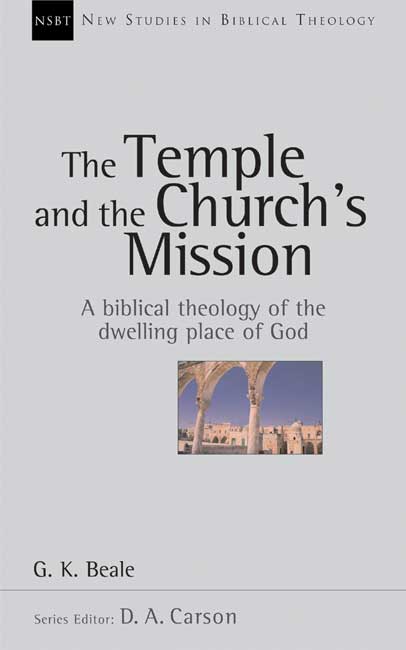
One of the main issues in this area of study is whether or not certain interpretations, both by the NT authors and their later commentators, seem to illegitimately “spiritualize” the fulfilment of a “literal” prophecy. Beale has a helpful passage on this very problem with respect to his interpretation of the Antichrist (“the man of lawlessness”) and the Temple in 2 Thessalonians in his work The Temple and the Church’s Mission: A Biblical Theology of the Dwelling Place of God.  One of the central contentions of his book is that in the NT, the Temple is replaced by Christ and in Christ by the people of God.  Therefore, the reference to the Temple in 2 Thessalonians is a reference to the church. On this basis and many other exegetical insights he claims that the prophecies of Daniel being alluded to in the text about the man of lawlessness setting up his rule in the Temple are ultimately taking place in the Church, not in some reconstructed Temple in Jerusalem as is commonly thought in popular Dispensationalism.

Obviously, for those advocating a strictly “literal hermeneutic” this will be a hopelessly spiritualizing interpretation that violates the principle by which all Scripture is to be interpreted. His responses to this charge are instructive both for general biblical hermeneutics as well as the specific problem of prophecy:

First, a ‘literal hermeneutic’ is not the best way to describe a biblical hermeneutic. Perhaps a ‘literate hermeneutic’ that aspires to the broad literary meaning in the canonical context is the better way to put it. We should want to follow an interpretive method that aims to unravel the original intention of biblical authors, realizing that that intention may be multi-layered, without any layers contradicting the others. Such original intentions may have meaning more correspondent to physical reality (hence so-called ‘literal interpretation’) while others may refer to ‘literal’ spiritual realities…”

So, there is a difference between reading something “literally” and “literately”. Kevin Vanhoozer has elsewhere said that if we want to talk about what the Reformers meant, and we ought to mean, by the term “literal interpretation”, we should speak of a “literary interpretation.” Basically, if the author intended a statement to be taken as a straightforward description, “the tree is outside”, we should understand it that way. But, if the author says, “the tree was a skyscraper”, we shouldn’t understand him to be saying that the tree is actually “scraping” the sky.  So, if a text is meant to be taken spiritually, then to read it appropriately is to read it spiritually.

“Second, the progress of revelation certainly reveals expanded meanings of earlier biblical texts. Later biblical writers further interpret earlier biblical writings in ways that amplify earlier texts. These subsequent interpretations may formulate meanings that earlier authors may not have had in mind but which do not contravene their original, essential, organic meaning. This is to say that original meanings have ‘thick’ content and that original authors likely were not exhaustively aware of the full extent of that content. In this regard, fulfilment often ‘fleshes out’ prophecy with details of which even the prophet may not have been fully cognizant.” (pg. 289)

So, a prophecy about the Temple, the dwelling place of God on earth amongst his people, can ultimately fulfilled in the church, who are now the dwelling place of God on earth amongst his people. For a prophecy to be fulfilled this way is not disruptive or illegitimate because the essential, organic content of the prophecy is preserved and grows naturally out of the original. Beale uses the example of a father in the year 1900 promising to buy his son a horse and buggy when he gets married, but by the time the son has grown up 30 years later, he ends up buying him a Ford. (pg. 291) The essential content of the promise is fulfilled even if the form is somewhat altered in a way the original utterer of the promise was unaware of.

I found these insights helpful. I pass them on to you with the hope that they will aid in your understanding of the scriptures and the surprising way that all of God’s promises “find their Yes in him.” (2 Cor 1:20)