Sorry About That, Here’s The Real Post (The Lord Giveth and Taketh Away–Via Twitter)

twitterI accidentally posted a ‘post’ that wasn’t a post, but a tentative post idea (and title.) I note those down quickly at time just so that I don’t forget them. Sometimes I write them, sometimes I don’t. In any case, this time I was using my wordpress app and didn’t shift the settings to ‘draft’ instead of ‘publish’, so a bunch of you got a fake post. Sorry about that. My bad.

While I’m here though, I figured I’d simply write the post anyways. It’s really just a fragment of an idea:

I was thinking about my friend Sean, this morning. He’s one of my best friends, like a brother to me really. We’ve been theology and church nerd friends for years now, geeking out over Kevin Vanhoozer and G.K. Beale books, arguing over ecclesiological issues over pints, and just generally trying to encourage each other in the faith. Among all my friend-brothers in Christ, he’s kind of been unique in that way in my life the last few years.

A few months ago I had the privilege of being in his wedding and then watching him head off to Chicago with his new bride. I was excited for him and sad at the same time because I knew that while we’d always be friends and brothers, he wasn’t just a 10 minute drive away anymore. He’s also been out of internet for a while so that was tough too. It’s been hard to find guys to just sit around and talk theology with like I would with Sean.

Now, thankfully, he’s got his internet back and we’ve been able to resume some contact. Looking forward to more of that. That said, I’ve realized that in the meantime, this whole year of writing and social media has been a surprise blessing in this area. It struck me this morning as I twitter-met (yes, I guess that’s a thing) another smart theology dude, that God’s been really providing a lot of weird, but wonderful online community in this way.

For a couple of years I’ve had a few, random theology nerd buddies online I’ve sparred, encouraged, and prayed with so I knew this was possible. But then I joined Christ and Pop Culture team, met an entire community there that has challenged, encouraged me, and with whom I actually feel quite close (except for Randy–he’s the worst.) Then weirdly enough I started meeting some really interesting, godly people on Twitter. People with whom I’ve been able to follow up, ask questions, joke with, pray for, and again, be really encouraged by.

None of this is really a jaw-dropping revelation. It reads like an Onion article headline: ‘Man discovers it’s possible to make friends online.’ Sure, this isn’t the local church community and it’s not a replacement for those friends with whom you live life, week to week, side by side, at work, or Bible study, or whatever. That said, it’s still remarkable to reflect on the way that God can use any medium, even those with a 140-character per note cap, to connect, grow, knit together, and encourage his people.

Soli Deo Gloria

4 Reasons We Tend to Ignore the Past

creedalCarl Trueman notes 3 main assumptions that underlie confessional Protestantism in his incisive, recent work The Creedal Imperative:

  1. The past is important, and has things of positive relevance to teach us.” (pg. 22)
  2. Language must be an appropriate vehicle for the stable transmission of truth across time and geographical space.” (pg. 22)
  3. There must be a body or an institution that can authoritiatively compose and enforce creeds and confessions.” (pg. 23)

Unfortunately, all three are increasingly problematic.

In a chapter outlining the cultural case against creeds, Trueman notes various trends that make them untenable to an expanding number of postmoderns and Evangelicals. I’d like to focus on the 4 that he identifies as weakening our appreciation for the past:

  1. “Science” – First, we must be clear that Trueman isn’t attacking science per se but rather the cultural mindset that science inculcates. The essential point is that for “science”, used in this sense, the “present is better than the past” (pg. 24). Our bias is tilted towards the present in such a way that we are increasingly skeptical that the past has anything to teach us. For instance, nobody wants to consult a 16th century medical text-book to learn how to heal a cold, so why should the Christians in that same century have anything to say about religion and spirituality?
  2. Technology – Technology has reversed the typical flow of information. In the past, elders taught children the various skills they need to live and work in the world. Youths were apprenticed to masters who were experienced experts in their trades. Nowadays technology has reversed the knowledge flow. If they’re over the age of 5, unless you’re a tech expert, your kids know more about technology than you do. Grandparents are particularly hopeless, needing tutorials in basic social requirements, like how to use a smart-phone. The general environment created is one where the old are dependent on the young, and, in a tech-dominated age, no longer relevant to the creation of culture or knowledge. If old people don’t know much, then dead people definitely can’t help us.
  3. Consumerism -Consumerism is problematic in the first place, simply as a species of materialism. Still, one might wonder what this has to do with an antipathy for creeds. Trueman points out that that central to modern consumerism is not just simply materialism, but the process of buying and consuming these new goods. Marketing strategies are aimed at creating a sense of the inadequacy of what is presently possessed for happiness: last year’s clothes, cars, and tech just isn’t good enough now. All of this feeds into the creation and funding of a culture in which the young and the new has status, while the old does not. 18-year olds rarely want to dress like 40-year olds, but the opposite is assumed in almost all modern marketing strategies. This is part of why young pop stars are interviewed on subjects like politics, religion, and morality. “Apparently, the lack of ‘baggage’ (to uses the standard pejorative) is an advantage to being able to speak with authority on complex subjects. In other professions, of course–‘baggage’ is generally referred to as ‘appropriate training.‘” (pg. 29) In which case, who cares what a bunch of old, dead religious “experts” thought about the matter? What’s Lady Gaga think instead? Or for Evangelicals, who cares what a Ph.D. in historical theology thinks about this? I wanna hear what the hip kid with the skinny jeans, candles, and an iPad says.
  4. The Disappearance of “Human Nature” – Without getting too technical about it, we are painfully aware of our social location in a way that no other society has been before us. You are a Hispanic, middle-class, single female navigating life primarily in your minority-culture community in the 21st Century, while the Westminster written by well-educated, upper-class, married, English, white men in the 17th. What could the latter possibly  have to say to the former? We have little sense that there is some stable “essence” we can call human nature that is constant enough, in history and space, that binds us all together, how could anybody speak across history and space to another. The framers of the Nicene Creed had no idea what the internet is,  who was Osama Bin Laden, or current geopolitical realities, so how could their thoughts on “spirituality” impact me today?

Again, none of this is meant to imply that science or technology are bad, just that some of the philosophical baggage and attitudes that comes with them, when paired with consumerism and the disappearance of human nature lead to some heavy currents leading us away from trusting or valuing the past as a source of knowledge of any kind. The idea that an ancient document might actually be binding on us is an even bigger pill to swallow.

All of these cultural trends are at work, not only against creeds, but against trust in the Scriptures and the Gospel itself. Christianity proclaims a truth tied to history, a salvation accomplished once and for all by a Jewish prophet 2,000 years ago on bloody Golgotha, and testified to by his disciples writing in the contest of Roman Imperial authority. To be a Christian is to stake one’s life on the importance of the past. Pastors and preachers need to be aware of the currents they’re navigating and trying to guide their congregants and hearers through. Wise as serpents they must learn to enter the world of their hearers, in order to present the truth from inside in a way that gently unravels (or explodes) their bias against the past.

Speaking practically, they might begin unraveling their own bias first.  American Evangelical pastors especially, swimming against/in a tide of anti-intellectualism and a strong cultural history of mantras like “no Creed but the Bible”,  are often-times just as jaded against the past as their congregations. Ask yourself this question: When was the last time I read a book that wasn’t published in the last 5 years? How about 50? How about 500? You  don’t need to become an expert in patristics, but it makes sense to become familiar with some Athanasius yourself, if you’re going to tell people that holding to the doctrine of the Trinity as taught in the Nicene Creed is important. Maybe lay your hands on some Calvin (not just Calvin as mediated by your favorite current author) before you go into the importance of the doctrines of grace.

Pastors, we have our work cut out for us.

Thankfully, deeper than even our own studies, stronger than any cultural force, we can to rely on the power of the Holy Spirit who makes present the historically-completed work of the Risen and Ascended Christ in the preaching of the Word and the sacraments.

Soli Deo Gloria

What’s a Culture and How Does it Work? 4 Functions of Culture According to Vanhoozer

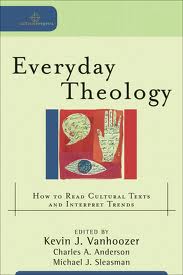
everyday theologyThe notion of culture has been on my mind for a long time now, but after joining the writing staff over at Christ and Pop Culture, I figured it was appropriate to do a little more digging on the notion of culture and cultural analysis. To that end I finally picked up a little volume edited by Kevin Vanhoozer Everyday Theology: How to Read Cultural Texts and Interpret Trends. While there are many volumes out that address the issue of biblical exegesis, there are few that address the crucial task of “cultural exegesis”, the practice of reading culture, interpreting the “signs of the times” (Matt. 16:1-3), in light of God and his revelation. That’s the gap that Vanhoozer and his co-editors (Charles A. Anderson, Michael J. Sleasman) aimed to fill. The volume opens with an programmatic essay by Vanhoozer in which he outlines a theory of culture, as well as a methodology for cultural interpretation. The essays that follow are examples of the method put into practice, with explorations of the check-out line, Eminem, Gladiator, and the blogosphere. In this post I’d like to take a (very) quick look at Vanhoozer’s view of culture and the way it works.

What’s a Culture? (Again)
Working primarily at the levels of what Roger Scruton has identified as “common culture” and “pop culture”, Vanhoozer’s discussion is fascinating and helpful many ways. One important point to note is his dependence on Dilthey’s idea that cultural studies observes the realm of human freedom, spirit, and creation v. that of nature. On this view cultural artifacts are concrete expressions of the human spirit by which our values, beliefs, and aspirations are given objective existence. As such, cultural artifacts such as songs, architecture, poetry, games, literature, and political practices “call not for explanation but for interpretation.” (pg. 22) Hermeneutics is key.

Another distinction he makes is the difference between culture and society; his chosen metaphor to understand the difference is hardware and software. Society is viewed more as the hardware of social institutions that gives shape to the shared life of a people. Culture he says, “is the software that determines how things function and how people relate in a given society. Culture is both system and practice, a means through which visions of the meaning of life (cultural worlds) are expressed, experienced, and explored through the diverse human products (cultural texts).” (pg. 27) So, police are institutional hardware that can be found across cultures, and yet an American “cop” is understood differently than a British “bobby” that usually doesn’t carry a gun. (pg. 23) Same institution, different cultural implementation.

How, then does Vanhoozer define culture? I won’t go into his very long and rewarding discussion, but in the end, Vanhoozer views culture “as a world and work of meaning. Better, culture is made up of “works” and “worlds” of meaning.” (pg. 26) It’s a work because it’s what humans do freely. Cultural objects are intentional creations–texts that communicate meaning. It is a world because these texts “create a meaningful environment in which humans dwell physically as well as imaginatively.” *(pg. 26)On this view,  popular culture is the shared context, practices, and “resources” that shapes and forms our way of life. (pg. 30)

How Does it Work?
The question remains, how does culture do this? Vanhoozer identifies 4 things that culture does to shape our lives.

  1. Culture communicates – First of all, culture is constantly communicating to us in ways both explicit as well as subtle, in a variety of formats, media, advertisements, and cultural artifacts. While there are hundreds of different specific messages aimed at a every discernable area of human life, the over-arching goal is to communicate a vision of the meaning of life, and the embodied form it should take. We mustn’t be naive the way this vision is communicated though. As Vanhoozer notes, “form and packaging” are just as important as content here. (pg. 28) Most cultural communication happens not through propositional argumentation but through allusion, suggestion, and connotation. It gives us pictures and metaphors (“life is like a box of chocolates”) that give rise to broader stories about the world we live in; subtle hermeneutical suggestions that shape the way we interpret our lives.
  2. Culture orients – This gives rise to the next function of culture: it orients us. By providing us with metaphors and models it gives us the inner logic by which we live our lives. “Life is like a baseball game”, “Life is like an episode of X show”, etc. These models also have “evaluative” and “affective” dimensions to them, in that they shape and form our loves and hates, our very sense of right and wrong. (pg. 29) Culture maps the world for us and creates a sense of mood by which we experience life. Moral and social orientation that we previously drew from family, community, and cult, we now draw from popular cultural texts such as movies, shows, song lyrics through which we construct the scripts of our lives. While How I Met Your Mother gives us a script about dating, childhood soccer-fields teach us about the nature of victory and competition. Importantly for Christians, Vanhoozer notes that while in the past culture gave us narratives of faith, we now more often find stories of “broken faith: defiance or anger at God; of fear of an indifferent or oppressive reality; of escape from sorrow over the absent God by finding joy in one’s immediate, mundane life.” (pg. 29)
  3. Culture reproduces -We need to understand that culture spreads. “Culture spreads beliefs, values, ideas, fashions, and practices from one social group to another.” (pp. 29-30) in the past through institutional force or colonization, but now it mostly happens through memetic reproduction. A “meme” is a “cultural unit” analogous to a gene in that it reproduces and passes itself on by means of imitation (mimesis). This could be anything from an idea, a fashion, phrase, song, or practice. The point is that cultural “programming” is spread from person to person, sort of like a virus, as people encounter each other and begin to copy or imitate the cultural behaviors that they see. This can happen institutionally in schools, or through parental instruction, but more often than not it’s happening informally all the time through everyday interactions with friends, online content, and media saturation.
  4. Culture cultivates – Finally, culture “cultivates”–it develops and grows. What does it grow? Well, recalling Dilthey’s point earlier, it cultivates the human spirit. By communicating and creating worlds for us to inhabit, metaphors to live by, or the basic orientation for our lives, culture develops our souls. It gives a vision of the meaning of life for our “hearts”–the seat our willing and acting–to desire and pattern itself against. “In short, culture cultivates character traits–the habits of the heart–and in doing so forms our spirit so that we become this kind of a person rather than that kind.” (pg. 31) The point isn’t that we are helpless against the onslaught of culture’s imagination or affection-shaping power. It is rather that we need to understand that it’s not a question of whether a particular show is educational, but what’s the lesson being taught? (pg. 31) Prolonged exposure to cultural texts presenting us with similar narratives and worlds shape our self-understandings and create a sort of “second nature” for good or ill. (pg. 32) Culture is a spirit-forming reality.

Because of this, Vanhoozer calls Christians to wake up and not simply walk about in culture like “sleep-walkers” unaware of the worlds which they are being invited to inhabit. (pg. 32) We need to be discerning readers both of Scripture and of culture, determining which is exerting a greater force on our hearts, and for what end. What vision of the good life are we buying into? What narratives and metaphors have we adopted? Which works and worlds dominate our imagination? The various little texts provided by marketers and other meaning-makers in pop culture, or the works and world of God as found in his Text?

Soli Deo Gloria

Why The New Pope Shouldn’t Listen to Obama’s Advice (CaPC)

obama

Obama isn’t the most precise theologian. Nor should that be expected of him–he’s only a politician after all.

In a recent interview before the selection of the new Pope Francis, President Obama was asked about his thoughts on the incoming pope. He expressed his hope that the next Holy Father would be faithful to what he considers the “central message of the Gospel.” Admirable sentiment. I think we should all hope for a pope who loves the Gospel. The question we have to ask ourselves is: what do we mean by the Gospel? Well, according to the President it’s “that we treat everybody as children of God and that we love them the way Jesus Christ taught us to love them.”

Now, I don’t want to single out or beat up on the President, but when you have people like Andy Stanley using language about him being pastor-in-chief and what-not, his definition of the Gospel becomes culturally-important. People listen to it whether they should or not. As such it becomes a teachable moment. Being a preacher-type, I can’t help myself.

You can go read me correct the President’s theology over at Christ and Pop Culture.

Soli Deo Gloria

Common? High? Pop? What Kind of Culture Is It? (With Some Help From Roger Scruton)

The notion of ‘culture’ has fascinated me ever since I first got my hands on Lesslie Newbigin’s The Gospel in a Pluralist Society in which he lays out his vision for engaging Western culture for the Gospel. It was around the time that the whole emergent church thing was still a thing and it seemed like everyone was talking about the shift to “postmodern” culture and what that meant. In middle of that conversation I started to realize that ‘culture’ was an important issue for evangelism, discipleship, and just ministry in general.

As I went on to read more about the issue, I found that almost everybody in the theological literature agrees that if you’re going to do ministry, then you have to understand cultural context you’re set in. Whether it’s modern culture, postmodern culture, indigenous cultures, or church cultures, ‘culture’ is everywhere and ever-so-important. Of course, this raises the issue of what exactly we mean by the term ‘culture’.

Seems like something we ought to have nailed down if we’re going to be talking about it so much.

You can almost feel the philosophy coming off of him.

You can almost feel the philosophy coming off of him.

Now I’ve had my own working definition of it for some time. The problem I’ve found is that, depending on the publication, author, or discipline you’re reading, everybody seems to have their own definition of it, many which seem to be at odds with each other.

This is why I was so pleased when I found that in first pages of his insightful little work Modern Culture, Roger Scruton helpfully lays out three different senses of the term ‘culture’ that are typically used today:

  • Common – The first is what might be called ‘common’ culture. It takes its cues from Herder, whose notion of kultur indicated the unique spirit of a nation or people as opposed to zivilization which could be shared with various other nations. This, apparently, was taken up and developed by the German romantics who pointed to the idea that culture is what shapes and is found in the various songs, art, traditions of a nation. In this view, it is what is common to all the people in a nation or tribe. This means that nobody, “however ill-educated, is deprived of culture, since culture and social membership is the same idea.” (pg. 1) It is this interpretation that most of the early anthropologists and sociologists of our day work with.
  • High – The second is what might be called ‘high’ culture and takes its roots in a more classical understanding that is linked to the idea of culture as cultivation and virtue. It is not common to all, but must be acquired through education, which usually requires some intellect, as well as leisure and resources for study. To have culture on this view is the province of the few and the well-educated. It comes with a knowledge of the broad literary canon, an appreciation of the right sorts of music and the arts. Culture, in this view, is a sort of moral-technical expertise. This idea has been championed by literary critics such as Matthew Arnold, and later by T.S. Eliot, and of course, Scruton himself. In fact, the book as a whole should be seen as a defense of high culture. (pp. 1-2)
  • Pop– Scruton says that a third sort of culture has emerged recently from the battles between the two. As we noted, the idea of common culture is usually attached to a tribe or a nation, a set, identifiable grouping of people whose culture can be identified and is generally shared. One of main characteristics of the modern/postmodern world which we inhabit is the breakdown of the various tribes associated with ‘traditional society.’ (pg. 2) There are no uncontested practices, thought patterns, songs, and narratives which can be appealed to without a sense of irony. That being said, humans still have need for a sort of solid and stable identity-shaping environment just as the traditional societies gave. It is in this situation that what might be termed ‘popular’ culture emerges, as a sort of tertium quid, a third thing, both like and unlike both of the prior conceptions. Pop culture is the province of ‘cultural studies’ programs in college and is thought of by its defenders as an equally valid ‘culture of the people’. Essentially pop culture is what’s involved when the notion of high culture as something that is a feature of “choice, taste, and leisure” in the sense of cultivation is merged with the common such as pop art and entertainment.  (pp. 2-3) As Scruton notes, “Any activity or artefact is considered cultural, if it is an identity-forming product of social interaction.” (pg. 3)

Of course, Scruton looks upon this last development with dismay, and, as mentioned earlier, in the rest of the work will launch a defense of high culture against any relativistic, postmodern deconstructions, or anti-elitist protests of the equal validity of popular culture.That doesn’t concern me at this point.

For Christians and ministers of the Gospel in particular, there are a number of theses I would like to simply list for reflection, without much additional comment.

  1. While these categories are not air-tight, uncontested, or always easily-distinguishable, it’s good to have some baseline working definitions to think with, especially when you’re reading about cultural engagement. It’s helpful to know what your author is dealing with because prescriptions for one category don’t always carry into the others.
  2. Christians should be engaged with culture at all levels. Common, high, or pop, there is no level or layer that can be ignored by ministers of the Gospel. Anything that is forming our people for good or ill, is our concern.
  3. Accordingly, effective ministers will become students of the common culture of the communities they inhabit.
  4. Depending on the type of congregation, or minister, they should also try be serious, not merely cursory, students of both the high and pop culture that our people draw on for their social-identity construction. (I emphasize ‘try’ because pastors have a lot on their plate already.)
  5. Preaching that both affirms and critiques in light of the Gospel needs to be alert to both the unconsciously formative, and consciously chosen elements of cultural formation. Sometimes it is the common cultural assumptions that are most difficult to expose, simply because they are assumptions.

As always, there’s more to say, but I don’t want to say it right now, so maybe I’ll say it later. Or maybe you should say it in the comments. Knock yourself out.

Soli Deo Gloria

Some Notes on Bavinck and the Relationship Between Christianity and Culture

After my post the other day, I did a little more digging on the great Dutch Reformed theologian Herman Bavinck. In the midst of my mini-research flurry I found a classic article by Bavinck on Calvin’s doctrine of common grace, which I highly recommend.  Not only is it a top-notch exposition of Calvin’s view of culture and common grace, it is also the work of one of the architects of that great and still influential movement of Dutch Neo-Calvinism. (Not Mark Driscoll and John Piper–think dead guys).

In the introduction to the article he gives his own brief sketch of “certain lines” which Scripture draws for us to understand how we should think about culture and cultural production:

It proceeds on the principle that for man God is the supreme good. Whatever material or ideal possessions the world may offer, all these taken together cannot outweigh or even be compared with this greatest of all treasures, communion with God; and hence, in case of conflict with this, they are to be unconditionally sacrificed. “Whom have I in heaven but thee? and there is none upon earth that I desire besides thee.” This, however, does not hinder earthly possessions from retaining a relative value. Considered in themselves they are not sinful or unclean; so long as they do not interfere with man’s pursuit of the kingdom of heaven, they are to be enjoyed with thanksgiving. Scripture avoids, both extremes, no less that of asceticism on the one hand than that of libertinism on the other hand.

The recognition of this as a principle appears most clearly in its teaching that all things, the entire world with all its treasures, including matter and the body, marriage and labor, are created and ordained of God; and that Christ, although, when He assumed a true and perfect human nature, He renounced all these things in obedience to God’s command, yet through His resurrection too them all back as henceforth purified of all sin and consecrated through the Spirit. Creation, incarnation, and resurrection are the fundamental facts of Christianity and at the same time the bulwarks against all error in life and doctrine.

This quote doesn’t cover everything, of course.  Still, Bavinck calls our attention to four points Christians need to keep in mind when thinking about cultural life:

  1. pintGod is the good to which all other goods point and to whom none can compare. Focusing on or choosing any created reality over the Creator is spiritual insanity.
  2. At the same time earthly, material, and cultural goods have relative value as long as our enjoyment of them doesn’t descend into idolatry. After all, they are the creation of God. He made them to be enjoyed with gratitude as his gift.
  3. The Gospel should lead neither to ascetism, nor libertinism; not legalism or license. In other words, a pint’s fine, just don’t get plastered and run around with your pants on your head.
  4. Christ, though he sacrificed all human material and cultural goods, has redeemed all in his life, death, and resurrection.

Now, Bavinck goes on to take account for human sin, depravity, and our natural tendency towards idolatry. He points out that in the first few centuries of Christianity, the church had to take a very contrasting stance towards the broader culture because all the cultural institutions of the day were tangled up in explicit idolatry. This is a point we ought to remember as well. At times in our rush to “enjoy culture” we fail to discern the way culture has gone wrong and too easily accommodate ourselves to its prevailing consumerism and nihilistic self-indulgence. Still, any criticism or antithesis against the culture we engage in needs to be set within the broader context of affirming the God’s good creation. The problem isn’t having some stuff, it’s obsessing over stuff and denying justice to the poor in our acquisition of it; the problem isn’t sex, it’s the abuse and perversion of sex as a unitive act into a self-centered assertion of the ultimacy of my own wants and desires.

Boiling it down to one verse, we need to remember Paul’s admonition to Timothy that, “everything created by God is good, and nothing is to be rejected if it is received with thanksgiving.” (1 Tim 4:14) This keeps us both from gnostic rejection of what God has made and pagan idolatry of it. Instead, culture becomes an opportunity for joyful gratitude overflowing into the worship of the Triune God.

Soli Deo Gloria