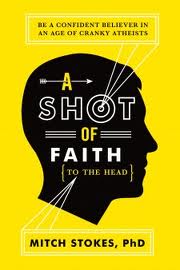
Book Review- A Shot of Faith (to the Head): Be a Confident Believer in an Age of Cranky Atheists by Mitch Stokes

Mitch Stokes. A Shot of Faith (to the Head): Be a Confident Believer in an Age of Cranky Atheists. Nashville: Thomas Nelson, 2012. 252 pp. $16.99. ($11.35 on Amazon)

In the last few years, with the rise of the New Atheism, authors like Dawkins, Dennett, Harris, and Hitchens have made popular Christian apologetics popular again. A veritable cottage industry of “responses” and rejoinders have been churned out by top-notch scholars (and some hacks too) either presenting arguments for Christianity or attempting to dismantle the claims of the New Atheists. While a number of these books are well-written and quite valuable, none of them quite accomplish what Mitch Stokes’ has in his recent work, A Shot of Faith to the Head: Be A Confident Believer in an Age of Cranky Atheists.  

He Knows What He’s Doing

What makes this book different? The key is that Stokes knows what he’s doing and, more importantly, what he isn’t. So often works of apologetics try to cover everything and don’t end up adequately covering anything.  Stokes knows better. He’s narrowed his focus, honed in on the key issues, and goes to work on them in a humorous, engaging, and readable fashion. What are those issues? The relationship between faith and reason, science, and the problem of evil.

Stokes is particularly qualified to tackle these. Before taking up his position as the Senior Fellow of Philosophy at New St. Andrews in Moscow, Idaho he got his MA in religion at Yale under Nicholas Wolterstorff, then went on to get his Ph.D. at Notre Dame under Alvin Plantinga and Peter Van Inwagen. No big deal–just three of the foremost philosophers of religion alive. And, if that weren’t enough,  prior to entering the philosophy game, he got an MS in mechanical engineering. The man knows what he’s talking about.

Introducing Reformed Epistemology–You’re Welcome

One way of describing Stokes’ project is translating Alvin Plantinga for everybody. Plantinga, while being, in my opinion, the most brilliant Christian philosopher working in the analytic tradition today, has not gone out of his way to make his philosophical genius widely accessible to the general reader. Don’t get me wrong, I think he’s hilarious and pretty clear as far as analytic philosophers go. Let’s be honest though, the average layman or pastor won’t take the time to read all 500 pages of Warranted Christian Belief  even if it’s worth it (which it is). Stokes takes the best of the Reformed epistemological approach developed by Plantinga and Wolterstorff (don’t worry, you don’t have to be a Calvinist to buy into it) applied to various issues in philosophy over the last 40 years and condenses it into short, winsome, witty, and clearly laid-out chapters uncluttered with small print or symbolic logic.  He also includes helpful “For Your Arsenal” summary points at the back of each chapter for easy recall of the information.

This isn’t to say that he merely repeats Plantinga, or offers nothing new–he does, especially the way he frames the discussion historically, concretely grounding these ideas in conversation with Hume and Locke on down to W.V.O. Quine. Still, even if translating Plantinga were all he did, this would be crucial because in engaging with both believers and unbelievers with the Gospel over the last couple of years, I’ve come to realize that the issue of epistemology is one that is too often ignored, or simply botched in most popular works on apologetics even though it lies at the root of so many of these discussions. By focusing his sights on the epistemological questions, Stokes really is aiming to give readers a “shot of faith to the head.”

So how does he actually do it? Stokes starts out by explaining and debunking the evidentialist objection to belief in God, that there isn’t sufficient evidence to “prove” he exists. He shows that, in fact, evidentialism is self-defeating–some beliefs must be basic, taken without reasons or evidence, otherwise reasoning itself cannot get off the ground. In fact, he pushes on to show that a demand for arguments and “reasons” for all of our beliefs, actually leads us to the conclusion that atheism itself is self-defeating. In place of the rationalism and evidentialism so commonly assumed by skeptics, Stokes proposes an alternative definition for what it means for a belief to be rational, that it is the product of “properly-functioning cognitive faculty operating in the appropriate environment” (read as good thinking equipment), like sense-perception, memory, and reason; this is a Reidian, reliabilist approach to epistemology as recovered and retooled by Plantinga and others. Stokes goes on to show that belief by way of testimony, or faith, is actually another valid way of coming by our beliefs, and that it is perfectly rational to believe in God by way faith, testimony, or “taking God at his word.”  Pressing a bit further, Stokes makes the very Plantingan point that if the “Christian epistemic story” is true, then the Christian can believe in God in a way that is basic and rational. Basically, in order to show that faith is irrational, you have to prove Christianity false first.

Now, none of these considerations means that he discounts reason or even the arguments for the existence of God–he actually has a very helpful “intermission” section dealing with the nature of the arguments and the problem of the burden of proof. Instead, Stokes shows that these arguments are helpful in supplementing faith and in dealing with “defeater” beliefs.

Defeaters and Highlights

What’s a “defeater”? A defeater is basically a reason to ditch a belief we gained previously in light of new evidence to the contrary, or that casts suspicion on the way we arrived at our belief. This is why Stokes moves on from his general discussion on faith and reason to consider the two main defeater beliefs for God out there today: science and the problem of evil.

I won’t review these two sections extensively, but some highlights include:

  • Helpful corrections of the historical record when it comes to the “history of the warfare between science and religion.” (Stokes has written short biographies of both Galileo and Newton so he’s well-equipped to handle this.)
  • A good discussion of the difference between the unnecessary “god of the Gaps” who intervenes from time to time to fix things that science can’t figure out and the God of the Bible who supervenes over and upholds the created order.
  • A much-needed guide to distinguishing between methodological naturalism, philosophical naturalism, and the scientific provincialism that convinces so many that accepting the former is predicated by the latter.
  • A fascinating historical and philosophical analysis of the rise of science, the way science actually proceeds, and how theism gives us confidence to engage in scientific study given belief in the Image of God and the rationality of a universe created by God.
  • Numbers. Stokes has an absorbing discussion on the nature of numbers that made even a math-hater like me wonder at the beauty of a mathematically-ordered universe–and how bizarre the existence of such a one truly is unless the world was created by a rational God.
  • A clean introduction into the “problem of evil” discussion that’s been going on in academic philosophy since the 1960s.
  • Short, but clear, Plantingan responses to both the logical and the probabilistic versions of the problem of evil, using both the Free Will Defense with respect to the logical, and a sober reflection on the epistemological limitations of finite thinkers in relation to the probabilistic.
  • A theistic turning of the tables, using the insights of the moral argument to point out that, without God, there is no absolute, moral standard, in which case the objection from evil can’t even get off the ground.
  • A bold statement of the uncommon yet undeniably appealing O Felix Culpa (Happy Fault) theodicy. (I won’t blow the surprise for you.)

Conclusions 

To sum up: Mitch Stokes has done the church a great service with this book.  By making available some of the best insights of the Christian community’s academic philosophers, believers who read this can be humbly confident that their faith in the Gospel is not blind, irrational, or illegitimate. Rather, it is in fact capable of standing up to the fiercest intellectual objections. I highly recommend this book to doubting believers, inquisitive skeptics, and especially pastors who want to be able to lovingly and persuasively commend the Gospel to the both groups.

Soli Deo Gloria
G.K. Beale on the Presence of a Covenant in Gen. 1-3

Alright, I finally cracked open G.K. Beale’s 962 page beast, A New Testament Biblical Theology: The Unfolding of the Old Testament in the New.  It’s been staring at me, tempting me with it’s theological awesomeness, so I finally gave in. At about 60 pages in I can safely say this is going to be a watershed work in New Testament studies. Describing the project in a short blog-post while doing it any sort of justice is next to impossible, especially when you consider the fact that Beale’s own description takes him about 25 pages. Still, the title alone points us to fact that one of the main thrusts of Beale’s work is to show how the New Testament can only be understood as the unfolding of the grand story-line of the Old Testament.

In order to do so, he opens with a summary and theological analysis of that story-line, beginning with a focus on the first 3 chapters of Genesis. He pays special attention to Adam, the concept of the Image of God,  and the eschatological thrust of the creational command to “conquer and subdue” the earth and “be fruitful and multiply” (Gen. 1:28), themes of crucial importance for understanding the rest of the tension and story-line of the OT.

It’s at this point that I ran across a very helpful passage discussing the presence of a “covenant” in Gen 1-3. After some careful examination of the texts Beale notes that there are a number of considerations that point us to the idea that it is possible, indeed necessary, to speak of a “covenant” relationship between God and Adam in the Garden, despite the objection that the word “covenant” is not used in the passage. The passage is worth quoting at length here:

In light of these observations, we can speak of the prefall conditions as a “beginning first creation” and the yet-to-come escalated creation conditions to be a consummate “eschatologically” enhanced stage of final blessedness. The period leading up to the reception of these escalated conditions is the time when it would be decided whether Adam would obey or disobey. These escalated conditions indicate that Adam was in a covenant relationship with God. Although the word “covenant” is not used to describe the relationship between God and Adam, the concept of covenant is there. God chooses to initiate a relationship with Adam by imposing an obligation on him (Gen. 2:16-17). This obligation was part of the larger task with which Adam had been commissioned in Gen 1.:28: to “rule” and “subdue” creation and in the process to “be fruitful and multiply and fill the earth.” Adam’s “ruling and subduing” commission included guarding the garden from any threat to its peaceful maintenance. In light of Gen. 2:16-17 and 3:22, Adam would receive irreversible blessings of eternal life on the condition of perfect faith and obedience, and he would receive the decisive curse of death if he was unfaithful and disobedient. Thus, the discernment of irreversible escalated creation conditions discussed above is the best argument for such a covenant notion.

Consequently, the argument that the word “covenant” is not used in Gen. 2-3 does not provide proof that there is not covenant relationship, just as Adam and Eve’s marriage relationship is not termed a “covenant” in Gen. 2:21-24 but expresses covenantal concepts and, in fact, is identified as a covenant elsewhere. Likewise, it is profitable that God’s covenant with Adam is referred to as a covenant elsewhere in the OT. The essential elements of a covenant are found in the Gen. 1-3 narrative: (1) two parties are named; (2) a condition of obedience is set forth; (3) a curse for transgression is threatened; (4) a clear implication of a blessing is promised for obedience. It could be objected that there is no reference to either party reaching a clear agreement or, especially, to Adam accepting the terms set forth in this so-called covenant. However, neither is this the case with Noah and Abraham, with whom God made explicit covenants. –A New Testament Biblical Theology: The Unfolding of the Old Testament in the New, pp 442-43

Again, these conclusions come after a solid examination of the texts (pp. 30-41), and is followed by reinforcing argumentation (pp. 43-46). Still, I found this passage to be helpful in showing that to speak of God’s creational covenant with Adam, or a “covenant of works”, is not an obvious imposition of foreign concepts onto the text in order to fit it into a theological grid, as is so often charged.  Rather, something like this is positively required by a close, narratively-oriented reading of the text.

As I continue to dive into this ambitious, and already thoroughly rewarding work, I’m sure more excerpts and summaries will follow this.

Soli Deo Gloria

The Complex Beauty of the Orthodox Jesus (Or, Why Heresy is too Simple)

My pastor’s sermon this week on Christ reminded me why Ross Douthat’s Bad Religion: How We Became a Nation of Heretics is easily one of the top 5 books I’ve read this year. Amidst the incisive analysis of recent American, religious history and sagacious social commentary he found and quoted one of those passages brimming with spiritual insight into the beauty of the Orthodox faith that Roman Catholics like Douthat seem particularly gifted at expressing. With great paradox and pathos, Douthat lays out the key to understanding the peculiar character of the Christian faith: the perplexing figure of Jesus Christ himself:

Christianity is a paradoxical religion because the Jew of Nazareth is a paradoxical character. No figure in history or fiction contains as many multitudes as the New Testament’s Jesus. He’s a celibate ascetic who enjoys dining with publicans and changing water into wine at weddings. He’s an apocalyptic prophet one moment, a wise ethicist the next. He’s a fierce critic of Jewish religious law who insists that he’s actually fulfilling rather than subverting it. He preaches a reversal of every social hierarchy while deliberately avoiding explicitly political claims. He promises to set parents against children and then disallows divorce; he consorts with prostitutes while denouncing even lustful thoughts. He makes wild claims about his own relationship with God, and perhaps his own divinity, without displaying any of the usual signs of megalomania or madness. He can be egalitarian and hierarchical, gentle and impatient, extraordinarily charitable and extraordinarily judgmental. He sets impossible standards and then forgives the worst of sinners. He blesses the peacemakers and then promises that he’s brought not peace but the sword. He’s superhuman one moment; the next he’s weeping. And of course the accounts of his resurrection only heighten these paradoxes, by introducing a post-crucifixion Jesus who is somehow neither a resuscitated body nor a flitting ghost but something even stranger still–a being at once fleshly and supernatural, recognizable and transfigured, bearing the wounds of the crucifixion even as he passes easily through walls.

The boast of Christian orthodoxy, as codified by the councils of the early Church and expounded in the Creeds, has always been its fidelity to the whole of Jesus. Its dogmas and definitions seek to encompass the seeming contradictions in the gospel narratives rather than evading them. Was he God or was he man? Both, says orthodoxy. Is the kingdom he preached something to be lived out in this world or something to be expected in the next? Both. Did he offer a blueprint for moral conduct or a call to spiritual enlightenment? Both. Did he mean to fulfill Judaism among the Jews, or to convert the Gentile world? Both. Was he the bloodied Man of Sorrows of Mel Gibson; the hippie, lilies of the field Jesus of Godspell; or the wise moralist beloved of Victorian liberals? All of these and more…

He goes on to explain how that paradoxicality gives rise to classic (and modern) heresies–they are sad, misbegotten attempts to handle the tension, usually by subtraction or suppression.

The goal of the great heresies, on the other hand, has often been to extract from the tensions of the gospel narratives a more consistent, stream-lined, and non-contradictory Jesus. For the Marcionites in the second century, this meant a merciful Jesus with no connection to the vengeful Hebrew God; for their rivals the Ebionites, it meant a Jesus whose Judaism required would-be followers to be come observant Jews themselves. For the various apocalyptic sects that have dotted Christian history, this has meant a Jesus whose only real concern was the imminent end-times; for modern  Christians seeking a more secular, this-worldly religion, it’s meant a Jesus who was mainly a moralist and social critic, with no real interest in eschatology.

These simplifications have usually required telling a somewhat different story about Jesus than the one told across the New Testament. Sometimes this retelling has involved thinning out the Christian canon, eliminating tensions by subtracting them. Sometimes it’s been achieved by combining the four gospels into one, smoothing out their seeming contradictions in the process. More often, though, it’s been achieved by straightforwardly rewriting or even inventing crucial portions of the New Testament account, as the Gospel of Judas’ authors did, to make them offer up a smoother, more palatable, and more straightforward theology.

Bad Religion: How We Became a Nation of Heretics, pp. 154-155

This is why, ultimately, heresies are usually too simple, or rather, simplistic, to be the truth about Jesus. They treat Jesus like a high school kid treats a Charles Dickens novel–they get an abridged version. When it comes to Jesus, though, dealing with the abridged version isn’t good enough. As soon as you start chopping off, or ignoring bits, or harmonizing the tension away, you lose the beauty of the Gospel because you lose Jesus, the complex, comprehensive savior. He is God and man; he saves body and soul; he is loving and just; he is something completely new that can only be understood as fulfillment of all that comes before. Again, as Douthat puts it, “He is all these things and more…”

Take some time this week to read the Gospels and think about the paradoxical Jew of Nazareth, the Lion who appears as the Lamb that was slain, the Jesus you love and the Jesus who makes you uncomfortable–the wisdom of creeds and councils, of the Gospels themselves, was to know that you need him in all of his complex beauty.

Soli Deo Gloria