I Am Not Abraham’s Mistake (My Christ and Pop Culture Feature)

Illustration by the amazing Seth T. Hahn. Pretty stoked.

Illustration by the amazing Seth T. Hahne Pretty stoked.

9/11 was a weird day for me. I was a sophomore in high school at the time and I distinctly remember thinking to myself, “Oh God, I hope it wasn’t Arabs”, as soon as I heard that a plane had been crashed into the first tower. I’m 3/4 Palestinian and at times have a distinctly Arab cast to me. My last name is Rishmawy. Admittedly it was a selfish thought, but I just didn’t see that going well for me in high school. And I was right.

That afternoon in football practice, upon discovering that I was of Arab descent, a “Palestilian” according to one educated linguist on the team, a team-mate of mine took it upon himself to spear me in the back–twice. For those of you who’ve never played, that sort of thing hurts. Thankfully my coach caught on quickly and put an end to that. Still, for the next few years I was lovingly called “dune-coon”, “sand-nigger”, “Taliban”, “Osama”, etc. by a good chunk of my team-mates and friends. And yes, I do mean lovingly. It was wrong, and I don’t really get it, but for some reason racial slurs were a way of bonding in the locker-room. Still, it grated on me at times.

As frustrating and awkward as being an Arab high-schooler in post-9/11 America could be at times, given garden-variety prejudices, fears, and ignorance–none of those slurs frustrated me as much as what some of my well-meaning, Evangelical brothers and sisters ignorantly implied: that I and my entire ethnic heritage were an unfortunate mistake–Abraham’s mistake to be exact.

Please go read the rest of this piece at the Christ and Pop Culture blog at patheos.com.


Turning the King Into a Fox (Or, Irenaeus on the Silliness of Heresy)

fox

I love foxes, but still, not as good as Jesus.

Among other things I’ve been reading Irenaeus’ classic Against Heresies and loving it. His goal in the work is to describe and debunk the heretical teaching of the Valentinian gnostics who were perverting Christian teaching into their bizarre, absurd system. The most frustrating part was the way these gnostic teachers, in their attempt to fool the faithful, were twisting scriptures in order to support their teaching:

Such, then, is their system, which neither the prophets announced, nor the Lord taught, nor the apostles delivered, but of which they boast that beyond all others they have a perfect knowledge. They gather their views from other sources than the Scriptures; and, to use a common proverb, they strive to weave ropes of sand, while they endeavour to adapt with an air of probability to their own peculiar assertions the parables of the Lord, the sayings of the prophets, and the words of the apostles, in order that their scheme may not seem altogether without support. In doing so, however, they disregard the order and the connection of the Scriptures, and so far as in them lies, dismember and destroy the truth. By transferring passages, and dressing them up anew, and making one thing out of another, they succeed in deluding many through their wicked art in adapting the oracles of the Lord to their opinions. –Against Heresies, 1.7.1

Explaining the way the gnostic use of the Bible was unbiblical, he came up with a brilliant analogy for their method of scriptural interpretation:

Their manner of acting is just as if one, when a beautiful image of a king has been constructed by some skilful artist out of precious jewels, should then take this likeness of the man all to pieces, should rearrange the gems, and so fit them together as to make them into the form of a dog or of a fox, and even that but poorly executed; and should then maintain and declare that this was the beautiful image of the king which the skilful artist constructed, pointing to the jewels which had been admirably fitted together by the first artist to form the image of the king, but have been with bad effect transferred by the latter one to the shape of a dog, and by thus exhibiting the jewels, should deceive the ignorant who had no conception what a king’s form was like, and persuade them that that miserable likeness of the fox was, in fact, the beautiful image of the king. In like manner do these persons patch together old wives’ fables, and then endeavour, by violently drawing away from their proper connection, words, expressions, and parables whenever found, to adapt the oracles of God to their baseless fictions. We have already stated how far they proceed in this way with respect to the interior of the Pleroma. -ibid, 1.7.1

Basically it’s like they’ve taken the Mona Lisa, cut it up, and re-pasted it together in the shape of a toilet and called it Leonardo’s masterpiece–or rather an improvement on it. Now, the fact that this can happen with the scriptures, that people can take them, quote them, and use them to justify all sorts of doctrines is troubling to some. Many, in seeing the way scripture is used in the mouths of false teachers and heretics, might despair of them, or doubt their beauty and efficacy. Not Irenaeus. He says that for the faithful, this shouldn’t invalidate the scriptures or make them any less true and precious:

In like manner he also who retains unchangeable in his heart the rule of the truth which he received by means of baptism, will doubtless recognise the names, the expressions, and the parables taken from the Scriptures, but will by no means acknowledge the blasphemous use which these men make of them. For, though he will acknowledge the gems, he will certainly not receive the fox instead of the likeness of the king. But when he has restored every one of the expressions quoted to its proper position, and has fitted it to the body of the truth, he will lay bare, and prove to be without any foundation, the figment of these heretics. -ibid, 1.9.1

The key is taking the precious stones and restoring them to their “proper position”; contextual reading of the scriptures according to basic principles of exegesis matters. Verses need to be taken within chapters, chapters within book, books within the canon, and, yes, for those of us at the end of the 20th century, canon within the broader churchly tradition of interpretation. (Not that the tradition stands over the scriptures, but at the very least it doesn’t hurt to listen to what wise biblical teachers of other generations past have found in them.) When we do these things, instead of the fox, the beautiful picture of King Jesus emerges once more, ready for the adoration and worship God intended to lead us into through his Spirit-inspired scriptures.

Soli Deo Gloria

Christians Are Book People (Seriously, We Were Into Books Before Everybody Else Was)

booksChristians are book people. Many of us have heard the claim before and it makes a certain sense. Christians worship a speaking God–an authoring God who reveals himself in the script of history as well as in the scriptures. That being the case, they ought to care about the written word. Now, being an avid reader myself, I’m inclined to agree. Still, we might wonder at times if the claim’s been exaggerated, especially given the fact that a vast portion of Christians throughout history have been illiterate. Apparently not. According to Robin Lane Fox we’ve been book people from the beginning:

…from a very early date there were Christians able to communicate with the literary culture of their age. As a “religion of the book,” Christianity had a particular relationship with texts. In Rome, several paintings in the burial chambers of the catacombs show Christian arriving at the Last Judgement clutching their books. When the governor of Africa asked a group of Christian prisoners what they had brought with them to court, they replied, “Texts of Paul, a just man.” One of the fundamental contrasts between pagan cult and Christianity was this passage from an oral culture of myth and conjecture to one based firmly on written texts. In the first communities, there had already been a significant break with contemporary habits of reading: Christians used the codex, or book, for their biblical texts, whereas pagans still vastly preferred the roll. The Christian codex was made of papyrus, not parchment. It was more compact and better suited to people on the move, and it was an easier form in which to refer to and fro between texts. This Christian revolution lies at the beginnings of the history of the modern book; for scriptural texts, on present evidence, it seems to have been universal…Gradually, this concern for the book extended to pagan culture too.
Pagans and Christians, pg. 304-305

A few take-aways from early Christian history:

  1. We are book people. I mean, not to be a hipster about it, but we were reading books before everybody else got into them.
  2. Building a personal library is the Christian thing to do. I do not have a book problem. 😉
  3. Apparently the NRA stole “..from my cold, dead hands.”
  4. On a more serious note, the early Christians knew where their strength and hope was: the word of God. When facing the judgment of men, or of God, they clung to the promise of the Gospel in the scriptures. May we do the same.

Soli Deo Gloria

Quick-Blog #13: Try Reading It Out Loud

Out LoudMy dad used to always tell me to try reading my papers out loud in high school in order to proof-read them. Sometimes hearing yourself say it helps you figure out what’s wrong with an awkward sentence, or figure out where a comma belongs. It’s advice I still try to follow today. Sometimes.

I was reminded of that little nugget of wisdom as I was reading R.T. France’s commentary on The Gospel of Mark. Scholars have remarked over the years on the inelegant and choppy style of Mark’s prose in comparison with the other Gospels. Mark has a lot of abrupt transitions and repetitive phrases, and the Greek is really, in many ways, elementary. For instance, if you’re familiar with the KJV translation, there’s a frequent use of the word “and”, that gets smoothed out in more recent, less literal renditions because of its seeming pointlessness. In the past this has served to sideline Mark as less sophisticated theologically or literarily.

France explains that recently it’s been noticed that Mark’s writing style probably served a different purpose, causing scholars to re-evaluate their earlier judgments:

It may seem obvious that a book is intended to be read. But modern scholars are apt to forget that in the ancient world not very many people could read. It has been recently estimated that literacy in the ancient Mediterranean world was ‘probably no more than 10 percent, although the figure may have risen to 15 or 20 percent in certain cities’. Unless Mark’s work was designed only for the benefit of the small minority who could read, he must have reckoned on its being experienced by most of his target group as an oral text, read aloud probably in meetings of the local church; E. Best describes it as ‘preaching’. Recent scholarship has increasingly recognized this factor, and it is relatively common these days to hear Mark discussed as an oral text, or at least as a text intended in part for oral presentation.

–The Gospel of Mark, pg. 9

France then goes on to point out how these for various features of the text mentioned above, as well as others, can be accounted for when taking into mind the aim of helping a hearer. Instead of Mark, the sub-literate writer, we are given Mark the master storyteller, Mark’s approach creates dramatic tension, is accessible to the largely uneducated 1st-Century congregation, and enables his hearers to keep the narrative in mind when there wasn’t a readily available text to flip back and forth to consult.

There are a lot of things that could be said about this little tidbit. I’ll limit myself to a two quick points:

  1. If you get bored reading the Bible, try reading some of it out loud. Most of it was written in an oral culture and was intended to be heard. Paul’s letters were supposed to be read to the congregations. The Psalms were read in worship. The Prophets consist largely of sermonic oratory. The point is, some of this stuff really sticks and shines when you hear it.
  2. Preachers, read the Bible our loud to your people in your sermons. They’re meant to hear it–large chunks of it. That’s where the liturgical churches get things right. It’s okay for your people to hear the Scriptures without you breaking down every detail of the grammar for them. Also, read them with passion. I heard Albert Tate speak up at Forest Home camp this last year with my college students and, aside from being a stud preacher, that man read the Scriptures like they meant something, not just as a set-up for his sermon. Often-times the it’s more important for your people to catch your attitude of reverence and passion about the Word, than your specific insights about it.

So, for what it’s worth: try reading it out loud.

Soli Deo Gloria

For the Love of God Read Your Bible This Year

The title of the blog’s a little cheeky.

On one level I’m quite serious–in order to love God better, it’s a good idea to read your Bible this new year. Now, don’t get me wrong, I’m not saying that reading your Bible will silver-bullet style immediately kill sin and light up your heart for Jesus. I mean, the Holy Spirit could do that, but typically not so much. Instead, you might think of it more like a balanced diet or vitamins. Eating one good meal or taking 2 or 3 vitamins won’t help much if 99% of your diet sucks. Still, day after day, week after week, month after month, getting the right nutrients and supplements will improve your health.

bibleIn a somewhat similar fashion, daily engagement with the scriptures, starting with something like just 5-10 minutes a day will, over time, give you a greater appreciation for the story of Bible, knowledge of God, Jesus Christ, your sin, the power of the Spirit, the sweep of salvation, and the Gospel message that saves. And really, that’s what changes your heart, what fills it with love for God in light of who He is and what He has done–the Spirit applying the Gospel of Jesus to your heart as you engage with it. Diving deep into the Gospel, meeting Jesus, is what will save you from the million different ways you try to sinfully save yourself throughout the day (money, sex, power, busyness, etc.). Being daily reminded of his glory, of his patient dealings with Israel, the eternal scope of his love, the suffering and triumphant Savior, the falseness of idols in comparison with his matchless beauty–all of these things are what will, over time, overwhelm sin with love.

Now, many of us know this but we struggle knowing how to go about reading our Bible more each year. We start out thinking we’re going to read it through cover to cover, but right about the time the Israelites are wandering in the desert, dying of thirst, we give up, or wish we could join them. Leviticus seems like it was written as part of the judgment on that first sinful generation.

Part of the problem is that we don’t have a guide, or a good plan to lead us through the wilderness sections of scripture, or even to know what we should be enjoying in its oases. We want to, but we don’t know where to start, and when we start, we don’t know what we’re reading. The spirit is willing, but the flesh is weak. O who will save me from this reading of death?!

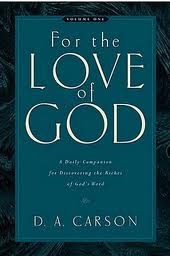
Love of GodEnter D.A. Carson
This last year my wife and I went through the first volume of D.A. Carson’s For the Love of God daily devotional based on the Murray M’Cheyne reading program and it’s been great. Robert Murray M’Cheyne designed a daily reading program that, at about 4 chapters a day, gets you through the New Testament and Psalms twice and the Old Testament once in the course of a year. So, for instance, January 1 begins with Genesis 1, Matthew 1, Ezra 1, Acts 1. It goes on from there. Originally the first two columns were labeled “family” intended to be read with the whole family, and the second two columns were “private” for personal devotion. It’s not necessarily the lightest program, but the arrangement is much better than most of the chronological reading programs or even some of the mixed year-long Bible programs.

With Carson’s devotional, you get a about a page of highly-readable biblical, theological, and pastoral commentary on one of the chapters by a top-notch theologian and scholar. Really, I compare the notes you get in this little devotional to the top-level commentaries sometimes and it’s amazing how he is quickly and, in an understandable fashion, making available the best scholarship and then moving to apply it to your daily life. I can’t begin to tell you how much I have enjoyed and personally benefited from both the daily Bible reading and Carson’s commentary. The arrangement of the chapters is helpful because it keeps you going through whole books of the Bible as they were intended to be read, instead of the “open and point” method that lands you reading a random chapter in Zechariah, leading you to think the prophet was on acid. Also, usually at least 2 of the chapters are in non-boring books, so you never have to truck through Leviticus all by itself.

No Sweat
Many of you might be intimidated at the thought of 4 chapters a day. Realize that’s only about 20 minutes total which can be broken up throughout the day if you have to. Still, that’s about 2% of the time you probably spend on facebook in a given day, so you have more time than you think. Also, you may choose to simply go through one book of the daily readings and whatever chapter Carson happens to be commenting on that day. Know that you might might miss a day. Or a week. Or a month. That’s fine, but just get back to it when you remember. When I asked my wife if we wanted to do volume 2 this year she said yes, because even though she didn’t get to it every day, she still had read more of her Bible this year than in any year prior. Sounds good to me.

Finally, if you’re worrying about dropping that 10 bucks on something you haven’t cruised through, or period, then you should know that D.A. Carson’s blog over at the Gospel Coalition is actually just his daily devotion. This last year they’ve been posting through volume 2, so next year will be volume 1 again. So, you can go check it out, or just use the blog as your daily devotional. You can even do it on your computer at work (on your break or lunch, of course).

The point of all of this is, for the love of God, read your Bible this year. It’s worth it and it just became a whole lot easier.

Soli Deo Gloria

The Day Reading Your Bible Won’t Matter

I’ve realized for some time now that my MA in Biblical studies has a shelf-life. I’m not just talking about the fact that scholarship moves on and that you constantly have to keep learning if your education is going to mean anything. I’m talking about the fact that eventually, there will come a time when learning about the Bible simply won’t matter.

You heard me. There’s going to come a day when READING YOUR BIBLE WON’T MATTER.

What day am I talking about? Check out this quote by old, dead guy, theologian Abraham Kuyper:

In paradise, before the Fall, there was no Bible, and there will be no Bible in the future paradise of glory. When the transparent light, kindled by nature, addresses us directly, and the inner word of God sounds in our heart in its original clearness, and all human words are sincere, and the function of our inner ear is perfectly performed, why should we need the Bible? What mother loses herself in a treatise upon the “love of our children” the very moment that her own dear ones are playing about her knee, and God allows her to drink in their love with full draughts? –Lectures on Calvinism, pg. 45

At the end of all things we won’t need to read our Bibles because the reality they’ve been pointing us to, teaching us about, will be here, fully available. We won’t just have to read about the glory of God in Jesus Christ, but we’ll be able to see, taste, and touch–we’ll swim in it. When face to face with our beloved, there is no need to read an old letter. In the New Creation, people won’t need Bible experts, teachers, etc. Once again, I’ll be out of a job. You won’t need to read your Bible.

Still, as Kuyper goes on to point out, this is not currently the case:

But, in our present condition, the immediate communion with God by means of nature, and our own heart, is lost. Sin brought separation instead, and the opposition which is manifest nowadays against the authority of the Holy Scriptures is based on nothing else than the false supposition that, our condition being still normal, our religion need not be soteriological. For of course, in that case, the Bible is not wanted, it becomes, indeed, a hindrance, and grates upon our feelings, since it interposes a book between God and your heart. Oral communication excludes writing. When the sun shines on your house, bright and clear, you turn off the electric light, but when the sun disappears below the horizon, you feel the necessitas luminis artificiosi ie., the need of artificial light, and the artificial light kindled in every dwelling. Now this is the case in matters of religion. When there are no mists to hide the majesty of divine light from our eyes, what need is there then for a lamp unto the feet, or a light unto the path? But when history, experience, and consciousness unite in stating the fact that the pure and full light of heaven has disappeared, and that we are groping about in the dark, then, a different, or if you will, an artificial light must be kindled for us–and such a light God has kindled for us in his holy Word.

Lectures on Calvinism, pp. 45-46

One day we won’t need our Bibles, but today is not that day. We’re still in need of light. We don’t see all things clearly. Things can get a little foggy out there. Your hearts can still deceive you, so you need someone to place “a book between God and your heart.” For now we see in a mirror dimly, but then face to face. Now I know in part; then I shall know fully, even as I have been fully known. (1 Cor 13:12)

For now, keep your Bibles open and shining light into your heart and let it remind you constantly of the day, when by God’s grace, you won’t need it.

Soli Deo Gloria

Kierkegaard on Interpreting the Text to Death

It is a truism today to say that the Bible needs to be interpreted. In fact, it was a truism back when the Bible was being written that it’s not simply a matter of just “reading” the thing all the time. Even the Bible says that it’s hard to understand. (2 Pet. 3:16) Or, as the Westminster Confession comments:

All things in Scripture are not alike plain in themselves, nor alike clear unto all: yet those things which are necessary to be known, believed, and observed for salvation are so clearly propounded, and opened in some place of Scripture or other, that not only the learned, but the unlearned, in a due use of the ordinary means, may attain unto a sufficient understanding of them. (2.7)

We’ve known for a long time then that even though the basics are clearly laid out, there are at least some parts that are not obvious or plain. For thousands of years now, Christians have wrestled with, commented on, and interpreted the text of the Bible. Today we have seminaries with classes in hermeneutics, study of the original languages and ancient cultures that form the setting and background of the text, dictionaries, commentaries that are thousands of pages long, and journals where scholars devote dozens of pages to analyzing the nuances of a single word in the context of a single verse. (No joke, I wrote 30 pages on 2 verses in Colossians in my MA program and just barely scratched the surface of the literature on the subject.) Without a doubt, our knowledge of the text has expanded and been deepened by the faithful work of scholars and interpreters over the last few generations and this is a good thing.

The people of God need preachers and pastors who will roll up their sleeves and get to work on the task of discerning what the Lord has spoken and is even now speaking in the text. Poor interpretation is at the root of so much bad preaching and teaching in the church, which leads to bad living by the church. Preachers, teachers, and even lay-people who have come to rely on them, still need to work at the task of interpretation.

Now, to some this might seem troublesome and daunting. As someone who has devoted my life to wrestling with the text in order to teach and preach it faithfully, I absolutely love this stuff. Digging into the interpretive issues and the complexity of the Scriptures is what I live for. “What’s that you say about an ingenious new understanding of that obscure verse in Leviticus? Brilliant! Let me read it.”  “Is that a new commentary on a book I finished studying last month? I must have it!” Anybody who’s seen my desk at home or at work knows that I live knee-deep in this stuff. I wouldn’t have it any other way.

Now why do I bring this up? To alert us to a deadly risk we run when engaging in the interpretive task.

Kierkegaard tells a cautionary parable about the danger that can come with an unbridled focus on interpretation:

Imagine a country. A royal command is issued to all the office-bearers and subjects, in short, to the whole population. A remarkable change comes over them all: they all become interpreters, the office-bearers become authors, every blessed day there comes out an interpretation more learned than the last, more acute, more elegant, more profound, more ingenious, more wonderful, more charming, and more wonderfully charming. Criticism which out to survey the whole can hardly attain survey of this prodigious literature, indeed criticism itself has become a literature so prolix that it is impossible to attain a survey of the criticism. Everything became interpretation—but no one read the royal command with a view to acting in accordance with it. And it was not only that everything became interpretation, but at the same time the point of view for determining what seriousness is was altered, and to be busy about interpretation became real seriousness. Suppose that this king was not a human king—for thought a human king would understand well enough that they were making a fool of him by giving the affair this turn, yet as a human king he is dependent, especially when he encounters the united front of office-bearers and subjects and so would be compelled to put the best face on a bad game, to let it seem as if all this were a matter of course, so that they most elegant interpreter would be rewarded by elevation to the peerage, the most acute would be knighted, etc.—Suppose that this kind was almighty, one therefore who is not put to embarrassment though all the office-bearers and all the subjects play him false. What do you supposed this almighty king would think about such a thing? Surely he would say, “ The fact that they do not comply with my commandment, even that I might forgive; moreover, if they united in a petition that I might have patience with them, or perhaps relieve them entirely of this commandment which seemed to them too hard—that I could forgive them. But this I cannot forgive, that they entirely alter the point of view for determining what seriousness is.” -For Self-Examination, pp. 58-59

With this little parable Kierkegaard throws up a large, flashing, red warning sign for those of us enamored with the endless study of the text. The danger comes when interpretation becomes an excuse for disobedience. Kevin Vanhoozer has pointed out that the proper interpretation of the text of Scripture requires performance. Ingenious readings are not the point–hearing and rendering a fitting response to the voice of God is. When the task of interpretation eclipses our actual response to God speaking to us out of the silence, calling us to repentance, commanding us in righteousness, convicting us of sin, consoling us in pain, and drawing us to communion with Himself, things have gone awry. At that point you have sentenced the text to a slow and agonizing death by commentary.

Do not mistake this for an anti-intellectual call to “just read the Bible” without trying to engage with it at that deeper level. Study the Bible. Wrestle with it. Don’t be satisfied with simplistic readings of difficult passages. Go read big books on the subject. At the end of the day though, we must never forget that when the “Word of the Lord” came to the prophets it didn’t come as a word to be inspected, dissected, and thereby domesticated, but as the mighty command of the King who intends for his subjects to hear and obey his voice. We study in order to hear–we interpret in order to obey.

Soli Deo Gloria

Beefing Up Your “Quiet Times”: Catechisms and Confessions as Devotional Literature

A little bit ago, a buddy of mine was musing about the fact that he doesn’t connect to most devotional literature of the type that truly “spiritual” people normally rave about. His critical, analytical mind and personality just doesn’t connect with warm meditation, but rather with critical analysis of history and culture.

For a while I’d found myself in a similar place. After seminary, my devotional life became a bit trickier. I find that my mind comes most alive to God when I’m reading systematic theology, or wrestling with some interesting piece of biblical theology, but when I try to slow down, pause, and meditate on something like My Utmost for His Highest, I just can’t do it. (That’s not to disparage Chambers. I loved it in college. The sad thing is, most current, popular stuff doesn’t even come close to his depth.) Because of this, finding good devotional material has been a challenge.

This didn’t trouble me much at first. I would simply pray, read my Bible, and then move on to my academic reading. Still, after a while I realized that I need a slowing down, a place for a more contemplative, heart-oriented approach to God in my devotional life. When I “just read my Bible” I found it hard to turn off the analytic mode. When I did, I didn’t really find my heart moved, but rather just bored.

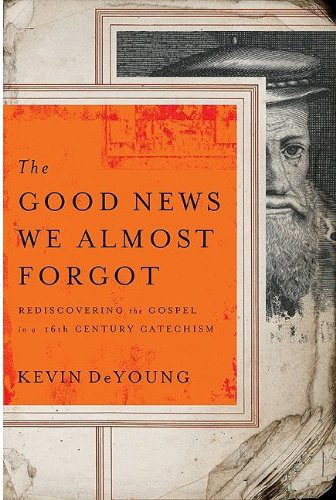
The Good News We Almost Forgot

Just when I thought all was lost, I got my hands on The Good News We Almost Forgot: Rediscovering the Gospel in a 16th Century Catechism by Kevin DeYoung. The book is basically a commentary on the Heidelberg Catechism, which you can read for yourself here. For those of you unfamiliar with catechisms, they are a series of questions and answers designed to be memorized by either new believers, old believers in need of depth, or children in order to teach them the content of the Christian faith. They’re employed across various confessional church traditions and they usually they have scripture references attached to the answers for believers to look up and study as well.

The Heidelberg Catechism was written at the University of Heidelberg at the commission of Elector Frederick III and was approved by the Synod of Heidelberg in 1563. The Catechism has 129 questions and answers that are basically commentary on the Apostles’ Creed, the Lord’s Prayer, and the 10 Commandments, but it is divided into fifty-two sections, called “Lord’s Days,” so that pastors could preach through them on each of the 52 Sundays of the year.  It is one of the most universally recognized pieces of Reformed theology across confessions and was adopted by the great Synod of 1618-1619, as one of the Three Forms of Unity, along with the Canons of Dort and the Belgic Confession.

How exciting!!!

Now for myself, having been raised in a barely-denominational Friends church, I hadn’t spent more than a minute with anything like a catechism, except to know \the Westminster Shorter Catechism’s famous first question and answer: “Q. What is the Chief End of Man? A. Man’s chief end is to glorify God and enjoy him forever.”  To my less-than-enlightened mind that was great, deep, but spare stuff.  The thought of spending a whole book reading about a catechism didn’t originally strike me as an edifying experience, because at that point, “I already knew that stuff.”

Still, my buddy told me that he’d been using DeYoung’s book as a devotion because it breaks up into 52 short chapters (2-3 pages) commenting on each of the Lord’s days.  I figured, why not? It can’t hurt.

After a short introduction to the catechism much more exhaustive than my paragraph, I got to the first Lord’s Day and read Question and Answer 1:

Q. What is your only comfort in life and in death?
A. That I am not my own, but belong—body and soul, in life and in death—to my faithful Savior, Jesus Christ. He has fully paid for all my sins with his precious blood, and has set me free from the tyranny of the devil. He also watches over me in such a way that not a hair can fall from my head without the will of my Father in heaven; in fact, all things must work together for my salvation. Because I belong to him, Christ, by his Holy Spirit, assures me of eternal life and makes me wholeheartedly willing and ready from now on to live for him.

When I read this I nearly started to tear up immediately. The first sentence alone gripped me: “I am not my own.” There is nothing sterile, dry or impersonal about this answer. At the same time, it deploys in a matter of sentences the doctrines of atonement, providence, adoption, union with Christ, the Holy Spirit, assurance, and sanctification, in order to draw me into the saving reality of the Gospel. As you read through the rest of the catechism, there are other questions of similar depth and power. DeYoung’s commentary each day was solidly theological, scriptural, and very pastoral. For the next month and a half I found myself daily edified by the truths encapsulated in the short answers and the meditation that followed.

I had finally found something to found the devotional gap in my life.

Why Read Catechisms– After this I went on a search and started reading through the different catechisms and confessions I could find, (Westminster, Luther’s, Belgic, Scots), as a part of my daily time of prayer and scripture. I found myself time and time again, blessed, challenged, and moved to worship and delight. I also found myself wondering why I had never done this before.

If you’ve never spent time with a catechism, here are three reasons you should in no particular order.

1. Hearing voices from other centuries– Christianity has been around for 2,000 years. This means that Christians have been reading, praying, thinking, and writing about the Gospel for 2,000 years. It is foolish to not pay attention to what our mothers and fathers in the faith have said in past generations as if the truth of the Gospel had a 2 month shelf-life. Their voices are needed if we are to hear the Gospel in all of its fullness in our own day. Catechisms  are a great way of doing that given that most of them were written centuries ago and have still been found spiritually beneficial after all of these years.

2. Deep truths; short phrases. Most catechisms and confessions are doing serious theology and yet condensing it down into short, memorable phrases that are perfect for meditation and contemplation throughout the day. They are perfect for engaging the mind as well as the heart with the truth of God throughout your day.

3. Know Your Bible- Finally, most catechisms and confessions are packed to the gills with scriptural references backing up every statement. You can trace them down as a devotional exercise that can help you get to know your Bible better than you did before, as well as learn the deep, biblical basis for what we believe. It also can help you get into the scriptures in a focused, guided way that is less intimidating for some people than just opening the thing up and reading it.

Where Do I Start?

Honestly, I think DeYoung’s book, The Good News We Almost Forgot is a great place to start. I don’t have a copy of my own any more because I keep giving it away. When one of my college students asks me if I know of a book they should read, it’s one of the first two or three that I recommend.

If you want to start checking out catechism right away, you can start here.