7 Tips on “How to Meet Reformed Men”

church_dating

Ah yes, the classic “let me show you a verse” move.

I’ve written enough articles over the last few months that I now get readers coming to my blog off of random Google searches. Sometimes they make sense, others not so much, and a few make me laugh. One particular search caught my eye the other day: “how to meet Reformed men.” Apparently there is at least one single Christian woman out there, looking for a man with a sound grasp of the doctrines of grace. Now, I’m not sure she found what she was looking for here, but in the spirit of brotherly love, I thought I’d list a few helpful, possibly humorous, suggestions from friends and family on “how to meet Reformed men”:

    1. Go to a local Reformed church and look for one. 
    2. If no Reformed church is available, look for the guy in the back of your local non-denominational church, furiously writing notes during the sermon in order to write the pastor an email filled with corrections.
    3. In that same church, mention words like “covenant”, “doctrine”, “election”, or “fatherly hand” in conversations with any single men and look for the twinkle in their eyes. (HT: Sean McLeish)
    4. Frequent local coffee shops with a copy of Calvin’s Institutes lying out on the table. Make sure you’ve read some of it, though, and include sufficient highlights and underlining.
    5. Repeat #4 in local breweries and pubs (unless Baptist).
    6. Move to Louisville, walk around Southern’s campus without a wedding ring on. (Reformed Baptist; HT Lauren Rambo)
    7. For those favoring the online approach, ReformedSingles.com offers to fill the gap. Unlike other dating sites this is a place where: “Our members are prepared for marriage by reading a wide variety of articles on marriage, dating pitfalls, courtship, divorce and remarriage, and more. Our Members’ identities have been verified by their pastor so people you meet really are who they say they are. Finally, our members know that their futures are predestined by our heavenly Father and rest in His kind hands.” (HT: Alan Noble)

Although I’ve limited myself to 7 tips, on biblical grounds, I’m sure our sisters would love some more (appropriate) suggestions from the readership in the comments. Blessings on the search.

Soli Deo Gloria

(Image Credit: Online For Love)

Salvation in Living Color

Rembrandt sketchHebrews 10:1 says that “the law has but a shadow of the good things to come instead of the true form of these realities, it can never, by the same sacrifices that are continually offered every year, make perfect those who draw near.”

Commenting on this truth, Calvin expands on the relation between Law and Gospel given in this verse:

He has borrowed this similitude from the pictorial art; for a shadow here is in a sense different from what it has in Colossians 2:17; where he calls the ancient rites or ceremonies shadows, because they did not possess the real substance of what they represented. But he now says that they were like rude lineaments, which shadow forth the perfect picture; for painters, before they introduce the living colors by the pencil, are wont to mark out the outlines of what they intend to represent. This indistinct representation is called by the Greeks σκιαγραφία, which you might call in Latin, “umbratilem“, shadowy. The Greeks had also the εἰκὼν, the full likeness. Hence also “eiconia” are called images (imagines) in Latin, which represent to the life the form of men or of animals or of places.

The difference then which the Apostle makes between the Law and the Gospel is this, — that under the Law was shadowed forth only in rude and imperfect lines what is under the Gospel set forth in living colors and graphically distinct. He thus confirms again what he had previously said, that the Law was not useless, nor its ceremonies unprofitable. For though there was not in them the image of heavenly things, finished, as they say, by the last touch of the artist; yet the representation, such as it was, was of no small benefit to the fathers; but still our condition is much more favorable. We must however observe, that the things which were shown to them at a distance are the same with those which are now set before our eyes. Hence to both the same Christ is exhibited, the same righteousness, sanctification, and salvation; and the difference only is in the manner of painting or setting them forth.

 –Commentary on Hebrews 10:1

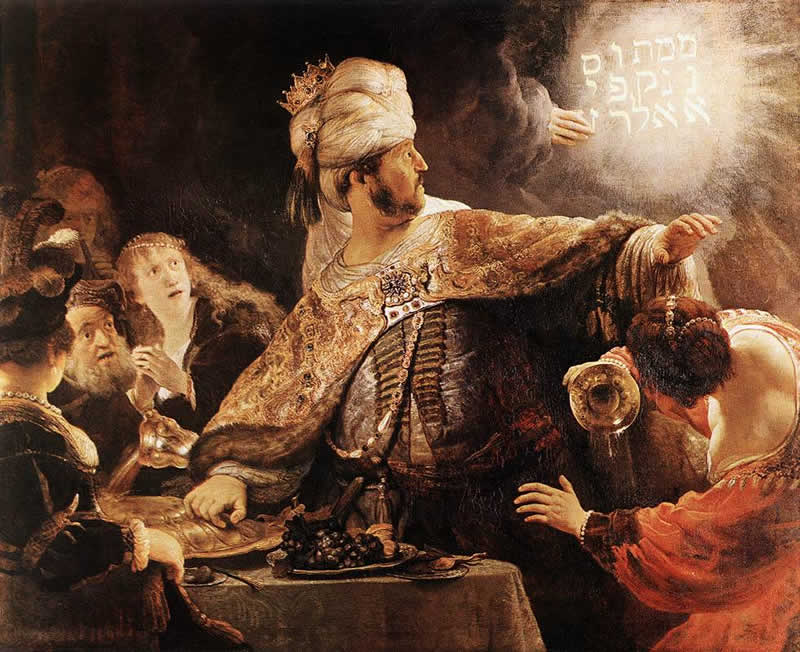
rembrandt-paintingMy wife and I went to the Getty Museum a couple of years ago to see the Rembrandt exhibit. There was a room full of his marvelous sketches, each one distinct and the result of crushing brilliance. I could have studied them for hours to great profit. And yet, when we stepped into the room with his finished products, the difference was unmistakable. Where before was the outline, here was the fullness, the brilliance, the subtle extravagance of his handiwork. Both unmistakably came from the same hand, while the one clearly outshone the other.

Calvin tells us here that in the same way, the Law is good and true, pointing forward to Christ. But the Gospel sets out a salvation in “living colors” that is “graphically distinct”, where there were only “lineaments” before. As different and superior as the sketch is to the finished product, so Christ’s work is from the sacrifices that prefigured it. In fact, I would argue that that even that picture falls short of what Hebrews or Calvin are teaching us here. Instead, as far as the sketch is from the living model, so the shadow of heavenly realities found in the Law, while faithful, inevitably falls short of the beauty of our living, breathing salvation in Jesus Christ.

Soli Deo Gloria

One Reason I Can’t Swim the Tiber

"Swimming the Tiber" is a euphemism for Roman Catholic conversion, as it is the river identified with the Vatican.

“Swimming the Tiber” is a euphemism for Roman Catholic conversion, as it is the river identified with the Vatican.

Q. What is your only comfort in life and in death?

A. That I am not my own, but belong—body and soul, in life and in death— to my faithful Savior, Jesus Christ. He has fully paid for all my sins with his precious blood, and has set me free from the tyranny of the devil. He also watches over me in such a way that not a hair can fall from my head without the will of my Father in heaven; in fact, all things must work together for my salvation. Because I belong to him, Christ, by his Holy Spirit, assures me of eternal life and makes me wholeheartedly willing and ready from now on to live for him.

Heidelberg Catechism Question and Answer 1

Commenting on the pastoral nature of the creeds and catechisms, Carl Trueman highlights a couple of the questions and answers in the Heidelberg Catechism, especially the way Q&A 1 highlights the heart of the Reformation:

Question 1 shows the glorious Reformation Protestant insight into the fact that assurance is to be the normal experience of every Christian believer and not merely the preserve of a few special saints who have been given extra-ordinary insight into their status before God, as was the medieval Catholic position.

This is perhaps one of the great Protestant insights of the Reformation. We live in an age where conversion to Roman Catholicism is not an uncommon thing among those who have been brought up as evangelicals. There are many reasons for this: some speak of being attracted by the beauty of the liturgy in comparison with what is often seen as a casual and irreverent flippancy in evangelical services; others like the idea of historical continuity, of knowing where the church has been throughout history; still others find the authority structure to be attractive in an age of flux and uncertainty. Whatever the reasons, most Protestants would concede that Rome has certain attractions. Nevertheless, the one thing that every Protestant who converts to Rome loses is the assurance of faith. –The Creedal Imperative, pg. 124

Lest people think Trueman is exaggerating, it must be remembered that Cardinal Bellarmine is reported to have written that assurance is the greatest of all Protestant heresies. Indeed, discussing the subject of assurance with one of my brilliant Catholic professors was one of the most challenging conversations I had in my undergaduate degree. She asked me repeatedly–not threateningly, but forcefully, the way a good philosopher should–how could I be so sure that I was going to be saved? It seemed so arrogant and, well, assured. I’m not sure I gave her the best answer I could have at the time–I mean, I was 20. Ironically though, I realized I was more assured of her salvation than she was.

Trueman continues:

The insight of the Reformation on assurance was key, theologically and pastorally. And, given that it is one thing that every convert to Roman Catholicism must lose, it’s worth noting its priority in the Heidelberg Catechism. The answer is beautifully phrased; and yet if one ceases to be a Protestant, one must cease to claim HC 1 as one’s own. That is a very high price to pay. Speaking for myself, all of the liturgical beauty of Rome, all of the tradition, all of the clarity of the authority structure (and the clarity is often, I think, more in the eye of the beholder than the Church itself) cannot compensate for the loss of the knowledge that I know I have been purchased by the precious blood of Christ that conversion to Rome requires. –Ibid, pg. 125

To be clear, I am not saying that my Roman Catholic brothers and sisters are not saved, or are not actually united to Christ, or can’t experience the Spirit’s wonderful assurance; I know far too many beautifully Catholic people, including my professor, to make that mistake. I am pointing out that formally-speaking, I couldn’t claim it in the sense that the catechism teaches it.

That’s far too precious a thing for me to risk in those waters.

Soli Deo Gloria

On a Scale From Harold Camping to Augustine…(Or, Why I Don’t Like the “F”-Word)

snakes2I hate the f-word. Not the f-bomb, or even that other f-word you might be thinking of. No, instead I’m thinking of that other lovely term of abuse: ‘fundamentalist.’ Originally, the term simply referred to those on the conservative side of the Fundamentalist/Modernist controversy in Evangelical Protestantism in the 1920s-1930s. These believers were the ones who affirmed things like the Incarnation, Christ’s atonement, the inerrancy of Scripture, the Resurrection, and Virginal conception of Christ–you know, the “Fundamentals.” Since then, it has morphed into a general catch-all label applied across various religions and possibly non-religious ideologies.

The first time I ran up against this reality was during office hours my sophomore year in college with my philosophy professor. I was sitting on her couch and proudly confessed to being a fundamentalist during our conversation on religion.  She looked at me quizzically and said, “Well, you don’t look like one.” By that she meant I was wearing blue jeans not made by my mom out on our farm.

Philosopher Alvin Plantinga goes into some lexical analysis demonstrating how nearly-useless the term has become especially in discussions regarding religion (pardon the playful-profanity):

“..we must first look into the use of this term ‘fundamentalist’. On the most common contemporary academic use of the term, it is a term of abuse or disapprobation, rather like ’son of a b#tch’, more exactly ’sonovab#tch’, or perhaps still more exactly (at least according to those authorities who look to the Old West as normative on matters of pronunciation) ’sumb#tch.’ When the term is used in this way, no definition of it is ordinarily given. (If you called someone a sumb#tch, would you fell obligated first to define the term?) Still, there is a bit more to the meaning of ‘fundamentalist’ (in this widely current use); it isn’t simply a term of abuse. In addition to its emotive force, it does have some cognitive content, and ordinarily denotes relatively conservative theological views. That makes it more like ’stupid sumb#tch’ (or maybe ‘fascist sumb#tch’?) than ’sumb#tch’ simpliciter. It isn’t exactly like that term either, however, because its cognitive content can expand and contract on demand; its content seems to depend on who is using it. In the mouths of certain liberal theologians, for example, it tends to denote any who accept traditional Christianity, including Augustine, Aquinas, Luther, Calvin, and Barth; in the mouths of devout secularists like Richard Dawkins or Daniel Dennett, it tends to denote anyone who believes there is such a person as God. The explanation that the term has a certain indexical element: its cognitive content is given by the phrase ‘considerably to the right, theologically speaking, of me and my enlightened friends.’ The full meaning of the term, therefore (in this use), can be given by something like ’stupid sumb#tch whose theological opinions are considerably to the right of mine’” —Warranted Christian Belief, pp. 244-245

Though Plantinga is a scholar, this is admittedly not a scholarly, sociological analysis. For a general observation on how the term is used in everyday discourse though, I think it’s spot-on. Depending on who uses the term, ‘fundamentalist’ can mean anything from Harold Camping/compound-out-in-Montana types to someone simply holding classic, Nicene Christianity–making it functionally useless.

I’m not sure I have any good word to replace it. Aside from the particular words to describe the beliefs in question, inevitably that new word will probably stretch and contract with usage, becoming similarly problematic as are terms like “liberal” and “conservative.” Relative statements inevitably need to be made. The problem is that my “liberal” might be your “moderate” depending on the scale you’re working with. Still, whenever I see someone or some belief labeled “fundamentalist”, unless I know the person or belief A, or the person B making the accusation, I am told almost nothing the belief in question, except that person B doesn’t agree with A because they find it idiotically-conservative.

All that to say, I don’t like the word much except for its historical, academic sense.

Soli Deo Gloria

5 Theses On Christ’s Priestly Ministry

christ as priestFor every high priest chosen from among men is appointed to act on behalf of men in relation to God, to offer gifts and sacrifices for sins. He can deal gently with the ignorant and wayward, since he himself is beset with weakness.  Because of this he is obligated to offer sacrifice for his own sins just as he does for those of the people.  And no one takes this honor for himself, but only when called by God, just as Aaron was. (Hebrews 5:1-4)


Reading through Hebrews this morning I was struck by this passage addressing the work of Christ, our great High priest whose ministry supersedes and fulfills that of the OT Levitical priests. In order to do so he outlines various functions of the OT priests in order to compare and contrast the two. I consulted Calvin, as I’ve been wont to do of late, to see what light he could shed on the matter.

Careful reader that he is, Calvin notes at least 5 truths about priests to be noted in the passage:

  1. He first says that the priests were taken from among men; 
  2. secondly, that they did not act a private part but for the whole people;
  3. thirdly, that they were not to come empty to appease God, but furnished with sacrifices;
  4. fourthly, that they were not to be exempt from human infirmities, that they might more readily succor the distressed;
  5. and lastly, that they were not presumptuously to rush into this office, and that then only was the honor legitimate when they were chosen and approved by God.

–John Calvin, Commentary on Hebrews 5:1-4

Building on these observations, he goes on to point out 5 truths this passage teaches us about Christ’s priestly ministry on our behalf:

  1. Christ is a True Man“Taken from among men, etc. This he says of the priests. It hence follows that it was necessary for Christ to be a real man; for as we are very far from God, we stand in a manner before him in the person of our priest, which could not be, were he not one of us. Hence, that the Son of God has a nature in common with us, does not diminish his dignity, but commends it the more to us; for he is fitted to reconcile us to God, because he is man..”
  2. Christ is a Man for Others “For men, etc…the priest was not privately a minister for himself, but was appointed for the common good of the people. But it is of great consequence to notice this, so that we may know that the salvation of us all is connected with and revolves on the priesthood of Christ. The benefit is expressed in these words, ordains those things which pertain to God…what the Apostle had in view is the same, namely, that we have no intercourse with God, except there be a priest; for, as we are unholy, what have we to do with holy things? We are in a word alienated from God and his service until a priest interposes and undertakes our cause.”
  3. Christ is a Man for Others Offering Gifts “That he may offer both gifts, etc. The third thing he mentions respecting a priest is the offering of gifts. There are however here two things, gifts and sacrifices; the first word includes, as I think, various kinds of sacrifices, and is therefore a general term; but the second denotes especially the sacrifices of expiation. Still the meaning is, that the priest without a sacrifice is no peacemaker between God and man, for without a sacrifice sins are not atoned for, nor is the wrath of God pacified. Hence, whenever reconciliation between God and man takes place, this pledge must ever necessarily precede. Thus we see that angels are by no means capable of obtaining for us God’s favor, because they have no sacrifice. The same must be thought of Prophets and Apostles. Christ alone then is he, who having taken away sins by his own sacrifice, can reconcile God to us.”
  4. Christ, Though Free from Sin, is a Man who Can Sympathize Who can, etc….the Apostle before taught us that mankind are united to God in the person of one man…but now he refers to another thing…that the priest ought to be kind and gentle to sinners, because he partakes of their infirmities. The word…simply means one capable of sympathy. All the things which are here said of the Levitical priests do not indeed apply to Christ; for Christ we know was exempt from every contagion of sin; he therefore differed from others in this respect, that he had no necessity of offering a sacrifice for himself. But it is enough for us to know that he bare our infirmities, though free from sin and undefiled. Then, as to the ancient and Levitical priests, the Apostle says, that they were subject to human infirmity, and that they made atonement also for their own sins, that they might not only be kind to others when gone astray, but also condole or sympathize with them…At the same time, though ever free from sin, yet that experience of infirmities before described is alone abundantly sufficient to incline him to help us, to make him merciful and ready to pardon, to render him solicitous for us in our miseries. The sum of what is said is, that Christ is a brother to us, not only on account of unity as to flesh and nature, but also by becoming a partaker of our infirmities, so that he is led, and as it were formed, to show forbearance and kindness… 
  5. Christ is a Man by the Call of God – And no man, etc. There is to be noticed in this verse partly a likeness and partly a difference. What makes an office lawful is the call of God; so that no one can rightly and orderly perform it without being made fit for it by God. Christ and Aaron had this in common, that God called them both; but they differed in this, that Christ succeeded by a new and different way and was made a perpetual priest. It is hence evident that Aaron’s priesthood was temporary, for it was to cease. We see the object of the Apostle; it was to defend the right of Christ’s priesthood; and he did this by showing that God was its author…Christ then is a lawful priest, for he was appointed by God’s authority…”

ibid, Commentary 5:1-4

According to Hebrews then, this is the Christ who is our Priest. He is the truly human one; the one who comes for us, not for himself alone; the one who has offered up a sacrifice for us; the one sympathizes with us in our weaknesses and infirmities; the one who comes by the call of God the Father, in the power of the Spirit. This Christ is indeed worthy of all our praise and worship.

Soli Deo Gloria

“So Why Does God Care About My Sex Life?” (CaPC)

A couple of weeks ago, I wrote a little piece for Christ and Pop Culture about a Q&A session with Tim Keller at The Gospel Coalition conference. I asked about revival, and among other things, Keller said something about sex and the complex nature of doubt. Given that what he said was fairly conservative, had to do with sex and doubt, and, in all fairness, could have been reported more clearly by me, the unsurprising result was a lot of pushback—some legitimate and some not so much. Feel free to read the article and peruse the comment section for yourself.

Why Does He Care?

Among the various criticisms lodged against the article, there was one thread in some (not all) of the responses that caught my attention: The allegedly unreasonable concern of Evangelicals or Christians in general about sex. One commenter in particular summed up:

Isn’t it possible that for many people it’s both doubt AND sex in a winning combination I like to file under, “Does the God of the Cosmos really give a **** about who I’m sleeping with and in what position?”

You can read the rest of his complaint and my response HERE at the Christ and Pop Culture site.

Soli Deo Gloria

C.S. Lewis: “Failure On This Paper Should Mean Failure On The Whole Exam.”

Lewis thinkingDifficult translation sections are included in the ordination exams of various denominations. Candidates are required to show their proficiency in both Greek and Hebrew, in order to demonstrate their competence in handling the texts they are to preach from the Word of God.

C.S. Lewis thought translation sections were a good idea, but recommended a different sort:

In both countries an essential part of the ordination exam ought to be a passage from some recognized theological work set for translation into vulgar English–just like doing Latin prose. Failure on this paper should mean failure on the whole exam. It is absolutely disgraceful that we expect missionaries to the Bantus to learn Bantu but never ask whether our missionaries to the Americans or English can speak American or English. Any fool can write learned language. The vernacular is the real test. If you can’t turn your faith into it, then either you don’t understand it or you don’t believe it.

— C.S. Lewis, ‘Version Vernacular’, The Christian Century vol. LXXV (31 December 1958) pg. 1515, reprinted in God in the Dockpg. 338

Nearly 60 years ago, before all the talk about contextualization was hip, and Lesslie Newbigin taught everyone that Western Culture was a mission-field too, Lewis was advocating for training in basic cultural literacy on the part of pastors and preachers. He saw the need to learn how to speak “American” and  “English”.

This is one of the two or three keys to understanding his appeal and genius: Lewis was a brilliant translator. It’s only years (and a number of heavy theological treatments of the subject) after reading Lewis’ treatment of the Trinity at the end of Mere Christianity that I can appreciate its disguised brilliance. It’s plainly-stated Athanasian and Nicene orthodoxy for beginners. As an absolute statement, it might be bit of a stretch to say that if it can’t be put in the vernacular, it probably isn’t understood or believed (cf. certain finer points of trinitarian doctrine such as the filioque, etc.). Still, as a general test for how well you actually grasp most of your professed theology, I’ve found it quite helpful. Teaching basic catechetical courses to youth or new believers is often a more challenging proposition than writing a paper for grad-level seminary courses.

Theologically-minded Protestants especially need to take heed of this. It’s fine to celebrate Luther, Calvin, Tyndale and the rest of the Reformers for giving the Bible back to the congregation through their vernacular Bible translations and worship. We need to be careful we don’t take it away from them again in rarified preaching filled with abstract, unexplained theological jargon. I have no problem with doctrinal preaching or using big words like ‘justification’ or even ‘perichoresis.’ They are good and fine and necessary. We just need to be careful we regularly use a lot of little words to explain them for those folks without seminary training. To insist that our hearers always come up, unaided, to your theological level is “shameful”, and an implicit denial of the Gospel of a Word who comes among us by taking on our flesh–1st Century Jewish flesh, to be exact.

Pastors, as you prepare to teach and preach to your people, work on your Greek, brush up on your Hebrew, but please, please, for the sake of the Gospel and your people, make it a priority to practice your ‘American.’

Soli Deo Gloria

Karl Barth’s 3 Aphorisms on Doubt

barthBarth devoted one of his lectures that formed the basis of his little work Evangelical Theology to the subject of doubt as an obstacle to theology. Having given some thought to the subject doubt recently, I pulled it off the shelf and I found it worth briefly outlining.

Two Types

Barth begins by noting two types of doubt that might arise for the theologian. First, there is the very “natural” doubt that comes with the territory, which is “susceptible to treatment” (pg. 121). When you’re doing theology, you’re asking questions about the nature of the faith. You’re taking things apart in order to put them back together again in a rational, coherent fashion. It is inevitable that in the process of taking things apart, you struggle or question as to whether the original shape made any sense. This is the doubt that comes with working everything through as thoroughly as possible because we do not possess God’s own knowledge of himself. Even though we work from revelation, we must eat “by the sweat of our brow”. The danger here is being a “sluggard” that fails to put things back together.

There is a second form of doubt, however. Barth says this one is far more dangerous, which is troublesome because his long-winded explanation of it makes it hard to pin down exactly. It seems to be an uneasiness that there is even any point to the enterprise of theology at all. It is the introduction of a note of embarrassment at the outset that renders the whole conversation suspect. It is the swaying between Yes and No as to whether there is anything to even discuss, or whether we’re not simply engaging in an exercise of trying to describe our own “pious emotions” (pg. 124). It’s not the honest doubting that comes naturally with the asking of questions, but the doubting that asks, “Did God really say?” (Gen. 3:1) It doubts the connection between God’s works and words to the task of theology itself. It is the kind of doubt that isn’t dealt with in answers, but must be “healed.”

Three Sources

Barth then “briefly” notes three reasons this latter form of doubt might arise. (As if Barth could ever “briefly” do anything.) First, it might rise in the face of “the powers and principalities” of the world. In looking about at the worlds of economics, politics, art, the newspapers–the world of “real life”–the theologian might be tempted to doubt the relevance or reality of the message he preaches. What can the Gospel really say to that world conflict? Who has time for theology in the face of the truly pressing issues of the day? Could it ever really have said anything in the first place?

The Church itself is another source of doubt in theology. Theologians and preachers have to look at the church, its history, with all of the disunity, ugliness, and petty weakness on a regular basis. Unsurprisingly they may come away jaded at times. In the face of ecclesiastical horrors, wars, heresy trials, and nonsensical squabbles, it might seem perverse to labor at theology.

Saving the deepest root for last, Barth points out that it might not be that “the world impresses him so much or that the Church impresses him so little” (pg. 128), but that his own innate flaws as an individual might be the chink in the armor of his faith.  Complicating things, yet again, Barth subdivides this into two possible iterations.

The first is that of a theologian whose public theology does not match his private practice. He has a very solid public theology that is ordered under the word of God, but his practical life  is ordered by any passing whim or principle. In this sense, he has put himself in the place of a wounded conscience.  Of course, this source of doubt is not unique to theologians, but is the common provenance of all Christians.

The inverse possibility is that he has so engulfed himself in theology, he’s failed to have a normal life. His interests do not extend into the normal range of human affairs, to the point where theology or church-life all but consumes him. At that point, he is but a step away from burnout or boredom, which can lead to doubt.

Three Aphorisms on Doubt

At the end of these meditations Barth gives three “aphorisms” on doubt for theologians worth quoting in full:

  1. No theologian, whether young or old, pious or less pious, tested or untested, should have any doubt that for some reason or other and in some way or other he is also a doubter. To be exact, he is a doubter of the second unnatural species, and he should not doubt that his doubt is by no means conquered. He might just as well–although this would certainly not be “well”–doubt that he is likewise a poor sinner who at the very best has been saved like a brand from the burning.
  2. He should not also deny that his doubt, in this second form, is altogether a pernicious companion which has its origin not in the good creation of God but in the Nihilthe power of destruction–where not only the foxes and rabbits but also the most varied kinds of demons bid one another “Good night.” There is certainly a justification for the doubter. But there is no justification for doubt itself (and I wish someone would whisper that in Paul Tillich’s ear). No one, therefore, should account himself particularly truthful, deep, fine, and elegant because of his doubt. No one should flirt with his unbelief or with his doubt. The theologian should only be sincerely  ashamed of it.
  3. But in the face of his doubt, even if it be the most radical, the theologian should not despair. Doubt indeed has its time and place. In the present period no one, not even the theologian, can escape it. But the theologian should not despair, because this age has a boundary beyond which again and again he may obtain a glimpse when he begs God, “Thy Kingdom Come!” Even within this boundary, without being able simply to do away with doubt, he can still offer resistance, at least like the Huguenot woman who scratched Resistes! on the windowpane. Endure and bear it!

Evangelical Theology, pp. 131-132

As I mentioned, I’ve been giving some thought to the problem of doubt. There is a natural place for the first kind of doubt in the Christian life, as Barth notes. It’s fine to pick things apart and re-examine what you’ve learned–in a sense, doubting in order to believe. At the same time, I’ve also found that our culture, and recently certain wings of Evangelicalism, have taken to valorizing nearly all doubt to an unhealthy degree. Doubt is never to be talked about as something to be resisted, endured, struggled through, but is rather celebrated and romanticized as a sort of rite of passage into relevance and authenticity. It is either subtly or openly commended as a pathway to a “particularly truthful, deep, fine, and elegant” form of faith, brave enough to doubt even God himself.

The problem is, I don’t see scripture anywhere commending doubt in God. It allows for it. It acknowledges it. It forgives it. Much as Barth teaches us, there is room for it–there is a justification for the doubter. And yet, the state of doubt is not the end for which we strive. It is not a good place to be or even to praise. This is why I found Barth’s aphorisms to be filled with much biblical good sense. For those struggling or looking to counsel those who struggle, we find here a pastoral, humble note that acknowledges our frailty and sin, yet still exhorts us onward in hope and faith for that coming day when doubt will be overwhelmed by the fullness of the Kingdom of God.

Soli Deo Gloria

Who Needs Preachers When You’ve Got the Bible?

preacherIf you’ve been around long enough, you’ve eventually encountered that guy. You know, the one who basically says all he needs is his Bible and the Holy Spirit. He’s got so much faith that he doesn’t need to listen to teachers or read commentaries. Really, nobody does if they trust the Spirit and the Word enough.

Right.

Well, if you haven’t had the blessing, don’t worry, you’ll meet him eventually. In any case, it’s a very old phenomenon that dates probably as far back as church history extends. It was certainly present in Calvin’s day. Commenting on Paul’s charge to teach the word in season and out of season (2 Tim 4:1-4), he pushes back on the same sort of fanaticism of some of his contemporaries in the Radical Reformation:

It is proper to observe carefully the word therefore, by means of which he appropriately connects Scripture with preaching. This also refutes certain fanatics, who haughtily boast that they no longer need the aid of teachers, because the reading of scripture is abundantly sufficient. But Paul, after having spoken of the usefulness of Scripture, infers not only that all ought to read it, but that teachers ought to administer it, which is the duty enjoined on them. Accordingly, as all our wisdom is contained in the Scriptures, and neither ought we to learn, nor teachers to draw their instructions, from any other source; so he who, neglecting the assistance of the living voice, shall satisfy himself with the silent Scripture, will find how grievous an evil it is to disregard that way of learning which has been enjoined by God and Christ. Let us remember, I say, that the reading of Scripture is recommended to us in such a manner as not to hinder, in the smallest degree, the ministry of pastors; and, therefore, let believers endeavor to profit both in reading and in hearing; for not in vain hath God ordained both of them. –Commentary on 2 Timothy 4:1

Calvin isn’t saying we shouldn’t read our Bibles on our own, or that the Holy Spirit can’t enlighten our personal study. No, there is real benefit there. But if Jesus says that there ought to be teachers the church, and that we ought to sit under sound preaching, who are we to be more spiritual than he is? Apparently there’s something to it.

Soli Deo Gloria

Judge or Expert Witness? Vanhoozer and Calvin on Scripture and the Councils

gavel and bibleKevin Vanhoozer’s Drama of Doctrine: A Canonical-Linguistic Approach to Christian Theology has one of the most sophisticated and nuanced Protestant approaches to the doctrine of sola scriptura and the relationship between scripture and tradition that I’ve encountered yet. As I was perusing through it the other day, I ran across this wonderful little teaser passage on Calvin, scripture, and the councils:

The Reformation was not a matter of Scripture versus tradition but of reclaiming the ancient tradition as a correct interpretation of Scripture versus later distortions of that tradition. The Reformers regarded the early church councils by and large as true because they agreed with Scripture, not because they had authority in and of themselves.

Certain critics of sola scriptura that the Reformers demythologized tradition by chasing the Holy Spirit out of the life of the church into a book. This goes too far. It is preferable to view tradition, like the church itself, as an example of what Calvin calls “external means” of grace. Tradition does not produce its effect ex opere operato; on the contrary, tradition efficaciously hands on the gospel only when it preserves the Word in the power of the Spirit. It is an external aid to faith, but not an infallible one. To speak of the ministerial authority of tradition is not espouse not a “coincidence” but an “ancillary” view of the relationship of Scripture and tradition.

Calvin honors the early church councils precisely because, for the most part, they were governed by word and Spirit: “[W]e willingly embrace and reverence as holy the early councils, such as those of Nicaea, Constantinople, Ephesus I, Chalcedon and the like…insofar as they relate to the teachings of the faith. For they contain nothing but the pure and genuine exposition of Scripture.” (Institutes 4.9.8) However, when one council contradicts another, as Chalcedon contradicted Ephesus II, the church must return to the word as ultimate norm. Church councils have a provisional, ministerial authority. To give them absolute authority, says Calvin, is to forget biblical warnings about false prophets and false teachers (Matt. 24:11; Acts 20:21-29; 1 Tim 4:1; 2 Tim 4:3; 2 Pet. 2:1). Indeed, with regard to Ephesus II–the council that accepted Eutyches’ heresy concerning the person of Christ–Calvin offers a sobering judgment: “The church was not there.” (Ibid., 4.9.8) This haunting observation neatly reverses the medieval formula extra ecclesiam, nulla salusCalvin might well have said: Extra scriptura et pneuma, nulla ecclesiam–“Outside word and Spirit, there is no church.”

Sola Scriptura refers to the practice of attending the Spirit speaking in the Scriptures as the final appeal in doctrinal disputes. How do we recognize the Spirit’s speaking? Church tradition enjoys the authority not of the judge but of the witness. Better: tradition enjoys the authority that attaches to the testimony of many witnesses. In this light, we many view the church fathers and church councils as expert witnesses as to the sense of Scripture in the courtroom drama of doctrine. Neither the Fathers nor the councils sit on the bench; the triune God has the final say. The task of theology is to cross-examine the witnesses in order to offer proximate judgments under the ultimate authority of the presiding judge: the Spirit speaking in the Scriptures.

To practice sola scriptura  is to treat Scripture alone as the “norming norm” and tradition as the “normed norm.” A theology that practices sola scriptura recognizes the ministerial authority of tradition, namely, its ability to nurture individuals in and to hand on the apostolic faith through the church’s corporate witness. Canon may be the cradle of the Christian doctrine, but tradition is its wet nurse. —The Drama of Doctrine: A Canonical-Linguistic Approach to Christian Doctrine, pg. 233-234

Again, that’s merely a teaser–Vanhoozer expands on each of those points at length. He shows us that the practice of sola scriptura is not a necessary recipe for historical ignorance or hopeless subjectivity in interpretation. It is a call to treat expert witnesses with all the due deference they deserve, while recognizing the true judge of the church: God in his Word.

Soli Deo Gloria