Kevin Vanhoozer on the Crucified King

I don’t do the random quote and link post but, in this case, I’ll break protocol. Last year I endorsed Jeremy Treat’s The Crucified King as one of my favorite books of the year. Well, now you don’t have to take only my word for it. Zondervan Academic’s excellent “Common Places” series edited by Michael Allen and Scott Swain at their blog has asked senior scholars to endorse the words of young, up and coming scholars for the attention of the rest of us. Today’s post features the inimitable Kevin Vanhoozer’s summary and review of Treat’s work.

“Things fall apart; the center cannot hold.”
—William B. Yeats, “The Second Coming”

Yeats probably did not have the academy and church in mind when he penned these lines in 1919, but he could have, for theological things, and the gospel itself, have been coming apart for centuries. Theology itself has come apart: what God joined together—doctrine and life—has been cast asunder, into the academy and church respectively. And, within the academy, the disciplines of biblical theology and systematic theology go their separate ways, speaking different languages. Even worse, the story and logic of the gospel have come apart in both the church and the academy, with some Christians focusing on the significance of Jesus’ death with its promise of heaven (cross) and others on Jesus’ message about the reign of God with its promise of justice for earth (kingdom).

The Crucified KingBlessed are the peacemakers, for they seek to repair the center—and shall receive honorable mention in Christianity Today’s Book Awards list, as Jeremy R. Treat’s first book has done in 2015—no mean feat for a work that began life as a doctoral dissertation. Treat’s The Crucified King (Zondervan, 2014) works several important mediations: church and academy; biblical theology and systematic theology; penal substitution and Christus Victor theory of the atonement. His title signals his reconciling intent: rather than viewing the kingdom and the cross as themes that belong to different universes of discourse, Treat argues that they form a seamless whole, centered on the unabbreviated gospel. The subtitle provides further italicized fuel to the mediatorial fire: “Atonement and Kingdom in Biblical and Systematic Theology.”
Please do go read the rest of the review here. And then pick up the book if you haven’t already. It’s well worth your time.

Soli Deo Gloria

Retrieval–It’s What All The Hip Reformed Catholic Kids Do

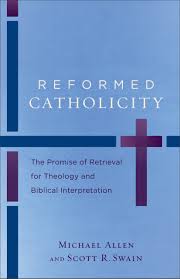
reformed catholicityThe theological hills are alive with the sound of “retrieval”–the idea that theology can only go forward if it begins by looking backward to the tradition that maintained and fed the faith that came before it. Whether it’s looking back to the Fathers, or Thomas, or the early Reformed tradition, across the denomination divides, theologians are increasingly explicit about their necessary dependence on the theology of their forebears, whether in the Creed, Counsels, or Confessions. In his section arguing for the importance of recovering traditioned thought in The Drama of Doctrine, Kevin Vanhoozer listed a number of reasons (Biblical, traditional, philosophical, inevitable, and spiritual), but among them was the fact that it was “fashionable” (pg. 158), by which he meant supported by contemporary movements in literary theory.

In other words, all the cool kids are doing it.

I was reminded of this point as I opened Michael Allen and Scott Swain’s little volume Reformed Catholicity: The Promise of Retrieval for Theology and Biblical Interpretation. Part of their project is making the case for a Reformed iteration of this movement that appreciates the traditional shape of even Protestant practices like Sola Scriptura, which commonly is interpreted as precluding this sort of activity. In order to set the stage for their own project, though, they begin by compiling and briefly describing a fascinating list of recent movements in theology that have set the stage, or contributed to the revival of retrieval in theology (pp. 4-12). I thought it might be useful to briefly summarize their summary and comment on their summary list.

  1. Nouvelle Theologie. Earlier in the 20th Century a bunch of Roman Catholic theologians like De Lubac and Congar led the way in trying to reappropriate patristic and biblical theology for systematics, sacramental theology, and liturgical practice. Much of this theology set the stage for the developments of Vatican II.
  2. Karl Barth. Barth’s Church Dogmatics did many things, but one of the big long-term effects it had was reviving the discipline of dogmatics in theology, drawing heavily as it did on patristic and Reformational sources.
  3. Reception History. Plenty of Biblical scholars like working with the historical context of the text, but there’s a big movement to do work on compiling commentaries or studies on the historical reception of texts. In other words, not just asking “how ought we read it?”, but asking “how has it been read in the past?” in order answer the former.
  4. Donald Bloesch and “Consensual Christianity.” Bloesch was a UCC theologian who tried to develop a “consensual” Christianity based on the witness of Holy Scripture and the Church’s tradition as a cross-denominational resource for the Church
  5. Thomas Oden’s “Paleo-Orthodoxy.” Thomas Oden’s conversion from liberal, Protestantism to a sort of “paleo-orthodoxy”, a “pastiche” of patristic and Protestant theology is an approach towards a “consensual Christianity.” He has also headed up the Ancient Christian Commentary on Scripture series in order to facilitate this sort of scholarship and spirituality as well.
  6. Robert Webber’s Ancient-Future Christianity. Webber has written various works and developed a number of ministries devoted to helping Evangelicals tap in the Christian past for the sake of engaging postmodern culture in worship and evangelism.
  7. The Modern Hymn Movement. Reformed and Presbyterian churches and ministries like RUF, Indelible Grace, and Keith and Kristyn Getty have been retooling classic hymns and developing new ones for revived congregational worship.
  8. Carl Braaten and Robert Jenson’s Evangelical Catholicism. From within the Lutheran tradition, Braaten and Jenson have been trying to focus the church on classical resources as a way forward for the ecumenical conversation and the strength of the church. To that end, they launched the Center for Catholic and Evangelical Theology, begin the journal Pro Ecclesia, and published a number of influential volumes in that vein. Allen and Swain note, though, that while Bloesch and Oden’s retrieval ends up looking like pretty standard classical theism, Jenson and others have still engaged in quite a bit of theological reconstruction, showing the retrieval doesn’t only lead to repetition.
  9. Theological Interpretation of Scripture. One big movement afoot is the drive towards theological exegesis”, or reading Scripture to do theology and not just historical or textual criticism. To that end, a lot of theoretical ink has been spilled, but a number of good theological commentary series have begun as well.
  10. Radical Orthodoxy. The movement by theologians like Catherine Pickstock, Graham Ward, and John Milbank, to reappropriate a sort of Christian Platonism in order to combat the decline of the Church, leans heavily on the idea of retrieval, even if it has been often criticized for its idiosyncratic and problematic readings of the history it’s attempting to retrieve.
  11. Evangelical Ressourcement. Evangelicals are getting in on the fun too. D.H. Williams has been arguing for recovering the early church as a theological resource and Hans Boersma has been even more specific in advocating a particular sacramental ontology, mostly drawing on the Nouvelle Theologie of Roman Catholic theologians.
  12. The Emerging or Emergent Church(es). Whatever their problems have been, the emerging or emergent movement did have an emphasis on retrieving the various insights, texts, and practices of the Christian past to meet the postmodern future. Of course, this played out differently for various kinds of emerging or emergent churches.
  13. Ressourcement Thomism. Thomism is the gift that keeps on giving. At least, that’s what a number of recent Roman Catholic theologians like Matthew Levering, Gilles Emery, and Reinhard Hutter have been arguing. Engaging with movements in biblical studies, systematics, and philosophical movements, these theologians have been making the case that Thomas still has something to say to the modern church.

As I read Allen and Swain’s list, I was fascinated to note how many of the movement and theologians had their effects on my own journey. When I was young in theology, the emergent conversation was in full swing and so the talk of appealing to tradition was definitely in the air. Thankfully reading some Pelikan and Vanhoozer showed me early that it could be done while keeping your Orthodox and Evangelical wits about you. In philosophy, MacIntyre’s work in After Virtue and Whose Justice? Which Rationality? had its effect as well. Oden and Bloesch are sitting on my shelf, duly marked up, as well as some Barth, Boersma, and Jenson. I suppose my early classes in the history of philosophy had their effect as well. It’s hard to take a whole class on Augustine’s thought and believe him irrelevant to any theological conversation. This is also largely the impulse behind my big reading projects.

Beyond this personal reflection, though, a few things are worth noting about this list.

First, retrieval is an ecumenical endeavor. Theologians across the major traditions, both Catholic and Protestant, are well-represented. Although, one important absence ought to be noted and that is the names of any Eastern Orthodox theologians. The burgeoning awareness of Eastern Orthodox theology has definitely spurred on the movement towards engagement with the Fathers on the part of Western theologians.

Second, retrieval is not a monolith. As already noted with the case of Jenson and someone like Oden, two theologians may be committed to the project and yet their engagement may yield wildly diverging judgments on something like the doctrine of God. What’s more, since it is an ecumenical endeavor with a catholic spirit, it will inevitably bear diverse fruits as theologians approach the catholic tradition from within their own ecclesiastic locations.

Third, and connected to the second, retrieval theology need not yield theological sterility. Some of the most creative theological minds of the 20th Century are included in that brief summary. Indeed, when think of some of the work being done in the Theological Interpretation of Scripture, some of the brightest of our own very young century are those looking back to the wisdom of yesteryear through figural and typological readings. Many have ended up breaking the modern, interpretive mold in the process.

Finally, retrieval can be quite practical. Indeed, most of the movements and theologians mentioned are quite heavily involved with the cause of church renewal within their respective communions. Looking to the past is not simply done for the sake of dry antiquarianism, but for the life of the Church in the world today. In other words, it’s not only done to preserve the memory of the victories of church triumphant, but for the battles the church militant is currently embroiled in.

Now the question is, what exactly will Allen and Swain contribute to the discussion? I suppose I’ll just have to keep reading to find out. I’d suggest that many of you consider doing the same. You can purchase the book here.

Soli Deo Gloria

Why Argue For a Position You Don’t Hold? Clarifying Crisp’s Deviant Calvinism

deviantI’ve already written about it once before, but one of the more interesting books I read last year was Oliver Crisp’s Deviant Calvinism. As I said there, Crisp aims to show that, contrary to popular perception, the Reformed tradition has been much broader and contained greater theological diversity than is commonly thought. This broadness was not a bad thing either. It’s not that we just hadn’t figured things out yet in the past, but rather that this diversity is a healthy, important feature of the Reformed tradition that needs to be recovered for its well-being and vitality.  In a sense, he wants us to remember that “always reforming” is a necessary part of the Calvinist theological ethos. In order to do so, Crisp engages in a number of studies of retrieval theology, examining marginal or “deviant” positions within the tradition.

I’ve been happy to see the way the book has sparked quite a bit of interest online through posts and reviews, some critical (apparently Roger Olson is miffed that Crisp sounds too much like a Calvinist…) and others quite positive. One issue though, that merits a bit of explanation or clarification is that of Crisp’s intention and method, as I think there has been some confusion on this point.

Crisp engages in a mode of theology that has been gaining in popularity recently, which has been termed “analytic theology.” Essentially, some theologians and philosophers of religion have been appropriating the insights of Anglophone analytic philosophy and applying them to mainstream theological discussion. So, whether it’s a matter of using more precise, contemporary modal logic, or using some of the epistemological insights of Alvin Plantinga for the purposes of theodicy, analytic theology chooses different philosophical conversation partners. It also adopts a mode of argumentation that prizes clear, conceptual definition, extended analysis of just what issue is up for grabs in any given argument, and logical rigor. Contrary to some rumors, from what I know of analytical theological types this isn’t out of some “rationalistic” impulse to systematize the faith into some easily graspable construct either. Many simply want to get back to the days when theology actually tried to ask and answer questions with care and clarity.

Given my undergraduate background in philosophy at a school that’s got a bit of an analytic bent, reading Crisp’s work took me back to the old days. I suppose that’s why I was unfazed by the one feature of Crisp’s work that has been causing readers some trouble: his tendency to argue for a number of positions that he apparently doesn’t hold, or at least gives no indication that he holds.

For instance, in one chapter he argues that the Westminster Confession is somewhat metaphysically underdetermined and so it is possible to believe in a form of Libertarian freedom consistent with Calvinist soteriology. Or again, he argues that views like eternal justification or justification in eternity don’t necessarily have the antinomian tendencies or corollaries that many have accused it of, and on that score it more consistent with mainstream Calvinist orthodoxy than is supposed. To my knowledge, Crisp doesn’t actually hold any of these positions. He’s simply clearing some elbow room in the tradition to say that these aren’t necessarily heterodox opinions to hold.

Now, to many, this might seem like an odd, counter-intuitive, and quite distracting theological endeavor to engage in. Why argue in favor of positions you don’t hold? Why defend what you may end up ultimately discarding?

I see two motives, one stemming from his analytic bent, and a second from basic Christian theological conviction.

1. Clarity. In the first place, I see this as a feature of his analytic pursuit of clarity bleeding through. I recall one important article on the problem of evil by Stephen Wykstra taking a significant amount of time to defend a position against two critical articles, only to then turn around and offer a third argument against that very same position. Taking the time to rule out bad arguments against positions you don’t like, or even ruling out bad arguments for positions you do like, clarifies the discussion at hand. Clearing out bad arguments narrows the field of discussion and un-muddies the waters so real dispute can take place. Alvin Plantinga does this sort of thing all the time.

For instance, some have rejected Calvinism or Augustinianism, because they have been turned off by the very common argument made by many Calvinists that the sole, or chief end of God in election or reprobation is the glory of God in the public display of attributes. Crisp argues, as Bavinck did before him, that if that argument proves anything, it proves too much and works much better for Universalism. Now, that may seem like a blow for many Calvinists looking to uphold Reformed theology. Instead, it can be seen as an opportunity to drive us back to clearer scriptural and exegetical arguments. In other words, getting rid of an argument that doesn’t work actually helps your case by not allowing your interlocutor to be distracted by the bad argument and forces them to face your better ones. Or, again, dispensing with bad arguments against positions you don’t hold allows you to focus on the arguments that actually do work.

2. Charity. The second reason is a bit more straightforward. Christian charity ought to motivate us to fairly represent the positions of those we disagree with in the best light possible, before disagreeing with them. It is a form of loving our neighbors as we love ourselves in the intellectual life. If we love someone, we don’t lie about them. We try our best to tell the truth about them in all areas. Showing that a position wrongly advocated by a brother does not necessarily entail or lead to antinomianism or something of that sort, is a form of truth-telling.

As always, there’s more to say here, but I think a couple of these concerns are at play in Crisp’s work. So yes, while it may seem a bit counter-intuitive and confusing to devote lengthy pieces of work to defending positions you don’t actually hold, I think there is an important place for them in public theology because there ought to be a place for clarity and charity in our work of elucidating the truth of God for the sake of the Church.

Soli Deo Gloria

Christ, the Eternal Wisdom of God

christ pantokratorRarely have I seen Turretin break forth in lyrical rapture in these first 300 pages of his Institutes of Elenctic Theology, but when he has, it’s been brilliant. Towards the back end of his section on “The One and the Triune God”, he devotes a lengthy question and marshals a bevy of nimble exegetical, philological, and theological arguments towards defending the eternal generation of the Son against the anti-Trinitarian Socinians of the day.

One of them is to appeal to the one of the classic disputed texts in Athanasius’ arguments against the “Arians”*, Proverbs declaration that:

“The LORD possessed me at the beginning of his work, the first of his acts of old. Ages ago I was set up, at the first, before the beginning of the earth. When there were no depths I was brought forth, when there were no springs abounding with water. Before the mountains had been shaped, before the hills, I was brought forth, before he had made the earth with its fields, or the first of the dust of the world. When he established the heavens, I was there; when he drew a circle on the face of the deep, when he made firm the skies above, when he established the fountains of the deep, when he assigned to the sea its limit, so that the waters might not transgress his command, when he marked out the foundations of the earth, then I was beside him, like a master workman, and I was daily his delight, rejoicing before him always, rejoicing in his inhabited world and delighting in the children of man. (Proverbs 8:22-31 ESV)

While Turretin himself gets into some of the lexical concerns and literary issues of whether this should be seen as a mere personification, or whether eternity, or creation should be ascribed to Wisdom, we won’t concern ourselves with that for the moment. God’s personal Wisdom, for Turretin, was brought forth by an eternal generation, before the beginning of all things. His argument that none but Jesus is the very embodiment of God’s eternal Wisdom as seen in the Proverbs stunning both for its logical force, as well as its simple beauty.

Now that this is none other than the Son of God, Christ our Lord, is collected not only from the name itself, Wisdom (by which he is also often distinguished in the New Testament, Lk. 7:35; 1 Cor. 1:24), but also from the attributes ascribed to this Wisdom (which most aptly square with him and can belong to no other).

For who else can deserve the name of Wisdom and indeed of Wisdoms?

Who else calls men to him, teaches them the way of true salvation, wished the law and his precepts to obtain in the church, convicts sinners of foolishness, promises life to those who regard him and denounces final destruction upon the unbelieving?

Who else was with God before the world was and was perpetually with him while creating the world?

If Jehovah is said to have possessed Wisdom form the beginning, is not the “Word” said “to have been in the beginning” and “to have been with God (Jn. 1:1)?

If it is said to have been a delight to the Father, is not Christ “the beloved Son” (Mt. 3:17)?

If ordained and anointed by the Father, was not Christ foreordained before the foundation of the world and anointed for the mediatorial office (1 Pet. 1:20)?

If Wisdom is said to have been brought forth before the hills, was not Christ before all things (Col. 1:17)?

If by her kings reign, is not Christ the King of Kings and the Lord of Lords (Rev. 19:16)?

If Wisdom teaches and cries out, calls and exhorts men to repentance in high and low places, both immediately by herself and immediately by her maidens, do we not read the same of Christ both immediately by himself preaching the gospel and mediately by his servants the apostles whom he sent through the whole world to call men to a participation of his grace?

-Third Topic, Q. XXIX, Sec. XI

Then, as now, the question is whether we will recognize Wisdom’s voice when we hear it? As Paul says, the Wisdom of God is a “secret and hidden wisdom of God, which God decreed before the ages for our glory” such that “none of the rulers of this age understood this, for if they had, they would not have crucified the Lord of glory” (1 Cor. 2:7-8). For that reason we must pray that the eyes of our heart may be enlightened, that the fog of our foolishness may be dispersed, that we may be among “those who are called, both Jews and Greeks,” who recognize “Christ…the wisdom of God” (1 Cor. 1:24).

 Soli Deo Gloria

*Yes, I know that term has been complicated by Lewis Ayres’ account and others. As shorthand, it’s still rather useful.

The Liberation of the Triune God

exodusOne of the helpful emphases of the Reformed tradition is its acknowledgment of the continuity as well as discontinuity of Old and New Testaments. This comes through very strongly in Turretin’s Institutes and even makes an appearance in his doctrine of the Trinity. After a couple of clarifying questions, as well as a lengthy question devoted to proving the doctrine of the Trinity from New Testament Scripture, he moves on to try and demonstrate the revelation of the Trinity in the Old Testament. For while it is admittedly true that God reveals himself as Father, Son, and Holy Spirit with greater clarity in New Testament, that does not at all mean that we cannot see him revealed as such in the Old as well.

He then proceeds to do some careful lexical and exegetical work in some of the usual places such as Genesis 1:26, and other references to the Divine plural in the manner of the Fathers, as well as some other surprises. The passage that caught my eye was his treatment of the salvation of Israel from Egypt. Here argues from the works of Father, Son, and Spirit in the Exodus to their unified of the Triune action in the Old Testament.

…the same may be proved from the deliverance of the people out of Egyptian bondage, the guidance of them through the wilderness, and introduction into Canaan. He is that true God whom the Israelite. He is that true God whom the Israelites acknowledged and worshipped, who brought them out of Egypt, lead them through wilderness and introduced them into the land of promise. For no other besides God could have performed so great a work, as he himself testifies in the preface to the Law. “I am the Lord thy God who brough thee out of the land of Egypt.” Also, he often claims this as his prerogative (Ex. 3:2; 23:20; 32:34), in which this work is ascribed to the three persons of the Trinity–the Father, the Son, and the Holy Spirit.

Concerning the Father, the adversaries do not doubt; concerning the Son, the following passages prove (Ex. 3:2; 23:20; 32:34), in which this work is ascribed to the “angel of Jehovah.” That this angel is not a created angel, but the uncreated Son of God himself, sent by God for this work and often manifesting himself under this form to the patriarchs, is evident from the description of him and the various attributes given to him (which are such as cannot apply to a creature, but belong to God alone). (1) He says he is the God of Abraham, of Isaac and of Jacob (Ex. 3:6); calls the Israelites his people (Ex. 3:7); sends Moses to Pharaoh (Ex. 3:10); promises himself divine worship after their deliverance from Egypt (Ex. 3:12). (2) He is said to have gone before the Israelites in a pillar of cloud and fire (Ex. 4:19), which is expressly attributed to Jehovah (Ex. 13:21; Num. 11:25; 14:14). (3) It is said that “the name of God” will be in himso that they will not escape unpunished who rebel against him (Exd. 23:20, 21). (4) He is called “the very presence of God” (“My presence shall go with thee,” Ex. 33:14) because he is the image of the invisible God, the express image of the person of the Father.

That the Holy Spirit also here concurred as a person with the others is evident from the noted passage: “I will mention the lovingkindesses of the Lord” (Is. 63:7-14). He said “surely they are my people, so he was their Savior.” “The angel of his presence saved them in his love, but they rebelled and vexed his Holy Spirit,” Here three distinct person are enumerated: “Jehovah,” “the angel of his presence,” and “the Holy Spirit.” Distinct operations are ascribed to each: to Jehovah, lovingkindness towards the people; to the angel of his presence, redemption; and to the Holy Spirit, vexation and contention with the people, which he was turned to be their enemy. Since, then, a truly divine work is ascribed to these three, it is necessary that they should be one true God essentially (although mutually distinguished in mode of subsisting and personall). –Third Topic, Q. XXV, sec. IX

There are a number of features worth noting in this treatment. The first is Turretin’s view of the Angel of the LORD, or the Angel of YHWH. As he makes clear in a number of places, Turretin views this as an appearance of the pre-incarnate Son. It is an appearance in angelic/human form that is, nonetheless, distinct from his incarnation in that there is no hypostatic union, but only concrete manifestation. Still, this is a thesis that Christian theologians have long appealed to in order to explain the way the Angel is both identified as a distinct agent who nonetheless is identified as the LORD somehow.

Connected with that is the issue of narrative identification of God by his works. The idea is that God is to be identified by his activities in history. God’s being is not constituted by his activity in history. Nonetheless, he is known and identified by his activity in history. YHWH is the God who rescued Israel from Egypt. That is YHWH’s activity and YHWH’s identity. Therefore, if an actor is identified as an actor in that same salvation, then they are identified with YHWH himself. In other words, if someone is doing what Scripture says only God does, then we must be dealing with God.

At the same time, there is clearly a distinction of the persons in their working of the one work of redeeming Israel from Egypt. The Fathers had a phrase that summed up this principle that while “the external works of the Trinity are undivided”–in other words, Father, Son, and Spirit are at work in the same work–nonetheless, the order and distinction among the persons should be observed. Father, Son, and Spirit are at work in the Incarnation of the Son, but only the Son becomes incarnate. The same is true here. While it is true that Father, Son, and Spirit are identified as agents of Israel liberation and are therefore identified as God, their particular activities are not lost to view. The God who is Father, Son, and Spirit acts Triunely to bring about Israel’s salvation.

Finally, the issue of “canonical” interpretation pops up in the passage. Turretin practices what might be called a form of canonical interpretation, taking the whole of the Old Testament to be the proper context for the interpretation of the Exodus event. Though the Exodus texts might not explicitly mention the activity of the Spirit, the LORD’s words in Isaiah about the same event illuminates it theologically. While we see Turretin employing this canonical reading within the Old Testament, the same principle holds true for the New Testament and the Old Testament. The New Testament’s clearer light is normative for how Christians are to read the Old Testament. Of course, that also takes some careful examination of the way that the New Testament is actually using an Old Testament text. Still, the principle holds. Jesus tells us what divorce law was about (Mark 10). Paul’s reading of the events of Exodus 34 in 1 Corinthians 10 actually helps us read Exodus 34. Hebrews tells us what the sacrificial system was really all about.

This is why I keep reading dead types. There’s gold in them thar hills. Turretin reminds us that our liberating God is our Triune God and our Triune God is a liberating God.

Soli Deo Gloria

“Does God Care if Your Favorite Football Team Wins?” and Other Theological Concerns

footballTheology is everywhere; even football players venture on theological territory. Witness Packers QB Aaron Rodgers’ response to a fan question after the Packers’ recent loss:

I always find it a little off-putting when athletes, actors and anybody says, “This is what God wanted,” or “I want to thank God for helping us win today,” anything along those lines when a game or award is won. I’m paraphrasing here, but you get the gist. Personally, with all the chaos in the world, I’m not sure God really cares about the outcome of a game or an awards show. What do you think of statements such as these? You’ve obviously got your faith. Does what happens on Sunday impact your relationship with God or your faith at all?

Rodgers’ response:

I agree with her. I don’t think God cares a whole lot about the outcome. He cares about the people involved, but I don’t think he’s a big football fan.

Of course, the puckish reply is, “Well, he did just lose.” At a deeper level, though, it’s fascinating to consider how sports reveals our theology of God’s will, providence, pleasure, and even the problem of evil. How we answer the question, “Does God care a whole lot about the outcome of football games?” reveals much about how we understand God’s love, sovereignty, and care for the world.

I don’t want to pick on Aaron Rodgers because, let’s be honest, he wasn’t trying to write a theological treatise on the subject. Also, he’s a professional football player, not a trained theologian. Still, I think it would be useful to think through in just what senses we might say that God does, or does not, care about who wins a football game.

You can read the rest of my analysis at Christ and Pop Culture.

Soli Deo Gloria

Four Helpful Words Before You Preach That Awkward Word

awkwardEvery pastor has sermons that they hate to preach, especially when it comes to cultural flashpoints. Unless you’re a glutton for conflict, or you’ve got nerves of steel, the thought of misunderstanding, rejection, or turning someone off from the Gospel because you’ve got to preach on that subject this week when Joe happens to be bringing his 10 unsaved, unchurched friends might just cause you some nerves.

The tension is there for various reasons. First, you want to be faithful to God’s word. You don’t want to hem or hedge or cover over what God has spoken. It’s God’s word and it’s nothing to be ashamed of. It’s truth that, even when it cuts, leads to the beautiful healing brought about by the Spirit. Then again, you also want people to properly hear what was actually spoken, as opposed to what they’ve been culturally-trained to hear as soon as a couple of key buzzwords are dropped. As wonderful as the Word is, aside from our own natural resistance, people have mishandled it, creating a natural, understandable hesitation about certain hot-button topics.

In these situations, I have found that it’s helpful to say a few words before, or with, or after, those words we’re a little worried to utter or expound. Consider them framing words. They help set up, frame, or prepare your people to process what you’re about to say. To use an odd, distracting image, it’s like trying to clear some wax out of the ears before putting in headphones. You want as little hindering your people as possible. What’s more, these are the kinds of helpful conversation-framers that teach your people how to talk to outsiders beyond Sunday morning in the pews. By the way, at the outset, you need to know that I probably got all of these from Tim Keller at some point.

So what are these ‘words’?

1. Culture changes, so do our presuppositions. The first point is that our moral intuitions, while there for our good, are culturally-shaped, and therefore pretty malleable. Things that just “felt wrong” to people 60 years ago, didn’t feel wrong 60 years before that, and vice versa. Or again, things that just “seem obviously right” to someone in the Middle East, will “seem obviously wrong” to someone in downtown Chicago. Yes, there is a fundamental human nature, with instincts for the basic shape of right and wrong, but like our sense of fashion it’s got a certain sense drift. We’ve worn jeans for a while now, but in the 90s they were baggy and under your butt. Now, they’re skinny compressed. At both times, they “feel right” as pants, despite their wide difference.

In a similar way, some of the Bible’s answers will make intuitive sense to people out in the culture and sometimes they won’t. Right now the Bible’s answers about grounding the nature of human rights, cultivating empathy, compassion and forgiveness, all resonate with our culture even if they don’t buy the story. In other areas like sex and money, the Bible’s message is going to grate. Sometimes, then, the Bible’s answers are like an odd image on puzzle-piece. It’s only when you’ve placed it in the broader picture, that it will make any sense.

2. The Unchanging Cultural Universal. The next truth that goes hand in hand with the last point is that no culture has ever been universally right on every point. Every culture has blind spots. As Lewis has pointed out before, we might look back on the Medievals and judge them for their violence and love of marshall conquest, while they would look at an age like ours and wonder at our cheap view of sex, or physical cowardice. Compassion towards outsiders might be a premium we champion, but our lack of loyalty in marriage, or our workaholism and materialistic consumerism are things that other ages and cultures would look at us and shake their heads at. Just like human individuals, the Bible teaches that human cultures are both filled with common grace truth and yet broken by sin. If that’s the case, if the Bible is the transcultural truth of God, wouldn’t we expect for it to affirm and challenge each culture and age in different spots?

3. First Things First.  Next, and this one is mostly for the skeptics or newbies checking out the faith, keep first things first. As Keller asks in The Reason for God, “Surely you don’t want to say that just because you don’t like what the Bible says about, issue x (women, same-sex marriage, etc) you don’t believe Jesus rose from dead? You wouldn’t want to make such a non-sequitur.” The point is this: Figure out the main things first and then come back for the tough, but peripheral stuff. There is an order of importance in the Christian faith for which beliefs ground other beliefs. In other words, who cares what the Bible says about contraception or gender roles if Jesus never rose from the dead? If Jesus didn’t rise from the dead, then, as Paul says, “your faith is futile and you’re still in your sins” (1 Cor. 15:12-20), so who cares right? So, if you’re troubled and new and don’t know what to think, that’s okay. Read and learn. But first, tackle the bigger issues like God, Christ, the nature of salvation, and then wrestle with what the Bible says about your pet issue.

4. If Jesus Did Rise… Now, for those of us who have come to the conclusion that Jesus did rise from the dead and he’s the Creator of all things and Cosmic Lord of the Universe, well, then it’s time to wrestle with the Bible he affirmed as true and authoritative. It’s not possible to say to him, “Jesus, you’re my Lord, my Savior, and I trust you with my eternal destiny when I die” and then turn around and add “but right there, what you said about my bank account (sex life, marriage, time, etc), is kind of off, so I’ll have to pass.” It just doesn’t work. Now, you may take a while to study and figure out what the Bible is saying, but after you’ve said yes to Jesus, straight-up disagreement is not an option.

So there you go. Obviously, you don’t have to frame them the way I did. And, it would probably be a good idea to go cruise through Keller’s Reason for God at some point if you haven’t, just to get the clearer version of all of these. Still, points like these are worth making. And now that I think about it, they’re good, not only during the particular sermon in question, but regularly, during all sorts of sermons. You often need to be tilling the soil long before planting season if it’s going to be ready to receive the more difficult seed you want to sow.

Of course, above all, trust God himself to be at work in the Word by his Spirit.

Soli Deo Gloria

Unchanging and Promise-keeping: A Reformed Metaphysics of the Exodus

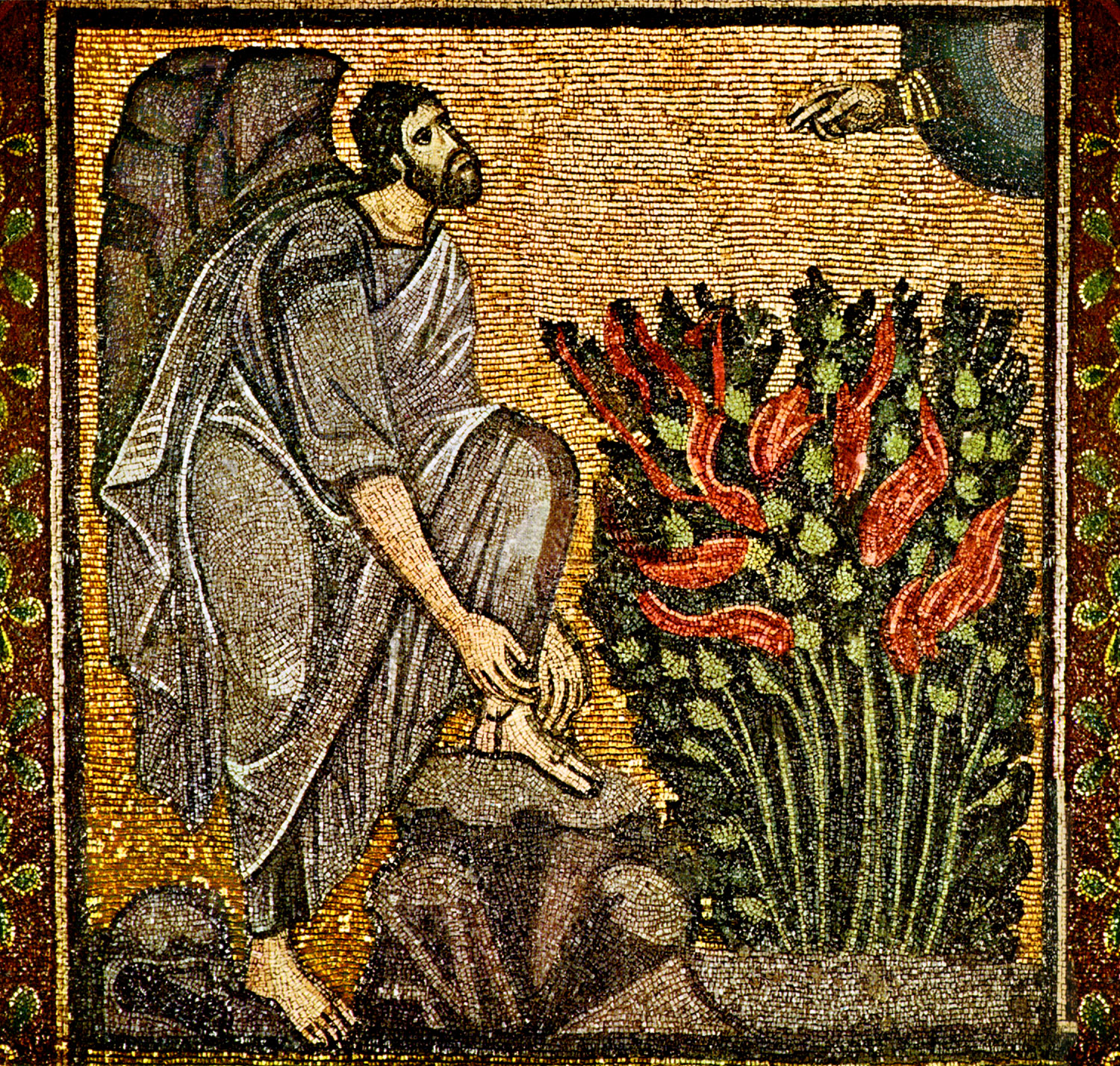
burning bushFew texts in the Bible have been as metaphysically-significant as Moses’ encounter with God at the Burning Bush. With the giving the Divine Name “I am that I am” in Exodus 3:14, the stage was set, not only for covenantal history, but philosophical reflection in the West for millennia to come.

When the Greek translation of the OT, the Septuagint (LXX), rendered that phrase something along the lines, “I am that which is”, a door was opened for philosophically-inclined Jewish and especially later Christian theologians to attempt an identification with the God of Israel, with the philosophical category of being.

Beginning with Justin Martyr down on through Augustine and Aquinas, this text became important for developing a Christian theology of the being and attributes of God. If God is the one who supremely is, then certain corollary attributes follow: independence, eternity, unchangeability, infinity, and so forth. Etienne Gilson famously dubbed this tradition of philosophical reflection “the Metaphysics of Exodus.”

Of course, not everybody has been sanguine about this history.

From various angles, the tradition has been attacked. Lexically, the Septuagint’s rendering has been called into question, and various alternative renderings of the complicated Hebrew have been offered.

Theologically, metaphysical interpretation of this sort has been rubbished as one more, if not the chief, example of the Greek captivity of Christian theology, imposing foreign categories upon the text in order to arrive at foregone philosophical conclusions.

Others have argued that the text is nowhere near philosophical categories. Connected with this, certain modern theologians assert that God is testifying to his faithfulness, or his consistency of action, not his mode of being. Biblical thought is concerned with God’s character, not his ontology.

While some of these arguments have some weight to them, especially the exegetical ones, I thought it might be worth presenting a chunk of Francis Turretin’s exposition of the divine name as a prime example of the tradition. It’s instructive in itself, not because everything in it holds up, but because many haven’t taken the time to look at what this type of argumentation looks like. Also, because it makes a key point that, whatever you do with the rest of it, still needs to be heard: ontology and character are bound up with each other.

There can be no simple bifurcation between being and doing.

The etymology and signification of the word is such as agrees with God alone. From Scripture, it is evident that it implies most especially three things which are seen to be connected (Is. 44:24-26):

(a) The eternity and independence of God, inasmuch as he is a necessary being, and existing of himself, independent of any other, self-existent (autoon)–“I am that I am” (Ex. 3:14). Hence he is called simply the being (ho on, as the ancient philosophers and Plato especially acknowledged). John describes him by the three distinctions of time: “which is, and which was, and which is to come” (ho on kai ho en kai ho erchomenos, Rev. 1:4). In reference to this we have that expression of the ancient heathen: “Zeus was, Zeus is, Zeus will be, O great Zeus” (Zeus hen, Zeus esti, Zeus essetai o megale Zeu, Pausanias, Description of Greece 10.12.10).

(b) It implies causality and efficiency because what is the first and most perfect in each genus is the cause of the rest (for God is by himself so that he is the cause of being to all others, Is. 44:24).

(c) It implies immutability and constancy in promises because he really performs and does what he has promised by giving to his promises being (to einai), not only self-existent (autoon), but also essentially existent (ousion) and essence-making (ousiopoios). In this sense, he says that he had not been known to the patriarch by his name Jehovah (Ex. 6:3), not as to the signifying word (for the contrary is evident from the book of Genesis), but as to the thing signified (because he had not as yet given being to his promises concerning the multiplication of seed, the bringing of people out of Egypt, their introduction to Canaan, etc.). He had made himself known to the patriarch by his power in the creation of the world, in its government and in the bestowal of many blessings and their wonderful defense; but he had not as yet really declared himself to be Jehovah, by fulfilling the promises given to the patriarchs. But since eternal existence, omnipotent power and immutable truth belong to God alone, the name Jehovah (which embraces these three) ought to be peculiar to him alone. —Institutes of Elenctic Theology Volume 1, Third Topic, Q. IV, Sec. V

As I said, there are a few things that are instructive about this passage.

For one thing, the diversity of sources appealed to is always enlightening to note, simply because at certain times Christians, or especially Evangelicals, have been accused (and been guilty) of intellectual ghettoization. Turretin can comfortably appeal to pagan philosophical and literary tradition in order to supplement his point.

Even more important is the point we see in subsection “c”. Turretin engages in some theological exegesis by appealing to the acts of God, the character of God, in order to ensure the point about the being of God. As Vanhoozer has argued, metaphysics is unavoidable because we must give an account what God is like in order to account for who he has shown himself to be. What must the God who acts in this story be like in order to do and say the kinds of things we see in the biblical narrative?

Well, Turretin answers that a promise-keeping God must be an unchanging God, who is in no way dependent on creation for his being or power. Otherwise, God’s promise-keeping is tentative, questionable, and contested. It would not be grounded solely in God’s own, unwavering power, but in the vagaries of history and chance.

So even if we reject the identification of God with being in the text, and link the name with issues of God’s covenant-keeping character, it’s clear that some level of metaphysical, or ontological reflection on the Name of God is warranted, even demanded by the text.

As the Psalmist says, “You are good and do good” (Psalm 119:68). Turretin would simply remind us to link and properly emphasize the verbs: He does good because He is good.

Soli Deo Gloria

STAHP Confusing Physics with Metaphysics

remthologizing“Well, according to quantum physics we now know that God’s activity in the world must be…”

“Biology has taught us about the human anatomy so our Christology needs to reckon with…”

“In light of our knowledge of emergent properties…”

Ever hear something like this in a conversation, or on a blog somewhere? Statements of this sort are among my least favorite to run across in a modern or contemporary text in theology. In our contemporary context, many are concerned to participate in the growing dialogue between the physical sciences and the science of theology, trying to figure out how to relate the two properly. Given that the reality of God speaks to every dimension of reality, spiritual as well as material, I can appreciate the intent. The problem is that many attempt the task without the proper philosophical, biblical, or theological categories in place, which leads to a confused view of God’s activity in the world.

One common place where this occurs is in conversations with some sorts of relational theists, panentheists, process theists who argue that God restrains himself from too much intervention in the world, or restricts it to a limited “persuasive” sort. One given reason is that for God to intervene too much in the physical world, that would disrupt the natural order, rendering his action coercive and, therefore, unloving. While there are numerous mistakes involved in this sort of view, Kevin Vanhoozer points out that there is one basic mistake underlying them all:

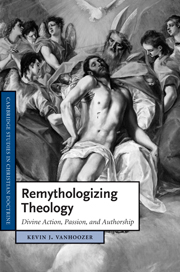
Underlying this categorial confusion of Creator and creation stands a metaphysical postulate that reduces what is logically possible for God to what is physically possible in the natural order. It is precisely this metaphysical postulate that leads some panentheists to dismiss divine interventionism  on the grounds that such divine action competes with and, at the limit, negates the natural order: “The category mistake is thus a confusion between natural causality and divine action.”  When it comes to the God–world relation, however,  there is no competition,  for the relation is enveloped by an even greater Creator–creation distinction: “For no similarity can be asserted between creature and creator unless an even greater dissimilarity is included.”  —Remythologizing Theology, pg 168

At core, it is a failure to properly reckon with Genesis 1:1, “In the beginning, God created the heavens and the earth.” As the Creator of all reality besides himself, God is the transcendent Lord of all reality besides himself. He is not in competition with it, but upholds it by his very word. He is not on an even playing field with the rest of reality, but sustains the playing field in existence.

I was reminded of this point by several passages in Turretin’s discussion of the nature of theology in the first subject of his Institutes. In several places, he makes salient points that ought to be kept in mind as well attempt to think of reality in light of God and vice versa.

First, we have to understand the way that theology studies the reality of the world and God. Each science or area of study takes its cues for how it knows on the basis of what its object is, but also on the way it approaches the object.

Although physics, ethics, and medicine treat of the subject, they do not cease to be distinct sciences because they consider man in different relations: physics as a species of natural body; ethics as capacious of virtue and happiness; medicine as curable from diseases and restorable to health. Thus although theology treats of the same things with metaphysics, physics, and ethics, yet the mode of considering is far different. It treats of God not like metaphysics as a being or as he can be known from the light of nature, but as the Creator and Redeemer made known by revelation. It treats of creatures not as things of nature, but of God (i.e., as holding a relation and order to God as their Creator, preserver, and Redeemer). (Topic 1., Qu.5, V.)

Theological approaches to the relationship between theology and science need to remember their own particular mode of study.

Next, theological approaches to the problem need to remember the limits of reason with respect to God’s power. Turretin affirms the place of reason, and even the judgment of contradiction in the theology, especially since Scripture itself authorizes that. Nonetheless:

Although the judgment of contradiction is allowed to reason in matters of faith, it does not follow that the human intellect becomes the rule of divine power (as if God could not do more things than human reason can conceive). God’s being able to do something above nature and human conception (which is said with truth in Eph. 3:30) is different from his being able to do something contrary to nature and the principles of natural religion (which is most false). Nor is the power of God in this manner limited by the rule of our intellect, but our mind judges from the word what (according to the nature of a thing established by God ) may be called possible and impossible. (Topic 1, Qu.XI, XIV)

Human reason’s reach can only go so far, but we must remember that the power of God can extend much farther. He is the author of our reason and so is transcendent of it, as are his works. That said, it’s not simply the case that what theology teaches simply contradicts what is in the sciences or philosophy and we mustn’t worry about the relation between the two. It is a matter of thinking clearly about which order or of reality we’re speaking of.

Although theology teaches many things which philosophy knows not, it does not follow that a thing may be false in philosophy which is true in theology because truth is not at variance with truth, nor is light opposed with light. But care must be taken that philosophical truths be not extended beyond their own sphere and the ordinary powers of nature to those things which are supernatural revelation and power; that the physical be not confounded with the hyperphysical or human with divine things. For example, it is true in philosophy that a virgin cannot bring forth, that a heavy body is carried downwards, that fire burns matter placed in contact with it, that from nothing, nothing can come–the contraries of which theology maintains. But they are not on this account opposed to each others because these things are spoken of in different relations. In philosophy, they are denied with reference to the laws of nature, but in theology they are affirmed with reference to divine omnipotence and supernaturally. -(Topic 1, Qu. XIII, XII)

In other words, we have to let the Creator/creation divide properly frame our thought on God and the sciences. As always, whenever the Creator and the creature are confused, mixed, or held under the same category, the darkening of reason follows (Romans 1).

Soli Deo Gloria

Selma and the Sufferings of Christ

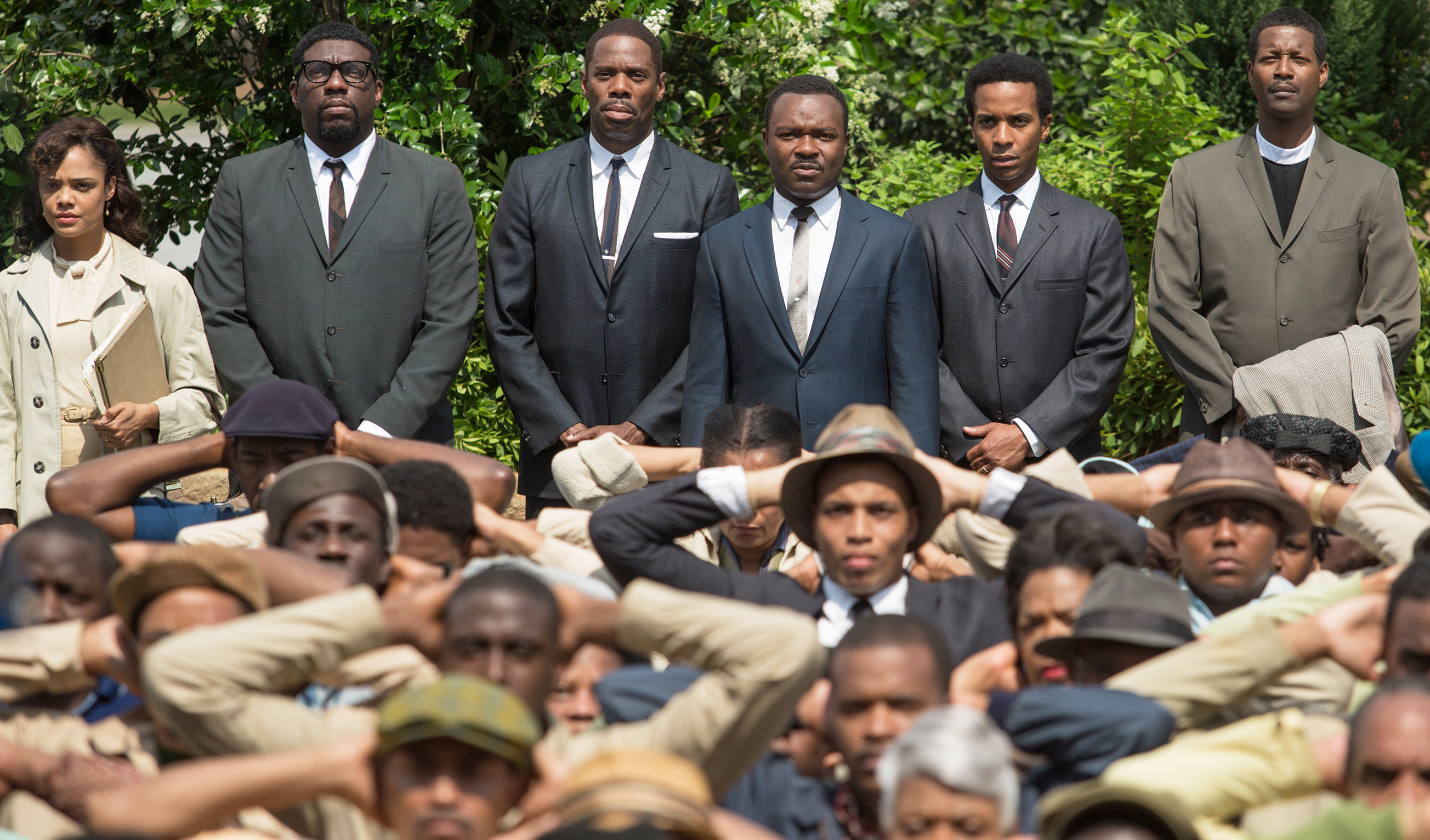
SELMAI went to go see the movie Selma with my wife yesterday and, as I predicted, I was wrecked. I do not cry often, nor especially in films, but along with the stories of the martyrs, the history of the struggle against slavery, Jim Crow, and segregation move on my heart. I wept as I have not wept in years. The kind of tears that wrench your gut and stick in your throat for hours. As I went home that evening, just thinking of the various injustices and degradations depicted threaten to bring on another torrent. I was exhausted with the grief and, yes, the heaviness of hope.

I am no film critic, but suffice it to say, the film was powerful. I really do suggest you go watch it. It is not just Black history, or American history, but our history, as Christians and humans made in the Image of God. The depth of human depravity, the height of human courage, and the slow, but inevitable coming of justice–however partial, however incomplete–is a story that will not sit easy, but builds you and blesses you nonetheless.

While there are any number of spiritual and theological themes I could profitably take up in this post, I want to talk about Jesus and Selma. Or rather, I want to ask a specific question about what our Christology, our view of Jesus, has to do with our view of what happened in Selma and what happens in the suffering of God’s people around the world. Admittedly, this is not the only question, and maybe not even the most important Christological question raised by the film, and yet I want to briefly address it nonetheless, because I think there is comfort and challenge involved here.

Does God Cry?

In the middle of the film, when Martin Luther King Jr. is out of town, a small band of Selma protesters engage in a night march. The police get wind of it and decide to teach them a lesson by ambushing them with a wave of brutality and violence. In the middle of it all, one young protestor, Jimmie Lee Jackson, is shot and killed trying to protect his mother and grandfather. It is wrenching and heartbreaking. When he hears the news, King comes to visit Jackson’s grandfather and speak some words of comfort. King addresses him and assures him that Jimmie will not have died in vain, but the very first words he says, are something to the effect of:

“I want you to know that when Jimmie died, God was the first to cry. He was the first to shed a tear.”

It is a powerful moment, especially as you watch Jimmie’s grandfather look at King with an expression of humility, comfort, and deep pain and say, “Oh yes, I believe that. I know that.” The words are so appropriately-timed and attuned to speak a message that provides balm for the soul. God knows your pain. He is not distant from your cares and woes. They are his cares and woes. Your tears do not fall to the ground alone but join with those shed from heaven above, by the God of all creation.

Of course, the question that struck me in the theater was, “Is that true? Does God shed a tear for Jimmie?”

A God Who Cannot Suffer Becomes A Redeemer Who Can

I asked the question because, as Wesley Hill recently reminded us, for most of her history the church has taught the doctrine of impassibility. The nearly unified confession of church history until about the 20th Century was that, strictly speaking, God does not and cannot in “suffer” passions–be overwhelmed by irrational or uncontrollable feelings, etc–or be acted upon in his divine nature. The Triune God is the author of life whose own glory is that of perfect, unchanging glory. He is incapable of being overwhelmed or overcome in his divine life. So does God cry? Well, in a sense, no. God is spiritual, not physical. In himself he cannot be overwhelmed as we are, have an adrenaline rush with a flush of the face, a flaring of the nostrils, or an unbidden moistening of the tear-ducts. God does not cry.

At the same time, though, as Ben Myers reminded the attendees of last week’s LA Theology conference, for the Church Fathers the presupposition of impassibility is precisely the logic behind the cross. As I’ve explained before, God’s impassibility should not be taken to mean that God does not care, or that he has no emotional life–he does. It’s just that we should not think of it precisely as we do our own. In fact, this is the glory of the God of the gospel: we find a God who cares so much that the one who cannot suffer and die in his own nature, takes on human nature in order to suffer and die with us and for us. The Impassible God is the one who loves so implacably that he overcomes the obstacle of his own perfect life in order to participate in our life, so marred with pain and sin, to redeem us from it. In other words, the God who could not suffer, became a Redeemer who could.

Jesus is the God who became human so he could shed tears with us at the tomb of Lazarus.

Eternal Mediator

What now, though? The Scriptures teach that this Godman is the one who, after his Resurrection, was exalted to the right hand of the Father in order to intercede for us even now. According to Hebrews, like Melchizedek, Christ “continues a priest forever” (Heb. 7:3). The Son of God, the second person of the Trinity is currently a human seated on the throne of the universe. If it is not too speculative, I would hazard the courage to say that Jesus is the God who can still shed human tears for his people in this world racked with sin and injustice.

I say this on the basis of Acts 9, when the Resurrected Christ comes to Saul, the marauder of the church and says, “Saul, Saul, why do you persecute me?” The Risen Christ so identifies with his people that any assault on them is an assault on him. Their suffering is his. Their tears are his. As Calvin writes about this passage:

…the godly may gather great comfort by this, in that they hear that the Son of God is partner with them of the cross, when as they suffer and labor for the testimony of the gospel, and that he doth, as it were, put under his shoulders, that he may bear some part of the burden. For it is not for nothing that he saith that he suffereth in our person; but he will have us to be assuredly persuaded of this, that he suffereth together with us, as if the enemies of the gospel should wound us through his side. Wherefore Paul saith, that that is wanting in the sufferings of Christ what persecutions soever the faithful suffer at this day for the defense of the gospel, (Colossians 1:24.) —Comment on Acts 9:4

Though impassible in his own nature, in Christ, God suffers in and with his people. Jesus is the God who cries for Jimmie Lee Jackson.

This is an unspeakable comfort for those suffering under grave oppression around the world. Whether it be the marchers in Selma, laboring for the justice of God’s kingdom, or the persecuted church around the world, God’s joy and impassible life does not mean he is separated from our pain and struggle. He is there in the heart of it, working to redeem it.

Yet the Gospel moves us beyond the tears of Christ to remind us that by his once and for all suffering on the Cross and victorious Resurrection, Christ has secured the day when “He will wipe away every tear from their eyes, and death shall be no more, neither shall there be mourning, nor crying, nor pain anymore, for the former things have passed away.” (Rev. 21:4)

May we look forward to that day as we look about our world filled with injustice and pain. May that hope gird us up as we shed the tears that will inevitably come as we follow Christ in looking the brokenness of the world, in order to meet it with the gospel of our justice-loving God.

Soli Deo Gloria