Torrey on the Trustworthy Temple of Scripture

torreyFred Sanders put together a nifty little collection of evangelist, expositor, Bible college dean, and pastor R.A. Torrey’s sermons entitled How God Used. R.A. Torrey. Sanders introduces the work with a little bio, then adds brief introductory commentary before 13 representative sermons and addresses by Torrey. I’ve been reading it for a couple of days between other works and it’s been a fun little work so far. The preaching is dynamic, personal, and spiritually compelling. Also, as a preacher, it’s just interesting to see how much the game has changed, so to speak, since Torrey was calling people back to faith.

One address I enjoyed, in particular, was his famous “10 Reasons Why I Believe the Bible is the Word of God.” Torrey, of course, famously edited the collection of essays in defense of orthodoxy known as The Fundamentals at the height of the Fundamentalist/Modernist controversies, so it’s unsurprising he dedicated significant preaching to the subject of the trustworthiness of the Scriptures.

Well, the whole sermon holds up remarkably well 100 years later on, but the section I enjoyed most was his argument about “the unity of the book”:

This is an old argument, but a very satisfactory one. The Bible consists of sixty-six books, written by more than thirty different men, extending in the period of its composition over more than fifteen hundred years; written in three different languages, in many different countries, and by men on every plane of social life, from the herdman and fisherman and cheap politician up to the king upon his throne; written under all sorts of circumstances; yet in all this wonderful conglomeration we find an absolute unity of thought.

A wonderful thing about it is that this unity does not lie on the surface. On the surface there is oftentimes apparent contradiction, and the unity only comes out after deep and protracted study.

More wonderful yet is the organic character of this unity, beginning in the first book and growing till you come to its culmination in the last book of the Bible. We have first the seed, then the plant, then the bud, then the blossom, then the ripened fruit.

Suppose a vast building were to be erected, the stones for which were brought from the quarries in Rutland, Vermont; Berea, Ohio; Kasota, Minnesota, and Middletown, Connecticut. Each stone was hewn into final shape in the quarry from which it was brought. These stones were of all varieties of shape and size, cubical, rectangular, cylindrical, etc., but when they were brought together every stone fitted into its place, and when put together there rose before you a temple absolutely perfect in every outline, with its domes, sidewalls, buttresses, arches, transepts–not a gap or a flaw anywhere. How would you account for it? You would say:

“Back of these individual workers in the quarries was the master-mind of the architect who planned it all, and gave to each individual worker his specifications for the work.”

So in this marvelous temple of God’s truth which we call the Bible, whose stones have been quarried at periods of time and in places so remote from one another, but where every smallest part fits each other part, we are forced to say that back of the human hands that wrought was the Master-mind that thought.

How God Used R.A. Torrey, pp. 23-24

I have to tell you, this “argument” isn’t one that you just trot out in the middle of an apologetic dispute, especially with someone predisposed to disbelieve or be hostile to Scripture. Still, year after year, this insight into the unity of Scripture–it’s ability to consistently point to Christ through Law, Prophets, and Gospels, across various genres, generations, authors, and centuries is a continuous marvel. This is especially the case when you take off the modernist blinders and begin to pour over the various narratival and typological continuities.

The Scriptures truly are a marvelous Temple of God’s truth. But Torrey is right–it’s not a unity that just lies there on the surface. It’s the kind of thing that you come to see once you give it the sustained attention and care that it deserves. But once you see it, much as Moses face coming down from Sinai, it shines with the reflected glory of God.

Soli Deo Gloria

In What Ways Is God our God in the Covenant of Grace?

Opening his lengthy treatment of the covenant of grace in the Institutes, Francis Turretin notes that getting this right is of central importance to theology because it is “the center and bond of all religion, consisting in the communion of God with man and embracing in its compass all the benefits of God towards man and his duties towards God” (Top. 12, Qu. 1, par. I). That certainly doesn’t leave much out does it? But that’s not surprising, is it? Turretin is right. Looking at the biblical storyline, it’s a matter of covenants made, broken, renewed, enforced, and ultimately fulfilled in Christ.

Of course, the central covenant promise in the Scriptures is that “you will be my people, and I will be your God” (Jer, 30:22′ cf. Exod. 6:7; Lev. 26:12). God’s gift to us, in the covenant, is quite simply himself. We will be his and he will be ours. But that raises the question, “How is God our God in the covenant of grace?” not in the sense of, “How is this accomplished?”, but “What is the result?” What goes into God becoming our God? What are the “benefits” of God being our God, so to speak?

In the next section (Top. 12, Qu. 2), among other things, Turretin goes ahead and tries to outline four ways in which God becomes our God in the promise of the covenant. God becomes ours: (1) according to his nature & attributes and persons; (2) according to the communication of goods; (3) according to our conformity to God; and (4) according eternity of good things. The section is rather stunning (and lengthy). While I can barely scratch the surface, in what follows, I’ll try sketch what a blessings Turretin outlines in our possession of God according to these four categories. And when I do, we’ll hopefully begin to see how he can say that the covenant encompasses “all the benefits of God towards man.”

1. According to Nature and Persons. For all Turretin’s strengths as a theologian, he rarely waxes poetic, but this next section is beautiful, so I’ll end up quoting him at length a couple of times. Turretin notes that in reconciliation, we are brought into communion with God. We move from a relationship of opposition to love, we relate to God no longer as an angry judge to us but a Father. In the covenant, we are betrothed to him as a husband and brought under his protection as a King protects his people. Because of this, we receive him as our God according to his attributes. But what does that mean?

God so gives himself to us as to be ours as to all the attributes (conducing to our advantage and salvation). They are well said to be ours by fruition and use because their salutary effects flow unto us. Ours is the wisdom of God for direction; the power of God for protection; the mercy of God for the remission of sins; the grace of God for sanctification and consolation; the justice of God for the punishment of enemies; the faithfulness of God for the execution of promises; the sufficiency of God for the communication of all manner of happiness. And as sin brought innumerable evils upon us, we find a remedy for all in the divine properties: wisdom heals our ignorance and blindness, grace our guilt, power our weakness, mercy our misery, goodness our wickedness, justice our iniquity, the sufficiency and fulness of God our poverty and indigence, fidelity our inconstancy and fickleness, holiness our impurity and life our death.

Okay, so that’s the attributes. But what does it mean for God to be given to us “personally”, or according to the persons of the Trinity? Again, Turretin, at length:

God is ours personally, inasmuch as the individual persons are ours and give themselves to us for accomplishing the work of redemption: the Father electing, the Son redeeming, the Holy Spirit sanctifying. He becomes our Father by adoption when he receives us into his own family and regards, cherishes and loves us as sons (1 Jn. 3:1). The Son becomes ours by suretyship when he offers himself as the surety to make satisfaction for us and as the head, to rule over and quicken us. He becomes ours as a Prophet, revealing salvation by the light of his doctrine; our Priest, who purchases it by his merit; and our King, who applies it (when acquired) by the efficacy of the Spirit. The Holy Spirit becomes ours when he is sent to us and gives himself to us as sanctifier and consoler that he may dwell in us as his temples and enrich us with his blessings, light, strength, joy, liberty, holiness and happiness. Thus our communion is with the Father and the Son and the Holy Spirit (1 Jn. 1:3; 2 Cor. 13:14). Hence, baptism, which is a seal of the covenant, is administered in their name so that we may be consecrated as sons of God, the Father, as members of the Son and as temples of the Holy Spirit and enjoy the blessings flowing from each person–the mercy of the Father, the grace of the Son and the power of the Holy Spirit.*

Already, it becomes apparent what Turretin means when he says that all of the benefits and blessings of God towards humanity are seen in the benefits of the covenant in communion with God. But wait, there’s more!

2. In the Communication of Goods. I won’t do the lengthy quote thing here. Still, Turretin moves on to point out that “He cannot be our God without all things belonging to him becoming ours.” As Paul tells us, all things are ours because we are Christ’s and Christ is God’s and so we have all things in him (1 Cor. 3:21-23). Piling up verse after verse, Turretin shows us how God’s creatures serve us, God’s angels protect us, God’s earth is our inheritance, and God’s promises (for this life and the next) are ours. Every spiritual blessing in the heavenlies is ours because God is our God through the covenant in Christ (Eph. 1:3).

3. In Conformity to God. It would be absurd, though, to believe that God could become ours without our own transformation. Turretin teaches us that God “is not satisfied with pouring upon us the salutary effects of his properties, but wishes further to impress upon us their mark and likeness (as far as a finite creature can bear it) that we may be ‘partakers of the divine nature’ (2 Pet. 1:4) and be like to it (which is the most perfect form of communion).” Here is the beginning of what we might loosely call Turretin’s doctrine of “theosis“, only with a very careful attention to the Creator/creature distinction. Turretin says here that just as the sun shining into a diamond irradiates it with its glory, so does God’s shining splendor fill his children and “makes us shine like many suns” (Matt. 13:43). True communion through the covenant requires conformity to his holy character, as well as happiness, immortality, and glory in body as well as as the soul, which means that our conformity will include our resurrection so that “we shall be like him; for we shall see him as he is” (1 Jn. 3:2).

4. For An Eternity of Good Things. Finally, Turretin tells us that none of these things could make us perfectly happy “unless perpetuity was added to them.” In other words, could you imagine being perfectly satisfied in having all of these things while knowing they that were only for a little while? Because God is unfailingly good, his promise to be our God extends into eternity. “So that as long as God will be God (and he will be so forever), he will also be our god that we may forever enjoy his communion and happiness”, as the Psalmist declares “This God is our God for ever and ever” (Ps. 48:14). And we can be confident of this, not only because of the nature of the promise, but with all the other blessings of the covenant like justification, deliverance from death, adoption, the gift of the Spirit, a new heart, and the resurrection of the body, who can imagine this continuing for only a short time?

I think there’s more than enough to meditate on here for while–actually, for an eternity–so I’ll wrap it up. The underlying point I hope you’ll come away with is this: blessing of the covenant is God. We don’t go to God for anything else because anything else we might want is already given to us with the gift of the Triune God who is the overflowing source of all good things. You will never receive a greater promise than this: “I will be your God.”

Soli Deo Gloria 

*I also found a post where Scott Swain comments on the two lengthy Turretin quotes after I decided to write this post. Not only did he save me the time of typing them out, the comments are worth your time.

Trinity and Organism in Bavinck (Or, Why Bother With Historical Theology?)

trinity and organismI’ve recently begun reading a fascinating work on the theology of Herman Bavinck by James Eglinton entitled Trinity and Organism: Towards a New Reading of Herman Bavinck Organic MotifIn his theology, Bavinck frequently appeals to the motif or theme of “organism” in relation to a number of theological issues like creation, Scripture, the church, and so forth. Regularly you’ll see Bavinck put forward some modern, mechanical conception of an issue and then suggest that, instead, one ought to think of these things in a far more “organic” manner, or something like that. Up until recently, many Bavinck scholars have chalked it up to the prevalence of the idea of “organism” in the 19th-century post-Hegelian, German Idealist climate that Bavinck was working in.

This idea goes hand in hand with a very popular understanding of Bavinck forwarded by Jan Veenhof that suggested that instead of one, there were “two Bavincks” that you could trace in his works. One was the orthodox Reformed theologian with roots in the conservative secessionist churches of his youth, and the second is the modern, scientific thinker trained in the modernist academy. Apparently, if you’re really smart, you can split Bavinck’s work up into bits according to that thesis because they’re clearly incompatible, and, Bavinck just never managed to reconcile them. The fun starts when theologians then take the thesis and use it to play Bavinck against himself and pick and choose the bits you like depending on which half you find more appealing. Now, obviously, on this reading, the “organic” motif is part of the modernist Bavinck’s bag of tricks, that sits uneasily with his Reformed orthodoxy.

Eglinton sets himself to correct the historical record by drawing on recent work done by Brian Mattson, John Bolt, and others that scuttles the “two Bavincks” thesis. Instead of assuming Bavinck’s theology was a bundle of contrarieties that the great man sadly never managed to properly compose, Eglinton sets Bavinck back in his historical and intellectual context, compares and contrasts him with other movements and influences in Dutch theology at the time, rereads Bavinck carefully, and manages to present us with one Bavinck whose “organicism” has less to do with his dependence on the post-Hegelian theology, and far more to do with his thoroughgoing, Reformed, trinitarian theology. Bavinck’s “organicism” is drawn more from Calvin and Reformed Orthodoxy than German idealism.

According to Eglinton, Bavinck’s “organism” metaphor is a way of speaking of the unity-in-diversity in creation that flows from the reality that the Creator is not a mere monad, but Father, Son, and Holy Spirit. In other words, the diversity and unity within the divine being finds a correspondence in the unity-in-diversity of creation designed to body forth the glory of the Triune God. Organism is Bavinck’s way of picking up and retooling the patristic idea of vestigia trinitatis, or “traces of the Trinity” found in creation. The Fathers and the medievals loved finding triads in creation that pointed towards the Trinity that created it. Bavinck takes up the same idea, but instead of focusing on numerical triads, he sees traces of the Trinity in the more generalized unified pluriformity and diversity of creation.

Of course, this is just scratching the surface. Eglinton makes his case by testing his thesis across the wide range of Bavinck’s theology, examining the organic motif in Bavinck’s doctrine of God, revelation, Scripture, ecclesiology, and so forth. In each section, he continues to do careful historical work, setting Bavinck in his own context, as well as paying close attention to Bavinck’s own usage of key terms and concepts, and not simply assuming he’s cribbing his work from his Idealist neighbors. At the end of the work, if you hadn’t before, you begin to get a beautiful vision of the trinitarian shape and aim of all of Bavinck’s talk of organism.

Why Historical Theology?

Now aside from my inherent interest in everything Bavinck, why pay attention to this kind of specialized historical work? In fact, some of us might wonder, why get so heavily invested in historical theology in general? Why worry about the nuances in the theology such and such 3rd Century bishop, or which motif does what in the thought of a 19th Century Dutch dogmatician? How does that matter to theology today, or the church today? Why not just focus on the material issues of theology according to Scripture instead of worrying about the problems of historical theology?

Because there’s a danger there, right? I mean, as I’ve started to study theology more and more, you begin to see weird, internecine academic fights about the ins and outs of Barth’s doctrine of whatever, and when you stop and consider for a moment, you begin to question, “Why does this matter?” As Phillip Cary put it in one recent article, “In most places outside Princeton, judging who gets Barth right is vastly less interesting than judging what Barth gets right—a work of discernment which belongs to the ongoing life of the tradition of Christian orthodoxy.” When you put it like that, I can’t help but agree.

Why, then, should historical theology matter to (at least some of) us? I can think of at least four reasons that I’ll attempt run through briefly.

1. Truth Matters.  The first is the basic reality that truth in all its forms matters because all truth is God’s. Indeed, we serve a God who is himself the Truth. The truth of nature tells us God’s creative work. The truth of history tells us the story of God’s providential work. This reality, not to mention various others, is sufficient enough reason for us to be concerned about the truth of any issue. I mean, this is the basic assumption that funds our conviction that the sciences and the humanities matter as subjects of study beyond their immediate, practical use.

2. Bearing false testimony. Historical theology matters as an issue of Christian truth-telling about the community of saints. The fact of the matter is that theology is taught within the Christian community, and certainly in the seminaries, as the story of teachers, preachers, saints, and professors, struggling to expound the truth of God to the men and women of their time. When we get that story wrong, when we get the theology of our forebears wrong, when we present them as less competent, fair, biblical, or orthodox (or more) than they actually were, we do them a disservice by bearing false witness against them. This is especially the case when we engage in the unfair caricature of whipping-boy theologians (Augustine and Anselm come to mind) as foils against which we can then forward our own pet theories. Christian love requires truth in speaking of our theological ancestors and often-times it means rehabilitating them.

3. Avoiding Error. It’s not just that theology happens to be taught as a story in seminaries, it’s that theology is an inherently historical enterprise. Christian theology exists only as the particular methods of reading Scripture, Creeds and Confessions drawn up around it, are passed on from generation to generation within the Church. Without historical theology, we keep ourselves from the wisdom accumulated over 2,000 years of trying, failing, and succeeding in preserving the truth of the Gospel from error and perversion. Those who ignore historical theology will almost inevitably be doomed to repeat errors the church has already discarded for some good, biblical reason or another.

4. Mining Riches. Beyond avoiding error, studies in historical theology prove that our Fathers and Mothers in the faith may still have something to new to say to us. Corrective studies like Eglinton’s have the possibility of opening up theological vistas or impasses in current theological and churchly debate because it comes from another time that’s not caught up in the assumptions we share. This is true whether it’s simply reminding ourselves of older sources we merely forgot or by gaining an understanding of their answers that weren’t properly heard the first time around. In this way, historical theology can become a timely word from another time. (Insert bit about ‘chronological snobbery’ here).

After all this, it’s wise to hear Cary’s warning stands as a valid one. Our priority as preachers, teachers, and lay (or professional) theologians is the truth about what Bavinck got right more than the truth about who got Bavinck right. Still, it would be foolish to think that our pursuit of the former won’t include an understanding of the latter.

Soli Deo Gloria

Preaching and Reversing the Polarity of the Heart

wesley on the lifeOne of the most insidious ideas we’re tempted to believe is that saving faith is a matter of the intellect alone. Obviously, it has to do with the intellect. You can’t trust something if you have no conception of it. But that reality shouldn’t obscure the fact that something of the will, the heart, is involved in receiving the grace of Christ by faith. Which is why it’s possible to sit in church your whole life, hear biblical sermon after biblical sermon on the nature of grace, Christ’s cross, the coming kingdom, the nature of a holy life–gospel presentations so clear Billy Graham couldn’t one-up them–and still never have faith, or come to a solid understanding of the good news.

Don’t believe me? This is precisely what renowned evangelist, theologian, and pioneer of Methodism, John Wesley famously reported about his own experience. He went years growing up in church, going to college, studying in seminary, getting ordained, preaching, teaching, going on mission, and yet, for the early part of his life, and yet, as Fred Sanders reports in his stimulating book Wesley on the Christian LifeWesley confessed that until a few months before his famous conversation at Aldersgate, he was “utterly ignorant of the nature and condition of justification.” (54)

But how is that possible? How can someone a couple hundred years after Luther and Calvin, coming up in a Reformation church whose basic documents and sermons affirmed the gospel, and raised in a home with a Puritan background, have never heard or understood the gospel? Fred Sanders picks up the image of a magnet to explain:

The magnet image is apt: Wesley’s mind was magnetized by the Law of God, and it drew to itself all the legalistic elements in his environment. Even when he read a good gospel-centered book, he only drew from in the legal bits. We know that Wesley read plenty of properly Protestant teaching in his earlier life. The Anglican and Puritan sources he immersed himself in included plenty of sound teaching on justification by grace alone though faith alone. Indeed, after Aldersgate, Wesley would rifle through the Anglican church’s official Homilies, Articles, and prayer book to confirm his new understanding was in fact not new to the church., but only new to him. It was an easy task, since the classic Anglican sources are packed with the gospel of justification by faith. But first the magnetic polarity of Wesley’s own soul had to be reversed. Until the principle of grace was activated in his strangely cold heart, Wesley systematically read for the message of legal performance. Until then, all the books kept pitching grace, but Wesley kept catching law. (54)

Many readers might be skeptical of this, but others will have experienced it themselves. I can’t tell you how many conversations I’ve had with students where it was clear there was this legal block on their ears. I don’t know how many sermons on justification by grace as the gospel I preached in my first couple of years–I probably bordered on Lutheranism at that point–but still, some students were still catching Law and not Grace. The polarity of their hearts was set on Law and it functioned as a hermeneutical grid through which everything was filtered. “He who has ears, let him hear.” Not everybody has the ears.

Well, what do we do with this? Does this mean that preaching the gospel clearly is of no importance because people are just going to hear what they’re going to hear? Should we not bother about striving to drive it home through solid exegesis, illustrations, stories, images, and so forth? Should we just throw up our hands and say, “Welp, I tried Lord” after a week or two of effort? Obviously not.

What I do think this does is reminds us of a few key realities that we ignore at our own peril.

First, preaching the gospel is not just a matter of sound words–though it is that–but also of the Spirit’s power. It is only when the Spirit drives the message of the gospel home that the stop “catching” Law when the Gospel is being preached. Only the Spirit is able to reverse the polarity of the heart so that our hearers can hear the gospel when it’s being preached. He is the one who puts flesh on dead bones and turns hearts of stone to hearts of flesh. He is the one who testifies to Christ–yes, through the proclamation of the Word–with power.

There are at least two comforts in this first point. First, preacher, the cold hearts of your people may not and probably are not the fault of your preaching. A great many pastors suffer condemnation and anguish over their inability to bring about effects that are not entirely within their power. Second, this is a comfort because this means that the cold hearts of your people are not beyond hope. If you feel you’ve exhausted every preaching or teaching trick in your arsenal, that doesn’t mean the game’s up. The Holy Spirit specializes in stepping in when we’re at the end of our strength.

The second big point follows from this first: if the Holy Spirit is the power behind reversing the polarity of the heart, your preaching ministry will only be as good as your praying ministry. To quote J.C. Ryle:

Prayer is the main secret of success in spiritual business. It moves him who can move heaven and earth. It brings down the promised aid of the Holy Spirit, without whom the finest sermons, the clearest teaching and hardest work are all alike in vain. It is not always those who have the most eminent gifts who are most successful laborers for God. It is generally those who keep closest communion with Christ and are most constant in prayer. It is those who cry with the prophet Ezekiel, “Come from the four winds, O breath, and breathe into these slain, that they may live” (Ezekiel 37:9). It is those  who follow most exactly the apostolic model, and give their “attention to prayer and the ministry of the word” (Acts 6:4). Happy is the church that has a praying as well as a preaching ministry! The question we should ask about new ministers is not merely “Can they preach well?” but “Do they pray much for their people?” –The Gospel of Mark, pg. 90

Now, of course, God is merciful beyond our prayers, but how arrogant do we have to be to think we can go stand before dead men and women expecting them to come to life under our preaching, if we have not been on our knees pleading with the author of life? Only he can work such miracles.

As you practice or prepare to preach, pray, then, that the Spirit would reverse the polarity of the hearts of your hearers. Pray that their hearts would be strangely warmed. Pray that your pitching Gospel might not be in vain. And then have faith that God will do it. He is faithful.

Soli Deo Gloria

Mere Fidelity And Christ And Pop Culture Plug: Blind Spots w/ Collin Hansen

This week on Mere Fidelity we had the pleasure of having Collin Hansen on to talk about his new book Blind SpotsDon’t worry, though, it’s not just a book plug episode. There was plenty of feistiness, charitable but substantial engagement, and, of course, me stumbling about trying to find something intelligent to say.

But really, I think Collin’s book raises a number of important issue and so does the conversation we have with him. I hope it challenges and encourages you.

blind spotsNow, while the conversation  wasn’t a plug, I did write one for the book for Christ and Pop Culture. Here’s the intro:

ne of the reasons I hated moving from my mid-size SUV down to an old sedan after my first car died was the fact that it was so short. I was used to riding up high, feeling like I could see most things, but now, in the smaller vehicle I felt exposed and off-kilter. Driving on the freeway was particularly annoying as I would frequently find myself being surprised by cars coming up on my sides. It appeared my blind spots had expanded. Now, fortunately, I knew what was going on and so I was able to correct for it.

But what about the blind spots you don’t know you have? Those are the most dangerous of all. And they can happen anywhere, can’t they? Not only on the road, but in our daily life of interpersonal interaction with friends, family, the broader culture, and even the Church. All too often, our conversations break down, our relationships fail, and even our unity is ruptured because we’re operating without an awareness of our blind spots–so we’re not prepared to correct for them. Collin Hansen’s new book, Blind Spots: Becoming a Courageous, Compassionate, and Commissioned Church is aimed at helping the Church, which Crossway has graciously made available for free to Christ and Pop Culture members. In a nutshell, Hansen offers his readers a brief theology of the importance of respecting the diverse experiences within the Church for the sake of the Church’s ability to follow Jesus.

Many of you are probably not Christ and Pop Culture members, though you should be, but you can still read the rest of my comments here.

Soli Deo Gloria

Are You Still ‘Reformedish’?

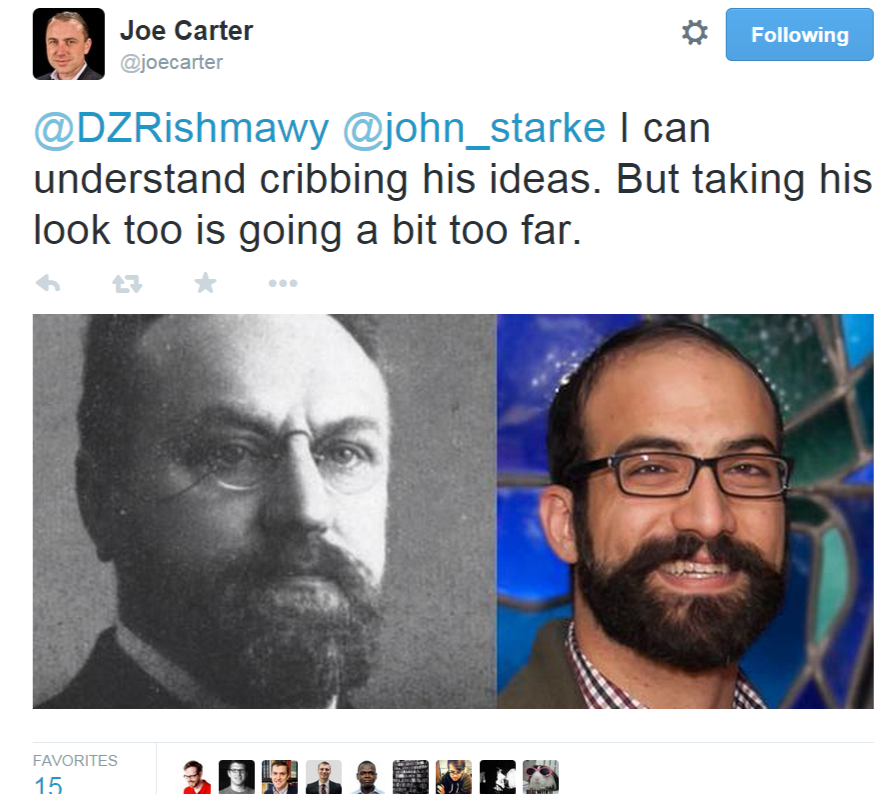
Cribbing Bavinck

I admit being entirely dependent on him theologically, but, for the record, that photo predates my Bavinck readings.

(Pardon me for the somewhat indulgent, self-referential post that follows. Then again, it is my blog, so that’s a thing. Also, on that note, I’d like to dedicate this post to Matthew Lee Anderson.)

“When are you gonna drop the ‘ish’, and just cop to being ‘Reformed’?” That’s the gist of the challenge I received as I was sitting around chatting theology with some friends last week. I can’t remember exactly what we had been talking about, but after my fifth or sixth time opening a statement with, “Well, Bavinck (Calvin, Turretin, Muller) says…”, apparently enough was enough and an intervention against my terminological obfuscation was called for.

It’s not the first time it’s happened, either. Over the last few years of blogging under the title “Reformedish”, I’ve been growing increasingly Reformed, tended to cite mostly Reformed sources, and written mostly for broadly Reformed publications. Understandably, I’ve had a number of people ask me what all the hesitation is about? Why not just own the term “Reformed”?

Well, there’s a few things to say to that, but first, I figure it’s wise to quote my own earlier explanation of my chosen blog-name:

Why ‘Reformedish’?
The title is an indicator of both my spiritual reality and theological outlook. Also, of the fact that I add “ish” to the end of a lot of words–more than I should really. The spiritual reality is that, while I’ve been saved in Christ through that ridiculous Gospel of grace and am even now being indwelled by the Holy Spirit of God, I am still in serious need of reformation–I am a work in progress. Much grace has been given–more will be needed. This will likely be evident in my writing.

Theologically I’ve become increasingly rooted in the Reformed tradition. I was drawn to this little patch of Christian thought by a few guys: Kevin Vanhoozer, Alvin Plantinga, Tim Keller, and N.T. Wright. They introduced me to their buddy, John Calvin. We’ve been friends ever since. This hasn’t always been the case, though, which means I’m still fairly new to this wing of things. I am not knee-jerk Reformed, nor an expert in the tradition. Consider me an increasingly avid novice. Still, I know that the Christian tradition is a broad and deep one so I try to read outside of what I’ve come to think of as my theological home.

So there are two dimensions. One is spiritual, the other theological and, honestly, I think both still apply. I’m not spiritually reformed by a long shot. Just ask…pretty much anybody I talk to on a daily, weekly, or centennial basis. I still stand in need of quite a bit of reformation. Consider it my own version of Kierkegaard’s unwillingness to call himself a Christian because it was too high a thing.

On the properly theological side, I still feel like I’m fairly new to the Reformed tradition. I’ve read far more now than I had when I started this thing, and can quote far more dead Reformed guys than I could then, but I’m not an expert by a long shot. In which case, I feel rather uncomfortable presenting myself as some sort of authority on “Reformed” theology. I’m not. I mean, I know more than some, but that’s not saying much. The more I read, the more I realize I’ve barely begun to scratch the surface of the riches of the Reformed tradition. So, yes, I think “Reformedish” is still applicable.

Now, that said, I’d like to be clear that I do own the name “Reformed”, certainly more than I did previously. I mean, I’m certainly not Roman Catholic, Lutheran, Wesleyan, or any of the other venerable theological traditions that get that sort of designation. I also don’t tend to call myself a “Calvinist” as that usually triggers a very specific reference to a narrow set of truths connected to the theology of salvation, instead of the broader panoply of Reformed theological distinctions connected to covenant theology, the sacraments, and so forth. So yes, if you asked me on the street, beyond simply saying “Christian”, or “Protestant”, or “Evangelical”, I’d call myself “Reformed.”

Finally, “Reformedish” is my blog title and I don’t feel like changing because I’m rather loyal. And in any case, it would take way too much work to think of a different name and I’m also kinda lazy like that.

So there you go.

Soli Deo Gloria

5 Questions To Ask Of Any Atonement Theory

atonementI’m something of a student of atonement theology. The funny thing about atonement theology is that, no matter how many books you read on the subject, there’s always one more angle (or multiple) to consider when trying to understand and explicate the saving significance of Jesus’ life, death, and resurrection. Which is why I was delighted to get my hands on an advanced copy of Biola Professor and atonement expert Adam Johnson’s elegant little work Atonement: A Guide for the Perplexed last week. There are a number of features that separate this work from a number of the recent entries into the field, but the biggest that comes to mind is that it’s not just a book on atonement theology, but a book about how to do atonement theology. It’s a “guide for the perplexed” not only as to the content of the atonement, but how to approach the problem of atonement theology in general.

All too often theology finds itself falling into familiar grooves because classic dichotomies are set up somewhere along the line, battle lines are drawn, and doing theology becomes a matter of picking between better and worse options without questioning whether they should accept the given categories in the first place. Johnson aims to shift up the conversation in atonement theology by pushing past the familiar terms of the debate between penal substitution, moral exemplar, and Christus Victor “theories” of atonement by encouraging us to turn and mine the many-splendored riches of Scripture and history for describing the unfathomable fullness of Christ’s work on our behalf.  Why settle for one when you can have all and more? Notions of victory, sacrifice, recapitulation, penalty, theosis, governmental, and so on down the line have a role to play here.

Johnson plays the role of guide in a number of ways. He clears the ground by critiquing some of the earlier conversations on the topic, less by way of negative polemic, and more by way of a dazzling invitation into a theological world unencumbered by the narrower discussions of the last century and half. He also tries to help us think through the trinitarian grounding of all atonement accounts, as well draw our attention to the importance to of attending the role the various attributes of God play a role in all of our theologizing about atonement. In these, and various other ways, Johnson aims to help us understand just how important it is for us to avoid doing our atonement theology without paying attention to the various other doctrines (God, Christology, anthropology, etc.) it depends, or impinges on.

Beyond that, Johnson actually does a ton of helpful constructive work to display to us the various facets or aspects of Christ’s reconciling life, death, and resurrection, drawing on Scripture as well as such diverse figure as Irenaeus, Von Balthasar, Calvin, Edwards, Aquinas, and, of course, Barth. While there’s plenty in Johnson’s that even the enthusiastic reader will be left chewing on (the nature of God’s suffering, the nature of atonement for the angels, the non-priority of penal substitution), the good thing is that it’s not intended to be the final word on the subject. It’s constructive as well as being suggestive for further work down the line.

Five Key Questions

While there are a number of fascinating and helpful sections in the work, one section that is particularly helpful is Johnson’s outline of five questions we should ask of any theory, dimension, or model of the atonement (pp. 47-50).

1. What is the key cast assembled in this work on the atonement? Every atonement account has a cast of players. God, humanity, demons, or angels, and so forth. Asking the question about the cast helps us understand, not only who is involved, but also what role the characters play and what emphasis a theory places on the players. Is it mostly about God? Or the human problem? Or are the demons center stage? Does it exclude those it should include, or focus too tightly on one to the exclusion of others.

2. What divine attribute, or set thereof, does this particular theory of the atonement emphasize? One of Johnson’s main theses is that every account depends on a focus on one or a couple of key attributes of God. Penal accounts might emphasize the need to satisfy justice as well as the apparent tension it causes with his love. Others such as victory accounts might focus on God’s faithfulness to his creation or his sovereignty. We need to be able to identify these, and even more, we need to ask careful questions about the way they are emphasized. Are attributes pitted against each other? Are some sidelined in favor of others? Are the ones highlighted treated according to the full witness of Scripture or is a muted picture presented?

3. What aspect of our sin does this particular theory focus on? Atonement deals with sin and different atonement accounts deal with different dimensions of sin. We need to ask which dimension this particular theory tackles. Is it focused on sin’s essence, or its effects? Is it personal, social, political, or cosmic? Is sin treated as sickness, rebellion, or bondage? Is the main problem guilt, or shame or even death? More importantly, are these set up in a way that only one is treated as the “real” problem? This is where I’ve seen problems show up in the various, reductive accounts on offer. Yes, shame needs answer, but so does bondage. Yes, we need new life, but does God grant that to those still bearing their guilt?

4. How does this particular theory develop Christ saving us from our sin? Obviously, this one follows off of the last. If atonement deals with different dimensions of sin, then there are correspondingly different methods. Does Christ pay a penalty and do away with our guilt? Unmask the powers of evil? Conquer the power of death? Heal the corrupting effects of sin in our souls and our bodies? Liberate the oppressed from unjust political systems? Hopefully, you answered yes to all of them. Still, each theory tends to focus on one or a couple of these. Asking these questions helps us identify areas of critique or needed expansion and addition to fill out our view of Christ’s full work. If your theory doesn’t admit of that, if it rules out further dimensions, then that might be a problem.

5. How does this theory develop Christ saving us for life with God and others? Finally, we need to remember that atonement is aimed, not only at saving us from sin, but for life with God. Every theory or aspect under consideration should point forward towards the resurrected life, just as atonement does not stop with the cross but continues on through the resurrection and ascension of Jesus. How is that result described? Is it union with God? Is it a new life of righteousness? Is it warm, reconciled family relations? Is it physical wholeness in the New Creation? Does it have implications for our life now, between the comings of Christ? Each aspect or theory of atonement ought to have something to say here. Now, note, not each dimension has to say everything–I’ve seen criticism of penal substitution that fault it for dealing with problems that other complementary dimensions deal with well (social, political, etc) and simply written off because people are under the impression you can’t have more than one aspect doing work at a time. That’s akin to faulting a hammer for not being wrench because you’re too silly to realize you can use both.

In any case, these five questions (and I’ve only scratched the surface of Johnson’s development of them) are a good place to start considering the various proposals, historic and contemporary, for understanding the grand, comprehensive work of Christ’s atonement. I know the book doesn’t release for a couple of months, but for serious students looking to dig deep into the manifold wisdom of God’s saving work in Jesus’ life, death, and resurrection, I highly commend preordering or wish-listing this book.

 Soli Deo Gloria

What does it mean to be ‘inclusive’ like Jesus?

exclusion and embraceAccording to one telling of the gospel narrative, Jesus came to end exclusion and preach the inclusive kingdom of God.  Certainly that’s part of what he came to do and arguably the feature of his ministry most appealing to our contemporary culture’s moral sensibilities. In Jesus, the outcasts of society have hope. Those long marginalized, kicked to the curb (figuratively and literally) can look up to see Jesus extending a hand, inviting them back into the community of the truly human as objects of dignity and divine affection.

Of course, issues of inclusion and exclusion are at the heart of our society’s most contested social issues. Whether it’s the dynamics underlying much of the racial tensions built up and released in our cities, or the heated theological discourse on sexuality, we need to come to grips with the realities of inclusion and exclusion. Which is why I decided to recently revisit Miroslav Volf’s justly famous meditation on the subject Exclusion & Embrace: A Theological Exploration of Identity, Otherness, and Reconciliation. It’s a fascinating theological account of the issues of forgiveness, truth, justice, and, yes, exclusions that gains a particular poignancy set in the context of his wrestling with the exclusionary violence that destroyed his own home in the Balkans.

Nuancing Inclusion. Right off the bat, though, I was struck by his nuancing of Jesus’ ministry of inclusion or, rather, ministry against exclusion. In some accounts of Jesus’ ministry of radical inclusion, his invitation was to all and sundry, with no requirements, no prohibitions except those who sin by way of exclusion. Exclusion is the aboriginal sin and any construction of binaries, ins and outs, wicked or righteous, sinner and virtuous is simply ruled out by the gracious kingdom of God. To follow Jesus is simply rolling back boundaries, deconstructing binaries, and flattening every moral and social hill before the coming of our inclusive God.

According to Volf, though, it’s not that simple. While it’s true that much of Jesus’ work included transgressing “social boundaries that excluded the outcasts, demonstrating that these boundaries themselves were evil, sinful, and outside of God’s will” (72), he goes on to say:

“it would be a mistake…to conclude from Jesus’ compassion toward those who transgressed social boundaries that his mission was merely to demask the mechanisms that created “sinners” by falsely ascribing sinfulness to those who were considered socially unacceptable. He was no prophet of “inclusion”…, for whom the chief virtue was acceptance and the cardinal vice intolerance. Instead, he was a bringer of “grace”, who not only scandalously included “anyone” in the fellowship of “open commensality”, but made the “intolerant” demand of repentance and the “condescending” offer of forgiveness (Mark 1:15; 2:15-17). The mission of Jesus consisted not simply of re-naming the behavior that was falsely labeled “sinful” but also in re-making the people who have actually sinned and suffered distortion. The double strategy of re-naming and re-making, rooted in the commitment to both the outcast and the sinner, to the victim and the perpetrator, is the proper background against which an adequate notion of sin as exclusion can emerge. (72-73)

This duality in Jesus’ method of ending exclusion or practicing inclusion is so important for us to grasp, if we’re going to think clearly about how to follow Jesus and what the call to be an inclusive Church really means. So what does Volf have to say about these two halves of Jesus’ ministry?

Renaming. First, he tackles re-naming. When Jesus declares all foods clean (Mark. 7:14-23), or heals the woman with the flow of blood (Mark. 5:25-34), or points to the inclusion of the Gentiles in the Kingdom of God, Jesus ends certain boundaries that divide people into the categories of clean and unclean. As Volf states it, “by the simple act of re-naming Jesus offset the stark binary logic that regulates so much of social life: society is divided into X (superior in-group) and non-X (inferior out-group)” (73). In this, Jesus upsets a false system of exclusion that divided people whom he now set on the same plane and brings into the mutual community of the clean.

The bit that I think is missing from Volf’s analysis here, is the further dual dimension this work of renaming can be split into. Jesus’ ministry of renaming often worked at both the level of correction as well as that of covenantal dispensation. Some of Jesus’ acts of renaming were aimed at correcting distortions within the Rabbinic or Pharisaic halakhah that had slowly emerged over time, and had aggravated the exclusion inherent in the ceremonial law of Torah (which inevitably still happens in nearly every church situation). Others, though, were Jesus’ declaration that because of the New Covenant, that which was ritually unclean before no longer is unclean because these distinctions (between Jew and Greek, Kosher, etc), have served their purpose in pointing to Christ and are now to be dispensed with. Jesus renames the distinction, not as evil, but rather as covenantally-irrelevant (Acts 10:5).

Remaking. But what about re-making? “In addition to removing the label “unclean” placed on the things that were clean, Jesus made clean things out of truly unclean things” (73). Jesus cast out unclean, sinful, tormenting spirits that held people captive and drove them to behaviors that excluded them from community (Mark. 5:1-20). But he also dealt with “people caught in the snares of wrongdoing”:

…people who, like tax-collectors, harm others in order to benefit themselves, people who, like prostitutes, debase themselves in order to prosper or just survive, people who, like most of us, are bend on losing their own souls in order to gain a bit of the world–such people were forgiven and transformed (Mark 2:15-17). (73)

In other words, Jesus ended their exclusion through the kind of grace that acknowledges there is something about the person, a condition, a habit, a disposition and behavior that is self-excluding and needs regeneration and forgiveness. Indeed, forgiveness is an including act that inherently contains within it an act of condemnation of the reality being forgiven. What’s important to see here, though, is that he doesn’t rename evil as good or indifferent, but instead tackles it head-on, by destroying its root in the human heart.

It’s important, at this point, to note that this is the more fundamental dimension of Jesus’ ministry of inclusion. Many suffer under regimes of unjust exclusion on the basis of gender, socio-economics, race, stigma attached to mental disorder, and so we praise God that Jesus offers hope and gives us a mandate proclaim that the social divisions are relativized in Christ (Gal. 3:28; 1 Cor. 11). But the reality is that not everyone was, or is, in a situation that needs to be renamed. That said, we all have fallen short of the glory of God, excluded ourselves from communion with God, and so stand in need of Jesus’ work of remaking or reconciling us to through the blood of his cross. Everybody, rich or poor, black or white, male or female, Jew or Gentile, stands in need of Christ’s remaking work in our lives. Indeed, one of the main ways that Jesus, Paul, and the apostles undermine systems of exclusion based on false social categorizations, is on the basis of that shared new name that is the sign of a shared new heart, as we move from being “in Adam” together to being “in Christ” together.

Two Kinds of Inclusion. I took the time to outline this, because I think a failure to appreciate or apply the distinction between renaming and remaking in the Church’s call to practice inclusion is at the heart of so many of our hottest disputes. While I’d like to address, in a future post, issues more closely related to race and diversity in the Church, obviously, this comes up on the sexuality question.

All too often, progressives on the issue set this up as a debate between those who understand Jesus’ radical message of inclusion and those who simply want to hold onto the old, excluding binaries like the Pharisees and the Judaizers; we’re given a choice between those who want to exclude and those who want to include. And how fun is it to play Jesus v. the Pharisees, right? With Volf’s categories in place, we can see that the more appropriate question, though, is which method of inclusion applies in this situation? Where progressives see a situation of renaming akin to the Gentiles, the Church has traditionally seen inclusion requiring a kind of remaking (which, connected to sexuality, needs careful parsing–don’t read certain psychological programs into my use of the term). Still, according to the historic position, to rename, in this case, would be to call evil good.

This is is where the irony comes in. Traditionalists are often accused of being gatekeepers seeking to exclude people from the kingdom of God. But if they’re right here, and treating sexual behavior as another one of those old, sinful categories to be renamed is a mistake, ultimately the danger is that many will not be called to repent from the kinds of behaviors that Christ, the apostles, and the prophets say lead to their self-exclusion from the kingdom of God. It’s precisely out of conservatives’ drive to include, that they’re opposed to the wrong sort of inclusion. It’s precisely because they hate the idea of anybody being excluded from the kingdom of God, that they insist we not offer up inclusion on false premises.

In the end, it’s like two people explaining to a visitor how to get into a building. One says they must enter the main gate while the other tells them to enter through a side-door, which is much closer, because they fear the gate is too far away and difficult to enter. Initially, the second person seems to be making it easier to get in while the first is imposing the harsher standard–that is until you find out there is no side-door. The second person’s efforts at inclusion are well-meaning, but ultimately they function as another way of keeping the visitor out.

 Soli Deo Gloria
The Reassuring Derision of the Lord

mockery of ChristIn the long run, there is nothing about God–no activity or attribute–that cannot be a comfort to the Christian. That might strike some of us as too sunny a view on things. I mean, everything?  Obviously, attributes like his compassion and his mercy are comforting, and his creation and salvation, but what about his jealousy, or his anger? Or how about this one? His derision.

What possible comfort and blessing is there in knowing God holds certain things in contempt and derision? Well, let’s consider a couple of the verses:

The wicked plots against the righteous
and gnashes his teeth at him,
but the Lord laughs at the wicked,
for he sees that his day is coming.
(Psalm 37:12-13 ESV)

According the Psalmist, the Lord finds the wicked pretty hilarious. While they’re sitting there plotting against the righteous, thinking of ways to overcome them, the Lord is looking ahead and seeing their end. His day is coming. These plans they set in motion with malicious intent will come to nothing when the Lord comes and judges. An earlier Psalm makes a similar point:

Why do the nations rage and the peoples plot in vain?
The kings of the earth set themselves,
and the rulers take counsel together,
against the LORD and against his Anointed, saying,
“Let us burst their bonds apart
and cast away their cords from us.”
He who sits in the heavens laughs;
the Lord holds them in derision.
Then he will speak to them in his wrath,
and terrify them in his fury, saying,
“As for me, I have set my King
on Zion, my holy hill.”
(Psalm 2:1-6 ESV)

The Nations, the wicked kings of the earth, are plotting evil. They want to reject the Anointed of YHWH, rule themselves and enforce their own wills upon the earth. But what is the YHWH’s response? It’s not insecurity. It’s not trembling fear. It’s the laughter, the derision, that comes from a total confidence of untrammeled authority, despite the feeble attempts of his enemies to overturn his rule. Seeing in the Psalm a type of the coming reign of Christ, Calvin comments thus on God’s laughter:

And David ascribes laughter to God on two accounts; first, to teach us that he does not stand in need of great armies to repress the rebellion of wicked men, as if this were an arduous and difficult matter, but, on the contrary, could do this as often as he pleases with the most perfect ease.

In the second place, he would have us to understand that when God permits the reign of his Son to be troubled, he does not cease from interfering because he is employed elsewhere, or unable to afford assistance, or because he is neglectful of the honor of his Son; but he purposely delays the inflictions of his wrath to the proper time, namely, until he has exposed their infatuated rage to general derision. Let us, therefore, assure ourselves that if God does not immediately stretch forth his hand against the ungodly, it is now his time of laughter; and although, in the meantime, we ought to weep, yet let us assuage the bitterness of our grief, yea, and wipe away our tears, with this reflection, that God does not connive at the wickedness of his enemies, as if from indolence or feebleness, but because for the time he would confront their insolence with quiet contempt.

Despite all outward appearances, God is not idly sitting by. He is biding his time, readying himself to judge and expose the tyrants who would assault the peace of his world to open shame. Again, Calvin comments a bit earlier:

The other consolation which follows is, that when the ungodly have mustered their forces, and when, depending on their vast numbers, their riches, and their means of defense, they not only pour forth their proud blasphemies, but furiously assault heaven itself, we may safely laugh them to scorn, relying on this one consideration, that he whom they are assailing is the God who is in heaven. When we see Christ well nigh overwhelmed with the number and strength of his enemies, let us remember that they are making war against God over whom they shall not prevail, and therefore their attempts, whatever they may be, and however increasing, will come to naught, and be utterly ineffectual. Let us learn, farther, that this doctrine runs through the whole gospel; for the prayer of the apostles which I have just quoted, manifestly testifies that it ought not to be restricted to the person of Christ.

While we might look at the world, see wicked rulers, observe what seem to be tidal waves of unconquerable injustice, we can know that eventually all of these threats to the Kingdom of God will fall before the Lord and we will join in his mockery of evil. Even though we weep now, we can laugh with God now in anticipation of the day when the enemies of our God are finally and fully vanquished.

Indeed, we have even better reason to do so than the Psalmist did. Back then, he was prophesying of a coming day when these things would happen; as the Church, you and I are living on the other side of Christ’s death and resurrection, in which he has, “disarmed the rulers and authorities and put them to open shame, by triumphing over them in him” (Col. 2:15 ), and made it possible that one day we will cry: “‘Death is swallowed up in victory.’ ‘O death, where is your victory? O death, where is your sting?'” (1 Cor. 15:54-55).

I can’t help but think that as Christ himself was being mocked, spit on, held in derision by the Nations–the Romans and his own countrymen–in the end, the Lord held them in derision knowing that it was in the midst of their injustice that he was laying the foundation for his own, ultimate victory.

Take comfort, then, even in the derision of the Lord. If you are in Christ, he mocks your enemies–even sin, death, and the powers of Hell. They are nothing to him.

What more shall we fear?

 Soli Deo Gloria

Do We Need Jesus To Be A Lawyer Or A Doctor? Why Not Both?

Judge’s Gavel and stethoscopeJesus, in case you didn’t know, was a doctor. One of the primary things he spent his time doing during his earthly ministry was healing the sick and the lame. Restoring sight to the blind. Making the crippled walk. Indeed, even bringing the dead back to life. But it wasn’t only physical healing that he offered, but spiritual as well. Indeed, it was his mission to make the spiritually diseased whole that brought reproach upon him:

And Levi made him a great feast in his house, and there was a large company of tax collectors and others reclining at table with them. And the Pharisees and their scribes grumbled at his disciples, saying, “Why do you eat and drink with tax collectors and sinners?” And Jesus answered them, “Those who are well have no need of a physician, but those who are sick. I have not come to call the righteous but sinners to repentance.” (Luke 5:29-31)

Although it seems to be often missed in popular Evangelical preaching, the Bible says Jesus’ saves by healing us. Indeed, the word salvation takes its roots in the concept of wholeness and health. Though some may think otherwise, the older Reformed did not forget this theme. Calvin commonly used the image of Christ as a physician, a doctor who heals us. When speaking of the life of the disciple carrying the cross, he spoke of it God’s medicine, used to heal the soul of its sin (Institutes, 3.8.5). Or again, in speaking of the Lord’s Supper, he referred to it as “medicine for the sick” (ibid, 4.17.42), that nourishes and renews us, because through it we partake of Christ’s benefits, his nature that he assumed, healed, and through which, he gives us life. This is unsurprising as he was a student of the Fathers and the theme of salvation is ubiquitous with them. Simply consult Athanasius, almost at random, and you’ll run across the idea.

This is an immensely important theme that should not be ignored in Christian preaching and teaching. It is a great comfort to know that we will not always be sick with sin, but are being healed by Christ, and will one day stand whole and complete before our Maker.

But once again, we need to be careful not to over-react. The other day I saw a friend share a quote to the effect that what we need is Jesus who is a doctor who can heal us, not a lawyer to defend us, as if admitting the one rules out the other. Or again, some people, allegedly looking to the Church Fathers or the East, think that looking to Jesus for “ontological” healing of our nature, rules out any kind of “forensic” or legal approaches to salvation that characterize “Western” theology. But is that true? Is that what Scripture says? Is that what Jesus says?

Well, as it turns out, no it’s not. In John 14:16, Jesus tells his disciples he “will ask the Father, and he will give you another Advocate, to be with you forever”, and again in 14:26 he speaks of when “the Advocate, the Holy Spirit, whom the Father will send in my name, he will teach you all things and bring to your remembrance all that I have said to you.” While the term is often translated “helper”, “comforter”, or “counselor”, A.T. Lincoln has shown that it belongs most properly in the legal setting of John’s Gospel. Jesus speaks of the Spirit as a legal advocate, a lawyer, and calls him “another” one, the implication being that he himself is our first advocate. This is confirmed by Jesus’ teaching about the work of the Spirit who is the other Advocate:

And when he comes, he will convict the world concerning sin and righteousness and judgment: concerning sin, because they do not believe in me; concerning righteousness, because I go to the Father, and you will see me no longer; concerning judgment, because the ruler of this world is judged. (John 16:8-11)

Sounds like a lawyer to me.

If that wasn’t enough, 1 John 2:1 clearly declares, “My little children, I am writing these things to you so that you may not sin. But if anyone does sin, we have an advocate with the Father, Jesus Christ the righteous.” In this case, we clearly see Jesus identified as our advocate before the Father, who as the Righteous One, can plead our case on the basis of his own work, because he is the “propitiation for our sins” (2:2). Through the Cross, Jesus has done away with our guilt, which is precisely why if we “confess our sins” before God “he is faithful and just” to forgive them (1:9). Because we are united with Christ, the Righteous One who stands before the Father as our Advocate, we have a new status as righteous in him. Jesus is our great Lawyer.

Just as we need to cling to all of the names God gives us in order to understand the fullness of his character, let us not fall into the silly trap of denying or denigrating any of  the titles by which the Scripture describes Christ’s multifaceted work on our behalf. In Jesus, we have a mighty doctor who heals us. We also have a powerful advocate, who defends and vindicates us. We need him to be both of these things and more.

Soli Deo Gloria