Mere Fidelity: The Last Supper and the Last Week of Jesus

Mere FidelityThis week on Mere Fidelity, Alastair, Matt, and I tackle the subject of the Lord’s Supper. We try to set it in the context of the last week of Jesus, while moving around to the various Gospels and the canon of Scripture as a whole. This one–I think–had some particularly appropriate insights as we enter Holy Week heading towards Maundy Thursday and Good Friday. We hope you are as edified as we were.

Feel free to share.

Soli Deo Gloria

The Fickle Crowd Can’t Stop the Resurrection

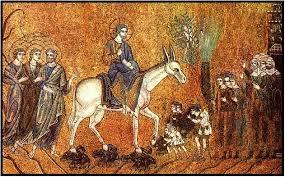
donkeyWhen Jesus entered Jerusalem on Palm Sunday, it was to the acclaim of the crowds. “Hosanna! Hosanna!” they cried. It must have been an inspiring sight to see for the disciples. “These people get it”, they must have thought. Now, finally, Jesus was getting the right recognition that he deserved. He is the coming King and his people have recognized it.

But that was Sunday. And as we all know, the crowds were screaming for his blood on Friday. How could they turn on him like that? How could it all go to hell so fast? Were they really that fickle? Can they really have changed their minds about him that quickly?

The answer is, “yes”, “no”, and “kinda.” I mean, to be fair, Jesus gets pretty aggressive in the Temple and the courts the next few days in his preaching, teaching, and condemnation of the religious practices of Israel at the time. So there’s some understandable shift in popular consciousness that can be accounted for.

But even with that, you begin to see that it’s not so much a matter of people being simply fickle, or changing their mind about Jesus, but rather coming to understand they hadn’t understood him in the first place.

Many had a Messiah box and had slid Jesus into that, without really checking the fit. They were excited that the liberation, salvation, the good life they had desired for so long was coming because Jesus was bringing it. But then they saw, they heard, they understood–he’s up to something else–he had a different vision. And so they changed their minds about Jesus precisely because they wouldn’t change their minds about the kind of kingdom that really mattered to them.

When they saw what Jesus was really about, they decided it was not in their rational, self-interest to identify with this sort of Messiahship. And so, they handed him over to be crucified by the Gentiles.

All this is fairly standard Palm Sunday sermon material, but as I was reflecting on it this morning, I began to think of our current social situation in the church. It’s easy for those of who care about the health of the Church to get discouraged about the how much the popular imagination of church-goers or self-identified Christians seems match worldly, distorted, fun-house visions of the kingdom, politics, and the good life.

Christians who chant Jesus’ name on Sunday seem to hand Jesus over to be crucified in a million different ways all throughout the week.

But the reality is, for 2,000 years the crowds have been chanting “Hosanna!” one day, and calling for Jesus’ crucifixion just a few days later. But Easter came all those years ago, despite the infidelity of the crowd.

Take heart this, then, this Palm Sunday. No matter the temporary woes of the Church today, the fickleness of the crowds, or the narrowness of their vision, the humble King who came riding on a donkey is even now seated at on the throne in glory, ruling the cosmos, salvation securely in hand. There is always hope, always resurrection life at work in the Church just around the corner.

Soli Deo Gloria


The Crucifixion: Understanding the Death of Jesus Christ by Fleming Rutledge

crucifixion rutledgeWhy the cross? Why this particular, bloody, grotesque means of execution? Why was this the necessary mode of the Savior’s redemption of the human race? Why not a life, leading into old age and peaceful death leading into resurrection? Why the seemingly Godforsaken horror of it all? This is the motivating question at the heart of Fleming Rutledge’s masterful tome The Crucifixion: It’s Meaning and Significance. After over twenty years study, research, and meditation, Rutledge has delivered a stunning piece of theological and pastoral reflection on the cross of Christ.

I originally intended to work through it for my Lenten readings every morning (being far too addicted and Protestant to give anything up for Lent), and found myself running far ahead of my intended, daily page-count. It’s really a beautiful piece of theology.

Aimed at reinvigorating the dying tradition of “Good Friday” preaching of the Church, Rutledge sets herself the task of examining the cross of Christ in its various biblical, theological, historical, and social dimensions. In other words, while she engages at a fairly academic level at points, she’s not so much concerned with the academy, but with the pulpit—which is why the book is rich with illustrations and reflective sections interacting not only with historical and biblical theology, but with literature, poetry, and newspaper headlines. Essentially, it’s a work aimed at pastor-theologians.

In what follows, I’ll simply highlight what I take to be some of the significant features (both positive and negative) of the work and hope that gives you something of a feel for the whole.

Sin and sins

One of Rutledge’s chief concerns is to get her audience to reckon with the reality of sin. Coming out of the Episcopal mainline, this is unsurprising given the theological trajectory much of the church has taken over the last forty years or so. Rutledge is not dour, or morbid, but after years of preaching, teaching, advocating for justice (especially on social and racial fronts), she is not naïve about the pervasive wickedness and corruption of both human nature and human cultures. As one of the blurbs put it, she wants us to “get real” with ourselves, open our eyes and truly look at the world as it is, and reckon with our dire need for redemption. Her work is a bracing antidote to any last vestiges of cheap sentimentalism in our doctrine of humanity that would blind us to our need for the kind of salvation only a bloody cross can bring.

Connected to this, Rutledge doesn’t simply want us to recognize personal culpability and “sins”, but rather the Power of Sin. This is partially due to her heavy leaning on the “Apocalyptic” school associated with J.L Martyn, De Boer, and the Union School. For Rutledge, we need rescue from the Powers of Sin, Law (used by Sin), and Death. We are not only culpable, but captives, sold and bound under the dark dominion of evil that overwhelms us and keeps us oppressed in sin.

Deliverance AND Substitution

It is this sense that gives shape to Rutledge’s main argument, which I take to be the resituating of the “substitution” motif within an Apocalyptic understanding of the Christus Victor motif. Because she takes both sins and Sin seriously, she wants to take both of those master motifs and develop them as well.

When it comes to substitution, Rutledge does a fantastic job slowly, carefully, and piercingly drawing our attention to the problem of injustice in the world. Whether to apartheid in South Africa, the struggle for racial equality in the Civil Rights movement, child abuse scandals in the Catholic church, to the millions of petty, untold sins in our own lives, she forces us to deal with both the biblical and the theological need for satisfaction, for an atoning sacrifice, for a judgment that says no to a culture of impunity, to cheap grace, or the sort of “forgiveness” that makes a mockery of the victims of violence throughout history. What’s more, she does it in such a way that is appealing, not so much to theological conservatives, but to those with more progressive and liberal sensitivities. You might say that as someone who has taken the social gospel seriously, Rutledge knows that you need a more classic theology to undergird it.

But, of course, we need not just sacrifice but redemption. The Exodus is a good model here. In the Exodus, the Israelites received both atonement in the slaughter of the lambs at the Passover, but also redemption from the social, political, and yes, spiritual, powers of Pharaoh and the gods of Egypt. Rutledge forcefully argues that the cross of Christ (and his resurrection) were at the heart of a liberation, a deliverance from the powers of Sin, the Law (as used by sin), Death, and the Devil. In him, we have a liberating “Lord”, who transfers us from the kingdom of darkness to the Kingdom of the Son, who frees us for his glorious service.

And these two halves point to the broader concept of righteousness and justification she embraces. Following much 20th Century scholarship, for Rutledge, God’s righteousness is his saving justice that is more than forensic, but also transformative and liberative. She translates “justification” as “rectification”—God’s justification of the ungodly, then, is not merely their forensic vindication, but their total deliverance from the Powers and their “setting right.”

This “rectification”, though, that comes by way of the cross and resurrection of Christ is not merely individualistic in nature. In this regard, she joins the choir of many other recent voices in proclaiming a “cosmic” salvation, in which God sets the whole world to rights through the Son in his cross, bringing about a New Creation, while the rectification of individual comes within that broader schema. Indeed, over and over again, Rutledge emphasizes the “cosmology” implied in Paul’s theology (because this is a heavily Pauline work), in regards to both the aim and the characters involved.

Multiple Motifs

Within those two broader motifs, Rutledge does a good job at trying to give voice to the broader range of New Testament motifs surrounding the death of Christ. Sacrifice, justification, ransom and redemption, Apocalyptic war, and the descent into Hell. In many ways, this is one of the chief strengths of the work. I would say, though, in comparing it to Jeremy Treat’s similar project The Crucified King, Rutledge’s treatment could have benefited from a more synthetic, redemptive-historically organized account.

While she is no Marcionite (she makes fantastic use of the Old Testament, connecting it to the New), there is something of an atomism, typical of much of the critical scholarship she draws on, at work in the treatment of the themes that could be integrated to greater effect. That seems to be something of a side-effect of her Apocalypticism which makes less use of unifying, covenantal themes, and places a greater emphasis on the disjunctive, in-breaking work of God. Again, though, overall, she’s got a very sensitive eye for the diversity of the New Testament witness to Christ’s work. There’s nothing reductionistic about it. And this, I think is probably because she’s not exclusively “Apocalyptic” in her orientation, but has a strong regard for certain traditional, Western exponents such as Anselm, Calvin, and others.  Still, I would probably add Treat’s work as a complementary one, in this regard.

The Problem of Theodicy

Given her concern with the necessity of the cross, justice, and sin, it’s no surprise that the question of theodicy is a running theme throughout the work. Indeed, much like the great theologian of “holy-love” P.T. Forsyth, Rutledge connects the cross with the issue of the “Justification of God.” There is much to commend in this regard. I will say, I had my qualms about this thread in her work, though, as it drinks quite deeply from the Dostoyevskian/Hart-style anti-theodicy. There seem to be some equivocations at work with respect to thinking about evil as “purposed” by God, or “part of God’s purposes” because of a failure to distinguish different senses of the will of God, the decree, and so forth.

Again, though, she does tap the breaks on the cheaper, hasty work of theodicy that we see all too often from the pulpit and the counselor’s office. So there is much benefit in the section.

Defending Substitution

One of the major sub-themes of Rutledge’s work is defending the substitutionary motif both against critics and misguided supporters. I have to say, her work here is simultaneously some of my favorite and least favorite segments. Connected to the themes of justice and God’s rejection of a culture of impunity, Rutledge has excellent discussions of the pastoral use of the doctrine of the wrath of God. She does fantastic work defending the different, mutually supporting elements of substitution and representation in Christ’s work. Also commendable is her repeated, careful emphasis on the perfectly and beautifully Trinitarian character of the Son’s cross-work. And I especially appreciated her exposition of Karl Barth’s contribution to the subject and the way his work can help us think more carefully about the notion of God’s agency in the cross, guarding against some of the more ham-handed expositions we’ve all heard.

That said, there were moments I thought she gave too much ground to the critics of “cruder” expositions of “penal substitution.” While there’s plenty right about those criticisms, I think there are not as many as Rutledge credits, or they don’t have quite the force she accords them. Also, her tendency to beat on the Post-Reformation Orthodoxy and their schematizing, propositionalizing, depersonalizing, etc. ways, grew a bit tiresome, but that’s probably just some of the Post-Barthian influence.

Overall, for those of us in more Reformed, Evangelical circles, it’s a very helpful exercise reading Rutledge’s defense of substitution within a church context that in many ways has left it by the wayside long ago.

Indeed, this could probably said about many of her discussions. Yes, there are tell-tale marks of the liberal tradition she’s engaged with that I just won’t agree with. For instance, Rutledge will follow Riceour on the nature of the Adam narrative (no historical Adam), and gesture towards either annihilationism or universalism in her discussion, all the while giving us a discussion of both radical evil and the realism of hell that’s still quite useful in pastoral conversations and preaching about the issues for those rejecting some of her premises. This is particularly relevant for more conservative readers since many of the theological tendencies Rutledge is speaking to are still with us and more widespread than simply the mainline.

Conclusion

Instead of wrapping up with my words, I figured I’d give you a taste of Rutledge’s own work drawn from her concluding summary:

The power of God to make right what has been wrong is what we see, by faith, in the resurrection of Jesus Christ on the third day. Unless God is the one who raises the dead and calls into existence the things that do not exist, there cannot be serious talk of forgiveness for the worst of the worst—the mass murderers, torturers, and serial killings—or even the least of the worst—the quotidian offenses against our common humanity that cause marriages to fail, friendships to end, enterprises to collapse, and silent misery to be the common lot of millions. “All for sin could not atone; thou must save, and thou alone.” This is what is happening on Golgotha.

All the manifold biblical images with their richness, complexity, and depth come together as one to say this: the righteousness of God is revealed in the cross of Christ. The “precious blood” of the Son of God is perfect sacrifice for sin; the ransom is paid to deliver the captives; the gates of hell are stormed; the Red Sea is crossed and the enemy drowned; God’s judgment has been executed upon Sin; the disobedience of Adam is recapitulated in the obedience of Christ; a new creation is coming into being; those who put their trust in Christ are incorporated into his life; the kingdoms of “the present age” are passing away and the promised kingdom of God is manifest not in triumphalist crusades, but in the cruciform witness of the church. From within “Adam’s” (our) human flesh, the incarnate Son fought with and was victorious over Satan—on our behalf and in our place. Only this power, this transcendent victory won by the Son of God, is capable of reorienting the kosmos to its rightful Creator. This is what the righteousness of God has achieved through the cross and resurrection, is now accomplishing by the power of the Spirit, and will complete in the day of Jesus Christ. (610-611)

That’ll preach.

Soli Deo Gloria

The Uncontrolling Love of God, Part Deux (Causality, “Reformed Theology”, etc)

Uncontrolling loveI’ve already given something of a full review of Thomas Oord’s book The Uncontrolling Love of God over at Christianity Today. Oord has very charitably responded to it and I’ve responded briefly in the comments. I wanted to follow that up, though, because there were a number of important points that I couldn’t make given reasonable space and genre constraints at CT. I want to be clear, though, that this is not about ill-will or picking on Oord’s work. He seems like a fine man and who can fault his pastoral instinct? But the work of theology is often carried out through critical engagement–indeed, Oord himself is quite sharp in his critique of many theological traditions in order to forward his significant revision of the doctrine of God. It seems necessary and appropriate, then, to engage it in this fashion. In the rest of this, I’ll assume knowledge of my prior review and the thesis of the book. Also, this will be far more of a ramble.

Experience and Compatibilism

First, a small point. Oord makes great hay about the intuitive nature of our possession of a certain form of libertarian or “genuine” free will against determinism. He notes that free will is key to our general self-understanding as responsible agents able to choose right and wrong, and so forth (55-56, 60). We experience ourselves as free and make many judgments in the moral life on that basis, so why doubt it on the basis of faulty brain science and so forth?

All of this is fine as far as it goes. Actually, much of it is quite helpful. What I’d simply like to point out is that the arguments in these sections might work well as a defense of genuine freedom against physicalist conceptions of determinism, where biology, physics, and so forth, are in the metaphysical driver’s seat. That said, they’re not much in the way of evidence against a theologically compatibilistic understanding of genuine freedom. On that view, God’s foreordination of all that passes isn’t dependent on physicalist determinants.

Actually, if you really think through a compatibilist view of freedom, our experience of reality would feel pretty much the same. God’s sovereignty isn’t thought to be experienced as some outside compelling force, “pushing on us”, so to speak. So, the “powerful” argument from experience or the phenomenology of freedom doesn’t tell that strongly against theological determinism.

Mistaking Physics and Metaphysics

On that note, I’d also like to register a complaint about Oord’s fairly constant quick movement from physics to metaphysics. Though he affirms the distinction between the two disciplines, things can get slippery in the midst of the argument. For instance, after reviewing a number of lines of evidence for randomness and chance in the physical universe from chaos theory, etc. as a way of refuting the idea that it’s a closed, causal system (34-41), he says, “If dominant views in science and philosophy are correct in their affirmation of randomness and chance, theologians such as Augustine, Calvin, and Sproul are wrong. God does not control all things; randomness is real.”

At that point, I just scratch my head and think, “You do realize that none of these classical theologians ever based their theological determinism on whether the universe was a closed, causal (in the physicalist sense) system, right?” That may have been the case with certain philosophers or theologians in the Modern period when Enlightenment rationalism began to creep in, but read any classic Augustinian theologian of the Medieval, Reformation, Post-Reformation Scholastic period, and down into the contemporary period, and you’ll see that most are quick to deny any kind of physicalist necessity or Stoic fate. Providence has never been something you can put under a microscope or measure using computer models.

Oord’s description of most of these theologians, then, is guilty of a category mistake, treating God’s activity as if it were one cause among others, on par with natural causes, only bigger, and invisible. But on their view, God’s causality is not just one cause among the others. God’s causality is in its own category, non-competitive with ours. God is the logically and metaphysically prior, creating, maintaining, and sustaining cause of all of our activity. In other words, God isn’t on the same, metaphysical playing field with us. Many of those theologians would affirm randomness as a physicalist level, all the while denying it with respect to God’s decree. Failing to appreciate the way that the Creator/creature distinction informs the relationship between God’s activity and natural and human causality is like imagining Shakespeare’s pen-strokes and Hamlet’s sword-thrusts are occurring on the same plane of activity.

Bavinck, Turretin, and the “Reformed” Omnicausal View

Which brings me to a point about Oord’s explanation of the “Reformed” view of providence. He labels it “omnicausality” and says this is the view where: “Although humans may seem to act freely and other creaturely causes exist in the universe, in some unfathomable way, God totally causes every event” (84). Now, admittedly, the term “omnicausality” has been used, but Oord’s description is simply not the traditional Reformed view. Most classic Reformed theologians operate with a notion of primary and secondary causality, or concursus, which means that while God is a necessary sustaining cause of all acts, he is not the only necessary cause for all things. He does not, then, “totally cause” everything in every way. That would be to think of monocausality or sola causa. God exercises his causality through secondary causes like human free choices, natural laws, and so forth.

While this might not be as apparent in the less technical, but pastoral Heidelberg Catechism he cites, it’s explicitly articulated in the equally (if not more) prominent Westminster Confession 3.1:

God, from all eternity, did, by the most wise and holy counsel of his own will, freely, and unchangeably ordain whatsoever comes to pass: yet so, as thereby neither is God the author of sin, nor is violence offered to the will of the creatures; nor is the liberty or contingency of second causes taken away, but rather established.

One may disagree with this, but not by caricaturing the Reformed view, for it is abundantly clear that the freedom, contingency, and secondary causes are all affirmed. This is not a crass, blatantly illogical “omnicausality” as Oord paints it. Again, you may find it illogical in the end, but I think you at least have to do a lot more work than Oord does to show it.

What’s more surprising about this is that he cites both Herman Bavinck and Francis Turretin as representatives of the “omnicausal” view (84) where other causes and humans only “seem to act freely” and have efficacy, but God really “totally causes” everything. In point of fact, they both clearly operate with careful distinctions of primary and secondary causality, permission, and complex, scholastic distinctions in the will of God and so forth. Bavinck, for one, goes on for pages distinguishing providence from the sort of physicalist, divine determinism taught by some of his liberal, theological contemporaries. Heck, even on the couple of pages Oord does cite, Bavinck is in the process of explicitly affirming secondary causes as “true and essential causes”, not “inanimate automata”, but with their own “nature, vitality, spontaneity, manner of working, and law of their own” (RD, Vol. 2, 614). In which case he’s saying something almost exactly the opposite of what Oord is citing him for. Passages like this could be multiplied ad nauseum in Bavinck, and Turretin does so as well, explicitly delineating the various senses in which contingency in creation and the human will could and should be rightly affirmed.

When Oord somewhat dismissively writes off the Reformed view as “making little if any sense” (85), then,  despite the citations, it appears he made little if any effort to make sense of it.

God of the Gaps 2.0: Just as “Mysterious”, but in a New, Pocket-Size

Continuing in this vein, when Oord does get around to discussing the primary and secondary causality distinction advocates by Barth and Aquinas (his representatives), he eventually writes it off as an elaborate appeal to mystery because, in the end, everybody who deploys it can’t give an adequate account of how God is at work in these causes. In response, I’d note two points of defense: First, some actually have recently tried to give an account of sorts along the communicative dimension. Second, trying to pin down the causal joint has been a problem for most of the theological tradition throughout the whole of church history. Again, at times, I think an appeal to mystery makes sense.

(Oh, and on this point, I’d like to clarify something about my comments on mystery. In his response, Oord has charged that I seem quite certain without an appeal to mystery on a number of things like the Trinity, miracles, etc. and so I am being inconsistent in my criticism of his allergy to mystery. But I have to say I think that largely misses my point. I believe that God has revealed those various truths I reference in Scripture, so I am confident in them–though not ruling out mystery around them. That said, I also think that God has actually revealed that his ways are mysterious in respect to the issue of providence and suffering. In that regard, I think Oord’s allergy to mystery is also a failure to pay attention to revelation. I see not inconsistency there, since both my confidence on some issues and my appeal to mystery on this issue is grounded in revelation. I think that Oord’s drive for one explanation to rule them all, causes him to reject the variety of answers, including some mystery, that the Scriptures give on this issue. )

But even coming back to causality, more positively, I’d point out that I think Oord’s own account of divine agency is just as fuzzy as that of the primary and secondary causality distinction. For instance, in his section on nature miracles, instances of God’s active power in the world, Oord speaks of God being present and introducing creative possibilities, new forms of creation, and so forth, in places where there are instances of quantum randomness, and so forth. Now that might seem promising and even “scientific” at first, but try as I might, searching high and low throughout the text, I couldn’t locate a clear explanation of how God does this introducing or what that even means. Those gestures I did find could easily be co-opted by advocates of a primary-secondary causality distinction. This is no advance over the earlier apophatic distinctions of Barth or Aquinas.

In other words, Oord’s account is just as “mysterious” as any primary and secondary causality account. Indeed, the only advantage it has is of reducing God’s agency so as to squish it into the randomness gaps that interrupt or coexist with the law-like regularities that God dare not cross or interrupt on pain of being labeled an “interventionist” in his own creation. I have to admit, this feels like something of a God of the gaps 2.0. Only here, if you find some cracks in the interstitial spaces of the universe and you just might find some room for God to work.

And while we’re on the subject of miracles, I’ll be honest, while a couple of his attempts to reconcile the big nature miracles with his non-interventionist God were helpful, others strain credulity as exegesis. For instance, take Moses leading the Israelites through the Red Sea. That seems like a fairly big interruption of the natural order of things. An intervention, if you will. Oord will have none that, though. Instead, what he speculates that what possibly happened is that God—because he’s omnipresent and knows the natural flows of wind, waves, and so forth—knew that the sea was going to be parted at that time. Then, he, in a still small voice, whispered for Moses to lead the Israelites to the Red Sea at just the right time when it was naturally splitting open (210). God’s mighty act of deliverance of the Nation of Israel through the waters of Chaos through to the dry ground freedom is reduced to instance of God’s great timing and some quirky wind patterns.

Now, I have no doubt that sometimes God’s providence looks like a still small whisper at the right time, but that is simply not how Exodus 14-15 depict the event, both in prose and song (go ahead and read the account here).

Adventurous Non-Assurance

Finally, I briefly touched on this, but I really want to expand on the eschatological point. Oord touts his view as an “adventure model of providence” that “fits our world”, but this isn’t an assuring doctrine of providence. The God who is unable to fully and finally put his foot down and stop evil, stop rape, stop war, stop tyranny, and all the horrors of this world, cannot fulfill the visions of John the Revelator who promises that God will wipe every tear from our eyes after he has made war on the Beasts who devour the saints. The God who has trouble healing cancer sometimes because our genomes are uncooperative, cannot usher in the New Jerusalem into a world that is as corrupt, non-responsive, and recalcitrant as ours. Biblical eschatology hangs or falls on the God who is the Lord of history, not one of its subjects. A God with enough metaphysical flex to intervene.

To put it another way, Pannenberg criticized certain forms of voluntary kenoticism as threatening our ultimate faith in God alone. What goes for voluntary kenoticism applies a fortiori to involuntary kenoticism. Because the limited God Oord proposes is not the only being or reality on which our hopes must lean. Instead, we have to hope in “God + the right set of cooperative circumstances for him to coordinate.”

Some Better Options

I could keep going, but I’ll just wrap-up by offering a couple of alternatives. First, on the problem of evil, suffering, and providence, I’d commend J. Todd Billings’ book Rejoicing in Lament. Written in the midst of his struggle with cancer, the work is at once more pastoral as well biblically-saturated and theologically-careful. He also has a very helpful discussion of a Reformed view of the doctrine of permission, which, contrary to some reports is compatible with Reformed theology. (Incidentally, I’m always nonplussed when I read criticisms of Reformed doctrines as immediately crumbling in the face of life. It’s as if they’re under the impression no Calvinist in history has ever suffered and been comforted by their doctrines, or even adopted them precisely because of suffering). In any case, I reviewed it here, but I can’t praise it enough.

Second, on the general issues of providence, the doctrine of God, and so forth, Kevin Vanhoozer’s big book Remythologizing Theology is very generous in his engagement with varieties of open theism, panentheism, and process theisms (and now in a cheaper paperback that is totally worth it). Actually, Vanhoozer critiqued related, nearly-identical versions of this sort of involuntary, relational, kenotic theism in the book some five years ago. What’s more, he engages the issue of the nature of love extensively, which I have not done, in a way that addresses some of Oord’s presuppositions and proposals.

I’ll wrap up by saying, even though I really do sympathize with Oord’s instincts and pastoral care, I remain unconvinced that this is a helpful way forward in the doctrine of providence.

Soli Deo Gloria


God’s Love Isn’t Neat and Tidy (The Uncontrolling Love of God, Review)

ocean vision

Evil—it’s a problem that asks, demands, cries out for explanation. The psalmist grasps the nettle when he asks, “How long, O Lord?” In the Western philosophical tradition, the question has been, “Why?” If there is a God who is all-powerful and all-loving, then presumably he’d make sure there is no evil. Yet a quick Google search shows you that evil is there all the same.

Of course, the sensible atheistic option is to admit there is no God. Historically, Christian thinkers have tried to reconcile these tensions by appealing to the existence of free will or divine wisdom, or clarifying the nature of goodness and power. Some, though, have opted to radically redefine the terms of debate.

That’s what theologian Thomas Jay Oord does in his book The Uncontrolling Love of God: An Open and Relational Account of Providence. Coming from the stream of recent theology called “open” or “relational” theism (which holds that God cannot predict or predetermine the choices we make), he’s not satisfied with traditional accounts of God’s providence. They don’t help him make sense out of life, especially the problem of “genuine” (purposeless, gratuitous) evil. At some point, they all have to appeal to mystery, and so they offer no “explanatory consistency.” In their place, Oord offers a winsome, clear, and charitable exposition of his own providential framework, drawing on philosophy, the sciences, and biblical wisdom to fill the gap.

You can read the rest of my review at Christianity Today.

Soli Deo Gloria

Loving Your Political Neighbor in an Age of Trumpian Anxiety

trump

For some context, you should know that I am a recovering political junkie/idolater. Many who’ve only known me the last few years wouldn’t have picked up on it. Because of my job at church and my own dive into theology, I really haven’t commented on it much, nor given myself over to it in-depth recently. I used to be obsessed as a kid, though.

My dad and I used to follow politics instead of sports and loved it–I still love talking politics with him. I remember the ’92 election and every Clinton scandal from Whitewater to Lewinsky and all the smaller ones everybody forgets (Filegate, Travelgate, Campaign Finance, pardons for money, etc). I remember the Contract with America–not from books. My dad used to print off articles from the WSJ, the Times, the Post, etc. and I’d read them in class when I was bored (and that was in Jr. High). I was downright wonkish. Heck, I even edited the opinion page for my high school paper.

For years the plan was law school, become a prosecutor, then jump into a politics and help gain the Nation back for Christ. Or something like that. And then, through a long, roundabout series of events, I got the call to pastoral ministry and theology around my freshman year of college and a bunch of that changed. Essentially, I went from thinking about the Nation to the Kingdom, and from political commentary to biblical studies, philosophy, theology, and so forth.

At that point, things moderated for me. I began to cool towards the overtly political, started reading the news less, and sort of when into a political detox mode. It was sort of necessary because—as a bit of hot-blooded young fella—things had gotten all tangled up in a fairly unbiblical, “God and country” sort of way. So the break was healthy.

Of course, I realized that at some point I probably went too far in the other direction. There’s a sort of danger that happens when you’re repenting of some error to see-saw over in the other direction. So, instead of being obsessed with politics and identifying the Church with the Republican or Democratic party, or America as the New Israel, you turn into the guy who loves Jesus-juking every political concern. There’s a sort of apolitical attitude some pious types get that forgets that much of the political instinct isn’t just power-plays and over-realized eschatology, but a real concern to love your neighbor by pursuing the common good of the cities, states, and nations God has placed us in. In essence, the confession that “Jesus is Lord” no matter what, becomes hard to distinguish from burn-it-to-the-ground nihilism with a Jesus-fish slapped on it.

Since then, I’ve been trying to figure out my theology of political engagement that takes into account our creation mandate, the corruption of the Fall, God’s redemption, the unique role of the Church in the World, and even my own place as a theology student and possible, future teacher in the Church. As simple and obvious as all that sounds, I haven’t nailed it down.

I know this because I feel myself getting sucked back into some of the same old patterns of thought and mind that were part of the unhealthy element of my former, political self.

To be honest, the 2016 election is so manic and anxiety-inducing. ISIS, Scalia’s death, the eroding middle class, racial tensions, religious liberty after Obergefell, the Donald, and everything else just seems to be bringing out the worst in everybody. The paranoia. The anger. The consternation and confusion that so many of these sheeple (i.e. my fellow citizens) are so obviously wrong about what matters!…Again, I don’t have this down.

What I have been doing, though, is trying to remind myself of a couple key doctrines as I continue to process my broader theology of political engagement and this election season in particular. I suppose they’re my list of truths that, as an average citizen with moderate levels of political efficacy, will help me stay engaged without becoming obsessed, or forget Jesus’ basic commands to love. Since I figure I’m not the only one who’s been getting sucked in this season, I offer some of them up to you as a brief encouragement as well.

Image of God, Fall, and Neighbor-Love.

The first is quite simply remembering that we’re created and fallen Image-bearers. I recently read that now, as a nation, we are more likely to date and marry someone of a different religion than of a different political party. This is partially because in a secular age, politics becomes our religion.  Whatever the reason, though, the result is that it’s becoming more difficult to relate to people across the political aisle. We’ve become so emotionally and relationally distanced from our political opponents that we have trouble empathetically entering into their intellectual space and understanding their points of view.

This sort of dynamic makes it that much easier to treat them as more than simply political opponents, but ideological threats—the “Other” (sorry for the trigger word). We demonize and thereby lose the ability to dialogue, tolerate, much less love people that disagree with on complex issues like economics, religious liberty, sexuality, and so forth.

Focusing on the doctrines of the Image of God and the Fall help me in at least two ways. First, whoever I’m talking to, no matter our disagreements, is a bearer of the Image of God and is to be treated with dignity, respect, and charity—certainly not with cursing (James 3:9). That doesn’t rule out argument, a sharp joke, or robust rebuke, but it does rule out the contempt that has come to characterize much of our online discourse. In other words, love your neighbor as yourself applies even to Trump supporters.

Second, the doctrine of the fall reminds me that disagreement really can be the result of a sinful refusal of one party to see the truth. And that party just might be me. The fall reminds me that I too have fallen short of the epistemological glory of God and just might stand in need of the correction of my interlocutors. It also sets a curb on my self-righteousness in general, even if I do end up convinced that I’m right on a subject.

Of course, that doesn’t rule out making judgments of character, wisdom, and so forth on the basis of someone’s political engagement. For instance, I’ll be blunt in saying, along with Matthew Lee Anderson, that supporting someone who retweets white Supremacists, won’t repudiate the KKK, breaks up marriages, grossly mocks women, minorities, the handicapped, etc., while there are any other options for an office with access to nuclear codes is a serious lapse in moral judgment. Especially if you call yourself a Christian pastor…But these considerations require that I make that judgment only in the broader context of regarding them as one of God’s Image-bearers, loved by God, and the object of God’s saving activity in Christ just as much as I am.

Penultimacy, Principalities, and Providence.

Paul urged his readers in the church in Corinth to engage in life in the world in something of a counter-intuitive way:

29 This is what I mean, brothers: the appointed time has grown very short. From now on, let those who have wives live as though they had none, 30 and those who mourn as though they were not mourning, and those who rejoice as though they were not rejoicing, and those who buy as though they had no goods, 31 and those who deal with the world as though they had no dealings with it. For the present form of this world is passing away. (1 Co 7:29–31).

While there are a number of quirks we could get into here, what I see Paul doing is advocating something of a doctrine of “penultimacy.” I don’t see Paul arguing that we should totally cut ties with the world, act as if our marriage vows don’t matter, or that death doesn’t cause us pain. If that was the case, then he wouldn’t spend as much time as he does in his letters addressing all of these issues. He’s saying we should act in such a way that remembers these aren’t the final realities. It’s not so much a matter of whether or not to do these things, but how we should.

In other words, God has acted to redeem the world in Christ. There is a New Creation coming. Yes, what we do in the body and in the world matters for that New Creation life (1 Cor. 6:12-20), but this version of the world is not all there is. Death is not the final word. This marriage is not the final relationship. And—this is where it counts for us—this political order is not the final kingdom of God. These things matter, but they matter in a penultimate way—not in an ultimate way.

Another way of thinking about it is repenting from the heresy of Americanism, which tends to treat America as a new Israel, a chosen nation in some sort of redemptive covenant with God, upon whose shoulders the fate of the Church depends. I believe in providence, so yes, I believe God has plans for America, just as he has for all of human history. I also love my country. But to be blunt, while America is a world-historically significant country, it is not a redemptive-historically crucial one. The Church and God’s plans survived the fall of Rome, the Holy Roman Empire, the sidelining of the British Empire, and every other nation identified with God’s unique purposes for history. The Church will be here long after America is gone.

Obviously, I don’t want to see the Republic I love and have grown up in (or even the Party) go down—and I don’t think we’re there—but putting the drama of American politics into a broader, theo-dramatic perspective allows us to pump the breaks on our anxieties before they carry us away into thinking we’re involved in an obvious battle of darkness and light, with the sides clearly and neatly drawn into black hats and white hats. No, we forget that our ultimate battle is not against flesh and blood, but against principalities and powers that span both parties and every political configuration and nation (Eph. 6).

It also reminds us that, no matter the details along the way, we do know where it all ends—exactly where God intends it. We forget too often that God’s eye is on the sparrow and he knows how many hairs are on your head—do we think he’s unaware of the primaries? I’m not saying this with a Pollyannaish view of political providence. Reading the court histories in 1 & 2 Samuel and 1 & 2 Kings is sobering stuff. All the same, God’s providence is a doctrine for sober times—for prophets living in the midst of sinful Israel as much as for Daniel in Nebuchadnezzar’s court. Even on the far side of the worst disaster and death we can imagine, lie hope and resurrection.

Prayer: A Better Way

Again, none of this is meant as a sort of Jesus-Juke to create apathy to the real, political concern and involvement we are all called to in our various roles as neighbors and average citizens on up the line to elected and appointed officials. If this world and its politics did not matter, then Paul wouldn’t tell us to pray for all of our political leaders, whether kings or elected officials so that they might govern in a way that enables a peaceful and quiet life (1 Tim. 2:1-2).

Instead, it is meant as a reminder that part of what makes Christians holy is not simply that we do different things than our neighbors, but that we do the same things our neighbors do differently. We vote, we argue, we serve, we engage, but we do so in the broader perspective of the gospel of Jesus’ life, death, resurrection, ascension to the throne of the universe from whence he will return to judge the living and the dead. We do it to love our neighbors, not simply triumph over them.

That said, I suppose it is appropriate to close with Paul’s encouragement. Though much of our holiness is caught up in doing things differently, sometimes the different things we do are what enable us to do so. Prayer is one of them because prayer reorients us to all the truths I’ve been outlining.

Praying for our neighbors, our nation, our leaders, our activities puts them in their proper, spiritual perspective. Prayer acknowledges that these things are right objects of our concern—indeed, we are bringing them to God for his concerned action and discernment. Prayer also—since it is for all people—treats our neighbors, our political opponents, and our leaders as worthy of God’s attention and our respect, honoring them as Image-bearers alongside ourselves. Most of all, prayer acknowledges our dependence upon God in Christ for wisdom, for his mercy, and his good, sovereign will.

Soli Deo Gloria

The Cross Between the World and Me

betweenAfter a number of months of having it on my to-do list, I finally got around to reading Ta-Nehisi Coates’ Between the World and Me. Written as an extended letter to his teenage son, Samori, it is part memoir, part manifesto, and part social history, giving voice to Coates’ experience growing up Black in America—with all the ironies, tragedies, dangers, and, yes, joys that affords.

I guess I read it for some familiar reasons. Like many, I’ve read Coates’ thoughtful and provocative pieces on race, justice, and public policy at The Atlantic. My curiosity was provoked by the wide variety of conflicting reviews of it, ranging from fawning praise to cynical rejection.

I’d like to say the biggest reason I read it was to try to and better understand my friends, my brothers and sisters in Christ, my fellow Image-bearers, who live, day to day, in a different set of skin than I have. At least, as much as reading a book can help with that. If I’m honest, I think it’s important to kids like me (having grown up in schools reading about the Civil Rights era) to remain aware of the conflicted reality of race in America. And I say this as someone not typically prone to liberal, white guilt, since I’m not liberal (being raised conservative), nor white (being Arab/Palestinian and Hispanic, a first-generation, somewhat Brown man born in the States).

The experience—because it’s something of an experience reading Coates—was challenging, nonetheless, both emotionally and intellectually. As a theology student, it’s become impossible to avoid reading texts like this in theological perspective and processing them in that fashion. But I don’t think I have to stretch things too much to see the work as a deeply theological one. Indeed, despite his avowed atheism, I found much of Coates’ analysis down-right Pauline.

In what follows, I’d simply like to note some the broadly theological points of contact with and criticism of Coates work and the Christian gospel. None of what I say will be ground-breaking or likely that eye-opening. All the same, I do feel the need to process this as best I know how, so here goes.

The Body

My first impression was related to the feature of the work that almost every commentator I’ve read has touched on: the viscerality and physicality of its anthropology. Coates’ writes constantly of the experience, the value, the suffering, the reality of living in the black body. Philosophically this flows in part from Coates’ materialism, but there’s more to it than that.

With story, with carefully chosen metaphor, and torrentially applied adjectives and verbs, Coates aims to communicate the experience, the consciousness of living as a black body who can be taken, dominated, used, threatened, destroyed, and plundered at all times with seeming impunity. The hardness, the constant fear, then, of growing up on the streets of Baltimore, is not merely psychological, but physiological, welling up in your bones, your muscles, tendons, and instincts too close, too raw, too ingrained by force of history, experience, and even birth to be a strictly philosophical reality.

In attempting to understand, we instinctively reach for analogous situations, even if they don’t quite fit. The closest I’ve come is thinking about life in post-9/11 as an Arab in the States with the last name Rishmawy. I remember getting called sand-nigger, dune-coon, and Taliban on the football field where I got speared in the back for being a “Palestinian.” I remember the chilly sweat that broke out on my skin at the airport, when the guard at the metal detector told me I’d “be in a world of hurt” if the detector went off again when I walked through. As I thought about rendition stories I’d read about, it didn’t matter that I had my cross necklace and Bible in my backpack and coming home from a mission trip—the threat to my young, Arab body coursed in every nerve of my soul. It was a reality bodily and yet more than simply bodily. But again, it’s only an analogy.

In any case, throughout the whole work, every time he spoke of bodies I kept thinking through the dynamic of flesh/body (or sarx/soma) in the New Testament. At times, these terms can simply refer to the physical, biological material of the person—flesh and bones. But most biblical scholars will point out that more often than not, these terms are more of a complex of the spiritual and historical forces that are located within our lived, physical reality. In Paul, the sarx can refer the corpse as the site of the created and fallen dimensions of human experience and nature apart from Christ, while the body is often referring to embodied, human experience in the renewed sphere of the Spirit in Christ.

As I noted, Coates’ viscerality is quite materialist—his description of the spirit and the soul as the charge flowing through his nerves is formally reductionistic in that the physics of the body are all there is. But in another way, his emphasis is quite biblical, even Pauline. Christians confess in their creed, not merely the immortality of the soul (though we affirm it), but the resurrection of the body in its fully physical, material, social, and historical dimensions. To certain forms of spirituality and philosophy, Christianity’s focus on resurrection can appear crassly materialistic. But for Paul, what we do in the body, not merely in our “spirits”, matters. We were created and redeemed, body and soul, at a price–so the body is an object of moral concern and a site of moral care (1 Cor. 6:12-20).

Many of us can tend to lose sight of that, however, losing our understanding of the damning, bone-crushing, destructive, disembodying (quite literally) nature of sin, or the gloriously physical relief that the resurrection promises. Coates’ language, his emphasis, I think, has the salutary effect of reminding some of us Christians of the material dimensions of being created good as bodies in the world. As Christians, we surely believe there is more, but we must not believe there is any less.

Sin and “The Dream” as Kosmos

Coates is also a theologian of sin.  This is almost more obvious than the viscerality of his language. For Coates, to tell the story, the history, the experience of the black body is to tell the story of its plundering, its rape, enslavement, subjugation, and burial under the edifice of white society and persons who “think themselves white.” Narrating the black body means narrating the sins committed against it.

There isn’t a blind, Manicheanism in Coates’ telling, though, with pure martyrs and pure villains. I was struck throughout the whole at Coates’ self-analysis, his coming to self-consciousness and questioning of his own motives, his own narratives, his own ideas that he speaks of in response to his mother’s writing assignments. Coates operates with a heavy hermeneutic of suspicion, but one that’s aware of the pervasive nature of sin in the self–in all selves—especially his own. It’s downright Puritanical (not in the bad sense) in terms of its self-interrogation.

Connected to this theology of individual sin is his broader cosmology and theology of culture as expressed in his idea of “The Dream”, which he outlines for his son and constantly warns him against. For those acquainted with biblical cosmology, the Dream functions like “the World” or kosmos in John and Paul. The world is not simply the physical creation, but rather the cosmos including and especially human culture under the power of sin, hostile to God and his ways of peace. For the Christian, the world with its desires, pressures, systemic drives, and allure to conformity threaten to overwhelm the believer with its ways of thinking, behaving, and being. It presents us with visions of the good life (money, sex, power, success, etc) and the standard, often-times godless patterns of procuring it.

The Dream, for Coates, is that of living “white”, of acting white, sequestered away in the safe, suburban communities, built on the sweat, tears, blood, bones, and centuries of black bodies plundered for their wealth–separated from the hard streets of Baltimore where being black and a child could still get you robbed of your body. It is a dream upheld and made manifest in school systems, social practices ranging from slavery to redlining to arrest quotas to the common trope that because a young, black man won’t keep his pants up and shows the defiance to authority common to most 15-year old boys, he’s kind of asking to get shot. Indeed, when you look at it closely, it’s not just that the Dream functions as the World, in many ways it serves as an angled description of what Scripture is actually speaking to.

And so, every time Coates tells his son Samori to resist the deep-seated ways his culture will try to shape and form his affections, his assumptions, his own dreams, desires, and prejudices, I just keep hearing Paul say, “Do not be conformed to the patterns of this world…” (Rom. 12:1-2).

This, I think, is connected to that deep sense of sin as act and Sin as Power. That’s not how he’d put it, of course, but there is a very thick theology of universal, personal complicity, and at the same time of an external, systemic, supra-personal Power that enslaves, enlists, and overwhelms. It’s not just whites, but blacks striving to be white, who are co-opted and conformed to the Dream. Again, it’s sin as individual acts, but more than that, it is Sin as a power that works its way into corporate systems that have their own logic that, in some sense, can’t be overturned simply by the exercise of the will of one, good-hearted individual.

As a Christian, I’m tempted to have recourse to the language of the demonic. Christians have always known that despite God’s rule and Christ’s reign, there is some sense in which world is “under the control of the evil one” (1 John 5:19), the god of this age who tends to blind and deceive the world about the truth, especially of the gospel (2 Cor. 4:4). Why wouldn’t he work through social and political systems to lie and wreak death in the world now, if that’s what he’s been doing since the beginning (John 8:44)?

Religion, Truth, and the Crucifixion of the Body

Naturally, following a discussion of the “plight”, a theological read of the book might lend itself to a section on “The Gospel according to Ta-Nehisi Coates.” But, to be honest, I couldn’t find one. I don’t believe that’s the point, either. Coates isn’t offering his son a grand, universal hope, a solution. He’s trying to prepare him for reality in a world without a coming universal redemption, with people and systems that don’t know they need one. To carve out a life—one with love, tenderness, integrity, and a sense of honest pride—neither enslaved, nor blind to the world as it is. As one friend put it—he’s preparing him for life in this present, evil age when that’s the only one on the horizon.

And this is where I think about Coates’ atheism and honest confession that he’s always been alienated from the comforts of religion, having never been raised with them. There’s an understandable ambivalence (though, I don’t sense a hostility) towards religious faith in the book. On the one hand, there is his early incomprehension at those taken with its comforts—their willingness to endanger their sacred, fragile, and single-shot bodies against clubs, against dogs, against death. Religion seemed to cultivate a carelessness about the body. “Do not be afraid of those who can kill the body…”

What’s more, there’s the problem of what Bonhoeffer called “cheap grace.” Coates has seen the quick rush to forgive in some churches and communities—calls that seem to glide quickly past the problem of Abel’s blood still wet on the pavement crying out for justice. Or the calls for non-violent suffering for black people from those watching the protests in the streets of Fergusson comfortably seated on their couches in the suburbs. Or reconciliation without any sense of restitution—or even an indictment. You can sense his realism, his history, his cosmic sense of injustice rise up much like protest atheism chronicled in Camus’s The Rebel.

How can religion of this sort not seem like a palliative?

All the same, Coates wonders if there’s something he’s missing out on. Something that he is alienated from in the faces and the souls of men and women he respects who believe differently on this score.

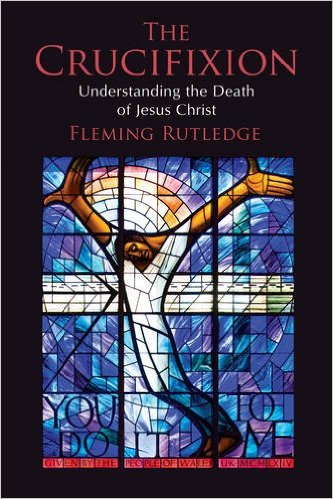
Wales WindowAnd this is where I think about the book I’m reading for Lent, The Crucifixion: Understanding the Death of Jesus Christ by Fleming Rutledge. The front-cover is an image of the “Wales Window” given to the 16th Street Baptist Church in Birmingham, Alabama. It was donated as a gift from the people of Wales after the 1963 Klan bombing that rocked the church and robbed the life of the four little, black girls in their Sunday best.

The stained glass is striking. In it, we see a Christ with brown skin, arms outstretched. Rutledge notes that the position of his head hangs at the same angle as that of an ikon called “Extreme Humiliation.” According to the artist, the two arms outstretched are doing different things. The one is thrust out, stiff-arming the powers of death and injustice, while the other reaches out, offering forgiveness for the world. Under him are the words “You do this to Me”, which come from the parable of the Sheep and the Goats in Matthew 25. Here Christ identifies himself with his people, declaring that whatever is done or not done unto them, for good or ill, for woe or weal, for blessing or curse, “you do this to me.” You do this unto me.

The central mystery of the Christian gospel is the Holy God who out of the fullness of his own, perfect life stooped, became incarnate, identifying himself with the whole of humanity, and, as the Creed has it, suffered under Pontius Pilate. The Savior is the Divine Son who knew no suffering, yet assumed human flesh, a Body in midst of a dominated people to suffer on our behalf and rise again. God became a gendered, embodied Jew in the 1st Century, heir to hundreds of years of political oppression at the hands of colonizing invaders (Babylonian, Persian, Greek), mostly recently of an empire, Rome, that stood as the chief political, economic, social, and religious power the world had ever seen. He grew up under the eye of the soldiers of a people who prided themselves as superior to every other people; a people who used subject nations and cultures to prop up their own; a people who threatened anyone who crossed that system with torture and death. And eventually it was under the administration of their laws, their justice, that his body hung naked, exposed, broken, shamed on a cross, tossed on the garbage heap of history, scorned even by the elite of his own people. In the particular sense that Coates speaks of being black, or at least, not white—that is the space that the Son of God entered in his body. That is the place that his body died.

I cannot do justice to the multifaceted character of Christ’s death, not with 3,000, nor 3,000,000 words, but the thing we must say is that the death he died, he died willingly for sin. He died in order to wipe us clean from the sins we commit as well as deliver us from the Sin we are enslaved to. He died in order to atone and liberate. He died to do justice, to ensure that forgiveness is not offered on the cheap. That reconciliation does not simply walk past restitution and truth, or support a culture of impunity.

Indeed, one the most powerful accomplishments of Christ in the visceral, flesh-ripping, godlessness of the cross is the way it tells the truth and opens our eyes to the violence of sin in the world. The hideousness of the cross, Rutledge notes, the crucifixion of this man who is God, puts to flight sentimental religion and forces us to face up to the malignant, persistent ugliness of sin. It unveils reality, much as Richard Wright writes in the poem from which Coates draws his title. To look upon “the sooty details of the scene” of our Savior upon the cross is to have them “thrust themselves between the world and me.”

And I think this moment in the Gospel is important for me to sit with when reading Coates. Obviously, a concern for the body and Coates’ totalizing fear of its loss, of his ultimate powerlessness and inability to secure it or that of his son, is crying for an answer in the good news of the Resurrection. For Christians, death is not the concluding word, and in his resurrection, Jesus actively and powerfully breaks the power of Sin, the World, the Dream, by showing that despite appearances to the contrary, it does not have the final say of things. This is what gives us hope, gives courage, gives the moral steel that accounts for the paradoxical attitude of Christians towards the body: it is precious, it is good, it is inviolable, and yet it’s loss is not our absolute terror. God’s promises do hold us up.

But the resurrection only comes as good news after we’ve sat in the shadow of the cross. Jesus is the Resurrected one only as the Crucified one. Hope for reconciliation, both personal and cultural, only comes after we’ve truly reckoned with the nature of the rupture, confessed, and repented. This is one of what I take to be the glories of the Christian gospel: it forces you to see the truth about the world, about yourself, about your neighbor—both the grime and the glory—and it is precisely there where the God with a broken body meets us.

In Lieu of a Conclusion

I have no conclusion, really. With a book like Coates’ there’s always more to say. I haven’t weighed in specifically on any particular charges, critiques, details of history, or political implications to be drawn with respect to things like reparations or #BlackLivesMatter. And I’m not really sure that’s the point.

I suppose at the end of Coates’ work–beyond a better, heavier understanding of the struggles of my neighbors–I can’t help but come away with a stronger desire to plumb the depth of the Christian gospel, to grasp the power of Christ and him crucified and speak it into the darkest reaches of the human condition without maudlin or mawkish sentimentality. A hope hell-bent on truth. A reconciliation forged through justice. A God who enters our life and then invites us into his, saying, “This is my body, broken for you.”

Soli Deo Gloria
Mere Fidelity: What is Apophatic Theology and Can It Work for You?

Mere FidelityThis week on Mere Fidelity we took up the ever-pressing issue of apophatic or negative theology (Don’t say “God is…”, say “God is not…”). To do so, we invited Dr. David Wilmington on to discuss the nature, the limits, and the proper uses of apophatic theology, especially some of the more contemporary forms drinking from the well of postmodern influences like Derrida and so forth. At core, we discuss the issue of language for God and knowledge of the God who transcends language, yet reveals himself in Scripture, nonetheless. This is an admittedly nerdy one, but we think it’s worth your time.

Soli Deo Gloria

The Paradox of Spiritual Hindsight (We Only See Sin in Light of Christ)

danger in the rearviewKierkegaard said that life can only be understood backward, but it must be lived forward. More popularly, “hindsight is 20/20.” I think there is no place this holds more truly than in the spiritual life. We’re finite beings, never more than marginally aware of the far-reaching impact upon the future of any single one of our choices. As Pascal said, if Cleopatra’s nose had been half an inch shorter, her fateful love affair with Mark Antony might never have happened, and the face of the ancient world might have been completely transformed.

But it’s not only finitude that affects our spiritual perception, but the state of our souls themselves.

Nowhere is this clearer than with the knowledge of sin. Sin is an active and malevolent evil that persists precisely because it hides itself. One of its marks is occlusion and confusion to hide in the shadows of our self-perception. The folly of sin isn’t restricted to the unintelligent either–indeed, at times is worse with the intellectually gifted. The smarter you are, the more complex and clever your self-justifications and rationalizations. Total Depravity, in case you were wondering, is really about this sort of dynamic–there’s no part of your self that’s pure, clean, and unaffected by sin. Even the more “noble” bits of you like the intellect have been corrupted by sin.

This leads to one of the many paradoxes of Christianity–the reality is that we only see our sin truly once we’ve begun to repent of it. Of course, someone could easily object that it’s unsurprising that once you become a Christian you begin to find more sins than you did before–that’s how brainwashing works! If we reflect on it, though, we can see the way this paradox makes quite a bit of sense without resorting to the brainwashing interpretation.

C.S. Lewis shed some light on the dynamic in his classic Mere Christianity:

When a man is getting better he understands more and more clearly the evil that is still left in him. When a man is getting worse, he understands his own badness less and less. A moderately bad man knows he is not very good: a thoroughly bad man thinks he is all right. This is common sense, really. You understand sleep when you are awake, not while you are sleeping. You can see mistakes in arithmetic when your mind is working properly: while you are making them you cannot see them. You can understand the nature of drunkenness when you are sober, not when you are drunk. Good people know about both good and evil: bad people do not know about either.

Many of you have seen this, right? The friend who has maybe had one or two drinks will listen if you tell them to slow down, but if they’ve had four or five, they’re not as likely to see the need.

Or again, if you’ve ever gotten new glasses, you know that you might have some sense of the fact that your vision has trouble for a while. But after getting your glasses for the first time, or the next prescription, you put them on and marvel at how clear the world becomes. It’s only after you begin to see clearly that you exclaim, “I never knew my eyesight was so bad!”

Karl Barth, in his own, inimitable way, painted a vivid picture of the paradox in a sermon on Ephesians 2:8 that he preached to inmates in his hometown of Basel:

You probably all know the legend of the rider who crossed the frozen Lake of Constance by night without knowing it. When he reached the opposite shore and was told whence he came, he broke down horrified. This is the human situation when the sky opens and the earth is bright, when we may hear: By grace you have been saved! In such a moment we are like that terrified rider. When we hear this word we involuntarily look back, do we not, asking ourselves: Where have I been? Over an abyss, in mortal danger! What did I do? The most foolish thing I ever attempted! What happened? I was doomed and miraculously escaped and now I am safe! You ask, Do we really live in such danger? Yes, we live on the brink of death. But we have been saved. Look at our Savior, and at our salvation! Look at Jesus Christ on the cross…Do you know for whose sake he is hanging there? For our  — because of our sin — sharing our captivity — burdened with our suffering! He nails our life to the cross. This is how God had to deal with us. From this darkness he has saved us. He who is not shattered after hearing this news may not yet have grasped the word of God: By grace you have been saved!”

Lewis shows us the way sin clouds our sense of sin, our conscience, or judgment about these things in ourselves, but while he hits on the subjective dimension, to the knowledge of sin, while Barth points us to the objective side. You see, while it’s possible to begin to recognize the reality of sin, the fact of sin, and even our own complicity, it’s not until we see Christ crucified for us that we truly understand the magnitude of it. The Son of God, murdered, hanging from the executioner’s gibbet is what my sin cost.

Of course, we only see that once we’ve come to see Christ crucified for me–that is, once we are Christ’s.  Not only was my sin that costly, my danger that pressing, my guilt that grotesque, so also was God’s love for me that magnificent. It is precisely in this way that God shows his love for us, in that while we were yet sinners, Christ died for the ungodly (Romans 5:8).

Pascal was caught up with the beauty and mystery of this paradox. He constantly spoke of the necessity of recognizing our greatness as created in God’s image and our wretchedness as sinners without God. In fact, part of our greatness is in the fact that we know we’re wretched! A tree can’t know it’s wretched, but we can. Of course, part of our wretchedness comes with the fact that we don’t know we’re wretched. And when you do know that you’re wretched, well, it’s crushing.

Pascal realized there’s only one way to know them both properly and that is in the light of Christ:

Knowing God without knowing our own wretchedness makes for pride. Knowing our wretchedness without knowing God makes for despair.

Knowing Jesus Christ strikes the balance because he shows us both God and our own wretchedness. –Pensees, (527)

Coming to know Christ helps us come to a knowledge of sin that simultaneously lifts us up and humbles us. He shows us our greatness and our wretchedness. He gives us God and a right recognition of our sin at once in light of his own glorious and horrible cross.

Or, as Tim Keller often puts it, “We’re far worse than we ever could have imagined, and far more loved than we could ever dream.”

Soli Deo Gloria

Mere Fidelity: Have Evangelicals Become Too Obsessed With Politics?

Mere FidelityIt’s election season again, which means that politics is on our mind more than it usually is. But is it too much? This episode of Mere Fidelty, Matt, Alastair, and I discuss the problem of political engagement and obsession in the church. We take up issues like the disconnect between different political and theological classes, the work of James Davison Hunter & the culture war syndrome, the problem of loudest voice in the room, instrumentalizing the faith, and so forth. And we even give Alastair a fantastic new nickname. You won’t want to miss this one.

Soli Deo Gloria