In Christ, I Am Not My Problems

addiction-28I was talking to a buddy the other day about the benefits and drawbacks of programs like AA and NA for dealing with addiction. While there is no denying the efficacy and overall benefit of the programs, my buddy struggled with the fact that so often people in the program are trained to identify themselves with their problems. Of course, that only solidifies the addiction’s grip on our life and imagination because we live out of our perceived identities.

Paul David Tripp, again, cuts to the heart of why creating an identity beyond our problems and sins is so crucial for actually overcoming them:

In the press of everyday life, it is easy to forget who we are. As we try to replace old behaviors with new ones, it is easy to take our eyes off our status as children of God. In fact, the longer we struggle with a problem, the more likely we are to define ourselves by that problem (divorced, addicted, depressed, co-dependent, ADD). We come to believe that our problem is who we are. But while these labels may describe particular ways we struggle as sinners in a fallen world, they are not our identity! If we allow them to define us, we will live trapped within their boundaries. This is no way for a child of God to live!

There is a radical difference between saying, “I am a depressed person,” and saying, “I am a child of God ‘in Christ’ and I tend to struggle with depression.” The second statement does not pretend the war isn’t raging, but it is infused with hope. It says, “Yes, I wrestle with depression every day, but I am not alone. I do not rest on my own strength and wisdom. I have come to understand that my Creator and Savior is also my Father. I am beginning to grasp how rich I really am because of my place in his family, and I am learning to live out of the riches he has provided, rather than the poverty of the identities I used to assign myself.” It is never a waste of time to remind people of who they are in Christ. Doing so stimulates hope, courage, and faith. —Instruments in the Redeemer’s Hands, pp. 260-261

Instead of identifying ourselves primarily in terms of our struggles, the Biblical call is to constantly remember who we are in Christ and the great resources that come with being a part of the family of God. It is only as we are reshaped in light of the Gospel by the power of the Spirit that we are able to become the kind of people who, yes, struggle, but in Christ are defined by his victory, not our failure.

Soli Deo Gloria

Jesus, Our Only Comfort

In the face of the Newton tragedy, we don’t need easy, trite answers, but the deep, bedrock truths that comfort and sustain us through all of life. Thankfully Kevin DeYoung reminds us that we have catechisms for such occasions, especially the Heidelberg:

Q1. What is your only comfort in life and in death?

A1. That I am not my own,
but belong–
body and soul,
in life and in death–
to my faithful Savior Jesus Christ.

He has fully paid for all my sins with his precious blood,
and has set me free from the tyranny of the devil.
He also watches over me in such a way
that not a hair can fall from my head
without the will of my Father in heaven:
in fact, all things must work together for my salvation.

Because I belong to him,
Christ, by his Holy Spirit,
assures me of eternal life
and makes me wholeheartedly willing and ready
from now on to live for him.

(The Heidelberg Catechism, Question and Answer 1)

The catechism points us to the only deep comfort we can have in the face of truly horrendous evil: Jesus Christ. I will have some thoughts on this whole thing in a later blog, but for now, I’d like to just offer you a song that’s been of great comfort to me in times of distress. In “Revelator” Josh Garrels gives us John’s vision of comfort to the martyrs in Revelation 5, of the Lamb who was Slain, seated on the throne, the suffering but victorious Lord of history. Take a few minutes to listen, read the lyrics, maybe go read Revelation 5, and look to Jesus.

Had a dream I was alone
A vast expanse of complete unknown
Sea of glass so clear it shone,
Like gold
Then a voice like thunder clapped,
As a dead man I collapsed
I am the first, I am the last,
Now rise my son

Then behold ten thousand kings,
And every creature worshipping
Every eye was on one thing,
One man
He’s like a lion like a lamb,
As though slain he holds the plan
To make war and peace with man,
And reign on earth

Holy, Holy, is the One,
Who was, and is, and is to come
In a robe as red as blood,
He comes forth
Ride like lightning in the sky,
On the war horse he draws nigh,
The same one we crucified,
Will return again

Holy, Holy, is the One,
Who was, and is, and is to come
In a robe as red as blood,
He comes forth
Ride like lightning in the sky,
On the war horse he draws nigh,
The same one we crucified,
Will come again

Soli Deo Gloria

Thomas Oden on the Joy of Studying Theology

People don’t always understand why I geek out over theology. They don’t get how I can spend hours and hours reading it, sifting, thinking, talking to friends, stroking my luxuriant beard in deep thought, and reading more about what I just read about. Thomas Oden quickly cuts to the chase in his systematic theology Classic Christianity (as of 12/12/2012 on Kindle for the stupid price $3.79):

You are invited to the quiet joy of the study of God—God’s being, God’s power, God’s insurmountable goodness, and God’s unfailing care of creation. Over centuries this subject has been the source of contemplative happiness, intellectual fascination, and moral guidance…The most intriguing questions of the introductory study of God can be stated in plain, uncomplicated words:

classic 2Is God uncreated?

Is God free?

Is God personal?

Is God compassionate?

Does God exist?

Does Jesus reveal God?

Does God care about us?

Why are we born?

Why do we die?

How do we draw closer to God?

How may we participate in God’s life?

Does scripture reveal God?

Does the reception of revelation call for reasoning?

Oden, Thomas C. (2009-07-23). Classic Christianity (pp. 15-16). Harper Collins, Inc.. Kindle Edition.

Theology is fascinating because at the end of the day, theology is about God, the source of all joy. If none of these questions even mildly interest you, if you never engage with them, if you never are drawn to think or meditate on their truth, you will miss out on joy. It’s that simple. I love theology because it leads to joy.

Quick-Blog #2- B.B. Warfield on the “un-Biblical” but Scriptural Doctrine of the Trinity

What does it mean for a doctrine to be ‘biblical’? Does there have to be a verse expressly stating it? Can we use only biblical words to express it? Is any teaching that departs from the explicit language of the Old and New Testaments thereby suspect? The Old Princeton giant B.B. Warfield helpfully shows us how a doctrine can (and sometimes must) be expressed in un-biblical language and yet be thoroughly scripturally-rooted.

The term “Trinity” is not a Biblical term, and we are not using Biblical language when we define what is expressed by it as the doctrine that there is one only and true God, but in the unity of the Godhead there are three coeternal and coequal Persons, the same in substance but distinct in subsistence. A doctrine so defined can be spoken of as a Biblical doctrine only on the principle that the sense of Scripture is Scripture. And the definition of a Biblical doctrine in such un-Biblical language can be justified only on the principle that it is better to preserve the truth of Scripture than the words of Scripture. The doctrine of the Trinity lies in Scripture in solution; when it is crystallized from its solvent it does not cease to be Scriptural, but only comes into clearer view. Or, to speak without figure, the doctrine of the Trinity is given to us in Scripture, not in formulated definition, but in fragmentary allusions; when we assembled the disjecta membra into their organic unity, we are not passing from Scripture, but entering more thoroughly into the meaning of Scripture. We may state the doctrine in technical terms, supplied by philosophical reflection; but the doctrine stated is a genuinely Scriptural doctrine.

-The Biblical Doctrine of the Trinity, B.B. Warfield

You can read the whole article here. It’s dense at some points and the language is a little dated, but this gem is entirely worth your time.

The Grace of Adoption

There’s been a lot written about the doctrine of adoption lately, both in books and around the blogosphere.  The doctrine that we are made God’s children in Christ, not just by nature, but through a sure and firm, though gracious adoption has become a great comfort to me and my wife over the last couple of years. J.I. Packer was on to something when he said that the richest description of a Christian was someone who “has God for his Father.” (Knowing God, pg. 181)

I plan on returning to this theme in the future, but I wanted to share one of my favorite descriptions of what is meant by and entailed in God’s adoption of us as his children. The Westminster Confession states in its 12th chapter:

All those that are justified, God vouchsafes, in and for His only Son Jesus Christ, to make partakers of the grace of adoption,251 by which they are taken into the number, and enjoy the liberties and privileges of the children of God,252 have His name put upon them,253 receive the spirit of adoption,254 have access to the throne of grace with boldness,255 are enabled to cry, Abba, Father,256 are pitied,257 protected,258 provided for,259 and chastened by Him as by a Father:260 yet never cast off,261 but sealed to the day of redemption;262 and inherit the promises,263 as heirs of everlasting salvation.264

This is rich and worth meditating on. I’ve left all of the footnotes in the text and included the verse references below. Take some time this weekend, and maybe the next week to read through and around these verses, considering and delighting in what it means to “Have his name put upon them” and to be one of those who have been made “partakers of the grace of adoption.”

251 EPH 1:5 Having predestinated us unto the adoption of children by Jesus Christ to himself, according to the good pleasure of his will.
GAL 4:4 But when the fulness of the time was come, God sent forth his Son, made of a woman, made under the law, 5 To redeem them that were under the law, that we might receive the adoption of sons.
252 ROM 8:17 And if children, then heirs; heirs of God, and joint-heirs with Christ; if so be that we suffer with him, that we may be also glorified together.
JOH 1:12 But as many as received him, to them gave he power to become the sons of God, even to them that believe on his name.
253 JER 14:9 Why shouldest thou be as a man astonied, as a mighty man that cannot save? yet thou, O Lord, art in the midst of us, and we are called by thy name; leave us not.
2CO 6:18 And will be a Father unto you, and ye shall be my sons and daughters, saith the Lord Almighty.
REV 3:12 Him that overcometh will I make a pillar in the temple of my God, and he shall go no more out: and I will write upon him the name of my God, and the name of the city of my God, which is new Jerusalem, which cometh down out of heaven from my God: and I will write upon him my new name.
254 ROM 8:15 For ye have not received the spirit of bondage again to fear; but ye have received the Spirit of adoption, whereby we cry, Abba, Father.
255 EPH 3:12 In whom we have boldness and access with confidence by the faith of him.
ROM 5:2 By whom also we have access by faith into this grace wherein we stand, and rejoice in hope of the glory of God.
256 GAL 4:6 And because ye are sons, God hath sent forth the Spirit of his Son into your hearts, crying, Abba, Father.
257 PSA 103:13 Like as a father pitieth his children, so the Lord pitieth them that fear him.
258 PRO 14:26 In the fear of the Lord is strong confidence: and his children shall have a place of refuge.
259 MAT 6:30 Wherefore, if God so clothe the grass of the field, which to day is, and tomorrow is cast into the oven, shall he not much more clothe you, O ye of little faith? 32 For after all these things do the Gentiles seek: for your heavenly Father knoweth that ye have need of all these things.
1PE 5:7 Casting all your care upon him; for he careth for you.
260HEB 12:6 For whom the Lord loveth he chasteneth, and scourgeth every son whom he receiveth.
261 LAM 3:31 For the Lord will not cast off for ever.
262 EPH 4:30 And grieve not the holy Spirit of God, whereby ye are sealed unto the day of redemption.
263 HEB 6:12 That ye be not slothful, but followers of them who through faith and patience inherit the promises.
264 1PE 1:3 Blessed be the God and Father of our Lord Jesus Christ, which according to his abundant mercy hath begotten us again unto a lively hope by the resurrection of Jesus Christ from the dead, 4 To an inheritance incorruptible, and undefiled, and that fadeth not away, reserved in heaven for you.HEB 1:14 Are they not all ministering spirits, sent forth to minister for them who shall be heirs of salvation?

It Takes a Hard Forehead and a Heavy Heart to Preach

Thinking about preaching while reading the prophets is a sobering thing. Whether it’s Isaiah’s commission to preach to a deaf and blind people, or Jeremiah’s call to go preach without fear to those who threaten his life and reject his message, the prophets don’t exactly make good promo material for aspiring seminarians.  (“Preaching God’s Word–Learn how to do it without getting killed.”) Nevertheless they are essential reading for anyone trying to engage in ministry within the church, especially the ministry of the Word. I was reminded of this again this week as I came to Ezekiel in my devotional.

Ezekiel’s Assignment and Ours

In Ezekiel 2-3, Ezekiel receives his commission to preach to the wicked, rebellious house of Israel in a vision. The basic call was to persevere in preaching the word of the Lord no matter what because through him God will make them know that “a prophet has been among them.” (2:5) This seems tough, but encouraging right? I mean, he is told that it will be evident that Ezekiel is God’s anointed prophet. God will be with him powerfully. That’s gotta be good?

Eh, not so much. There’s more.

See, while promising to be with him, God also makes it clear he’s not going to be greeted with a lot of success. He is going to be rejected. His message will fall on rebellious ears and stubborn hearts. He says that he’s sending him to a people who are so stubborn that, even though the message is not hard to understand, and the language is not a barrier, even so, they will reject it because they continually reject God. (3:6) Yet still, God calls him to be a “watchman” over the house of Israel (3:17), preaching a warning to God’s people so that they might turn, repent, and not come under judgment. Knowing that the people will rebel, knowing that they will reject him, knowing the difficulty he is still to preach the word of the Lord.

How are we to preach under conditions like this? What drives faithfulness in situations like this? How do we bear up under the pressure? Most of us don’t think about this going in. I mean, we might “know” it’s going to be hard. We might “know” that if we faithfully preach the word, not all that we say is going to be received well. Nevertheless, coming face to face with recalcitrant members of the body, people who won’t repent, members you’re intimidated to speak honestly to for fear of causing them to leave, can catch some of us off guard and make us lose our nerve. Even with the Spirit of God indwelling the hearts of believers, nobody likes being told to repent. The house of Israel can still be a rebellious people this side of the Cross.

A Hard Forehead

So what do you need to preach faithfully to people with stubborn hearts? First of all, you apparently need some good facial bone density.

Early in the chapter the Lord says to Ezekiel, “But the house of Israel will not be willing to listen to you, for they are not willing to listen to me: because all the house of Israel have a hard forehead and a stubborn heart. Behold, I have made your face as hard as their faces, and your forehead as hard as their foreheads. Like emery harder than flint have I made your forehead. Fear them not, nor be dismayed at their looks, for they are a rebellious house.”(3:7-9)

The Lord uses the picture of Israel having a “hard forehead” after years of rebellion; they were people with a stubborn will that won’t be turned aside, having set their face against the Lord. God tells Ezekiel that as hard as their forehead was, he would make Ezekiel’s that much firmer. God would give Ezekiel a strength of will, a forehead harder than flint that was used to strike a fire. We need a supernaturally emboldened will to preach. Ezekiel did not derive his boldness from his own strength—his strength was the Lord’s. It was the Spirit of God who proved to be the firm ground on which he could make his stand.  You can’t preach to a stubborn people if your will is weaker than theirs. Inevitably heads will butt and someone’s will have to break. Pray for the sake of your people that it’s not yours.

A Heavy Heart

Your people need you to have a hard forehead because this passage also teaches us that our message is a weighty one. It can only be preached with heavy heart, burdened with the gravity of God’s words. That’s the only way I know how to describe the Lord’s charge in the middle of the chapter. God tells Ezekiel that he must preach to the people because unless he does he’s accountable for their blood.

“Son of man, I have made you a watchman for the house of Israel. Whenever you hear a word from my mouth, you shall give them warning from me. If I say to the wicked, ‘You shall surely die,’ and you give him no warning, nor speak to warn the wicked from his wicked way, in order to save his life, that wicked person shall die for his iniquity, but his blood I will require at your hand. But if you warn the wicked, and he does not turn from his wickedness, or from his wicked way, he shall die for his iniquity, but you will have delivered your soul. Again, if a righteous person turns from his righteousness and commits injustice, and I lay a stumbling block before him, he shall die. Because you have not warned him, he shall die for his sin, and his righteous deeds that he has done shall not be remembered, but his blood I will require at your hand. But if you warn the righteous person not to sin, and he does not sin, he shall surely live, because he took warning, and you will have delivered your soul.”  (3:16-21)

God says that he will punish the wicked and forgive the repentant according to their own actions, but Ezekiel is still held liable for whether he preached the word of repentance to them or simply left them to their wickedness.

All throughout the Scriptures there is a weight to being a preacher and teacher of God’s Word. (Jas 3:1; Heb 13:17) They are to be faithful shepherds to the flock knowing they must give an account to the True Shepherd. (1 Peter 5:1-4) Paul tells Timothy “Watch your life and doctrine closely. Persevere in them, because if you do, you will save both yourself and your hearers.” (1 Tim. 4:16)

Preachers have to know that there is a weight to the words we speak. We’re not just bandying about interesting ideas that are fun to debate sometimes. We are preaching the difference between life and death, both in this life and what follows.  . This knowledge should drive us to set our foreheads like flint and preach no matter the “result.” All too often we pull back for fear of the “results” when the results of pulling back are far more terrifying. Instead, our charge should propel us forward, to humbly, but confidently speak “thus says the Lord” for the sake of our hearers.

Getting Weightier Hearts and Tougher Craniums

A lot of us reading Ezekiel 3 know that we don’t have that hard forehead or that heavy heart. In moments of weakness I want to turn aside from saying what I need to say and console myself with the thought that, in the grand scheme of things, my words won’t really make that great a difference. The bracing truth is that this is a lie that our people can’t afford for us to believe.

How do we gain some weightier hearts and tougher craniums?

  1. Pray. It’s that simple. God promises that HE will make Ezekiel’s forehead hard. We need to be on our knees, pleading with God for the might to bear up under the pressure. The Spirit is the only one who can impress upon our hearts the burden of the word as well as give us the courage we need.
  2. Preach the word alone. We gain strength and passion for preaching when we commit ourselves to studying and wrestling with God’s word in order to present it to God’s people. It is then that we are convinced and convicted of what God has said,; it is then that we are unhindered by the ambition to forward our own clever ideas; it is then that our fears are quenched that would cause us to shrink from our task. “But when I speak with you, I will open your mouth, and you shall say to them, ‘Thus says the Lord GOD.’ He who will hear, let him hear; and he who will refuse to hear, let him refuse, for they are a rebellious house.” (Ezek 3:27) When we preach the word and that alone it gives us confidence that it is the Lord “opening our mouth.”

Once again, I offer these incompletely reformed thoughts more as a prayer for my own ministry than as the distilled wisdom of achieved experience.

Soli Deo Gloria

Progressive God-Talk, Reformed Theological Method, The Doctrine of Analogy, and God’s Grace in our Knowledge

(Warning: this is a mildly dense one. If you haven’t had coffee yet, you might want to grab some, then come back. Also, it might seem dry at first, but there’s a punch-line you don’t want to miss.)

Progressive God-Talk

A few days ago, progressive author and blogger, Tony Jones threw down a challenge to his fellow progressive bloggers to start actually saying something substantive about God, “Not about Jesus, not about the Bible, but about God”, because they seem to  “have a God-talk problem. That is, progressives write lots of books and blog posts about social issues, the church, culture, and society. But we don’t write that much about God. That is, we don’t say substantive things about who God is, what God does, etc.”

I don’t have a lot to say on the subject of liberal God-talk at this point, except that its been interesting to watch as it unfolds (or the way it doesn’t.) My hope is that more liberal/progressives do post substantive pieces of theology so that a real discussion of the nature and character of God can ensue.

One thing I do have something to say about is the topic of Reformed God-talk, and the attitude that those of us who engage in theology out of the Reformed tradition should take towards the conversation that’s happening right now amongst the progressives. To do that, though, I’m gonna call in a little help.

Reformed Theological Method (Or how Reformedish people go about thinking about God)

A while back I read a great article by Michael Horton on the Reformed theological method in conversation with Open Theism that will be helpful to our conversation. In it he deals with the common charge made that the Reformed scholastics were too dependent on “Hellenistic” thought or Greek speculative, systematizing which distorted the true, “dynamic”, biblical portrait of God. Leaving aside the problem that many who lodge this charge are guilty of the genetic fallacy, Horton shows that, in fact, “Contrary to popular caricature, Reformed scholasticism championed an anti-speculative and anti-rationalistic theological method based on the Creator-creature distinction.” He quotes Francis Turretin as representative of the tradition when he says,

But when God is set forth as the object of theology, he is not to be regarded simply as God in himself . . . , but as revealed . . . Nor is he to be considered exclusively under the relation of deity (according to the opinion of Thomas Aquinas and many Scholastics after him, for in this manner the knowledge of
him could not be saving but deadly to sinners), but as he is our God  (i.e.,covenanted in Christ as he has revealed himself to us in his word) . . .

Thus although theology treats of the same things with metaphysics, physics and ethics, yet the mode of considering them is far different. It treats of God not like metaphysics as a being or as he can be known from the light of nature; but as the Creator and Redeemer made known by revelation . . . For theology treats of God and his infinite perfections, not as knowing them in an infinite but in a finite manner; nor absolutely as much as they can be known in themselves, but as much as he has been pleased to reveal them.

So, theology treats, not of God in general, but of God as he has given himself to us in Christ and in the history of Israel as attested to in the Scriptures. This straight from the mouth of Turretin, the Reformed Aquinas and the grand-daddy of all post-Reformation dogmaticians.

Horton then outlines then expands on 4 important distinctions that flow from the Creator/creature distinction that give Reformed theology its particular shape (transcendence and immanence, hidden/revealed , eternal decree/temporal execution, and archetypal/ectypal knowledge). We don’t have space to go into all of them here, but the final one, the archetypal/ectypal knowledge distinction is important for us. This distinction teaches that God’s knowledge is archetypal and primary, while our knowledge is ectypal and dependent on God’s. Horton writes that:

“It is the epistemological corollary of the ontological Creator-creature distinction. Although it had been a category in medieval system, Protestant dogmatics gave particular attention to this distinction and made it essential to their method. Just as God is not merely greater in degree (“supreme being”), but in a class by himself (“life in himself,” John 5:26), his knowledge of himself and everything else is not just quantitatively but qualitatively different from that of creatures…affirmation of this distinction is essential if we are to maintain with Scripture that no one has ever known the mind of the Lord (Rom 11:34, where the context is predestination), that his thoughts are far above our thoughts (Isa 55:8), and that he is “above” and we are “below” (Eccl 5:2)—if, in other words, we are to truly affirm the Creator-creature distinction.”

So, the idea is that because there is a radical gap in reality between God and ourselves–he is necessary, infinite, transcendent, etc. and we are contingent, finite, bound–there is also a radical gap in our knowledge. In the same way that God’s reality is at a higher level than ours and sustains ours, the same is true of our knowledge. It’s not just that we know less stuff, but that we know the stuff we do in a lesser way than God does.  This is not to say that we don’t have true knowledge, any more than to say that we are not real, simply because we’re not on the same ontological playing field as God, but that our knowledge is at a lower level than God does and is.

The Doctrine of Analogy (“God is…”)

With this distinction in hand, our discussion brings us to the doctrine of analogy, which has a long history both in Catholic and Protestant theology. I’d explain it, but here’s Horton again:

“All of this leads us, finally, to the doctrine of analogy. When we assert certain predicates of God, based on God’s own self-revelation, we use them in one of three senses: univocally, analogically or equivocally. If we say that the predicate “gracious” means exactly the same thing, whether in God or in a creature, we are using “gracious” univocally. At the other end of the spectrum, if we say that by using that predicate we are ascribing something to God whose appropriateness is unknown to us, we are using it equivocally. If, however, God is said to be “gracious” in a way that is both similar and dissimilar to creatures, we say it is analogical. For instance, when we acknowledge that God is a “person,” do we really mean to say that he is a person in exactly the same sense as we are? When we follow Scripture in using male pronouns to refer to God, do we really believe that he is male? Unless we are willing to ascribe to God (in an univocal sense) all attributes of human personhood, predications must be analogical. Human language cannot transcend its finitude, so when God reveals himself in human language, he draws on human analogies to lead us by the hand to himself. It is correct description, but not univocal description.”

This is a useful doctrine for many reasons, but as Horton points out, it both acknowledges human finitude unlike rationalistic, univocal approaches to God-talk, as well as gives a place for real knowledge of God unlike modern, skeptical, equivocal approaches God.

Calvin’s Lisp, or God’s Grace in our Knowledge

Why do I bring all of this up? Well, aside from the fact that it’s just important for theology as a discipline, it’s important for our own theology as a part of life. It’s very easy for theology types to get really puffed up when it comes to their “knowledge” of God and his ways. Paul had to administer many a 1st Century beat-down over this in the church in Corinth. (cf. 1 Cor 1-4) What all of this points to is that this should not be so for Christians, especially for those who claim to be Reformed. Listen to Horton again:

“Thus, Calvin and the Reformed do not use analogy as a fall-back strategy when they find something that does not fit their system. Rather, it is the warp and woof of their covenantal approach, a necessary implication of the Creator-creature relationship as they understand it. All of God’s self-revelation is analogical, not just some of it. This is why Calvin speaks, for instance, of God’s “lisping” or speaking “baby-talk” in his condescending mercy. Just as God comes down to us in the incarnation in order to save us who could not ascend to him, he meets us in Scripture by descending to our weakness. Thus, not only is God’s transcendence affirmed, but his radical immanence as well. Transcendence and immanence become inextricably bound up with the divine drama of redemption. Revelation no less than redemption is an act of condescension and grace.”

All of our knowledge of God is had by God’s grace. It’s not just that we find out about a gracious God when we hear the Gospel, but that our hearing the Gospel at all is an act of grace! Our very knowledge of God is God’s kindness, God’s condescension to take up our feeble language and use it in powerful ways to speak to us of his great love. For the Reformed, it should be grace all the way down to your epistemology.

This is why it makes no sense at all for us to boast, or pride ourselves as better than others because of our ability to say and believe true things of God or on our theological systems and tradition. These are good things; they’re great. They’re a rich resource. They can be a great blessing. They can be all of these things, but the one thing they cannot be, must not be, is a source of arrogance or pride. Instead  every truth we utter or find in one of our dogmatics should be a reminder of God’s grace, not our own awesomeness.

So, if you’re cruising around the blogosphere, or just in life, reading people or hearing people talk about God in what you find to be silly fumbling, or inadequate ways, your first instinct should not be to look on condescendingly or pridefully, but remember God’s condescension that made your knowledge possible. When you get that point, maybe, just maybe you can engage in a loving, humble conversation about God and his truth with those whom you disagree.

Beefing Up Your “Quiet Times”: Catechisms and Confessions as Devotional Literature

A little bit ago, a buddy of mine was musing about the fact that he doesn’t connect to most devotional literature of the type that truly “spiritual” people normally rave about. His critical, analytical mind and personality just doesn’t connect with warm meditation, but rather with critical analysis of history and culture.

For a while I’d found myself in a similar place. After seminary, my devotional life became a bit trickier. I find that my mind comes most alive to God when I’m reading systematic theology, or wrestling with some interesting piece of biblical theology, but when I try to slow down, pause, and meditate on something like My Utmost for His Highest, I just can’t do it. (That’s not to disparage Chambers. I loved it in college. The sad thing is, most current, popular stuff doesn’t even come close to his depth.) Because of this, finding good devotional material has been a challenge.

This didn’t trouble me much at first. I would simply pray, read my Bible, and then move on to my academic reading. Still, after a while I realized that I need a slowing down, a place for a more contemplative, heart-oriented approach to God in my devotional life. When I “just read my Bible” I found it hard to turn off the analytic mode. When I did, I didn’t really find my heart moved, but rather just bored.

The Good News We Almost Forgot

Just when I thought all was lost, I got my hands on The Good News We Almost Forgot: Rediscovering the Gospel in a 16th Century Catechism by Kevin DeYoung. The book is basically a commentary on the Heidelberg Catechism, which you can read for yourself here. For those of you unfamiliar with catechisms, they are a series of questions and answers designed to be memorized by either new believers, old believers in need of depth, or children in order to teach them the content of the Christian faith. They’re employed across various confessional church traditions and they usually they have scripture references attached to the answers for believers to look up and study as well.

The Heidelberg Catechism was written at the University of Heidelberg at the commission of Elector Frederick III and was approved by the Synod of Heidelberg in 1563. The Catechism has 129 questions and answers that are basically commentary on the Apostles’ Creed, the Lord’s Prayer, and the 10 Commandments, but it is divided into fifty-two sections, called “Lord’s Days,” so that pastors could preach through them on each of the 52 Sundays of the year.  It is one of the most universally recognized pieces of Reformed theology across confessions and was adopted by the great Synod of 1618-1619, as one of the Three Forms of Unity, along with the Canons of Dort and the Belgic Confession.

How exciting!!!

Now for myself, having been raised in a barely-denominational Friends church, I hadn’t spent more than a minute with anything like a catechism, except to know \the Westminster Shorter Catechism’s famous first question and answer: “Q. What is the Chief End of Man? A. Man’s chief end is to glorify God and enjoy him forever.”  To my less-than-enlightened mind that was great, deep, but spare stuff.  The thought of spending a whole book reading about a catechism didn’t originally strike me as an edifying experience, because at that point, “I already knew that stuff.”

Still, my buddy told me that he’d been using DeYoung’s book as a devotion because it breaks up into 52 short chapters (2-3 pages) commenting on each of the Lord’s days.  I figured, why not? It can’t hurt.

After a short introduction to the catechism much more exhaustive than my paragraph, I got to the first Lord’s Day and read Question and Answer 1:

Q. What is your only comfort in life and in death?
A. That I am not my own, but belong—body and soul, in life and in death—to my faithful Savior, Jesus Christ. He has fully paid for all my sins with his precious blood, and has set me free from the tyranny of the devil. He also watches over me in such a way that not a hair can fall from my head without the will of my Father in heaven; in fact, all things must work together for my salvation. Because I belong to him, Christ, by his Holy Spirit, assures me of eternal life and makes me wholeheartedly willing and ready from now on to live for him.

When I read this I nearly started to tear up immediately. The first sentence alone gripped me: “I am not my own.” There is nothing sterile, dry or impersonal about this answer. At the same time, it deploys in a matter of sentences the doctrines of atonement, providence, adoption, union with Christ, the Holy Spirit, assurance, and sanctification, in order to draw me into the saving reality of the Gospel. As you read through the rest of the catechism, there are other questions of similar depth and power. DeYoung’s commentary each day was solidly theological, scriptural, and very pastoral. For the next month and a half I found myself daily edified by the truths encapsulated in the short answers and the meditation that followed.

I had finally found something to found the devotional gap in my life.

Why Read Catechisms– After this I went on a search and started reading through the different catechisms and confessions I could find, (Westminster, Luther’s, Belgic, Scots), as a part of my daily time of prayer and scripture. I found myself time and time again, blessed, challenged, and moved to worship and delight. I also found myself wondering why I had never done this before.

If you’ve never spent time with a catechism, here are three reasons you should in no particular order.

1. Hearing voices from other centuries– Christianity has been around for 2,000 years. This means that Christians have been reading, praying, thinking, and writing about the Gospel for 2,000 years. It is foolish to not pay attention to what our mothers and fathers in the faith have said in past generations as if the truth of the Gospel had a 2 month shelf-life. Their voices are needed if we are to hear the Gospel in all of its fullness in our own day. Catechisms  are a great way of doing that given that most of them were written centuries ago and have still been found spiritually beneficial after all of these years.

2. Deep truths; short phrases. Most catechisms and confessions are doing serious theology and yet condensing it down into short, memorable phrases that are perfect for meditation and contemplation throughout the day. They are perfect for engaging the mind as well as the heart with the truth of God throughout your day.

3. Know Your Bible- Finally, most catechisms and confessions are packed to the gills with scriptural references backing up every statement. You can trace them down as a devotional exercise that can help you get to know your Bible better than you did before, as well as learn the deep, biblical basis for what we believe. It also can help you get into the scriptures in a focused, guided way that is less intimidating for some people than just opening the thing up and reading it.

Where Do I Start?

Honestly, I think DeYoung’s book, The Good News We Almost Forgot is a great place to start. I don’t have a copy of my own any more because I keep giving it away. When one of my college students asks me if I know of a book they should read, it’s one of the first two or three that I recommend.

If you want to start checking out catechism right away, you can start here.

G.K. Beale on the difference between a “Literal” and a “Biblical” Hermeneutic of Old Testament Prophecies

G.K. Beale is quickly becoming one of my favorite New Testament interpreters. He has a long list of impressive works including authoring what is likely the new standard commentary on the book of Revelation, editing the New Testament Commentary on the New Testament use of the Old Testament, and delivering the recent tome that is A New Testament Biblical Theology: The Unfolding of the Old Testament in the New. Needless to say based on the titles of these last two works, one of his specialties is the problem of the interpretation of the use of the Old Testament, especially prophecies, in the New Testament.

One of the main issues in this area of study is whether or not certain interpretations, both by the NT authors and their later commentators, seem to illegitimately “spiritualize” the fulfilment of a “literal” prophecy. Beale has a helpful passage on this very problem with respect to his interpretation of the Antichrist (“the man of lawlessness”) and the Temple in 2 Thessalonians in his work The Temple and the Church’s Mission: A Biblical Theology of the Dwelling Place of God.  One of the central contentions of his book is that in the NT, the Temple is replaced by Christ and in Christ by the people of God.  Therefore, the reference to the Temple in 2 Thessalonians is a reference to the church. On this basis and many other exegetical insights he claims that the prophecies of Daniel being alluded to in the text about the man of lawlessness setting up his rule in the Temple are ultimately taking place in the Church, not in some reconstructed Temple in Jerusalem as is commonly thought in popular Dispensationalism.

Obviously, for those advocating a strictly “literal hermeneutic” this will be a hopelessly spiritualizing interpretation that violates the principle by which all Scripture is to be interpreted. His responses to this charge are instructive both for general biblical hermeneutics as well as the specific problem of prophecy:

First, a ‘literal hermeneutic’ is not the best way to describe a biblical hermeneutic. Perhaps a ‘literate hermeneutic’ that aspires to the broad literary meaning in the canonical context is the better way to put it. We should want to follow an interpretive method that aims to unravel the original intention of biblical authors, realizing that that intention may be multi-layered, without any layers contradicting the others. Such original intentions may have meaning more correspondent to physical reality (hence so-called ‘literal interpretation’) while others may refer to ‘literal’ spiritual realities…”

So, there is a difference between reading something “literally” and “literately”. Kevin Vanhoozer has elsewhere said that if we want to talk about what the Reformers meant, and we ought to mean, by the term “literal interpretation”, we should speak of a “literary interpretation.” Basically, if the author intended a statement to be taken as a straightforward description, “the tree is outside”, we should understand it that way. But, if the author says, “the tree was a skyscraper”, we shouldn’t understand him to be saying that the tree is actually “scraping” the sky.  So, if a text is meant to be taken spiritually, then to read it appropriately is to read it spiritually.

“Second, the progress of revelation certainly reveals expanded meanings of earlier biblical texts. Later biblical writers further interpret earlier biblical writings in ways that amplify earlier texts. These subsequent interpretations may formulate meanings that earlier authors may not have had in mind but which do not contravene their original, essential, organic meaning. This is to say that original meanings have ‘thick’ content and that original authors likely were not exhaustively aware of the full extent of that content. In this regard, fulfilment often ‘fleshes out’ prophecy with details of which even the prophet may not have been fully cognizant.” (pg. 289)

So, a prophecy about the Temple, the dwelling place of God on earth amongst his people, can ultimately fulfilled in the church, who are now the dwelling place of God on earth amongst his people. For a prophecy to be fulfilled this way is not disruptive or illegitimate because the essential, organic content of the prophecy is preserved and grows naturally out of the original. Beale uses the example of a father in the year 1900 promising to buy his son a horse and buggy when he gets married, but by the time the son has grown up 30 years later, he ends up buying him a Ford. (pg. 291) The essential content of the promise is fulfilled even if the form is somewhat altered in a way the original utterer of the promise was unaware of.

I found these insights helpful. I pass them on to you with the hope that they will aid in your understanding of the scriptures and the surprising way that all of God’s promises “find their Yes in him.” (2 Cor 1:20)

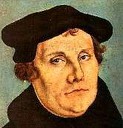
The Gospel According to Luther

So, another confession I have to make: Martin Luther’s a favorite of mine. So sue me, I’m a Protestant. He’s an atrociously flawed man, but the more I read him, the more I love him despite the flaws. He is easily one of my top 5 “Dead Guys I’d love to have a Beer with.”

Despite the fact that he’s been dead for over 500 years and he’s a favorite whipping boy in many wings of Biblical studies, he’s kind of a must-read for anyone trying to get a handle on the New Testament or the Gospel. This absolutely brilliant passage on the Gospel is one of the many reasons why:

One should thus realize that there is only one Gospel, but that it is described by many apostles. Every single epistle of Paul and of Peter, as well as the Acts of the Apostles by Luke, is a Gospel, even though they do not record all the works and words of Christ, but one is shorter and includes less than another. There is not one of the four major Gospels anyway that includes all the words and works of Christ; nor is this necessary. Gospel is and should be nothing else than a discourse or story about Christ, just as happens among men when one writes a book about a king or a prince, telling what he did, said, and suffered in his day. Such a story can be told in various ways; one spins it out, and the other is brief. Thus the Gospel is and should be nothing else than a chronicle, a story, a narrative about Christ, telling who he is, what he did, said, and suffered-a subject which one describes briefly, another more fully, one this way, another that way.

For at its briefest, the Gospel is a discourse about Christ, that he is the Son of God and became man for us, that he died and was raised, that he has been established as a Lord over all things. This much St. Paul takes in hand and spins out in his epistles. He bypasses all the miracles and incidents [in Christ’s ministry] which are set forth in the four Gospels, yet he includes the whole Gospel adequately and abundantly. This may be seen clearly and well in his greeting to the Romans [1:1-4], where he says what the Gospel is, and declares, “Paul, a servant of Jesus Christ, called to be an apostle, set apart for the Gospel of God which he promised beforehand through his prophets in the holy scriptures, the Gospel concerning his Son, who was descended from David according to the flesh and designated Son of God in power according to the Spirit of holiness by his resurrection from the dead, Jesus Christ our Lord,” etc.

There you have it. The Gospel is a story about Christ, God’s and David’s Son, who died and was raised and is established as Lord. This is the Gospel in a nutshell. Just as there is no more than one Christ, so there is and may be no more than one Gospel….

– excerpt from Martin Luther, A Brief Instruction on What to Look For and Expect in the Gospels’