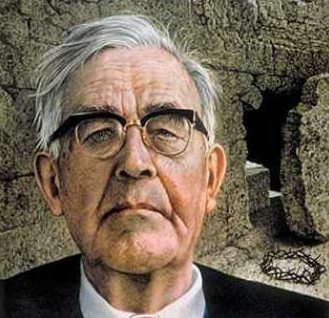
Karl Barth and C.S. Lewis on the Birth of ‘Chronological Snobbery’

progressivismIn assessing various arguments across over the years, I’ve found C.S. Lewis’ notion of the fallacy of “chronological snobbery” to be extremely helpful. He describes this flawed thought process as the “the uncritical acceptance of the intellectual climate common to our own age and the assumption that whatever has gone out of date is on that account discredited.” (Surprised by Joy,  p. 207) In other words, “That’s what people a hundred years ago believed, surely you can’t expect me to agree to that?”

Although writing off an idea simply because it is old is a fairly common move in our context, ancient philosophers, theologians, and moralists regularly appealed to the antiquity of a doctrine in order to establish its authority for the present. Somewhere along the line the witness of history ceased to be a source of credibility for an idea, and in some cases, became a liability.

I was reminded of this after writing the other day about Barth’s characterization of eighteenth century man as “the absolute man.” His attitude towards life, the natural order, politics, philosophy, the inner and outer self is that of an autonomous master who has come, or is coming, fully into his own such that his power and potentiality is increasingly limitless. It is an impulse that can be traced throughout various spheres of life including, as Barth points out, his attitude towards history.

Barth and the ‘Absolute’ Historians

Barth notes that the Enlightenment is often unfairly criticized as being historically “deficient.” He recognizes that it was during the birth of the modern academy and the proliferation of the various fields of academic discipline which accompanied the time that much careful research into ancient history was conducted.  At the same time, and it is here that Barth sees the force of the accusation, it is at this point that the problematic “critical study of history” began:

But what else can this mean but that it was in the eighteenth century that man began to axiomatically to credit himself with being superior to the past, and assumed a standpoint in relation to it whence he found it possible to set himself up as a judge over past events according to fixed principles, as well as to describe its deeds and to substantiate history’s own report? And the yardstick of these principles, at least as applied by the typical observer of history living at that age, has the inevitable effect of turning that judgment of the past into an extremely radical one. For the yardstick is quite simply the man of the present with his complete trust in his own powers of discernment and judgment, with his feeling for freedom, his desire for intellectual conquest, his urge to form and his supreme moral self-confidence.

What historical facts, even, can be true except those which to the man of the age seem psychologically and physiologically probable, or at any rate not improbable? How, in face of such firm certainty about what was psychologically and physiologically probable and improbably could eighteenth century man conceive of the existence of historical riddles and secrets? And what else in fact could the past consist of than either of light, in so far as it reveals itself to be a preparation and mount for the ever-better present ‘You’ll pardon me–it is my great diversion, to steep myself in ages long since past; to see how prudent men did think before us, and how much further since we have advanced’–or simply of darkness–a warning counter-example and as such, if you like, a welcome counter-example–in so far as the past had not yet sense the right road to the future, or had even actively opposed it.

The third thing which this attitude precluded was that the historian should take history seriously as a force outside himself, which had it in its power to contradict him and which spoke to him with authority. One way or another the historian himself said that which he considered history might seriously be allowed to say, and, being his own advocate, he dared to set for both aspects of what he alleged history to have said, its admonitory and its encouraging aspect.

Protestant Thought: Rousseau to Ritschl, pg. 36

Apparently if we’re looking for the birthplace of chronological snobbery as a dominant intellectual instinct, we need look no farther than eighteenth century man. At root, the impulse to chronological snobbery is the absolute one; it is the confident assurance that history has been in motion leading moral and historical thought to culminate in the worldview or cultural assumptions of the critical historian. Like nature, history was the raw material of time upon which the absolute historian could impose his moral will to reshape and retell the story of his own understanding of greatness. It must be understood, not on its own terms, but from the historian’s own, critical standpoint–one which at no point could be challenged by the object of its study.

Barth draws out a number of deleterious effects this mode of historical inquiry had on this generation of historians, one of the most instructive and damning of which was that, “although as a race they were very learned in historical matters, they were at the same time singularly uninstructed, simply because their modern self-consciousness as such made them basically unteachable.” (pg. 37) When you come to believe that the judgments of this age are inherently superior to those of prior generations simply because they are further down the time-stream, you’ve rendered yourself unteachable; you can’t be corrected or called to account or caused to question any of your own assumptions by any other age than your own.

On Avoiding Snobbery

Unfortunately, the Enlightenment’s absolutist instinct towards history is alive and well in popular Western culture. The myth of progress, and the unconscious tendency to assume a posture of historical maturity and superiority towards our benighted forbears is part of the intellectual air we breathe. Of course, 200 years on some of the details are different; a certain postmodern fuzziness enters into the equation. A touch of historicism or relativism may prevent some of us from judging the past too harshly, and yet the basic structure of thought, in which our ancestors cannot speak a real word of correction or instruction to the present still dominates.

How might we avoid rendering ourselves unteachable by the past? Lewis gives us some sound advice at this point. He says that whenever we encounter an idea or an assumption that we deem regressive, passe, or “out of date”:

You must find why it went out of date. Was it ever refuted (and if so by whom, where, and how conclusively) or did it merely die away as fashions do? If the latter, this tells us nothing about its truth or falsehood. From seeing this, one passes to the realization that our own age is also “a period,” and certainly has, like all periods, its own characteristic illusions. They are likeliest to lurk in those widespread assumptions which are so ingrained in the age that no one dares to attack or feels it necessary to defend them.

–ibid, pg. 208

In the words of Tim Keller, be prepared to “doubt your own doubt.” Be “radical” enough to question the assumptions of the present age–even the radical, progressive ones–in order to listen to ages past, which, at times, had a better feel for what life in the “age to come” is to be.

Soli Deo Gloria
The Gospel–It’s a Union Thing

One more bit from Letham:

Indeed, the Christian faith can be summed up as, inter alia, a series of unions. There is the union of the three persons in the Trinity, the union of the Son of God with our human nature, the union of Christ with his church, the union established by the Holy Spirit with us as he indwells us. Each of these unions preserves the integrity of the constituent elements or members, being at once a real union and simultaneously not absorbing the one into the other.

Union with Christ: In Scripture, History, and Theology, pp. 37-38

You could spend the rest of your Christian life simply studying the various unions mentioned by Letham and still not come to the end of the grace and glory of the Gospel. The Triunity of God alone ought to, and will, delight us for all eternity, before we even get to the unions whereby God includes us in that life, becomes our brother, makes us part of the church, or sets us free from sin. Simply put: the Gospel is a union thing.

Soli Deo Gloria

Letham on Union with Christ and Salvation

unionRobert Letham briefly summarizes the connection between union with Christ and our justification, sanctification, and resurrection:

Union and Justification

According to Paul in Romans 5:12-21, just as Adam plunged the whole race into sin and death because of their relationship of solidarity with him, so the second Adam brings life and righteousness to all who sustain a relationship of solidarity with him

If, because of one man’s trespass, death reigned through that one man, much more will those who receive the abundance of gracee and the free gift of righteousness reign in life through the one man Jesus Christ. (Rom. 5:17 ESV)

Here Paul reflects on his previous statement of the one way of salvation from sin by the propitiatory death of Christ, which avails for all who believe (Rom. 3:21ff). Justification is received only by faith and is grounded in what Christ did once for all in his death and resurrection (4:25).  Paul’s point is that we are not addressed merely as discrete individuals; instead, we are a team of which we all were members. His sin plunged the whole team into sin, ruin, death, and condemnation. What Christ did for us was also done as the head of a team of which we are a part. He did it on our behalf, for us–and God reckons it to our account as a result of our being united, through faith, with him as the head of the team. Our justification is therefore grounded on union with Christ.

Union and Sanctification

In Romans 6:1ff, in answer to charges that his gospel encourages moral indifference, Paul insists that believers, the justified, live to Christ and do not give themselves over to sin.  This is because they died with Christ to sin and rose again to new life in his resurrection. Not only did Christ die and rise again for them, but they died and rose with him. Union with Christ is the foundational basis for sanctification and the dynamic force that empowers it. As Paul says, “Do you not know that as many were baptized into Christ Jesus were baptized into his death; we were buried with him through baptism into death, so that as Christ was raised from the dead through the glory of the Father so we too should live in newness of life” (6:3-4).

Union and Resurrection

Paul argues in 1 Corinthians 15 that the resurrection of Christ and the future resurrection of his church is one reality (vv. 12-19). Paul argues back and forth from one to the other. If Christ is not raised, there can be no resurrection of believers. If there is no general resurrection, Christ cannot have been raised himself. The two stand together. In fact, Christ has been raised–and so, therefore, will we be. Christ is the firstfruits of the resurrection of believers at his return (vv. 19-23). Not only is his resurrection first in time, but as firstfruits, it is of the same kind as the full harvest. Hence, it is the guarantee not only that the full harvest will be gathered but that both his resurrection and ours are identical. From this it is clear that the resurrection of believers at the parousia is a resurrection in Christ. The resurrections are effectively the same…Christ resurrection and the resurrection of the righteous, separated by indefinite time, are identical because the later occurs in union with the former.

Union with Christ: In Scripture, History, and Theology, pg. 5-7

Each of those points could be expanded upon at length, but this brief summary gives us a glimpse into the way the biblical record places our union with Christ at the blazing center of our salvation through Christ. There is no Gospel without union.

Soli Delo Gloria

God is Creatively Creative

creationMost believers in God, if they’ve given our world more than a cursory glance, must come to the conclusion that we serve a creative God. The Maker of heaven and earth filled it with everything from aphids to the Aurora Borealis. Canvas after canvas is filled with the glory of our God’s infinitely fecund imagination. What we don’t often give thought to is the creative way in which God is creative. Let me rephrase that: God is not simply creative as to his works, but also in the way that he works.

Robert Letham notes at least three ways that God works to shape the our world in the creation account in Genesis 1:

In particular, he forms the earth in a threefold manner. First, he issues direct fiats. He says, “Let there be light,” and there is light (v.3). So, too, he brings into being with seemingly effortless command the expanse (v. 6), the dry ground (v. 9), the stars (vv. 14-15), the birds and the fish (vv. 20-21). Each time it is enough for God to speak, and his edict is fulfilled.

Second, he works. He separates the light from the darkness (v. 4), he makes the expanse and separates the waters (v. 7), he makes the two great lights, the sun and the moon (v.16), and sets them in the expanse to give light on the earth (v. 17), he creates the great creatures of the seas and various kinds of birds (v. 21), he makes the beasts of the earth and the reptiles (v. 25), and finally he creates man–male and female–in his own image (v. 26-27) The thought is of focused, purposive action by God, of divine labor accomplishing his ends.

But there is also a third way of formation, in which God uses the activity of the creatures themselves. God commands the earth to produce vegetation, plants, and trees (vv. 11-12). He commands the lights to govern the day and the night (vv. 14-16). Here the creatures follow God’s instructions and contribute to the eventual outcome.

–Robert Letham, Union with Christ: In Scripture, History, and Theology, pp. 10-11

God might be described as a king, a craftsman, and a delegator in his threefold creation. He issues decrees that are immediately fulfilled, gets his hands dirty by getting the job done himself, and giving creation itself tasks to accomplish. There are a number of observations that can be made on this basis, but I’ll limit myself to three.

For one, it begins to set the stage for understanding God in a more fully-personal fashion. We see the Father acting by what Ireneaus called his two hands, the Word and the Spirit, to bring about a varied-but-united order. “This God loves order and variety together” (pg. 11), because he himself is the Triune one who is One and yet Three.

We also see in this threefold activity an incipient theology of multiple-levels of causality. Sometimes God’s action is a direct, creative word which needs to mediation. Sometimes, God acts through creaturely means in ways that can be properly ascribed both to God as primary cause, and creature as a secondary, but no less real, cause. It gives God no glory to ascribe to him strict mono-causality in an effort to secure his sovereignty. (Which good Reformed theologians shouldn’t do.)

Finally, something of the nature of redemption is prefigured here. First, God speaks by fiat a declarative word in justification that brings to life those who were dead. God also separates out a people, making them holy by his Word and Spirit. Finally, he uses creaturely means such as the preaching of the Word, water, bread, and wine to save and recreate his people. 

Our Triune God is not only creative, he is creatively creative.

Soli Deo Gloria

Karl Barth: Fashion Critic?

Sabatini (18th century) - The Music LessonKarl Barth characterizes eighteenth century man as the “absolute man” in his volume on modern Protestant theology. The absolute man’s attitude towards life, the natural order, politics, philosophy, the inner and outer self is that of autonomous master; it is the attitude of one who has come, or is coming, fully into his own such that his power and potentiality is increasingly limitless. Barth traces this “absolute” spirit throughout various spheres of cultural activity and thought to great profit. In reading it, one somewhat surprising section in particular caught my attention: his analysis of eighteenth century fashion.

Following his discussion of the way eighteenth century architecture expresses the absolute man’s will to subjection in form, he comments on the way that same spirit is at work in his treatment of the human form:

It must also be granted to eighteenth-century man that he did not, still in accordance with the same absolute will for form, spare himself his own personal outer appearance. We have only to think of the fashion of the eighteenth-century. There is no need for me here to describe the dress, the coiffure, both for men and for women, the forms of intercourse, sociability, play and dancing. One cannot look too attentively at the portraits of the time, the contemporary illustrations of historical and social life, and also at the caricatures, if one is bent upon finding out what it was exactly that these people who thus adorned and comported themselves were trying to express (unconsciously, and therefore all the more revealingly, as is always the case with fashion).

What they were certainly not trying to do say was that like the lilies of the field we should not care for our attire. And they were certainly not saying that no man can increase his height by an ell. What they were expressing the whole time, from top to toe in actual fact, was this: that man carries in his soul an image of himself which in comparison with his actual figure is still much more noble, much more graceful and much more perfect, and that he is not at a loss for means to externalize this image and render it visible. No age, perhaps, has made this confession of faith so systematically as man of the eighteenth century.

As to its results, they need not concern us here. We need only note the following: when man, as happened at that time,  proceed to take himself (that is to say, his idea of himself) seriously, in the grand manner, without humour, but with a certain logic, all the things emerged which now cause us astonishment in the matter of men’s and women’s dress and in the manners of the age. Man felt bound to weigh himself down in these respects with all the burdens and discomforts which an absolute will for form apparently demands–but at the same time he was able to achieve all the dignity and charm to which eighteenth-century man did without doubt achieve.

Protestant Thought: Rousseau to Ritschl, pg. 35

For the absolute man, there was no physical barrier that could not and should not be subjected to the will of the self. Its fashion is at once an act of pride as well as longing and misplaced hope. Pride is obvious in that its excesses and ostentation give testimony to what can be see as a Pelagian act of self-deification. We can also see a longing at work it in it, a desire to return to a pre-fall splendor–or, with an eschatological focus, an over-reach at heavenly glory. Of course, that’s symptomatic of the whole of the eighteenth century–an over-realized, secular eschatology of absolute man’s eventual apotheosis in every sphere.

While some of us, especially those of us with an exclusively theological bent, might question the theological significance of fashion, Barth avoids this gnosticizing mistake. Barth’s exposition instructs us in the way that fashion is an important part of cultural production–another window into the soul of a civilization. For those seeking to be faithful interpreters of culture, fashion ought not be ignored. Nor should it be constantly be engaged in a damning or critical way. Like every sphere of culture, because of common grace and the Image of God, there are those elements which can be celebrated, condemned, or still yet, redeemed. Fashion requires a discerning eye–a development of theological as well as aesthetic sense. Barth apparently had both.

Soli Deo Gloria

One Reason I Can’t Swim the Tiber

"Swimming the Tiber" is a euphemism for Roman Catholic conversion, as it is the river identified with the Vatican.

“Swimming the Tiber” is a euphemism for Roman Catholic conversion, as it is the river identified with the Vatican.

Q. What is your only comfort in life and in death?

A. That I am not my own, but belong—body and soul, in life and in death— to my faithful Savior, Jesus Christ. He has fully paid for all my sins with his precious blood, and has set me free from the tyranny of the devil. He also watches over me in such a way that not a hair can fall from my head without the will of my Father in heaven; in fact, all things must work together for my salvation. Because I belong to him, Christ, by his Holy Spirit, assures me of eternal life and makes me wholeheartedly willing and ready from now on to live for him.

Heidelberg Catechism Question and Answer 1

Commenting on the pastoral nature of the creeds and catechisms, Carl Trueman highlights a couple of the questions and answers in the Heidelberg Catechism, especially the way Q&A 1 highlights the heart of the Reformation:

Question 1 shows the glorious Reformation Protestant insight into the fact that assurance is to be the normal experience of every Christian believer and not merely the preserve of a few special saints who have been given extra-ordinary insight into their status before God, as was the medieval Catholic position.

This is perhaps one of the great Protestant insights of the Reformation. We live in an age where conversion to Roman Catholicism is not an uncommon thing among those who have been brought up as evangelicals. There are many reasons for this: some speak of being attracted by the beauty of the liturgy in comparison with what is often seen as a casual and irreverent flippancy in evangelical services; others like the idea of historical continuity, of knowing where the church has been throughout history; still others find the authority structure to be attractive in an age of flux and uncertainty. Whatever the reasons, most Protestants would concede that Rome has certain attractions. Nevertheless, the one thing that every Protestant who converts to Rome loses is the assurance of faith. –The Creedal Imperative, pg. 124

Lest people think Trueman is exaggerating, it must be remembered that Cardinal Bellarmine is reported to have written that assurance is the greatest of all Protestant heresies. Indeed, discussing the subject of assurance with one of my brilliant Catholic professors was one of the most challenging conversations I had in my undergaduate degree. She asked me repeatedly–not threateningly, but forcefully, the way a good philosopher should–how could I be so sure that I was going to be saved? It seemed so arrogant and, well, assured. I’m not sure I gave her the best answer I could have at the time–I mean, I was 20. Ironically though, I realized I was more assured of her salvation than she was.

Trueman continues:

The insight of the Reformation on assurance was key, theologically and pastorally. And, given that it is one thing that every convert to Roman Catholicism must lose, it’s worth noting its priority in the Heidelberg Catechism. The answer is beautifully phrased; and yet if one ceases to be a Protestant, one must cease to claim HC 1 as one’s own. That is a very high price to pay. Speaking for myself, all of the liturgical beauty of Rome, all of the tradition, all of the clarity of the authority structure (and the clarity is often, I think, more in the eye of the beholder than the Church itself) cannot compensate for the loss of the knowledge that I know I have been purchased by the precious blood of Christ that conversion to Rome requires. –Ibid, pg. 125

To be clear, I am not saying that my Roman Catholic brothers and sisters are not saved, or are not actually united to Christ, or can’t experience the Spirit’s wonderful assurance; I know far too many beautifully Catholic people, including my professor, to make that mistake. I am pointing out that formally-speaking, I couldn’t claim it in the sense that the catechism teaches it.

That’s far too precious a thing for me to risk in those waters.

Soli Deo Gloria

5 Theses On Christ’s Priestly Ministry

christ as priestFor every high priest chosen from among men is appointed to act on behalf of men in relation to God, to offer gifts and sacrifices for sins. He can deal gently with the ignorant and wayward, since he himself is beset with weakness.  Because of this he is obligated to offer sacrifice for his own sins just as he does for those of the people.  And no one takes this honor for himself, but only when called by God, just as Aaron was. (Hebrews 5:1-4)


Reading through Hebrews this morning I was struck by this passage addressing the work of Christ, our great High priest whose ministry supersedes and fulfills that of the OT Levitical priests. In order to do so he outlines various functions of the OT priests in order to compare and contrast the two. I consulted Calvin, as I’ve been wont to do of late, to see what light he could shed on the matter.

Careful reader that he is, Calvin notes at least 5 truths about priests to be noted in the passage:

  1. He first says that the priests were taken from among men; 
  2. secondly, that they did not act a private part but for the whole people;
  3. thirdly, that they were not to come empty to appease God, but furnished with sacrifices;
  4. fourthly, that they were not to be exempt from human infirmities, that they might more readily succor the distressed;
  5. and lastly, that they were not presumptuously to rush into this office, and that then only was the honor legitimate when they were chosen and approved by God.

–John Calvin, Commentary on Hebrews 5:1-4

Building on these observations, he goes on to point out 5 truths this passage teaches us about Christ’s priestly ministry on our behalf:

  1. Christ is a True Man“Taken from among men, etc. This he says of the priests. It hence follows that it was necessary for Christ to be a real man; for as we are very far from God, we stand in a manner before him in the person of our priest, which could not be, were he not one of us. Hence, that the Son of God has a nature in common with us, does not diminish his dignity, but commends it the more to us; for he is fitted to reconcile us to God, because he is man..”
  2. Christ is a Man for Others “For men, etc…the priest was not privately a minister for himself, but was appointed for the common good of the people. But it is of great consequence to notice this, so that we may know that the salvation of us all is connected with and revolves on the priesthood of Christ. The benefit is expressed in these words, ordains those things which pertain to God…what the Apostle had in view is the same, namely, that we have no intercourse with God, except there be a priest; for, as we are unholy, what have we to do with holy things? We are in a word alienated from God and his service until a priest interposes and undertakes our cause.”
  3. Christ is a Man for Others Offering Gifts “That he may offer both gifts, etc. The third thing he mentions respecting a priest is the offering of gifts. There are however here two things, gifts and sacrifices; the first word includes, as I think, various kinds of sacrifices, and is therefore a general term; but the second denotes especially the sacrifices of expiation. Still the meaning is, that the priest without a sacrifice is no peacemaker between God and man, for without a sacrifice sins are not atoned for, nor is the wrath of God pacified. Hence, whenever reconciliation between God and man takes place, this pledge must ever necessarily precede. Thus we see that angels are by no means capable of obtaining for us God’s favor, because they have no sacrifice. The same must be thought of Prophets and Apostles. Christ alone then is he, who having taken away sins by his own sacrifice, can reconcile God to us.”
  4. Christ, Though Free from Sin, is a Man who Can Sympathize Who can, etc….the Apostle before taught us that mankind are united to God in the person of one man…but now he refers to another thing…that the priest ought to be kind and gentle to sinners, because he partakes of their infirmities. The word…simply means one capable of sympathy. All the things which are here said of the Levitical priests do not indeed apply to Christ; for Christ we know was exempt from every contagion of sin; he therefore differed from others in this respect, that he had no necessity of offering a sacrifice for himself. But it is enough for us to know that he bare our infirmities, though free from sin and undefiled. Then, as to the ancient and Levitical priests, the Apostle says, that they were subject to human infirmity, and that they made atonement also for their own sins, that they might not only be kind to others when gone astray, but also condole or sympathize with them…At the same time, though ever free from sin, yet that experience of infirmities before described is alone abundantly sufficient to incline him to help us, to make him merciful and ready to pardon, to render him solicitous for us in our miseries. The sum of what is said is, that Christ is a brother to us, not only on account of unity as to flesh and nature, but also by becoming a partaker of our infirmities, so that he is led, and as it were formed, to show forbearance and kindness… 
  5. Christ is a Man by the Call of God – And no man, etc. There is to be noticed in this verse partly a likeness and partly a difference. What makes an office lawful is the call of God; so that no one can rightly and orderly perform it without being made fit for it by God. Christ and Aaron had this in common, that God called them both; but they differed in this, that Christ succeeded by a new and different way and was made a perpetual priest. It is hence evident that Aaron’s priesthood was temporary, for it was to cease. We see the object of the Apostle; it was to defend the right of Christ’s priesthood; and he did this by showing that God was its author…Christ then is a lawful priest, for he was appointed by God’s authority…”

ibid, Commentary 5:1-4

According to Hebrews then, this is the Christ who is our Priest. He is the truly human one; the one who comes for us, not for himself alone; the one who has offered up a sacrifice for us; the one sympathizes with us in our weaknesses and infirmities; the one who comes by the call of God the Father, in the power of the Spirit. This Christ is indeed worthy of all our praise and worship.

Soli Deo Gloria

Karl Barth’s 3 Aphorisms on Doubt

barthBarth devoted one of his lectures that formed the basis of his little work Evangelical Theology to the subject of doubt as an obstacle to theology. Having given some thought to the subject doubt recently, I pulled it off the shelf and I found it worth briefly outlining.

Two Types

Barth begins by noting two types of doubt that might arise for the theologian. First, there is the very “natural” doubt that comes with the territory, which is “susceptible to treatment” (pg. 121). When you’re doing theology, you’re asking questions about the nature of the faith. You’re taking things apart in order to put them back together again in a rational, coherent fashion. It is inevitable that in the process of taking things apart, you struggle or question as to whether the original shape made any sense. This is the doubt that comes with working everything through as thoroughly as possible because we do not possess God’s own knowledge of himself. Even though we work from revelation, we must eat “by the sweat of our brow”. The danger here is being a “sluggard” that fails to put things back together.

There is a second form of doubt, however. Barth says this one is far more dangerous, which is troublesome because his long-winded explanation of it makes it hard to pin down exactly. It seems to be an uneasiness that there is even any point to the enterprise of theology at all. It is the introduction of a note of embarrassment at the outset that renders the whole conversation suspect. It is the swaying between Yes and No as to whether there is anything to even discuss, or whether we’re not simply engaging in an exercise of trying to describe our own “pious emotions” (pg. 124). It’s not the honest doubting that comes naturally with the asking of questions, but the doubting that asks, “Did God really say?” (Gen. 3:1) It doubts the connection between God’s works and words to the task of theology itself. It is the kind of doubt that isn’t dealt with in answers, but must be “healed.”

Three Sources

Barth then “briefly” notes three reasons this latter form of doubt might arise. (As if Barth could ever “briefly” do anything.) First, it might rise in the face of “the powers and principalities” of the world. In looking about at the worlds of economics, politics, art, the newspapers–the world of “real life”–the theologian might be tempted to doubt the relevance or reality of the message he preaches. What can the Gospel really say to that world conflict? Who has time for theology in the face of the truly pressing issues of the day? Could it ever really have said anything in the first place?

The Church itself is another source of doubt in theology. Theologians and preachers have to look at the church, its history, with all of the disunity, ugliness, and petty weakness on a regular basis. Unsurprisingly they may come away jaded at times. In the face of ecclesiastical horrors, wars, heresy trials, and nonsensical squabbles, it might seem perverse to labor at theology.

Saving the deepest root for last, Barth points out that it might not be that “the world impresses him so much or that the Church impresses him so little” (pg. 128), but that his own innate flaws as an individual might be the chink in the armor of his faith.  Complicating things, yet again, Barth subdivides this into two possible iterations.

The first is that of a theologian whose public theology does not match his private practice. He has a very solid public theology that is ordered under the word of God, but his practical life  is ordered by any passing whim or principle. In this sense, he has put himself in the place of a wounded conscience.  Of course, this source of doubt is not unique to theologians, but is the common provenance of all Christians.

The inverse possibility is that he has so engulfed himself in theology, he’s failed to have a normal life. His interests do not extend into the normal range of human affairs, to the point where theology or church-life all but consumes him. At that point, he is but a step away from burnout or boredom, which can lead to doubt.

Three Aphorisms on Doubt

At the end of these meditations Barth gives three “aphorisms” on doubt for theologians worth quoting in full:

  1. No theologian, whether young or old, pious or less pious, tested or untested, should have any doubt that for some reason or other and in some way or other he is also a doubter. To be exact, he is a doubter of the second unnatural species, and he should not doubt that his doubt is by no means conquered. He might just as well–although this would certainly not be “well”–doubt that he is likewise a poor sinner who at the very best has been saved like a brand from the burning.
  2. He should not also deny that his doubt, in this second form, is altogether a pernicious companion which has its origin not in the good creation of God but in the Nihilthe power of destruction–where not only the foxes and rabbits but also the most varied kinds of demons bid one another “Good night.” There is certainly a justification for the doubter. But there is no justification for doubt itself (and I wish someone would whisper that in Paul Tillich’s ear). No one, therefore, should account himself particularly truthful, deep, fine, and elegant because of his doubt. No one should flirt with his unbelief or with his doubt. The theologian should only be sincerely  ashamed of it.
  3. But in the face of his doubt, even if it be the most radical, the theologian should not despair. Doubt indeed has its time and place. In the present period no one, not even the theologian, can escape it. But the theologian should not despair, because this age has a boundary beyond which again and again he may obtain a glimpse when he begs God, “Thy Kingdom Come!” Even within this boundary, without being able simply to do away with doubt, he can still offer resistance, at least like the Huguenot woman who scratched Resistes! on the windowpane. Endure and bear it!

Evangelical Theology, pp. 131-132

As I mentioned, I’ve been giving some thought to the problem of doubt. There is a natural place for the first kind of doubt in the Christian life, as Barth notes. It’s fine to pick things apart and re-examine what you’ve learned–in a sense, doubting in order to believe. At the same time, I’ve also found that our culture, and recently certain wings of Evangelicalism, have taken to valorizing nearly all doubt to an unhealthy degree. Doubt is never to be talked about as something to be resisted, endured, struggled through, but is rather celebrated and romanticized as a sort of rite of passage into relevance and authenticity. It is either subtly or openly commended as a pathway to a “particularly truthful, deep, fine, and elegant” form of faith, brave enough to doubt even God himself.

The problem is, I don’t see scripture anywhere commending doubt in God. It allows for it. It acknowledges it. It forgives it. Much as Barth teaches us, there is room for it–there is a justification for the doubter. And yet, the state of doubt is not the end for which we strive. It is not a good place to be or even to praise. This is why I found Barth’s aphorisms to be filled with much biblical good sense. For those struggling or looking to counsel those who struggle, we find here a pastoral, humble note that acknowledges our frailty and sin, yet still exhorts us onward in hope and faith for that coming day when doubt will be overwhelmed by the fullness of the Kingdom of God.

Soli Deo Gloria

Judge or Expert Witness? Vanhoozer and Calvin on Scripture and the Councils

gavel and bibleKevin Vanhoozer’s Drama of Doctrine: A Canonical-Linguistic Approach to Christian Theology has one of the most sophisticated and nuanced Protestant approaches to the doctrine of sola scriptura and the relationship between scripture and tradition that I’ve encountered yet. As I was perusing through it the other day, I ran across this wonderful little teaser passage on Calvin, scripture, and the councils:

The Reformation was not a matter of Scripture versus tradition but of reclaiming the ancient tradition as a correct interpretation of Scripture versus later distortions of that tradition. The Reformers regarded the early church councils by and large as true because they agreed with Scripture, not because they had authority in and of themselves.

Certain critics of sola scriptura that the Reformers demythologized tradition by chasing the Holy Spirit out of the life of the church into a book. This goes too far. It is preferable to view tradition, like the church itself, as an example of what Calvin calls “external means” of grace. Tradition does not produce its effect ex opere operato; on the contrary, tradition efficaciously hands on the gospel only when it preserves the Word in the power of the Spirit. It is an external aid to faith, but not an infallible one. To speak of the ministerial authority of tradition is not espouse not a “coincidence” but an “ancillary” view of the relationship of Scripture and tradition.

Calvin honors the early church councils precisely because, for the most part, they were governed by word and Spirit: “[W]e willingly embrace and reverence as holy the early councils, such as those of Nicaea, Constantinople, Ephesus I, Chalcedon and the like…insofar as they relate to the teachings of the faith. For they contain nothing but the pure and genuine exposition of Scripture.” (Institutes 4.9.8) However, when one council contradicts another, as Chalcedon contradicted Ephesus II, the church must return to the word as ultimate norm. Church councils have a provisional, ministerial authority. To give them absolute authority, says Calvin, is to forget biblical warnings about false prophets and false teachers (Matt. 24:11; Acts 20:21-29; 1 Tim 4:1; 2 Tim 4:3; 2 Pet. 2:1). Indeed, with regard to Ephesus II–the council that accepted Eutyches’ heresy concerning the person of Christ–Calvin offers a sobering judgment: “The church was not there.” (Ibid., 4.9.8) This haunting observation neatly reverses the medieval formula extra ecclesiam, nulla salusCalvin might well have said: Extra scriptura et pneuma, nulla ecclesiam–“Outside word and Spirit, there is no church.”

Sola Scriptura refers to the practice of attending the Spirit speaking in the Scriptures as the final appeal in doctrinal disputes. How do we recognize the Spirit’s speaking? Church tradition enjoys the authority not of the judge but of the witness. Better: tradition enjoys the authority that attaches to the testimony of many witnesses. In this light, we many view the church fathers and church councils as expert witnesses as to the sense of Scripture in the courtroom drama of doctrine. Neither the Fathers nor the councils sit on the bench; the triune God has the final say. The task of theology is to cross-examine the witnesses in order to offer proximate judgments under the ultimate authority of the presiding judge: the Spirit speaking in the Scriptures.

To practice sola scriptura  is to treat Scripture alone as the “norming norm” and tradition as the “normed norm.” A theology that practices sola scriptura recognizes the ministerial authority of tradition, namely, its ability to nurture individuals in and to hand on the apostolic faith through the church’s corporate witness. Canon may be the cradle of the Christian doctrine, but tradition is its wet nurse. —The Drama of Doctrine: A Canonical-Linguistic Approach to Christian Doctrine, pg. 233-234

Again, that’s merely a teaser–Vanhoozer expands on each of those points at length. He shows us that the practice of sola scriptura is not a necessary recipe for historical ignorance or hopeless subjectivity in interpretation. It is a call to treat expert witnesses with all the due deference they deserve, while recognizing the true judge of the church: God in his Word.

Soli Deo Gloria

The Three-fold Work of the Spirit

people and placeWarning: This is a nerdy one.

I’ve long found the three-fold office of Christ as Prophet, Priest, and King to be an extremely helpful and biblical way of organizing the complex fullness of his once-for-all reconciling work in his life, death, resurrection, ascension, and session at the right hand of the Father. What I’ve not found is a succinct piece linking the accomplishment of Christ’s final mediatorial with the present work of the Spirit in the community and the life of the believer–that is until I ran across this passage by Michael Horton:

From John 14-16 we also see that the Spirit brings about the…effect of the threefold office of Christ in these last days. As prophet, the Spirit bears the covenant word of judgment and justification, conviction of sin and faith-creating promise. This is what it means for the Spirit to be poured out on all flesh (Joel 2). As Barth famously put it, “The Lord of speech is also the Lord of our hearing.”

Furthermore, the Spirit is not merely a bonding agent between the Father and the Son, but an equal actor in the economy of grace. Although the external works of God are undivided, the agency of each person is distinct. The one Word is spoken by the Father and reaches its creaturely goal through the perfecting power of the Spirit. As the Spirit is different from the Son (“another Paraclete”), Pentecost is a genuinely new episode in the economy of grace. The Spirit “translates” for us and within us the intra-Trinitarian discourse concerning us (election, redemption, and renewal in Christ). The content of the Spirit’s teaching ministry is Christ (John 15:26b)–not another Word, but its inward effect in our hearts, provoking an “Amen!” AS one sent by the Father in the name of Christ, the Spirit preaches Christ, gives faith to hearers, and thereby unites them to Christ as members of his mystical body.

As “another Advocate,” the Spirit also ministers within us as that priestly office that Christ holds objectively outside of us. The Spirit is not our high priest, but applies the benefits of Christ’s completed work to us and unites us to Christ himself. Apart from the Spirit’s agency, we would remain “dead in trespasses and sins,” refusing the Gift, without any vital connection to Christ’s person and work (Eph. 2:1-5) We have already been reconciled to God in Christ “while we were still enemies” (Rom. 5:10), but the Spirit comes to make us friends and children of God (Rom. 8:1-27). As a covenant attorney, the Spirit makes more than a truce–a mere cessation of hostilities–and brings about a state of union.

Mediating Christ’s royal ministry, the Spirit subdues unbelief and the tyranny of sin in the lives of believers, creating a communion of saints as body ruled by its living head through prophets and apostles, evangelists, pastors, and teachers that Christ has poured out as the spoils of his victory (Eph. 4:11-16). The Spirit makes Christ’s rule effective in us and mong us by inspiring the scriptural canon and by creating a people who will be constituted by it. Jesus Christ had already appointed apostles as Spirit-inbreathed witnesses, but now at last through the ordinary ministry of pastors, teachers, and other officers in the church, Moses’ request in Numbers 11:29 (“Would that all the LORD’s people were prophets, and that the LORD would put his Spirit on them!”) will be fulfilled beyond his wildest dreams. Not only the seventy elder, but also the whole camp of Israel is made a Spirit-filled community of witnesses. The charismata bestowed on the whole body are orchestrated by the Spirit through the ordained office-bearers, who differ only in the graces (vocation), but in the grace (ontic status) of the Spirit. Thus, the mission of the Twelve in Luke 9:1-6 widens to the seventy in chpater 10. Yet this was but a prelude to the commissioning ceremony of Pentecost.

People and Place: A Covenant Ecclesiology, pp 24-25

Soli Deo Gloria