There’s More To The Church Than Meets The Eye

church southRecently, I found myself greatly encouraged as I read about some classic distinctions made in the doctrine of the church. While many of us are familiar with biblical images of the church (‘the body of Christ’, ‘the people of God’, ‘the Temple’, etc.) as well as the four marks of the church (unity, holiness, catholicity, apostolicity), Edmund Clowney briefly reminds us of three key contrasts to keep in mind:

The heavenly definition of the church explains the contrasts of its existence in time (militant/triumphant) and space (local/universal), as well as the perspectives of heaven and earth (visible/invisible.)

The Church, Edmund P. Clowney, pg. 73

Rarely do we see theological refinement as a potentially encouraging exercise. Instead we view theological distinctions in terms of pointless, or necessary but dreary, exercises in logic-chopping to be endured, but never dwelt on with an aim towards spiritual blessing. Of course, that’s completely wrong-headed. If I never considered the classic distinction between justification and sanctification, and was constantly judging my assurance in Christ on the basis of latter, I’d be a miserable wreck.

What’s more, we North American Evangelicals hardly ever look to the doctrine of the Church as a source of consolation or joy. Thinking of the cross, the resurrection, the mystery of the Trinity, eschatology–these things can be a blessing for meditation. The Church? Eh…we having trouble seeing it. Even more difficult for many of us then, is the idea of finding encouragement in historic distinctions made in the doctrine of the church. Logic-chopping about an already uninspiring subject is a doubly-uninspiring prospect.

Properly considered though, these three distinctions in our theology of the church ought to be extremely encouraging to believers, as they teach us about our walk with Christ, the God who saves us, and our hope in God’s promises.

Militant/Triumphant – The distinction between the church triumphant and the church militant reminds us, both of the hope of glory, and the life of struggle to be endured this side of Jesus’ return. On earth, between the times, the Church is still embattled, hard-pressed on all sides, engaged in a battle, not against flesh and blood, but against the principalities and powers of the world.

We should not be dismayed, therefore, when we face opposition here on earth, but ought to be prepared for this sort of thing. And yet, the hope of glory awaits us, In Christ who has already conquered, as the church triumphant is at rest with Christ, enjoying a foretaste awaiting the consummation yet to come.

Local/Universal – The distinction between the local and the universal, encourages to remember that our God is a global one, whose purposes expand beyond the little corner of sky that we can see. In the age to come, we will see people from every tribe, tongue, and nation, seated at the wedding supper of the Lamb, feasting with God, and praising the Son. For those of us discouraged by the state of the church in our country, state, or neighborhood, remember that God is always up to something and that our horizons are much smaller than those of our Lord.

This can also help keep us from the pride that believes our church’s particular, culturally-specific ways of preaching the Gospel and administering the sacraments are the be-all and end-all of God’s works through his people. Realize that the hour and five minute worship service of the community, Bible mega-church you grew up at doesn’t have the corner on Gospel-ministry; there are probably some house-churches in China that could probably teach our pastors a little something about Gospel-community, the ministry of prayer, and preaching with unction. Again, the universal church is far broader that the local congregation we’ve been blessed with.

Visible/Invisible – The distinction between the visible church with its institutions, sacraments, offices, and ordinary congregations and the invisible church comprised of the elect, known only to God is also, when properly-construed, can give us hope in difficult times. This distinction is a helpful eschatological buffer (already/not-yet) that keeps us from too quickly identifying the all-too-human actions of the present-before-us group of sinful, broken, institutional realities we participate as a failure of God’s promises.

While the visible church truly is the body of Christ, it is still a mixed company to some degree, both in terms of individual, as well as corporate holiness. The point is, yes, your local church and the global church, are in many ways, visible failures, and yet, the visible is not all there is to the church. Heaven sees and knows more than our limited vision can capture. God’s faithfulness goes deeper still than all of our faithlessness.

Take comfort and encouragement, then, in remembering that the church we see is not all that there is to the Church.

Soli Deo Gloria

The God of Theology or Reality? (Or, The Value of Spiritual Cartography)

desertTowards the end of Mere Christianity C.S. Lewis tackles the doctrine of the Trinity as well as salvation. Before he does so, he gives a bit of an apologetic for the task of teaching and studying theology to those who would say its unnecessary or dry in light of the reality of God that they’ve experienced in nature, watching a sunset, hiking in the woods, or in those dark moments where we’ve “felt” him.  This is easily among my top 5 favorite passages in Lewis’ works. And really, it’s so good, I don’t think it even needs more comment than to say that it’s as relevant today as it was 60 years ago. Take this passage to heart and meditate on it:

Everyone has warned me not to tell you what I am going to tell you in this last book. They all say “the ordinary reader does not want Theology; give him plain practical religion.” I have rejected their advice. I do not think the ordinary reader is such a fool. Theology means “the science of God,” and I think any man who wants to think about God at all would like to have the clearest and most accurate ideas about Him which are available. You are not children: why should you be treated like children?

In a way I quite understand why some people are put off by Theology. I remember once when I had been giving a talk to the RA.F., an old, hard-bitten officer got up and said, “I’ve no use for all that stuff. But, mind you, I’m a religious man too. I know there’s a God. I’ve felt Him: out alone in the desert at night: the tremendous mystery. And that’s just why I don’t believe all your neat little dogmas and formulas about Him. To anyone who’s met the real thing they all seem so petty and pedantic and unreal!”

Now in a sense I quite agreed with that man. I think he had probably had a real experience of God in the desert. And when he turned from that experience to the Christian creeds, I think he really was turning from something real to something less real.

In the same way, if a man has once looked at the Atlantic from the beach, and then goes and looks at a map of the Atlantic, he also will be turning from something real to something less real: turning from real waves to a bit of coloured paper. But here comes the point. The map is admittedly only coloured paper, but there are two things you have to remember about it. In the first place, it is based on what hundreds and thousands of people have found out by sailing the real Atlantic. In that way it has behind it masses of experience just as real as the one you could have from the beach; only, while yours would be a single isolated glimpse, the map fits all those different experiences together.

In the second place, if you want to go anywhere, the map is absolutely necessary. As long as you are content with walks on the beach, your own glimpses are far more fun than looking at a map. But the map is going to be more use than walks on the beach if you want to get to America.

Now, Theology is like the map. Merely learning and thinking about the Christian doctrines, if you stop there, is less real and less exciting than the sort of thing my friend got in the desert. Doctrines are not God: they are only a kind of map. But that map is based on the experience of hundreds of people who really were in touch with God—experiences compared with which any thrills or pious feelings you and I are likely to get on our own are very elementary and very confused. And secondly, if you want to get any further, you must use the map.

You see, what happened to that man in the desert may have been real, and was certainly exciting, but nothing comes of it. It leads nowhere. There is nothing to do about it. In fact, that is just why a vague religion—all about feeling God in nature, and so on—is so attractive. It is all thrills and no work; like watching the waves from the beach. But you will not get to Newfoundland by studying the Atlantic that way, and you will not get eternal life by simply feeling the presence of God in flowers or music. Neither will you get anywhere by looking at maps without going to sea. Nor will you be very safe if you go to sea without a map.

In other words, Theology is practical: especially now. In old days, when there was less education and discussion, perhaps it was possible to get on with a very few simple ideas about God. But it is not so now. Everyone reads, everyone hears things discussed. Consequently, if you do not listen to Theology, that will not mean that you have no ideas about God. It will mean that you have a lot of wrong ones—bad, muddled, out-of-date ideas. For a great many of the ideas about God which are trotted out as novelties today, are simply the ones which real Theologians tried centuries ago and rejected. To believe in the popular religion of modern England is retrogression—like believing the earth is flat.
Mere Christianity, Bk. 4.1 (Making and Begetting)

While I might like to say a little bit more about the role the Bible plays as the authorized set of interpreted experiences of God, this passage gives the lie to the idea that studying theology is of no practical value, or a discipline divorced from reality. If your goal is to actually know God, love God, worship God, as he is and not merely feel some vague fluff of a religious sense, then theology, or spiritual cartography, is necessary and vital.

Soli Deo Gloria

5 Tips for Finding Your Theological Balance

TightropeIf I had to name my theological pet peeves, right near the top would be what I’ve called pendulum-swing theology. You grow up hearing one particular view of something, you get sick of it, and you swing to the opposite extreme. Grow up a hyper-Calvinist, something happens and you swing to Open Theism. This happens a lot in atonement theology too. Sometimes when Evangelicals who’ve grow up on a steady diet of penal substitutionary preaching find out that Jesus did some other things, like defeat the powers, demonstrate God’s love, and so forth, instead of integrating them all into a holistic doctrine of reconciliation, they end up chucking PSA altogether.  Luther described the history of theology as a drunk man getting on his horse only to fall off the other side, only to repeat the process. This irks me.

Of course this means that finding even-handed treatments of just about any subject is one of my greatest delights. A sense for balance is one of the highest virtues a theologian can possess, while a lack of balance is a serious vice. In trinitarian theology, focusing on God’s oneness over his threeness, or vice versa, leads to either modalism or tritheism, neither of which really works well with the Gospel. Actually, they both destroy it. In Christology, the Chalcedonian definition is bedrock because it keeps us from tipping into an overemphasis of the Son’s divinity or his humanity to the exclusion or distortion of the other. Again, lose your balance, you lose the Gospel. God is both immanent and transcendent–tip one way or the other and you end up either in a soggy pantheism or a cold deism, neither of which leads to Gospel. You see how that works?

Now, that said, it’s important that we be balanced even our love of balance in theology. Bruce Ware explains this for us in his foreword to Rob Lister’s excellent, balanced book on the doctrine of impassibility:

Theological balance, like physical balance, is normally a sign of health and well-being. The reason such balance is “normally” but not exclusively best is simply that, in some situations, imbalance is clearly required. So physically, balancing equally on both legs with sustained upright posture is normally best, yet if one wishes to dive into a swimming pool, one must embrace the imbalance of leaning altogether forward–a position that if done “normally” would result in endless bloody noses and skull fractures. –God is Impassible and Impassioned: Toward a Theology of Divine Emotion, pg 16

In all sorts of areas then, balance is good. Sometimes, though, there is no balance to be had. Ware reminds us specifically of the Reformation solas. Christ is not one among many mediators, or else he is not Savior. We aren’t saved by by divine grace and our own human merit and if faith is supplemented by works, the Gospel is confused with Law. It can’t be God’s glory and ours. And, of course, as soon as we elevate other authorities alongside of Scripture, we begin to lose sight of this.

No, there are times when balance is no virtue, but a Gospel-destroying vice. The Gospel requires a few head-long plunges. In other words, a true sense of balance will recognize that there are times for both/ands and times for either/ors. Knowing the difference between the two is crucial to avoiding heresy and preserving the Gospel. Finding your theological balance can be difficult, so here are five tips for those still in process:

  1. Read your Bible like crazy. I mean, really, you can’t know the Scriptures too well. And by “knowing the Scriptures” I don’t just mean the canon within a canon you’ve chosen for yourself out of 3 of Paul’s epistles and a Gospel, or the book of James and Matthew. Get a few prophets, OT narratives, and maybe some Torah in there. God gave us 66 books to reveal himself, so ignoring bits will inevitably leave you off-balance. Get this one wrong and the rest won’t matter.
  2. Read more than one theologian. Focusing on that one pastor or thinker you found that you connect to, to the exclusion of all others is a recipe for imbalance. As a limited, fallible human, they’re going to be myopic somewhere. Expand your horizons a bit. Read outside your tradition a bit. Maybe even wander outside your century. Who knows what gems you’ll find.
  3. Read the key irenic, broad-focused theologians. Every theologian has their hobby-horses and pet issues, but some are well-known for their controversies and some for their broad, even-keeled treatments of issues. Look for those theologians who are widely consulted even across traditional boundaries. If there’s a Methodist or Catholic being quoted by a Reformed theologian, like a Thomas Oden, go ahead and pick him up.
  4. Read the key polemical theologians. I’ve recently set myself the task of reading some of the key theologians in the early church controversies. Ireneaus against the Gnostics, Athanasius against the Arians, Cyril against the Nestorians, Augustine against the Pelagians, and so forth. These teachers demonstrated an ability to defend or preserve some necessary tension, or holy imbalance, in the faith. The ability to defend one issue clearly is often-times a sign of having a good grasp of the whole.
  5. Read about more than one subject. This one should be obvious, but if you fixate on one issue, no matter how central it is, you’ll have balance issues. It’s okay to give sustained attention to key or interesting subjects, but if I’ve only ever read about the cross and never a treatment of the resurrection or the ascension, I’ll have a skewed view of Christ’s person and work. What’s more, usually you won’t have as good of an understanding of the couple of subjects you do study since every doctrine takes it’s meaning within the framework of the whole.

I could easily list more (and if you have any ideas, feel free comment), but the point is, don’t be that drunk guy falling off of his horse. Study widely, read deeply, and constantly check yourself against the whole of Scripture. Do that, and you may just begin to find your balance.

Soli Deo Gloria

Distorted Application Doesn’t Nullify Good Doctrine

Inevitably, something like this was going to be the picture.

Inevitably, something like this was going to be the picture.

In my online forays, I’ve observed that its increasingly common for someone to explicitly reject a doctrine, or the notion of orthodox teaching in general, on the basis of its abuse. You’ll quite often read something along the lines of, “I grew up in a church that had a heavy emphasis on doctrine X (depravity, judgment, sola scriptura, etc.). My pastors and elders used that to berate people, cow them into submission, or excuse horrible evils.” So, now, whenever they hear that, they can’t accept it because they know (feel) it’s a tool being used to control them, or some other harmful result. In fact, some will go further and turn into a principle of theological methodology to the point where, if a doctrine could be or has been used to hurt or damage someone, it’s to be rejected out of hand.

First off, I want to say: I get the impulse. For someone who’s been beat down with the Bible like it’s a weapon, or doctrines like they’re billy clubs, when they see someone pick them up, even as agents of healing, some PTSD is understandable. It can be hard to distance or differentiate a doctrine from its uses, especially if that’s all you’ve ever known. It doesn’t matter if someone’s trying to offer you an oxygen mask, if someone used one to choke you out in the first place, you’re going to flinch when you see it, even if it’s what you need most.

Everything Get’s Twisted
What I want to point is something very simple, though: just about any doctrine can be distorted or misused to harm others. Tim Keller makes this point in The Reason for God when speaking about the way Christianity has been distorted throughout church history. Many would look at the way Christianity’s been used to justify horrible evils as evidence of it’s inherently flawed character. Keller points out that even universally praised values like reason, freedom, and equality have been the battle-cry of unjust regimes like the Reign of Terror in Revolutionary France. Instead of seeing the abuses of Christianity and Christian theology as evidence of their falsehood, it rather points to the fact that something is so wrong in the human heart that it can take anything, no matter how good and true, and use it for wicked ends.

This is true not only of the types of teachings we culturally are more apt to reject like judgment, original sin, or inerrancy, or the types that we typically find appealing.

For instance, we tend to like the idea of a gracious, nonjudgmental God. A deity who loves us and affirms us unconditionally, mess and all, seems kinder, gentler, and difficult to imagine as a tool of oppression or power. And yet, this is the kind of doctrine that criminals use to justify their own crimes. If God doesn’t judge, then how dare we? If God would never punish, then how can we punish oppressors? In the same vein, I’ve seen people excuse their glaring character defects like pride, narcissism, harshness, and insensitivity to the fact that “it’s just my personality; God made me the way I am.”

Or take classic teaching on forgiveness. Christians are told that God is a forgiving God, having forgiven all of our sins in Christ. We then are told to forgive those who sin against us as Christ has commanded. Now, the problem here is that people have taken this teaching on forgiveness and used it to force victims to ‘forgive’ their abusers in ways that basically brush over sin and ignore the reality of justice.

Again, pick almost any doctrine you can think of (creation, fall, grace, etc.) and there is some way it can be abused and applied improperly. Given this reality, if our main criterion for accepting or rejecting doctrine whether or not it can be used to harm others, we’ll be left with a two-word creed: “I believe…”

Abusus Non Tollit Usum
This is why one of the most important rules I’ve had to learn in my theological studies is abusus non tollit usum, or “abuse does not take away use.” The basic point is that just because fire can destroy, that doesn’t mean it isn’t good for cooking or keeping your home warm; an oxygen mask can still save your life, even if someone choked you with one; scalpels can still cut out cancer, even if someone was injured with one. In the same way, doctrines can still be good, true, beautiful, and helpful despite the ways they’ve been abused or misconstrued in the past.

As always, Jesus points the way forward in this regard. When correcting the Pharisees and Sadducees’ distortions of scriptural teaching, he didn’t do it by chucking Scripture, but by quoting it, and pointing them to its true meaning. (Matt. 9:12-13; 12:1-8; 19:4; 22:29, 41-45) In the Sabbath controversy, it wasn’t a denial of the Sabbath command that brought relief, but a renewed, deeper understanding of what the command was always about. Or again, when Paul wanted to correct the Judaizers who were saying the Gentiles weren’t full members of the covenant by faith alone, but needed the practice of Torah as well, he didn’t reject Torah. No, he went back to the Scriptures to make his argument (Gal. 3-5)

As difficult as it might be (and I get it, it’s really difficult sometimes) Jesus shows us how important it is to strive to distinguish the true doctrines of the Christian faith from their distorted applications and expositions. There will be things you might end up rejecting after the process. Often-times there is some bad theology that has to be rejected being taught along precious truths to be held firmly. I would encourage you to search the Scriptures, though, before rejecting something only on the basis of your negative experience with it. It may take some years of books, conversations, good churches, and maybe a good counselor, but it’s worth it to make sure you’re not rejecting some key truth of the Gospel because some wicked teacher ruined it for you.

Soli Deo Gloria

Mistaking a Stick for the Son

sunpaintingEver run across those verses with God kind of loudly declaring “I am God, acknowledge that” and so forth? You find them in Isaiah (43:11; 45:5), Ezekiel (12:15; 2044), and places like that. I remember when I first read them in my studies, I was kind of put off. I didn’t get it at first. God seemed awfully narcissistic and insecure to be going on about himself like that, kind of like the awkward guy who refers to himself in third person. (“Derek doesn’t like mayonnaise. Derek is the greatest.”)

Well, later on, I read a bit more, understood the context, and began to deeply love these declarations of God’s sovereign uniqueness. He truly is the LORD, and compared to him there is no other. I love the bold, forthright assertion of his His kingly ‘colossal self-regard’, to use Walter Brueggeman’s phrase. What’s really amazing about it is that there’s actually something very humble about God coming to us and declaring himself to a rebellious people. Given our willful blindness to the truth, why should a great and mighty Creator bother with us at all? Yet in these statements God invites us to relationship with a true and living God, not the false little idols we’ve made for ourselves.

Athanasius paints helpful picture for us when it comes to understanding these passages:

And this account of the meaning of such passages is satisfactory; for since those who are devoted to gods falsely so called, revolt from the True God, therefore God, being good and careful for mankind, recalling the wanderers, says, ‘I am Only God,’ and ‘I Am,’ and ‘Besides Me there is no God,’ and the like; that He may condemn things which are not, and may convert all men to Himself. And as, supposing in the daytime when the sun was shining, a man were rudely to paint a piece of wood, which had not even the appearance of light, and call that image the cause of light, and if the sun with regard to it were to say, ‘I alone am the light of the day, and there is no other light of the day but I,’ he would say this, with regard, not to his own radiance, but to the error arising from the wooden image and the dissimilitude of that vain representation; so it is with ‘I am,’ and ‘I am Only God,’ and ‘There is none other besides Me,’ viz. that He may make men renounce falsely called gods, and that they may recognise Him the true God instead…

Discourses Against the Arians 3.8

Our idols are like finger-paintings of the sun posted in our windows. There’s no comparison to the real thing. In his mercy, God reveals himself to us that we might turn from these darkening idols to the true light of God.

Now, Athanasius is dealing with this text in his disputes with the Arians.  They were contending that in light of these, it’s blasphemy to say that the Son is co-eternal with the Father. Athanasius goes on to give the passage a Christological shape in order to expose their confusions:

Indeed when God said this, He said it through His own Word…For the Word of the Lord came to the Prophet, and this was what was heard; nor is there a thing which God says or does, but He says and does it in the Word. Not then with reference to Him is this said, O Christ’s enemies, but to things foreign to Him and not from Him. For according to the aforesaid illustration, if the sun had spoken those words, he would have been setting right the error and have so spoken, not as having his radiance without him, but in the radiance shewing his own light. Therefore not for the denial of the Son, nor with reference to Him, are such passages, but to the overthrow of falsehood.

-ibid.

Just as its ridiculous to think that the sun could shine a light without its own radiance, Athanasius says it’s a mistake to think of God saying “I am the LORD, apart from me there is no other” without His Word. The Son is not some thing external to the Father, but is of his own essence. From all of eternity God has been the Father of the Son. Which is why, when he wants to make himself  known, God declares himself to us through Jesus Christ, the Son. The Son is how God calls us away from the worship of false gods of our own making, speaking light into all of our darknesses.

Soli Deo Gloria

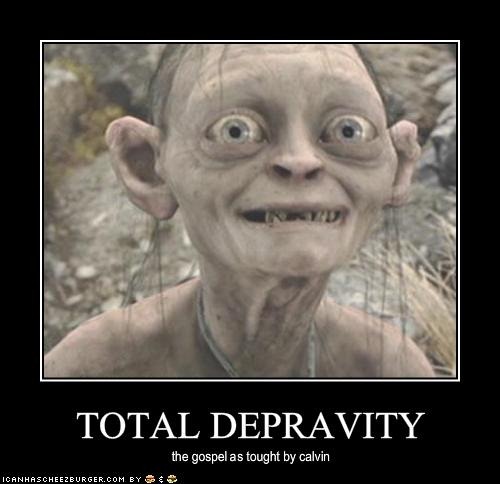
That Time C.S. Lewis Got ‘Total Depravity’ Wrong (Like Everybody Else)

Yes, Gollum is a Tolkien character, not Lewis. I don't care.

Yes, Gollum is a Tolkien character, not Lewis. I don’t care.

Cliché Evangelical confession: I love C.S. Lewis. Probably too much. His influence on my life and intellectual development as a disciple is hard to gauge. For a while there in seminary, next to the Bible, you were apt to hear me quoting “St. Clive” (as one of my professors dubbed him) more than any other thinker. This is why it pains me to admit that he was slightly misleading about something in his writings, namely Calvinism.

Actually, let’s make that more specific. He got one letter wrong of the Anglo-American acronym that has come to represent ‘Calvinism’ in the minds of most people who have heard the term: the ‘T’ in T.U.L.I.P. , standing for ‘total depravity.’

In his work The Problem of Pain, Lewis discusses the nature of our moral knowledge, and the distance between our judgments and God’s. After making the case that the term ‘good’, when applied to God, is apt to mean something a bit different than we usually think of, he doubles back to say that it can’t be completely different:

On the other hand, if God’s moral judgement differs from ours so that our “black” may be His “white”, we can mean nothing by calling Him good; for to say “God is good,” while asserting that His goodness is wholly other than ours, is really only to say “God is we know not what”. And an utterly unknown quality in God cannot give us moral grounds for loving or obeying Him. If He is not (in our sense) “good” we shall obey, if at all, only through fear – and should be equally ready to obey an omnipotent Fiend. The doctrine of Total Depravity – when the consequence is drawn that, since we are totally depraved, our idea of good is worth simply nothing – may thus turn Christianity into a form of devil-worship. –The Problem of Pain, pg. 29

While Lewis is making a very a good point about our analogical knowledge of good and evil, he happens to do so by trading on a widely-popular caricature of the doctrine of total depravity.

Most people are introduced to the teaching by hearing something along the lines of, “That John Calvin, he was such a pessimist. Did you know that he taught that we were totally depraved? That all of us are about as awful as it gets, none of us knows right from wrong, and we’re born simply and utterly wicked? No wonder he was a downer.” Or something like that.

The problem is that is neither what total depravity, properly understood, nor John Calvin teach with respect to human nature. (Although, I do grant that Calvin probably was kind of prickly.) Actually, as a matter of history, Calvin nowhere mentioned the acronym ‘TULIP’. Being dead at this point, he didn’t even know about the Canons of Dordt, the 17th century document that the 19th century acronym is trying to summarize.

So what do Calvin and total depravity teach? Richard Muller sheds some light for us:

Calvin’s references to the utter deformity or depravity of the human will and human abilities were directed against forms of synergism or Semi-Pelagianism and refer to the pervasiveness of sin — reducing this language to the slogan “total depravity” endangers the argument…“Total depravity,” at least as understood in colloquial English, is so utterly grizzly a concept as to apply only to the theology of the Lutheran, Matthias Flacius Illyricus who an almost dualistic understanding of human nature before and after the fall, arguing the utter replacement of the imago Dei with the imago Satanae and indicating that the very substance of fallen humanity was sin. Neither Calvin not later Reformed thinkers went in this direction and, to the credit of the Lutherans, they repudiated this kind of language in the Formula of Concord. What is actually at issue, hidden under the term “total depravity” is not the utter absence of any sort of goodness but the inability to save one’s self from sin.

-Richard Muller, Was Calvin a Calvinist? Or, Did Calvin (or Anyone Else in the Early Modern Era) Plant the “TULIP”?, pp. 8-9 (HT: Alastair Roberts)

As you can see, Muller isn’t much of a fan of TULIP, mostly because of the easy tendency towards caricature (I mean, even Lewis didn’t explain it properly.) Still, his explication of Calvin’s thought on the subject also serves for the better articulations of total depravity taken up by current Reformed theologians.

To be clear, the doctrine does not teach that all humanity is as “depraved” as possible. “Total” refers to the scope, not depth, of the problem of sin. It affirms that there is not a single area or part of our nature that has not been subject to sin’s corrupting influence; though created good, not our mind, will, reason, bodily instincts, or anything else that could be singled out, remains untouched by the Fall. As such, there is no leverage or foothold in human nature whereby it might reach up to God, or present any merit, without having first been enlivened by the Holy Spirit’s power. As Michael Horton says, “there is no Archimedean point within us that is left unfallen, from which we might begin to bargain or restore our condition” (The Christian Faith, pg. 433). Nor is there any impulse or instinct that is not subject to correction from God’s Word.

This is true of the vilest criminal, or the sweetest, kindest neighbor that most of us would describe as a “good guy.” None has a chance of saving themselves by drawing on their own inner, moral resources. But, as we said, that doesn’t mean that they’re as bad as they can be. We are “not incapable of any justice or good before fellow humans” (Horton, ibid, pg. 433). No, in fact, we do have an active, if defective, conscience that points to right and wrong, as well as accuses and defends us before God (Rom. 2). Calvin himself quoted pagan philosophers approvingly, at times, when they concurred with Scripture’s moral judgment. We are able to do relatively good, yet not saving, acts through common grace and common virtue. Good of this sort is nothing to be sneered at and is a testimony to the permanence of the Image of God as well as the gracious, restraining work of the Holy Spirit.

Where does this little crash course in one, highly-misunderstood, aspect of Reformed anthropology, leave us? Well, for one thing, you can say you know something that C.S. Lewis didn’t about the history of Christian doctrine. But seriously, it serves as an important lesson against making any theologian, pastor, or author, even someone as wonderful as Lewis too authoritative in your intellectual life. As great as someone might be, if you’ve never disagreed with them, you’re probably not reading them critically enough.

Most of all though, it serves as a reminder of God’s redeeming, regenerative grace. For every inch of you that’s been ‘depraved’ or, rather, bent through sin, is being restored and resurrected whole and new in Christ.

Soli Deo Gloria

Sin: Self or Circumstances?

Society-of-the-spectacleChristianity has a simple message: Jesus saves from sin. When you start asking questions about what that means, you realize that simple message can generate, and indeed, necessitates some very complicated explanations. A simple question like “Who is Jesus?” can call forth debates that span centuries, councils, and countless learned treatises that, even when they establish a solid baseline, never fully come to the end of the issue.

So what of the other part of the equation? What are we talking about when it comes to the ‘sin’ that Jesus saves us from? While we could tackle this from a number of angles, one question that has been a rather thorny one in the modern period is whether sin is more of a personal or a social reality. Painting with a ridiculously broad brush, one could say that contemporary pop-Evangelicalism and mainline liberalism have typically taken opposing approaches to sin and sanctification.

Evangelicalism has typically focused on sin as a problem with individuals. I choose to sin, personally disobeying God, loving things other than the Lord my God with heart, soul, mind, and strength first. If society as a whole is debauched or unjust, it is because of the collective individuals of which it consists. Liberalism has typically given priority to society and structural issues. Sin is less about personal acts of unrighteousness, but rather unjust systems of oppression that trap people in harmful, destructive behavioral cycles. If holiness is to be achieved, we must change the social structures first and the individual issues will be mended from there.

So which is it? The sinful self or the circumstances that lead to sin? Jurgen Moltmann weighs in:

‘Change yourself’ some say, ‘and then your circumstances will also change.’ The kingdom of God and of freedom is supposed to have to do only with persons. Unfortunately the circumstances will not oblige. Capitalism, racism, and inhuman technocracy quietly develop in their own way. The causes of misery are no longer to be found in the inner attitudes of men, but have long been institutionalized.

‘Change the circumstances’ others say, ‘and men will change with them.’ The kingdom of God and of freedom is supposed to be a matter only of circumstances and structures. Unfortunately, however, men will not oblige. Breakdowns in marriage, drug addiction, suicide and alcoholism continue undisturbed. Structures which make people unhappy can be broken down, but no guarantee is attached that men will be happy.

Thus both must be done at the same time. Personal, inner change without a change in circumstances and structures is an idealist illusion, as though man were only a soul and not a body as well.  But a change in external circumstances without inner renewal is a materialist illusion, as though man were only a product of his social circumstances and nothing else.

The Crucified God, pg. 23

Once again, the Gospel is a simple message but it is not simplistic. We need salvation both from our own personal sin and rebellion, as well as the redemption of broken social structures that are generated by and aggravate that rebellion. Evangelical that I am, I think the latter is rooted in the former; in the narrative of Scripture, sin moves progresses from the personal (the garden, Gen. 3) to the social (Babel, Gen. 11). Still, it does not help to ignore either as we think through reality of redemption.

Now, as always, its beyond me to suggest how that all plays out. I work in the local church, primarily at the level of the individual, and am only now framing my theology of how the Church, either as an organism or an institution, should be engaged in social change. I do know that as I continue to pursue these questions, I don’t have to panic as the world is firmly in Jesus’ saving hands.

Soli Deo Gloria

The Theological Importance of Knowing What ‘Time’ It Is

old-clockMost of us don’t think of knowing what time it is as a significant theological issue. Beyond showing up promptly out of respect for an acquaintance, or knowing when to get to church on Sunday, how could it be? According to Athanasius it could mean difference between heresy and orthodoxy. In his First Discourse Against the Arians he sets about answering objections to the Son’s deity from Scripture, showing that the Arians’ hermeneutics were hopelessly misguided and indeed, characterized by interpretive folly.

Bringing forward texts like Hebrews 1:4 “being made so much better to angels as the name he has inherited is more excellent than theirs”, they argued from this that it is clear that the Son is made ‘better’ in which case he could not be eternal, uncreated, admitting of improvement. Athanasius says that this exegetical failure is rooted in their ignorance of time.

Appealing to the Eunuch’s question to the apostle Philip, “of whom does the Prophet speak, of himself, or of some other man?” (Acts 7:34), he expounds the very important interpretive rule that:

…it is right and necessary, as in all divine Scripture, so here, faithfully to expound the time of which the Apostle wrote, and the person, and the point; lest the reader, from ignorance missing either these or any similar particular, may be wide of the true sense… (7.54)

Athanasius notes how persistent the disciples were about understanding these particulars, especially the time, so that they would not fall into error:

…And the disciples, wishing to learn the time of what was foretold, besought the Lord, ‘Tell us,’ said they, ‘when shall these things be? and what is the sign of Thy coming?’ And again, hearing from the Saviour the events of the end, they desired to learn the time of it, that they might be kept from error themselves, and might be able to teach others; as, for instance, when they had learned, they set right the Thessalonians. who were going wrong. When then one knows properly these points, his understanding of the faith is right and healthy; but if he mistakes any such points, forthwith he falls into heresy… (ibid.)

Scripture also gives us the negative example of what happens when one is temporally disoriented:

…Thus Hymenæus and Alexander and their fellows were beside the time, when they said that the resurrection had already been; and the Galatians were after the time, in making much of circumcision now. And to miss the person was the lot of the Jews, and is still, who think that of one of themselves is said, ‘Behold, the Virgin shall conceive, and bear a Son, and they shall call his Name Emmanuel, which is being interpreted, God with us;’ and that, ‘A prophet shall the Lord your God raise up to you,’ is spoken of one of the Prophets; and who, as to the words, ‘He was led as a sheep to the slaughter,’… (ibid)

Arius and his followers were making Hymenaeus and Alexander’s mistake, not noting the time with respect to the texts in dispute. If they had, they would have observed that the apostle is not referring to the Lord with respect to his pre-incarnate state, but within the economy of salvation with respect to his humanity. That is the time when God “spoke to us by His Son” (Heb. 1:2), and the Son obtained a more excellent name than the angels (Heb. 1:3, 4).  In other words, they didn’t understand the hermeneutical difference it makes that the story’s main character has a “history” that begins in eternity.

Christianity is a historical faith about things that took place in particular locations at precise times. Salvation is a dramatic reality which means that knowing which act we’re in can drastically impact the way we read the lines. While modern biblical studies have directed us to pay closer attention to the concrete socio-historical circumstances surrounding the texts, and recent narratival/canonical approaches have re-emphasized the redemptive-historical location of the text, Athanasius reminds us to keep an eye on the distinction between history and eternity.

Soli Deo Gloria

I’m Taking a Sabbath (And So Should You)

This is the first thing that came up when I Googled 'Sabbath.' That's culturally-telling.

This is the first thing that came up when I Googled ‘Sabbath.’ That’s culturally-telling.

I’m taking off this week on a little road-trip up to Santa Barbara. We’re packing up 20+ college students to go beach camping for our summer retreat and plan on having a blast. After a couple of days there, my wife and I are taking a mini-vacation for our 2-year anniversary, by sticking around the area in a hotel while the students head back down to Orange County. Needless to say, I am very excited.

This means two things for me: First, I won’t be on the blog much this week. Don’t worry though, I’ve prepped a few posts that are scheduled to go up, so there will be plenty of Reformedish content to read. That said I won’t be sharing them around much (so feel free to share them for me!), nor will I be commenting in response much either. You’ll have to amuse yourselves otherwise.

Second, in light of my own mini-Sabbath, I’ve been thinking about the issue of Sabbath. In fact, that’s the subject of our meditations this week with the students. Americans in general, for all of our leisure, don’t really know how to Sabbath. Surprisingly enough to some, college students are some of the worst offenders I know. They do plenty of random, “non-work” activities, but the actual practice of Sabbath is something that escapes them–so we’re going to talk about it.

Calvin on Sabbath: Too Much to Talk About
Given all these things, I was curious to go back and read what Calvin had to say on the subject. It turns out there was a lot–far too much to review here. Unbeknownst to many, Calvin’s commentary on the Torah is a lengthy Harmony of the Law comprising 4 volumes in which he comments on the narratives in Exodus-Deuteronomy (he has a separate commentary on Genesis) and, well, “harmonizes” the Law by treating the various laws according to groupings and subject matter, while still dealing with specific texts. I don’t have time to go through it all, but you can go read what he does with the Sabbath command at length here.

Thankfully Calvin summarizes a great deal of that in a shorter but still lengthy section in the Institutes as well, which contains a brief commentary on the 10 commandments in Book 2. But, of course, he outlines those comments briefly at the beginning too. That’s what I want to look at. Yes, it’s a summary of a summary, but even that is plenty of Calvin to work with.

Three Reasons
Following the Fathers he thinks that this commandment is “a foreshadowing because it contains the outward keeping of a day which, upon Christ’s coming, was abolished with the other figures” (2.12.28) Now, this is true as far as it goes, but he thinks that when we limit it to this, “they touch upon only half the matter.”

Calvin sees at least three reasons for the Lord’s Sabbath command:

  1. First, under the repose of the seventh day the heavenly Lawgiver meant to represent to the people of Israel spiritual rest, in which believers ought to lay aside their own works to allow God to work in them.” (ibid.) First and foremost the Sabbath is not a work to be achieved on our part, but a promise, a foreshadowing, of God’s Gospel accomplishment on our behalf. God was pointing his people ahead to the day when their own ceaseless and ineffective spiritual labors would cease because Christ the Redeemer had done the great work on our behalf. Of course, for us, this serves as a reminder that the great work has already been done; we rest in Christ. At the same time, there is still an eschatological element to the Christian keeping of the Sabbath as it points to that final rest that we still await. (Heb. 4) Our current Sabbath is a down-payment on eschatological Sabbath to come.
  2. Secondly, he meant that there was to be a stated day for them to assemble to hear the law and perform the rites, or at least to devote it particularly to meditation upon his works, and thus through this remembrance to be trained in piety.” (ibid.) God knows we regularly need to gather, hear the word of the Lord, and meditate on all of his goodness. Sabbath is not mere leisure time, but a specific rhythm by which we set aside time to recall the promises of God, his commandments, and worship Him as he deserves and our hearts were designed to do. The key to remember here is that God does not need this, but we do. He demands it as his due lawful due, but the benefit is ours.
  3. Thirdly, he resolved to give a day of rest to servants and those who are under the authority of others, in order that they should have some respite from toil.” (ibid.) Finally, Calvin notes the very practical nature of the command: physical rest. Even before the Gospel of Resurrection taught us that the Lord is redeeming the body as well as the soul (1 Cor. 6), we see in God’s commands his care for our physical being as well as our spiritual–indeed, the two are indissolubly connected. God knows that we simply need rest from our labors, a time when we simply are still and know that the world will keep turning as we recuperate our strength for the tasks that God has set us to do in this world.

As with all of God’s good commands, there is far more to say, but in obedience to the command, I will cease from my labors and trust that God himself will teach you all that you need to know in this regard. Consider this an invitation to rest in the Lord.

Soli Deo Gloria

Director, Soul, and King: The Word

directorReading the early Fathers gives you a sense that they were smitten by the wonder of God’s creative glory. Ireneaus was one of the first and greatest theologians of the significance and grandeur of God’s works. Following on his heels comes Athanasius’, waxing eloquent on the subject in his work Contra Gentes. In his argument against the pagan gods, he points to the magnificent order of the universe as evidence that they could only be the result of a single, purposive God according to Wisdom–the Word Himself.

Master teacher that he is, Athanasius gives us three similes to explain how the Word gives order to the Universe:

  1. Director – “And for so great a matter to be understood by an example, let what we are describing be compared to a great chorus. As then the chorus is composed of different people, children, women again, and old men, and those who are still young, and, when one, namely the conductor, gives the sign, each utters sound according to his nature and power, the man as a man, the child as a child, the old man as an old man, and the young man as a young man, while all make up a single harmony…”
  2. Soul – “or as our soul at one time moves our several senses according to the proper function of each, so that when some one object is present all alike are put in motion, and the eye sees, the ear hears, the hand touches, the smell takes in odour, and the palate tastes,—and often the other parts of the body act too, as for instance if the feet walk..”
  3. King – “or, to make our meaning plain by yet a third example, it is as though a very great city were built, and administered under the presence of the ruler and king who has built it; for when he is present and gives orders, and has his eye upon everything, all obey; some busy themselves with agriculture, others hasten for water to the aqueducts, another goes forth to procure provisions,—one goes to senate, another enters the assembly, the judge goes to the bench, and the magistrate to his court. The workman likewise settles to his craft, the sailor goes down to the sea, the carpenter to his workshop, the physician to his treatment, the architect to his building; and while one is going to the country, another is returning from the country, and while some walk about the town others are going out of the town and returning to it again: but all this is going on and is organised by the presence of the one Ruler, and by his management…”

Against the Heathen, -§43

Of course Athanasius notes that these pictures are “inadequate”, and “yet with an enlarged idea” they serve to illumine the way God sustains the creative rhythm of reality through his Word–“For with the single impulse of a nod as it were of the Word of God, all things simultaneously fall into order, and each discharge their proper functions, and a single order is made up by them all together.”

In all this he is a student of  the Psalmist who proclaims to us:

1The heavens declare the glory of God,
and the sky above proclaims his handiwork.
2 Day to day pours out speech,
and night to night reveals knowledge.
3 There is no speech, nor are there words,
whose voice is not heard.
4 Their voice goes out through all the earth,
and their words to the end of the world.

Psalm 19:1-4

Let us never cease to marvel at the works of the Word.

Soli Deo Gloria