Your Preaching Ministry is Only As Good As Your Praying Ministry

Another awesome beard.

Another awesome beard.

Young ministry-types like myself, especially in the Reformed tradition, are usually pretty concerned about the quality of their preaching. We study, we prep, we exegete, we outline, and practice, making sure that our sermons are sharp, sound, and culturally-relevant (well, some of us on that last one). There’s one key piece that’s often lacking in our zealous preparation–an area that God’s been convicting me about recently–the prayer prep.

J.C. Ryle has some convicting comments on that oversight. Commenting on Mark 6:30-34, here writes:

These words are deeply instructive. They are a bright example to all ministers of the Gospel, and to all laborers in the great work of doing good to souls. All such people should daily do as the apostles did on this occasion. They should tell all their work before Christ, and ask him for advice, guidance, strength, and help.

Prayer is the main secret of success in spiritual business. It moves him who can move heaven and earth. It brings down the promised aid of the Holy Spirit, without whom the finest sermons, the clearest teaching and hardest work are all alike in vain. It is not always those who have the most eminent gifts who are most successful laborers for God. It is generally those who keep closest communion with Christ and are most constant in prayer. It is those who cry with the prophet Ezekiel, “Come from the four winds, O breath, and breathe into these slain, that they may live” (Ezekiel 37:9). It is those  who follow most exactly the apostolic model, and give their “attention to prayer and the ministry of the word” (Acts 6:4). Happy is the church that has a praying as well as a preaching ministry! The question we should ask about new ministers is not merely “Can they preach well?” but “Do they pray much for their people?” –The Gospel of Mark, pg. 90

Pastors, preachers, laborers for the Gospel in all forms, the message is clear: pray. Study, prep, practice, and strive as best you can to develop yourself as a minister and counselor of the Gospel. Don’t abandon the very necessary disciplines it takes to grow into the call God has placed on your life, but realize that without prayer, you’re trying to accomplish a spiritual work by purely human effort, trying to minister the Word in a way that effectively denies the Gospel of grace you’re supposed to be preaching. Let’s be blunt and say that this is folly. Remember, salvation “depends not on human will or exertion, but on God, who has mercy.”(Rom. 9:16) Instead, pray and seek to “move him who can move heaven and earth”, and wait expectantly with faith, looking for God to breath life into dry bones. He’s done it before.

I mean, you’re here aren’t you?

Soli Deo Gloria

Preaching A and B (Or, How Preaching is Like Feeding Your Kids Vegetables)

I don't think I was ever this cute--my mom says I was cuter.

I don’t think I was ever this cute–my mom says I was cuter.

I didn’t like eating broccoli as a kid. I don’t think any kid does. In fact, I distrust people who tell me they’ve always liked it. I mean, I’ve made my peace with it over the years–I had freakishly high cholesterol for some reason, so my parents fed it to me almost every night–but you never really like broccoli. That’s why parents usually try to find some way of feeding it to their kids. It’s good for them, but they won’t willingly eat it. It has to be fed to them.

Biblical truth is like that sometimes. There are a number of doctrines that we need to believe for our spiritual health, for us to have a correct view of God, the Gospel, and our lives, that aren’t particular appealing to us given our life-circumstances, intellectual history, etc. This is true not just at a personal level, but also at a cultural level. Certain aspects of biblical truth are just going to be harder to swallow in each culture given the dominant paradigms within them. For instance, in our relativistic-individualist culture teaching about truth and authority won’t be particularly popular. Still, we need to understand the nature of truth and God’s authority or our lives will go off the rails. Or again, the doctrine of God’s judgment is ridiculous, harsh, and arbitrary to the vast majority of Americans and secular Westerners, but it’s a core biblical teaching we need to understand if we are to understand the Gospel of the Cross, the Kingdom, or God’s promised salvation.

So, how do we preach and teach these truths in our culture in a way that they’re received and heard?

Keller on Preaching A and B
KellerPreaching to skeptical Manhattanites Tim Keller’s become a bit of an expert on this sort of thing. In his book Center Church he says that preachers need to be able to distinguish two types of beliefs in our culture: “A” beliefs and “B” beliefs. “A” beliefs are those bits of biblical teaching that people in the culture already hold by common grace. For instance, after a couple thousand years of Christian influence, our Western culture places a premium on forgiveness, or on the notion of human rights, so they readily accept those parts. Still, there are “B” beliefs in the culture, beliefs that function as ‘defeaters’ that make other Christian doctrines seem implausible and problematic as we pointed out above. (pg. 123-125)  You’ll have to do some thinking and research on this because these will change from culture to culture.

Keller says there are two things we need to do once we’ve identified those two sets:

  1. First, we need to make sure and affirm the “A” doctrines. God’s common grace has given people in the culture real wisdom, real truth, and we need to be as positive about them and preach them as forcefully as we can and show them that, in fact, we believe these truths even more strongly. “You believe in human rights? Great! So do we, but even more strongly because of the doctrine of the Image of God.” We do so first because they are scriptural. I mean, we should be talking about forgiveness, the Image of God, and grace anyways. Beyond that though, these ‘A’ doctrines form points of contact with our culture that enable us to gain a hearing within it.
  2. The second thing we need to do is challenge the “B” doctrines that make the Christian faith implausible. We need to engage our hearers to show them that their doubts are rather doubtful, or more problematic than they realize. One of the ways we do this is on the basis of the “A” doctrines we already identified and affirmed. The goal is to show that their “B” beliefs are inconsistent with their “A” beliefs. This is why it’s particularly important to emphasize the “A” doctrines. Keller uses an illustration about trying to make rocks float. Logs float and rocks sink. If you’re going to get rocks and logs across a river, you have to lash the logs together and put the rocks on top and “float” them across. In a sense, the same thing is true with doctrines. Your goal in preaching is to connect the dots between doctrines that people like, their “A” beliefs, to the ones that they’ve rejected on the basis of their faulty “B” beliefs.

Making it Concrete
What does this look like? Well, an “A” belief we’ve already identified is that of human rights. Our culture has a particularly keen sense of the rights and worth of the individual. Despite the abuses and confusion surrounding the issue, I think that’s a good, biblical insight. As we already said, the Image of God gives us good reason for affirming basic human rights. Now, a “B” belief that our culture holds which undermines basic Christian doctrines such as sin, judgment, God’s authority, etc. is the pervading moral relativism that relegates moral judgments to the sphere of mere personal opinion. Our culture strongly assumes that everyone has the right to make their own judgments about what is acceptable behavior, and that no one view can claim to be the “right” one. It’s a matter of individual preference. But “A” and “B” can’t both be true. If you want a robust notion of human rights, you can’t keep your relativism. If you think the Civil Rights movement was a good thing, a right thing, a thing that ought to have happened, not just something that suits your particular fancies, then you can’t consistently be a relativist.

Again, I remember having a conversation with my friend a few years ago on how to preach the difficult doctrine of the wrath of God. In a traditional Reformed fashion he argued that God’s holiness and righteousness require his wrath against evil and that’s generally how he approached it. Now, I think he’s basically right, but still, when it comes to preaching I favor recent approaches like that of Miroslav Volf who argues for it from the reality of God’s love. He points out that most of us will concede God is a God of love, but if God does not have wrath and judgment against the creation-destroying sin we participate in, he can’t truly be love. A God who doesn’t strongly reject and judge that which destroys the objects of his affection, can’t really be said to love them. To have a God of love, you need a God of judgment.

Or again, our culture is currently rediscovering community. We realize that we need each other–we don’t function well as islands. That’s a thoroughly biblical thought, taught over and over again in the Gospel. At the same time, our radical individualism and worship of the autonomy of the sovereign individual makes any idea of standards of belief or practice very distasteful. No one has the right to tell me there is a “right” and a “wrong” way to believe and act that I don’t determine for myself. The problem is that any community, even the most inclusive and anti-authoritarian, if it is to remain stable and safe, needs standards and norms governing its shared life.  If you want community, any kind of community, you’re inevitably going to have to accept norms of belief and practice.

Examples like this abound (cf. Paul at the Areopagus in Acts 17 for a biblical model) but to sum up, in preaching and teaching you move to establish “A” because its right, but also because it is your best way of undermining “B”, enabling you to teach counter-intuitive but necessary truths to your people.

Conclusion
This is why preaching is like feeding your kids vegetables. Often-times the only way you can get your kids to eat their vegetables is to feed it to them clothed in other food, or connected to some promised dessert. To many these suggestions might seem like over-pragmatic suggestions to water down the Gospel. They’re not. God’s truth ought to be proclaimed and I’d never ask anybody to not speak the difficult truth. I think it’s perfectly fine to affirm God’s holiness, righteousness, and justice in and of themselves, especially in theological discussion. I’m just saying it’s better to not adopt the “you’re gonna sit there and you won’t eat anything else until you eat these” school of preaching.

The point, as always, is to “preach Christ and him crucified” like Paul, knowing that our words will be foolishness to the Greeks and an offense to the Jews (1 Cor 1-2). At the same time, like Paul, we should care about getting our hearers to listen to us so that they might come to know the beautiful Gospel of Christ.

Soli Deo Gloria

It Takes a Hard Forehead and a Heavy Heart to Preach

Thinking about preaching while reading the prophets is a sobering thing. Whether it’s Isaiah’s commission to preach to a deaf and blind people, or Jeremiah’s call to go preach without fear to those who threaten his life and reject his message, the prophets don’t exactly make good promo material for aspiring seminarians.  (“Preaching God’s Word–Learn how to do it without getting killed.”) Nevertheless they are essential reading for anyone trying to engage in ministry within the church, especially the ministry of the Word. I was reminded of this again this week as I came to Ezekiel in my devotional.

Ezekiel’s Assignment and Ours
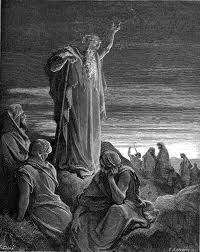
In Ezekiel 2-3, Ezekiel receives his commission to preach to the wicked, rebellious house of Israel in a vision. The basic call was to persevere in preaching the word of the Lord no matter what because through him God will make them know that “a prophet has been among them.” (2:5) This seems tough, but encouraging right? I mean, he is told that it will be evident that Ezekiel is God’s anointed prophet. God will be with him powerfully. That’s gotta be good?

Eh, not so much. There’s more.

See, while promising to be with him, God also makes it clear he’s not going to be greeted with a lot of success. He is going to be rejected. His message will fall on rebellious ears and stubborn hearts. He says that he’s sending him to a people who are so stubborn that, even though the message is not hard to understand, and the language is not a barrier, even so, they will reject it because they continually reject God. (3:6) Yet still, God calls him to be a “watchman” over the house of Israel (3:17), preaching a warning to God’s people so that they might turn, repent, and not come under judgment. Knowing that the people will rebel, knowing that they will reject him, knowing the difficulty he is still to preach the word of the Lord.

How are we to preach under conditions like this? What drives faithfulness in situations like this? How do we bear up under the pressure? Most of us don’t think about this going in. I mean, we might “know” it’s going to be hard. We might “know” that if we faithfully preach the word, not all that we say is going to be received well. Nevertheless, coming face to face with recalcitrant members of the body, people who won’t repent, members you’re intimidated to speak honestly to for fear of causing them to leave, can catch some of us off guard and make us lose our nerve. Even with the Spirit of God indwelling the hearts of believers, nobody likes being told to repent. The house of Israel can still be a rebellious people this side of the Cross.

A Hard Forehead

So what do you need to preach faithfully to people with stubborn hearts? First of all, you apparently need some good facial bone density.

Early in the chapter the Lord says to Ezekiel, “But the house of Israel will not be willing to listen to you, for they are not willing to listen to me: because all the house of Israel have a hard forehead and a stubborn heart. Behold, I have made your face as hard as their faces, and your forehead as hard as their foreheads. Like emery harder than flint have I made your forehead. Fear them not, nor be dismayed at their looks, for they are a rebellious house.”(3:7-9)

The Lord uses the picture of Israel having a “hard forehead” after years of rebellion; they were people with a stubborn will that won’t be turned aside, having set their face against the Lord. God tells Ezekiel that as hard as their forehead was, he would make Ezekiel’s that much firmer. God would give Ezekiel a strength of will, a forehead harder than flint that was used to strike a fire. We need a supernaturally emboldened will to preach. Ezekiel did not derive his boldness from his own strength—his strength was the Lord’s. It was the Spirit of God who proved to be the firm ground on which he could make his stand.  You can’t preach to a stubborn people if your will is weaker than theirs. Inevitably heads will butt and someone’s will have to break. Pray for the sake of your people that it’s not yours.

A Heavy Heart

Your people need you to have a hard forehead because this passage also teaches us that our message is a weighty one. It can only be preached with heavy heart, burdened with the gravity of God’s words. That’s the only way I know how to describe the Lord’s charge in the middle of the chapter. God tells Ezekiel that he must preach to the people because unless he does he’s accountable for their blood.

“Son of man, I have made you a watchman for the house of Israel. Whenever you hear a word from my mouth, you shall give them warning from me. If I say to the wicked, ‘You shall surely die,’ and you give him no warning, nor speak to warn the wicked from his wicked way, in order to save his life, that wicked person shall die for his iniquity, but his blood I will require at your hand. But if you warn the wicked, and he does not turn from his wickedness, or from his wicked way, he shall die for his iniquity, but you will have delivered your soul. Again, if a righteous person turns from his righteousness and commits injustice, and I lay a stumbling block before him, he shall die. Because you have not warned him, he shall die for his sin, and his righteous deeds that he has done shall not be remembered, but his blood I will require at your hand. But if you warn the righteous person not to sin, and he does not sin, he shall surely live, because he took warning, and you will have delivered your soul.”  (3:16-21)

God says that he will punish the wicked and forgive the repentant according to their own actions, but Ezekiel is still held liable for whether he preached the word of repentance to them or simply left them to their wickedness.

All throughout the Scriptures there is a weight to being a preacher and teacher of God’s Word. (Jas 3:1; Heb 13:17) They are to be faithful shepherds to the flock knowing they must give an account to the True Shepherd. (1 Peter 5:1-4) Paul tells Timothy “Watch your life and doctrine closely. Persevere in them, because if you do, you will save both yourself and your hearers.” (1 Tim. 4:16)

Preachers have to know that there is a weight to the words we speak. We’re not just bandying about interesting ideas that are fun to debate sometimes. We are preaching the difference between life and death, both in this life and what follows.  . This knowledge should drive us to set our foreheads like flint and preach no matter the “result.” All too often we pull back for fear of the “results” when the results of pulling back are far more terrifying. Instead, our charge should propel us forward, to humbly, but confidently speak “thus says the Lord” for the sake of our hearers.

Getting Weightier Hearts and Tougher Craniums

A lot of us reading Ezekiel 3 know that we don’t have that hard forehead or that heavy heart. In moments of weakness I want to turn aside from saying what I need to say and console myself with the thought that, in the grand scheme of things, my words won’t really make that great a difference. The bracing truth is that this is a lie that our people can’t afford for us to believe.

How do we gain some weightier hearts and tougher craniums?

  1. Pray. It’s that simple. God promises that HE will make Ezekiel’s forehead hard. We need to be on our knees, pleading with God for the might to bear up under the pressure. The Spirit is the only one who can impress upon our hearts the burden of the word as well as give us the courage we need.
  2. Preach the word alone. We gain strength and passion for preaching when we commit ourselves to studying and wrestling with God’s word in order to present it to God’s people. It is then that we are convinced and convicted of what God has said,; it is then that we are unhindered by the ambition to forward our own clever ideas; it is then that our fears are quenched that would cause us to shrink from our task. “But when I speak with you, I will open your mouth, and you shall say to them, ‘Thus says the Lord GOD.’ He who will hear, let him hear; and he who will refuse to hear, let him refuse, for they are a rebellious house.” (Ezek 3:27) When we preach the word and that alone it gives us confidence that it is the Lord “opening our mouth.”

Once again, I offer these incompletely reformed thoughts more as a prayer for my own ministry than as the distilled wisdom of achieved experience.

Soli Deo Gloria