No Such Thing as a Dumb Question?

I must confess that I’ve always thought the phrase, “There’s no such thing as a dumb or bad question” to be a bit silly.  Admittedly, patience with ignorance has not historically been a strength of mine. In high school I was that guy who would groan audibly at silly answers given by my classmates at times.  I blame this almost entirely on my arrogance.  (Occasionally it was probably merited, but that’s no excuse.) Still, arrogance aside, I always could think of a number of questions that were foolish to ask given any situation.

Now, I’ve mellowed a bit since my high school days, become more aware of my own intellectual failings, and expanded my definition of what counts as a good question, especially in a teaching situation where I myself have come to use the phrase to encourage those shy students. And yet, I still find myself wincing a bit when I hear that phrase uttered or when I come across a  particularly silly question.

Which brings me to Richard Dawkins.

Dawkins is a Big Silly

For the last couple of weeks I’ve been trekking through the New Atheist canon in preparation for an upcoming teaching series. First it was Harris, then it was Hitchens, and now I’ve finally made it to Dawkins. I was unsurprisingly unimpressed by the first two given that there really wasn’t much in the way of an actual refutation of Christianity or even theistic belief forthcoming. Well, unless you count some unhelpful platitudes about reason and faith. I came to Dawkins’ God Delusion though, expecting a bit more since he, among the 4 Horsemen, has the reputation of being most interested in giving serious arguments against God’s existence. I can’t say I was expecting much in light of some criticisms I’d read beforehand. Still, looking at the table of contents and noting that it includes a decent-length chapter on the traditional proofs for the existence of God, I allowed myself to be somewhat hopeful.  “Maybe it’s not all that bad. Maybe it’s not as painful as they say.”

I won’t bore you with all of the details of that 35-page train wreck except to say that my forehead was a nice bright pink at the end of the ordeal given the frequent face-palming I was doing. There were many delightful turns of phrases, misleading but amusing analogies, arrogant snark enough to last for months, and questions on par with “Could God make a martini so big that even HE couldn’t drink it? Ha! He’s not omnipotent!”

It was beautiful.

The one piece that irked me most was what he touted as the most damning response possible to the argument from design. The design argument is something like:

  1. Where there is design, there must be a designer.
  2. The universe exhibits unmistakable signs of complexity and design. (Insert various examples from physics, biology, the existence of salsa)
  3. The conclusion is that there must be a universal designer.

Now, what is Dawkins’ grand damning response to this? “Who made God?” (109, a question which apparently occurs to all “thinking people”) and “Who designed the designer?” (158) I swear, I am not making this up.

This, as you can tell, is what got me thinking about silly questions. For a 5-year old or even a 15-year old to ask, “Well, who made God?” is fine; nothing dumb or illegitimate about that. For an Oxford professor to trumpet this as his damning argument against God’s existence is just sad.

Now, some of you might be thinking, “Hey, wait a minute. There’s got to be more to it than that.” And, in a sense, you’d be right. Dawkins has an argument here. In fact, this is his grand argument against God’s existence. As he puts it, “However statistically improbable the entity you seek to explain by invoking a designer, the designer himself has got to be at least as improbable.” His point is that a being that can create something complex like the universe, would have to be incredibly complex: at least as complex as the universe itself. The more complex something is, the less likely it is. In which case, whatever created the universe would have to be extraordinarily complex, and therefore even more improbable which is why God probably doesn’t exist.

If that weren’t bad enough, apparently, the whole exercise is silly because in any case, since the whole point of the argument from design is to explain complexity or statistical improbability, introducing a statistically improbable, complex being to explain complexity explains nothing. (158)

This can sound convincing at the surface level. To explain why this actually isn’t, I’d like to call in an expert witness: Alvin Plantinga.

Plantinga lays the Hammer down

You’ll be hearing about Alvin Plantinga from time to time on this blog. Suffice it to say for now that he is probably THE SINGLE-MOST BRILLIANT ANALYTIC PHILOSOPHER ALIVE. In his very humorous and instructive review of Dawkins’ book, he points out a number of problems with this argument. I’m only going to excerpt a couple, but you’ll want to go read the whole thing.

First, Plantinga points out that Dawkins is confused as to what it means to speak about complexity with regards to God:

Now suppose we return to Dawkins’ argument for the claim that theism is monumentally improbable. As you recall, the reason Dawkins gives is that God would have to be enormously complex, and hence enormously improbable (“God, or any intelligent, decision-making calculating agent, is complex, which is another way of saying improbable”). What can be said for this argument?

Not much. First, is God complex? According to much classical theology (Thomas Aquinas, for example) God is simple, and simple in a very strong sense, so that in him there is no distinction of thing and property, actuality and potentiality, essence and existence, and the like. Some of the discussions of divine simplicity get pretty complicated, not to say arcane. (It isn’t only Catholic theology that declares God simple; according to the Belgic Confession, a splendid expression of Reformed Christianity, God is “a single and simple spiritual being.”) So first, according to classical theology, God is simple, not complex.  More remarkable, perhaps, is that according to Dawkins’ own definition of complexity, God is not complex. According to his definition (set out in The Blind Watchmaker), something is complex if it has parts that are “arranged in a way that is unlikely to have arisen by chance alone.” But of course God is a spirit, not a material object at all, and hence has no parts. A fortiori (as philosophers like to say) God doesn’t have parts arranged in ways unlikely to have arisen by chance. Therefore, given the definition of complexity Dawkins himself proposes, God is not complex.

Translation: First, by definition, both those of classical theology and Dawkins’ own definition as laid out elsewhere, God is not a complex being. Given that God is a simple, spiritual being God does not demonstrate physical complexity or design in a way that allows Dawkins’ question to even make sense. Therefore, Dawkins’ argument fails.

The next part is where he shows how Dawkins’ question completely misses the point and responds to his idea that introducing God as an explanation for complexity explains nothing:

In The Blind Watchmaker, he considers the claim that since the self-replicating machinery of life is required for natural selection to work, God must have jump-started the whole evolutionary process by specially creating life in the first place—by specially creating the original replicating machinery of DNA and protein that makes natural selection possible. Dawkins retorts as follows:

“This is a transparently feeble argument, indeed it is obviously self-defeating. Organized complexity is the thing that we are having difficulty in explaining. Once we are allowed simply to postulate organized complexity, if only the organized complexity of the DNA/protein replicating machine, it is relatively easy to invoke it as a generator of yet more organized complexity… . But of course any God capable of intelligently designing something as complex as the DNA/protein machine must have been at least as complex and organized as that machine itself… . To explain the origin of the DNA/protein machine by invoking a supernatural Designer is to explain precisely nothing, for it leaves unexplained the origin of the Designer…”

Here there is much to say, but I’ll say only a bit of it. First, suppose we land on an alien planet orbiting a distant star and discover machine-like objects that look and work just like tractors; our leader says “there must be intelligent beings on this planet who built those tractors.” A first-year philosophy student on our expedition objects: “Hey, hold on a minute! You have explained nothing at all! Any intelligent life that designed those tractors would have to be at least as complex as they are.” No doubt we’d tell him that a little learning is a dangerous thing and advise him to take the next rocket ship home and enroll in another philosophy course or two. For of course it is perfectly sensible, in that context, to explain the existence of those tractors in terms of intelligent life, even though (as we can concede for the moment) that intelligent life would have to be at least as complex as the tractors. The point is we aren’t trying to give an ultimate explanation of organized complexity, and we aren’t trying to explain organized complexity in general; we are only trying to explain one particular manifestation of it (those tractors). And (unless you are trying to give an ultimate explanation of organized complexity) it is perfectly proper to explain one manifestation of organized complexity in terms of another. Similarly, in invoking God as the original creator of life, we aren’t trying to explain organized complexity in general, but only a particular kind of it, i.e., terrestrial life. So even if (contrary to fact, as I see it) God himself displays organized complexity, we would be perfectly sensible in explaining the existence of terrestrial life in terms of divine activity.

Translation: We are not trying to explain organized complexity in general. The argument from design is dealing with one instance of complexity: the universe. As an explanation for that, a universal mind like God’s works even when granting complexity, (which we’ve already seen is unnecessary).

Conclusion

Now, we’ve seen why this question “Who designed the designer?” and Dawkins’ further elaboration of it into an argument against God’s existence is confused and a bit silly. The thing that makes it truly silly though, is the arrogance with which he wields it. In the mouth of a truly inquiring child, teenager, or even adult, it is perfectly legitimate question that can be answered honestly and without any condescension or arrogance. In fact, most answers should be given that way. In the mouth of a snarky professor who should know better, it becomes very silly indeed, and is safely ignored as a serious threat to belief in God.

To wrap up here are a few things to keep clear:

  1. Apparently a Ph.D. in biology doesn’t do much for your philosophical chops. So, next time you hear a biologist or a chemist pronouncing confidently on philosophic and theological issues beyond the remit of their chosen discipline, remember: they’re only scientists, not philosophers. That doesn’t mean you should listen and weigh what they say, but it also means you should take it with a grain of salt.
  2. None of this necessarily proves that the design argument “works.” It just means that Dawkins’ response to it doesn’t. Nobody needs to get freaked out by the question, “Who designed the designer?”
  3. At the same time, if you’re a believer, realize that there are legitimately thoughtful atheists who have good questions and serious doubts who should be taken seriously and lovingly answered. Pointing out the silly things that one of them has written should not cause us to think they’re all that silly and smug.

Disclaimer– I’d just like to point out that even though I’ve called attention to some intellectual problems with Mr. Dawkins’ arguments, this in no way denies his prodigious abilities as a biologist or is meant to imply that I consider myself smarter than him. Consider it an exercise in God using the foolish to shame the wise. (1 Cor 1:27) Or rather, God using the foolish (me), using the wise (Plantinga), to shame the wise (Dawkins.)

Recommended resources:

1. Go read the whole review by Plantinga that I linked above.
2. Where the Conflict Really Lies: Science, Religion, and Naturalism by Alvin Plantinga is his definitive work on the problem of theistic belief, science, and naturalism. I highly recommend this work.
3. A Shot of Faith to the Head: How to Be a Confident Believer in an Age of Cranky Atheists by Mitch Stokes is Plantinga’s awesomeness written for everybody. I’ll be reviewing this book soon.

Is it Really Bad if God Brings Something Good out of it? C.S. Lewis, Joseph, and Moral Judgments

“Is it really a bad thing if God does something good with it?” You may have heard this kind of question before. Maybe in a discussion after your philosophy 101 class, or a Bible study, or in a coffee shop, the issue of God and evil comes up. How can God still be good and powerful given the amount of evil and suffering we see in the world? Copious amounts of ink have been spilled on the subject and numerous answers have been given. I’m not going to attempt anything so bold as to hazard a definitive answer except to clarify a couple of important points we must keep straight in our thinking about this issue.

Good Enough Reasons and the Problem of Naming Evil

One commonly made point is that it’s possible for God to still be good and powerful and allow all the evil we see in the world, if he has a morally justifiable reason to such as avoiding a greater evil or bringing about an outweighing moral good. For instance, I’m morally justified in allowing my child to suffer pain while getting vaccination shots because it will prevent some later, horrible disease. In fact, at that point, I’m just justified in purposing the pain, because it is outweighed by the good of avoiding the disease.

This is somewhat common-sensical, and leaving aside some issues related to God’s power, you could see the way that the principle could apply to God. God can still be good and powerful, yet allow for some good purpose even if it’s one that only He can understand. (The epistemological issue is an important one, but I’ll deal with that in another post on another day.)

At this point our post title becomes relevant. God is justified in allowing something we think is evil because of the good that comes from it or that evil that it avoids. But, the question actually goes a bit further and says, “Well, in fact, it seems that instance of suffering and evil wasn’t really evil because of the good result that came from it. Maybe it’s just that evil is just a good that is misunderstood?”

Is that right, though?

Natural questions like these make some worry about appealing to some higher “plan.” They fear that it impermissibly justifies evil and makes moral language ambiguous. In other words, if that crime was really part of God’s plan that he used to bring about some greater good, are we allowed to call it evil? Is suffering really bad? If that’s the case, then doesn’t that remove moral responsibility and render us unable and name evil as evil since it is “justified”? To say otherwise is “nihilism.”

In light of this, they would want to say that, in fact, all we can morally say is that there is no “good” reason for much of the evil that we see in the world. All we know is that God hates it, will end it someday, and make everything better.

But that seems troubling as well because if we can’t say that God had a good reason for allowing an evil, that leaves us back where we started with God allowing evil for no good reason at all.

Is there a way forward from this?

C.S. Lewis on Simple Good, Simple Evil, and Complex Good

There are a great many issues to consider here, but C.S. Lewis has a great little passage in his work devoted to the problem of suffering and evil, The Problem of Painthat begins to address the issue. He’s discussing whether Christians should seek suffering because so often it is linked to spiritual growth and moral goodness. In it he says:

I answer that suffering is not good in itself. What is good in any painful experience is, for the sufferer, his submission to the will of God, and, for the spectators, the compassion aroused and the acts of mercy to which it leads. In the fallen and partially redeemed universe we may distinguish (1) The simple good descending from God, (2) The simple evil produced by rebellious creatures, and (3) the exploitation of that evil by God for His redemptive purpose, which produces (4) the complex good to which accepted; suffering and repented sin contribute. Now the fact that God can make complex good out of simple evil does not excuse – though by mercy it may save – those who do the simple evil. And this distinction is central. Offences must come, but woe to those by whom they come; sins do cause grace to abound, but we must not make that an excuse for continuing to sin. The crucifixion itself is the best, as well as the worst, of all historical events, but the role of Judas remains simply evil.

We may apply this first to the problem of other people’s suffering. A merciful man aims at his neighbour’s good and so does “God’s will”, consciously co-operating with “the simple good”. A cruel man oppresses his neighbour, and so does simple evil. But in doing such evil, he is used by God, without his own knowledge or consent, to produce the complex good – so that the first man serves God as a son, and the second as a tool. For you will certainly carry out God’s purpose, however you act, but it makes a difference to you whether you serve like Judas or like John. 

So we see it is possible to speak of simple good, simple evil, God’s redemptive work, and the complex good that follows from God’s redemptive work. It is possible for both God and humans to be at work in one and the same events event–to be able to speaking meaningfully of human evil while still affirming God’s goodness in that particular event. Sounds good Clive, but is it biblical?

Joseph: A Biblical Paradigm

There are a number of events in biblical history which God speaks of as evil on the part of humans, yet part of a broader, good divine plan. The story of Joseph is often used as a paradigm for this way of thinking. In the story, he is sold into slavery by his jealous brothers, is wrongfully imprisoned by his Egyptian slave-master, left in jail for many years, but through a providential chain of events is elevated to a position of power in Egypt before a time of great famine. This then enables him years later to provide food for his family that had initially sold him into slavery as well as provide for the entire nation of Egypt. Eventually, from that family, comes the Messiah, the savior of the world.

In an encounter with his brothers years later he realizes that they fear for their lives from him. Even years after forgiving them and treating them well, they still worry that he might be holding a grudge against him for their evil. Joseph calms their fears by assuring them he knows that although they did what they did for evil intentions, God intended for good (Gen. 50:20):

As for you, you meant evil against me, but God meant it for good, to bring it about that many people should be kept alive, as they are today.

So, in the one affirmation we see him affirm that being sold into slavery by your own brothers is evil. Being wrongfully imprisoned is evil. At the same time, being in the right place, at the right time to avert disaster for a nation and one’s own family is good. But the humanly-intended evil and the divinely-intended good were being accomplished side by side in the same events! Examples like this could be multiplied over and over again in Scripture, whether in the prophets or the preaching of the early church in Acts. Lewis is on firm, biblical ground here.

Conclusions

So let’s put this together: First, it is not that moral evil or evil events are just good not yet understood. We don’t want to deny the evil of evil, especially of sinful human actions. At the human level, we can say of those things that God condemns them as wicked and they ought not be done. Again, Judas is morally blameworthy and an evil individual for betraying Jesus. God disapproves of his actions. They are really and truly evil.

At the same time, on another level the existence of these evils is morally-justified even if we cannot see the moral justification currently,  with respect to God.  In the case of Judas and the Cross, God used Judas’ wickedness to accomplish his good divine intention. Judas is evil in his action. God is not because he had a good enough reason for allowing this evil to occur.

Admittedly, this is just a thumb-nail sketch of an answer to one of the many questions within a much broader issue. Still, I think can help us keep a couple of points clear that ought not be confused whenever we are trying to think about or discuss the issue of evil and suffering from a biblical perspective.

In all things Soli Deo Gloria.

Progressive God-Talk, Reformed Theological Method, The Doctrine of Analogy, and God’s Grace in our Knowledge

(Warning: this is a mildly dense one. If you haven’t had coffee yet, you might want to grab some, then come back. Also, it might seem dry at first, but there’s a punch-line you don’t want to miss.)

Progressive God-Talk

A few days ago, progressive author and blogger, Tony Jones threw down a challenge to his fellow progressive bloggers to start actually saying something substantive about God, “Not about Jesus, not about the Bible, but about God”, because they seem to  “have a God-talk problem. That is, progressives write lots of books and blog posts about social issues, the church, culture, and society. But we don’t write that much about God. That is, we don’t say substantive things about who God is, what God does, etc.”

I don’t have a lot to say on the subject of liberal God-talk at this point, except that its been interesting to watch as it unfolds (or the way it doesn’t.) My hope is that more liberal/progressives do post substantive pieces of theology so that a real discussion of the nature and character of God can ensue.

One thing I do have something to say about is the topic of Reformed God-talk, and the attitude that those of us who engage in theology out of the Reformed tradition should take towards the conversation that’s happening right now amongst the progressives. To do that, though, I’m gonna call in a little help.

Reformed Theological Method (Or how Reformedish people go about thinking about God)

A while back I read a great article by Michael Horton on the Reformed theological method in conversation with Open Theism that will be helpful to our conversation. In it he deals with the common charge made that the Reformed scholastics were too dependent on “Hellenistic” thought or Greek speculative, systematizing which distorted the true, “dynamic”, biblical portrait of God. Leaving aside the problem that many who lodge this charge are guilty of the genetic fallacy, Horton shows that, in fact, “Contrary to popular caricature, Reformed scholasticism championed an anti-speculative and anti-rationalistic theological method based on the Creator-creature distinction.” He quotes Francis Turretin as representative of the tradition when he says,

But when God is set forth as the object of theology, he is not to be regarded simply as God in himself . . . , but as revealed . . . Nor is he to be considered exclusively under the relation of deity (according to the opinion of Thomas Aquinas and many Scholastics after him, for in this manner the knowledge of
him could not be saving but deadly to sinners), but as he is our God  (i.e.,covenanted in Christ as he has revealed himself to us in his word) . . .

Thus although theology treats of the same things with metaphysics, physics and ethics, yet the mode of considering them is far different. It treats of God not like metaphysics as a being or as he can be known from the light of nature; but as the Creator and Redeemer made known by revelation . . . For theology treats of God and his infinite perfections, not as knowing them in an infinite but in a finite manner; nor absolutely as much as they can be known in themselves, but as much as he has been pleased to reveal them.

So, theology treats, not of God in general, but of God as he has given himself to us in Christ and in the history of Israel as attested to in the Scriptures. This straight from the mouth of Turretin, the Reformed Aquinas and the grand-daddy of all post-Reformation dogmaticians.

Horton then outlines then expands on 4 important distinctions that flow from the Creator/creature distinction that give Reformed theology its particular shape (transcendence and immanence, hidden/revealed , eternal decree/temporal execution, and archetypal/ectypal knowledge). We don’t have space to go into all of them here, but the final one, the archetypal/ectypal knowledge distinction is important for us. This distinction teaches that God’s knowledge is archetypal and primary, while our knowledge is ectypal and dependent on God’s. Horton writes that:

“It is the epistemological corollary of the ontological Creator-creature distinction. Although it had been a category in medieval system, Protestant dogmatics gave particular attention to this distinction and made it essential to their method. Just as God is not merely greater in degree (“supreme being”), but in a class by himself (“life in himself,” John 5:26), his knowledge of himself and everything else is not just quantitatively but qualitatively different from that of creatures…affirmation of this distinction is essential if we are to maintain with Scripture that no one has ever known the mind of the Lord (Rom 11:34, where the context is predestination), that his thoughts are far above our thoughts (Isa 55:8), and that he is “above” and we are “below” (Eccl 5:2)—if, in other words, we are to truly affirm the Creator-creature distinction.”

So, the idea is that because there is a radical gap in reality between God and ourselves–he is necessary, infinite, transcendent, etc. and we are contingent, finite, bound–there is also a radical gap in our knowledge. In the same way that God’s reality is at a higher level than ours and sustains ours, the same is true of our knowledge. It’s not just that we know less stuff, but that we know the stuff we do in a lesser way than God does.  This is not to say that we don’t have true knowledge, any more than to say that we are not real, simply because we’re not on the same ontological playing field as God, but that our knowledge is at a lower level than God does and is.

The Doctrine of Analogy (“God is…”)

With this distinction in hand, our discussion brings us to the doctrine of analogy, which has a long history both in Catholic and Protestant theology. I’d explain it, but here’s Horton again:

“All of this leads us, finally, to the doctrine of analogy. When we assert certain predicates of God, based on God’s own self-revelation, we use them in one of three senses: univocally, analogically or equivocally. If we say that the predicate “gracious” means exactly the same thing, whether in God or in a creature, we are using “gracious” univocally. At the other end of the spectrum, if we say that by using that predicate we are ascribing something to God whose appropriateness is unknown to us, we are using it equivocally. If, however, God is said to be “gracious” in a way that is both similar and dissimilar to creatures, we say it is analogical. For instance, when we acknowledge that God is a “person,” do we really mean to say that he is a person in exactly the same sense as we are? When we follow Scripture in using male pronouns to refer to God, do we really believe that he is male? Unless we are willing to ascribe to God (in an univocal sense) all attributes of human personhood, predications must be analogical. Human language cannot transcend its finitude, so when God reveals himself in human language, he draws on human analogies to lead us by the hand to himself. It is correct description, but not univocal description.”

This is a useful doctrine for many reasons, but as Horton points out, it both acknowledges human finitude unlike rationalistic, univocal approaches to God-talk, as well as gives a place for real knowledge of God unlike modern, skeptical, equivocal approaches God.

Calvin’s Lisp, or God’s Grace in our Knowledge

Why do I bring all of this up? Well, aside from the fact that it’s just important for theology as a discipline, it’s important for our own theology as a part of life. It’s very easy for theology types to get really puffed up when it comes to their “knowledge” of God and his ways. Paul had to administer many a 1st Century beat-down over this in the church in Corinth. (cf. 1 Cor 1-4) What all of this points to is that this should not be so for Christians, especially for those who claim to be Reformed. Listen to Horton again:

“Thus, Calvin and the Reformed do not use analogy as a fall-back strategy when they find something that does not fit their system. Rather, it is the warp and woof of their covenantal approach, a necessary implication of the Creator-creature relationship as they understand it. All of God’s self-revelation is analogical, not just some of it. This is why Calvin speaks, for instance, of God’s “lisping” or speaking “baby-talk” in his condescending mercy. Just as God comes down to us in the incarnation in order to save us who could not ascend to him, he meets us in Scripture by descending to our weakness. Thus, not only is God’s transcendence affirmed, but his radical immanence as well. Transcendence and immanence become inextricably bound up with the divine drama of redemption. Revelation no less than redemption is an act of condescension and grace.”

All of our knowledge of God is had by God’s grace. It’s not just that we find out about a gracious God when we hear the Gospel, but that our hearing the Gospel at all is an act of grace! Our very knowledge of God is God’s kindness, God’s condescension to take up our feeble language and use it in powerful ways to speak to us of his great love. For the Reformed, it should be grace all the way down to your epistemology.

This is why it makes no sense at all for us to boast, or pride ourselves as better than others because of our ability to say and believe true things of God or on our theological systems and tradition. These are good things; they’re great. They’re a rich resource. They can be a great blessing. They can be all of these things, but the one thing they cannot be, must not be, is a source of arrogance or pride. Instead  every truth we utter or find in one of our dogmatics should be a reminder of God’s grace, not our own awesomeness.

So, if you’re cruising around the blogosphere, or just in life, reading people or hearing people talk about God in what you find to be silly fumbling, or inadequate ways, your first instinct should not be to look on condescendingly or pridefully, but remember God’s condescension that made your knowledge possible. When you get that point, maybe, just maybe you can engage in a loving, humble conversation about God and his truth with those whom you disagree.

Sam Harris, the End of Faith, and “The Myth of Religious Violence”

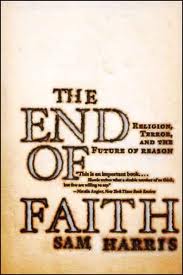
I’ve begun reading Sam Harris’ breakout work on religion and violence The End of Faith that gained him notoriety as one of the “4 Horsemen” of the New Atheism. In prepping for a teaching series on the intellectual objections to Christianity in the fall, I thought it appropriate to read some of the popular literature on the subject.

To be honest, before beginning to read it I was scared…of facepalming the whole way through.

My only acquaintance with Harris’ work was his debate with William Lane Craig at Notre Dame last year. In my opinion Craig thoroughly trounced him, but I was struck by Harris’ cool, composed, unflappably secure attitude that all religious belief was basically nonsense, and demonstrably so. He was a great communicator, if not always the clearest-thinking philosopher. (In point of fact, he is not a philosopher, but rather has his Ph.D. in neuroscience.)

Nothing about that judgment has changed since reading the majority of his manuscript. He writes marvelously clear prose and has a peculiar gift for asking questions with an incredulous tone–in print. He also excels in finding particularly horrifying stories of violence associated or motivated by religious belief, and purposefully picking the least charitable reading of any given text of scripture he can. That being said, my faith is in no danger from his philosophical arguments against Christianity, simply because there aren’t many to speak of. Or, if they’re there, they’ve been answered over and over again.

The one truly positive thing I can say that I appreciate about Harris’ work is that he is refreshingly free of postmodern squishiness when it comes to moral relativism, or even metaphysical relativism. He is a realist and understands that beliefs link up to actions in important ways. He also understands Christian theological claims about the Resurrection, the Virgin Birth, etc. are claims about reality, not just subjective statements about my consciousness, (unlike so many postmodern theologians.) This, in fact, is a crucial portion of his argument; it is precisely the absurd beliefs of the religious that lead to insane, unjustifiably horrible violence.

I am not interested in giving a full review and critique here. That has been many times over and would be rather pointless. What I want to do is draw attention to the fact that this work is basically a popular example of the conventional wisdom on the subject of religion and violence that William T. Cavanaugh writes about in The Myth of Religious Violence

In a short lecture entitled “Does Religion Cause Violence?” he outlines his argument deconstructing the “conventional wisdom” like this:

But what is implied in the conventional wisdom that religion is prone to violence is that Christianity, Islam, and other faiths are more inclined toward violence than ideologies and institutions that are identified as “secular.” It is this story that I will challenge here. I will do so in two steps. First, I will show that the division of ideologies and institutions into the categories “religious” and “secular” is an arbitrary and incoherent division. When we examine academic arguments that religion causes violence, we find that what does or does not count as religion is based on subjective and indefensible assumptions. As a result certain kinds of violence are condemned, and others are ignored. Second, I ask, “If the idea that there is something called ‘religion’ that is more violent than so-called ‘secular’ phenomena is so incoherent, why is the idea so pervasive?” The answer, I think, is that we in the West find it comforting and ideologically useful. The myth of religious violence helps create a blind spot about the violence of the putatively secular nation-state. We like to believe that the liberal state arose to make peace between warring religious factions. Today, the Western liberal state is charged with the burden of creating peace in the face of the cruel religious fanaticism of the Muslim world. The myth of religious violence promotes a dichotomy between us in the secular West who are rational and peacemaking, and them, the hordes of violent religious fanatics in the Muslim world. Their violence is religious, and therefore irrational and divisive. Our violence, on the other hand, is rational, peacemaking, and necessary. Regrettably, we find ourselves forced to bomb them into the higher rationality. 

Cavanaugh does this and more in his book, and delivers on his promises in the lecture as well. I highly recommend both.

Now, I read this a while back, but when I was reading Harris’ work, I ran across a passage that sounded remarkably familiar. I returned to this lecture and I found that Cavanaugh had addressed Harris’ work specifically. If you’ll pardon me, I’ll quote him at length again:

Sam Harris’s book about the violence of religion, The End of Faith, dramatically illustrates this double standard [Secular violence is rational, but religious violence is irrational and unjustified]. Harris condemns the irrational religious torture of witches, but provides his own argument for torturing terrorists. Harris’s book is charged with the conviction that the secular West cannot reason with Muslims, but must deal with them by force. In a chapter entitled “The Problem with Islam,” Harris writes: “In our dialogue with the Muslim world, we are confronted by people who hold beliefs for which there is no rational justification and which therefore cannot even be discussed, and yet these are the very beliefs that underlie many of the demands they are likely to make upon us.” This is especially a problem if such people gain access to nuclear weapons. “There is little possibility of our having a cold war with an Islamist regime armed with long-range nuclear weapons. . . . In such a situation, the only thing likely to ensure our survival may be a nuclear first strike of our own. Needless to say, this would be an unthinkable crime—as it would kill tens of millions of innocent civilians in a single day—but it may be the only course of action available to us, given what Islamists believe.” Muslims then would likely misinterpret this act of “self-defense” as a genocidal crusade, thus plunging the world into nuclear holocaust. “All of this is perfectly insane, of course: I have just described a plausible scenario in which much of the world’s population could be annihilated on account of religious ideas that belong on the same shelf with Batman, the philosopher’s stone, and unicorns.”

In other words, if we have to slaughter millions through a nuclear first strike, it will be the fault of the Muslims and their crazy religious beliefs.

This, to me, is the most amazing, (and dangerous) irony in Harris’ work. Essentially, Harris believes, that some religious people’s beliefs are so dangerous to other people’s lives, that we should take their lives, and possibly millions alongside of them.

Harris is absolutely right: our beliefs matter when it comes to dealing with violence in the world. Some beliefs are dangerous. What he’s missing is the fact that some of them are his own.