Jesus Went to the Cross For Me–Now What?

crossI’ve spent a lot of time thinking about the Cross–what did it accomplish, why did it happen, was it planned, what should we think about it, etc. I don’t regret any of it. A good atonement theology is at the core of any good understanding of Jesus and the Gospel. If your understanding of the atonement is narrow and weak, so will be the salvation Jesus offers. The more efficacious, broad, bold, and beautiful you see the Cross to be is the measure of how efficacious, broad, bold, and beautiful you will find Jesus. And that, of course, will determine the character of our discipleship and our churches.

Often-times we don’t get to that second part. We stop at theory and don’t move to practice–to response. We pour over all the verses that talk about what Jesus did, and we don’t think about what the Bible says our response should be to it. So how should we react to Christ’s love-provoked, justice-satisfying, holiness-creating, devil-defeating, guilt-blotting, righteousness-fulfilling, self-giving on the Cross?

Leon Morris helpfully lays out 8 New Testament responses to the Cross:

  1. We have faith in the efficacy of his blood, Romans 3:25
  2. We are to glory alone in the Cross of Christ, Galatians 6:14
  3. We should determine to know nothing save Jesus Christ and Him crucified, 1 Corinthians 2:2
  4. We are to look upon Christ’s offering of Himself as an example, and to follow in His steps, 1 Peter 2:21
  5. We are to overcome by the blood of the Lamb, Revelation 12:11
  6. We are to reckon ourselves crucified with Christ, and continually seek to be made conformable to His death–Romans 6:3, 4, 5, 8; Galatians 2:20; Philippians 3:10; Colossians 2:12; 2 Timothy 2:11; 1 Peter 4:13
  7. We are to preach Christ crucified, 1 Corinthians 1:23
  8. We are to “proclaim the Lord’s death till He come.” in our observing the Lord’s Supper, 1 Corinthians 11:26; cf. “a communion of the blood of Christ,” 1 Corinthians 10:16

–Leon Morris, The Cross in the New Testament, pg. 426

We could easily find more, but that should be plenty to keep us, both as individuals and as churches, busy for a while.

Soli Deo Gloria

Shoot First, Ask Questions Later (Or, 3 Tips On How Not To Talk With Someone About Jesus)

evangelism

Some of us are scared we look like this. Others of us should be.

Some of us don’t talk about Jesus because we’re scared we’re going to screw things up. We don’t think we know what we’re doing, so we timidly hold back and hope someone else will step up to the plate with the person sitting next to us. Some of us realize we are that “someone else”, but screw things up because we’re not scared enough–or rather, we have a zeal, but it’s not a zeal in accordance with knowledge. We mean well, mostly, but for some reason when we try to share Jesus friendships end, restraining orders get filed, and we end up wondering where it all went wrong.

Believe me, I’ve been there. (Well, not the restraining order.) I’m not a naturally quiet kind of guy, so I’ve had my share of evangelism catastrophes. I’m not an expert at this. I still fumble. I walk away from conversations replaying various missteps, thinking, “I should have said this right there and waited a bit for that.” At the same time, over the years, through trial and error, various lectures, sermons, books, and plenty of the Holy Spirit working on me, things have gotten better. I can generally walk away from conversations having said something true, sometimes even uncomfortably true, about Jesus, and not have the person hate me, or scuttle away every time they see me. Sometimes that plays out into something more like being able to hand them a book, or invite them to church.

In the spirit of helping people who want to witness to Jesus more effectively, I offer 3 tips on what NOT to do:

1. Shoot First, Ask Questions Later – Let’s be honest, we have things to say. We have a Gospel message, a Bible-full of truth to share. Great. Awesome. I’m just going to point out, that if they don’t care, it doesn’t matter. You want to say something that means something–to them. According to Jerram Barrs, Francis Schaeffer used to say, “If I’ve got only an hour with someone, I’ll spend the first 55 minutes asking questions, and only then will I try to say anything.” See, unless you know something about the person you’re speaking to, you’re just going to be speaking at them. Instead, try listening first. Hear their story. Ask them about their life, their passions, interests, personal history. Often-times it’s only after knowing something about them that the Holy Spirit will guide you to speak some Gospel truth that actually connects with their lives and renders open to hear more. It’s better to plant a seed that takes root, than to try and ram a full-grown tree down into the soil with no prep. Even if it’s only something small, you have no idea what that seed will sprout into.

Update: My friend Sean Kelly adds, “Also be ready to share yourself with the other person. Asking them questions about their life is a great place to start, but they’re not going to take you seriously unless you’re willing to open up to them as well. Even if it’s just discussing simple, unimportant, everyday happenings. Otherwise, it just feels like an inquisition.”

2. Find Out What’s Wrong First – In a sense, the Good News is only good against the back-drop of some bad news. Forgiveness is beautiful in light of a ruptured relationship, meaning and hope in light of apathy and despair, grace in light of law, so on and so forth. Aware of this reality, many of us immediately go looking for what’s wrong with a person, whether spiritually, emotionally, or intellectually, pounce on it, and then move to introduce the Gospel. Instead, maybe you look for what’s right first. Try looking for those points of truth, goodness, and beauty that the person acknowledges through common grace and the Image of God and start working from those shared values towards the truth of the Gospel. For instance, work from their sense of justice to the beauty of biblical justice, or from their sense of the value of art, to the firm rooting that God gives for creative activity. If you’re a pastor, you should probably try doing the same thing in your preaching.

3. Assume the Other Person Is a Strung Out, Fornicating, Blasphemer Ready To Eat Your Babies – This one may be obvious based on the last two: don’t assume the worst about whoever you’re dealing with. Do not condescend. Do not self-righteously huff and puff about with your moral fervor. Yes, theologically-speaking, they are sinners, depraved, with a darkened heart and mind, in need of the light of the Gospel (just like you).  At the same time, theologically-speaking, they are made in the Image of God, objects of his love, mercy, and the common grace of God, and have consciences that are often-times more finely-tuned than most Christians. Realize this: you might be talking to someone who doesn’t know Jesus, but is a much better person than you by most standards of moral evaluation. It is completely possible for you to learn about loving your wife, raising your kids, studying in school, general work ethic, and general life-knowledge from someone who desperately needs to know the Gospel. When you take that into account, it changes the way you to talk to them.  Again, first stop, listen, watch, and then speak.

At the most basic level, all of these tips boil down to one: when you’re talking to people about Jesus, do it with respect. We are told in scripture to “always be prepared to make a defense to anyone who asks you for a reason for the hope that is in you” and yet we are supposed to “do it with gentleness and respect.” (1 Peter 3:15) Treat people with the dignity that the Gospel requires–the dignity that Jesus himself commands.

Soli Deo Gloria

Luna Lovegood on Why You Need Church (Or, the Spiritual Wisdom of Harry Potter)

LunaMcKenna and I received the Harry Potter films on Blu-Ray for Christmas this year, so, of course, we’ve been watching one every couple of days. As we’ve made our way through the years, I’ve been reminded of why I loved the books. I’ll come clean and say I was late to the game when it came to the Harry Potter franchise. I put off reading the books for a long time, and then blazed through them in a month and a half right after seminary. (I was suffering from a serious fantasy fiction-deficiency.)

Of course, even when watching/reading Harry Potter, I can’t turn off the theology-grid, so it’s been interesting for me to see how much spiritual wisdom there is to be found in both the books and the films. It’s not too surprising given Rowling’s confessed Christian beliefs. I was particularly struck by a conversation in the 5th film, Harry Potter and the Order of the Phoenix between Harry and Luna (Looney) Lovegood, an eccentricly spacey, but insightful classmate of Harry’s at Hogwarts. He’s feeling particularly discouraged about his situation, having been the victim of a smear campaign seeking to discredit his claims that the dark Lord Voldemort (He-Who-Must-Not-Be-Named), the satanic antagonist of the series, had returned and was seeking to take over the wizarding world again:

Luna Lovegood: [about her father] We believe you, by the way. That He-Who-Must-Not-Be-Named is back, and you fought him, and the Ministry and the Prophet are conspiring against you and Dumbledore.
Harry Potter: Thanks. Seems you’re about the only ones that do.
Luna Lovegood: I don’t think that’s true. But I suppose that’s how he wants you to feel.
Harry Potter: What do you mean?
Luna Lovegood: Well if I were You-Know-Who, I’d want you to feel cut off from everyone else. Because if it’s just you alone you’re not as much of a threat.

To anyone with ears to hear, it isn’t hard to discern this bit of insight into the nature of spiritual warfare. I’m not a “there’s a demon hiding under every bush”, kind of guy, but still, Jesus took the reality of the demonic seriously, as do the rest of the NT writers, in which case we ought to as well.

One thing to keep in mind is that while the devil is a roaring lion, looking to devour his prey, and shipwreck your faith, (1 Pet. 5:8) he doesn’t always do it in an obvious, open fashion. As Luna points out about Lord Voldemort, one of the easiest ways for him to tear at you is to isolate you, to whisper lies that you’re all alone, that nobody cares, that you will go unvindicated, that you must ultimately care for yourself, rather than trust in the one who holds your life in his hands–which, of course, is the root of sin. And it’s easy to get discouraged, isn’t it? It’s easy to believe lies. Our guilty hearts and consciences are only too ready to fall for them, especially when they’re so believable. He is the father of lies, you know. (John 8:44)

This is one of the many reasons we go to church. Without it, the lies creep in and take root. Christianity is not, and never has been, a Lone-Ranger faith, where you and Jesus are off fighting the whole world together. No, Jesus founded a community. He said to the community of disciples that he would be with them to the end of the age. (Matt 28:20) You can’t do this by yourself and you were never intended to.

Instead, the author of Hebrews warns us to not neglect meeting together, so that we may “encourage one another”, especially in light of the approaching Day of truth. (Heb. 10:25)  It is only through hearing the regular preaching of the Word, receiving the Gospel in the sacraments, and the community itself that the evil one’s lies are vanquished in our hearts. It is through the church that we are reminded that we have full assurance to approach the Lord in faith, because of blood of Jesus. (Heb. 10:19, 22) The church is how we know we’re not alone.

Soli Deo Gloria

The Crib Leads to the Cross (Or, the Fathers on the Incarnation and Passion)

At Christmas we celebrate the advent of our Lord, the mystery of Incarnation of the Son of God.  For those of us with a theological bent, it raises a question that theologians have asked for centuries: if not for sin, would the Son have become incarnate anyways? Or, is the Incarnation the central act of salvation or the Passion? Christ’s birth or Christ’s death? Which is logically prior? Obviously they’re both important, but the way you answer this question has implications for other doctrines down the line and there are good arguments on both sides.

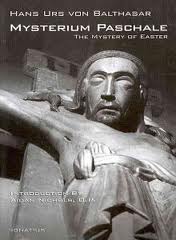
Mysterium paschaleCatholic giant Hans Urs Von Balthasar addressed this question in one of the most fascinating atonement theologies of the 20th century, his Mysterium Paschale: The Mystery of Easter, a meditation on the Triduum Mortis, the three days of Christ’s atonement: Good Friday, Holy Saturday, and Resurrection Sunday. Honestly, even though I’m not sure I can go for his controversial theology of Holy Saturday, brilliant though it is, most Evangelicals could stand to read his section on Good Friday–it’s worth the price of the book alone.

Before getting to the treatment of the three days, Balthasar argues that the Incarnation is clearly ordered to the Passion and that most attempts to reconcile the two trains of thought are misguided. Yet, the same time, if we look deeply into the Scriptures, the tradition, and the deeper theological logic, we will see that:

…to focus the Incarnation on the Passion enables both theories to reach a point where the mind is flooded by the same perfect thought: in serving, in washing the feet of his creatures, God reveals himself even in that which is most intimately divine in him, and manifests his supreme glory. (pg. 11)

East and West
Balthasar’s biblical arguments and later theological elucidation are both fascinating and convincing. The section that was most eye-opening for me in reading it a few years ago, was his section on the testimony of the tradition, both East and West on this subject matter.

Typically we are told that in the Orthodox East, a greater emphasis was laid on the Incarnation and that the Passion is accidental within the scheme, while the Latin West has placed a greater emphasis on the death on the Cross and so subordinates the Incarnation. Balthasar argues that this is a mischaracterization for “There can surely be no theological assertion in which East and West are so united as the statement that the Incarnation happened for the sake of man’s redemption on the Cross.” (pg. 20) Since this is somewhat uncontroversial of the West, specifically of the East he highlights that in their main theory, “the assuming of an individual taken from humanity as a whole…affects and sanctifies the latter in its totality, except in relation with the entire economy of the divine redemptive work. To ‘take on manhood’ means in fact to assume its concrete destiny with all that entails—suffering, death, hell—in solidarity with every human being.” (ibid.)

The Consensus
He then goes on to substantiate his claim with more citations from the Fathers than I have space to quote here; a number of them in Latin and Greek. I will reproduce only a few:

Athanasius

The Logos, who in himself could not die, accepted a body capable of death, so as to sacrifice it as his own for all.

The passionless Logos bore a body in himself…so as to take upon himself what is ours and offer it in sacrifice…so that the whole man might obtain salvation.

Gregory of Nyssa

If one examines this mystery, one will prefer to say, not that his death was a consequence of his birth, but that the birth was undertaken so that he could die.

Hippolytus

To be considered as like ourselves, he took upon him pain; he wanted to hunger, thirst, sleep; not to refuse suffering; to be obedient unto death; to rise again in a visible manner. In all this, he offered his humanity as the first-fruits.

Hilary

In (all) the rest, the set of the Father’s will already shows itself the virgin, the birth, a body; and after that, a Cross, death, the underworld—our salvation.

Maximus Confessor

The mystery of the Incarnation of the Word contains, as in a synthesis, the interpretation of all the enigmas and figures of Scripture, as well as the meaning of all material and spiritual creatures. But whoever knows the mystery of the Cross and the burial, that person knows the real reasons, logoi, for all these realities. Whoever lastly, penetrates the hidden power of the Resurrection, discovers the final end for which God created everything from the beginning.

Again, I have left out various citations by figures such as Irenaeus, Tertullian, Ambrose, Gregory Nazianzen, Cyril of Alexandria, Leo the Great, Augustine, and others (pp. 20-22). Still, as Balthasar notes, “These texts show…that the Incarnation is ordered to the Cross as its goal. They make a clean sweep of that widely disseminated myth” that the Greek Fathers, against the Latins, are focused on the Incarnation to the exclusion of the Cross. (pg. 22)

MangerThe Crib leads to the Cross
As interesting of a conclusion as this is for the history of theology, “more profoundly” says Balthasar, “the texts offered here also demonstrate that he who says Incarnation, also says Cross.” (pg. 22) Of course this should come as no surprise. In all these texts the Fathers were only repeating the apostles, “But when the fullness of time had come, God sent forth his Son, born of woman, born under the law, to redeem those who were under the law, so that we might receive adoption as sons” (Gal. 4:4-5),  and our Lord himself who said, “And what shall I say? ‘Father, save me from this hour’? But for this purpose I have come to this hour.” (John 12:27)

As we look to the Crib, we must see the Cross in the background—both holding our Savior in his weakness and humility—the peaceful beginning pointing the agonizing end suffered for our sakes; the cries from the cradle foreshadowing the cries from the Cross. This Christmas, as we gather around to celebrate the mystery of Incarnation, we cannot forget the Passion.

Soli Deo Gloria

Quick-Blog #9: Tim Keller on 3 Things You Should be Praying for Your Church

This man is praying. Also, he has an amazing beard. Two reasons to imitate him.

So, as I already mentioned, I’ve been working through Tim Keller’s book on Gospel-centered ministry, Center Church. It’s really a must-read for anybody in or even connected to ministry, whether pastors, elders, directors, group leaders, volunteers, admins, etc. I cannot recommend it highly enough. One section that really convicted me last week was in the chapter on Gospel renewal in a church. First off, you should know that Gospel-renewal is “a life-changing recovery of the gospel.” (pg. 54) At the church-wide level it has historically been called a revival. (Think the first Great Awakening–you know, the good one.) Keller lists a few things that contribute to Gospel-renewal in a church including preaching, which is what most of the chapter is dedicated to, but right at the top of the list is “extraordinary prayer.” (pg. 73)

Drawing on the work of C. John Miller, he makes a distinction between “maintenance prayer” and “frontline prayer.” Maintenance prayer is focused on keeping the church going–maintaining what’s happening currently. It’s not a bad thing, but it’s not particularly passionate about the mission. By contrast, frontline prayer is focused on the advance of the Gospel, the forceful spread of the Kingdom in human hearts. He lists three particular traits these prayers possess:

  1. A request for grace to confess sins and to humble ourselves
  2. A compassion and zeal for the flourishing of the church and the reaching of the lost
  3. A yearning to know God, to see his face, to glimpse his glory (pg. 73)

As I mentioned, I was very convicted by this. I mean, I pray for my ministry, for my students, but to be honest it’s mostly been maintenance work. I haven’t been on my knees pleading with the God of heaven that we might be a people humbled, confessing, and passionate to see his glory for a while. I think many could probably relate. In the flow of ministry, prayer doesn’t so much get lost, but squished in between everything else.

Last week I resolved to repent of this and have these three traits mark my prayers. I would encourage you to do the same. It doesn’t matter if you’re a pastor, or not. If you’re a part of the body, then you’re in ministry. Pray for these traits to mark your church and your church’s prayers–not in a rote, mechanical fashion, but from the heart. You can’t manipulate the Spirit into working for you on command. And remember, he’s the one doing the renewing; Gospel-renewal is a gift of grace. Still, pray boldly. Pray this for your members, your pastors, the congregation, the preaching, the worship, the service, and everything else connected to the church. Pray and look for God to move.

Soli Deo Gloria

Happy Reformation Day! Now Repent

When our Lord and Master Jesus Christ said, “Repent” [Matt. 4:17], he willed the entire life of believers to be one of repentance.

-Martin Luther, the 95 Theses

Among the many important letters Martin Luther wrote in his storied career, the one he wrote in protest of the sale of indulgences to Albrecht, Archbishop of Mainz, on October 31, 1517 might have been the most important. The letter itself isn’t the important part, but enclosed within it was a copy of his “Disputation of Martin Luther on the Power and Efficacy of Indulgences,” which came to be known as The 95 Theses. Now, scholars debate whether or not Luther actually took up a mallet to nail the theses up on Wittenburg’s Castle Church on that same day. Also up for debate is whether or not Luther actually intended to accomplish anything more than invite a scholarly debate between solid, Catholic theologians on an issue of importance. What is not up for debate is the colossal significance these theses had in instigating a theological and socio-political revolution that ripped open Europe, changing the face of Western, indeed global, Christianity to this day: the Protestant Reformation. 

This is what Protestant churches celebrate on Reformation Day. Now, to be clear, we don’t mainly celebrate the politics, although a few good (and many bad) things followed. We certainly don’t sing about the tearing of the visible unity of the church. We don’t rejoice in the centuries of acrimonious disputes that followed. No, in fact, many of these are things we lament–at least we ought to.

What we celebrate is the recovery of an essential insight into the Gospel: the good news that Jesus’ reign and rule are freely available to all, without regard to their present ‘righteousness’, or meritorious works; that we are saved by the grace and good will of our heavenly Father through the work of Jesus Christ; that we are justified, declared righteous because by faith we are united with the Righteous One, King Jesus. As it was later summarized in the 5 Solas: we are saved by grace alone, through faith alone, in Christ alone, according to the Scriptures alone, for God’s glory alone.

Celebrate by Repenting

Unfortunately many of us don’t know how to celebrate this Gospel properly. We sing, we praise, we write blogs about Martin Luther and the message of justification by faith, and in general have some nice, warm thoughts about the whole affair. Now this great news is certainly worth singing about; it’s definitely worth a blog or two. For these truths, unfortunately clouded over and muddied up however temporarily in the dominant, late-medieval theology of the day, to be regained and preached loudly and clearly for all to hear is a glorious thing.

Still, if we want to celebrate Reformation Day properly, there is only one truly appropriate response: repentance. See, surprisingly enough for many Protestants, Martin Luther never mentioned the phrase “justification by faith” in the 95 theses. Not by name at least. He certainly spoke of grace and the nature of forgiveness, issues connected to it, but the subject he opened up with was the nature of repentance.

For centuries Jerome’s mistranslation of Matthew 3:2 as “Do penance” instead of “repent”(as well as some other doctrinal developments) had led to a misunderstanding of Jesus’ call to respond to the Kingdom of God. The Greek term metanoia means a deep, internal change of mind–a reconsidering of one’s course of action in light of new realities. Luther saw that when Jesus called for people to repent, he wasn’t calling for a simple change of external actions, or for meritorious acts of penance, and certainly not for people to buy themselves some grace through indulgences. He was calling people to recognize the arrival of God’s reign and rule by turning and submitting themselves to it; it was an invitation to consciously live in the new reality of God’s kingdom made available by grace through Jesus.

The Reformation was, in many ways, an attempt at this kind of repentance not only in the life of the individual Christian, but in the life of the Church as a whole. For those of us claiming the mantle of ‘Protestant’ there can be no question whether the whole of our lives need be one long process of reconsidering everything in light of the Gospel. Repentance is not simply a one-time act but a life-long task. Sin is too deep and Jesus is too good for us to think we ever have it handled–there will always be some sin our heart needs to release and some gift of God’s grace to embrace. God’s liberating reign in Christ is something we’re called to dive into daily.

So, this Reformation Day celebrate the Gospel by repenting–call to mind the goodness of God, the new reality made available in Christ, and live in light of that. Can’t think of anything? Here’s a starter list:

  • Pride – Consider God’s glorious humility in Christ and get over yourself–discover the joy of self-forgetfulness. In fact, try to practice humility by serving someone else without being able to take credit for it.
  • Lust – Look to God’s beauty in Christ and realize He’s the summit of true desire.
  • Gluttony – Take hold of God’s feast provided in the body and blood of Christ and pass the plate to those in need.
  • Greed – Observe of God’s riches, his generosity in Christ and remember that God provides all we could ever want. Give generously to those who do not have.
  • Sloth – See God’s active drawing near in Christ and respond–act–turn to him. Begin (or re-engage) in the spiritual disciplines that draw you to Christ.
  • Wrath – Remember God’s putting away his own righteous wrath toward you in Christ and put away your own unrighteous rage towards others. Instead, be gracious in word and deed towards those around you–especially the aggravating ones.
  • Envy – Recognize God’s gifts toward you in Christ and be grateful for what you have, not bitter what your neighbor has instead.

These ought to keep you busy for a while. Now, start celebrating!

Soli Deo Gloria

The Gospel According to Bach

Because Chris Tomlin just wasn’t good enough for Reformation Sunday, our choir performed a majestic rendition of Johann Sebastian Bach’s Cantata No. 4 this morning. Now, I have to admit I am a bit of a neanderthal and growing up in the churches I have, great as they were, I was never really exposed to high church culture; it’s not my natural jam. Still, I was deeply moved by this piece.

Musically, it was Bach–’nuff said. Lyrically, again, it was Bach, but this particular piece was based on Martin Luther’s hymn, “Christ Lay in Death’s Cold Prison.” While it was meant to be heard, not merely read, I’d encourage you to take some time this week to work your way through the verses, meditating on the deep, Gospel truths about Christ’s death for sin, and hard-won victory of the powers of hell and the grave. It is heavy with theological and spiritual substance; rich food for the soul. Eat up.

Christ lay in death’s cold prison
bound fast for our transgression;
but now he has arisen
and brought to us salvation.
Let us all be joyful, then,
praise God and give thanks to Him
and sing Hallelujah,
Hallelujah!

O Death, you spared no mortal soul
of any race or nation,
for all were under sins control,
none was without transgression.
Therefore came grim Death so soon
and with swift advance it brought our doom,
and held us in its realm of terror.
Hallelujah!

Our Savior Jesus, God’s own Son,
here in our stead descended.
The knot of sin has been undone,
the claim of death is ended!
Christ has crushed the power of hell;
now there is naught but death’s gray shell;
It’s sting he now has ended.
Hallelujah!

It was a war of majesty,
of Life and Death together;
but Life gained the victory,
and did destroy the other.
Scripture has proclaimed it so,
how one death devoured its foe,
and mocked its fleeting power.
Hallelujah!

Here is the spotless Easter-lamb,
that God the Lord did give us,
who high upon the cross was hung
and sacrificed to save us.
On our doorposts is his blood,
The price he paid to conquer Death:
the Strangler now cannot destroy us.
Hallelujah!

Then let us keep this holy feast
with all delight and pleasure,
which God the Lord makes manifest;
he is our light and pleasure,
who through the splendor of his grace
has lightened our most sacred place.
The night of sin has vanished.
Hallelujah!

So Christians, feast with joy each day
on Christ, the bread of heaven,
the Word of grace has purged away
the old and evil leaven.
Christ alone, our holy meal,
the hungry soul will feed and heal;
faith lives upon no other!
Hallelujah!

Soli Deo Gloria

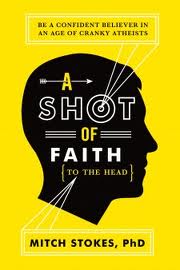
Book Review- A Shot of Faith (to the Head): Be a Confident Believer in an Age of Cranky Atheists by Mitch Stokes

Mitch Stokes. A Shot of Faith (to the Head): Be a Confident Believer in an Age of Cranky Atheists. Nashville: Thomas Nelson, 2012. 252 pp. $16.99. ($11.35 on Amazon)

In the last few years, with the rise of the New Atheism, authors like Dawkins, Dennett, Harris, and Hitchens have made popular Christian apologetics popular again. A veritable cottage industry of “responses” and rejoinders have been churned out by top-notch scholars (and some hacks too) either presenting arguments for Christianity or attempting to dismantle the claims of the New Atheists. While a number of these books are well-written and quite valuable, none of them quite accomplish what Mitch Stokes’ has in his recent work, A Shot of Faith to the Head: Be A Confident Believer in an Age of Cranky Atheists.  

He Knows What He’s Doing

What makes this book different? The key is that Stokes knows what he’s doing and, more importantly, what he isn’t. So often works of apologetics try to cover everything and don’t end up adequately covering anything.  Stokes knows better. He’s narrowed his focus, honed in on the key issues, and goes to work on them in a humorous, engaging, and readable fashion. What are those issues? The relationship between faith and reason, science, and the problem of evil.

Stokes is particularly qualified to tackle these. Before taking up his position as the Senior Fellow of Philosophy at New St. Andrews in Moscow, Idaho he got his MA in religion at Yale under Nicholas Wolterstorff, then went on to get his Ph.D. at Notre Dame under Alvin Plantinga and Peter Van Inwagen. No big deal–just three of the foremost philosophers of religion alive. And, if that weren’t enough,  prior to entering the philosophy game, he got an MS in mechanical engineering. The man knows what he’s talking about.

Introducing Reformed Epistemology–You’re Welcome

One way of describing Stokes’ project is translating Alvin Plantinga for everybody. Plantinga, while being, in my opinion, the most brilliant Christian philosopher working in the analytic tradition today, has not gone out of his way to make his philosophical genius widely accessible to the general reader. Don’t get me wrong, I think he’s hilarious and pretty clear as far as analytic philosophers go. Let’s be honest though, the average layman or pastor won’t take the time to read all 500 pages of Warranted Christian Belief  even if it’s worth it (which it is). Stokes takes the best of the Reformed epistemological approach developed by Plantinga and Wolterstorff (don’t worry, you don’t have to be a Calvinist to buy into it) applied to various issues in philosophy over the last 40 years and condenses it into short, winsome, witty, and clearly laid-out chapters uncluttered with small print or symbolic logic.  He also includes helpful “For Your Arsenal” summary points at the back of each chapter for easy recall of the information.

This isn’t to say that he merely repeats Plantinga, or offers nothing new–he does, especially the way he frames the discussion historically, concretely grounding these ideas in conversation with Hume and Locke on down to W.V.O. Quine. Still, even if translating Plantinga were all he did, this would be crucial because in engaging with both believers and unbelievers with the Gospel over the last couple of years, I’ve come to realize that the issue of epistemology is one that is too often ignored, or simply botched in most popular works on apologetics even though it lies at the root of so many of these discussions. By focusing his sights on the epistemological questions, Stokes really is aiming to give readers a “shot of faith to the head.”

So how does he actually do it? Stokes starts out by explaining and debunking the evidentialist objection to belief in God, that there isn’t sufficient evidence to “prove” he exists. He shows that, in fact, evidentialism is self-defeating–some beliefs must be basic, taken without reasons or evidence, otherwise reasoning itself cannot get off the ground. In fact, he pushes on to show that a demand for arguments and “reasons” for all of our beliefs, actually leads us to the conclusion that atheism itself is self-defeating. In place of the rationalism and evidentialism so commonly assumed by skeptics, Stokes proposes an alternative definition for what it means for a belief to be rational, that it is the product of “properly-functioning cognitive faculty operating in the appropriate environment” (read as good thinking equipment), like sense-perception, memory, and reason; this is a Reidian, reliabilist approach to epistemology as recovered and retooled by Plantinga and others. Stokes goes on to show that belief by way of testimony, or faith, is actually another valid way of coming by our beliefs, and that it is perfectly rational to believe in God by way faith, testimony, or “taking God at his word.”  Pressing a bit further, Stokes makes the very Plantingan point that if the “Christian epistemic story” is true, then the Christian can believe in God in a way that is basic and rational. Basically, in order to show that faith is irrational, you have to prove Christianity false first.

Now, none of these considerations means that he discounts reason or even the arguments for the existence of God–he actually has a very helpful “intermission” section dealing with the nature of the arguments and the problem of the burden of proof. Instead, Stokes shows that these arguments are helpful in supplementing faith and in dealing with “defeater” beliefs.

Defeaters and Highlights

What’s a “defeater”? A defeater is basically a reason to ditch a belief we gained previously in light of new evidence to the contrary, or that casts suspicion on the way we arrived at our belief. This is why Stokes moves on from his general discussion on faith and reason to consider the two main defeater beliefs for God out there today: science and the problem of evil.

I won’t review these two sections extensively, but some highlights include:

  • Helpful corrections of the historical record when it comes to the “history of the warfare between science and religion.” (Stokes has written short biographies of both Galileo and Newton so he’s well-equipped to handle this.)
  • A good discussion of the difference between the unnecessary “god of the Gaps” who intervenes from time to time to fix things that science can’t figure out and the God of the Bible who supervenes over and upholds the created order.
  • A much-needed guide to distinguishing between methodological naturalism, philosophical naturalism, and the scientific provincialism that convinces so many that accepting the former is predicated by the latter.
  • A fascinating historical and philosophical analysis of the rise of science, the way science actually proceeds, and how theism gives us confidence to engage in scientific study given belief in the Image of God and the rationality of a universe created by God.
  • Numbers. Stokes has an absorbing discussion on the nature of numbers that made even a math-hater like me wonder at the beauty of a mathematically-ordered universe–and how bizarre the existence of such a one truly is unless the world was created by a rational God.
  • A clean introduction into the “problem of evil” discussion that’s been going on in academic philosophy since the 1960s.
  • Short, but clear, Plantingan responses to both the logical and the probabilistic versions of the problem of evil, using both the Free Will Defense with respect to the logical, and a sober reflection on the epistemological limitations of finite thinkers in relation to the probabilistic.
  • A theistic turning of the tables, using the insights of the moral argument to point out that, without God, there is no absolute, moral standard, in which case the objection from evil can’t even get off the ground.
  • A bold statement of the uncommon yet undeniably appealing O Felix Culpa (Happy Fault) theodicy. (I won’t blow the surprise for you.)

Conclusions 

To sum up: Mitch Stokes has done the church a great service with this book.  By making available some of the best insights of the Christian community’s academic philosophers, believers who read this can be humbly confident that their faith in the Gospel is not blind, irrational, or illegitimate. Rather, it is in fact capable of standing up to the fiercest intellectual objections. I highly recommend this book to doubting believers, inquisitive skeptics, and especially pastors who want to be able to lovingly and persuasively commend the Gospel to the both groups.

Soli Deo Gloria

The Complex Beauty of the Orthodox Jesus (Or, Why Heresy is too Simple)

My pastor’s sermon this week on Christ reminded me why Ross Douthat’s Bad Religion: How We Became a Nation of Heretics is easily one of the top 5 books I’ve read this year. Amidst the incisive analysis of recent American, religious history and sagacious social commentary he found and quoted one of those passages brimming with spiritual insight into the beauty of the Orthodox faith that Roman Catholics like Douthat seem particularly gifted at expressing. With great paradox and pathos, Douthat lays out the key to understanding the peculiar character of the Christian faith: the perplexing figure of Jesus Christ himself:

Christianity is a paradoxical religion because the Jew of Nazareth is a paradoxical character. No figure in history or fiction contains as many multitudes as the New Testament’s Jesus. He’s a celibate ascetic who enjoys dining with publicans and changing water into wine at weddings. He’s an apocalyptic prophet one moment, a wise ethicist the next. He’s a fierce critic of Jewish religious law who insists that he’s actually fulfilling rather than subverting it. He preaches a reversal of every social hierarchy while deliberately avoiding explicitly political claims. He promises to set parents against children and then disallows divorce; he consorts with prostitutes while denouncing even lustful thoughts. He makes wild claims about his own relationship with God, and perhaps his own divinity, without displaying any of the usual signs of megalomania or madness. He can be egalitarian and hierarchical, gentle and impatient, extraordinarily charitable and extraordinarily judgmental. He sets impossible standards and then forgives the worst of sinners. He blesses the peacemakers and then promises that he’s brought not peace but the sword. He’s superhuman one moment; the next he’s weeping. And of course the accounts of his resurrection only heighten these paradoxes, by introducing a post-crucifixion Jesus who is somehow neither a resuscitated body nor a flitting ghost but something even stranger still–a being at once fleshly and supernatural, recognizable and transfigured, bearing the wounds of the crucifixion even as he passes easily through walls.

The boast of Christian orthodoxy, as codified by the councils of the early Church and expounded in the Creeds, has always been its fidelity to the whole of Jesus. Its dogmas and definitions seek to encompass the seeming contradictions in the gospel narratives rather than evading them. Was he God or was he man? Both, says orthodoxy. Is the kingdom he preached something to be lived out in this world or something to be expected in the next? Both. Did he offer a blueprint for moral conduct or a call to spiritual enlightenment? Both. Did he mean to fulfill Judaism among the Jews, or to convert the Gentile world? Both. Was he the bloodied Man of Sorrows of Mel Gibson; the hippie, lilies of the field Jesus of Godspell; or the wise moralist beloved of Victorian liberals? All of these and more…

He goes on to explain how that paradoxicality gives rise to classic (and modern) heresies–they are sad, misbegotten attempts to handle the tension, usually by subtraction or suppression.

The goal of the great heresies, on the other hand, has often been to extract from the tensions of the gospel narratives a more consistent, stream-lined, and non-contradictory Jesus. For the Marcionites in the second century, this meant a merciful Jesus with no connection to the vengeful Hebrew God; for their rivals the Ebionites, it meant a Jesus whose Judaism required would-be followers to be come observant Jews themselves. For the various apocalyptic sects that have dotted Christian history, this has meant a Jesus whose only real concern was the imminent end-times; for modern  Christians seeking a more secular, this-worldly religion, it’s meant a Jesus who was mainly a moralist and social critic, with no real interest in eschatology.

These simplifications have usually required telling a somewhat different story about Jesus than the one told across the New Testament. Sometimes this retelling has involved thinning out the Christian canon, eliminating tensions by subtracting them. Sometimes it’s been achieved by combining the four gospels into one, smoothing out their seeming contradictions in the process. More often, though, it’s been achieved by straightforwardly rewriting or even inventing crucial portions of the New Testament account, as the Gospel of Judas’ authors did, to make them offer up a smoother, more palatable, and more straightforward theology.

Bad Religion: How We Became a Nation of Heretics, pp. 154-155

This is why, ultimately, heresies are usually too simple, or rather, simplistic, to be the truth about Jesus. They treat Jesus like a high school kid treats a Charles Dickens novel–they get an abridged version. When it comes to Jesus, though, dealing with the abridged version isn’t good enough. As soon as you start chopping off, or ignoring bits, or harmonizing the tension away, you lose the beauty of the Gospel because you lose Jesus, the complex, comprehensive savior. He is God and man; he saves body and soul; he is loving and just; he is something completely new that can only be understood as fulfillment of all that comes before. Again, as Douthat puts it, “He is all these things and more…”

Take some time this week to read the Gospels and think about the paradoxical Jew of Nazareth, the Lion who appears as the Lamb that was slain, the Jesus you love and the Jesus who makes you uncomfortable–the wisdom of creeds and councils, of the Gospels themselves, was to know that you need him in all of his complex beauty.

Soli Deo Gloria

Some Stuff on the Holy Spirit and Being Used by God and Stuff

“Can God ever use someone like me?” I’m sure if you’ve been in church for a long enough time, you’ve either heard or wrestled with that question. It’s almost inevitable when thinking about the majesty of God, the weightiness of his kingdom-work and then considering our own weakness and frailty that we’ll doubt that we can ever play a part in it.

The quick answer to that question though, is, yes. Why? “Jesus?” Well, close–the Holy Spirit.

See, all throughout the Scriptures we see this thing happen when God wants to use someone, he sends the Holy Spirit on them. Whether it be prophet (Num. 11), king (1 Sam. 10:6), judge (Judg 3:10), or temple craftsmen (Exod 31:3), if God was going to use you in a spectacular way, he empowered you to do so through his divine breath of life, his ruach, his Spirit. It didn’t matter who you were before the Spirit got a hold of you, if God’s Spirit was with you, his purposes were accomplished through you. Samson, “an arsonist, an informer, and a brawler” was used powerfully by the Spirit of God to liberate God’s people time and again. (Judg 15)

In order to understand and act in light of this, we need to know two things about the Holy Spirit.

Spirit of Life The first thing we need to know is that He is the Spirit of life. See, some of us doubt we can be used because of the handicaps we face. In our view, we’re simply limited. It might be a physical handicap connected to illness or one that we’ve struggled with from birth that hobbles and defeats us. Possibly we struggle financially in ways that make doing something beyond earning a paycheck seem like a nice fairy-tale. Others of us wonder if we’re smart enough, loud enough, or skilled enough. So often it seems to those of us raised in American Christianity that only those fit to be on stage leading the show are the ones doing things for the Lord and we’re just not that kind of person.

We forget that the Spirit of God is the one who was hovering over the waters at creation (Gen 1:2), bringing life and form out of the chaos. He is the Spirit that puts flesh on dry bones and makes them live again. (Ezek 37) He is the Spirit who holds even our fragile life together as we speak. (Job 34:14-15) This Spirit is the one who empowered the earliest Christians, simple fishermen and uneducated tradesmen to testify and work miracles in the name of the Lord. This is why Gideon, the cowardly member of the smallest family of the smallest tribe in Israel was able to overcome the Midianites, when “the Spirit of God clothed him.” (Judg 6:34) Whatever your weakness, whatever your handicap, when you confess Christ you can be assured that you have the Spirit and therefore have been clothed with his strength to accomplish whatever good work God calls you to. (1 Cor 12)

Spirit of Holiness The other thing we often-times forget is that this is the Spirit of holiness we’re dealing with. See, for some of us the road-block is past failures. Maybe we came to Christ later in life, or we racked up some heavy mileage getting there in a short of amount of time and we struggle with shame, wondering if we can ever really be clean enough. Others of us wonder if our current weaknesses would disqualify us. We look at our current spiritual struggles, the anger, insecurity, apathy, shame or lust that fills our hearts and wonder, “Me? Really? Do you know what’s in me?”

When we think of the ‘holy’ in Holy Spirit we usually often focus on the fact that this Spirit is holy and therefore pure; we think of it as a description of the Spirit’s own holiness. That’s mostly a good thing. The problem comes when we forget that it’s also a job description. The Spirit’s job is not only to be holy but to make holy. He is the one who sets us apart and sanctifies us. He is the one who takes what is common and unclean and makes it holy to the Lord, purifying us for use in the Temple of the Lord. (1 Cor 3, 6) He is the one that leads us in the life of righteousness. (Rom 8) The long and the short of it is that yes, despite your past, despite your present, God can use you. If he can take Paul, an ex-murdering, racist and turn him into the greatest missionary and theologian who ever lived, then the Spirit can take you, set you apart, and use you for his kingdom-work as well.

This is a pitifully tiny glimpse into the work of the Holy Spirit, but hopefully it’s enough of an encouragement to know that, yes, you can be used by God. Your weakness, your frailty, your sin are not obstacles too strong for the Spirit of Life to empower you or the Spirit of Holiness to set you apart for God’s good works.

Soli Deo Gloria