Karl Barth’s 3 Aphorisms on Doubt

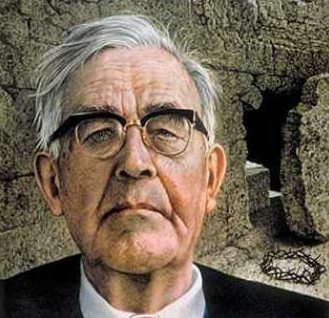
barthBarth devoted one of his lectures that formed the basis of his little work Evangelical Theology to the subject of doubt as an obstacle to theology. Having given some thought to the subject doubt recently, I pulled it off the shelf and I found it worth briefly outlining.

Two Types

Barth begins by noting two types of doubt that might arise for the theologian. First, there is the very “natural” doubt that comes with the territory, which is “susceptible to treatment” (pg. 121). When you’re doing theology, you’re asking questions about the nature of the faith. You’re taking things apart in order to put them back together again in a rational, coherent fashion. It is inevitable that in the process of taking things apart, you struggle or question as to whether the original shape made any sense. This is the doubt that comes with working everything through as thoroughly as possible because we do not possess God’s own knowledge of himself. Even though we work from revelation, we must eat “by the sweat of our brow”. The danger here is being a “sluggard” that fails to put things back together.

There is a second form of doubt, however. Barth says this one is far more dangerous, which is troublesome because his long-winded explanation of it makes it hard to pin down exactly. It seems to be an uneasiness that there is even any point to the enterprise of theology at all. It is the introduction of a note of embarrassment at the outset that renders the whole conversation suspect. It is the swaying between Yes and No as to whether there is anything to even discuss, or whether we’re not simply engaging in an exercise of trying to describe our own “pious emotions” (pg. 124). It’s not the honest doubting that comes naturally with the asking of questions, but the doubting that asks, “Did God really say?” (Gen. 3:1) It doubts the connection between God’s works and words to the task of theology itself. It is the kind of doubt that isn’t dealt with in answers, but must be “healed.”

Three Sources

Barth then “briefly” notes three reasons this latter form of doubt might arise. (As if Barth could ever “briefly” do anything.) First, it might rise in the face of “the powers and principalities” of the world. In looking about at the worlds of economics, politics, art, the newspapers–the world of “real life”–the theologian might be tempted to doubt the relevance or reality of the message he preaches. What can the Gospel really say to that world conflict? Who has time for theology in the face of the truly pressing issues of the day? Could it ever really have said anything in the first place?

The Church itself is another source of doubt in theology. Theologians and preachers have to look at the church, its history, with all of the disunity, ugliness, and petty weakness on a regular basis. Unsurprisingly they may come away jaded at times. In the face of ecclesiastical horrors, wars, heresy trials, and nonsensical squabbles, it might seem perverse to labor at theology.

Saving the deepest root for last, Barth points out that it might not be that “the world impresses him so much or that the Church impresses him so little” (pg. 128), but that his own innate flaws as an individual might be the chink in the armor of his faith.  Complicating things, yet again, Barth subdivides this into two possible iterations.

The first is that of a theologian whose public theology does not match his private practice. He has a very solid public theology that is ordered under the word of God, but his practical life  is ordered by any passing whim or principle. In this sense, he has put himself in the place of a wounded conscience.  Of course, this source of doubt is not unique to theologians, but is the common provenance of all Christians.

The inverse possibility is that he has so engulfed himself in theology, he’s failed to have a normal life. His interests do not extend into the normal range of human affairs, to the point where theology or church-life all but consumes him. At that point, he is but a step away from burnout or boredom, which can lead to doubt.

Three Aphorisms on Doubt

At the end of these meditations Barth gives three “aphorisms” on doubt for theologians worth quoting in full:

  1. No theologian, whether young or old, pious or less pious, tested or untested, should have any doubt that for some reason or other and in some way or other he is also a doubter. To be exact, he is a doubter of the second unnatural species, and he should not doubt that his doubt is by no means conquered. He might just as well–although this would certainly not be “well”–doubt that he is likewise a poor sinner who at the very best has been saved like a brand from the burning.
  2. He should not also deny that his doubt, in this second form, is altogether a pernicious companion which has its origin not in the good creation of God but in the Nihilthe power of destruction–where not only the foxes and rabbits but also the most varied kinds of demons bid one another “Good night.” There is certainly a justification for the doubter. But there is no justification for doubt itself (and I wish someone would whisper that in Paul Tillich’s ear). No one, therefore, should account himself particularly truthful, deep, fine, and elegant because of his doubt. No one should flirt with his unbelief or with his doubt. The theologian should only be sincerely  ashamed of it.
  3. But in the face of his doubt, even if it be the most radical, the theologian should not despair. Doubt indeed has its time and place. In the present period no one, not even the theologian, can escape it. But the theologian should not despair, because this age has a boundary beyond which again and again he may obtain a glimpse when he begs God, “Thy Kingdom Come!” Even within this boundary, without being able simply to do away with doubt, he can still offer resistance, at least like the Huguenot woman who scratched Resistes! on the windowpane. Endure and bear it!

Evangelical Theology, pp. 131-132

As I mentioned, I’ve been giving some thought to the problem of doubt. There is a natural place for the first kind of doubt in the Christian life, as Barth notes. It’s fine to pick things apart and re-examine what you’ve learned–in a sense, doubting in order to believe. At the same time, I’ve also found that our culture, and recently certain wings of Evangelicalism, have taken to valorizing nearly all doubt to an unhealthy degree. Doubt is never to be talked about as something to be resisted, endured, struggled through, but is rather celebrated and romanticized as a sort of rite of passage into relevance and authenticity. It is either subtly or openly commended as a pathway to a “particularly truthful, deep, fine, and elegant” form of faith, brave enough to doubt even God himself.

The problem is, I don’t see scripture anywhere commending doubt in God. It allows for it. It acknowledges it. It forgives it. Much as Barth teaches us, there is room for it–there is a justification for the doubter. And yet, the state of doubt is not the end for which we strive. It is not a good place to be or even to praise. This is why I found Barth’s aphorisms to be filled with much biblical good sense. For those struggling or looking to counsel those who struggle, we find here a pastoral, humble note that acknowledges our frailty and sin, yet still exhorts us onward in hope and faith for that coming day when doubt will be overwhelmed by the fullness of the Kingdom of God.

Soli Deo Gloria

A Political Non-Pacifist Reading of The Sermon on the Mount

constantineIt’s often alleged that any reading of Jesus’ teaching in the Sermon on the Mount that doesn’t result in a pacifist ethic is a depoliticized and de-historicized one. Jesus’ commands against retaliation and of neighbor-love, (Matthew 5:38-48) set in a context of Roman oppression and violence must lead obviously one of non-violence lest the politics of Jesus be lost. Leithart notes that for John Howard Yoder without pacifism Jesus’ ethic loses its political force because Yoder believes that Jesus’ teaching offered no instruction for his disciples in political power because his followers were never to have that sort of power.

In a striking passage Leithart moves to counter that contention by offering a brief, non-pacifist, “political” reading of the Sermon on the Mount in which Jesus’ words for his disciples can shape the governance of those disciples who happen to hold political authority; for a way in which the “Eucharistic city” of the Church can offer guidance to the City of Man based on the teachings of her King:

  1. “Turn the other cheek” gives instruction not about self-defence but about honor and shame. To slap someone on the right cheek, you have to slap back-handed, and back-handed slap expresses contempt, not threat. Is this relevant to political ethics? Of course. The Roman Empire was built on a system of honor, insult and retaliation. Before Rome, Thycidides knew that wars arose from “fear, honor, and interest.” Remove retaliation and defense of honor from international politics, and a fair number of the world’s wars would have been prevented. There would have been a lot of slapping but not nearly so much shooting.
  2. The Eucharistic city would teach rulers to agree with their adversaries quickly, to defuse domestic and international disputes before they explode.
  3. What if rulers were instructed not to look at a woman lustfully? That would also prevent some wars, keep presidents busy with papers and things at their desks, protect state secrets, save money and divisive scandals. The church would insist that rulers be faithful to their wives and not put them away for expediency or a page girl (or boy.)
  4. The church would insist on honesty and truth telling, urging rulers to speak the truth even when it is painful.
  5. The church would insist that a ruler not do alms or pray or fast or do any other good things to be seen by others, especially by others with cameras—a rule that would revolutionize modern politics.
  6. Rulers would be instructed to love enemies and do good to all. Obama would be seeking the best for the Republican Party, Ms. Anonymous Republican would be doing her best to serve the president. A ruler would have to stand firm against the antics of tyrants, not out of hatred but out of love, to prevent the tyrant from doing great evil to himself and others. If the tyrant attacked, the rule would have to defend his people out of love for them and out of love for his enemy. Punishments would be acts of love for the victims, the public and the punished, just as a father disciplines his son in love. The church would insist that the ruler not use his legitimate powers of force for unjust ends, on pain of excommunication.
  7. The church would urge rulers to beware their own blind spots and remove logs from their eyes so they can see rightly in order to judge.
  8. The church would remind a ruler that she will face a Judge who will inquire what she had done for the homeless, the weak, the sick, the imprisoned, the hungry.
  9. At the extreme, a ruler might place himself on a cross, sacrifice his political future and his reputation, for the sake of righteousness. In certain kinds of polities, he would be the first soldier, the first to fly against the enemy, because being the leader means you get to die first. In great extremity, he might follow Jeremiah’s example and submit to conquest, defeat, deportation—endure a national crucifixion to preserve people for future rebirth.

Defending Constantine, pp. 338-339

Whether you’re in full agreement with this list or not, Leithart demonstrates that one doesn’t have to be a pacifist in order to give “an earful of the politics of Jesus” to any ruler.

Soli Deo Gloria

Some Unoriginal Notes on the Importance of Story for the Moral Life (With Help from MacIntyre, O’Donovan, and Machen)

aftervirtueAlasdair MacIntyre is widely credited with restoring the category of ‘story’ or ‘narrative’ to the forefront of the discussion in meta-ethics. In his influential work After Virtue (1981) he set out his argument for the bankruptcy of most modern ethical theories such as utilarianism and Rawlsian contractarianism and the necessity of recovering an Aristotelian-Thomistic virtue-ethics set within a narrative framework. Among other things, MacIntyre argues that the virtues, those moral practices and habits that characterize the just person, only make sense within a narrative framework because all human action is essentially historical in character–it is historically-enacted and historically-motivated. That is an inescapable feature of human life–whether pagan, post-Enlightenment liberal, or orthodox Christian, we live out of the stories and narratives we tell ourselves. Even the most postmodern among us, suspicious of the various master narratives told to us by modernity, are still living in the sort of story that includes moderns trying to control us through master narratives. Indeed, it is commonly suggested that instead of the idea of the “worldview”, a narrative-identity is a more useful conception for understanding the comprehensive perspective through which we approach moral action in the world.

Now, none of this is all that new. Why bring it up? Simply to introduce a few loosely connected quotes and notes on the importance of narrative for Christian reflection on the moral life that ought to be kept in mind. One is cautionary, the other couple are complementary and, after thinking on them, can be classified under the rubric of Creation, Sin, and Redemption.

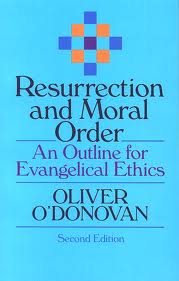
1. The Story is About Something (Creation) – First the caution. Oliver O’Donovan in his Resurrection and the Moral Order alerts us against the sort of historicisms which take this emphasis on narrative and history to the point of forgetting that the story is about something. In essence, the denial of the category of ‘nature’ or creation as a relevant one for moral reflection:

We cannot object to the idea that history should be taken seriously. A Christian response to historicism will wish to make precisely the opposite point: when history is made the categorical matrix for all meaning and value, it cannot be then taken seriously as history. A story has to be a story about something; but when everything is a story there is nothing for the story to be about. The subject of a story must be something or someone of intrinsic value and worth; if it is not, the story loses all its interest and importance as a story. The story of what has happened in God’s good providence to the good world which God made is ‘history’ in the fullest sense. But when that world is itself dissolved into history…then history is left without a subject, so that we have no history any more, but only…’process’. And then again, the story of the world as Christians have told it has its turning-point in the saving act of God in Jesus Christ. Through that crisis it is uniquely determined towards its end. But when every determination to every end is understood equally as a determination to the end of history, the critical moment of the story is lost, the turning-point forgotten.

-Oliver O’Donovan, Resurrection and the Moral Order: An Outline for Evangelical Ethics, pg. 60

O’Donovan is getting at the point that creation, as a whole and in human natures as created, is the necessary pre-requisite for history as the stage of moral action–it is the set-up. Unless the human being is a certain sort of thing before the action, and the world is a certain kind of place, the things that happen within it lose their meaning. Without creation as the “theater of God’s glory”, to use Calvin’s phrase, there can be no drama of redemption.

2. You Are Not the Only, or Main, Author/Character (Sin) – Although it wasn’t likely his intention, a quote from MacIntyre himself sheds some light on the nature of sin:

I spoke earlier of the agent as not only an actor, but an author. Now I must emphasize that what the agent is able to do and say intelligibly as an actor is deeply affected by the fact that we are never more (and sometimes less) that the co-authors of our own narratives. Only in fantasy do we live what story we please. In life, as both Aristotle and Engels noted, we are always under certain constraints. We enter upon a stage which we did not design and we find ourselves as part of an action that was not of our making. Each of us being a main character in his own drama plays subordinate parts in the dramas of others and each drama constrains the others. In my drama, perhaps, I am Hamlet or Iago or at least the swineherd who may yet become a prince, but to you I am only A Gentleman or at best Second Murderer, while you are my Polonius or my Gravedigger, but your own hero. Each of our dramas exerts constraints on each others’s making the whole different from the parts, but still dramatic.

Alasdair MacIntyre, After Virtue 2nd Ed.,  pg. 213

In drawing attention to the narrative shape of our lives, there comes the realization that, in some sense, we are not just agents but authors. In a theological context this comes with a serious qualification, though–given the doctrine of creatio ex nihilo and God’s sustaining providence we are sub-authors at best. MacIntyre reinforces the point by calling our attention to the fact that at the merely human level my authorship is not total or complete. I am a sort of Mad-libber who inserts my responses at key points in the story that already has particular parameters beyond my control. This begins to expose the narcissistic madness we engage in when we claim credit for the blessings in our lives. Most of the good that comes our way is not in any way attributable to our own wonderful moral character, at least not by comparison to others. The fact that you’re reading this blog on a computer right now has more to do with the fact that you were born into a society in which computers are easily-accessed and not in the 5th Century China, than your own stellar work ethic. The resulting story of my life is, yes, something I’m responsible for, but at the same time, not something I can claim credit for. Paul asks, “What do you have which you did not receive?” (1 Cor 4:7) And yet, that’s precisely what sin is: claiming credit for someone else’s work. It is our willfully blind, ungrateful denial of the Author of our existence, who determines the times and the places in which we will play our parts in his story. (Acts 17:26)

MacIntyre also begins to show us the way this false sense of authorship leads to conflict with our neighbors. At the end of the day, in our arrogance and pride we are convinced that we are both the author and the main character in the epic which everybody else plays a bit part or supporting role. Most conflict comes when you find out that the story doesn’t revolve around you, or when you clash with your neighbor because he’s trying to accomplish his own heroic ends at your expense, and not playing the bit role you’ve assigned him. What else should we expect when two sinners, who’ve rejected any acknowledgment of the true Author or story-line, begin to encounter the “constraints” imposed by the dramas of others?

3. The Power is in the Story (Redemption) – This one is for preachers and pastors. Nearly 60 years before MacIntyre wrote After Virtue, J. Gresham Machen was criticizing the Liberals of his day, among other things, for misunderstanding the nature of Christian moral exhortation. In denying or radically reducing the basic outlines of the gospel narrative into generalized moral principles, “a life”, they robbed it of its power to result in real moral change:

From the beginning Christianity was certainly a life. But how was the life produced? It might conceivably have been produced by exhortation. That method had often been tried in the ancient world; in the Hellenistic age there were many wandering preachers who told men how they ought to live. But such exhortation proved to be powerless. Although the ideals of the Cynic and Stoic preachers were high, these preachers never succeeded in transforming society. The strange thing about Christianity was that it adopted an entirely different method. It transformed the lives of men not by appealing to the human will, but by telling a story; not by exhortation, but by the narration of an event. It is no wonder that such a method seemed strange. Could anything be more impractical than the attempt to influence conduct by rehearsing events concerning the death of a religious teacher? That is what Paul called “the foolishness of the message.” It seemed foolish to the ancient world, and it seems foolish to liberal preachers today. But the strange thing is that it works. The effects of it appear even in this world. Where the most eloquent exhortation fails, the simple story of an event succeeds; the lives of men are transformed by a piece of news.

– J. Gresham Machen, Christianity and Liberalism, pg 42

The Christian call to repentance is not simply a challenge to live differently or adopt some new moral principles. It is fundamentally a call to embrace the drama of redemption that God has authored in Christ as a new story to live by–and that only happens as the Holy Spirit enlightens our hearts through the preaching of the Gospel. Preaching aimed at real transformation can never degenerate into mere moral exhortation because at the end of the day, the power is in the story.

Soli Deo Gloria

Just Because You Can’t See It, Doesn’t Mean It’s Not There – O’Donovan on Ethics

moral orderA great joy of mine is finding out that I’m not dumb. By that I mean, I love running across sections in works by legitimately brilliant people articulating something that I’ve been thinking for a while, but haven’t taken the time to write out anywhere, or I haven’t seen laid out clearly before. Reading Oliver O’Donovan’s brilliant piece of Christian moral theory Resurrection and the Moral Order has afforded me a number of those experiences. (Note: that wasn’t an intentional humble-brag, just an accidental one.) For instance, in one exceptionally helpful passage, he highlights the importance in separating out the epistemological questions involved in knowledge of the moral order and the ontological question of its existence.

What am I talking about? Well, in a nutshell, some moral thinkers, particularly in the Natural Law tradition, have made the point that if a rational God has created the world, he must have done so with a certain order to it, particularly a moral one consistent with his own nature, that ought to be intelligible (readable) to human agents within it. Indeed, there seem to be some self-evident truths about morality and life that transcend culture which give testimony to this indelibly-written law on the heart of humanity.

Others have pointed out that moving from culture to culture, and even within the same culture, there are large areas of dispute as to the moral character of the universe. Much of the content of our moral judgments that are “self-evident” to us in the West are largely rejected throughout the world and therefore seem merely cultural values, or perhaps, adaptively-advantageous norms, such that a real skepticism about framing any sort of moral judgments based on the natural order is a chimera. Indeed, on this basis many of them doubt that there even exists some order of this sort.

Into the confusion steps O’Donovan. While he argues quite forcibly for the necessity of grounding any ethical system in the created order, he acknowledges and explains the theological root of the non-obviousness of that moral order:

There is, however, another side to the matter which has to be asserted equally strongly. In speaking of man’s fallenness we point not only to his persistent rejection of the created order, but also to an inescapable confusion in his perceptions of it. This does not permit us to follow the Stoic recipe for ‘life in accord with nature’ without a measure of epistemological guardedness. The very societies which impress us by their reverence for some important moral principle will appal us by their neglect of some other. Together with man’s essential involvement in created order and his rebellious discontent with it, we must reckon also upon the opacity and obscurity of that order to the human mind which has rejected the knowledge of its Creator. We say that man’s rebellion has not succeeded in destroying the natural order to which he belongs; but that is something which we could not say with theological authority except on the basis of God’s revelation in the resurrection of Jesus Christ. We say that this, that or the other cultural demand or prohibition (the prohibition of incest, for example, or of racial discrimination) reflects the created order of God faithfully, but that too is something which we can know only by taking our place within the revelation of that order afforded us in Christ. It is not, as the sceptics and relativists correctly reminds us, self-evident what is nature and what is convection. How can we be sure that the prohibition of incest is not yet another primitive superstition? How can we assert confidently that Bantu and Caucasian races belong equally to one human kind that renders cultural and biological differentiation between them morally irrelevant? The epistemological programme for an ethic that is ‘natural’, in the sense that its contents are simply known to all, has to face dauntingly high barriers. But we are not to conclude from this that there is no ontological ground for an ‘ethic of nature’, no objective order to which the moral life can respond. We may only conclude that any certainty we may have about the order which God has made depends on God’s own disclosure of himself and of his works.

Oliver O’Donovan, Resurrection and the Moral Order: An Outline for Evangelical Ethics, pg 19

O’Donovan insists that keeping our epistemological judgments and our ontological judgments straight is imperative if we’re going to understand the nature of our moral situation. Admitting that the moral order isn’t obvious should not betray us into concluding it isn’t there. To do so would constitute a gross denial of the doctrine of creation and the moral character of God.

Instead, an acknowledgement of the Fall’s distorting effect upon our moral knowledge leads us to be humble in our judgments, and seek the truth of the universe as it is revealed in Jesus Christ. Not because Jesus points us to a moral order that was never there prior to his advent, although his coming does bring about a new moral situation, but because he points us to and renews the one that has been there since the beginning. Also because repentance (metanoia) must form part of our quest for moral truth. In repentance we reconsider our relationship to God’s created order which, in sin, we have rejected and misunderstood. Jesus Christ is the one who grants repentance by the power of the Holy Spirit to confused sinners whose moral judgments stand condemned alongside of them. Once again, even our knowledge of the moral reality we have violated comes down to the grace of the one who instituted it and redeemed it.

Soli Deo Gloria