The Silliness of Impatience

This last weekend our church’s high school ministry went on a little retreat. The theme for the weekend was learning how to grow in Christ in the midst of an instant gratification culture. In our Siri and Google Voice instant-access context we are trained in so many ways to expect things instantaneously. We don’t understand the slow and steady discipline it takes to grow in holiness and in the grace of Christ. In order to illustrate the silliness of the kind of impulsive impatience we are so prone to, a couple of my students put together this little video. It is one of the many reasons I love my college students. I thought I’d pass it on for your enjoyment and edification. Check it out.

Impatient Paul from Josh Berry on Vimeo.

Where is True Peace Found?

I’ve begun my second attempt through John Bunyan’s spiritual classic, Pilgrim’s Progress this week in my attempt to find more theologically-rich devotional literature. (The first was an unfortunately broken off in college due to my immaturity.) I’m pleased to say that I have been thoroughly blessed by it. It’s easy to see why Charles Spurgeon confessed that, “Next to the Bible, the book I value most is John Bunyan’s The Pilgrim’s Progress.” The allegory is riddled with biblical quotations and wisdom designed to illustrate the pilgrimage of the Christina through the current world on to glory.

Bunyan does this by telling a dream-vision he has of the pilgrimage of Christian, an everyman character, who is on a journey from his home-town “the City of Destruction” to the “Celestial City.” His journey is provoked by his reading of a book that causes him great distress and anguish about his spiritual state.  On the way he is met by various characters such as Worldly-Wise Man and Evangelist who give him varied instructions as to ease his turmoil. Eventually after a foolish detour in the direction of the village of Morality on the advice of Worldly-Wise Man that lands him in great peril, he takes Evangelist’s advice and heads down the narrow road that leads to life and his true journey begins.

Burdens Released

Christian is committed and so he makes great headway for a while, but from the very start of his journey he is weighed down by a burden, a pack that hinders his progress. The pack symbolizes the spiritual weight of his sins, the anxiety and fear of judgment, the encumberance of great guilt and shame. He suffers with it despite his best efforts as well as the godly counsel of those good characters such as Evangelist and Interpreter who open the truth to him and he receives no respite until he catches a vision of something glorious:

Now I saw in my dream, that the highway up which Christian was to go, was fenced on either side with a wall, and that wall was called Salvation. Isaiah 26:1. Up this way, therefore, did burdened Christian run, but not without great difficulty, because of the load on his back. He ran thus till he came at a place somewhat ascending; and upon that place stood a cross, and a little below, in the bottom, a sepulchre. So I saw in my dream, that just as Christian came up with the cross, his burden loosed from off his shoulders, and fell from off his back, and began to tumble, and so continued to do till it came to the mouth of the sepulchre, where it fell in, and I saw it no more. 

Then was Christian glad and lightsome, and said with a merry heart, “He hath given me rest by his sorrow, and life by his death.” Then he stood still a while, to look and wonder; for it was very surprising to him that the sight of the cross should thus ease him of his burden. He looked, therefore, and looked again, even till the springs that were in his head sent the waters down his cheeks. Zech. 12:10. Now as he stood looking and weeping, behold, three Shining Ones came to him, and saluted him with, “Peace be to thee.” So the first said to him, “Thy sins be forgiven thee,” Mark 2:5; the second stripped him of his rags, and clothed him with change of raiment, Zech. 3:4; the third also set a mark on his forehead, Eph. 1:13, and gave him a roll with a seal upon it, which he bid him look on as he ran, and that he should give it in at the celestial gate: so they went their way. Then Christian gave three leaps for joy, and went on singing,

“Thus far did I come laden with my sin,
Nor could aught ease the grief that I was in,
Till I came hither. What a place is this!
Must here be the beginning of my bliss?
Must here the burden fall from off my back?
Must here the strings that bound it to me crack?
Blest cross! blest sepulchre! blest rather be
The Man that there was put to shame for me!”

So many of us suffer the burdens of guilt and shame. We walk day in and day out bearing a great burden, an inexpressible anxiety and grief that doesn’t seem to dissipate no matter how many self-help books we read, mantras we chant, or health-goals we set and meet.

Christian found the true source of peace: “Blest cross! blest sepulchre! blest rather be/The Man that there was put to shame for me!” In Christ all of our sins, our shames, our hurts are taken, destroyed on the cross with him, buried in the sepulchre with him, and in him we rise again to new life, freedom, joy and hope. In him we find true peace.

Soli Deo Gloria

You’re a Holy Mess (Or, Surprised by Sanctification)

I was teaching through 1 Corinthians last year around this time when I was first struck by something very odd in that letter. It’s something that can sneak past you unless you go through the thing a few times. Right at the outset of Paul’s letters he usually broadcasts what he’s going to be writing about in a kind of intro-prayer or in the greeting.

Paul, called by the will of God to be an apostle of Christ Jesus, and our brother Sosthenes,
To the church of God that is in Corinth, to those sanctified in Christ Jesus, called to be saints together with all those who in every place call upon the name of our Lord Jesus Christ, both their Lord and ours:
Grace to you and peace from God our Father and the Lord Jesus Christ.
(1 Cor 1:1-3)

Did you catch those words in verse 2 that I helpfully bolded for you to notice? Good. In the space of a few words, Paul calls the believers at Corinth “sanctified” and “saints”; he calls them holy.

Surprised by Sanctification

For those of us who have read the letter through, this is surprising to say the least.  This is easily the most jacked-up church we know of in the New Testament. Scholars think that Paul probably wrote more letters to the church than 1 and 2 Corinthians because of the issues with it. To give you a picture, the problems include: factions being formed dividing the church due to people buying into cultural notions of wisdom and power (chapters 1-4), Christians suing each other (5), one dude sleeping with his step-mom and everybody just acting like nothing was going on as well as people visiting prostitutes (5-6), screwy views about sex and marriage (7),  people eating food offered up to idols and demons at pagan temples (8-10), groups treating the poor like crud at church (11), getting drunk at communion (11), freaky pride connected to spiritual gifts (12-14), and, to top it off, false teaching about the resurrection (15).

Now, how in the world is Paul go and call this church “holy”? If you look up the word “saints” in a thesaurus, the antonym would probably be “Corinthians”. There is nothing that you could term righteous, moral, or upright about their character. In fact, in some ways Paul says they’re worse than the surrounding pagan culture. And yet, time and again Paul does call them just that. What’s more, in chapter six after listing off a number of practices they were supposed to avoid, he says “And such were some of you. But you were washed, you were sanctified, you were justified in the name of the Lord Jesus Christ and by the Spirit of our God.” (1 Cor 6:11 )

Did you see that? “You were sanctified” is talking about a past tense action that makes the believer holy starting at a particular point resulting in a continuous state of holiness in much the same way that in the text he speaks of justification as occurring at a specific point in time resulting in you now being “justified.”

For those of us raised in general evangelicalism this is not typically the way we think or speak. Generally we think of justification as the once and for all legal declaration by God that we are vindicated, pardoned, no longer held as guilty against the covenant because of Jesus’ death and resurrection and now part of the people of the Messiah. It’s what happens at the beginning of our experience that we look back at. Sanctification is then the process that begins afterwards and is the increasing growth in holiness that makes us look more and more like Jesus. It’s the life-long process of becoming righteous in our character.

This is not a bad way of looking at things. Still, it’s also not the most accurate way of thinking about sanctification biblically. Historically Reformed theologians have talked about the difference between “progressive sanctification” and “definitive sanctification.” The first process is the one we’ve been describing that a lot of us understand. Definitive sanctification is that “once and for all act of claiming us as saints.” (Michael Horton, The Christian Faith, pg. 650)

Rethinking Holiness

See, the original idea of holiness or sanctification in the Old Testament was to “separate” something away from their ordinary or common use to a special use for God. The Temple, the sabbath, the tithe, the utensils and furniture for the temple were all normal things, taken and set aside, consecrated for use by God. God even does this with a people, Israel, (Exod. 19) He takes one people and sets them apart to be a light to the nations and show the world what life with God is like. They were to be “holy, for I the LORD am holy.” (Lev. 20:26) Paul and the rest of the New Testament picks up on this by seeing God’s act of saving us in Christ as a setting apart, a making holy totally independent of our own righteous acts. Jesus tells us that we are clean because of the word that he has spoken to us. (John 15:3) Indeed, Jesus says that he will be the one who sanctifies us by sanctifying himself, setting us apart through setting himself apart in his death. (John 17:19) The author of Hebrews follows Jesus by telling us that “by God’s will we have been sanctified through the offering of the body of Jesus Christ once for all.” (10:29)

In Christ, by the Spirit, God definitively sanctifies us, sets us apart to be his own in a once and for all way. When we place our faith in Christ, we’re united with him so that what is true of him, becomes true of us. We are holy because Christ is holy. “All that is found in Christ is holy, because it is in Christ.” (Horton, pg. 651) This is why before we’ve done anything good, righteous, holy, cleaned up our act, made good on our promises or done anything but trust Jesus’ work for us, we are declared saints. Before we clean up, God declares us clean in Christ. This is the holiness, the saintliness that Paul is often speaking of in his letters.

Motivating his instructions to the Corinthian congregation is the reality that, in Christ, they are clean. In essence, “You’re holy! Now act like it. Become what you already are in Christ.” Over and over again in the New Testament we are told that we have been made righteous in Christ or holy in Christ and so now we should live like that’s true.

But I’m Still A Mess

“So, I’m already holy, so now I should live like it? Is that what you’re saying? Okay, here’s my problem: I don’t feel holy. In fact, most of the time I feel angry, lustful, annoyed, proud, downcast and anything but holy. Where does that leave me? It’s fine that God legally sets me apart as holy, declares me righteous, etc., but I still feel like me. What does God saying something out there have anything to do with me in here?” Everything, for at least two reasons.

First, as Michael Horton points out, for an orphan to enjoy the love and care of a new family, they must first by legally adopted. Or, for two nations who have been at war with each other to begin peaceful relations, they must first declare a legal peace. (Pg. 652-653) The definitive declaration of God “out there” is the legal basis of that secures our relationship to the sanctifier. God’s declaration is your hope of sanctification.

Second, God’s declaration isn’t really something that happens “out there.” When God sets us apart, he sets us apart in Christ, in the power of the Spirit. This act actually connects us to Christ like branches being inserted into a vine from which it then begins to draw strength. (John 15) We are connected to Christ like members of a body to the head. (1 Cor 6; 12; Eph. 4) We are given the Spirit, the Holy Spirit, who is a new power at work in us to progressively conform us to reflect the image of Christ. We receive strength and righteousness from the source of all goodness, Christ. God’s definitive sanctification of us is the source of God’s progressive sanctification in us.

You don’t feel holy, but honestly, your feelings are not the ultimate reality you need to be focusing on. Instead, you should be focusing on who you are in Christ. You’re a mess, but in Christ you’re a holy mess who’s getting cleaned up because you’re in the one who is clean. In fact, forget even focusing on who you are at all. Focus on Christ. “Abide in my and I will abide in you.” (John 15:4) When you do that, that’s when things start coming together.

Maybe this is why what Paul writes to his wayward saints the way he does. In the first 9 verses of 1 Corinthians he mentions “Jesus”, or “Jesus Christ”, or “our Lord Jesus Christ” 9 times. Apparently he believes that if his people are going to become holy, start living into the holiness that they’ve been brought into, they need to focus their eyes on Christ, the Holy One.

May we do the same.

Soli Deo Gloria

It Takes a Hard Forehead and a Heavy Heart to Preach

Thinking about preaching while reading the prophets is a sobering thing. Whether it’s Isaiah’s commission to preach to a deaf and blind people, or Jeremiah’s call to go preach without fear to those who threaten his life and reject his message, the prophets don’t exactly make good promo material for aspiring seminarians.  (“Preaching God’s Word–Learn how to do it without getting killed.”) Nevertheless they are essential reading for anyone trying to engage in ministry within the church, especially the ministry of the Word. I was reminded of this again this week as I came to Ezekiel in my devotional.

Ezekiel’s Assignment and Ours

In Ezekiel 2-3, Ezekiel receives his commission to preach to the wicked, rebellious house of Israel in a vision. The basic call was to persevere in preaching the word of the Lord no matter what because through him God will make them know that “a prophet has been among them.” (2:5) This seems tough, but encouraging right? I mean, he is told that it will be evident that Ezekiel is God’s anointed prophet. God will be with him powerfully. That’s gotta be good?

Eh, not so much. There’s more.

See, while promising to be with him, God also makes it clear he’s not going to be greeted with a lot of success. He is going to be rejected. His message will fall on rebellious ears and stubborn hearts. He says that he’s sending him to a people who are so stubborn that, even though the message is not hard to understand, and the language is not a barrier, even so, they will reject it because they continually reject God. (3:6) Yet still, God calls him to be a “watchman” over the house of Israel (3:17), preaching a warning to God’s people so that they might turn, repent, and not come under judgment. Knowing that the people will rebel, knowing that they will reject him, knowing the difficulty he is still to preach the word of the Lord.

How are we to preach under conditions like this? What drives faithfulness in situations like this? How do we bear up under the pressure? Most of us don’t think about this going in. I mean, we might “know” it’s going to be hard. We might “know” that if we faithfully preach the word, not all that we say is going to be received well. Nevertheless, coming face to face with recalcitrant members of the body, people who won’t repent, members you’re intimidated to speak honestly to for fear of causing them to leave, can catch some of us off guard and make us lose our nerve. Even with the Spirit of God indwelling the hearts of believers, nobody likes being told to repent. The house of Israel can still be a rebellious people this side of the Cross.

A Hard Forehead

So what do you need to preach faithfully to people with stubborn hearts? First of all, you apparently need some good facial bone density.

Early in the chapter the Lord says to Ezekiel, “But the house of Israel will not be willing to listen to you, for they are not willing to listen to me: because all the house of Israel have a hard forehead and a stubborn heart. Behold, I have made your face as hard as their faces, and your forehead as hard as their foreheads. Like emery harder than flint have I made your forehead. Fear them not, nor be dismayed at their looks, for they are a rebellious house.”(3:7-9)

The Lord uses the picture of Israel having a “hard forehead” after years of rebellion; they were people with a stubborn will that won’t be turned aside, having set their face against the Lord. God tells Ezekiel that as hard as their forehead was, he would make Ezekiel’s that much firmer. God would give Ezekiel a strength of will, a forehead harder than flint that was used to strike a fire. We need a supernaturally emboldened will to preach. Ezekiel did not derive his boldness from his own strength—his strength was the Lord’s. It was the Spirit of God who proved to be the firm ground on which he could make his stand.  You can’t preach to a stubborn people if your will is weaker than theirs. Inevitably heads will butt and someone’s will have to break. Pray for the sake of your people that it’s not yours.

A Heavy Heart

Your people need you to have a hard forehead because this passage also teaches us that our message is a weighty one. It can only be preached with heavy heart, burdened with the gravity of God’s words. That’s the only way I know how to describe the Lord’s charge in the middle of the chapter. God tells Ezekiel that he must preach to the people because unless he does he’s accountable for their blood.

“Son of man, I have made you a watchman for the house of Israel. Whenever you hear a word from my mouth, you shall give them warning from me. If I say to the wicked, ‘You shall surely die,’ and you give him no warning, nor speak to warn the wicked from his wicked way, in order to save his life, that wicked person shall die for his iniquity, but his blood I will require at your hand. But if you warn the wicked, and he does not turn from his wickedness, or from his wicked way, he shall die for his iniquity, but you will have delivered your soul. Again, if a righteous person turns from his righteousness and commits injustice, and I lay a stumbling block before him, he shall die. Because you have not warned him, he shall die for his sin, and his righteous deeds that he has done shall not be remembered, but his blood I will require at your hand. But if you warn the righteous person not to sin, and he does not sin, he shall surely live, because he took warning, and you will have delivered your soul.”  (3:16-21)

God says that he will punish the wicked and forgive the repentant according to their own actions, but Ezekiel is still held liable for whether he preached the word of repentance to them or simply left them to their wickedness.

All throughout the Scriptures there is a weight to being a preacher and teacher of God’s Word. (Jas 3:1; Heb 13:17) They are to be faithful shepherds to the flock knowing they must give an account to the True Shepherd. (1 Peter 5:1-4) Paul tells Timothy “Watch your life and doctrine closely. Persevere in them, because if you do, you will save both yourself and your hearers.” (1 Tim. 4:16)

Preachers have to know that there is a weight to the words we speak. We’re not just bandying about interesting ideas that are fun to debate sometimes. We are preaching the difference between life and death, both in this life and what follows.  . This knowledge should drive us to set our foreheads like flint and preach no matter the “result.” All too often we pull back for fear of the “results” when the results of pulling back are far more terrifying. Instead, our charge should propel us forward, to humbly, but confidently speak “thus says the Lord” for the sake of our hearers.

Getting Weightier Hearts and Tougher Craniums

A lot of us reading Ezekiel 3 know that we don’t have that hard forehead or that heavy heart. In moments of weakness I want to turn aside from saying what I need to say and console myself with the thought that, in the grand scheme of things, my words won’t really make that great a difference. The bracing truth is that this is a lie that our people can’t afford for us to believe.

How do we gain some weightier hearts and tougher craniums?

  1. Pray. It’s that simple. God promises that HE will make Ezekiel’s forehead hard. We need to be on our knees, pleading with God for the might to bear up under the pressure. The Spirit is the only one who can impress upon our hearts the burden of the word as well as give us the courage we need.
  2. Preach the word alone. We gain strength and passion for preaching when we commit ourselves to studying and wrestling with God’s word in order to present it to God’s people. It is then that we are convinced and convicted of what God has said,; it is then that we are unhindered by the ambition to forward our own clever ideas; it is then that our fears are quenched that would cause us to shrink from our task. “But when I speak with you, I will open your mouth, and you shall say to them, ‘Thus says the Lord GOD.’ He who will hear, let him hear; and he who will refuse to hear, let him refuse, for they are a rebellious house.” (Ezek 3:27) When we preach the word and that alone it gives us confidence that it is the Lord “opening our mouth.”

Once again, I offer these incompletely reformed thoughts more as a prayer for my own ministry than as the distilled wisdom of achieved experience.

Soli Deo Gloria

Playful, Passionate, Principled, but never Putrid Polemics (Or, Don’t Forget Jesus in an Argument)

If you’ve ever had an “intensely engaged” discussion with a friend in person, a facebook comment, a blog, etc. the odds are that you’ve engaged in polemics. The Webster definition of polemics is “an aggressive attack on or refutation of the opinions or principles of another” or “the art or practice of disputation or controversy.” Basically it’s a form of reasoned argumentation against a position with which you disagree.

Having spent a couple of years in a philosophy program, then seminary, as well as far too much time on the blogosphere, I’ve observed and participated in quite of bit of polemics myself. I have what you might call a “polemical bent”,  which is probably why I like thinkers like Luther, Calvin, Pascal, Kierkegaard, and Plantinga. Brothers can argue.

In that time, I’ve had some time to think about  some of the basic attitudes and approaches to polemics, some of which are consistent with Christian life and some of which are not. I’d like to offer up some reflections three qualities or attitudes that should define your approach to whatever discussion you engage in, and one that shouldn’t. These aren’t comprehensive, exhaustive, or entirely correct, but, for what it’s worth, here they are.

Playful– The first quality that I think should be cultivated within our discussions with others  is playfulness, a certain amount of mirth and good humor. It’s that kind of light-hearted reasonableness that G.K. Chesterton seems to embody in his works like Orthodoxy and Heretics. To say that his arguments are playful is not to say that they aren’t “serious”, or aren’t dealing with serious issues, but that they are clearly not driven by fear or pride but rather a humble self-forgetfulness and joy deeply rooted in the Gospel. His ability to sport and laugh at, and with, his interlocutors managed to communicate both disagreement with and real fondness for them. This is not an excuse for being flippant, disrespectful, or condescending. When your heart is filled with confidence in God, it allows you to speak with humor and grace knowing that whatever the outcome of the argument, you’re securely held in the arms of your Father because of the Son. One of the benefits of engaging your intellectual “opponents” with this attitude is that it is attractive. So often people are used to dealing with Christians arguing out of their insecurities or pride which drives them to be snippy, harsh, humorless, and retaliatory. Nobody wants to listen to someone like that, or end up believing whatever they’re arguing for. The Gospel should lead to a confident, good-naturedness that, on the one hand, respects the other person, and at the same time allows you to take yourself less seriously.

Passionate– The second quality that ought to characterize our polemics is passion.  Like the first, it is deeply rooted in the truth of the Gospel and a deep love for people. You can see this is all over Paul’s letters. Paul is nothing but passionate in his polemics for the sake of the Gospel. Galatians, anybody? Paul goes aggro in that letter because of his great gospel-fear that they might be abandoning Christ, and so he forcefully makes his points at times, giving voice to his real concern in order to communicate just how important the issue was. Sometimes people might know you disagree, but really have no idea how important an issue is until they hear the concern or passion in your voice. Paul’s letter not only communicated truth, but the way he communicated it gave it an emotional tenor, an urgency, that was just as vital as the content. A lot of us may be scared of passionate engagement with our neighbors and friends over the truth. We’re scared of offending, or coming off as pushy or unloving. In a world like ours where our radios, TVs, and blogs are full of people just yelling and trying to brow-beat people into submission, that’s a real danger. I don’t want to minimize that. We should never argue just to argue. So often that’s what we find ourselves caught up in: meaningless arguments about things that really, nobody should get that agitated over. Still, this shouldn’t stop us from engaging passionately with our friends about things that really matter. Love engages over truth. Apathy or an unwillingness to trouble yourself with have a difficult conversation out of fear is not the loving thing to do. The truth is something to be passionate about because truth is about life.

Principled- The third quality that it ought to possess is that of being principled. (Honestly, I could have used other words like “integrity”, “honesty”, etc, but I’m a sucker for cheap alliteration.) We must always strive in our engagements with others to be principled in our dealings, speaking honestly, actively avoiding unfair caricatures, and cheap shots. Whenever arguing against a position we must strive to represent our interlocutors accurately, fairly, and charitably. In other words, don’t purposely take the dumbest interpretation of any statement they make and argue against that.  That’s just dishonest. I’ll be the first to admit that there is a place for irony, sarcasm, and the reductio ad absurdum in arguments. There is a place for humorously following someone’s premises out to their surprising conclusions, or creating humorous, sarcastic analogies to bring out a point. Still, there is absolutely no place for a lack of integrity in our communication with others, even those with whom we deeply disagree. This is part of how we love our neighbors as ourselves as Jesus taught us to. Being people who confess the lordship of Jesus, the one who is the Truth, we should never play fast and loose with the truth in order to score a cheap, rhetorical point.

Never Putrid– If we strive for and keep these three qualities in mind as we engage others, they will keep us from descending into the putrid polemics that seems to define our culture’s approach to “rational”discourse. So much of what we hear and read today pours out of corrupted hearts darkened by arrogance, rage, pride, fear, and the rot of our decomposing sin nature. So much of what is popular out there is just straight-up lies, fear-mongering, cynical mockery, caricature, manipulation, gracelessness, straw-manning, cheap shots, and rhetorical bullying. It is simply putrid. For those of us who have been raised in Christ and indwelled by the resurrection Spirit of God, there should be nothing rotten or foul about what we say. Even those words we utter that cut should only cut in the way a doctor’s scalpel does–in order to heal. They should be words of life, not death, because we are made, and are being remade, in the image of the God who, by his Word, speaks life into existence.

Once again, I write all of these things, not as someone who has achieved or arrived. Lord knows I have not even come close in this area. Instead, I write them as one still struggling alongside; still fumbling about trying to become the kind of person who speaks rightly and righteously.

Enduring Church Staff Meetings

The end of summer and the beginning of the school year means one thing at my church: the return of staff meetings. It’s not that we don’t have them over summer, we just have a lot less of them. This is one of the many reasons I love summer.

Staff meetings, in my opinion, are one of the many ways that the Fall has corrupted life on God’s good earth. Just to give you a picture, this is how I feel during probably 90% of staff meetings. (Let it be known that I make up statistics at random.)

Now, don’t get me wrong. I know they’re important. I know they’re part of ministry so that everybody knows what’s going on in each other’s departments, can be praying for each other, working together,  but let’s be honest, there are times when you’re just sitting there thinking, “Lord, if I still believed in the Rapture, I wish it would happen right now so this would be over.”  When you’re in a peripheral ministry like college or high school, a majority of what gets discussed can seem:

  • Boring. (Honestly, I have no dog in the parking lot discussion. We meet off-campus most of the time.)
  • Not directly relevant to my ministry. (None of my students have kids in the children’s choir.)
  • Like something we just talked about and didn’t come to a conclusion about last time. (This is almost every subject.)

Again, this is probably worse for young types in the ministry like myself because we tend to be in less central roles, therefore we’re more likely to be at the edge of these things. Also, we’re impatient.

Because freaking out and yelling at the rest of staff usually isn’t the best option, here are a few things you might try to do during conversations that can help you get through.

Grow up – Seriously, grow up. Don’t be such a narcissistic idiot. I suck at this, but things that I find boring, often-times really matter. For instance, thinking about parking-lots and their use is an issue of how to be a good neighbor to the homes and businesses around our church, and how we welcome new-comers. A lot of your college students got saved in children’s choir and the Lord cares about these little ones. This actually matters, even if I can’t see it right now, and I’m not directly involved in it. It’s easy to forget I am only 26–what do I know?

Pray- When you don’t care about something because it’s not directly relevant to your ministry, you should pray about it. It’s hard to not care about something you’re praying about. It’s like people who whine about church but have never spent a minute on their knees for it. I think one of the only reasons I’m still with it unlike some of my friends from youth group is that, while we both saw the flaws, an older, wiser friend or two challenged me to pray about the things that bugged me. God used that birth a love and concern for the church that I would have not had otherwise. Pray about these things and see what the Spirit does in your heart and in that ministry.

Contribute- This one should come after growing up and praying. But seriously, if one of your main issues is that your staff seems to talk about the same things over and over without resolving anything, prayerfully consider contributing to the conversation. You have no idea what God can do through a humble voice that is willing to speak to the issue rather than just complain in the back that it’s never solved. God may have placed you where He placed you for this very situation.

Or not. Sometimes you have to just shut-up and pray and trust that the Lord is sorting it out without you.

I write these reflections, not as someone who as attained, but as someone who is struggling along the way.  My prayer is that we would learn to be constantly redeeming the time, and making the most out of every opportunity, (Eph. 5:16)–even in staff meetings.

Beefing Up Your “Quiet Times”: Catechisms and Confessions as Devotional Literature

A little bit ago, a buddy of mine was musing about the fact that he doesn’t connect to most devotional literature of the type that truly “spiritual” people normally rave about. His critical, analytical mind and personality just doesn’t connect with warm meditation, but rather with critical analysis of history and culture.

For a while I’d found myself in a similar place. After seminary, my devotional life became a bit trickier. I find that my mind comes most alive to God when I’m reading systematic theology, or wrestling with some interesting piece of biblical theology, but when I try to slow down, pause, and meditate on something like My Utmost for His Highest, I just can’t do it. (That’s not to disparage Chambers. I loved it in college. The sad thing is, most current, popular stuff doesn’t even come close to his depth.) Because of this, finding good devotional material has been a challenge.

This didn’t trouble me much at first. I would simply pray, read my Bible, and then move on to my academic reading. Still, after a while I realized that I need a slowing down, a place for a more contemplative, heart-oriented approach to God in my devotional life. When I “just read my Bible” I found it hard to turn off the analytic mode. When I did, I didn’t really find my heart moved, but rather just bored.

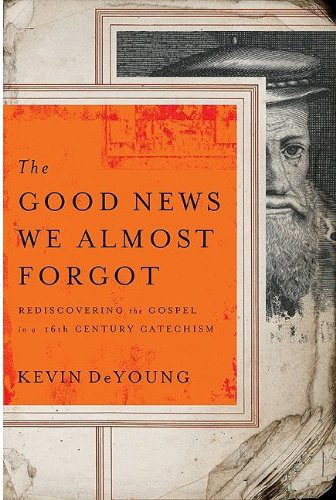
The Good News We Almost Forgot

Just when I thought all was lost, I got my hands on The Good News We Almost Forgot: Rediscovering the Gospel in a 16th Century Catechism by Kevin DeYoung. The book is basically a commentary on the Heidelberg Catechism, which you can read for yourself here. For those of you unfamiliar with catechisms, they are a series of questions and answers designed to be memorized by either new believers, old believers in need of depth, or children in order to teach them the content of the Christian faith. They’re employed across various confessional church traditions and they usually they have scripture references attached to the answers for believers to look up and study as well.

The Heidelberg Catechism was written at the University of Heidelberg at the commission of Elector Frederick III and was approved by the Synod of Heidelberg in 1563. The Catechism has 129 questions and answers that are basically commentary on the Apostles’ Creed, the Lord’s Prayer, and the 10 Commandments, but it is divided into fifty-two sections, called “Lord’s Days,” so that pastors could preach through them on each of the 52 Sundays of the year.  It is one of the most universally recognized pieces of Reformed theology across confessions and was adopted by the great Synod of 1618-1619, as one of the Three Forms of Unity, along with the Canons of Dort and the Belgic Confession.

How exciting!!!

Now for myself, having been raised in a barely-denominational Friends church, I hadn’t spent more than a minute with anything like a catechism, except to know \the Westminster Shorter Catechism’s famous first question and answer: “Q. What is the Chief End of Man? A. Man’s chief end is to glorify God and enjoy him forever.”  To my less-than-enlightened mind that was great, deep, but spare stuff.  The thought of spending a whole book reading about a catechism didn’t originally strike me as an edifying experience, because at that point, “I already knew that stuff.”

Still, my buddy told me that he’d been using DeYoung’s book as a devotion because it breaks up into 52 short chapters (2-3 pages) commenting on each of the Lord’s days.  I figured, why not? It can’t hurt.

After a short introduction to the catechism much more exhaustive than my paragraph, I got to the first Lord’s Day and read Question and Answer 1:

Q. What is your only comfort in life and in death?
A. That I am not my own, but belong—body and soul, in life and in death—to my faithful Savior, Jesus Christ. He has fully paid for all my sins with his precious blood, and has set me free from the tyranny of the devil. He also watches over me in such a way that not a hair can fall from my head without the will of my Father in heaven; in fact, all things must work together for my salvation. Because I belong to him, Christ, by his Holy Spirit, assures me of eternal life and makes me wholeheartedly willing and ready from now on to live for him.

When I read this I nearly started to tear up immediately. The first sentence alone gripped me: “I am not my own.” There is nothing sterile, dry or impersonal about this answer. At the same time, it deploys in a matter of sentences the doctrines of atonement, providence, adoption, union with Christ, the Holy Spirit, assurance, and sanctification, in order to draw me into the saving reality of the Gospel. As you read through the rest of the catechism, there are other questions of similar depth and power. DeYoung’s commentary each day was solidly theological, scriptural, and very pastoral. For the next month and a half I found myself daily edified by the truths encapsulated in the short answers and the meditation that followed.

I had finally found something to found the devotional gap in my life.

Why Read Catechisms– After this I went on a search and started reading through the different catechisms and confessions I could find, (Westminster, Luther’s, Belgic, Scots), as a part of my daily time of prayer and scripture. I found myself time and time again, blessed, challenged, and moved to worship and delight. I also found myself wondering why I had never done this before.

If you’ve never spent time with a catechism, here are three reasons you should in no particular order.

1. Hearing voices from other centuries– Christianity has been around for 2,000 years. This means that Christians have been reading, praying, thinking, and writing about the Gospel for 2,000 years. It is foolish to not pay attention to what our mothers and fathers in the faith have said in past generations as if the truth of the Gospel had a 2 month shelf-life. Their voices are needed if we are to hear the Gospel in all of its fullness in our own day. Catechisms  are a great way of doing that given that most of them were written centuries ago and have still been found spiritually beneficial after all of these years.

2. Deep truths; short phrases. Most catechisms and confessions are doing serious theology and yet condensing it down into short, memorable phrases that are perfect for meditation and contemplation throughout the day. They are perfect for engaging the mind as well as the heart with the truth of God throughout your day.

3. Know Your Bible- Finally, most catechisms and confessions are packed to the gills with scriptural references backing up every statement. You can trace them down as a devotional exercise that can help you get to know your Bible better than you did before, as well as learn the deep, biblical basis for what we believe. It also can help you get into the scriptures in a focused, guided way that is less intimidating for some people than just opening the thing up and reading it.

Where Do I Start?

Honestly, I think DeYoung’s book, The Good News We Almost Forgot is a great place to start. I don’t have a copy of my own any more because I keep giving it away. When one of my college students asks me if I know of a book they should read, it’s one of the first two or three that I recommend.

If you want to start checking out catechism right away, you can start here.

Confessions

I have a confession to make: this is not my first blog. Back in the days when MySpace wasn’t just the punchline to jokes about irrelevance (Irony!), I blogged fairly regularly on faith in the MySpace blog forum. It was a formative experience for me. I was just a 19-year old who knew next to nothing, but for some reason I was getting read. I met a lot of great people and great writers through that blog, some of whom I still keep in touch with. I learned a lot about respectful dialogue with people from various worldviews as well as differing tribes within Christianity. It was a great part of my spiritual and theological development in college that I look back on with much fondness.

At the same time, I’m glad it died.

the rise and fall of my blog

For a while was going well; I was posting on a regular basis, once or twice a week as my school schedule allowed. My blogs were being read and regularly ranked in the top 10 of the Religion and Spirituality section on MySpace in terms of views and comments. (I know that’s not much, but it was pretty good for a 19-year-old with a brain full of mush.) At a certain point though, I began to notice that the posts were slowing down until I eventually found myself unable to write anymore. I mean, I could write, but I couldn’t find the will to write. When I stepped back to think about my writer’s block, I realized that it set in about the time that I started to do serious theological reading. While I have always been a reader, I had not starting reading books relating to Christian theology until my college years, and even then I didn’t start reading what I would call “serious” theology until my last year.

In looking back on the experience, I’ve realized that one thing that came with reading, growing, and learning is that I began to learn how much I had left to read, grow, and learn. I knew next to nothing. I wasn’t even aware of how much I didn’t know. I dare say I’m still just scratching the surface of my ignorance. At the time I came to realize that most of what I could say or write had been said and written long before I started typing by men and women with greater depth, insight, and skill than myself. It was a humbling experience.

In realizing this, I also recognized one my main motivations for blogging: I had been captivated by the feeling of saying something novel and being applauded for it. I loved the feeling of writing something and getting “likes”, seeing comments engaging my thoughts as if they were important insights, and getting acclaim for it. Of course this wasn’t my only motive. I am a natural teacher. I like sharing thoughts. At that point though, the love of being heard was novel and captivating. I don’t say that this is not a temptation even now–it is. At the time it was easy for it to become consuming. When I realized that I wasn’t actually saying anything new, or that people ought to be reading others instead myself, a large portion of my motivation died.

Again, I take this, in many ways, to be a good development. Writing for applause doesn’t do good things for your soul. At the same time, the death of my blog was not an unambiguously positive event. In being humbled, in coming to realize my smallness, relative ignorance and foolishness, I also was struck with a peculiar voicelessness. In coming to know that I knew very little, I fell into a certain of paralysis that robbed me of the ability to try to write about the things that I did know. I just didn’t see the point, or even feel competent to.

the birth pangs

Since that time I have gone to grad school, written a few papers, read a great many books, preached regularly for a couple of years, spent far too much time pontificating in Facebook conversations, and been humbled time and again in various contexts (as I’m sure I’ll continue to be.) In other words, God’s been working on my heart for, knowledge of, and ability to communicate the truth of the Gospel. I’m in a better spot in that respect than I was a few years ago.  After prayer, deliberation, and counsel, I came to the decision to start blogging again.

Surprisingly, this has not been an easy one. For the amount of time that I’ve spent in online forums expressing myself, discussing, debating, as well as preaching on a regular basis, coming to the point of committing my thoughts to print in an intentional and sustained fashion has felt daunting. Temporary disengagement from an activity can become habit that leads to the eventual atrophy of the talents or will required to participate in it. This is true, I am finding, in nearly all areas of life. There’s a part of me that still asks much as I did a few years ago, “Why write? There are much smarter and more valuable things that have already said by more capable writers than myself?”

the hope

I’ve been asking myself this question for a bit and, for the most part, I have not really had any good reasons other than a basic sense that I ought to be writing. It was only until a friend of mine gave me some good advice in personal correspondence that I have been able arrive at any sort of conclusion. In discussing the issue, my friend wrote, “I would say that you should write as a discipline for yourself. If others want to participate in that, awesome, but the goal should be developing to skill of creatively communicating what truths the Lord has revealed. That is, as you know, the task of a theologian.”

This is what I want to be the heart behind my writing. I want it to be an act of discipleship and obedience to my covenant Lord; another area in which to grow in humility and grace; a means by which I can continue to grow in the Gospel of Jesus Christ and share it with others according to the gifts and abilities God has given me; another area of my life in which I can strive to glorify God and enjoy him even now in this life.

This is my hope and my prayer.