Comfort for Slaves in the NT

Bondservants, obey in everything those who are your earthly masters, not by way of eye-service, as people-pleasers, but with sincerity of heart, fearing the Lord. Whatever you do, work heartily, as for the Lord and not for men, knowing that from the Lord you will receive the inheritance as your reward. You are serving the Lord Christ. For the wrongdoer will be paid back for the wrong he has done, and there is no partiality. Masters, treat your bondservants justly and fairly, knowing that you also have a Master in heaven. –Colossians 3:22-4:1

servantOur experiences with the Civil War, the slave trade, and the Civil Rights movement made us particularly sensitive to the way certain texts have been used by those in power to oppress others. Certain verses in the NT in especially, like Paul’s household codes have been pointed to as encouraging slavery and subjugation. In some cases, they have been seen as evidence of the diversity of theologies in the NT on this issue. J.D. Crossan, for instance, sees them as evidence of a drift in the early church from a more liberated Paul (the undisputed letters), to a conservatising Pauline theologian (Ephesians, Colossians), and finally to a traditionalist disciple (the pastorals.)

Now, while I think these issues have been dealt with and adequately explained by modern NT scholars, it’s encouraging to note that long before the disturbing history of the colonial slave trade, Christians had been wrestling with what to do with these texts. For instance, commenting on this text in Colossians, Calvin doesn’t find a program for oppression, but rather a deep comfort for those who find themselves ‘under subjection’:

By the former statement he means, that service is done to men in such a way that Christ at the same time holds supremacy of dominion, and is the supreme master. Here, truly, is choice consolation for all that are under subjection, inasmuch as they are informed that, while they willingly serve their masters, their services are acceptable to Christ, as though they had been rendered to him. From this, also, Paul gathers, that they will receive from him a reward, but it is the reward of inheritance, by which he means that the very thing that is bestowed in reward of works is freely given to us by God, for inheritance comes from adoption.

-Comment on Colossians 3:22-25

Calvin sees at least three sources of comfort here: First, when the slave/bondservant renders his service willingly, he transform it from an instance of subjugation, to another opportunity to freely do honor to his Lord. Instead of work stolen from him by a powerful master, the servant of Christ transvalues it in faith and renders the work an act of spiritual freedom despite whatever political situation of oppression he finds himself in. This is a spiritually subversive counsel.

Second, this is a real source of blessing because the God who has adopted us, sees our faithfulness in this difficult situation and will surely reward us for it. Trial though it may be, God the Father of our Lord Jesus Christ, who made himself a slave for us, will see that the good works of his oppressed are crowned with glory.

Third, the justice of God is testified to here. In the world there may be no justice, but God does not judge things by outward appearance, but rather will repay masters according to the way they treat their workers. No, God has not forgotten his children in trying situations, but jealously will act in justice on their behalf. All wrongs will be righted and so the Christian can wait on the Lord, trusting him to take care of those situations which are beyond our control.

No, far from being a mere conservatising reinforcement of the status quo, we have here a pastorally appropriate word of comfort to real people dealing with a situation they likely had little control over. There is deep assurance here that the God they have found in Jesus Christ cares for the lowliest slave and that his work of judgment and salvation is not only on behalf of the masters of the world, but those whom the world has despised. For that reason, though their work is bitter, they can render it to the Lord with full assurance that it will not be in vain. While over the long haul the Gospel would prove to be corrosive of unjust systems of slavery and oppression, we see the promise of a God who sustains even in the midst of them.

Soli Deo Gloria

Holy Hilarity (Or, Don’t Forget Jesus in Your Jokes)

jokeCalvin’s not usually known for his sense of humor, nor should he be. I mean, he’s funny in print sometimes, but the general consensus is that he was a pretty serious fellow. Actually, Luther was the riot among the Magisterial Reformers. I mean, the man named a treatise “TO THE SUPERCHRISTIAN, SUPERSPIRITUAL, AND SUPERLEARNED BOOK OF GOAT EMSER OF LEIPZIG WITH A GLANCE AT HIS COMRADE MURNER: GOAT, BUTT ME NOT.” To my knowledge, aside from an early treatise satirizing the use of spiritual trinkets and other ‘holy’ objects, Calvin didn’t produce anything so…pugnaciously humorous. He did use the word “stupid” on numerous occasions to great effect, though.

In any case, he makes an important exhortation on the subject of humor in his comments in Colossians. When explaining what it means to “sing Psalms, hymns, and spiritual songs” to one another (3:16), Calvin would have us expand Paul’s encouragement to all aspects of our speech:

Psalms, hymns. He does not restrict the word of Christ to these particular departments,but rather intimates that all our communications should be adapted to edification, that even those which tend to hilarity may have no empty savor. “Leave to unbelievers that foolish delight which they take from ludicrous and frivolous jests and witticisms; and let your communications, not merely those that are grave, but those also that are joyful and exhilarating, contain something profitable. In place of their obscene, or at least barely modest and decent, songs, it becomes you to make use of hymns and songs that sound forth God’s praise.”

Commentary on Colossians 3:16

Now, we might find Calvin a bit dour here. Surely there’s a time and a place for nearly pointless jokes. I enjoy a funny cat-falling-off-of-a-fan video as the next guy. I also love the back and forth of a good-natured battle of witty replies and roasts. Still, I find myself challenged a bit here when it comes to the way I use my humor. We live in snarky, sarcastic, and downright mean culture. And, let’s be honest, it’s hilarious sometimes. Okay, I’ll be really honest and say that a good chunk of my own humor is mockery-related. I mean, I work with college students–things get ridiculous at times.

Still, for those of us called by the God who speaks life and redemption through his words, all of our words should somehow bear testimony to that grace. I’m not saying we should all start making Bible jokes, (which are incredibly hard to do well unless you: a. know a good bit of the Bible; b, have an audience who does as well; and c. have a good sense of timing). And yet, I am saying that we still have something to hear in Calvin’s comments here.

Too often our speech-patterns, including our humor, is too conformed to the patterns of the world. Calvin spoke more directly to obscene and frivolous speech, but it might equally apply to uncharitable utterances. I had a mentor who would constantly call out his boys in Sunday School for putting each other down and then trying to cover it with “Just Kidding.” He’d look at us and say, “Here’s the thing, most of the time it still hurts anyways and you don’t want to tear down your brother, so just find something else to say.” Or something like that. I was in the 5th grade. In any case, while I think some playful ribbing is fine among brothers and sisters, he had a point. How often are our words aimed at building up our brothers and sisters? Can we think of the last time we used our humor positively? To build someone up instead of chipping away at them?

Calvin seems to think there’s a way for all of our speech to be ‘profitable’, even our hilarity.

To some this might seem like a recipe for a stiff, humorless life. Of course, the challenge is to get more creative with your humor. If you can’t think of a joke that doesn’t somehow trade on negativity, attack, or a put-down, you might not just be lacking in charity, but in imagination.

Take it as a challenge then: it’s not that you’re going to entirely eliminate the occasional joke at another’s expense, but rather, try to see your humor as one more area where you can obediently submit yourself to Christ/  Strive to creatively build up the body in all that you do–even in your jests.

Soli Deo Gloria

Work the Pictures

rootsOne thing I appreciate about Calvin the Exegete is his ability to work a metaphor. As good as he was at tracing a logical argument, drawing together variegated texts into a unified whole, he also had a deep appreciation for the pictures that Scripture uses to teach us. Not only does he understand and note them, he expands them and fills them out to great pastoral effect.

We can see him at work in his commentary on the Colossians. Paul is exhorting the Colossians early in chapter two to remain grounded firmly in the tradition that they were taught by Epaphras. False teachers were aiming to steal Christ from them, so Paul mixes three metaphors to paint a portrait of what faithful holding the true doctrine of Christ. Calvin draws them out for us:

  1. The first is in the word walk. For he compares the pure doctrine of the gospel, as they had learned it, to a way that is sure, so that if any one will but keep it he will be beyond all danger of mistake. He exhorts them, accordingly, if they would not go astray, not to turn aside from the course on which they have entered.
  2. The second is taken from trees. For as a tree that has struck its roots deep has a sufficiency of support for withstanding all the assaults of winds and storms, so, if any one is deeply and thoroughly fixed in Christ, as in a firm root, it will not be possible for him to be thrown down from his proper position by any machinations of Satan. On the other hand, if any one has not fixed his roots in Christ, he will easily be “carried about with every wind of doctrine”, (Ephesians 4:14,) just as a tree that is not supported by any root.
  3. The third metaphor is that of a foundation, for a house that is not supported by a foundation quickly falls to ruins. The case is the same with those who lean on any other foundation than Christ, or at least are not securely founded on him, but have the building of their faith suspended, as it were, in the air, in consequence of their weakness and levity.

Commentary on Colossians 2:6-7

So, we are to be keep to the path, in order to stay rooted, so we can be built up into Christ. Calvin takes each of those metaphors here and lets them have their full force, not letting the reader simply skim on by as we’re wont to do. No, instead, we are shown a safe path, a solidly-rooted tree, and a building which nothing can shake. Scripture’s metaphors are now engraved on our minds–or at least held more concretely than before.

Preachers of God’s word should take note here: work the pictures. Don’t rush past them to make some logical, structural point, but play with the images that the Word gives us–then make the point.

I’m not simply saying we should be like Calvin.  Calvin knew what the authors of scripture knew: that God uses these metaphors, these pictures, to capture our imagination in a way that, by the Spirit, our faith is actually increased and maintained. We are affective-imaginative-rational beings who can’t simply hear a logical point, we need to be immersed in it. Our minds and hearts need to have Scripture painted on their walls and windows, so that looking out at the world is like starting through a stained-glass window.

Scripture wouldn’t be so jam-packed with living, breathing images, like bees in a hive, if there weren’t some purpose to them. For preachers, they’re there to be used, to stir up the faith of our hearers to trust more deeply in the Christ whom they heard preach. That’s what Paul did, Calvin after him, and, if we’re smart, we will do too.

Soli Deo Gloria

Wait, I Thought N.T. Wright Said That First?

New Creation WrightOne of my favorite things about reading the Reformers, or the Fathers for that matter, is finding that the best insights I’ve loved in modern scholars aren’t really that new at all. Take the concept of ‘new creation.’ For many of us, N.T. Wright is probably the modern scholar who brought our attention to the theology of new creation. At least for me he did. In his many works on Paul, the Resurrection, and Christian Origins, again and again, he calls us to hear the proclamation that in Christ’s life, death, and resurrection all things, the cosmos as a whole, have been renewed. God wasn’t simply concerned with saving souls off to an ethereal heaven, but rather faithfully rescuing the world from the decay into which it had fallen. Resurrection isn’t just for people, but the universe as a whole. This is bracing and beautifully good news.

As great as learning all of that is, however, one of the unfortunate side effects of reading Wright, and other modern scholars, is that we’re tempted to think that cosmic element to the Gospel had been entirely screened out and forgotten until about 20 years ago. And yet, here I ran across it in Calvin’s comments on the Christ-hymn in Colossians:

He is the beginning. As ἀρχὴ is sometimes made use of among the Greeks to denote the end, to which all things bear a relation, we might understand it as meaning, that Christ is in this sense (ἀρχὴ) the end. I prefer, however, to explain Paul’s words thus — that he is the beginning, because he is the first-born from the dead; for in the resurrection there is a restoration of all things, and in this manner the commencement of the second and new creation, for the former had fallen to pieces in the ruin of the first man. As, then, Christ in rising again had made a commencement of the kingdom of God, he is on good grounds called the beginning; for then do we truly begin to have a being in the sight of God, when we are renewed, so as to be new creatures. He is called the first-begotten from the dead, not merely because he was the first that rose again, but because he has also restored life to others, as he is elsewhere called the first-fruits of those that rise again. (1 Corinthians 15:20.)

Comment on Colossians 1:18

Calvin Said it FirstOf course, the concept was biblical first–he is commenting on Paul. In that sense it’s always been silly to think this was a new idea. Still, here we see Calvin, 500-something years ago, teaching us that Christ’s resurrection is the beginning of a ‘new creation.’ Way back when, in the hey-day of the Reformation, back when everybody was allegedly too pre-occupied with debates about justification and the salvation of the soul, one of its chief architects was preaching redemption as the act of the God who made all things and is now restoring them, indeed, bringing them to the completion he had always intended. Go figure.

As grateful as I am for scholars like Wright who highlight these themes, giving them new life, deeper connections to their 2nd Temple historical settings–I’m all for development and additional heft–it’s good to know that you can still go back to the greats of theological history and find most of the framework’s been in place for a long time. Indeed, the Reformers would probably say they’re only repeating what the Fathers taught us. And, of course, the Fathers would probably say they’re only repeating what the Apostles said, pointing us faithfully back to the Scriptures.

All that to say, don’t be scared to pick up a commentary published earlier than 1950, or even 1550 for that matter.

Soli Deo Gloria

Careful Reader

close readingCareful readers of Scripture see instruction in every turn of phrase. That’s how Calvin read the text. Trained as a humanist scholar, he was attentive to both the content as well as the form in which we receive it. Actually, more accurately, he understood that the way the authors said something was part of what they were saying. Commenting on Paul’s greeting to the Colossians, Calvin draws out the significance of his prayer of thanksgiving for the believers:

He praises the faith and love of the Colossians, that it may encourage them the more to alacrity and constancy of perseverance. Farther, by shewing that he has a persuasion of this kind respecting them, he procures their friendly regards, that they may be the more favourably inclined and teachable for receiving his doctrine. We must always take notice that he makes use of thanksgiving in place of congratulation, by which he teaches us, that in all our joys we must readily call to remembrance the goodness of God, inasmuch as everything that is pleasant and agreeable to us is a kindness conferred by him. Besides, he admonishes us, by his example, to acknowledge with gratitude not merely those things which the Lord confers upon us, but also those things which he confers upon others.

Commentary on Colossians 1:3

He notes first the rhetorical purpose of the greeting: to encourage his readers to faith and perseverance and endear himself to the readers at Colossae by assuring him of his warm affections for them. Calvin reads the text understanding that, though inspired and having apostolic authority, Paul writes at the human level as one who still uses common language, specific rhetorical forms, and rational approach to persuade his reader.

Next, and this is the significant portion, Calvin calls attention to the fact that when Paul wants to encourage them, he doesn’t congratulate them, he thanks God for them. Calvin not only sees what he says, but what he doesn’t say. Typically we would congratulate someone on their faith, hope, and love. Not Paul—he knows the true source of our goodness. Instead, Paul thanks God to acknowledge the theological reality that all blessings come from comes from his fatherly hand. Not only that, it points to a brotherly love grateful even for those things which don’t come directly to us. Again, even the shape of his encouragement is pedagogical.

Calvin was not a cursory or careless reader, and just as Paul teaches us in the way he encourages the Colossians, so Calvin gives us an example in our studies of the Word. Convinced that we are reading more than just an ancient text, but God’s own self-disclosure through human speech, we read that human speech with reverent sensitivity to every detail.

Soli Deo Gloria 

That Time C.S. Lewis Got ‘Total Depravity’ Wrong (Like Everybody Else)

Yes, Gollum is a Tolkien character, not Lewis. I don't care.

Yes, Gollum is a Tolkien character, not Lewis. I don’t care.

Cliché Evangelical confession: I love C.S. Lewis. Probably too much. His influence on my life and intellectual development as a disciple is hard to gauge. For a while there in seminary, next to the Bible, you were apt to hear me quoting “St. Clive” (as one of my professors dubbed him) more than any other thinker. This is why it pains me to admit that he was slightly misleading about something in his writings, namely Calvinism.

Actually, let’s make that more specific. He got one letter wrong of the Anglo-American acronym that has come to represent ‘Calvinism’ in the minds of most people who have heard the term: the ‘T’ in T.U.L.I.P. , standing for ‘total depravity.’

In his work The Problem of Pain, Lewis discusses the nature of our moral knowledge, and the distance between our judgments and God’s. After making the case that the term ‘good’, when applied to God, is apt to mean something a bit different than we usually think of, he doubles back to say that it can’t be completely different:

On the other hand, if God’s moral judgement differs from ours so that our “black” may be His “white”, we can mean nothing by calling Him good; for to say “God is good,” while asserting that His goodness is wholly other than ours, is really only to say “God is we know not what”. And an utterly unknown quality in God cannot give us moral grounds for loving or obeying Him. If He is not (in our sense) “good” we shall obey, if at all, only through fear – and should be equally ready to obey an omnipotent Fiend. The doctrine of Total Depravity – when the consequence is drawn that, since we are totally depraved, our idea of good is worth simply nothing – may thus turn Christianity into a form of devil-worship. –The Problem of Pain, pg. 29

While Lewis is making a very a good point about our analogical knowledge of good and evil, he happens to do so by trading on a widely-popular caricature of the doctrine of total depravity.

Most people are introduced to the teaching by hearing something along the lines of, “That John Calvin, he was such a pessimist. Did you know that he taught that we were totally depraved? That all of us are about as awful as it gets, none of us knows right from wrong, and we’re born simply and utterly wicked? No wonder he was a downer.” Or something like that.

The problem is that is neither what total depravity, properly understood, nor John Calvin teach with respect to human nature. (Although, I do grant that Calvin probably was kind of prickly.) Actually, as a matter of history, Calvin nowhere mentioned the acronym ‘TULIP’. Being dead at this point, he didn’t even know about the Canons of Dordt, the 17th century document that the 19th century acronym is trying to summarize.

So what do Calvin and total depravity teach? Richard Muller sheds some light for us:

Calvin’s references to the utter deformity or depravity of the human will and human abilities were directed against forms of synergism or Semi-Pelagianism and refer to the pervasiveness of sin — reducing this language to the slogan “total depravity” endangers the argument…“Total depravity,” at least as understood in colloquial English, is so utterly grizzly a concept as to apply only to the theology of the Lutheran, Matthias Flacius Illyricus who an almost dualistic understanding of human nature before and after the fall, arguing the utter replacement of the imago Dei with the imago Satanae and indicating that the very substance of fallen humanity was sin. Neither Calvin not later Reformed thinkers went in this direction and, to the credit of the Lutherans, they repudiated this kind of language in the Formula of Concord. What is actually at issue, hidden under the term “total depravity” is not the utter absence of any sort of goodness but the inability to save one’s self from sin.

-Richard Muller, Was Calvin a Calvinist? Or, Did Calvin (or Anyone Else in the Early Modern Era) Plant the “TULIP”?, pp. 8-9 (HT: Alastair Roberts)

As you can see, Muller isn’t much of a fan of TULIP, mostly because of the easy tendency towards caricature (I mean, even Lewis didn’t explain it properly.) Still, his explication of Calvin’s thought on the subject also serves for the better articulations of total depravity taken up by current Reformed theologians.

To be clear, the doctrine does not teach that all humanity is as “depraved” as possible. “Total” refers to the scope, not depth, of the problem of sin. It affirms that there is not a single area or part of our nature that has not been subject to sin’s corrupting influence; though created good, not our mind, will, reason, bodily instincts, or anything else that could be singled out, remains untouched by the Fall. As such, there is no leverage or foothold in human nature whereby it might reach up to God, or present any merit, without having first been enlivened by the Holy Spirit’s power. As Michael Horton says, “there is no Archimedean point within us that is left unfallen, from which we might begin to bargain or restore our condition” (The Christian Faith, pg. 433). Nor is there any impulse or instinct that is not subject to correction from God’s Word.

This is true of the vilest criminal, or the sweetest, kindest neighbor that most of us would describe as a “good guy.” None has a chance of saving themselves by drawing on their own inner, moral resources. But, as we said, that doesn’t mean that they’re as bad as they can be. We are “not incapable of any justice or good before fellow humans” (Horton, ibid, pg. 433). No, in fact, we do have an active, if defective, conscience that points to right and wrong, as well as accuses and defends us before God (Rom. 2). Calvin himself quoted pagan philosophers approvingly, at times, when they concurred with Scripture’s moral judgment. We are able to do relatively good, yet not saving, acts through common grace and common virtue. Good of this sort is nothing to be sneered at and is a testimony to the permanence of the Image of God as well as the gracious, restraining work of the Holy Spirit.

Where does this little crash course in one, highly-misunderstood, aspect of Reformed anthropology, leave us? Well, for one thing, you can say you know something that C.S. Lewis didn’t about the history of Christian doctrine. But seriously, it serves as an important lesson against making any theologian, pastor, or author, even someone as wonderful as Lewis too authoritative in your intellectual life. As great as someone might be, if you’ve never disagreed with them, you’re probably not reading them critically enough.

Most of all though, it serves as a reminder of God’s redeeming, regenerative grace. For every inch of you that’s been ‘depraved’ or, rather, bent through sin, is being restored and resurrected whole and new in Christ.

Soli Deo Gloria

The Order Doesn’t Matter Because a Painting is All We Need

Why?  Why not?

Why?
Why not?

Anybody who’s given the Gospel accounts more than a cursory reading knows that there are apparent inconsistencies between them. Were there one or two angels at the tomb when Jesus arose? Did the Transfiguration happen 6 or 8 days after his teaching on  the cost of discipleship? Issues like these have motivated theologians and biblical scholars to write works of apologetics and “harmonies” of the Gospels reconciling these issues. Sometimes the answers work quite well and other times you end up with “solutions” that are worse than the problem they’re trying to explain.

Now, most of us might suspect that the older an author, the more conservative and likely to try and come up with an answer, no matter how odd, in order to “cover” for the Gospel-writers. That’s why it was funny to run across this little tidbit in Calvin’s Harmony of the Law on the temptation accounts. When you read the accounts in Matthew and Luke, you see that the order of the temptations is switched up. How does Calvin account for this?:

It is not of great importance, that Luke’s narrative makes that temptation to be the second, which Matthew places as the third: for it was not the intention of the Evangelists to arrange the history in such a manner, as to preserve on all occasions, the exact order of time, but to draw up an abridged narrative of the events, so as to present, as in a mirror or picture, those things which are most necessary to be known concerning Christ. Let it suffice for us to know that Christ was tempted in three ways. The question, which of these contests was the second, and which was the third, need not give us much trouble or uneasiness. In the exposition, I shall follow the text of Matthew.

Harmony of the Law, Matthew 4:5-11; Mark 1:13; Luke 4:5-13

Long before modern historical and literary critics came on the scene, Calvin knew that we must not impose modern standards of historiography on the Gospel writers. Their intent was not to give us a perfect blow-by-blow, video-camera-replacing description, but to give us those things “most necessary” for us to know about Jesus’ saving ministry. This isn’t imputing error or falsehood to them, but recognizing the nature the of the account they’re trying to provide. It’s no insult to recognize a wonderful painting for what it is; the problem comes when you’re expecting an HD photograph. God has given us what he knows we need in his Word, not what we think we need.

Soli Deo Gloria

I’m Taking a Sabbath (And So Should You)

This is the first thing that came up when I Googled 'Sabbath.' That's culturally-telling.

This is the first thing that came up when I Googled ‘Sabbath.’ That’s culturally-telling.

I’m taking off this week on a little road-trip up to Santa Barbara. We’re packing up 20+ college students to go beach camping for our summer retreat and plan on having a blast. After a couple of days there, my wife and I are taking a mini-vacation for our 2-year anniversary, by sticking around the area in a hotel while the students head back down to Orange County. Needless to say, I am very excited.

This means two things for me: First, I won’t be on the blog much this week. Don’t worry though, I’ve prepped a few posts that are scheduled to go up, so there will be plenty of Reformedish content to read. That said I won’t be sharing them around much (so feel free to share them for me!), nor will I be commenting in response much either. You’ll have to amuse yourselves otherwise.

Second, in light of my own mini-Sabbath, I’ve been thinking about the issue of Sabbath. In fact, that’s the subject of our meditations this week with the students. Americans in general, for all of our leisure, don’t really know how to Sabbath. Surprisingly enough to some, college students are some of the worst offenders I know. They do plenty of random, “non-work” activities, but the actual practice of Sabbath is something that escapes them–so we’re going to talk about it.

Calvin on Sabbath: Too Much to Talk About
Given all these things, I was curious to go back and read what Calvin had to say on the subject. It turns out there was a lot–far too much to review here. Unbeknownst to many, Calvin’s commentary on the Torah is a lengthy Harmony of the Law comprising 4 volumes in which he comments on the narratives in Exodus-Deuteronomy (he has a separate commentary on Genesis) and, well, “harmonizes” the Law by treating the various laws according to groupings and subject matter, while still dealing with specific texts. I don’t have time to go through it all, but you can go read what he does with the Sabbath command at length here.

Thankfully Calvin summarizes a great deal of that in a shorter but still lengthy section in the Institutes as well, which contains a brief commentary on the 10 commandments in Book 2. But, of course, he outlines those comments briefly at the beginning too. That’s what I want to look at. Yes, it’s a summary of a summary, but even that is plenty of Calvin to work with.

Three Reasons
Following the Fathers he thinks that this commandment is “a foreshadowing because it contains the outward keeping of a day which, upon Christ’s coming, was abolished with the other figures” (2.12.28) Now, this is true as far as it goes, but he thinks that when we limit it to this, “they touch upon only half the matter.”

Calvin sees at least three reasons for the Lord’s Sabbath command:

  1. First, under the repose of the seventh day the heavenly Lawgiver meant to represent to the people of Israel spiritual rest, in which believers ought to lay aside their own works to allow God to work in them.” (ibid.) First and foremost the Sabbath is not a work to be achieved on our part, but a promise, a foreshadowing, of God’s Gospel accomplishment on our behalf. God was pointing his people ahead to the day when their own ceaseless and ineffective spiritual labors would cease because Christ the Redeemer had done the great work on our behalf. Of course, for us, this serves as a reminder that the great work has already been done; we rest in Christ. At the same time, there is still an eschatological element to the Christian keeping of the Sabbath as it points to that final rest that we still await. (Heb. 4) Our current Sabbath is a down-payment on eschatological Sabbath to come.
  2. Secondly, he meant that there was to be a stated day for them to assemble to hear the law and perform the rites, or at least to devote it particularly to meditation upon his works, and thus through this remembrance to be trained in piety.” (ibid.) God knows we regularly need to gather, hear the word of the Lord, and meditate on all of his goodness. Sabbath is not mere leisure time, but a specific rhythm by which we set aside time to recall the promises of God, his commandments, and worship Him as he deserves and our hearts were designed to do. The key to remember here is that God does not need this, but we do. He demands it as his due lawful due, but the benefit is ours.
  3. Thirdly, he resolved to give a day of rest to servants and those who are under the authority of others, in order that they should have some respite from toil.” (ibid.) Finally, Calvin notes the very practical nature of the command: physical rest. Even before the Gospel of Resurrection taught us that the Lord is redeeming the body as well as the soul (1 Cor. 6), we see in God’s commands his care for our physical being as well as our spiritual–indeed, the two are indissolubly connected. God knows that we simply need rest from our labors, a time when we simply are still and know that the world will keep turning as we recuperate our strength for the tasks that God has set us to do in this world.

As with all of God’s good commands, there is far more to say, but in obedience to the command, I will cease from my labors and trust that God himself will teach you all that you need to know in this regard. Consider this an invitation to rest in the Lord.

Soli Deo Gloria

That Time Calvin Disagreed with Augustine (Or, How to Read the Fathers Like a Protestant)

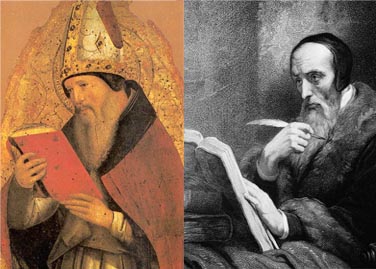
Augustine-JohnCalvinIt doesn’t take a specialist to know that Calvin loved the writings of St. Augustine of Hippo. After the Bible, he quotes Augustine more than anybody else in the Institutes (I think, but don’t quote me on this) more than all the other Fathers combined. Whenever he wanted to establish the antiquity of a doctrine, or its soundness with the interpretation of the Church universal, it’s a safe bet he’s going to pull out an Augustine quote, especially since he was an authority both he and his Roman interlocutors agreed upon.

Calvin’s Quibbles

That said, Calvin wasn’t a slavish admirer of the great bishop as we see here in his comments on the story of Pentecost:

And when. To be fulfilled is taken in this place for to come. For Luke beareth record again of their perseverance, when he saith that they stood all in one place until the time which was set them. Hereunto serveth the adverb, with one accord Furthermore, we have before declared why the Lord did defer the sending of his Spirit a whole month and a half. But the question is, why he sent him upon that day chiefly. I will not refute that high and subtle interpretation of Augustine, that like as the law was given to the old people fifty days after Easter, being written in tables of stone by the hand of God, so the Spirit, whose office it is to write the same in our hearts, did fulfill that which was figured in the giving of the law as many days after the resurrection of Christ, who is the true Passover. Notwithstanding, whereas he urgeth this his subtle interpretation as necessary, in his book of Questions upon Exodus, and in his Second Epistle unto Januarius, I would wish him to be more sober and modest therein. Notwithstanding, let him keep his own interpretation to himself. In the mean season, I will embrace that which is more sound.

-Commentary on Acts 2:1-4

While according him great respect and noting his interpretation, Calvin says that the great Augustine has put forward what he considers to be a less “sober” and “modest” interpretation which he simply cannot follow. So what explanation does he find more plausible?:

Upon the feast day, wherein a great multitude was wont to resort to Jerusalem, was this miracle wrought, that it might be more famous. And truly by means hereof was it spread abroad, even unto the uttermost parts and borders of the earth.  For the same purpose did Christ oftentimes go up to Jerusalem upon the holy days, (John 2, 5, 7, 10, 12,) to the end those miracles which he wrought might be known to many, and that in the greater assembly of people there might be the greater fruit of his doctrine. For so will Luke afterward declare, that Paul made haste that he might come to Jerusalem before the day of Pentecost, not for any religion’s sake, but because of the greater assembly, that he might profit the more, (Acts 20:16.) Therefore, in making choice of the day, the profit of the miracle was respected: First, that it might be the more extolled at Jerusalem, because the Jews were then more bent to consider the works of God; and, secondly, that it might be bruited abroad, even in far countries. They called it the fiftieth day, beginning to reckon at the first-fruits.

-Ibid

We see here the difference I’ve mentioned before when it comes to the Reformers and the earlier, especially medieval, hermeneutical tradition; they will usually privilege the ‘literal’/historical-grammatical sense of the text over any spiritualizing, allegorizing, or typological senses. Calvin isn’t opposed to typological interpretation in principle–he engages in quite a bit of it himself and accepts the prefigurement of Pentecost in the sense of first-fruits pointing towards the initial fruitfulness of the Gospel by the Spirit’s power. He’s concerned, though, that the interpretation first be grounded plausibly in the history of the event. In other words, in a text like this, he insists that the intentionality of the human actors be made sense of and that “the profit of the miracle was respected.” Only then may we move on to the typological meaning without it becoming over-subtle.

Now, that said, I myself think Calvin was being a little over-cautious here; Augustine’s got a point linking Pentecost with the giving of the Law, and the Spirit who writes the Law on our very hearts. Part of the point of typology is that God’s authorship of history can transcend even the human actor’s, or author’s original intent, without violating them. Also, given modern studies in the theological dimension to the authorship of the Gospel writers, it doesn’t strike me as improbable that Luke intended for multiple resonances to be in play in the text connected to as rich a concept as Pentecost.

The Moral of the Story

More interesting than the specific interpretation given to the passage however, was Calvin’s treatment Augustine’s interpretation. Here he offers us a model for a Protestant engagement with the interpretive tradition of the Fathers: respectful, but critical listening. He doesn’t do what so many pop-Protestant approaches do and simply ignore the tradition because, “All I need is my Bible.” Calvin knows that the Church, at least some segments of it, has been reading the Bible well enough for a very long time, so he doesn’t need to reinvent the wheel. He knows the arrogance it takes to approach the text in a way that says the Spirit has skipped 20 centuries of interpreters in order to finally reveals the Scriptures to me. In fact, it is precisely through the teachers of the Church that he works most of the time.

At the same time, in order that the Spirit may truly rule through the Word, Calvin reads the Fathers critically–not disrespectfully, but with a knowledge that they are fallible men, who can err just as he might. As you would treat a respected pastor who has faithfully labored over the texts for years, so with the Fathers: pay careful attention to what they have to say, consider deeply, and go back to the text. Indeed, this lesson is valuable, not only for Protestants looking to read the Fathers, but for Protestants looking to read the early Reformers; Calvin teaches me by his disagreement with Augustine that it’s permissible for me to disagree with Calvin!

Soli Deo Gloria

Job, Providence, and Multiple Intentionality

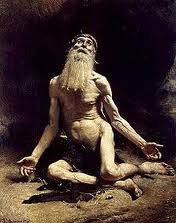
JobIf anybody knows anything about Calvin, it is that he believes God to be the ultimate author of history, good or bad, with all of its twists and turns. Though not obsessed with the doctrine of providence as some might think, he does devote a significant section of Book I of the Institutes to it, defends it in a number of special treatises, and addresses it all throughout the commentaries. One particular passage on Job grabbed my attention when I first read through the Institutes, though, when I was yet early on in developing my Reformedish tendencies.

Theologians, especially those concerned that God not be considered the author of evil, tend to make the distinction between God causing a thing to come to pass directly, or merely “permitting” it to come to pass. While elsewhere Calvin seems affirm a proper place for this distinction (cf. Commentary on Genesis 3:1), he’s not too keen on those who would try to rob God of his sovereign governorship over all things by using the doctrine of permission to get God off the hook for human wickedness. Although they are fully responsible for their choices (Institutes I.17.2-3), not being compelled by some Stoic fate (ibid, I.16.8), men and women make the choices they make according to the “secret plan of God.” Calvin’s beef is with a permission that teaches “that men are borne headlong by blind motion unbeknown to God or with his acquiescence.” God’s providence does not admit of a passive permission in which he simply lets things happen, but rather it is active permission according to his own secret plan, for his own good will.

Calvin backs this up with a battery of scriptural examples and texts, but he opens with the story of Job:

From the first chapter of Job we know that Satan, no less than the angels who willingly obey, presents himself before God [Job 1:6; 2:1] to receive his commands. He does so, indeed, in a different way and with a different end; but he still cannot undertake anything unless God so wills. However, even though a bare permission to afflict the holy man seems then to be added, yet we gather that God was the author of that trial of which Satan and his wicked thieves were the ministers, because this statement is true: “The Lord gave, the Lord has taken away; as it has pleased God, so is it done” [Job 1:2 ]. Satan desperately tries to drive the holy man insane; the Sabaeans cruelly and impiously pillage and make off with another’s possessions. Job recognizes that he was divinely stripped of all his property, and made a poor man, because it so pleased God. Therefore, whatever men or Satan himself may instigate, God nevertheless holds the key, so that he turns their efforts to carry out his judgments.

-Institutes of the Christian Religion, I.18.1

The reason this passage was so fascinating to me was that it called my attention to a single instance where three wills were at work, each a key component in the action, and all for different purposes. At the human level we see the Sabaeans out of a simple human lust and wickedness pillaging and looting in order to satisfy their own desires. Satan was at work as well, goading the Sabaeans in order to afflict Job and cause him to curse God, thereby proving him wrong. God actively permitted Satan to goad the Sabaeans in order to, well, we don’t have the full reasons, but at the very least, prove Satan’s accusations wrong and vindicate the righteousness of his servant Job. The same event is the result of God’s good divine will and the two wicked wills, demonic and human. God is just in his determinations, and yet Satan and the Sabaeans are utterly wicked in theirs.

This is not the way we’re used to thinking about things. Regularly, we would try to figure out, “Well, who’s really responsible here? Who caused it? It’s either God, or the devil, or humans, so which is it?” Or we’d try and parse it out and say that this part was God, this part was Satan, and this part was humans. That’s not what we see in the text, though. Instead, it seems to point us to God working out his own will through wicked demonic and human wills at the very same time.

Calvin moves on to cite the stories of the lying spirit and King Ahab (1 Kings 22:20-22), Jesus’ death at the hands of Pilate and wicked men by the plan of God (Acts 2:23,  4:28), Jeremiah’s declaration that the Chaldean’s cruel invasion was God’s own work (Jeremiah 1:15; 7:14; 50:25), and a half-dozen other instances where human wickedness is also credited to God’s good purposes in history. As Calvin says, “Those who are moderately versed in the Scriptures see that for the sake of brevity I have put forward only a few of many testimonies.”

I’ve wrestled myself for a number of years as to just how God’s sovereignty and our real, human freedom play out. Of course, the Scriptures don’t resolve this tension cleanly for us, nor does Calvin; they just let the it hang there. The conclusion I’ve come to is that both are in the Bible and any solution that too heavily pits the one against the other–either minimizing or limiting God’s control, foreknowledge, and power or those hyper-Calvinists who would call all human freedom a chimera–are reading against the grain of the text. None of this is an “answer”, of course. I have for years gone back and forth between a more deterministic compatibilism, Molinism, and something else I’ve never really had a name for.

What Calvin does in this passage is ensure that whatever your answer, it must be one that reckons with the fact that there are no runaway wills in God’s world; his “permission” is an active one, and he does not stand idly by, wringing his hands in distress, or waiting with baited breath to see what happens next. Again, this is the God of the Gospel who didn’t just stand by and let his Son be crucified by wicked men, but purposed according to his own plan and foreknowledge to save the world through these things.

Soli Deo Gloria