 Fred Sanders has written a book about the Trinity called The Triune God. Yes, he has already written one previously, The Deep Things of God (which you should have already read by now), and dissertation on it (which is too expensive for anyone to read), but this one is different. Coming as the second volume in Zondervan’s promising New Studies in Dogmatics series, Sanders isn’t interested in giving a serviceable, “here’s the Trinity in OT, the NT, then the Fathers, now the Medievals, and here’s how to not be a heretic today” structure. Instead, Sanders says,
The goal of this book is to secure our knowledge of the triune God by rightly ordering the theological language with which we praise the triune God. Its central contention is that the manner of the Trinity’s revelation dictates the shape of the doctrine: it draws its dogmatic conclusions about how the doctrine should be handled on the basis of the way the Trinity was revealed (19).
Yes, it’s a work of trinitarian doctrine, but it’s also a master class in how to construct trinitarian doctrine. Sanders doesn’t just set about telling you how to think about the Trinity, but also how to think about thinking about the Trinity. In that sense, Sanders is concerned with trinitarian doctrine as a species of Theological Interpretation of Scripture; he wants to show us how to read the Bible to arrive at the doctrine of the Trinity without misconstruing either the Bible, or even worse, the Trinity. And all of this for the sake of rightly praising our glorious God.
I will just come out and say that if you are anything approaching a theology nerd, serious student, or professor, I would highly recommend this work. Treat yourself for Christmas or something. Sanders is already known for his acumen in all matters trinitarian, but this book ought to solidify that reputation. And rightly so. This is a serious, top-shelf entry within the academic and churchly conversation around the doctrine of the Trinity. Sanders’ writing is clear, lucid, with an astonishing command of the height, depth, and breadth of the Christian tradition (Patristic, Medieval, Roman, Orthodox, and Protestant) of reflection on the Triune God.
That said, if you’re looking for an intro book on the Trinity, I’ll go ahead and recommend you pick up The Deep Things of God instead (which is coming out in a second edition, I hear).
So what is his argument in this book? Well, it’s a rather complex one that I can’t fully cover here. But essentially its concerned that we go about doing trinitarian theology in a way that fits trinitarian revelation. How God has revealed himself as the One who is Three, ought to definitively govern the way we confess (in praise and print, and printed praise) God as the Three who are One. Theologians aren’t in the business of clarifying God’s muddle, but communicating God’s self-manifestation.
To do that, Sanders delves into issues like the nature of revelation. What does it mean for us to talk about the revelation of the Trinity, for instance? Well, it doesn’t just mean that God is incomprehensible and that he is beyond our understanding. That’s what the doctrine of incomprehensibility means. Instead, in keeping with the NT sense of “mystery”, the reality of the Trinity is of a truth temporarily “hidden, but now revealed” in history for us and our salvation.
But how is it revealed? Well, in the act of God sending God, in missions of the Son and Spirit, or the Incarnation and Pentecost. In these historical acts, God reveals himself as Triune. This means that strictly speaking, the New Testament isn’t the revelation of the Trinity. The New Testament is the inspired (and authoritative!) attestation of that revelation. The words of the apostles inspired by the Spirit are necessary to disambiguate the nature of the Word who comes in the power of the Spirit. There is a unity of word and act at that point.
Sanders touches on and attempts to untangle sundry other issues. For instance, the question of how to think about the relationship between God’s reality in himself and his revelation to us in history. In the 20th century it’s been popular to think of this in terms of the unity or identity of the economic Trinity (God seen in history-of-redemption) and immanent Trinity (God in himself apart from history). Sanders’ moves away from this formulation and, along with John Webster, champions the older formulation which speaks instead of God’s internal processions (the Father generating the Son, the Spirit being spirated by Father and Son), as the foundation of his historical missions (Incarnation and Pentecost). The latter reveals the former and the former is founded on the latter. (Incidentally, much of the hermeneutical muddle surrounding the Trinity debate this summer could be cleared up by working through this book).
When we think of the relationship between the Bible and the Trinity, Sanders helpfully covers a broad terrain. He forthrightly faces the problem of the fact that a good many classic proof-texts of the Trinity have been taken away by modern critical, or careful historical-grammatical exegesis. All the same, new reading strategies—which at times are the recovery of older reading strategies—has opened up new vistas for trinitarian exegesis.
For instance, looking at the Fathers and the New Testament authors, there has been a turn to recovering “retrospective prosoponic identification” or “prosopological exegesis”—the practice of rereading OT texts like the Psalms and identifying persons (prosopa) within them—as fruitful field within which we can toil. Think of Jesus appealing to Ps. 110 and asking the Pharisees who God is speaking to when David sings, “The LORD said to my Lord…” Texts like that are regularly appealed to in New Testament, and the Fathers deployed this mode of reading extensively. On that front the harvest is plentiful! But what about the workers?
Sanders covers all sorts of other ground, like what to make of so-called “Christophanies” (hint: something else), or how to go about spotting the trinitarian presupposition of Paul’s theology, and so forth. That said, you should know that Sanders doesn’t write a “definitive” work in this regard. He does plenty of Trinitarian theology and plenty of exegesis at key points, but often it is illustrative of a general point and not an exhaustive treatment of it.
This might seem like a drag at first. Part of you wants Sanders to work it all out across the Gospels, Paul, even Revelation. Or even though he touches on how to think of the Christophanies, it would be fun to see him work with a story like Abraham and the angel of YHWH at Mamre. But he doesn’t. Besides probably being limited by word-count, I suspect there’s something generous about Sanders’ reticence to give an exhaustive, run-down: it forms something of an invitation to others to discern the glory of the Triune God in Scripture alongside him.
So what are you waiting for?
Soli Deo Gloria
 This review was originally written for Books and Culture before its unfortunate closing. Thanks to John Wilson for encouraging me to write it.
 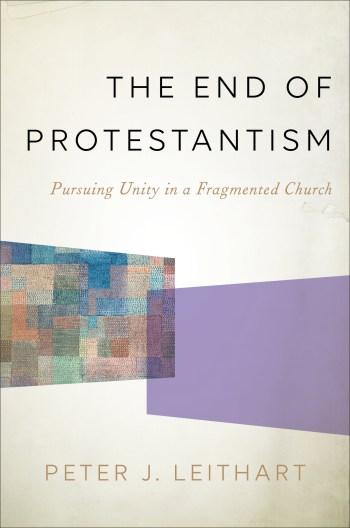 According to Peter Leithart, the history of God’s people is a process of being creatively torn apart and put back together again in new, complex, more holistic ways. With each stage in the LORD’s dealing with his people, beginning from Adam after the fall, Noah after the Flood, Moses after the Exodus, down on into the present, there are separations and reunions. These result in new forms of arrangement, liturgy, and worship according to God’s good pleasure. Single sacrifices become altars, altars become Tabernacle, Tabernacle becomes Temple, Temple becomes Christ, Christ becomes Church, and so forth. Biblical history moves from “glory to glory” in that regard.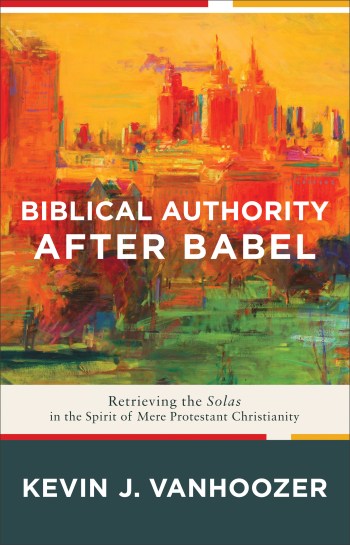
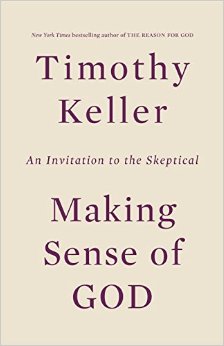 When I was in college ministry, I had a small budget for books and resources to use with my students.So for almost the entirety of those four and half years, I had a small stack of Tim Keller’s The Reason for God sitting on a shelf in my office, as well as one or two tucked in the backseat of my car to hand out to students. Ever since reading it right after college, I have found it to be the single-most helpful one-book, contemporary apologetic introductions to Christianity out there. I’ve led small-groups through it, handed it to doubters, skeptics, fervent Christians, and everyone in-between.
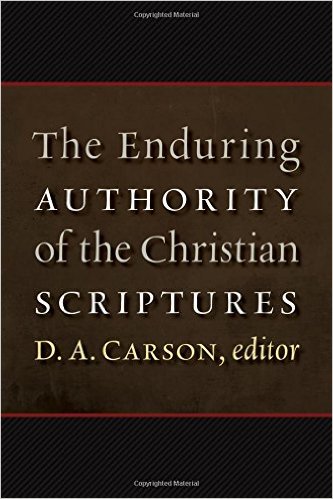 D.A. Carson has spent his career studying and teaching the Bible, with work spanning across a wide range of commentaries, monographs, and articles. He has also been defending its authority as Christian Scripture, God’s Word, for the whole of that time, with multiple individual works and co-edited monographs like
  There are few laments more frequently raised in the evangelical academy than the divorce between the academy and the church, or between the life of piety and that of theological scholarship. Indeed, it is not uncommon for pastors to admit that seminary was one of the most spiritually difficult times in their lives, precisely because the pursuit of academic rigor in theology, by its very nature, seemed to choke out the spiritual life. Moreover, the relevance of the theological task seems distant from the life of faith for the average congregant.
 The heart of the New Testament gospel is the idea of union with Christ. All of the benefits of salvation (justification, adoption, sanctification, and glorification) we only receive as we are “in Christ.” It is the doctrine without which all these other truths is not good news. Unsurprisingly, then, you can’t read Paul, John, Peter, or even the words of Jesus himself without tripping over these references.
 I have to admit, I have never aspired to become a “God-fearing woman.” I benefited, nonetheless, while reading Jen Wilkin’s new book
  In 1874, Russian composer Modest Mussorgsky created his famous, 10-piece suite of music Pictures at an Exhibition. The work was originally composed in honor of the work of his friend and creative compatriot, Viktor Hartmann, an architect and artist. When Hartmann died, a number of his friends organized a special exhibition of over 400 of his works as a tribute. Mussorgsky’s contribution was to composes this work, which was a soundtrack, of sorts, for the exhibition, based on 10 of Hartmann’s works.
 Reformedish