Francis Turretin on Early Divine Christology

Francis-TurretinTheology is a historical practice. We’ve been reading the Bible and thinking about it for a long time. While that doesn’t entirely rule out advances, it does mean we shouldn’t be so surprised when we find that some of our modern studies (biblical, systematic, and practical) are at times only catching up or reworking old variations on a theme that’s been played throughout the history of the church. I’ve said something like this before, but I’ve been reminded of it recently with the recent works on Christology (teaching about Christ) in New Testament studies I’ve been digging into lately.

Scholars like Chris Tilling, Richard Bauckham, Crispin Fletcher-Louis, Larry Hurtado, and others have bee mounting a case in that earliest Christology we have (in the New Testament documents) is a divine Christology. Unlike so many liberal scholars have thought, it’s not a matter of slow development moving from “low” to “high”, but that Paul, John, and the other apostles were already up in the nosebleed section of Christology, so to speak. They all are moving along a certain trajectory, focusing on the way the New Testament either ascribes worship to Jesus as only God should, has him doing the things only God in the OT did, receives the Name that God alone has, and so forth.

All of this reminded of Francis Turretin’s defense of the deity of the Son against the Socinian heretics in the 17th century in his Institutes of Elenctic Theology, Third Topic, question 28, paragraph V.:

That the Son is true God, both consubstantial and eternal with the Father, these four things ascribed to him (and belonging to God alone) invincibly prove: (1) the names of God; (2) the attributes of God; (3) the works of God; (4) the worship due to God.

And from there he goes on in precise, compact, scholastic manner to show the various names, works, attributes, and worship that are ascribe to God in the Old Testament being given to the Son in the New.

Now, of course, Turretin is not doing all of the careful work comparing the New Testament texts with parallels in 2nd Temple Judaism, nor are there extensive studies in the Greek (though he does treat a number of text-critical issues). What’s more, certain specific texts, we might want to read differently in light of recent work (like the fact the Son of Man is more of an exalted, divine title, and the Son of God, more of a royal, human, kingly one). The structure and much of the basic argumentation present in modern, New Testament studies is there all the same, though.

So, long before Richard Bauckham suggested we consider the divine identity in terms of the God-world relation, or the narrative history of God’s mighty acts, Turretin argued that the ascription of divine works to Christ (creation, redemption, etc), should be seen as proof of the deity of the Son.  Indeed, some of Turretin’s work on the issue of Christ sharing divine attributes seems to be underplayed in contemporary scene. Do a little digging in contemporary works on the 2nd Temple period and you’re well on your way to opening up a new line of inquiry in Christology.

Among other things, this is one of those reasons I’m grateful for the increasing attention certain biblical scholars and theologians are paying to the reception history and historical theology. We have nothing to lose in drawing on the exegetical and theological insights of our forebears and everything to gain.

Soli Deo Gloria

Spotting Jesus as God in 1 Corinthans 10

divine ChristologyLast year I had the privilege of studying 1 Corinthians with my college students, or, as I like to call it, “The Book of Very Hard Sermons.” Among the most difficult and rich texts to preach from is chapter 10, where Paul is wrapping up a lengthy discussion about whether church members ought to grab a bite to eat with their pagan neighbors at the local temples. While I knew the passage had fascinating and challenging implications for issues like the sacraments (10:1-5, 14-22), temptation (10:6-13), other religions (10:14-22),  and Christian liberty (10:23-32), I hadn’t fully grasped their relevance for the issue of Christology in the New Testament.

Enter Chris Tilling’s fantastic, recent work Paul’s Divine Christology. For those of you who have been reading lately, Christology has come up a bit this year, both in relation to Crispin Fletcher-Louis’ recent Jesus Monotheism and Wesley Hill’s Paul and the Trinity. Both figures have been contributing to the recent discussion initiated by Larry Hurtado, Richard Bauckham, and others around the way the New Testament authors viewed Christ as central to the “divine identity.” While Fletcher-Louis’ and Hill’s contribution have been quite stimulating, I’m so glad to have found Tilling’s work because he adds a helpful, quite expansive dimension to conversation.

To recap, Hurtado has argued that it’s clear on the basis of the “pattern of devotion”, prayer, worship, etc. witnessed in the New Testament, that Jesus Christ was worshipped as God. Bauckham has argued that Jesus is included in the divine identity in the New Testament because he is depicted as having the relationship to the world (creator, redeemer, etc) that Jewish monotheism only reserved for God. Much of the debate around their thesis then becomes an issue of whether or not you can spot similar devotional patterns of worship, or a fuzziness in monotheistic theology of 2nd Temple Jewish texts, with various intermediaries. Tilling argues that one missing dimension in the discussion is a focus on the way that Paul explicitly depicts the believer’s relationship to Christ in the same fashion that the Old Testament does that between and God.

Tilling points out, as many others have, that the distinctive feature of Jewish monotheism wasn’t primarily a metaphysic, but a covenantal relation. YWHW is Israel’s God and Israel is YHWH’s people. That’s the heart of the 10 Commandments, the covenant as a whole, and the chief confession of the people of God in the OT, the Shema (plus a verse):

“Hear, O Israel: The LORD our God, the LORD is one. You shall love the LORD your God with all your heart and with all your soul and with all your might. (Deuteronomy 6:4-5)

This “relational monotheism”, the sort of relationship that has love, fidelity, devotion, and jealousy as correlates, is what it means for Israel to worship one God. So, alongside all the key texts that link Christ with statements of pre-existence, deity, creative power, and so forth, Tilling says we’ve missed the heart (or at least a key dimension) to Paul’s very divine Christology if we don’t analyze the believer’s relationship with Christ as part of the evidence.

It’s not for nothing, then, that he begins his case by using 1 Corinthians 8:1-7 to kick off his study. It contains the key verse, 8:6, in which Paul splits up the Shema to include Jesus in the confession of Israel’s God:

For although there may be so-called gods in heaven or on earth—as indeed there are many “gods” and many “lords”—yet for us there is one God, the Father, from whom are all things and for whom we exist, and one Lord, Jesus Christ, through whom are all things and through whom we exist. (1 Corinthians 8:5-6)

While other scholars have noted the importance of those verses (and spilled a great deal of ink doing so), Tilling points out that really, the whole section of 1 Corinthians 8-10 is framed in terms of the proper worship, love, and knowledge of God (8:1-3). Paul is challenging the Corinthian believer’s appeal to freedom and knowledge to eat idol meat, to consider the implication it has for their relationship with Christ in ways that are only suited for Israel’s God. What is need is a “relational hermeneutic” (87), to properly see the way Paul’s argument progresses.

Now, I can’t summarize or reproduce his argument here, in full, but I did want to highlight a few exegetical nuggets on along these lines.

First, there’s the rather curious line about the way going to eat Temple meat and wounding your brother’s conscience is a “sin against Christ” (8:12). At first, it seems like the point is that by sinning against your brother, you’re sinning against Christ, because you’re sinning against the body of Christ. But Tilling points out (among a number of other things), that if that’s what Paul meant, he could have said so explicitly as he does elsewhere (1 Corinthians 10:9, 22). Instead, it seems appropriate the read the relationship more directly as an example of Paul treating Christ as God. Much as David confesses that his sin with Bathsheba against Uriah is directly against God (Ps. 51), Paul’s “simple and natural reflex” was to see this sin against a brother as directly against Christ (94).

Jumping ahead to chapter 10, in his warning against idolatry, Paul cites a gnarly string of Old Testament narratives where YHWH judges the Israelites, ‘our ancestors’ in the faith (10:1-5), for various sins such as idolatry, sexual immorality, grumbling, testing the Lord, etc (10:6-10).  What’s fascinating about these texts where Paul says, “we must not sorely test Christ, as some of them did” (10:9), is that here, “Paul…associates the relation between Israel and YHWH in the Pentateuchal narratives with the relation between the risen Lord and believers in Corinth” (96).

Continuing on, the same relation can be seen in Paul’s warnings about drinking from the cup of Christ and the cup of demons (10:14-22). In these verses, Paul is explicitly identifying  eating meat in the pagan temples with idolatry and urging them to stay away from it (10:14). Why? Because even if there is no real “god” behind it, these meals are still communion meals, acts of “participation.” It’s an act of devotion that in the Old Testament was reserved for the Israelite and YHWH in the feasts and Temple cult. And yet, here we have Paul speaking not of the cup of “God”, but instead warning:

You cannot drink the cup of the Lord and the cup of demons. You cannot partake of the table of the Lord and the table of demons. (1 Corinthians 10:21)

Just as the Israelites were not supposed to provoke God by worshipping other gods, Christians should not “provoke the Lord to jealousy” (10:22), by trying to have it both ways. “Koinonia with respect to Christ…becomes the expression of covenant loyalty, of monotheistic loyalty without idolatry” (100).

Again, I’ve barely scratched the surface of Tilling’s argument (I’m only halfway through the book), but as the kids say, “what has been seen cannot be unseen.” Indeed, once you get a grip on Tilling’s basic argument, it becomes rather intuitive to begin to see it all over the place in Paul. And it seems that’s rather the point. Paul’s divine Christology is not only an affair of key, isolated proof-texts (as helpful as some of those are), but rather form the warp and woof of his whole thought.

Soli Deo Gloria

Classifying Biblical Theodicies (Or, Must There Be Only One?)

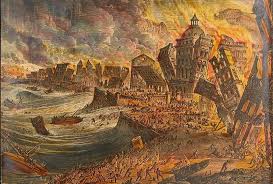
lisbonEvil and theodicy are central to the storyline of the Bible. Indeed, they are central to much of the great secular and especially religious literature in history. Theodicy, for those unaware, is the term coined (or simply popularized) by Leibniz referring to the sort of rational justifications or explanations given for the co-existence of evil and God (or the gods). Antti Laato and Johannes C. de Moor’s massive, edited work Theodicy in the World of the Bible is a collection of essays dedicated to exploring the various sorts of theodicies on offer both in the Ancient Near Eastern texts (ranging from Sumerian, Assyrian text to 2nd Temple Jewish text) surrounding the world of the Bible as well as the biblical materials themselves (both Old and New Testaments). They do so both for historiographical as well as properly theological reasons, calling on specialists to describe, critique, and retrieve the perspectives of the ancients for reflection today.

A Typology of Theodicies

In an attempt to lend order to the various essays and perspectives, in their introduction Laato and De Moor come up with a helpful typology of the kinds of theodicies found in the texts their contributors deal with. After listing various categories, they narrow their options down to the monotheistic, non-dualist options given in the Jewish-Christian theological tradition (p. xxx):

  1. Retribution theology
  2. Educative theodicy
  3. Eschatological theodicy
  4. The mystery of theodicy
  5. Communion theodicy
  6. Human determinism

The names tend to be straightforward, but I’ll briefly give you the gist of each, but know that I’m leaving out references to a number of the texts they use in each section.

Retribution theology as a theodicy explains human suffering in terms of human responsibility and divine punishment for sin. Humans are given free will, which they are legally accountable for (per the widespread covenant theology found both in the ANE and the Biblical record), and as violators, much of the evil suffered is the result of divine retribution. Much of the theodicy given in the OT surrounding the Exile falls under this rubric, as well as the Deuteronomistic literature and vast swathes of the Wisdom texts. Disobedience results in curse, just like Leviticus and Deuteronomy warned (xxx-xxxviii).

Educative theodicy can be found in places like Job, Jeremiah, Lamentations, Ruth, and other types of wisdom literature. In essence, suffering is allowed in the light of the righteous because through it he gains understanding he would not have had otherwise. Naomi learns God’s purposes span farther than she could know as her suffering leads to the birthline of the Davidic king. (xxxix-xlii).

Eschatological theodicy tries to justify God allowing evil by pointing ahead to either the reward of the righteous in the afterlife, or the judgment of the wicked to come. This thread is found in some of the prophetic literature such as Isaiah, Daniel, and so forth. Here, the emphasis showing that much human suffering will shown to not have been in vain. It is a theodicy of comfort, in that regard. (xlii-xlv)

The mystery of theodicy refers to the various traditions which emphasize the fact that we just don’t know what God is up to. Here, humanity’s epistemological limits are compared to the divine’s limitless, unfathomable wisdom. The book of Job and Qoheleth are taken as paradigms here, as well as Maimonedes reading of Job or the theology of 4 Ezra. Lamentations also contains texts that conform to this pattern (xlvi-xlviii).

Communion theodicy emphasizes the fact that in the midst of suffering, the afflicted may draw closer to God in the end. Psalms is a key witness here. But again, so is Job. Here Laato and De Moor also include the tradition of the Suffering Servant of Isaiah, where his expiatory, redemptive suffering actually brings the nation into closer to God through reconciliation. For that reason, its hard to classify it under communion alone, because it (along with the later martyr traditions in the Maccabees) blending suffering for sin with restored relationship. Indeed, often the martyr traditions following blend educative and eschatological dimensions as well (xlvii-liv).

Finally, human determinist theodicies appeal to a certain, necessary human sinfulness or with divine determinism. Here Laato and De Moor have less material, and the Biblical material they adduce is hints in Paul and Qoheleth. It seems the biblical material about Israel’s stiff-necked nature and Moses’ speech in Deuteronomy might fit nicely here as well.

Varied Answers for Variegated Experiences

Laato and De Moor’s typology and helpful literature review points up nicely one of my major problems with certain kinds of theodicies that I see offer: too many insist that only one or two of these theodical angles are the proper answer to or explanation of suffering. Actually, it seems that in light of the fact that all of these themes are at play in the Biblical text, it’s probable that we are meant to understand them all playing a partial role in explaining the problem of evil in the Scriptures. For that reason, we should refrain from settling on just one answer, or reducing our explanations to simple, pat answers. We should also slow down from rejecting these answers as part of the Biblical analysis, as some have done, simply because it doesn’t account for a certain experience or text. Taken as a total answer it might not, but as a partial dimension, it could be very helpful.

Its undeniable that sometimes evil befalls us because of evil choices leading to suffering (both for the perpetrator and victim). Beyond that, Scripture attests that evil does often provoke God’s retribution in this life. Of course, discerning that retribution is a dicey business for those without eyes to see (as Elisha had), or lips cleansed by God’s purifying fire (as Isaiah did), so it is wise to refrain from presuming all suffering is the direct result of sin as the disciples did (John 9). From another angle, it may be that we suffer evil because God is delaying retribution and so evil will have its recompense in the next life, and undeserved suffering will be rewarded at that time as well. What’s more, it could very well be that God allows certain instances of suffering in order to teach us, or to draw us nearer to himself. Finally, as I’ve already argued, it could be that some ultimate explanation for particular evils or evil as a whole will only be unveiled at the end of all things. Mystery can coexist with the acknowledgement that there are various dimensions to the problem of evil.

The biblical corpus is multi-faceted as is its theological witness. I don’t mean that it is self-contradictory, but that it preserves a plurality of voices testifying to the various, real, dimensions of human existence in the world that need to be reckoned with and not simply flattened into each other. And that makes sense given that it’s the revelation of God and his works. God himself knows to understand the whole from his eternal, unified, singular perspective, but for finite beings such as ourselves, we need multiple angles, or lenses on the world to make sure we get a more appropriate understanding of the whole.

Let us not, then, flatten or deny that witness in search of cheap, easy answers.

Soli Deo Gloria

What Counts as a Historical Precedent for New Testament Christology?

Jesus monotheismFor the last 30 or so years (or maybe more), there’s been a running debate surrounding the nature, shape, and origins of New Testament Christology. How high or low was it really? Was Paul really working with a concept of Christ as fully divine and fully human a la Chalcedon, or did that come later as the Church reflected on the implications of what Paul and the other apostles wrote? And did Jesus think himself divine? Was that even an option for a 1st Century Jew? Where did that Christology eventually come from? Was it the influence of Greek, pagan cult, or rooted in classic, Hebrew monotheism? And are these even the right questions? (See Wesley Hill on this)

While much New Testament scholarship in the 20th century took it for granted that “high” Christology was a later development, scholars like Larry Hurtado, Richard Bauckham, Chris Tilling, N.T. Wright, and others, have recently forwarded a thesis of early “Christological Monotheism” that argues the earliest Christology we have is a divine Christology. From the beginning, Paul, John, and the other apostles believed there to be one God (YHWH) and yet, somehow, the man Jesus was central to that one God’s identity (1 Cor. 8, Phil. 2, Col. 1, John 1, etc).

This “emerging consensus” has grown in force and strength over the years, despite variations among the different proponents. Some emphasize the new pattern of reading Scripture that forced the early Christians to recognize Christ as the one who has come and done what only YHWH himself would come and do (Wright), or the fact that he is ascribed the divine Name (Bauckham), or that he receives worship in a way only suited to the Creator in Jewish monotheism (Hurtado). All the same, one thesis that most seem agreed on is that this “Christological monotheism” has no real precedent in the 2nd Temple Jewish texts of the period before Christ.

Crispin Fletcher-Louis disagrees. He does so in a recently published first work of an ambitious, projected four-volume series on the issue, Jesus Monotheism Volume 1: Christological Origins: The Emerging Consensus and Beyond. I’m only about half-way through it, but it’s already proving instructive and provocative. For those interested, in the series, Fletcher -Louis aims both to support and forward the “emerging consensus” while simultaneously critiquing and strengthening it from what he takes to be real weaknesses, due largely from a failure to consider biblical anthropology and theology.

While mostly appreciative of Bauckham and Hurtado’s work (often sharply defending them against critics such as James Dunn or James McGrath), here he says they’ve missed the mark. They say that the various designated emissaries of God such as kings, prophets, priests, nor angelic figures were ever included in the identity of the one God, nor did they receive the kind of worship that Jesus does in the New Testament. Fletcher-Louis thinks that while they are right to point out the real, sharp discontinuity with anything that’s come before in pre-Christian Judaism, their method doesn’t give proper due to the range of thinking about Messianic or medatorial figures present in the 2nd Temple texts discovered by recent scholarship (128-129).

At this point in the study, he notes two problems with their method. First, he thinks they handle key texts idiosyncratically, taking minority positions without showing their work enough. Fletcher-Louis aims to tackle that issue at length later, with case-studies in key texts (130).

Second, and this was the interesting point for me, Fletcher-Louis claims they don’t handle the notion of precedents properly with respect to NT Christology. Obviously, there is no exact precedent. There is a radical discontinuity and difference. There is no direct parallel, nor does the Old Testament explicitly demand the New Testament’s Christology (though it is not inconsistent with it). All the same, Fletcher-Louis says that Hurtado in particular “demands too much of the Jewish material for it ever to hope to gain a proper hearing as a factor in explaining the phenomenon attested in the NT” (131). In other words, Hurtado has too high a criterion for what counts as a “precedent” and so it’s obvious that he won’t find one. There won’t be a precedent for each and every part in a single figure, but given the fact that the “Christological monotheism” of the New Testament has many parts, it can be shown that many of the various parts can be found in other sources, even if the whole is not.

He uses an illustration I found particularly instructive:

The Dominican friar Girolamo Savonarola (1452-98) is generally, reckoned, to have anticipated Luther’s German Reformation with an uprising against the power of the clergy in Renaissance Florence. But the full flowering of the theologcal and ecclesial revolution was only seen several decades later the other side of the Alps in Germany (and Switzerland). Savonarola was an historical precedent for Luther, but by no means did his attempted reformation have all the elements of the theological, ecclesial, and political revolution that would spread from Germany.  For the waves of Pentecostal and Charismatic renewal and revival that have overtaken parts of the church in the twentieth century there is precedent in pietistic and popular movements, some of which were focused on visionary and “Spirit” experiences, in the medieval church. But in many ways modern Pentecostalism is theologically (and sociologically) quite peculiar to the twentieth century. Such is the stuff of historical precedent. And sometimes precedent entails a degree of historical causality…but sometimes it only offers an intriguing comparison from another, separate historical context… (131)

In the same way, it’s not that we must find a total package Christological monotheism before Christ for it to count as a precedent, but similar elements. Nor, argues Fletcher-Louis, should we be too worried that some anticipations to the Christology of the New Testament might sideline the uniqueness of Christian claims. On the contrary, the similarities are precisely what can aid us in understanding the distinctive character of Christian worship of Christ in distinction from surrounding movements and theologies in the 2nd Temple literature we find (132).

I find his point well-taken, though, it remains to be seen (at least for me) whether he actually does demonstrate the precedents, or whether he does properly safeguards against some of the parallelomania that’s prevalent in certain quarters of the NT guild. Given the case he’s made so far, though, and this write-up of his work by Andrew Wilson, I’m quite excited to see him make the attempt.

Soli Deo Gloria

Really Elisha? Bears Attacking Children? This is Why We Can’t Have Nice Things

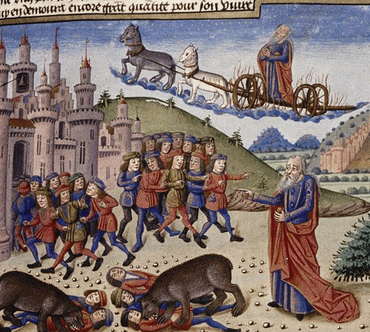
bearsOne of the weirdest stories in the narratives of the Old Testament comes at the end of 2 Kings 2 with Elisha and the bears. The deal is that the prophet Elisha has just been anointed by God through his old master the prophet Elijah to succeed him after God took Elijah up to heaven in a vision of God’s holy chariot. Just prophet stuff. In any case, 2 Kings tells of a number of incidents where Elisha is confirming his role as God’s holy prophet by performing similar, miraculous works as Elijah did. As he’s going along, this weird thing happens:

He went up from there to Bethel, and while he was going up on the way, some small boys came out of the city and jeered at him, saying, “Go up, you baldhead! Go up, you baldhead!” And he turned around, and when he saw them, he cursed them in the name of the LORD. And two she-bears came out of the woods and tore forty-two of the boys. From there he went on to Mount Carmel, and from there he returned to Samaria. (2 Kings 2:23-25)

Now, there are several reactions you can have to this story about bears mauling youths for bald jokes. First, if you’re a teenager or something, you can think, “Sweet! Bears!” Or, as a balding man, you can think, “Well, there’s justice.” Finally, as just a normal person you can think, “Whoa. Seriously? Bears? Against children? For a bald joke? That’s fairly horrifying.” Of course, if you’re prone to trust the prophets of Scripture as being not terrible, various answers start to suggest themselves as to whether one should really take the text at face value.

For instance, you might wonder, “Are those ‘little boys’ really ‘little boys’? What if that’s a translation issue and we’re talking about a street gang or something? And is this really about a bald joke, or is something else going on here? Maybe the 3,000 year cultural gap is playing with our perceptions?” Once again, I ran across a stimulating passage in Peter Leithart’s commentary on 1 & 2 Kings, shedding some contextual light on the bizarre passage.

One point I have to make before sharing, though, is that Leithart has earlier identified a key typology or resemblance in the story of Elijah and Elisha with that of Moses and Joshua. Elisha is to Elijah as Joshua is to Moses, the latter carrying on the conquest into the Holy Land after Moses leads the people out of slavery to idolatry and gives them the Law on the mountain. Alright, back to the bears:

In 2:3 and 2:5, the sons of prophets inform Elisha that “Yahweh will take your, master from over your head today”. Elijah is Elisha’s protector, guide, and “head,” and Elisha is about to lose that leadership. As Elisha’s head, Elijah enters heaven, while Elisha continues the work of his master in Israel, just as the church’s head is enthroned victorious in heaven as it suffers, serves, and overcomes on earth (Eph. 1:20-23).

This repeated statement from the sons of the prophets helps to explain the story at the end of 2 Kgs. 2, one of the most controversial passages in Scripture. The phrase “little boys” in 2:23 can mean “young men” or “subordinates.” Bethel is the site of Jeroboam I’s golden calf shrine, and the context suggests that these are not children, but “Levites” of the idolatrous shrine. Elisha’s curse is an act of warfare, a Joshua-like attack on a center of idolatry. This is reinforced by the chiastic structure of the chapter:

A removing the “head” (2:1-6)
B fifty men (2:7)
C cross Jordan: Elijah divides waters (2:8)
D Elisha requests spirit (2:9-10)
E chariot separates them (2:11a)
F Elijah by whirlwind into heaven (2: lib)
E’ Elisha sees, calls to chariot, tears clothes (2:12)
D’ mantle (2:13)
C’ divides water (2:14)
B’ fifty men (2:15-18)
A’ bald head (2:23-25)

The young men mock Elisha because his “hairy head,” his “baal of hair” (1:8), is taken from him. Perhaps he literally shaves his head in mourning over Elijah’s departure, but it is also possible that they are mocking Elisha because they assume he is unprotected without Elijah. Their taunt to Elisha to “ascend” also points back to Elijah: “You know where you can go, Elisha!” Elisha again demonstrates that he bears the spirit of Elijah, which is the Spirit of Yahweh, for he can call out bears from the forest as readily as Elijah can call out fire from heaven to consume the soldiers of Ahaziah…., as readily as Yahweh can unleash lions against disobedient prophets (1 Kgs. 13:20-25; cf. Lev. 26:22). –1 & 2 Kings, 175-176

Elisha’s opponents are not toddlers with bold mouths, then, but a large band of hostile, adult priests serving the idolatrous shrine of the Northern Temple in Israel. For myself, I believe the context of the earlier story of King Ahaziah sending out a troop of soldiers to attack and lay hands on the prophet of God, Elijah, makes it likely that this “taunt” was more than a simple act of name-calling, but an expression of hostility, spiritual warfare, and a present threat to Elisha’s person. This is not an exaggeration when considering the various, deadly fates the prophets of Israel had suffered throughout her history and even Elijah’s own generation in the time of Ahab and Jezebel.

Of course, this may not solve all the difficulty of the passage for you. I’m not sure it does for me, either. It is one more example, though, of what a willingness to sit and wrestle with the Scriptures instead of simply turning from them when they’re difficult or offensive. That’s not a recipe for accepting any and every interpretation that comes along. There are a lot of bad ones that, in an attempt to “preserve” the Scriptures, end up betraying the character of God. All the same, trusting in the character of God as revealed in Scripture will give us the interpretive resilience needed to struggle with the text long enough to win a blessing and gain new light for the path.

Soli Deo Gloria

Update: As it turns out, my friend Seth T. Hahne has written on the passage in a similar and complementary way, adding some broader canonical considerations that reinforce the reading offered above.

Mayors and Prophets: Both Servants of the Lord in Tricky Times

kingsAhab’s reign in the Kingdom of Israel was one of the most godless in her whole history. And that’s saying something. Queen Jezebel has instituted worship of the Baals and ordered all the prophets of Yahweh slaughtered. The godlessness is so rampant that Yahweh has the prophet Elijah proclaim a drought and a famine in the land of Israel, in response. If Jezebel and Ahab want the word of Yahweh to dry up in the land, they will suffer the consequences.

What does it look like to serve Yahweh faithfully in this context? In the first half of 1 Kings chapter 18, right before Elijah’s confrontation with the prophets of Baal on Mt. Carmel, we’re given a portrait of two quite distinct servants of Yahweh: Obadiah, the household manager in Ahab’s court, and Elijah, the iconoclastic prophet.

In his absurdly insightful theological commentary, Peter Leithart sheds some light on the distinct roles they play in the Yahweh’s retinue:

As “mayor of the palace” Obadiah holds a high position in Israel, with responsibility for Ahab’s palace, estates, and livestock. Both Elijah and Obadiah (whose name means “servant of Yah”) are faithful servants of Yahweh, the God of Israel, but radically differ in their position and mode of service. Elijah confronts Ahab from outside the court, while Obadiah works for the preservation of the prophets–and hence the preservation of the word of Yahweh–from within Ahab’s court, subverting the official policies of the court even while acting as chief steward. Not every faithful believer is called to be an Elijah. Many are called to the tricky work of remaining faithful in a faithless context, to the business of serving Elijah and Yahweh as “master” (18:7) and serving Ahab as “master” (18:8) Obadiah’s position is not merely tricky; it is dangerous. A false shepherd, Ahab tolerates Jezebel “cutting off”…prophets (18:4), but is reluctant to “cut off” any of his cattle…(18:5). Jezebel the Baal worshiper is willing to tolerate golden calves and other forms of idolatrous worship, but she cannot tolerate the intolerance of Yahweh worshipers.

1 & 2 Kings, 133-134

Elijah is obviously the hero of the whole narrative and one of the central figures in both 1 & Kings. Elijah has the word of Yahweh come to him personally. Elijah courageously calls out Ahab, the king of Israel in the name of the true God. Elijah faces off with the prophets on the mountain, calling down fire from Yahweh in the heavens. Elijah is a model of prophetic faithfulness, the willingness to stand outside the compromising systems of empire and power, depending solely on the Yahweh’s protection and preservation to carry out his task.

And yet, there stands Obadiah–the skittish, possibly compromised, bureaucrat. Because, think about it–wouldn’t many of us on the purist end (a rather exaggerated Neo-Anabaptist, possibly), be tempted to consider him compromised? Isn’t he working for a godless king in a regime that seems actively hostile the will of Yahweh? Aren’t followers of Yahweh to remain pure and set apart from evil-doers and the systems of power that they run? To avoid colluding with Empire? Doesn’t running Ahab’s household count?

Well, according to the political theology of 1 & 2 Kings, it’s only because of Obadiah’s willingness to stay within the regime that he was able to successfully resist it and save some of Yahweh’s prophets, ensuring that when Elijah’s showdown happens and the prophets of Baal are overthrown, there’s someone around to preach God’s Word. Obadiah is able to exercise wisdom and rebel from within, only because he stays within.

In times of trial like those facing God’s people in the times of Ahab, the danger is the Elijahs and Obadiahs God has called to serve him might not recognize each other’s distinct calls. Elijah might be tempted to scorn the cowardice and compromise of Obadiah’s wisdom in difficult places. Obadiah, meanwhile, might be tempted to bemoan and begrudge the “trouble” brought on by the rash words and confrontational stance of Elijah, who seems to paint everything in black and white with no shades of grey. And yet that would be a mistake, for God’s wisdom can employ both prophet and bureaucrat to preserve and proclaim his Word, each according to the gifts and privileges that God had given them. In a sense, we need Paul’s theology of the body and the gifts (Romans 12; 1 Corinthians 12). applied outward into the worldly vocations that the citizens of the Kingdom must engage in.

Texts like this are obviously relevant in the face of a culture that is increasingly intolerant of the “intolerance” or exclusivity of Christian values and truth claims. Don’t worry, I’m not breaking out the “p”-word and claiming that Christians will have to face firing squads soon, or something like that. All the same, let’s not be naive in the other direction. If there are Chicken Littles running around proclaiming the imminent descent of the heavens, there are also ostriches with their heads in the sand. Or worse, those who refuse to see any difficulties ahead because, well, you know, Jezebel “has a point.” Trouble will come and, indeed, has always come for the people of God.

For that reason, we need deep, biblical wisdom like that of the book of 1 & 2 Kings, read with an eye to the horizon. As Paul says, “Now these things happened to them as an example, but they were written down for our instruction, on whom the end of the ages has come” (1 Corinthians 10:11). These things happened back then and there, but since the patterns of the world’s sin repeat in history, these texts are still used by the Spirit of God “for teaching, for reproof, for correction, and for training in righteousness, that the man of God may be complete, equipped for every good work” (2 Timothy 3:16-17).

Soli Deo Gloria

Final Review: Assorted Thoughts on John Barclay’s Paul and the Gift

paul and the giftI’ve already written once about John M.G. Barclay’s phenomenal new work Paul and the Gift. We also plan on taking up the issue on the Mere Fidelity podcast soon. All the same, having just finished the work, I wanted to address a few themes and offer a few assorted and incomplete judgments about the work. If you’re interested in the thesis of the, Barclay’s own summary of his work that I excerpted here ought to fill you in as he basically delivered on what he promised. And more.

First, an evaluative point: the book really is ground-breaking and it’s set to light up the field of Pauline studies. I don’t think all the rave reviews from other scholars are just an exercise in academic back-scratching, at this point. If you’re at all interested in discussions around the New Perspective or Old Perspective on Paul, Judaism, and justification, this should be on your list along with the other major recent works by Wright, Dunn, and so forth.

Beyond that, I simply wanted to note some thematic takeaways, quibbles, and comments.

Vindication of the Reformers. From a theological and historical perspective, the first thing I noticed was the way Barclay’s work offers at least a partial vindication of the Reformer’s use of Paul in the medieval debates over justification. Recall that Barclay makes a couple of key points.

First, yes, Judaism in general had a very present theology of grace. On that point, E.P. Sanders was correct. Second, “grace” didn’t mean the same thing for all of Paul’s Jewish contemporaries. “Grace is everywhere in Judaism, but it is not everywhere the same.” For many, grace meant the “priority” or “super-abundance” or “singularity” of God’s favor, but for Paul it particularly meant the “incongruity”–the unfittingness–of God’s grace to the undeserving. Second, writing after Augustine and Luther left their mark on the interpretation of grace, when Sanders saw someone affirming the priority of “grace”, he also read into it the “incongruity” of grace because he assumed that everywhere the word is used, it must have that resonance. Not so.

Now, this offers a partial vindication of the Reformers in that, theologically, whatever else you might say about a possible individualism, or misreading of the nature of “works-righteousness”, they were affirming the incongruity of grace against the medieval theology of grace that had managed to sneak “congruity” or worth back into the picture. By conceiving God as “graciously” accepting the merit of the saints which could be procured by good works, penance, “doing what is in us”, and so forth, there is still an element of God accepting or rewarding on the basis of achieved worth or “fittingness”, that’s not dependent on the grace of Christ alone. And this conception of “congruent” grace seems to mirror some of the theology found in 2nd Temple Jewish texts, against which Paul’s teaching stands out starkly.

I did say “partial” for a reason, though. Two related points of difference to note are Barclay’s criticism of Lutheran “non-circularity” and his position on works at the final judgment. Barclay points out that it’s only with Luther that we first find a prominent emphasis on the “non-circularity” of grace, or it’s “unconditional” character in which God’s gift of grace expects no “return” of any kind. It’s a “pure” gift in the modern sense. That’s not something Barclay finds in Paul. For Paul, grace is unconditioned by any notion of worth, but it is not unconditional; Paul expects a change in the life of the believer that issues in good work that will be approved of at the eschaton.

Even with those points made, Barclay’s very careful and sensitive survey of both the 2nd Temple literature and the reception history of Paul does end up highlighting significant parallels between the Reformation debates and Paul’s 2nd Temple context that are illuminating.

Sociology. Second, Barclay, like so many current interpreters of Paul, stresses the sociological dimension to Paul’s theology. Thankfully, Barclay doesn’t use that to screen out or kick to the side classic concerns about individual salvation and such. Still, Barclay is very clear that Paul’s main aim is to create a community of Jew and Gentile upon the joint recognition that both have been received without respect to worth, not according to the old values systems of the world, or according to Torah, but only because of the incongruous grace of God through Christ in the New Age.

Barclay goes into all sorts of helpful social dynamics that Paul’s moral instruction cuts off or addresses, setting things in Jewish and Greco-Roman social context. This angle is a real gain from recent, New Perspective and social science emphases. I found especially illuminating the way Barclay draws on Pierre Bordieu’s notion of practice, habitus, and the body as the site of sanctification.

That said, Barclay can maybe go too far along the sociological angle for my taste. Consider his paraphrase of Galatians 2:15-21:

You and I, Peter, are Jews, used to thinking of ourselves as categorically distinct from “Gentile sinners.” But we know (though conviction and experience) that a person (whether Gentile or Jew) is not considered of worth (“righteous”) by God through Torah-observance (“living Jewishly”), but through faith in (what God has done in) Christ. We look to God to consider us valuable (“righteous”) in Christ, not through obeying the Torah, and this is so even if (in situations like Antioch’s) our resulting behaviour makes us look like “sinners” (“living in a Gentile fashion”). Does that mean that Christ has led us into sin? No way! Only if one were to reinstate the Torah as the arbiter of worth (“righteousness”) would “living like a Gentile” in Christ be classified as “transgression”. In fact (taking myself as a paradigm), I have died to the Torah – it is no longer what constitutes my standard of value – because I have been reconstituted in Christ. My old existence came to an end with the crucified Christ; my new life has arisen from the Christ-event and is therefore shaped by faith in the death of Christ, who loved me and gave himself for me. This divine gift I will by no means reject: if “righteousness” were measured by the Torah, the death of Christ would be without effect.

While there’s much that’s clarifying in this reading, the translation of “righteousness” into the language of “worth”, or the way he focuses in other places on the “transgression” of Torah as a cultural framework of evaluation, or the “recalibration of social norms”, seems more appropriate as a preacherly contextualization for late-modern, Westerners than a straightforward, historical reading of Paul.

Apocalyptic-Augustinian-Lutheran. Barclay says that depending on how you look at it, he might be an Augustinian-Lutheran appropriating New Perspective themes, or vice-versa. So, a strong theology of the incongruity of grace, meets social context and a more fine-grained, positive evaluation of Judaism.

What’s more, Barclay has his eye on drawing on the focus of recent “apocalyptic” readings of Paul highlighting Jesus as divine activity that ruptures history and which avoids presenting salvation as the smooth development of potentialities inherent within it. At the same time, unlike some other apocalyptic readings, he acknowledges that in Galatians and especially Romans, salvation happens in fulfillment of the promises to Israel that came before.

All the same, I’ll just put my cards on the table and say that the Augustinian-Lutheran-Apocalyptic Paul still needs more Calvin and the Reformed emphasis on redemptive-history. (Which is interesting because I thought his treatment of Calvin to be very helpful, historically). This is one of those places where Wright, though he can get a bit carried away, is right to give us “big story” readings of Paul’s letters. Also, I don’t think Barclay has done quite enough justice to the positive, continued place of the Law as instruction in Paul’s thought, even though he does give positive place to the growth of holiness and practice of good works in the life of the believer.

Is Paul’s Grace Real Grace? One of the brilliant points Barclay makes about the whole discussion around whether Judaism was gracious or not, is that people have been coming into the discussion with a master concept of grace that doesn’t recognize its various shades and “perfections”, which don’t always have to come together as a package. This is why Sanders was right to think Judaism had grace in it and wrong to think that Paul disagreed with various of his contemporaries about the issue of God’s grace. In other words, it wasn’t only that they disagree as to whether or not Jesus was the only mediator of it, but it truly was about its nature.

At this point, this is where I put my theologian-in-training hat back on (if I ever happen to take it off). The question I’m toying around with is whether “grace in Paul” simply is grace for the confessional theologian.

In other words, it makes sense for a religious historian to be somewhat neutral about which 2nd Temple Jewish theologian had a “better” conception of grace in order to not prejudge the sources from a Christian standpoint. What’s more, we shouldn’t be anachronistic or slanderous, saying that all Jewish religion at the time was legalistic, graceless, and so forth. It wasn’t.

But the time comes when we must speak dogmatically and make normative statements about other conceptions of grace on the basis of Scripture. If we follow Barclay’s case out to its dogmatic conclusions, according to Paul, according to Scripture, to speak of God’s grace without recognizing (and maybe even denying) that it is not according to merit or worth–even though you see that it’s abundant, prevenient, and so forth–is to speak wrongly of grace. This is no attempt to denigrate Judaism, or certain forms of it, but if we take Paul’s letters as revelation—then where Paul disagrees with his contemporaries about grace on the basis of the “Christ-event”, they are wrong.

Now, this might cut against the grain of Barclay’s methodological aims, but at the end of the day, that’s what I think his exhaustive study of grace in Paul has shown us.

Concluding

To wrap up, none of my quibbles disqualifies anything I’ve said about the book as a must-read bit of Pauline scholarship. Its top-rate and I’ve benefitted from it immensely. Even though it’s not a full-dress commentary, there’s no way I’m going to preach or teach in Galatians or Romans without consulting the passage references, since it’s chocked full of exegetical insights waiting to be applied.

So, yes, if you’re wondering, right about now would be a good time to start adding it to your Christmas list.

Soli Deo Gloria

The Rejection of Cain: Halbertal Contra Girard on Sacrifice and Violence

On SacrificeOne of the most influential accounts of the nature of religious violence and sacrifice in the 20th Century comes from the (quite sadly) recently deceased giant, Rene Girard. For those unfamiliar with it, he begins with an understanding of humans as essentially mimetic or imitative creatures. We desire what we desire because we see others desiring it. Joey has a toy, so little Johnny wants it. This structure of desire has a number of implications, one of which is a build-up of psychic antagonism fueled by frustrated desire, jealousy, and so forth. This toxicity builds up in societies over time and so it needs a spiritual outlet, so a scapegoat is chosen. The scapegoat must be someone close enough to blame, but not close enough to be too important–the outcast (beggar, leper, racial minority, etc) who is hateable and dispensable. They are taken, “sacrificed”, and violently expulsed so that the society can work out its pent up mimetic rage and allow social equilibrium to be restored.
This scapegoat mechanism is taken to be at the root of the ritualized violence of sacrifice as well as the sacred myths we tell from the Greeks on down until the present day. The unique thing, on Girard’s view, about Christianity is that it tells us the scapegoats we choose are innocent. Specifically the story of Jesus, the innocent victim of the mob, in his life, death, and resurrection exposes the scapegoating mechanism for what it is and allows us to break free from the cycle of mimetic violence.

Now, I’ve written appreciatively and critically about Girard before. He’s got a phenomenal eye for social and anthropological dynamics, but for my tastes, his theory of sacrifice has some missing elements. For one thing, despite his best intentions, it fails to take seriously the inner coherence of some of his subjects’ own self-understanding as to just what they’re doing when engaged in ritual and sacrifice. From another angle, Anabaptist theologian D. Snyder Belousek has argued, it’s too much an a priori theory imposed upon the texts–at least the biblical ones–than one drawn from them (Atonement, Justice, and Peace, pg. 173 ). Certainly on sacrifices of atonement there’s something clearly missing with respect to the expiation of guilt and the notion of sin having a Godward orientation. These are just a couple of the reasons I’ve been skeptical of the uses to which he’s been put in recent theology on atonement and violence.

Halbertal on Sacrifice

This is why I was pleased to encounter Jewish philosopher Moshe Halbertal’s little work On Sacrifice, in which he engages the dynamics of sacrifice and violence, as well as the notion’s expansion into our political life, offering a counter-understanding from that of Girard. In Halbertal’s account, sacrifice takes its roots in the relational cycle of gift-giving which secures relationships of love between persons. Sacrifices are a specialized form of gift we engage in when the relationship is asymmetrical as it is with God or the gods. We don’t engage in the normal gift cycles with him because he is not our equal. Instead, our sacrifices, our gifts to him, are an expression of gratitude in returning a portion of what he has given to us. Before they are anything else, sacrifices have a relational purpose aimed at communion.

From there, later dimensions such as atonement are added on, but the gift/relational dimension is primary and foundational. Sacrifices for atonement include not only the original sense of gift, but the acknowledgement of a breach than needs to be healed, made up for, or “paid” back (though not in crassly commercial terms). The underlying aim is still that of inclusion in the relationship of communion and gift-giving, though.

Halbertal points out there is an uncertainty that naturally enters into the picture. Gifts can be rejected, which is even worse, in many ways, than being left out of the gift cycle. It’s one thing to be forgotten. It’s quite another to be seen, to be acknowledged, but then turned away and purposely excluded as unacceptable, as immoral, as lacking in some fundamental way. To have your “gift” deemed unworthy. Halbertal suggests this is partially why ritual develops around sacrifice. Ritual, in some ways, formulaically secures the proper mode of offering a sacrifice in such a way that it won’t be deemed unworthy, but will be accepted.

Incidentally, this is why it’s a mistake to see ancient rituals as fundamentally magical–at least in the biblical account. A magical understanding of sacrificial ritual is the fetishization and deterioration of the sacrificial process which, at core, is a relational practice aimed at securing the relationship of communion. This is part of the prophetic critique of the prophets against the sacrificial system in later centuries; instead of using it as the LORD had intended, for the sake of strengthening communion and relationship, they had turned it into an ex opere operato affair that “worked” even if the worshippers heart was set on other things.

Sacrifice and the Violence of Cain

Now, all of this is relevant in shedding light on a number of important texts related to sacrifice and violence. I’ll take time only with one that Halbertal works with, namely the story of Cain and Abel. In this story, Halbertal sees a number of the basic features of his account of sacrifice, atonement, and some of the dynamics of violence connected to it.

Cain and Abel both offer gifts to God, but Abel is accepted while Cain is rejected. The text is silent as to the reason and Halbertal takes this silence as the suggestion that it’s a matter as mysterious as “human love and endearment” (9). While I think there’s an element of mystery, it’s also important to note that God himself implies that Cain’s offering was rejected because he found some real fault in it (Gen. 4:6-7). All the same, Halbertal insightfully points out the relational stakes involved in the risk of sacrifice and the pain Cain experienced in the rejection of his gifts:

A proper understanding of Cain’s and Abel’s sacrifices provides an alternative to Girard’s account concerning the nexus of violence and sacrifice. The source of violence is in the rejection from the sacrificial bond, the exclusion from the gift cycle. Because Cain’s gift was refused, he was excluded from the most meaningful bond. He brought forward his gift, thus showing his desire to take part, and was slapped in the face, annihilated…. (19)

As we said earlier, it’s far worse to have your gift rejected than to simply be ignored. It is stronger than being ignored, but rather examined and then put to the side consciously. Halbertal says this rejection is the root of Cain’s violence:

Cain asserted his presence through an act of violence. He destroyed the bond that he was excluded from and then made his weight felt again. The response to rejection from the cycle of bounty, to marginalization from what constitutes being itself, might be the deepest element of violence.

Here we see, I think, where Girard’s insight about the jealousy involved in mimetic violence both rings true and needs to be deepened. Which is precisely what Halbertal does:

The first murder was not only motivated by jealousy; it came from the acute response to banishment and isolation. The exclusion from the possibility of giving is a deeper source of violence than the deprivation that results from not getting. (20)

At the core of being human is a sense of having something to offer and to be received as such. Cain’s violence, then, flows from his exclusion from the cycle of gift-giving and the would to his sense of worth as an actor capable of making an acceptable offering.

Before moving on with Halbertal’s analysis, for myself, if I had to hazard a speculative (though fairly conservative) guess at the difference between Cain and Abel’s sacrifices, it’s that in a post-fall context, Cain’s offering failed to acknowledge the atoning dimension. It’s possible that his gift failed to acknowledge the breach of sin. He tried to offer the sacrifice of one who had a knowledge of his own sin as Abel’s sacrifice of the sheep–foreshadowing the temple sacrifices for sin–clearly did. Cain’s offering, then, was laced with pride and arrogance.

Speculation aside, Halbertal’s analysis of sacrifice also sheds light on the nature of God’s judgment upon Cain:

Cain’s punishment was proper and accurate, a kind of perfect retribution. He was not executed but rather excluded forever. He was cast away, to wander. “Cain left the presence of the Lord and settled in the land of Nod, east of Eden” (Gen. 4:16). His initial sacrifice from the fruits was meant to ensure the continuation of that bounty; he wished to return the fruits he was given in order to get more of them, thereby fueling that crucial process. Can was punished: “If you till the soil, it shall no longer yield its strength to you. You shall become a ceaseless wanderer on the earth” (Gen. 4:12). The land–Cain’s source of bounty and life–will turn barren. (21)

Halbertal’s comments are suggestive in a number of ways. First, Cain’s judgment is to be cast out from God’s presence as well as the land the and its bounty that he tried to secure from God. It is a fitting retribution that matches the essence of the crime. What’s more, it’s one that is consistent with the heart of judgment throughout the rest of the Old Testament, especially Israel’s exile from the Land and the Presence of the Lord.

Second, beyond my own speculative guess above, Halbertal–despite claiming the text is mysteriously silent on why Cain is rejected–suggests another angle. Cain’s exile from the fields he plants hints at the possibility of idolatry–valuing the Land over God and using his sacrifice as magical means to attain it. In other words, in Cain we already have the instrumentalized distortion of the sacrifice. But again, that’s only a possibility.

To wrap up, though, Halbertal has given us an illuminating and suggestive account of the nature of sacrifice and its relationship to violence. I’d highly commend the work to any interested audiences.

Soli Deo Gloria


Jesus and the Coherence of Scripture

Jesus and the BibleHaving gifts that differ according to the grace given to us, let us use them: if prophecy, in proportion to our faith (Romans 12:6)

Historically, the Church has taken this verse as an exegetical basis for reading the Scriptures according to the “analogy of faith”  (which shouldn’t be confused with Karl Barth’s version) or the “analogy of Scripture.” The assumption is that prophets are being urged to keep their prophecies consistent with the faith they have received–the deposit of apostolic truth already given to them. They shouldn’t prophesy anything that contradicts what has already been revealed by the Lord, for that would point to a contradiction in Spirit’s revelation and therefore God himself. This reading was then built out into the principle of interpretation that Scripture ought to be read in line with Scripture–it is “self-interpreting” in that sense. And there are a few versions of what this means.

Back in the 80s, Henri Blocher argued in an article in the Scottish Bulletin of Theology (“The ‘Analogy of Faith’ in the Study of Scripture: In Search of Justification and Guidelines’), that the primary sense is the practice of interpreting individual texts in light of the whole of Scripture:

The main application of the analogy is the comparison of all relevant passages on any topic, under the methodical duty to avoid substantial contradictions. It implies a systematic character in biblical interpretation, the totality of a coherent Scripture being the norm. One is not far from the older idea of the ‘hermeneutical circle’, the reciprocal determination of the whole and of the parts. (23)

While this process would have been relatively uncontroversial from the Fathers on into the Post-Reformation period, in the contemporary scene this endeavor becomes far more dubious. Historical critics allege that strong assertions of the coherence of the Biblical books within the canon imposes a false uniformity on a set of diverse texts. They charge that this approach is prone to dehistoricized readings that smack more of the theological systems of the readers than the intentions of the authors in question.

Instead, we need to understand that we have “conversations” (arguments?) going on in Scripture between the various authors, whom often are not only saying distinct things, but may often be contradicting each other in the process. Rather than saying John and Mark are highlighting different angles of what it means for Jesus to be Messiah, or that they are making the same judgments with different language, we must admit that they actually have contradicting Christologies at key points.

From a more theological angle, Blocher mentions those who would resist analogy of faith readings by pointing to the accommodating nature of God himself:

Ever-changing life! Cannot the God of life and of paradoxical kenosis, the-God who writes straight on crooked lines and takes pleasure in always surprising us, speak through contradictions? The opposite, traditional, opinion is charged with Western, or Greek, of Cartesian, ‘rationalism’!

On this view, truth emerges in the midst of the contradiction, the dialectic, the negotiation going on within the canon itself. Theologians, therefore, are not to attempt to harmonize texts and their theologies, but should either affirm the contradictions as contradictions, or  construct some canon within the canon that allows us to adjudicate the disputes in our modern context. Pretty heady stuff, right?

Blocher, however, is not persuaded by this line of reasoning. No, instead he points out that everywhere in Scripture the unity and coherence of revealed truth is assumed:

At all stages of biblical history, coherence is highly valued, and ascribed to whatever teaching is believed to have come from God. Truth, emeth, rhymes with eternity, immutable permanence (Ps. 119:160, etc.). The law of the Lord is pure, that is, perfectly homogeneous, more thoroughly purged of dross than refined silver and gold; all his ordinances go together as one in their lightness (Ps. 19:9). No miracle may authorize unorthodox prophecies (Dt. 13:lff). Inspite of God’s freedom to display new things in history, failure to harmonize with the dominant tone of earlier revelations raises doubts on the authenticity of a message (Je. 28:7ff). Paul exhorts his readers to be of one mind (Phil.2:2, etc.); they are to grow into the unity of faith (Eph. 3:13), since there is only, under one Lord, one faith and one baptism (v.5). His preaching is not ‘Yes’ and ‘No’ (2 Cor. 1:18), an echo of Jesus’ famous words…Paul insists that his message is identical with that of the other apostles (1 Cor. 15:11); their approval and recognition gave him the assurance that he was not running in vain (Gal. 2:2). In the face of misinterpretations, 2 Peter 3:16 reaffirms this accord. John highlights the three witnesses’ agreement (1 Jn. 5:8), and the Fourth Gospel puts forward the theme of ‘repetition’, not parrot-like indeed, but meeting a concern for identity of substance (Jn. 8:26, 28; 16:13). Discord is a symptom of untruth, as it was in the case of the false witnesses of Jesus’ trial (Mk. 14:56,59). Contradictors are to be refuted (Rom.16:17; Tit.l:9): it could never be done if the standard itself embraced several conflicting theologies. (29-30)

Of course, a number of these readings can be contravened, difficulties could be brought forward, and it could be argued that, well, that’s just a couple of apostles, a Psalmist, and a prophet or two. We, though, are Christians who follow Jesus, not Paulinists who follow Paul.

Well, okay, but what does Jesus say about the issue? While there are any number of directions you could take this, Blocher points to an instructive bit of dialogue in the Gospels–Jesus’ confrontation with Satan in the wilderness:

And he took him to Jerusalem and set him on the pinnacle of the temple and said to him, “If you are the Son of God, throw yourself down from here, for it is written, “‘He will command his angels concerning you, to guard you,’ and “‘On their hands they will bear you up, lest you strike your foot against a stone.’” And Jesus answered him, “It is said, ‘You shall not put the Lord your God to the test.’” And when the devil had ended every temptation, he departed from him until an opportune time. (Luke 4:9-13)

Satan attacks Jesus by using Scripture in order to lead him towards disobedience from the Father’s will. So what’s Jesus’ response? The same as it is with the Pharisees and the Sadducees–he quotes Scripture in order to correct a twisted use of Scripture. Blocher expands on this point:

As a matter of fact, the whole logic of our Lord’s appeal to Scripture in argument (and similarly of his apostles’) would instantly collapse if the presupposition of scriptural coherence were taken away. Even against the Tempter, Jesus relies on the internal consistency of his Father’s Word, quoting Scripture to rebuff a twisted use of Scripture. ‘It is written’ would no longer settle an issue if it were conceded that several contradictory views compete with each other on the pages of the Book. The authority of the Word of God would no longer function as it does in Scripture in that case (how could it function at all as supreme?). (30)

Jesus’ response to the Tempter assumes the unity and coherence of Scripture and in this he is followed by his disciples.

Of course, none of this rules out the need for care in applying the of the analogy of faith. There are bad harmonizations. People can be ham-fisted and too quick to assume that John was saying exactly the same thing with his Logos-Christology as Mark when, in fact, Mark is making a slightly different and complementary point about Jesus in the “Son of Man” sayings. Or again, there are ways of trying to harmonize timelines that ignore the nature of biblical history writing which didn’t have the same standards of precision as we do today. Nor should we rush to find the consistencies without careful study, lest we lose the truth in our haste to defend it. The fact that Scripture is coherent and unified does not mean that it is flat and undifferentiated. Respecting that reality may take time, patience, and the vulnerability required to not foreclose interpretive horizons.

Reading with the analogy of faith, the part in light of the whole, means taking seriously the distinctness of each passage within the pattern of the whole, none of which rules out thinking historically, or contextually about them. That’s the kind of reading allows you to recognize, for instance, the different historical situations James and Paul are facing with respect to the issue of faith and works. Or again, we begin to say the way that Paul’s message about the salvation that comes through Jesus the King is not a deviation from Jesus’ proclamation of the Kingdom, since Paul is writing post-death-and-resurrection. Of course the emphasis is going to shift, even if there’s a proper continuity between the two.

So then, all those who decide to read Scripture in light of Scripture are not simply guilty of historical anachronism, a fear of biblical tensions, or a need for “Cartesian” certainty. They’re simply trying to be faithful to the pattern modeled to them by their Lord.

Soli Deo Gloria