Sex-Trafficking, Evangelical “Colonialism”, and the Blasphemy of the Holy Spirit

Sex-Trafficking-1024x692In preparing to teach my students about Jesus’ hard saying about the “blasphemy against the Holy Spirit” (Mark 3:29) this week, I couldn’t help but make the connection to the recent, bizarre criticism of Evangelical efforts to end the sex-trafficking trade. What’s the charge? Well, apparently taking women and children out of the pay-for-rape game smacks of Evangelical colonialism to some. According to Yvonne Zimmerman, a professor of Christian Ethics, instead of focusing on trafficking in all of its forms, Evangelicals seem to narrow their concern to sex-trafficking, likely because of their “Protestant” theology of sex and vision of the “sexually pure and pious” woman. (Read “evil, Victorian sexual mores that Freud opened our eyes to, and Foucalt exposed as forms of social control.”) If they weren’t so obsessed with restricting sex to their particular norm, they wouldn’t be so focused on the prostitution-trade. What they seem to be overlooking is that some of these women might actually want to stay in prostitution and so the imposition of our values is, at the very least, problematic. They are assuming an idea of freedom and inadvertently limiting the freedom some of these women would choose for themselves.

Right.

You can read the rest of my guest piece over at the Christ and Pop Culture Blog at Patheos.com.

Soli Deo Gloria

Jesus is Batman and Jonah is Ra’s Al Ghul (Or, How Christopher Nolan Reminded Me of the Gospel)

Jonah is Ra’s Al Ghul and Jesus is Batman. I made this realization the other night at the young adult Bible study I lead. We have some serious game and comic people among us, so occasionally little flashes of nerdly brilliance will strike in our midst. I prefer to think of it as the Holy Spirit’s little-discussed comic book habit shining through. In any case, it came to me as we were studying chapter 4 in the book of Jonah. But first, for the uninitiated, a little background on Ra’s Al Ghul.

Admit it, part of you wishes there was Batman movie with an older Bruce played by Liam Neeson.

Admit it, part of you wishes there was Batman movie with an older Bruce played by Liam Neeson.

Holy Liam NEESONS, Batman!!
The comic-book villain has had multiple incarnations over the years as one of Batman’s greatest enemies, most recently and famously played by Liam Neeson as the lead villain in Christopher Nolan’s Batman Begins. (Late Spoiler-Alert: Liam Neeson is actually Ra’s Al Ghul, not Ken Watanabe. If this is news to you, well, I don’t apologize. You should have already seen this movie. It’s brilliant.) In this iteration, he appears as the head of the ancient and morally-ambiguous League of Shadows, a secret organization dedicated to rooting out evil and corruption in society, restoring balance and justice in the world. He gives Bruce Wayne some sweet ninja training, teaching him how to us “theatricality and deception” to fight the underworld, and lead the team to Gotham to clean it up. Great goal, right? Sure. The only hiccup is that by “cleaning it up” he means absolutely destroying it. More of a “Noah and the Flood” cleansing, than anything else.

As Al Ghul says, “Gotham’s time has come. Like Constantinople or Rome before it the city has become a breeding ground for suffering and injustice. It is beyond saving and must be allowed to die. This is the most important function of the League of Shadows. It is one we’ve performed for centuries. Gotham… must be destroyed.”

Predictably, Bruce has a problem with this, and refuses to go along. At that point, he burns down the sweet ninja training house, setting up the great conflict in the rest of the movie.

Back to Gotham, er, I mean Nineveh
As I mentioned, this whole background struck me the other night during Bible study. We were in chapter 4 of the prophet Jonah where we find the root of Jonah’s odd behavior in the first few chapters. I guess I should recap that too:  See, the “evil” of the great Assyrian city-state of Nineveh had come up before Yahweh (Jonah 1:2), so he tells his prophet Jonah to go preach against it. Then, in the very famous part of the book, Jonah, quite foolishly, runs away instead, jumps on a boat, gets stuck in a God-sent storm, gets chucked off the boat by the sailors, and then is saved by God who has a big fish swallow him. From there Jonah kinda repents, gets spit out on dry land, goes to Nineveh and preaches the lamest sermon ever, “40 days and Nineveh will fall” (Jonah 3:4), the city freaks out, repents, and then God has mercy on them.

Now, initially you might have thought that Jonah was running away from fear. Nineveh wasn’t a nice place. As one of the main cities in the aggressive, Neo-Assyrian empire, it was dark, pagan, cruel and imperialistic. The historical evidence we have depicts a culture drunk with violence and a lust for power. With a message like, “40 days and you’re going to be wiped off the map”, you might expect some opposition there. Turns out that wasn’t the main problem. Jonah wasn’t scared of Nineveh’s reaction, but Yahweh’s:

But it displeased Jonah exceedingly, and he was angry. And he prayed to the LORD and said, “O LORD, is not this what I said when I was yet in my country? That is why I made haste to flee to Tarshish; for I knew that you are a gracious God and merciful, slow to anger and abounding in steadfast love, and relenting from disaster.

(Jonah 4:1-2)

Nineveh was a desperately wicked city and as an Israelite, whose nation lived under the constant threat of Assyrian intimidation, Jonah wanted to see it burn. He wasn’t scared of Nineveh’s evil, but rather wary of God’s gracious mercy. In fact, he gets so mad about God’s mercy towards Nineveh that he wants God to put him out of his misery. (4:3) God questions him on this, “Do you do well to be angry?” (4:4) After an odd object-lesson with a plant (4:5-10) He calls him out and says, “And should not I pity Nineveh, that great city, in which there are more than 120,000 persons who do not know their right hand from their left, and also much cattle?” (4:11)

I would imagine Jesus in a Batman suit is far more intimidating. Actually, Jesus in a Jesus suit more than that. Still, love this pic.

I would imagine Jesus in a Batman suit is far more intimidating. Actually, Jesus in a Jesus suit more than that. Still, love this pic.

Yahweh is Batman
When I read that line I realized that Yahweh is Batman. In the movie Al Ghul saw only Gotham’s evil, but in Batman’s mind Gotham is a city worth saving. He would fight its injustice, but he refused to become an executioner.  Similarly Jonah saw only wickedness and evil needing to be destroyed, but Yahweh saw more. He certainly saw the evil, so much so that he threatened them with real judgment. Yet, he also saw people made in his Image so morally disordered (“who do not know their right hand from their left”), and far from his original intentions for human flourishing, that he had pity on them. So he threatened in order to bring about repentance; he judged in order to save.

One other Batman-related insight: Batman’s concern isn’t just for individual Gothamites, but for the flourishing of the whole city, with its economy, infrastructure, and shared civic life. In the same way, God calls Nineveh that “great city”, and commentators have pointed out that his mention of “much cattle” isn’t just a reference to animals, but the economy of the city. The repentance we read about is structural, from the king of the city, to his officials, down to the lowest peasants. God is concerned with cities and cultures, not just the people in them.

Yahweh and Grace
This was the gracious and merciful God Jonah knew and feared. As a prophet, he knew Israel’s long history of being spared despite its rebellion. In fact, the phrase “you are a gracious God, and merciful, slow to anger and abounding in steadfast love, and relenting from disaster” comes from God’s own self-description in Exodus 34 when he spares Israel after the incident with the golden calf. Yes, he is a just a God, “who will by no means clear the guilty”,  but he is one whose fundamental stance is “steadfast love…forgiving iniquity and transgression and sin.” (Exod 34:7) He doesn’t take evil lightly, but his love goes deeper than our sin. Of course, that’s what the Cross is all about.

Jonah couldn’t handle that disturbing grace. He is the OT equivalent of the elder brother in the parable of the two sons (Luke 15), angry at the Father for showing grace to the undeserving younger brother, while self-righteously refusing to see his own need for it. We’ve got the same God in both testaments. It’s not the case that God is angry and just in the OT, and nice and gracious in the NT. As we see here, He’s just as gracious in the Old. (And if you read it properly, there’s plenty of justice in the New.) In the same vein, the God of Israel isn’t merely a tribal God, but the God of the “nations” as well–both of the Jews and the Gentiles. (Rom. 3:29)

As a figure representing OT Israel, Jonah’s story stands as a rebuke to his countrymen and a warning for their NT counterpart, the church. Far too many of our churches are more like Jonah and Ra’s Al Ghul than God and Batman. Instead of looking with pity on a culture that can’t tell its right from its left, we’d rather take a seat and watch the destruction go down. (Jonah 4:5) We would do well to reconsider our stance towards the culture and towards our neighbors. Are we more like Al Ghul or Batman? Do we look out and see only evil, or signs of a fallen creation awaiting redemption? Are we eager to go to the ‘nations’ (neighbors) with God’s word, a much better Gospel-word than Jonah had? Let’s hope so.  If not, let’s be quick to repent anyways.

A Final Word
Let’s be honest, my initial impulse to write this was nerdy excitement about connecting one of my favorite books in the Bible to one of my favorite comic-book movies. Once I started writing it though, I realized there are all sorts of applications and insights to be gleaned from it. If you’re looking for it, you can see imperfect glimpses God’s truth anywhere–even a comic-book movie. Be on the lookout for it. Also, read your Bible. If you don’t know God’s “authorized” truth, you’re not as likely to recognize it elsewhere.

Soli Deo Gloria

Christians Are Book People (Seriously, We Were Into Books Before Everybody Else Was)

booksChristians are book people. Many of us have heard the claim before and it makes a certain sense. Christians worship a speaking God–an authoring God who reveals himself in the script of history as well as in the scriptures. That being the case, they ought to care about the written word. Now, being an avid reader myself, I’m inclined to agree. Still, we might wonder at times if the claim’s been exaggerated, especially given the fact that a vast portion of Christians throughout history have been illiterate. Apparently not. According to Robin Lane Fox we’ve been book people from the beginning:

…from a very early date there were Christians able to communicate with the literary culture of their age. As a “religion of the book,” Christianity had a particular relationship with texts. In Rome, several paintings in the burial chambers of the catacombs show Christian arriving at the Last Judgement clutching their books. When the governor of Africa asked a group of Christian prisoners what they had brought with them to court, they replied, “Texts of Paul, a just man.” One of the fundamental contrasts between pagan cult and Christianity was this passage from an oral culture of myth and conjecture to one based firmly on written texts. In the first communities, there had already been a significant break with contemporary habits of reading: Christians used the codex, or book, for their biblical texts, whereas pagans still vastly preferred the roll. The Christian codex was made of papyrus, not parchment. It was more compact and better suited to people on the move, and it was an easier form in which to refer to and fro between texts. This Christian revolution lies at the beginnings of the history of the modern book; for scriptural texts, on present evidence, it seems to have been universal…Gradually, this concern for the book extended to pagan culture too.
Pagans and Christians, pg. 304-305

A few take-aways from early Christian history:

  1. We are book people. I mean, not to be a hipster about it, but we were reading books before everybody else got into them.
  2. Building a personal library is the Christian thing to do. I do not have a book problem. 😉
  3. Apparently the NRA stole “..from my cold, dead hands.”
  4. On a more serious note, the early Christians knew where their strength and hope was: the word of God. When facing the judgment of men, or of God, they clung to the promise of the Gospel in the scriptures. May we do the same.

Soli Deo Gloria

Quick-Blog #13: Try Reading It Out Loud

Out LoudMy dad used to always tell me to try reading my papers out loud in high school in order to proof-read them. Sometimes hearing yourself say it helps you figure out what’s wrong with an awkward sentence, or figure out where a comma belongs. It’s advice I still try to follow today. Sometimes.

I was reminded of that little nugget of wisdom as I was reading R.T. France’s commentary on The Gospel of Mark. Scholars have remarked over the years on the inelegant and choppy style of Mark’s prose in comparison with the other Gospels. Mark has a lot of abrupt transitions and repetitive phrases, and the Greek is really, in many ways, elementary. For instance, if you’re familiar with the KJV translation, there’s a frequent use of the word “and”, that gets smoothed out in more recent, less literal renditions because of its seeming pointlessness. In the past this has served to sideline Mark as less sophisticated theologically or literarily.

France explains that recently it’s been noticed that Mark’s writing style probably served a different purpose, causing scholars to re-evaluate their earlier judgments:

It may seem obvious that a book is intended to be read. But modern scholars are apt to forget that in the ancient world not very many people could read. It has been recently estimated that literacy in the ancient Mediterranean world was ‘probably no more than 10 percent, although the figure may have risen to 15 or 20 percent in certain cities’. Unless Mark’s work was designed only for the benefit of the small minority who could read, he must have reckoned on its being experienced by most of his target group as an oral text, read aloud probably in meetings of the local church; E. Best describes it as ‘preaching’. Recent scholarship has increasingly recognized this factor, and it is relatively common these days to hear Mark discussed as an oral text, or at least as a text intended in part for oral presentation.

–The Gospel of Mark, pg. 9

France then goes on to point out how these for various features of the text mentioned above, as well as others, can be accounted for when taking into mind the aim of helping a hearer. Instead of Mark, the sub-literate writer, we are given Mark the master storyteller, Mark’s approach creates dramatic tension, is accessible to the largely uneducated 1st-Century congregation, and enables his hearers to keep the narrative in mind when there wasn’t a readily available text to flip back and forth to consult.

There are a lot of things that could be said about this little tidbit. I’ll limit myself to a two quick points:

  1. If you get bored reading the Bible, try reading some of it out loud. Most of it was written in an oral culture and was intended to be heard. Paul’s letters were supposed to be read to the congregations. The Psalms were read in worship. The Prophets consist largely of sermonic oratory. The point is, some of this stuff really sticks and shines when you hear it.
  2. Preachers, read the Bible our loud to your people in your sermons. They’re meant to hear it–large chunks of it. That’s where the liturgical churches get things right. It’s okay for your people to hear the Scriptures without you breaking down every detail of the grammar for them. Also, read them with passion. I heard Albert Tate speak up at Forest Home camp this last year with my college students and, aside from being a stud preacher, that man read the Scriptures like they meant something, not just as a set-up for his sermon. Often-times the it’s more important for your people to catch your attitude of reverence and passion about the Word, than your specific insights about it.

So, for what it’s worth: try reading it out loud.

Soli Deo Gloria

For the Love of God Read Your Bible This Year

The title of the blog’s a little cheeky.

On one level I’m quite serious–in order to love God better, it’s a good idea to read your Bible this new year. Now, don’t get me wrong, I’m not saying that reading your Bible will silver-bullet style immediately kill sin and light up your heart for Jesus. I mean, the Holy Spirit could do that, but typically not so much. Instead, you might think of it more like a balanced diet or vitamins. Eating one good meal or taking 2 or 3 vitamins won’t help much if 99% of your diet sucks. Still, day after day, week after week, month after month, getting the right nutrients and supplements will improve your health.

bibleIn a somewhat similar fashion, daily engagement with the scriptures, starting with something like just 5-10 minutes a day will, over time, give you a greater appreciation for the story of Bible, knowledge of God, Jesus Christ, your sin, the power of the Spirit, the sweep of salvation, and the Gospel message that saves. And really, that’s what changes your heart, what fills it with love for God in light of who He is and what He has done–the Spirit applying the Gospel of Jesus to your heart as you engage with it. Diving deep into the Gospel, meeting Jesus, is what will save you from the million different ways you try to sinfully save yourself throughout the day (money, sex, power, busyness, etc.). Being daily reminded of his glory, of his patient dealings with Israel, the eternal scope of his love, the suffering and triumphant Savior, the falseness of idols in comparison with his matchless beauty–all of these things are what will, over time, overwhelm sin with love.

Now, many of us know this but we struggle knowing how to go about reading our Bible more each year. We start out thinking we’re going to read it through cover to cover, but right about the time the Israelites are wandering in the desert, dying of thirst, we give up, or wish we could join them. Leviticus seems like it was written as part of the judgment on that first sinful generation.

Part of the problem is that we don’t have a guide, or a good plan to lead us through the wilderness sections of scripture, or even to know what we should be enjoying in its oases. We want to, but we don’t know where to start, and when we start, we don’t know what we’re reading. The spirit is willing, but the flesh is weak. O who will save me from this reading of death?!

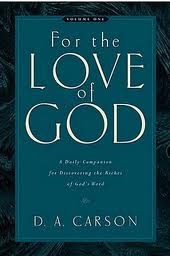
Love of GodEnter D.A. Carson
This last year my wife and I went through the first volume of D.A. Carson’s For the Love of God daily devotional based on the Murray M’Cheyne reading program and it’s been great. Robert Murray M’Cheyne designed a daily reading program that, at about 4 chapters a day, gets you through the New Testament and Psalms twice and the Old Testament once in the course of a year. So, for instance, January 1 begins with Genesis 1, Matthew 1, Ezra 1, Acts 1. It goes on from there. Originally the first two columns were labeled “family” intended to be read with the whole family, and the second two columns were “private” for personal devotion. It’s not necessarily the lightest program, but the arrangement is much better than most of the chronological reading programs or even some of the mixed year-long Bible programs.

With Carson’s devotional, you get a about a page of highly-readable biblical, theological, and pastoral commentary on one of the chapters by a top-notch theologian and scholar. Really, I compare the notes you get in this little devotional to the top-level commentaries sometimes and it’s amazing how he is quickly and, in an understandable fashion, making available the best scholarship and then moving to apply it to your daily life. I can’t begin to tell you how much I have enjoyed and personally benefited from both the daily Bible reading and Carson’s commentary. The arrangement of the chapters is helpful because it keeps you going through whole books of the Bible as they were intended to be read, instead of the “open and point” method that lands you reading a random chapter in Zechariah, leading you to think the prophet was on acid. Also, usually at least 2 of the chapters are in non-boring books, so you never have to truck through Leviticus all by itself.

No Sweat
Many of you might be intimidated at the thought of 4 chapters a day. Realize that’s only about 20 minutes total which can be broken up throughout the day if you have to. Still, that’s about 2% of the time you probably spend on facebook in a given day, so you have more time than you think. Also, you may choose to simply go through one book of the daily readings and whatever chapter Carson happens to be commenting on that day. Know that you might might miss a day. Or a week. Or a month. That’s fine, but just get back to it when you remember. When I asked my wife if we wanted to do volume 2 this year she said yes, because even though she didn’t get to it every day, she still had read more of her Bible this year than in any year prior. Sounds good to me.

Finally, if you’re worrying about dropping that 10 bucks on something you haven’t cruised through, or period, then you should know that D.A. Carson’s blog over at the Gospel Coalition is actually just his daily devotion. This last year they’ve been posting through volume 2, so next year will be volume 1 again. So, you can go check it out, or just use the blog as your daily devotional. You can even do it on your computer at work (on your break or lunch, of course).

The point of all of this is, for the love of God, read your Bible this year. It’s worth it and it just became a whole lot easier.

Soli Deo Gloria

The Jesus Who Quotes Himself

Jesus SpeakingBack in the day, liberal theologians liked to say Jesus never claimed any particularly extraordinary authority for himself; not to be the Messiah, the Son of God, or any of it, and that all of the church’s later teaching on it was an unjustified addition and corruption of Jesus’ originally pure, moral message about God’s Fatherhood, and the universal brotherhood of man. Usually this claim was advanced in order to forward a less doctrinally-“rigid” Christianity, more in keeping with the modern spirit, picturing Jesus as a teacher of universal moral truths and general wisdom suited to their post-Victorian sensibilities.

Actually, this kind of move still gets made today only we don’t use the “sexist” and gendered language of the “Fatherhood of God”, or the “brotherhood of man.” Typically we replace that with some talk about justice, equality, the end of oppression and such things. Don’t get me wrong, justice and ending oppression are good, biblical things. Still, it’s not uncommon to hear sentiments like, “If only we could forget all this business about Christ being ‘Lord’, or those abstruse Trinitarian controversies, or his atoning death with all of the silly theological disputes that go along with it, we could get down to the real business Jesus was about–you know, all that stuff in the Sermon on the Mount. The Sermon on the Mount! That’s the real Jesus. That’s the Jesus we should be listening to, considering, and putting what he preaches into practice. The Sermon on the Mount is where you find what Jesus was really all about–not all of this silly dogma about him that mainstream Christianity has gotten hi-jacked with.”

MachenBasically, if we could get Jesus’ ethics, his moral teachings, without all the doctrine, then we’d be good.  When J. Gresham Machen encountered this line of thinking back in his own day he pointed out the flaw, at least from the New Testament standpoint, with it:

Even those parts of the Gospels which have been regarded as most purely ethical are found to be based altogether upon Jesus’ lofty claims….But even in the Sermon on the Mount there is far more than some men suppose. Men say that it contains no theology) in reality it contains theology of the most stupendous kind. In particular, it contains the loftiest possible presentation of Jesus’ own Person. That presentation appears in the strange note of authority which pervades the whole discourse; it appears in the recurrent words, “But I say unto you.” Jesus plainly puts His own words on an equality with what He certainly regarded as the divine words of Scripture; He claimed the right to legislate for the Kingdom of God. Let it not be objected that this note of authority involves merely a prophetic consciousness in  Jesus, a mere right to speak in God’s name as God’s Spirit might lead. For what prophet ever spoke in this way? The prophets said, “Thus saith the Lord,” but Jesus said, “I say.” We have no mere prophet here, no mere humble exponent of the will of God; but a stupendous Person speaking in a manner which for any other person would be abominable and absurd. –Christianity and Liberalism, pg. 31-32

In essence he said, “Fine, let’s look at the Sermon on the Mount. Let’s see what kind of Jesus we find there: the Jesus who quotes himself.” What’s significant about that? Well, I mean, even in our modern context if you find a guy walking around quoting himself, you know he’s got a high opinion of himself. In the Bible this was a slightly bigger deal. See, a prophet of God would say, “Thus says the Lord”, but Jesus goes ahead and basically says, “Here’s what I say”–essentially elevating his word alongside the word of Lord. Actually, Machen goes on to point out that Jesus explicitly does that:

The same thing appears in the passage Matt. vii. 21-23: “Not everyone who says to me Lord, Lord, shall enter into the Kingdom of Heaven, but he who does the will of my Father who is in heaven. Many shall say to me in that day: Lord, Lord, have we not prophesied in thy name, and in thy name cast out demons, and in thy name done many mighty works? And then I shall confess to them, ‘I never knew you; depart from me, ye that work lawlessness.”’ This passage is in some respects a favorite with modern liberal teachers; for it is interpreted − falsely, it is true, yet plausibly − as meaning that all that a man needs to attain standing with God is an approximately right performance of his duties to his fellow-men, and not any assent to a creed or even any direct relation to Jesus. But have those who quote the passage triumphantly in this way ever stopped to reflect upon the other side of the picture − upon the stupendous fact that in this same passage the eternal destinies of men are made dependent upon the word of Jesus?

Jesus here represents Himself as seated on the judgment-seat of all the earth, separating whom He will forever from the bliss that is involved in being present with Him. Could anything be further removed than such a Jesus from the humble teacher of righteousness appealed to by modern liberalism? Clearly it is impossible to escape from theology, even in the chosen precincts of the Sermon on the Mount. A stupendous theology, with Jesus’ own Person at the center of it, is the presupposition of the whole teaching. -ibid., pg 32

Basically, if you want the Jesus of the Sermon on the Mount, you can’t get away from that Jesus of “doctrine”. Inevitably Jesus himself points you to the Jesus of the creeds–the Messiah, dead, buried, risen, ascended, the ruling and reigning Lord, equal with the Father, and coming to judge the quick and the dead. There is no ethical Jesus without the doctrinal Jesus; eventually you have to deal with the Jesus who quotes himself.

Soli Deo Gloria

On the Difference Between “Literal” and “Idiot-Literal” Interpretation

literalI’ve already written once before on the issue of a ‘literal’ hermeneutic. I want to take time once again to clarify, from another angle, that there is a difference between a ‘literal’ hermeneutic (method of interpretation) and what I’m calling an ‘idiot-literal’ hermeneutic.

Classic Literal
A classic “literal” hermeneutic was the favored interpretive method of the Magisterial Reformers such as Calvin and Luther, which, at its better moments, has been followed by their Protestant heirs. It also might be called the “historical-grammatical” method because, in a nutshell, its aim is to first understand what the author’s intended use of a given word, sentence, paragraph was in accordance with the historical, cultural, and literary context and usual grammatical rules. As Kevin Vanhoozer has said, “the literal sense is the literary sense.” Interpreting a text ‘literally’ in this sense did not mean ignoring figures of speech, metaphors, analogy, or running roughshod over genres, context, or linguistic anomalies. Essentially, if the biblical author is trying to write history, you read the text like history; if poetry, like poetry; if a letter, then as a letter.

The Magisterial Reformers were, for the most part, humanist scholars trained in rhetoric and an appreciation for literary art, so they championed this sort of exegesis as a corrective against the spiritualizing, or rather allegorizing, interpretive methods favored by some in the Middle Ages, and passed down from some of the Fathers such as Origen and Augustine that could, and I say this with great respect for those classic interpreters, could go off the rails a bit as they found all sorts of hidden, “spiritual” meanings in rather straightforward texts. While the Reformers didn’t rule out certain typological interpretations–for instance it’s fine, and even necessary, to see a figure of Christ when discussing OT sacrifices or King David–they worried that some of the allegorizing that went on led to the Scriptures becoming a “wax nose” of sorts, that could be shaped and reshaped at will. Any typological interpretation must come after and be in line with the original story, or law that was set forth according to its intended purpose. (From what I understand, Thomas Aquinas was actually a champion of rooting the “spiritual” sense in the literal sense as well.) Now, admittedly they weren’t perfect at this themselves, but by and large this was a good move for biblical studies and theology in general.

My point here is to clarify that a “literal” interpretation in the classic sense is not what might be called a “literalistic”, or illiterate approach to the text, but rather it is one concerned with discovering the author’s intended meaning in accordance with sound rules of literary interpretation. Which brings me to our next category: the idiot-literal hermeneutic.

Idiot-Literal
An idiot-literal hermeneutic is the interpretive method that is favored mostly by liberalizing critics for straw-manning conservative  opponents. It consists of finding the most obtuse, ham-handed, or silly interpretation of any given biblical text that fails to recognize a textual or literary clue that we’re dealing with figurative language and holding it up as the necessary reading for anybody holding a “literal” hermeneutic. Often-times it’s linked in these presentations to the doctrine of “inerrancy” (which, for some reason, is usually also caricatured, confused, and conflated with a straight dictation theory of inspiration).

Now, I’m not denying that often-times you can find conservative/fundamentalist interpreters whose readings border on self-caricature. In fact, along with Beale, I do think the time might come when we need to start using the phrase “literate” hermeneutic, or something of that sort in order to distinguish things. Still, I do think it’s important to clarify that just because someone self-identifies as adhering to a “literal” hermeneutic, or because the Reformers held to one, it does not mean they must adopt whatever silliness is imputed to them by their critics on pain of inconsistency.

Conclusions
This was necessarily rough and probably simplistic, but hopefully it sufficed to make my point–a literal reading of the text is not the same as an idiot-literal reading of the text. You haven’t refuted conservative hermeneutical approaches by simply picking the dumbest reading possible and saying, “Here, this is what you have to believe, right?” Also, if you pride yourself on your conservative view of scripture and hermeneutical approach, please don’t play into the caricature–do your homework.

Soli Deo Gloria

PS. For those looking to learn how to read their Bibles better:

1.  How To Read Your Bible For All It’s Worth by Gordon Fee and Douglas Stuart is an excellent place to start.
2.  Introduction to Biblical Interpretation by William W. Klein, Craig Blomberg, and Robbert I. Hubbard Jr. is also excellent, although a bit more advanced.

Are You a Dualist? Is that Bad? Just ask N.T. Wright

I was a sophomore in college when I found out that there was more than one kind of dualism. I was sitting in my class on St. Augustine (it was my medieval philosophy class) when a fellow classmate brought up the issue of dualism and how interesting it was given that nobody believed it. I piped up and said, “Oh, yeah, I’m a dualist.”

Looking at me with surprise, “Oh really? I’ve never met one. That’s odd.”

I didn’t think it odd at all: “Well, I am a Christian so it’s not that weird.”

“Really? I thought the two were kinda not compatible.”

At this point I was truly confused. Turns out we both were.  See, I had been talking about mind-body dualism and he was referring to theological dualism a la Zoroastrianism where you have a good god and a bad god facing off. At that point I started to realize that the subject of dualism was far more complicated than I thought. In fact, I didn’t realize how complicated it was until I read N.T. Wright’s The New Testament and the People of God (NTPG)In that work he lists 9-10 different kinds of dualism that you could speak of when discussing the views of 1st Century Pagans and Jews.

I was reminded of this little discussion when reading this article by Wright on anthropology, or the theology of humanity, in the Apostle Paul’s thought. In it, he offers this helpful summary of his own discussion in NTPG.

So let’s run through these types of dualism or duality, beginning with four types that would be comfortably at home within ancient Jewish thought:

  1. a heavenly duality: not only God exists, but also angels and perhaps other heavenly beings;
  2. a theological or cosmological duality between God and the world, the creator and the creature;
  3. a moral duality between good and evil;
  4. an eschatological duality between the present age and the age to come.

All of these dualities a first-century Jew would take for granted. But none of them constitutes a dualism in any of the following three senses:

  1. a theological or moral dualism in which a good god or gods are ranged, equal and opposite, against a bad god or gods;
  2. a cosmological dualism, a la Plato, in which the world of space, time and matter is radically inferior to the noumenal world; this would include, perhaps, dualisms of form and matter, essence and appearance, spiritual and material, and (in a Platonic sense) heavenly/earthly (something like this would be characteristic of Philo);
  3. an anthropological dualism which postulates a radical twofoldness of soul and body or spirit and body (this, too, would be familiar in Philo).

Then there are three more which might be possible within ancient Judaism:

  1. epistemological duality as between reason and revelation – though this may be problematic, since it’s really the epistemological face of the cosmological dualism which I suggest ancient Jews would mostly reject;
  2. sectarian duality in which the sons of light are ranged against the sons of darkness, as in Qumran;
  3. psychological duality in which the good inclination and the evil inclination seem to be locked in perpetual struggle, as in Rabbinic thought.

It’s important to know about these different sorts dualisms in order to keep a clear theological head on your shoulders wading into these discussions–which I know you do everyday. But seriously, for Christians wanting to understand reality out of a properly Christian worldview, or theological framework, we have to keep in mind what Wright underlines here:

The radical rejection by most ancient Jews, in particular, of what we find in Plato and in much oriental religion, and the radical embrace of space, time and matter as the good gifts of a good creator God, the place where this God is known and the means by which he is to be worshipped – all this remains foundational, and is firmly restated and underlined in the New Testament. Creational, providential and covenantal monotheism simply leave no room for those four dualisms in the middle. In particular, I argued that such dualisms tend to ontologize evil itself, whereas in first-century Judaism evil is not an essential part of the creation, but is the result of a radical distortion within a basically good created order.

While we might not all agree with his judgments on Plato’s dualisms or body and soul, it’s important to keep distinct the things that ought to be distinct (God/creation, good/evil, present age/age to come, etc.) while avoiding tearing apart those things that should be kept together. That basic creational framework of a good God who creates a good world that gets distorted by sin is the backdrop of God’s redemption of all things in Christ. This is what the ancient gnostics missed when they created a Jesus who was simply a redeemer who saved people’s souls from their bodies–in which case, who cares what you do with your body? This is what is absent in pantheistic theologies that drag God into the world, who end up giving us a “compassionate” God that, in the end, is just as trapped in the world’s agony as we are, instead of being the distinct, but sovereign redeemer who can fix it. This is what modern Evangelicals sometimes miss with their tendency for evacuating from the world, despising creation, and simply waiting for Jesus to come back and rapture them out of their nicely air-conditioned churches they hide in most of the week.

God freely created the world distinct from himself, he loves it–he’s going to save it. He wants his people out in the world, in it, but not of it, proclaiming that good news, and working for it out in the world.

The bottom-line is: if you don’t keep your dualisms straight, you might lose the Gospel.

Soli Deo Gloria

4 Sources of Wisdom (Or, How to Stop Being a Moron)

Proverbs was one of my favorite books in the OT as a teenager because it was just straight advice. Advice is a good thing when you’re a moron high schooler. I mean, I didn’t understand half of it, but the verses were short and it felt easier to read. When I hit college and went through my bitter realist phase (which I may or may not still be in) Ecclesiastes and Job jumped up the list. The reality that life doesn’t work out cleanly, that bitterness has corrupted our work and our play “under the sun”, and that our only hope is in Christ really resonated. It still does.

Still, now that I’ve got my own ministry working with college kids I find myself returning to the Proverbs. One of the things I’ve realized about my job is that I’m not just here to preach the Gospel. I mean, that’s my main job, but part of loving and discipling college students is teaching them some of basics of being an adult. Apparently, I’m supposed to teach them wisdom–the practical knowledge of living in God’s world. Go figure.

Since I’m still somewhat of a youngster myself, the Proverbs have been a blessing to me. In many ways it’s a biblical short-cut on the road to not being a moron.

As I started doing some more in-depth study, I picked up Tremper Longman III’s commentary on Proverbs in the Baker Commentary on the Old Testament Wisdom and Psalms series. (Book nerd note: it’s excellent, readable, preachable, and scholarly.) In it, he notes that not only do the proverbs teach us specific bits of wisdom and practical advice like, “A soft answer turns away wrath, but a harsh word stirs up anger” (Prov 15:1), a key tidbit to remember in the blogging world, but also teaches the way to gain wisdom.

Longman specifically notes four sources of wisdom in Proverbs–where morons ought to look to become wise:

1. Observation and Experience. This should be obvious, but wise people are those who pay attention to life and reflect on the meaning of their experiences. In 6:6-11, the teacher tells the student to go look at the ant, observe his ways, and learn diligence. Wise people stop and think about which of their behaviors work and which don’t. They consider the actions of others, the way the world, history and draw lessons from it. This is why typically older people have more wisdom. Longman points out that in the Proverbs it is always the father or the mother instructing the son and never the other way around. (pg. 75) This not a universal truth–I’ve met some old fools–but it is a general one, that you will grow wiser as you grow older because you’ve experienced more. So, if you’re young and wanting to gain wisdom, listen to older people who’ve gone before and learn from their experiences. It’s the first step to not being a moron.

2. Instruction Based on Tradition. This last point is the essence of the next source of wisdom: tradition. In this passage, a father tells his son to cling to the instruction that was taught to him by his father, which apparently has served him well in his own life:

Hear, O sons, a father’s instruction,
and be attentive, that you may gain insight,
for I give you good precepts;
do not forsake my teaching.
When I was a son with my father,
tender, the only one in the sight of my mother,
he taught me and said to me,
“Let your heart hold fast my words;
keep my commandments, and live.
Get wisdom; get insight;
do not forget, and do not turn away from the words of my mouth.”
(4:1-5)

See, tradition is not just dead, trite ritualism. Over the years accumulated observations about successful and failed strategies for living, truths of human nature, and relationships end up becoming “tradition” that we can learn from. To some degree we know this instinctively. When we want to learn a new skill or a trade, we apprentice ourselves to someone who knows it–an expert that’s been doing it long enough to know the ins and outs of the business. Living well is also a skill, a practice that people have been working at for a long time, and the wise take advantage of the wisdom of their elders. That’s another great way to not be a moron.

3. Learning from Mistakes. Connected to the last two is the idea of learning from one’s mistakes. A great amount learning from experience and heeding the wisdom of the tradition has to do with finding out what doesn’t work. The sages know that you’re gonna screw things up as you go. That’s why two common words you’ll find in the Proverbs are “discipline” and “correction.”

“Those who love discipline love knowledge; and those who hate correction are dullards.” (12:1)

“Those who guard discipline are on the way to life, and those who abandon correction wander aimlessly.” (10:17)

The idea is that the wise are those who receive correction, learn from their mistakes, and do not reject the counsel of those who are trying to return them to the way from which they’ve strayed. This is why pride is so foolish; the proud never learn from their mistakes that eventually lead to their destruction. (Prov. 16:18) On the contrary, the wise humble themselves to the point of loving correction because it leads to wisdom. (Prov. 9:8) The bottom line is that a significant part of learning from experience and from tradition is figuring out what didn’t work and avoiding it. Only morons don’t learn from their mistakes.

4. Revelation. Longman notes that while these three sources–experience, tradition, mistakes–are key for gaining wisdom, nothing is more foundational than revelation, for “at the heart of wisdom is God himself.” (pg. 78) This is clear from the very beginning:

“The fear of Yahweh is the beginning of knowledge, but fools despise wisdom and discipline.” (1:7)

How can you know how to live properly in the world, if you don’t know the character of the one who made it? Indeed, it’s not simply that God is an important feature of reality that one must account for in order to be wise. The Lord is the source of wisdom:

For the LORD gives wisdom;
from his mouth come knowledge and understanding;
he stores up sound wisdom for the upright;
he is a shield to those who walk in integrity,
guarding the paths of justice
and watching over the way of his saints.
(2:6-8)

Ultimately God is the one who teaches you through experience, tradition, and correction. Whatever you learn, you learn because of him. This is why, according to Proverbs, the way to gain wisdom, and yes, stop being a moron, is to humble yourself before the creator of the universe and ask him for it.

Wisdom in Christ

Finally, for the Christian the ultimate source of wisdom is Christ himself “in whom are hidden all the treasures of wisdom and knowledge.” (Col. 2:2-3) If we want to see the fullness of human life, to know what a truly wise life, a life lived in sync with the rhythm with which God created all things, then we must look to Christ. He is not simply wise, but wisdom from God himself, incarnate for us. (1 Cor. 1:30) Jesus is God’s gracious wisdom come to us–to help us stop being morons.

Soli Deo Gloria

G.K. Beale on the Presence of a Covenant in Gen. 1-3

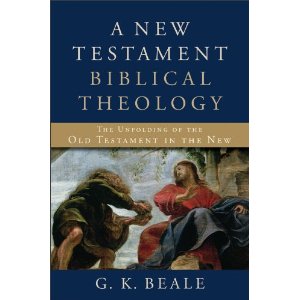
Alright, I finally cracked open G.K. Beale’s 962 page beast, A New Testament Biblical Theology: The Unfolding of the Old Testament in the New.  It’s been staring at me, tempting me with it’s theological awesomeness, so I finally gave in. At about 60 pages in I can safely say this is going to be a watershed work in New Testament studies. Describing the project in a short blog-post while doing it any sort of justice is next to impossible, especially when you consider the fact that Beale’s own description takes him about 25 pages. Still, the title alone points us to fact that one of the main thrusts of Beale’s work is to show how the New Testament can only be understood as the unfolding of the grand story-line of the Old Testament.

In order to do so, he opens with a summary and theological analysis of that story-line, beginning with a focus on the first 3 chapters of Genesis. He pays special attention to Adam, the concept of the Image of God,  and the eschatological thrust of the creational command to “conquer and subdue” the earth and “be fruitful and multiply” (Gen. 1:28), themes of crucial importance for understanding the rest of the tension and story-line of the OT.

It’s at this point that I ran across a very helpful passage discussing the presence of a “covenant” in Gen 1-3. After some careful examination of the texts Beale notes that there are a number of considerations that point us to the idea that it is possible, indeed necessary, to speak of a “covenant” relationship between God and Adam in the Garden, despite the objection that the word “covenant” is not used in the passage. The passage is worth quoting at length here:

In light of these observations, we can speak of the prefall conditions as a “beginning first creation” and the yet-to-come escalated creation conditions to be a consummate “eschatologically” enhanced stage of final blessedness. The period leading up to the reception of these escalated conditions is the time when it would be decided whether Adam would obey or disobey. These escalated conditions indicate that Adam was in a covenant relationship with God. Although the word “covenant” is not used to describe the relationship between God and Adam, the concept of covenant is there. God chooses to initiate a relationship with Adam by imposing an obligation on him (Gen. 2:16-17). This obligation was part of the larger task with which Adam had been commissioned in Gen 1.:28: to “rule” and “subdue” creation and in the process to “be fruitful and multiply and fill the earth.” Adam’s “ruling and subduing” commission included guarding the garden from any threat to its peaceful maintenance. In light of Gen. 2:16-17 and 3:22, Adam would receive irreversible blessings of eternal life on the condition of perfect faith and obedience, and he would receive the decisive curse of death if he was unfaithful and disobedient. Thus, the discernment of irreversible escalated creation conditions discussed above is the best argument for such a covenant notion.

Consequently, the argument that the word “covenant” is not used in Gen. 2-3 does not provide proof that there is not covenant relationship, just as Adam and Eve’s marriage relationship is not termed a “covenant” in Gen. 2:21-24 but expresses covenantal concepts and, in fact, is identified as a covenant elsewhere. Likewise, it is profitable that God’s covenant with Adam is referred to as a covenant elsewhere in the OT. The essential elements of a covenant are found in the Gen. 1-3 narrative: (1) two parties are named; (2) a condition of obedience is set forth; (3) a curse for transgression is threatened; (4) a clear implication of a blessing is promised for obedience. It could be objected that there is no reference to either party reaching a clear agreement or, especially, to Adam accepting the terms set forth in this so-called covenant. However, neither is this the case with Noah and Abraham, with whom God made explicit covenants. –A New Testament Biblical Theology: The Unfolding of the Old Testament in the New, pp 442-43

Again, these conclusions come after a solid examination of the texts (pp. 30-41), and is followed by reinforcing argumentation (pp. 43-46). Still, I found this passage to be helpful in showing that to speak of God’s creational covenant with Adam, or a “covenant of works”, is not an obvious imposition of foreign concepts onto the text in order to fit it into a theological grid, as is so often charged.  Rather, something like this is positively required by a close, narratively-oriented reading of the text.

As I continue to dive into this ambitious, and already thoroughly rewarding work, I’m sure more excerpts and summaries will follow this.

Soli Deo Gloria