Moses = Mini-Israel = Jesus (Or, Theological Inception)

inceptionOne principle of Christian theological interpretation of Scripture is the practice of identifying typology. To over-simplify it, in the flow of redemptive-history, the sovereign God who ordains all things, prefigures the salvation to be accomplished through Jesus Christ by way of types (events, persons, symbols) to which Jesus Christ’s person and works are the anti-type.

For instance, Adam points to Jesus as Second Adam through whom God is creating a new humanity (Romans 5; 1 Corinthians 15). Abraham’s willingness to sacrifice his only son Isaac points to the true Sacrifice of God’s only Son (John 3:16). The Tabernacle and Temple where God dwells with Israel points to the ultimate Tabernacling of God with humanity in Jesus Christ (John 1:14). Once you start to think in these terms, it’s almost impossible not to see Christ on every page of the Scriptures.

A particularly important type of Christ in the OT is Israel’s greatest prophet and deliver–Moses. In various ways, the NT reveals Jesus as the New Moses. Like Moses, Jesus escapes the death at the hands of a murdering king as an infant (Matt 2:13-18); he goes up on a Mount to give a new Law (Matt 5-7), which fulfills the old Law; he also institutes a new covenant that supersedes the old one (Lk 22); he rescues his people in a New Exodus of the Egypt of sin, death, and oppression into the Promised Land of salvation (Col 1:13-14). The list could easily be expanded.

While I’d known about these typological parallels between Moses and Jesus, I was nonetheless struck by this passage drawing out the way that Moses functions as a type and representative of Israel as well:

Moses, who narrowly escapes disaster by being placed in an ark in the River Nile (Exod. 2:1-10)…Moses’ salvation echoes backwards and forwards in the text; backwards to the salvation of humanity from the judgment of the flood by Noah (Gen. 6-8), and forwards to the Israelites’ future escape from the waters of the Reed Sea (Exod 14). Significantly…the figure of Moses, this child born as a type of saviour figure, not only saves Israel but also embodies Israel at times. His rescue from the water prefigures the nation’s salvation from the water; his escape after the death of an Egptian (Exod. 2:11-15) is a prelude to the Israelites flight after the death of many Egyptians (Exod. 12:29-39); his experience of being in the desert for forty years (Exod. 2:21-25) foreshadows the same for Israel (Num, 14:33); his divine encounters before the burning bush (Exod. 3) anticipates Israel before the fire of Sinai (Exod. 19-24).

Stephen G. Dempster, Dominion and Dynasty: A Theology of the Hebrew Bible, pg. 94

Moses is not only a type of Christ, but a type for Israel. Israel, God’s firstborn son (Exod. 4:22) is another type of Christ, who also wanders in the desert for 40 days and is tested (Matthew 4), so on and so forth. Moses is also Israel’s embodiment at times, which is a type for Christ’s representative embodiment of his newly re-formed Israel. We could chase the connections for pages, but what I’m saying is that this is like a theological version of Inception: we have found a type within a type within a type.

The intricacy, beauty, and inter-canonical-coherence of the biblical history of redemption should lead us to awe and worship. While human authors create inter-textual resonances, the sovereign Lord of time creates inter-historical ones.

Soli Deo Gloria

In Christ It’s All There

puzzle pieceAll of us come to God at one point or another for some sort of help; we have a need, problem, guilt, angst, or longing we think he might be able to deal with. Some of us find it and some don’t. The difference between the Christian and the seeker who eventually walks away is whether we come to see, as Calvin put it, that there is no benefit from God that isn’t attached to Christ, “as if he alone did not contain all things in himself.”

In order to show the futility of such thinking Calvin’s comments expansively on 1 Corinthians 1:30 (“And because of him you are in Christ Jesus, who became to us wisdom from God,righteousness and sanctification and redemption”) and demonstrates that the sum of our salvation–our righteousness, wisdom, holiness, and redemption–are only had in Christ. Christ does not simply give these differing elements to us as separate gifts, but rather, he gives us himself, he unites us to his glorious person and in him we have and become all of these things. They are not infused from without or accounted to us in an external, extrinsic fashion, but are made ours because we have been knit by the Spirit through faith into Christ’s living body:

  1. First, he is made unto us wisdom, by which he means, that we obtain in him an absolute perfection of wisdom, inasmuch as the Father has fully revealed himself to us in him, that we may not desire to know any thing besides him. There is a similar passage in Colossians 2:3: “In whom are hid all the treasures of wisdom and knowledge.” Of this we shall have occasion to speak afterwards when we come to the next chapter.
  2. Secondly, made unto us righteousness, by which he means that we are on his account acceptable to God, inasmuch as he expiated our sins by his death, and his obedience is imputed to us for righteousness. For as the righteousness of faith consists in remission of sins and a gracious acceptance, we obtain both through Christ.
  3. Thirdly, he calls him our sanctification, by which he means, that we who are otherwise unholy by nature, are by his Spirit renewed unto holiness, that we may serve God. From this, also, we infer, that we cannot be justified freely through faith alone without at the same time living holily. For these fruits of grace are connected together, as it were, by an indissoluble tie, so that he who attempts to sever them does in a manner tear Christ in pieces. Let therefore the man who seeks to be justified through Christ, by God’s unmerited goodness, consider that this cannot be attained without his taking him at the same time for , or, in other words, being renewed to innocence and purity of life. Those, however, that slander us, as if by preaching a free justification through faith we called men off from good works, are amply refuted from this passage, which intimates that faith apprehends in Christ regeneration equally with forgiveness of sins...
  4. Fourthly, he teaches us that he is given to us for redemption, by which he means, that through his goodness we are delivered at once from all bondage to sin, and from all the misery that flows from it. Thus redemption is the first gift of Christ that is begun in us, and the last that is completed. For the commencement of salvation consists in our being drawn out of the labyrinth of sin and death; yet in the meantime, until the final day of the resurrection, we groan redemption, (as we read in Romans 8:23.) If it is asked in what way Christ is given to us for redemption, I answer — “Because he made himself a ransom.”

Commentary on 1 Corinthians 1:30

Calvin concludes that in the end, “we must seek in Christ not the half, or merely a part, but the entire completion. For Paul does not say that he has been given to us by way of filling up, or eking out righteousness, holiness, wisdom, and redemption, but assigns to him exclusively the entire accomplishment of the whole.” This is why we place our faith in Christ alone. God can deal with our issues, but he does it through Christ. The Christian is the one who looks to Christ and finally confesses with Peter, “Lord, to whom shall we go?” (John 6:68)

In Christ it’s all there.

Soli Deo Gloria

God is Creatively Creative

creationMost believers in God, if they’ve given our world more than a cursory glance, must come to the conclusion that we serve a creative God. The Maker of heaven and earth filled it with everything from aphids to the Aurora Borealis. Canvas after canvas is filled with the glory of our God’s infinitely fecund imagination. What we don’t often give thought to is the creative way in which God is creative. Let me rephrase that: God is not simply creative as to his works, but also in the way that he works.

Robert Letham notes at least three ways that God works to shape the our world in the creation account in Genesis 1:

In particular, he forms the earth in a threefold manner. First, he issues direct fiats. He says, “Let there be light,” and there is light (v.3). So, too, he brings into being with seemingly effortless command the expanse (v. 6), the dry ground (v. 9), the stars (vv. 14-15), the birds and the fish (vv. 20-21). Each time it is enough for God to speak, and his edict is fulfilled.

Second, he works. He separates the light from the darkness (v. 4), he makes the expanse and separates the waters (v. 7), he makes the two great lights, the sun and the moon (v.16), and sets them in the expanse to give light on the earth (v. 17), he creates the great creatures of the seas and various kinds of birds (v. 21), he makes the beasts of the earth and the reptiles (v. 25), and finally he creates man–male and female–in his own image (v. 26-27) The thought is of focused, purposive action by God, of divine labor accomplishing his ends.

But there is also a third way of formation, in which God uses the activity of the creatures themselves. God commands the earth to produce vegetation, plants, and trees (vv. 11-12). He commands the lights to govern the day and the night (vv. 14-16). Here the creatures follow God’s instructions and contribute to the eventual outcome.

–Robert Letham, Union with Christ: In Scripture, History, and Theology, pp. 10-11

God might be described as a king, a craftsman, and a delegator in his threefold creation. He issues decrees that are immediately fulfilled, gets his hands dirty by getting the job done himself, and giving creation itself tasks to accomplish. There are a number of observations that can be made on this basis, but I’ll limit myself to three.

For one, it begins to set the stage for understanding God in a more fully-personal fashion. We see the Father acting by what Ireneaus called his two hands, the Word and the Spirit, to bring about a varied-but-united order. “This God loves order and variety together” (pg. 11), because he himself is the Triune one who is One and yet Three.

We also see in this threefold activity an incipient theology of multiple-levels of causality. Sometimes God’s action is a direct, creative word which needs to mediation. Sometimes, God acts through creaturely means in ways that can be properly ascribed both to God as primary cause, and creature as a secondary, but no less real, cause. It gives God no glory to ascribe to him strict mono-causality in an effort to secure his sovereignty. (Which good Reformed theologians shouldn’t do.)

Finally, something of the nature of redemption is prefigured here. First, God speaks by fiat a declarative word in justification that brings to life those who were dead. God also separates out a people, making them holy by his Word and Spirit. Finally, he uses creaturely means such as the preaching of the Word, water, bread, and wine to save and recreate his people. 

Our Triune God is not only creative, he is creatively creative.

Soli Deo Gloria

Salvation in Living Color

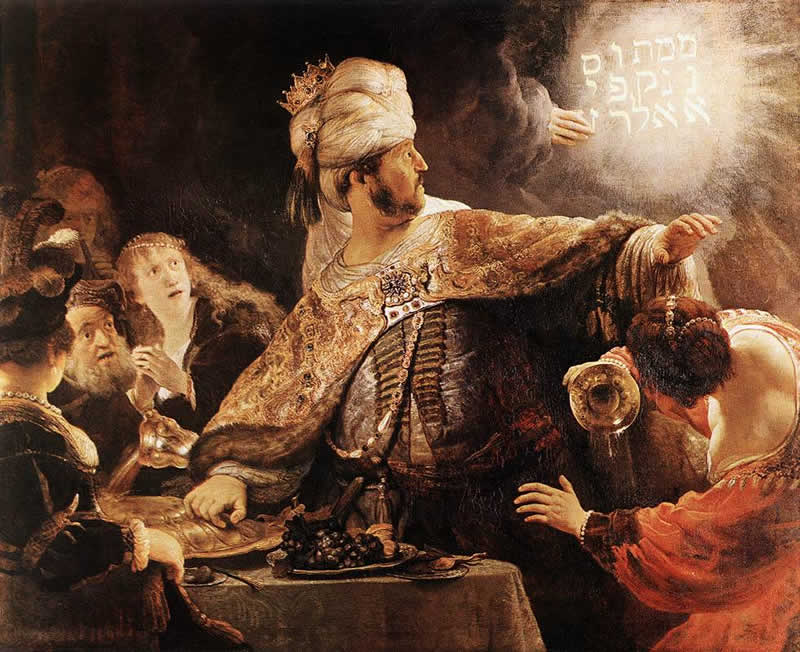
Rembrandt sketchHebrews 10:1 says that “the law has but a shadow of the good things to come instead of the true form of these realities, it can never, by the same sacrifices that are continually offered every year, make perfect those who draw near.”

Commenting on this truth, Calvin expands on the relation between Law and Gospel given in this verse:

He has borrowed this similitude from the pictorial art; for a shadow here is in a sense different from what it has in Colossians 2:17; where he calls the ancient rites or ceremonies shadows, because they did not possess the real substance of what they represented. But he now says that they were like rude lineaments, which shadow forth the perfect picture; for painters, before they introduce the living colors by the pencil, are wont to mark out the outlines of what they intend to represent. This indistinct representation is called by the Greeks σκιαγραφία, which you might call in Latin, “umbratilem“, shadowy. The Greeks had also the εἰκὼν, the full likeness. Hence also “eiconia” are called images (imagines) in Latin, which represent to the life the form of men or of animals or of places.

The difference then which the Apostle makes between the Law and the Gospel is this, — that under the Law was shadowed forth only in rude and imperfect lines what is under the Gospel set forth in living colors and graphically distinct. He thus confirms again what he had previously said, that the Law was not useless, nor its ceremonies unprofitable. For though there was not in them the image of heavenly things, finished, as they say, by the last touch of the artist; yet the representation, such as it was, was of no small benefit to the fathers; but still our condition is much more favorable. We must however observe, that the things which were shown to them at a distance are the same with those which are now set before our eyes. Hence to both the same Christ is exhibited, the same righteousness, sanctification, and salvation; and the difference only is in the manner of painting or setting them forth.

 –Commentary on Hebrews 10:1

rembrandt-paintingMy wife and I went to the Getty Museum a couple of years ago to see the Rembrandt exhibit. There was a room full of his marvelous sketches, each one distinct and the result of crushing brilliance. I could have studied them for hours to great profit. And yet, when we stepped into the room with his finished products, the difference was unmistakable. Where before was the outline, here was the fullness, the brilliance, the subtle extravagance of his handiwork. Both unmistakably came from the same hand, while the one clearly outshone the other.

Calvin tells us here that in the same way, the Law is good and true, pointing forward to Christ. But the Gospel sets out a salvation in “living colors” that is “graphically distinct”, where there were only “lineaments” before. As different and superior as the sketch is to the finished product, so Christ’s work is from the sacrifices that prefigured it. In fact, I would argue that that even that picture falls short of what Hebrews or Calvin are teaching us here. Instead, as far as the sketch is from the living model, so the shadow of heavenly realities found in the Law, while faithful, inevitably falls short of the beauty of our living, breathing salvation in Jesus Christ.

Soli Deo Gloria

5 Theses On Christ’s Priestly Ministry

christ as priestFor every high priest chosen from among men is appointed to act on behalf of men in relation to God, to offer gifts and sacrifices for sins. He can deal gently with the ignorant and wayward, since he himself is beset with weakness.  Because of this he is obligated to offer sacrifice for his own sins just as he does for those of the people.  And no one takes this honor for himself, but only when called by God, just as Aaron was. (Hebrews 5:1-4)


Reading through Hebrews this morning I was struck by this passage addressing the work of Christ, our great High priest whose ministry supersedes and fulfills that of the OT Levitical priests. In order to do so he outlines various functions of the OT priests in order to compare and contrast the two. I consulted Calvin, as I’ve been wont to do of late, to see what light he could shed on the matter.

Careful reader that he is, Calvin notes at least 5 truths about priests to be noted in the passage:

  1. He first says that the priests were taken from among men; 
  2. secondly, that they did not act a private part but for the whole people;
  3. thirdly, that they were not to come empty to appease God, but furnished with sacrifices;
  4. fourthly, that they were not to be exempt from human infirmities, that they might more readily succor the distressed;
  5. and lastly, that they were not presumptuously to rush into this office, and that then only was the honor legitimate when they were chosen and approved by God.

–John Calvin, Commentary on Hebrews 5:1-4

Building on these observations, he goes on to point out 5 truths this passage teaches us about Christ’s priestly ministry on our behalf:

  1. Christ is a True Man“Taken from among men, etc. This he says of the priests. It hence follows that it was necessary for Christ to be a real man; for as we are very far from God, we stand in a manner before him in the person of our priest, which could not be, were he not one of us. Hence, that the Son of God has a nature in common with us, does not diminish his dignity, but commends it the more to us; for he is fitted to reconcile us to God, because he is man..”
  2. Christ is a Man for Others “For men, etc…the priest was not privately a minister for himself, but was appointed for the common good of the people. But it is of great consequence to notice this, so that we may know that the salvation of us all is connected with and revolves on the priesthood of Christ. The benefit is expressed in these words, ordains those things which pertain to God…what the Apostle had in view is the same, namely, that we have no intercourse with God, except there be a priest; for, as we are unholy, what have we to do with holy things? We are in a word alienated from God and his service until a priest interposes and undertakes our cause.”
  3. Christ is a Man for Others Offering Gifts “That he may offer both gifts, etc. The third thing he mentions respecting a priest is the offering of gifts. There are however here two things, gifts and sacrifices; the first word includes, as I think, various kinds of sacrifices, and is therefore a general term; but the second denotes especially the sacrifices of expiation. Still the meaning is, that the priest without a sacrifice is no peacemaker between God and man, for without a sacrifice sins are not atoned for, nor is the wrath of God pacified. Hence, whenever reconciliation between God and man takes place, this pledge must ever necessarily precede. Thus we see that angels are by no means capable of obtaining for us God’s favor, because they have no sacrifice. The same must be thought of Prophets and Apostles. Christ alone then is he, who having taken away sins by his own sacrifice, can reconcile God to us.”
  4. Christ, Though Free from Sin, is a Man who Can Sympathize Who can, etc….the Apostle before taught us that mankind are united to God in the person of one man…but now he refers to another thing…that the priest ought to be kind and gentle to sinners, because he partakes of their infirmities. The word…simply means one capable of sympathy. All the things which are here said of the Levitical priests do not indeed apply to Christ; for Christ we know was exempt from every contagion of sin; he therefore differed from others in this respect, that he had no necessity of offering a sacrifice for himself. But it is enough for us to know that he bare our infirmities, though free from sin and undefiled. Then, as to the ancient and Levitical priests, the Apostle says, that they were subject to human infirmity, and that they made atonement also for their own sins, that they might not only be kind to others when gone astray, but also condole or sympathize with them…At the same time, though ever free from sin, yet that experience of infirmities before described is alone abundantly sufficient to incline him to help us, to make him merciful and ready to pardon, to render him solicitous for us in our miseries. The sum of what is said is, that Christ is a brother to us, not only on account of unity as to flesh and nature, but also by becoming a partaker of our infirmities, so that he is led, and as it were formed, to show forbearance and kindness… 
  5. Christ is a Man by the Call of God – And no man, etc. There is to be noticed in this verse partly a likeness and partly a difference. What makes an office lawful is the call of God; so that no one can rightly and orderly perform it without being made fit for it by God. Christ and Aaron had this in common, that God called them both; but they differed in this, that Christ succeeded by a new and different way and was made a perpetual priest. It is hence evident that Aaron’s priesthood was temporary, for it was to cease. We see the object of the Apostle; it was to defend the right of Christ’s priesthood; and he did this by showing that God was its author…Christ then is a lawful priest, for he was appointed by God’s authority…”

ibid, Commentary 5:1-4

According to Hebrews then, this is the Christ who is our Priest. He is the truly human one; the one who comes for us, not for himself alone; the one who has offered up a sacrifice for us; the one sympathizes with us in our weaknesses and infirmities; the one who comes by the call of God the Father, in the power of the Spirit. This Christ is indeed worthy of all our praise and worship.

Soli Deo Gloria

Judge or Expert Witness? Vanhoozer and Calvin on Scripture and the Councils

gavel and bibleKevin Vanhoozer’s Drama of Doctrine: A Canonical-Linguistic Approach to Christian Theology has one of the most sophisticated and nuanced Protestant approaches to the doctrine of sola scriptura and the relationship between scripture and tradition that I’ve encountered yet. As I was perusing through it the other day, I ran across this wonderful little teaser passage on Calvin, scripture, and the councils:

The Reformation was not a matter of Scripture versus tradition but of reclaiming the ancient tradition as a correct interpretation of Scripture versus later distortions of that tradition. The Reformers regarded the early church councils by and large as true because they agreed with Scripture, not because they had authority in and of themselves.

Certain critics of sola scriptura that the Reformers demythologized tradition by chasing the Holy Spirit out of the life of the church into a book. This goes too far. It is preferable to view tradition, like the church itself, as an example of what Calvin calls “external means” of grace. Tradition does not produce its effect ex opere operato; on the contrary, tradition efficaciously hands on the gospel only when it preserves the Word in the power of the Spirit. It is an external aid to faith, but not an infallible one. To speak of the ministerial authority of tradition is not espouse not a “coincidence” but an “ancillary” view of the relationship of Scripture and tradition.

Calvin honors the early church councils precisely because, for the most part, they were governed by word and Spirit: “[W]e willingly embrace and reverence as holy the early councils, such as those of Nicaea, Constantinople, Ephesus I, Chalcedon and the like…insofar as they relate to the teachings of the faith. For they contain nothing but the pure and genuine exposition of Scripture.” (Institutes 4.9.8) However, when one council contradicts another, as Chalcedon contradicted Ephesus II, the church must return to the word as ultimate norm. Church councils have a provisional, ministerial authority. To give them absolute authority, says Calvin, is to forget biblical warnings about false prophets and false teachers (Matt. 24:11; Acts 20:21-29; 1 Tim 4:1; 2 Tim 4:3; 2 Pet. 2:1). Indeed, with regard to Ephesus II–the council that accepted Eutyches’ heresy concerning the person of Christ–Calvin offers a sobering judgment: “The church was not there.” (Ibid., 4.9.8) This haunting observation neatly reverses the medieval formula extra ecclesiam, nulla salusCalvin might well have said: Extra scriptura et pneuma, nulla ecclesiam–“Outside word and Spirit, there is no church.”

Sola Scriptura refers to the practice of attending the Spirit speaking in the Scriptures as the final appeal in doctrinal disputes. How do we recognize the Spirit’s speaking? Church tradition enjoys the authority not of the judge but of the witness. Better: tradition enjoys the authority that attaches to the testimony of many witnesses. In this light, we many view the church fathers and church councils as expert witnesses as to the sense of Scripture in the courtroom drama of doctrine. Neither the Fathers nor the councils sit on the bench; the triune God has the final say. The task of theology is to cross-examine the witnesses in order to offer proximate judgments under the ultimate authority of the presiding judge: the Spirit speaking in the Scriptures.

To practice sola scriptura  is to treat Scripture alone as the “norming norm” and tradition as the “normed norm.” A theology that practices sola scriptura recognizes the ministerial authority of tradition, namely, its ability to nurture individuals in and to hand on the apostolic faith through the church’s corporate witness. Canon may be the cradle of the Christian doctrine, but tradition is its wet nurse. —The Drama of Doctrine: A Canonical-Linguistic Approach to Christian Doctrine, pg. 233-234

Again, that’s merely a teaser–Vanhoozer expands on each of those points at length. He shows us that the practice of sola scriptura is not a necessary recipe for historical ignorance or hopeless subjectivity in interpretation. It is a call to treat expert witnesses with all the due deference they deserve, while recognizing the true judge of the church: God in his Word.

Soli Deo Gloria

The Strong Voice of the Lord

 Ascribe to the Lord, O heavenly beings,

ascribe to the Lord glory and strength.

 Ascribe to the Lord the glory due his name;

worship the Lord in the splendor of holiness.

 The voice of the Lord is over the waters;

the God of glory thunders,

the Lord, over many waters.

 The voice of the Lord is powerful;

the voice of the Lord is full of majesty.

 The voice of the Lord breaks the cedars;

the Lord breaks the cedars of Lebanon.

 He makes Lebanon to skip like a calf,

and Sirion like a young wild ox.

The voice of the Lord flashes forth flames of fire.

The voice of the Lord shakes the wilderness;

the Lord shakes the wilderness of Kadesh.

The voice of the Lord makes the deer give birth

and strips the forests bare,

and in his temple all cry, “Glory!”

 The Lord sits enthroned over the flood;

the Lord sits enthroned as king forever.

 May the Lord give strength to his people!

May the Lord bless his people with peace!

Psalm 29

Kind of a fake-out blog–it’s just the Bible this time. I’m intentionally not going to comment on it except to say:

  • Read it a few times through and note which phrases or thoughts are repeated or highlighted.
  • Read it again and note the differences between the lines.
  • Ask questions like, “What is the prayer to the Lord?” or “What is the command to the people?” and “On what basis does the Psalmist tell the people to do these things?”
  • Before all of these things, though, pray that the Spirit would illumine the text for you.

I pray the Lord’s strong voice speaks to you in this morning through his Word.

Soli Deo Gloria

I Am Not Abraham’s Mistake (My Christ and Pop Culture Feature)

Illustration by the amazing Seth T. Hahn. Pretty stoked.

Illustration by the amazing Seth T. Hahne Pretty stoked.

9/11 was a weird day for me. I was a sophomore in high school at the time and I distinctly remember thinking to myself, “Oh God, I hope it wasn’t Arabs”, as soon as I heard that a plane had been crashed into the first tower. I’m 3/4 Palestinian and at times have a distinctly Arab cast to me. My last name is Rishmawy. Admittedly it was a selfish thought, but I just didn’t see that going well for me in high school. And I was right.

That afternoon in football practice, upon discovering that I was of Arab descent, a “Palestilian” according to one educated linguist on the team, a team-mate of mine took it upon himself to spear me in the back–twice. For those of you who’ve never played, that sort of thing hurts. Thankfully my coach caught on quickly and put an end to that. Still, for the next few years I was lovingly called “dune-coon”, “sand-nigger”, “Taliban”, “Osama”, etc. by a good chunk of my team-mates and friends. And yes, I do mean lovingly. It was wrong, and I don’t really get it, but for some reason racial slurs were a way of bonding in the locker-room. Still, it grated on me at times.

As frustrating and awkward as being an Arab high-schooler in post-9/11 America could be at times, given garden-variety prejudices, fears, and ignorance–none of those slurs frustrated me as much as what some of my well-meaning, Evangelical brothers and sisters ignorantly implied: that I and my entire ethnic heritage were an unfortunate mistake–Abraham’s mistake to be exact.

Please go read the rest of this piece at the Christ and Pop Culture blog at patheos.com.


Turning the King Into a Fox (Or, Irenaeus on the Silliness of Heresy)

fox

I love foxes, but still, not as good as Jesus.

Among other things I’ve been reading Irenaeus’ classic Against Heresies and loving it. His goal in the work is to describe and debunk the heretical teaching of the Valentinian gnostics who were perverting Christian teaching into their bizarre, absurd system. The most frustrating part was the way these gnostic teachers, in their attempt to fool the faithful, were twisting scriptures in order to support their teaching:

Such, then, is their system, which neither the prophets announced, nor the Lord taught, nor the apostles delivered, but of which they boast that beyond all others they have a perfect knowledge. They gather their views from other sources than the Scriptures; and, to use a common proverb, they strive to weave ropes of sand, while they endeavour to adapt with an air of probability to their own peculiar assertions the parables of the Lord, the sayings of the prophets, and the words of the apostles, in order that their scheme may not seem altogether without support. In doing so, however, they disregard the order and the connection of the Scriptures, and so far as in them lies, dismember and destroy the truth. By transferring passages, and dressing them up anew, and making one thing out of another, they succeed in deluding many through their wicked art in adapting the oracles of the Lord to their opinions. –Against Heresies, 1.7.1

Explaining the way the gnostic use of the Bible was unbiblical, he came up with a brilliant analogy for their method of scriptural interpretation:

Their manner of acting is just as if one, when a beautiful image of a king has been constructed by some skilful artist out of precious jewels, should then take this likeness of the man all to pieces, should rearrange the gems, and so fit them together as to make them into the form of a dog or of a fox, and even that but poorly executed; and should then maintain and declare that this was the beautiful image of the king which the skilful artist constructed, pointing to the jewels which had been admirably fitted together by the first artist to form the image of the king, but have been with bad effect transferred by the latter one to the shape of a dog, and by thus exhibiting the jewels, should deceive the ignorant who had no conception what a king’s form was like, and persuade them that that miserable likeness of the fox was, in fact, the beautiful image of the king. In like manner do these persons patch together old wives’ fables, and then endeavour, by violently drawing away from their proper connection, words, expressions, and parables whenever found, to adapt the oracles of God to their baseless fictions. We have already stated how far they proceed in this way with respect to the interior of the Pleroma. -ibid, 1.7.1

Basically it’s like they’ve taken the Mona Lisa, cut it up, and re-pasted it together in the shape of a toilet and called it Leonardo’s masterpiece–or rather an improvement on it. Now, the fact that this can happen with the scriptures, that people can take them, quote them, and use them to justify all sorts of doctrines is troubling to some. Many, in seeing the way scripture is used in the mouths of false teachers and heretics, might despair of them, or doubt their beauty and efficacy. Not Irenaeus. He says that for the faithful, this shouldn’t invalidate the scriptures or make them any less true and precious:

In like manner he also who retains unchangeable in his heart the rule of the truth which he received by means of baptism, will doubtless recognise the names, the expressions, and the parables taken from the Scriptures, but will by no means acknowledge the blasphemous use which these men make of them. For, though he will acknowledge the gems, he will certainly not receive the fox instead of the likeness of the king. But when he has restored every one of the expressions quoted to its proper position, and has fitted it to the body of the truth, he will lay bare, and prove to be without any foundation, the figment of these heretics. -ibid, 1.9.1

The key is taking the precious stones and restoring them to their “proper position”; contextual reading of the scriptures according to basic principles of exegesis matters. Verses need to be taken within chapters, chapters within book, books within the canon, and, yes, for those of us at the end of the 20th century, canon within the broader churchly tradition of interpretation. (Not that the tradition stands over the scriptures, but at the very least it doesn’t hurt to listen to what wise biblical teachers of other generations past have found in them.) When we do these things, instead of the fox, the beautiful picture of King Jesus emerges once more, ready for the adoration and worship God intended to lead us into through his Spirit-inspired scriptures.

Soli Deo Gloria

The Promise of Covenant Love: Pt. 2

Meaning of Marriage

Seriously, I cannot recommend this book enough whether you’re single, dating, married, newly-married, divorced, or an infant. Read it.

I ended the last post asking “What does love have to be if it’s something I can promise?” How is it different than the poetic love that Kierkegaard is speaking of? In this post I’ll lay out three differences between poetic and covenantal love, largely drawn from Keller’s The Meaning of Marriage.

1. More Action than Emotion – If poetic love is primarily an affair of the emotions that just sweeps you up in a passion, covenantal love is primarily an action. Paul assumes this when commands husbands to love their wives. (Eph 5:25) You can’t command feelings, but you can command activities. Saying “I love you” or “I do” with a covenantal love in view, is committing yourself to “BE” and “DO” certain things for a person. It is a decision to sacrificially commit yourself fully and wholly in loyalty to another person, putting their welfare, joy, and life above your own. When I promised to love my wife, I didn’t promise “I will always feel warm fuzzies towards you.” I promised, “I will be a husband to you–I will care, pray, show affection, be there when you need me, support you, cling to you, and will your good.”

Now, of course it does involve emotion, but often-times what I find is that these emotions can actually flow from the actions. For example, it might be a date night with my wife bit I’m tired and just want to stay home and watch TV to decompress after a long week. Making the decision to go through the trouble of getting ready, getting dressed, shaving (my neck–because neck beards are unnacceptable), and getting in the car when I don’t really feel like it, surprisingly can lead towards actually feeling like it. The loving action stirs up my loving emotion so by the time we’re on the road, I’m actually excited for the night out with my wife. That’s a microcosm of what can happen in marriage as a whole, when the decision to act in loving ways is made independent of a current emotional basis, the emotion often follows.

2. Other-centered not Self-centered –  The next difference is what love is centered on. Aside from the fact that it’s unstable, our culture’s understanding of love is essentially self-centered. It’s consumeristic in that it basically says, “As long as you fulfill me, please me, tickle my fancy, then I’m here. As soon as the buzz fades, I leave.” If love is primarily about an emotion felt, then you only ‘love’ the person when they are producing feelings in you. Actually, that’s why you’re loving them.  The point is, in this view, love is a potent emotion that the other person inspires in you because of what they do for you, who they are–it’s primarily a selfish experience about you, your wants, your desires.

By contrast, in the Bible love is not primarily about what I get out of the person or what I feel about the person, but about what I am willing to give to the person. Am I willing to give them time, faithfulness, exclusivity? I know how much I love someone by how much I am willing to put their needs ahead of my own, not necessarily how much I “feel” about  them. In consumer love, the self is placed before the relationship: the point is you’re in it to get something out of it. In covenant love, the relationship is placed before the self. In fact, the point is, covenant love is a union where I so identify myself with you, that your needs become my needs, your wants are my wants even when they’re not what I personally want. I am so bound to you that I desire to serve you just like I serve me. Covenant love doesn’t tally. It doesn’t keep records because when I give to you, in love I have identified your needs as my own. Now, how beautiful is this? Two people who have so placed the needstrying to sacrifice, two people trying to out-serve each other, two people out for each other’s joy instead of two people out for their own joy.

3. Vertical v. Horizontal– This brings us to the final difference. If love is primarily an emotional thing, if the reason I go to the other, serve, the other, etc. give emotion to the other is because of the way we make each other feel, then this is essentially a consumer transaction. We are paying each other in warm fuzzies. If that’s the case, then it makes sense to think about marriage as basically something that’s just happening between you and your spouse and to be honest, I don’t know if that’s going to work out for very long. Unfortunately, in most marriages there comes a time when I just can’t say, “I love you” because I don’t feel it. In the hardness of my heart, I’m going to be tempted to say, “You’re not worth it” or “I just don’t have the strength.”

This is where Kierkegaard’s “love transformed by the eternal” comes into play–what if love was not just between two people, but between two people and God? See, when we promise, when we say “I do”,  we’re promising God not our spouse. So, when I’m serving my wife, I’m serving my God. When I’m loving my wife, I’m loving God. I can’t separate the two. Of course, the inverse means that to break faith with spouse is to break faith with God at the same time. This is at the core of why God has something to say about divorce and marriage–as a covenant partner it is His business.

At first this sounds threatening, but in reality, it should be encouraging. If it’s not just me and the sinner I married, then I have a shot. When that day comes when you look at your spouse and you, in the hardness of your heart, might say, “You’re not worth this”–putting my relationship in the context of my relationship with God gives me the strength to love when it’s hard, stick it out when it’s painful, and be faithful anyways. When it’s not just me and another sinner trying to tell each other we’re worth it, it’s a lot easier: Why? Because God is always worth it. Even more than that, it’s not just me and another sinner trying to pull this off on our own strength. If you understand that love has a vertical dimension to it, it means that you can call on God to sustain your love. He has a vested interest in this because ultimately, at the core of who God is and what God has done is the reality covenantal love.

Good News, There is Love
This is something we cannot let our hearts forget: the Gospel is a story about covenantal love. Since we live our lives, and even our marriages, out of the stories we tell ourselves, we need to remind ourselves daily that there is story above all stories–a true story about one, Jesus Christ, who saw his bride and said, “It’s not about me.” He was not drawn to her because she was so awesome that she created all kinds of warm feelings in him out of her own worthiness. Instead, He decided to love her despite her unworthiness. He decided to bind himself and make a covenant with her; to put her needs ahead of His own; to serve her and not himself; to give rather than receive; to be trustworthy and faithful when she was untrustworthy and faithless;  to unite himself with her so much that her needs became his needs, and her sins became his sins, and in order to keep the covenant, her death became his death, so that His life could be her life. It is this story that needs to set the framework within which we understand love and marriage. Once again, as in all things, the Gospel of a God who proves his own covenantal love for us in the death of Christ for sinners changes everything. (Rom 5:8)

Soli Deo Gloria