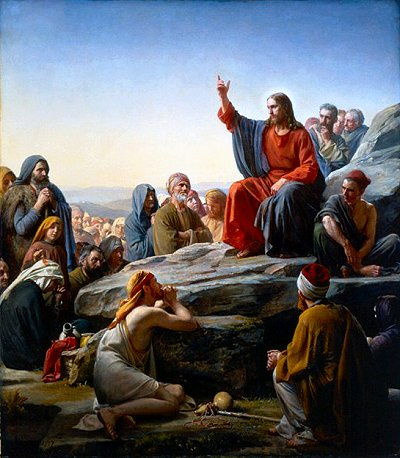
The Word of Sauron, The Word of Tolkien, and the Word of God

sauronA long time ago, I used to argue with people on blogs. Wait…yeah, I guess I still do. But the story I’m setting up was a long time ago. One of said blogs I argued on was that of my buddy Mike, an old youth pastor of mine who was going the way of the Bell and McLaren (pre-the really, really lame stuff). He’d post some controversial thought to ‘ask a question’ and I’d be the little gadfly college philosophy student who’d jump in and jostle with him. (Also, this was pre-Reformedish days. I would have laughed in your face if you’d have told me in 6 or 7 years I’d be quoting Calvin.)

In any case, he had raised the issue of Scripture one of those posts. Among other questions he was asking whether ‘all’ of the Bible was the Word of God, or only some of the parts, especially those where Divine Speech is specifically denoted, such as in the Prophets. Are the horrifying narrative sections, or the sections where the thoughts and emotions of the prophets, the psalmists, or the god-hating pagans with speaking parts, are speaking truly God’s Word?

In response to this, I came up with an analogy, on the fly, once again Lord of the Rings-related, to answer how I thought, at a minimum, even those sections could be considered the ‘Word of God.’ Once again, remember this is my 21-year old, still-really-piecing-it-together self:

“One way that I think about the way that the whole Bible is the Word of God, is thinking about it much like I think about The Lord of the Rings being the word of ‘Tolkien.’ It is at least all the Word of God in that he is its Divine Author. (I don’t mean to imply some kind of dictation theory of Scripture. I think its possible to have more than one author of a text at different levels. See Wolterstorff or Vanhoozer on this.) That said, not every word spoken in the text can be taken as his direct ‘word’ revealing his thoughts and desires in normative sense–certainly not those uttered by Sauron or Saruman. But, at the same time, those words are there in the text at Tolkien’s prerogative and are part of the overall “Word” that he speaks through the text and so can be taken as his Word.

In the same way, the words of the pagans in Scriptures are God’s Word in the same way that Sauron’s words are Tolkien’s word. There is a way that Tolkien can show us something about or say something about the nature of evil, through the evil words and actions of Sauron, which Tolkien himself would never do or say. In this way, the words and actions are properly Sauron’s, but they are also Tolkien’s in the context of the larger story he is authoring. In an analogous way God says things through these texts in a way that accounts for and does not reduce the multiple human voices, genres, etc, but also accomplishes his specific purposes in the world through the Text as its over-arching Author. Of course, this is an analogy and it kind of breaks down, but I think captures part of the picture.

A few years on, I’d probably massage a few phrases here and there, but in the main, I still find the analogy useful. God’s authorship of Scripture is a nuanced and layered one. That I affirm the Bible as God’s Word in its totality, does not mean I’m proposing a flat reading of the text, that fails to take into account narrative or genre dynamics. Far from it. In fact, it means I have to take care to read it even more carefully, not brushing past or carelessly dismissing any of God’s words, in order to discern just what exactly the Spirit is communicating through the inspired Word.

Soli Deo Gloria

It’s all the Aragorn Parts

aragonrSo, I’ve noticed an interesting trend in the way I read fantasy or sci-fi novels (aside from the fact that I have less time to read it). Whenever there is a multi-thread plotline, with the author following multiple, inter-connected story-lines, I tend to have one or two favorites that I follow very intensely, and one or two that aren’t quite as compelling.

For instance, when reading the Lord the Rings Trilogy, in the later books when the Fellowship breaks up and we split to follow the various story-lines of Frodo and Sam, and Aragorn & Co. I always found the Aragorn bits far more compelling. I’m not saying that the Frodo thread wasn’t fabulous as well, but, let’s be honest, the Dead Marshes can be a bit…well, less lively than one of Aragorn’s romps through Rohan.

Interestingly enough, I found early on that my reading habits were much the same way with Scripture. There were passages and threads that were enticing and compelling, and some that…well, while still God-breathed, seemed like he wasn’t breathing as hard.

What do I mean? Well, while the Chronicles have their moments, the Gospels capture our attention from beginning to end. Jesus’ doings and saying are never boring, or tedious, or to be suffered though in order to get to the good part. In this way, and, actually, in many others, the story of Jesus is the Aragorn bits of Scripture. The rest of it, well, I might get that they’re necessary and, yes, good, but at times I feel myself ‘getting through’ them. I’m sure I’m not alone in feeling this way.

Now, the funny thing about this is that ever since I listened to Tim Keller and Edmund Clowney’s lectures on preaching, I’ve been an advocate of a Christ-centered hermeneutic of the sort taught to us by Jesus, the disciples, the Fathers, and the Reformers, emphasizing both the redemptive-historical and typological reading of Scripture. In other words, to read and apply the text properly you have to see how this somehow this leads, points, foreshadows, or is fulfilled in Christ.

For example:

  • Adam- Jesus is the Second Adam who brings righteousness with one righteous act.
  • Abraham and Isaac- Jesus is the only Son, sacrificed by the Father for us to provide salvation.
  • Moses- Jesus is the Greater Moses who brings his people out of a greater Exodus, not from slavery to Egypt, but out of slavery to sin and death and the devil.
  • Passover Lamb- Jesus is the greater Passover Lamb whose blood was shed to cover you so that the destroyer would passover.
  • Day of Atonement- Jesus is the Great High Priest who enters once and for all to offer up sacrifices, as well as the final sacrifice offered.
  • David- Skipping ahead, Jesus is the greater Son of David, who, like David, defeats our enemies in single-combat, winning a great victory for his people.

We could go on for days here, but those are some easy and obvious ones to give you a picture what I’m talking about. If you’re looking at it from a canonical perspective, everything points to Christ, whether law, prophets, wisdom literature, or poetry.

So where am I going with all of this? Well, it struck me the other night as I was teaching my college students about this way of reading Scripture that, essentially, when read properly, it’s all the ‘Aragorn bits’. There isn’t any bit that somehow isn’t connected, or can’t be seen in light of Christ.

This is why it pays to not skim, to eventually read and study it all. Admittedly it takes a bit more work for some to see Christ in Leviticus, or a genealogy in the Chronicles. But as any mountain-climber knows, when the hard work is done, when we scale the summit of the text, the view we get of Christ is spectacular.

For those interested in learning more about how to read the Scriptures with Christ at the center I’d recommend these resources:

The Unfolding Mystery: Discovering Christ in the Old Testament by Edmund Clowney
Jesus on Every Page: 10 Simple Ways to Seek and Find Christ in the Old Testament by David P. Murray

Soli Deo Gloria

Tim Keller on Judges and OT Violence

KellerLast week I wrote a post engaging with Brian Zahnd on the issue of the authority and inspiration of the Old Testament. In dealing with the issue of the conquest narratives in Joshua and other places, a lot of people have trouble dealing with the apparent tension of the grace, love, peacableness, and forgiveness found in the New Testament with God’s commands to judge and destroy the Canaanites in the Old. Some will quickly move to justify the texts, not dealing with the understandably troubling nature of the narratives, while others will simply write them off as remnants of a more savage time to be left behind now that we have Jesus.

Well, the question came up again this week in Matt Smethurst’s interview article (and by the way, he does great interviews) over at the Gospel Coalition with Tim Keller on why Keller had written a study guide to the book of Judges:

Smethurst: The Israelite conquest of Canaan appears to give warrant for imperialism, holy war, and genocide. How can enlightened modern people take a book like Judges seriously?

Keller: Yes, in teaching the book of Judges you simply have to deal with this issue—you can’t ignore it. And in this brief space I can’t even list the issues and the various objections and answers. Maybe the most fundamental thing to say is that if you believe the rest of what the whole Bible teaches—that there’s only one true God, that for a period of time he spoke directly to Israel through prophets and through the Urim and Thummim in the priest’s breastplate, but that now, since Christ, he speaks to us through his inscripturated Word—then the conquest of Canaan makes sense.

Why? First, God alone has the right to judge people—only he knows what they deserve and what they will do if not stopped. He alone has the right to take a life. Second, in “holy war” Israel did not seek to imperialistically expand its wealth and power but acted as an instrument of God’s judgment on a particular set of people. Third, if you believe in the authority of the Bible as the only infallible way to know God’s will for us—then holy war today is impossible. God gives no warrant for it. That’s what we see when reading the Bible is read as a whole, with the New Testament completing and fulfilling the Old. Jesus specifically forbids Christians to take up the sword in his name, to spread the Christian faith by force. In short, if you believe the rest of the things the Bible teaches, the period of holy war makes sense. Holy war is not, therefore, a reason to reject what the rest of the Bible says about God.

Note very clearly, Keller says that there are more concerns and more objections to be dealt with. Away with any suggestion that Keller deliberately ignored a host of problems. What he does do is raise three that help to address the charge that the OT narratives are indefensible and encourage violence.

  • God is the final, trustworthy judge.
  • Holy war served a limited, focused purpose in God’s economy: the judgment of people with whom he had been patient for hundreds of years.
  • The narrative logic of the whole of Scripture forbids violence to Christians for spreading the faith.

That last one deserves a bit more comment. Often-times you’ll see a biblical critic point to a particular text and say, “See, there, that story encourage X behavior (misogyny, violence, ecological carelessness, etc.). We can’t trust it and must move past it.” Or, they’ll simply use it as evidence that the Bible as a whole is flawed. The problem here is, yes, a problematic text, but even more, the fact that atomistic readings can distort the shape of any kind of text. This is one more example of why historical, narrative, and canonical context matters. You don’t know the meaning of any story, or really, any scene in a story, until you’ve reached the end.

And what do we see in the book of Judges when we reach the end of story, the full story that finds its climax in Jesus Christ? Keller says we can’t help but see Jesus:

He’s the ultimate judge—the perfect and unflawed Gideon and Samson. He is the ultimate king we don’t yet have but whom we need. Even at the terrible end of Judges, where a man gives up his spouse to death to save his own skin, we can’t help but think of Jesus our true husband who gives himself up to death in order to save us. Jesus in Judges, as usual, is everywhere.

This is why we need to be careful when dealing with the OT. If you simply rush to judgment, writing things off quickly because of a contextless, atomistic, moralistic reading, you might miss Jesus in the middle of it.

Soli Deo Gloria

P.S. I’d commend the whole interview to you here. Also, again, I’d commend this article by Paul Copan dealing with historical issue with the Canaanite conquest and OT violence.

Speech-Acts and the Peace of Jesus

Jesus talkingOne of the most interesting and useful concepts I picked up in my philosophy undergrad is the idea of a ‘speech-act.’ Speech-act philosophy takes as its basic insight that language isn’t just about representing thoughts, or making simple statements of fact, but that, we actually do things with our words. There are words that we say in order to accomplish or bring about a new state of affairs. There are innumerable examples of this sort of thing (promising, lying, etc.) and all sorts of distinctions that philosophers can, and have made, but we see the basic point that, some words can be more efficacious than others.

The classic example of this is the minister’s words in a wedding. ‘I now pronounce you man and wife’ doesn’t just state the fact, but actually creates the fact. Before that statement, the two are merely engaged, but after that, they are married.

Now, of course, theologians have taken this and done all sorts of things with this over the years. For instance, we can see that a number of very important theological concepts can be understood and refined with the concept of speech-acts. When God justifies us, he is making a strongly declarative statement that, not only asserts that we are just and righteous in God’s sight, but in fact, actually brings about that situation. Or, again, God’s pronouncement of forgiveness is a constitutive speech-act. God saying ‘I forgive you’ creates the situation in which you are a forgiven person. Actually, push back farther and you’ll realize that we’re dealing with a God who speaks the world into existence (‘let there be light…’ Gen. 1). Kevin Vanhoozer and Nicholas Wolsterstorff have done extensive work with this, but, it’s safe to say it’s a fairly common concept in Biblical interpretation nowadays.

Why bring all this up? Well, the idea of speech-acts came to mind as I was going through my recent study in John’s Farewell Discourses in Calvin’s commentaries. Commenting on Jesus’ words “Peace I leave with you; my peace I give to you. Not as the world gives do I give to you. Let not your hearts be troubled, neither let them be afraid” (John 14:27), Calvin says:

By the word ‘peace’ he means prosperity, which men are wont =to wish for each other when they meet or part; for such is the import of the word peace in the Hebrew language. He therefore alludes to the ordinary custom of his nation; as if he had said, ‘I give you my Farewell.’ But he immediately adds, that this peace is of far greater value than that which is usually to be found among men, who generally have the word peace but coldly in their mouth, by way of ceremony, or, if they sincerely wish peace for any one, yet cannot actually bestow it. But Christ reminds them that his peace does not consist in an empty and unavailing wish, but is accompanied by the effect. In short, he says that he goes away from them in body, but that his peace remains with the disciples; that is, that they will be always happy through his blessing.

Commentary on John 14:27

…his peace does not consist in an empty and unavailing wish, but is accompanied by the effect.” Calvin reminds us that when Jesus speaks ‘peace’ to us, he’s an effective speaker. When we wish each other peace, if we actually mean it, it’s just that–a wish. We’re not in a place to grant our own wishes. When Jesus speaks peace, he’s an authoritative speaker who can actually bring that peace into our lives–in fact, by speaking it, he brings it. He can do this because, as Paul says elsewhere, Jesus is, in himself, our peace (Eph. 2:14).  He is the one who brought about the reconciliation that is the foundation of peace in his cross and resurrection in our place, so that, united to him by faith, we have the peace that he himself is (Col 1:20-22).

In other words, when Peter said, “Lord, to whom shall we go? You have the words of eternal life”, he wasn’t just blowing smoke.

Soli Deo Gloria 

Either Way You’re Gonna Get Cut

vine“I am the true vine, and my Father is the vinedresser. Every branch in me that does not bear fruit he takes away, and every branch that does bear fruit he prunes, that it may bear more fruit.” -John 15:1-2

Jesus tells us here that, whether you bear fruit or you don’t bear fruit, either way, you’re gonna get cut. “Come again?” If you’re someone just sitting in church, hearing the Gospel but not responding, not growing, not developing the faith and showing no signs of spiritual life you’re going to be cut by the Lord. AND, if you’re someone who has responded in faith, is growing, developing, deepening in your love by the Spirit’s power, and showing the good fruit of good works, you’re going to be cut by the Lord. This is straight from Jesus’ mouth.

The Gardener, The Vine, and the vines
But why? Because God is a Gardener, the Great Vine-dresser attending to the health and growth of the Church which draws its life from the Son, the True Vine. To get where this is going, you have to understand the image of the vine. The image Jesus uses here is one drawn from the OT. Israel is often compared to a vine that gives or does not give the fruit of true obedience. Here, Jesus tells us that he is the True Vine, the one that Israel was always supposed to be. He will do all that Israel should have done and be all that Israel should have been.

Now, building on that, he compares as branches that have been grafted onto a good vine. As Calvin reminds us, Jesus is using this image to tell us “that the vital sap — that is, all life and strength  — proceeds from himself alone. Hence it follows, that the nature of man is unfruitful and destitute of everything good; because no man has the nature of a vine, till he be implanted in him.” (Commentary on John 15:1)  On our own, we can do some relatively (outwardly) good things, yes, but to work truly spiritual works, those that are pleasing to the Father, producing true fruit, we need to be dependently drawing on the grace of the Son. In other words, the goodness of the Messiah only flows to us as we’ve been made a part of his people, being united by faith with Christ.

Here’s the thing, when you’ve been around long enough, you start to see that there two kinds of branches appearing to be connected to the vine. There are some branches that bear fruit and some that apparently have only been outwardly grafted on. Some people have joined up with the Messiah outwardly, but never started to draw life from him. Instead, at best they’re harmlessly taking up space on the branch, or at worst, they’re impeding the growth of the other branches. Others have taken hold of Christ by faith, or rather been grasped by Christ, and they’ve begun to take on the character of the original vine and are producing real fruit.

Thing is, as a good gardener, God cuts both. The dead branches get cut to clear them away for the health of the whole. If it’s not growing and giving off fruit, it’s dead wood.  The live vines he prunes so that they might give more fruit.

The Cutting Tool
Now, the interesting thing is that he uses the same tool to do it: adversity. It doesn’t say this explicitly in the text, but I think it’s a legitimate inference from the surrounding context. Jesus is preparing his disciples to deal with his absence. He talks to them about the comfort of the Holy Spirit, their need to remain in him, the opposition they’re going to face in life because of his name, and so forth. One of the main themes of the Farewell Discourses (John 14-17), is comfort in the face of adversity.

Adversity will often-times reveal the character of our faith; is it merely superficial, that of dead branches, or deep and true, one that draws life from the vine? How do we react when the bills start stacking up? Or marriage stresses? Or a difficult semester? Maybe a break-up? Divorce? Death? An unruly child? A church community divided against itself? Hostility from co-workers? Unrelenting health issues? I could go on for pages here, but you all know the adversity that life brings–the cuts.

And the cuts reveal the character. So, when adversity hits, do we get bitter, or cling harder? Do we shake our fist up at God for “failing” to give us what he never promised, or dig deeper into the gospel-blessings that he has provided for us in Christ? Do we feel robbed by God, or held by God? Does our faith deepen and grow, or die and grow cold? Do we strive for greater obedience and hope, or plunge ourselves into rebellious apathy? Will the cut lead to death, or deeper life? The same cut, the same adversity reveals the nature of the branch.

Believers need to know that Jesus never promises protection from the ordinary troubles of life, or the particular problems that attend with following him in the world. They need to understand that, so when the Gardener’s pruning tools go to work they accept it as the perfecting work of God in their life, instead of his careless abandonment. Again, either way, you’re gonna get cut–but for the person who has truly been in-grafted, they can know that the cuts come from the good hand of the master Vine-dresser whose aim is to cut away the dead parts of your life. We need those cuts so that the new, true life of Christ can flow more freely and result in even great fruits of righteousness and life. Trust the Gardener when the cut comes and remain in the Vine.

Soli Deo Gloria

The Cure that Killed the Patient (Or, Sorry Zahnd, Marcionism isn’t a Better Option)

tumblr_mr9zzaTmj01rj8v6zo1_400A while back John Piper put out a video that defended God’s right to judge the Canaanites by the hand of the Israelites in the conquest narratives of the OT. He said something along the lines of “God is God, he made you and doesn’t owe you jack, so if he takes your life, you really have nothing to complain about. Also, God can use whom he pleases to do so.” Roughly.

Predictably, some people got mad. I mean, I get that. It’s a tough subject and any answer is going to be kind of awkward (although, honestly, at this point Piper could say that God loves kittens and somebody would snark, “But only elect ones, right?”). Beyond just general Facebook furor when it hit, it recently provoked a frontal-assault/response from author and pastor Brian Zahnd. For those who don’t know, Zahnd has been a rising voice on the Evangelical/Post-Evangelical Left since his book “Beauty Will Save the World” came out last year. I actually read it and loved it, even if I did have some qualms about the pacifism peeking out here and there.

Well, pacifist though he may be, Zahnd came out guns blazing with accusations of voluntarism against the monstrous God of Calvinism, and, just the slightest bit of Muslim-baiting in his provocatively titled, “John Piper and Allahu Akbar.” As you might have picked up, I didn’t love this post quite as much as the book and I’ll get to why in a minute. But first, a few quick caveats.

To be clear, I don’t particularly care to defend Piper’s views here as he is a big boy who can defend himself. Nor is this is denial that the OT narratives involving the conquest and destruction of the Canaanites require some serious consideration. They do. Actually, while we’re on the subject, I’d commend Paul Copan’s work on the subject in the book “Is God a Moral Monster?” or this summary article paying attention to historical, genre, and canonical considerations here. Finally, I too am very concerned about the misuse of Scripture to promote violence.

What I do want is to look at is Zahnd’s reponse, which, to mind, left something to be desired in terms of theological honesty as well as, well, ‘soundness of teaching’? (I don’t want to say orthodoxy, given his clear, robust Nicene and Chalcedonian faith.) Yes, I’m putting on my argumentative Reformed hat again, which I do try to stay away from, but, in all fairness, Zahnd shot first.

Well, without further ado, here are a few points in no particular order.

Yeah, never taught that.

Yeah, never taught that.

Calvin’s “Ism”

Zahnd found a cute short-hand for Piper’s theology of sovereignty, or rather, that of “Calvin’s disciples”, which he dubbed “Calvin’s Ism.” He then proceeded to rail on it, lamenting the way Piper and others would go to such great lengths to defend the “Ism” to the point of creating a monstrous voluntaristic/nominalist God whose will is what it is, simply because it is, and so forth. Don’t you know that we should look at Jesus, not what Calvin thought about Jesus?! Away with such Greek-philosophy-influenced, metaphysical barbarisms!

scumbag girardIt’s typical anti-Calvinist boilerplate that fires up the troops and so forth, so I get it. As one of “Calvin’s Disciples” though, I simply wanted to stop and point out that, as a matter of historical fact, Calvin strongly repudiated the overly-voluntaristic and nominalist tradition popular in his day at the Sorbonne flowing from theological giants like Scotus and Ockham. (Incidentally, I always find it funny when guys who basically riff off of French social theorists like Rene Girard’s scapegoating theory when it comes to the Gospel, have the gall to call out “Greek philosophical categories” in more traditional theology.)

Calvin explicitly rejected a view of God’s unrestrained will, or absolute power, divorced from God’s justice or God’s goodness. While he unabashedly defends God’s complete sovereignty over human history, he simultaneously condemns “that absolute will of which the Sophists babble, by an impious and profane distinction separating his justice from his power.” (Institutes 1.17.2) That’s just one among many examples.

Again, it’s a fun phrase, and when you’re driving the punch-line home, why not pick a baddie to rip on your fanbase already doesn’t like? Calvin’s perfect for that, especially since most people haven’t actually read him much. But, in this case, Zahnd should probably find another whipping boy to pin the voluntarism charge on.

Killing is Not Always Murder

Moving more to the point, Zahnd tells us that God could never have ordered the conquest and judgment of the Canaanites in the way the narratives portray it because that would involve killing which is murder and God would never order murder.

So for some this next point might seem basic: while all murder is killing, not all killing is murder. For others, this is a basic false distinction that they rejected as un-biblical a long time ago.

I’ll just say that a prima facie reading of the Scriptures, especially the OT legal code (Exod. 21), shows that while God hates human death, the law that he handed down seemed to recognize a distinction between killing and murder. Actually, very early on in the narrative of the Torah, we find out that the reason he allows for some killing is precisely because he hates murder (Gen. 9:6). Murder is unjustifiable, but executions and judgments seemed to be accounted for and even commanded by God himself in various places in the OT law and the subsequent narrative. Of course, that raises the issue of the reliability of the OT on this point.

Which brings us to the really big issue with Zahnd’s post.

Marcionism isn’t a Better Option 

See, Zahnd says we shouldn’t let something like the Old Testament slow us down when we’re thinking about these things:

And don’t let the Old Testament work you into a corner. You don’t need to defend the Old Testament to the extent that you find it necessary to justify genocide. God forbid! We can simply say this…

The Old Testament is the inspired telling of the story of Israel coming to know their God. Along the way assumptions were made and they didn’t get everything right. Keep reading the Bible until you come to Jesus and then center your reading of all Scripture in the light of Christ.

This is a perfect example of what Andrew Wilson has called the “New Marcionism“, which, while not explicitly repudiating the OT the way Marcion did, insists on seeing such a radical discontinuity between the God we see testified to in the OT and that of the NT that it has much the same effect.

Let me unsympathetically paraphrase Zahnd for you to see the problem: “The ancient Israelites who wrote the Holy Scriptures got some stuff wrong, but we know better now that Jesus came. We know that Jesus would never order something like that, so we know that God didn’t order something like that, so just don’t trouble yourself about it. The verses are just wrong. I mean, sure, Jesus said that the Scriptures all pointed to him (John 5:39), and the law is to be perfectly fulfilled (Matt. 5), and we can assume he read those parts, but he couldn’t possibly have meant all of it. Sure we have parallels in the NT with Revelation and God raining down judgment, etc. not to mention Jesus himself casting down judgment of his own, but again, don’t let that trouble you. Nevermind the deeply pervasive theology of God the Warrior who goes before Israel in battle that informs much of the OT, and depends on some of those “mistaken assumptions”–just try and skip those bits. I mean don’t worry that this even figures into Luke’s telling of Acts as a conquest narrative. Just squint until you see it properly. God wouldn’t do anything like that. I mean, don’t bother trying understand the difference between God’s administration of covenant justice in Israel v. the Church because of Christ’s ushering in a new phase in redemptive-history. It’s not that the same God can manifest his eternally good and beautiful character in consistent, but historically-distinct ways. We have the much easier option of saying the Israelites just got it wrong. Simple as that. Don’t worry about what that does to undermine the authority of the OT and its ability to actually point to Jesus Christ. Please don’t trouble yourself with the way this sort of crypto-Marcionism might spill into the subtle anti-Semitism of viewing the Old Testament as an inherently inferior text like the old-school German Liberal scholars who made this sort of argument popular back in the early part of the 20th Century. I mean, no big deal.”

In a dispute with the Pharisees in John 10:35, Jesus tells us that the scriptures cannot be “broken.” The Greek word there is luo which can be translated “to destroy, to tear down, the break to pieces” (Louw-Nida 20:35).  Essentially, it can’t be ignored, released, explained away, or rendered null or void. Except, that’s exactly what Zahnd suggests we do with those uncomfortable bits.

On ‘Christocentric’ Readings (Or, The Cure that Killed the Patient)  

Here’s the thing, when your “Christocentric” reading of the Scriptures leads you to ignore or deny parts of Scriptures the way Christ says shouldn’t happen, you might be doing it wrong. Realize that this isn’t about whether we’re going to read the Bible in light of Jesus, but about how. Does the revelation of Jesus Christ crucified and risen shed light on and transfigure the testimony of God’s dealing with Israel, or simply deny, or downgrade its validity by cutting chunks out?

Of course, this goes to the deeper theological question who we’re going to allow God to be? Will we allow him to reveal himself as a God who, though simple in essence, is narratively-complex in his self-rendering in the history of Israel?  “The Lord, the Lord, a God merciful and gracious, slow to anger, and abounding in steadfast love and faithfulness, keeping steadfast love for thousands, forgiving iniquity and transgression and sin, but who will by no means clear the guilty, visiting the iniquity of the fathers on the children and the children’s children, to the third and the fourth generation.” (Exod. 34:6-7) Do we let Jesus be both the one who longs to shelter Jerusalem under his wings to save them, all the while forcefully proclaiming God’s impending, violent, judgment on their sins (Matt 23:29-39)? Do we allow for the full picture of Jesus to emerge, or the one we’ve shoved into our pacifistic Procrustean bed, and shave off the verses that don’t fit?

Tom needs a drink after that.

Tom needs a drink after that.

While some of us are tempted to take Zahnd’s path of essentially rejecting prior revelation as the mistaken assumptions of our spiritual fathers, Might I suggest a surer, admittedly less comfortable, course? It is a route that N.T. Wright offers up in his answer to Wilson on the issue of the New Marcionism:

“There are many many things that God does, has done or will do which are not waiting for my approval or sanction before he does them. You know that line, “Many people want to serve God, but usually only in an advisory capacity.” Bonhoeffer said that putting the knowledge of good and evil before the knowledge of God is the primary sin in Genesis 3. They go for the knowledge of good and evil rather than what God says. Now that could just be an escape; it could just be throwing up our hands and saying we don’t know anything about God (when the whole point of the gospel is that we do know who God is, because of Jesus). However, if it’s the crucified Jesus, and if the cross means what it means in the light of the whole history of Israel, which is focused onto that, then … these narratives are the way in which all of those horrible, puzzling ambiguities, and all the awful things that happen – like Jesus saying, “what about those eighteen on whom the tower of Siloam fell?” – there’s a sense that the cross gathers up all those puzzling, tragic horrible fragments of life, and says swoosh this is where it’s all going.

“I hold this within the framework I articulated this morning, which is to say: from the call of Abraham onwards, what God is committing himself to do is to act to bring about the restoration of the world, but to act through deeply flawed human beings, who constantly need to be reminded that they’re deeply flawed. That then produces all kinds of (to our mind) ambiguities. And I see all of it coming together in the cross. The cross is the moment when I see Israel’s God performing the salvific event, which is simultaneously the worst and most blasphemous act of judicial, theocidal murder than one can ever imagine. And somehow the cross itself says: these things are now reconciled.”

Of course there’s more to say, but I’ve already said too much for what’s an allegedly short blog post. (May God forgive my lies.) The end of the matter is that while Zahnd may find Piper’s alleged voluntarism to be a gross misrepresentation of Jesus by distortion, his own neo-Marcionism leaves us with a highly-abridged Bible, and therefore an abridged Jesus, which is hardly an improvement. While offering a solution to the Bible’s problematic texts, Zahnd is inadvertently administering the kind of cure that kills the patient.

Soli Deo Gloria
Jesus is the Beginning, the Middle, and the End

way“I am the way, the truth, and the life” is Jesus’ (in)famous reply to Thomas’ request for directions to the Father (John 14:6). The text has been in dispute ever since, especially in light of disputes about salvation, exclusivism/inclusivism, and the sole Lordship of Christ.  What does it mean for Jesus to be the “way, the truth, and the life”? How can a person be a life? Or a way? Or the truth? How are they connected?

Once again, Calvin cuts to the core of the matter and sheds an illuminating (and worship-inspiring) light on the text:

The way, the truth, and the life. He lays down three degrees, as if he had said, that he is the beginning, and the middle, and the end; and hence it follows that we ought to begin with him, to continue in him, and to end in him. We certainly ought not to seek for higher wisdom than that which leads us to eternal life, and he testifies that this life is to be found in him. Now the method of obtaining life is, to become new creatures. He declares, that we ought not to seek it anywhere else, and, at the same time, reminds us, that he is the way, by which alone we can arrive at it. That he may not fail us in any respect, he stretches out the hand to those who are going astray, and stoops so low as to guide sucking infants. Presenting himself as a leader, he does not leave his people in the middle of the course, but makes them partakers of the truth. At length he makes them enjoy the fruit of it, which is the most excellent and delightful thing that can be imagined.

Commentary on John 14:6

These are not primarily words of divisive exclusion (although they do testify to Jesus’ exclusive role as Savior), but of assuring grace.  We might be tempted to look to our own plans, prayers, righteousness, special knowledge, inner strength, or find multiple mediators.Jesus here is telling us that he is the beginning, middle, and end of our salvation. It’s not just that we can’t turn anywhere else, but that by the mercy of God, we don’t need to.

When it comes to gaining the life that is truly life, there’s no way around, or above, or away from Jesus.  He himself is the source of that life. We don’t start by Jesus and do the rest ourselves, or move on to something deeper to get to life. No, at every step of the way, it is Jesus moving us along. He is the one who recreates us, brings us to participate in the truth that leads to life, and guides us by the hand to that life that we would not be able to find on our own strength.

Soli Deo Gloria

Was Jesus a Pacifist? Posts on Pacifism and Just War

Jedi JesusFor being the dominant position in the Western theological tradition, finding a good, cleanly argued text for Just War Theory can be pretty difficult. While popular defenses of pacifism abound, now that it’s increasingly in vogue amongst the younger theological set, similarly accessible counterpoints are rarer. Actually, I’d be surprised if most people have encountered Just War reasoning outside of pacifistic refutations of the tradition. That’s why I’ve been pleased to read Andrew Fulford’s multi-post series over at the Calvinist International defending Just War theory entitled “Was Jesus a Pacifist?”

I’d summarize  them myself, but Fulford does it himself in his brief overview of  the project in his 7th post which contains links to the first six:

The argument began with a survey of four aspects of Jesus’ background: natural law, the context of literary conventions, social context, and the Old Testament. These four aspects pointed to the conclusion that Jesus’ teaching was not pacifistic. The second post presented the various kinds of pacifisms, and the reasons offered to support these kinds, to facilitate comparison. That is, once the reasons for non-violence were clear, we could check to see whether the source documents for the Christian religion held those reasons. The third post began by concluding the background for Jesus’ teaching did not consist with pacifism. It continued by surveying the NT documents, written after Jesus’ teaching had first been given. This aimed at discovering if Jesus’ teaching, intervening as it does between OT and NT, produced effects that would suggest he had departed from what his background would lead us to expect. The third post found that all four aspects of his background continued into the age of the New Testament. This made the conclusion that Jesus was not a pacifist even more likely.  The fourth and fifth parts of the series attempted to explain the teachings and actions of Jesus that pacifists claim support their position, and found that none of these teachings or actions do so.  Finally, the sixth post provided some possible explanations as to why the early church misunderstood what those teachings were really about, and turned to embrace pacifism.

After the summary, he concludes the post with a lengthy overview of the relationship between the doctrine of the Two Kingdoms and the Just War tradition.

This is a careful, thoughtful treatment that eschews quick generalizations and snap-readings of passages, engages with scholarly work, but doesn’t get bogged down in endless detail. The articles are not quick skims, but neither are they unapproachable beasts. I’d strongly encourage anybody interested in the question Christians, war, and the state to read these posts carefully and attentively.

Soli Deo Gloria

Comfort for Slaves in the NT

Bondservants, obey in everything those who are your earthly masters, not by way of eye-service, as people-pleasers, but with sincerity of heart, fearing the Lord. Whatever you do, work heartily, as for the Lord and not for men, knowing that from the Lord you will receive the inheritance as your reward. You are serving the Lord Christ. For the wrongdoer will be paid back for the wrong he has done, and there is no partiality. Masters, treat your bondservants justly and fairly, knowing that you also have a Master in heaven. –Colossians 3:22-4:1

servantOur experiences with the Civil War, the slave trade, and the Civil Rights movement made us particularly sensitive to the way certain texts have been used by those in power to oppress others. Certain verses in the NT in especially, like Paul’s household codes have been pointed to as encouraging slavery and subjugation. In some cases, they have been seen as evidence of the diversity of theologies in the NT on this issue. J.D. Crossan, for instance, sees them as evidence of a drift in the early church from a more liberated Paul (the undisputed letters), to a conservatising Pauline theologian (Ephesians, Colossians), and finally to a traditionalist disciple (the pastorals.)

Now, while I think these issues have been dealt with and adequately explained by modern NT scholars, it’s encouraging to note that long before the disturbing history of the colonial slave trade, Christians had been wrestling with what to do with these texts. For instance, commenting on this text in Colossians, Calvin doesn’t find a program for oppression, but rather a deep comfort for those who find themselves ‘under subjection’:

By the former statement he means, that service is done to men in such a way that Christ at the same time holds supremacy of dominion, and is the supreme master. Here, truly, is choice consolation for all that are under subjection, inasmuch as they are informed that, while they willingly serve their masters, their services are acceptable to Christ, as though they had been rendered to him. From this, also, Paul gathers, that they will receive from him a reward, but it is the reward of inheritance, by which he means that the very thing that is bestowed in reward of works is freely given to us by God, for inheritance comes from adoption.

-Comment on Colossians 3:22-25

Calvin sees at least three sources of comfort here: First, when the slave/bondservant renders his service willingly, he transform it from an instance of subjugation, to another opportunity to freely do honor to his Lord. Instead of work stolen from him by a powerful master, the servant of Christ transvalues it in faith and renders the work an act of spiritual freedom despite whatever political situation of oppression he finds himself in. This is a spiritually subversive counsel.

Second, this is a real source of blessing because the God who has adopted us, sees our faithfulness in this difficult situation and will surely reward us for it. Trial though it may be, God the Father of our Lord Jesus Christ, who made himself a slave for us, will see that the good works of his oppressed are crowned with glory.

Third, the justice of God is testified to here. In the world there may be no justice, but God does not judge things by outward appearance, but rather will repay masters according to the way they treat their workers. No, God has not forgotten his children in trying situations, but jealously will act in justice on their behalf. All wrongs will be righted and so the Christian can wait on the Lord, trusting him to take care of those situations which are beyond our control.

No, far from being a mere conservatising reinforcement of the status quo, we have here a pastorally appropriate word of comfort to real people dealing with a situation they likely had little control over. There is deep assurance here that the God they have found in Jesus Christ cares for the lowliest slave and that his work of judgment and salvation is not only on behalf of the masters of the world, but those whom the world has despised. For that reason, though their work is bitter, they can render it to the Lord with full assurance that it will not be in vain. While over the long haul the Gospel would prove to be corrosive of unjust systems of slavery and oppression, we see the promise of a God who sustains even in the midst of them.

Soli Deo Gloria

Holy Hilarity (Or, Don’t Forget Jesus in Your Jokes)

jokeCalvin’s not usually known for his sense of humor, nor should he be. I mean, he’s funny in print sometimes, but the general consensus is that he was a pretty serious fellow. Actually, Luther was the riot among the Magisterial Reformers. I mean, the man named a treatise “TO THE SUPERCHRISTIAN, SUPERSPIRITUAL, AND SUPERLEARNED BOOK OF GOAT EMSER OF LEIPZIG WITH A GLANCE AT HIS COMRADE MURNER: GOAT, BUTT ME NOT.” To my knowledge, aside from an early treatise satirizing the use of spiritual trinkets and other ‘holy’ objects, Calvin didn’t produce anything so…pugnaciously humorous. He did use the word “stupid” on numerous occasions to great effect, though.

In any case, he makes an important exhortation on the subject of humor in his comments in Colossians. When explaining what it means to “sing Psalms, hymns, and spiritual songs” to one another (3:16), Calvin would have us expand Paul’s encouragement to all aspects of our speech:

Psalms, hymns. He does not restrict the word of Christ to these particular departments,but rather intimates that all our communications should be adapted to edification, that even those which tend to hilarity may have no empty savor. “Leave to unbelievers that foolish delight which they take from ludicrous and frivolous jests and witticisms; and let your communications, not merely those that are grave, but those also that are joyful and exhilarating, contain something profitable. In place of their obscene, or at least barely modest and decent, songs, it becomes you to make use of hymns and songs that sound forth God’s praise.”

Commentary on Colossians 3:16

Now, we might find Calvin a bit dour here. Surely there’s a time and a place for nearly pointless jokes. I enjoy a funny cat-falling-off-of-a-fan video as the next guy. I also love the back and forth of a good-natured battle of witty replies and roasts. Still, I find myself challenged a bit here when it comes to the way I use my humor. We live in snarky, sarcastic, and downright mean culture. And, let’s be honest, it’s hilarious sometimes. Okay, I’ll be really honest and say that a good chunk of my own humor is mockery-related. I mean, I work with college students–things get ridiculous at times.

Still, for those of us called by the God who speaks life and redemption through his words, all of our words should somehow bear testimony to that grace. I’m not saying we should all start making Bible jokes, (which are incredibly hard to do well unless you: a. know a good bit of the Bible; b, have an audience who does as well; and c. have a good sense of timing). And yet, I am saying that we still have something to hear in Calvin’s comments here.

Too often our speech-patterns, including our humor, is too conformed to the patterns of the world. Calvin spoke more directly to obscene and frivolous speech, but it might equally apply to uncharitable utterances. I had a mentor who would constantly call out his boys in Sunday School for putting each other down and then trying to cover it with “Just Kidding.” He’d look at us and say, “Here’s the thing, most of the time it still hurts anyways and you don’t want to tear down your brother, so just find something else to say.” Or something like that. I was in the 5th grade. In any case, while I think some playful ribbing is fine among brothers and sisters, he had a point. How often are our words aimed at building up our brothers and sisters? Can we think of the last time we used our humor positively? To build someone up instead of chipping away at them?

Calvin seems to think there’s a way for all of our speech to be ‘profitable’, even our hilarity.

To some this might seem like a recipe for a stiff, humorless life. Of course, the challenge is to get more creative with your humor. If you can’t think of a joke that doesn’t somehow trade on negativity, attack, or a put-down, you might not just be lacking in charity, but in imagination.

Take it as a challenge then: it’s not that you’re going to entirely eliminate the occasional joke at another’s expense, but rather, try to see your humor as one more area where you can obediently submit yourself to Christ/  Strive to creatively build up the body in all that you do–even in your jests.

Soli Deo Gloria